Showing posts with label St Paul. Show all posts

02 February 2024

'Her last two years were also full of pain, yet always of love and light . . .' Sunday Reflections, 5th Sunday in Ordinary Time, Year B


 A Sick Woman
Jan Josef Horemans II [Web Gallery of Art]

Now Simon's mother-in-law lay ill with a fever, and immediately they told him about her (Mark 1:30; Gospel}.

Readings (Jerusalem Bible: Australia, England & Wales, Ireland, New Zealand, Pakistan, Scotland)

Readings (New American Bible: Philippines, USA)

Gospel Mark 1:29-39 (English Standard Version Anglicised: India)

And immediately Jesus left the synagogue and entered the house of Simon and Andrew, with James and John. Now Simon's mother-in-law lay ill with a fever, and immediately they told him about her. And he came and took her by the hand and lifted her up, and the fever left her, and she began to serve them.

That evening at sunset they brought to him all who were sick or oppressed by demons. And the whole city was gathered together at the door. And he healed many who were sick with various diseases, and cast out many demons. And he would not permit the demons to speak, because they knew him.

And rising very early in the morning, while it was still dark, he departed and went out to a desolate place, and there he prayed. And Simon and those who were with him searched for him, and they found him and said to him, “Everyone is looking for you.” And he said to them, “Let us go on to the next towns, that I may preach there also, for that is what I came for.” And he went throughout all Galilee, preaching in their synagogues and casting out demons.


Léachtaí i nGaeilge


Pope Benedict with children [Source]

One of the striking features of the Gospels is the number of times Jesus healed sick people, usually an individual, such as Simon Peter's mother-in-law in in this Sunday's gospel, sometimes all who were sick or oppressed by demons in the same gospel reading. 

This week I will simply copy Pope Benedict's words on Sunday's gospel during his Angelus talk on this same Sunday in 2012. I will highlight what particularly strikes me. 

Dear Brothers and Sisters,

This Sunday’s Gospel presents to us Jesus who heals the sick: first Simon Peter’s mother-in-law who was in bed with a fever and Jesus, taking her by the hand, healed her and helped her to her feet; then all the sick in Capernaum, tested in body, mind and spirit, and he 'healed many… and cast out many demons' (Mk 1:34). The four Evangelists agree in testifying that this liberation from illness and infirmity of every kind was — together with preaching — Jesus’ main activity in his public ministry.

Illness is in fact a sign of the action of Evil in the world and in people, whereas healing shows that the Kingdom of God, God himself, is at hand. Jesus Christ came to defeat Evil at the root and instances of healing are an anticipation of his triumph, obtained with his death and Resurrection.

Jesus said one day: 'those who are well have no need of a physician, but those who are sick' (Mk 2:17). On that occasion he was referring to sinners, whom he came to call and to save. It is nonetheless true that illness is a typically human condition in which we feel strongly that we are not self-sufficient but need others. In this regard we might say paradoxically that illness can be a salutary moment in which to experience the attention of others and to pay attention to others!

However illness is also always a trial that can even become long and difficult. When healing does not happen and suffering is prolonged, we can be as it were overwhelmed, isolated, and then our life is depressed and dehumanized. How should we react to this attack of Evil? With the appropriate treatment, certainly — medicine in these decades has taken giant strides and we are grateful for it — but the Word of God teaches us that there is a crucial basic attitude with which to face illness and it is that of faith in God, in his goodness. Jesus always repeats this to the people he heals: your faith has made you well (cf. Mk 5:34, 36).

Even in the face of death, faith can make possible what is humanly impossible. But faith in what? In the love of God. This is the real answer which radically defeats Evil. Just as Jesus confronted the Evil One with the power of the love that came to him from the Father, so we too can confront and live through the trial of illness, keeping our heart immersed in God’s love.


Blessed Chiara Luce Badano [Source]
(29 October 1971 - 7 October 1990) 

We all know people who were able to bear terrible suffering because God gave them profound serenity. I am thinking of the recent example of Blessed Chiara Badano, cut off in the flower of her youth by a disease from which there was no escape: all those who went to visit her received light and confidence from her! Nonetheless, in sickness we all need human warmth: to comfort a sick person what counts more than words is serene and sincere closeness.

Dear friends, next Saturday, 11 February, the Memorial of Our Lady of Lourdes, is the World Day of the Sick. Let us too do as people did in Jesus’ day: let us present to him spiritually all the sick, confident that he wants to and can heal them. And let us invoke the intercession of Our Lady, especially for the situations of greater suffering and neglect. Mary, Health of the Sick, pray for us!

[Sunday, 11 February, is this year's World Day of the Sick, which takes place each year on the Memorial of Our Lady of Lourdes, not observed this year because Sunday takes precedence.]

Blessed Chiara [Source]

On a pastoral visit to Palermo, Italy, on 3 October 2010 Pope Benedict had this to say about Blessed Chiara [emphases added]: I do not want to start with a discussion but with a testimonial, a true and very timely life story. I believe you know that last Saturday, 25 September, a young Italian girl, called Chiara, Chiara Badano, was declared Blessed in Rome. I invite you to become acquainted with her. Her life was a short one but it is a wonderful message. Chiara was born in 1971 and died in 1990 from an incurable disease. Nineteen years full of life, love and faith. Her last two years were also full of pain, yet always of love and light, a light that shone around her, that came from within: from her heart filled with God! How was this possible? How could a 17- or 18-year-old girl live her suffering in this way, humanly without hope, spreading love, serenity, peace and faith? This was obviously a grace of God, but this grace was prepared and accompanied by human collaboration as well: the collaboration of Chiara herself, of course, but also of her parents and friends.

 You may read more about Blessed Chiara Luce Badano in The Saint Who Failed Math by Richelle Verdeprado  published in the September-October 2010 issue of MISYONonline.com, the magazine of the Columbans in the Philippines of which I used to be editor. 

The whole of Pope Benedict's address to the young people and families of Sicily is well worth reading and reflecting on. 


St Paul on Preaching

Ruins with St Paul Preaching
Giovanni Paolo Pannini [Web Gallery of Art]

St Paul begins the Second Reading with these words: For if I preach the gospel, that gives me no ground for boasting. For necessity is laid upon me. Woe to me if I do not preach the gospel! (1 Corinthians 9:16). 

n my 80 years I never remember such confusion in the teaching Church. We need to pray earnestly that all who are called to preach and teach the Gospel will be faithful to what the Church has handed down since the time of the Apostles, the teaching that they received from Jesus Christ. 

The Ten Commandments apply to every person. No one is exempted from any of them, though none of us lives fully up to them. But Jesus has given the Church the great gift of the Sacrament of Penance/Confession/Reconciliation to forgive us and get us up on our feet again.

The first recorded words of Jesus are in the Gospel of St Mark, the first of the Four Gospels to be written: The time is fulfilled, and the kingdom of God is at hand; repent and believe in the gospel (Mark 1:15). 


Traditional Latin Mass

Sexagesima Sunday

The complete Mass in Latin and English is here. (Adjust the date at the top of that page to 2-04-2024 if necessary).

Epistle2 Cor 11:19-33; 12:1-9Gospel: Luke 8:4-15. 

 Shipwrecked Sailors Coming Ashore
Jean-Baptiste Pillement [Web Gallery of Art]

Three times I have been shipwrecked; a night and a day I have been adrift at sea. (2 Corinthians 11:24; Epistle).


01 July 2017

'Peregrinari pro Christo' - 'To be an exile/pilgrim for Christ'. Sunday Reflections, 13th Sunday in Ordinary Time, Year A

The Calling of St Matthew (detail), Caravaggio [Web Gallery of Art]

Readings(New American Bible: Philippines, USA)

Readings (Jerusalem Bible: Australia, England & Wales, India [optional], Ireland, New Zealand, Pakistan, Scotland, South Africa)


Jesus said to his Apostles:

Whoever loves father or mother more than me is not worthy of me; and whoever loves son or daughter more than me is not worthy of me; and whoever does not take up the cross and follow me is not worthy of me. Those who find their life will lose it, and those who lose their life for my sake will find it.

‘Whoever welcomes you welcomes me, and whoever welcomes me welcomes the one who sent me. Whoever welcomes a prophet in the name of a prophet will receive a prophet’s reward; and whoever welcomes a righteous person in the name of a righteous person will receive the reward of the righteous; and whoever gives even a cup of cold water to one of these little ones in the name of a disciple—truly I tell you, none of these will lose their reward.’


Post-World War II Japan [Source]

Whoever loves father or mother . . . son or daughter more than me . . . and whoever does not take up the cross and follow me is not worthy of me.

These words of Jesus in today's Gospel speak to the hearts of missionaries who leave their homelands and who give up the right to have their own families. Up to maybe a hundred years or so ago it was not uncommon for missionaries, and emigrants, never to return home. When I entered the Columban seminary in Ireland in 1961 our priests came home only after seven years. And they travelled by ship across the Atlantic and Pacific. We were, and are, inspired by our patron saint, St Columban, whose motto was Peregrinari pro Christo, 'To be an exile/pilgrim for Christ'.

Times have changed and long-distance travel by plane has replaced journeys on ocean liners and freighters and is much cheaper. People fly across the Atlantic for weekends. And people are living much longer, which has led to many missionaries spending their latter days in the country of their birth. For some, this is a second experience of going into exile.

My Columban confrere Fr Eamonn Horgan went to Japan as a young priest in 1954 and came back to Ireland for good in 2013. He writes about these two experiences in his article Two Sorrows.

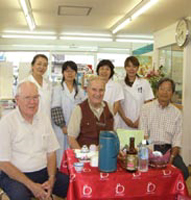
Fr Eamonn Horgan with Japanese friends

Father Eamonn writes: The months since my ordination the previous December (1953) had been pleasantly spent finishing my seminary course and visiting friends and relatives. My mission destination was to be Japan, where, God willing, I would spend the rest of my active life as a Columban missionary.  

But then: The year since ordination had slipped by without much concern on my part about facing the ordeal of leaving kin, friends and country. Exile was something I had only read about, but here I was about to embark on my own. I’m afraid that during those final months before leaving, the missionary spirit in me had noticeably faded. Any tint of glamour attached to a missionary career suddenly grew dim. I had heard many tales of missionaries who, through accident, sickness or even martyrdom, had never come home. Would I someday find myself joining that brave company?

However, his experience in Japan gradually lifted his spirits: Little by little the clouds of melancholy began to lift. It has been said that Japanese have difficulty understanding foreigners. My experience of them belies that opinion. On so many occasions I have found the Japanese understanding my peculiarities and idiosyncrasies better than I understood them myself. Their loyalty was inspiring and the virtues they displayed at every turn would match or surpass those of many ‘official’ Christians.

A farewell party

Father Eamonn gradually found that he had a new homeland: Time and again, when overseas folk came to visit me, local friends or mere acquaintances insisted that I bring them to their homes. The welcome was ever genuine, the hospitality lavish. Over the years as Japan ‘grew on me’, I learned to appreciate more and more how kind the Lord had been to me, in bringing me to so charming a land and so loving a people. Almost imperceptibly I found myself feeling more and more at home among them. They seemed to reciprocate the feeling.

Minimata Railway Station [Wikipedia]

But then came the second sorrow, 'exile' once again: Forward to April 2013: the scene, a train station in Minamata City, South Japan. A group of 40 or so Japanese, men and women, baptised and non-baptised, bidding farewell to their pastor as he departs for retirement to the land of his birth. As the train pulls out, copious tears, theirs and mine, flow freely.

This scene is similar to that in Acts 20:36-37When he had finished speaking, he knelt down with them all and prayed. There was much weeping among them all; they embraced Paul and kissed him.

Another farewell

The pain, though mixed with joy, continues: The heartbreak of separation still persists, not just on my side but on theirs too I think. Frequent letters and emails, genuinely nostalgic, continue to arrive here. January 1, 2016 brought two members of an English conversation group of mine [Father Eamonn used to teach English to adults] who had sacrificed their Japan New Year festivities, the biggest of the year, to fly all the way here to visit their departed friend.

Irish airmail stamp, 1948-9 [Wikipedia]

Richard King's set of four Irish airmail stamps published in 1948-9 feature the Angel Victor over four sacred sites bringing the 'Voice of Ireland' to St Patrick asking him to come among the Irish once again as an exile, this time freely as a missionary unlike his first six years in Ireland when he was kidnapped and brought there as a slave. The great saint let go of all the pain of his first exile and embraced the pain of his second at the call of Jesus in order to bring the Gospel to the Irish people.

Crypt of St Columban, Bobbio, Italy [Wikipedia]

St Columban for many years begged his abbot in Bangor, Ireland, to allow him to go into exile to the European continent. His abbot finally relented and twelve other monks, including St Gall went with the great missionary. St Columban was driven out of a number of places by various authorities who did not like the demands of the Gospel. But he brought a renewal of the Catholic Christian faith to much of western Europe because he had embraced the grace of the call to be an exile/pilgrim for Christ.

Father Eamonn followed the example of the patron saint of the Missionary Society of St Columban in embracing his first exile from Ireland in going to Japan and his second 59 years later when leaving Japan in order to return to the land of his birth.

Please pray for all overseas missionaries and for the millions of people who have been forced from their home places by war or by economic necessity. We missionaries have been able to make a choice and accept or reject God's invitation. For far too many refugees there has been no choice.


Kim Jung-hae, Roberta, a Korean, served in Japan as a Columban lay missionary.

01 September 2016

'. . . no longer as a slave but more than a slave, a beloved brother . . .' Sunday Reflections, 23rd Sunday in Ordinary Time, Year C

St Paul in Prison, Rembrandt, 1627
Staatsgalerie, Stuttgart [Web Gallery of Art]

Readings (New American Bible: Philippines, USA)

Readings (Jerusalem Bible: Australia, England & Wales, India [optional], Ireland, New Zealand, Pakistan, Scotland, South Africa)


Now large crowds were traveling with Jesus; and he turned and said to them,  “Whoever comes to me and does not hate father and mother, wife and children, brothers and sisters, yes, and even life itself, cannot be my disciple.  Whoever does not carry the cross and follow me cannot be my disciple. For which of you, intending to build a tower, does not first sit down and estimate the cost, to see whether he has enough to complete it? Otherwise, when he has laid a foundation and is not able to finish, all who see it will begin to ridicule him, saying, ‘This fellow began to build and was not able to finish.’  Or what king, going out to wage war against another king, will not sit down first and consider whether he is able with ten thousand to oppose the one who comes against him with twenty thousand?  If he cannot, then, while the other is still far away, he sends a delegation and asks for the terms of peace. So therefore, none of you can become my disciple if you do not give up all your possessions.

Private Collection [Web Gallery of Art]

Second Reading, Philemon 9-10, 12-17

I would rather appeal to you on the basis of love—and I, Paul, do this as an old man, and now also as a prisoner of Christ Jesus. I am appealing to you for my child, Onesimus, whose father I have become during my imprisonment.

I am sending him, that is, my own heart, back to you. I wanted to keep him with me, so that he might be of service to me in your place during my imprisonment for the gospel; but I preferred to do nothing without your consent, in order that your good deed might be voluntary and not something forced. Perhaps this is the reason he was separated from you for a while, so that you might have him back forever, no longer as a slave but more than a slave, a beloved brother—especially to me but how much more to you, both in the flesh and in the Lord.
So if you consider me your partner, welcome him as you would welcome me.
Ingemar Johansson knocks out Floyd Patterson, 1959 [Wikipedia]

Three times between 1959 and 1961, my last two years in secondary school, Ingemar Johansson, a Swede, and Floyd Patterson, an American, fought for the Undisputed World Heavyweight Boxing Championship. Johansson won the first while Patterson won the succeeding fights. Those were the days when the Heavyweight Boxing Championship was followed worldwide. I remember a few times getting up at around 3am to listen to a fight on a shortwave station from the USA, lots of static and sleepiness making it difficult to listen.

What I remember clearly about the fights between these two men, who became great friends later, was that my classmates and I were rooting for Patterson, even though he was a Black American and we were White Europeans, just like Johansson. The reason was that Floyd Patterson was a Catholic. Johansson, we presumed, was a Lutheran.

Those were pre-ecumenical days but nevertheless, without reflecting on it and with perhaps more tribalism than theology involved, we were expressing something of our deepest identity, being Catholics. That identity was more important to us that any identity from where we lived or from the colour of our skin.

Portuguese and Brazilian pilgrims
World Youth Day 2016, Kraków, Poland [Wikipedia]

St Paul's Letter to Philemon is essentially about our deepest identity. Onesimus was a slave of Philemon - this relationship was not at all of the same brutality as that between African-American slaves and their White 'owners' - and for whatever reason had run away. He met St Paul, who was in prison at the time and who took care of him and led him to the Christian faith and baptism.

St Paul appeals to Philemon in very moving terms: I would rather appeal to you on the basis of love—and I, Paul, do this as an old man, and now also as a prisoner of Christ Jesus. I am appealing to you for my child, Onesimus, whose father I have become during my imprisonment.

Chinese and Polish pilgrims WYD 2016 [Wikipedia]

He speaks as a father of Onesimus, whose name means 'useful'. Indeed, St Paul was this young man's 'father in the faith' as Abraham is referred to in the Roman Canon (First Eucharistic Prayer). And as an old man who is a prisoner he is appealing for the young man's freedom.

But more than that, I am sending him, that is, my own heart, back to you . . . no longer as a slave but more than a slave, a beloved brother—especially to me but how much more to you, both in the flesh and in the Lord.

Paul is spelling out the implications of baptism - through that Sacrament we become brothers and sisters of each other as brothers and sisters of Jesus. This is shown explicitly, for example, in meetings of the Legion of Mary at all levels where members are addressed as 'Brother' or 'Sister'. At praesidium (branch) meetings of soldiers, for example, one may be 'General' outside, one 'Sergeant', another 'Private'. But during Legion activities they address each other as 'Brother'.

From different countries and continents
WYD 2016 [Wikipedia]

One of my culture shocks when I came to the Philippines in 1971 was that so many families had what I saw to be servants. In some these were younger relatives who were given board and lodging in exchange for work so that they could go to school. This was a way of enabling others within the extended family to get on in life. But wealthier families had, and still have, employed workers, a driver, perhaps, a cook and some housemaids. Some of these employees stay with a family for life and truly become part of the household. The majority don't.

I have a suspicion that some who employ a household staff would never miss Sunday Mass but, perhaps, don't give time to their workers to go to Mass or to church. I occasionally mention in homilies that the Sunday Mass obligation includes enabling our workers to go also though, of course, we cannot force them to do so. And, along with that is our domestic workers' right to a proper wage and to proper time off.

St Paul, who speaks of the young man as my own heart, is asking of Philemon that he forgive Onesimus for any wrongdoing, that he make him a free man, no longer a slave, and above all that he accept him as a brother in Christ.

Can there be any more intimate expression of our deepest identity than to describe another Christian as my own heart?

Daryl, 2nd from the left beside Fr Eamon Sheridan, is a Filipino-Irish parishioner in St Joseph's, Balcurris, Dublin, which has been a Columban parish for many years. The parish, which is not a prosperous one, raised the funds to send Daryl to WYD 2016 as one of the delegates of the Archdiocese of Dublin. Fr Sheridan has worked in Taiwan, in Hong Kong as a member of the General Council and will soon be moving to Myanmar (Burma). [Photo: FB of Fr Sheridan]


From 4 September: St Teresa of Kolkata