Showing posts with label children. Show all posts

14 January 2016

'Do whatever he tells you.' Sunday Reflections, 2nd Sunday in Ordinary Time, Year C (Outside the Philippines)

Marriage at Cana (detail), Paolo Veronese, 1571-72
Gemäldegalerie, Dresden, Germany [Web Gallery of Art]


Readings (New American Bible: Philippines, USA)

Readings (Jerusalem Bible: Australia, England & Wales, India [optional], Ireland, New Zealand, Pakistan, Scotland, South Africa)


On the third day there was a wedding in Cana of Galilee, and the mother of Jesus was there.  Jesus and his disciples had also been invited to the wedding. When the wine gave out, the mother of Jesus said to him, “They have no wine.” And Jesus said to her, “Woman, what concern is that to you and to me? My hour has not yet come.” His mother said to the servants, “Do whatever he tells you.” Now standing there were six stone water jars for the Jewish rites of purification, each holding twenty or thirty gallons. Jesus said to them, “Fill the jars with water.” And they filled them up to the brim. He said to them, “Now draw some out, and take it to the chief steward.” So they took it. When the steward tasted the water that had become wine, and did not know where it came from (though the servants who had drawn the water knew), the steward called the bridegroom and said to him, “Everyone serves the good wine first, and then the inferior wine after the guests have become drunk. But you have kept the good wine until now.” Jesus did this, the first of his signs, in Cana of Galilee, and revealed his glory; and his disciples believed in him.


A production of the Lumo Project.

Feast of the Santo Niño

On the third Sunday of January the Church in the Philippines celebrates the Feast of the Sto Niño, the Holy Child. These Sunday Reflections focus on the Second Sunday in Ordinary Time, Year C. You will find Sunday Reflections for the Feast of the Sto Niño here.


I used this material for the same Sunday three years ago. I have made one or two small changes here. I do believe that the lives of King Baudouin and Queen Fabiola can speak to all Christians no matter what their state of life or social positions are.

Last Sunday I featured the late King Baudouin of the Belgians. This week I feature him again, with Queen Fabiola, who died on 5 December 2014. The King died suddenly on 31 July 1993. The story of how they met is quite remarkable and the late Cardinal Suenens tells the story in his biography of the King, Baudouin, King of the Belgians, The Hidden Life.

The video above has as background music an Irish song that I learned in Grade Three, The Dawning of the Day, in Irish Gaelic Fáinne Geal an Lae, the version I learned. (The singer in the video is Mary Fahl). An Irish song is not at all inappropriate as the matchmaker of the marriage of Baudouin and Fabiola was an Irish woman, Veronica O'Brien. 

Veronica was envoy of the Legion of Mary to France and some other European countries. Much 'cloak and dagger' work was involved in finding a wife and queen for the young king. Much more importantly, much prayer was involved too, prayer that was basically a searching for God's will. They became formally engaged in Lourdes, France, King Baudouin travelling incognito, as he always did when he went there. (There are references online in obituaries of the King and elsewhere to Veronica O'Brien as 'Sister Veronica'. She was not a religious but a lay person. Members of the Legion of Mary address each other as 'Brother' and 'Sister' only during Legion meetings, not elsewhere).

The couple were married in Brussels on 15 December 1960. The video shows photos of both the civil and church ceremonies. In a number of European countries a separate civil ceremony is required by law and takes place before the church celebration. The King wrote in his spiritual diary for that day: Normally we are awake by day and dream at night, but this time it's as if I'm in a dream all day.

On 8 July 1978 Baudouin wrote in his diary: My God, I thank you for having led us by the hand to the feet of Mary, and every day since then, I thank you, Lord, that we have been able to love each other in your Love, and that that love has brown each day.

And Queen Fabiola wrote to Veronica: I knew Our Blessed Lady was a Queen and a Mother, and all sort of other things, but I never knew that she was a Matchmaker!

Quoting the Queen led Cardinal Suenens to quote a Spanish verse:

Cristo dijo a su Madre 
el dia de la Asunción 
no te vaya de este mundo 
sin pasar por Aragón.

Christ said to his Mother 
on the day of the Assumption: 
do not leave this world 
without passing through Aragón.

Before her marriage the Queen was Doña Fabiola de Mora y Aragón.
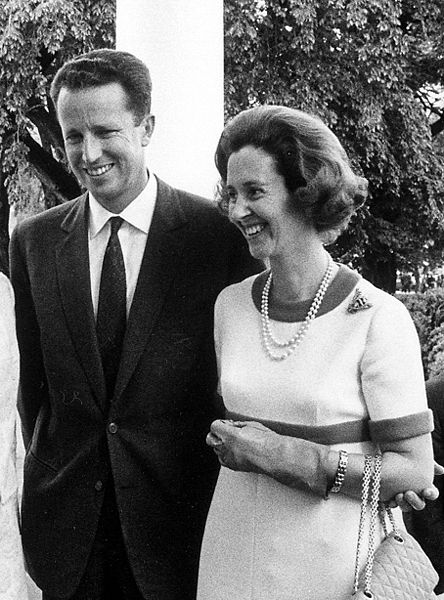

The Cardinal quotes freely from Baudouin's diary about Queen Fabiola.

Fill Fabiola with your holiness. May she live her life in your joy and your peace. Teach me to love her with your own tenderness . . .

Fabiola is so loving; she warms my heart. Her silent, yet active presence is a source of great joy to me. My God, how you have spoiled me!

Thank you, Jesus, for having nurtured in me an immense love for my wife. Thank you for having given me a spouse whose love for me is second only to her love for You. May we both grow in you, Lord.

When Veronica O'Brien met Fabiola in Spain she asked the young woman, who had no idea why where things were leading, why she had never married. She replied, What can I say? I have never fallen in love up to now. I have put my life into the hands of God. I abandon myself to Him, maybe he is preparing something for me.

Veronica recounted all of this in a letter to the King and concluded, It was utterly astounding, because I knew exactly what God was preparing for her.

Thirty years later the King wrote in his spiritual diary: Mary, show me what I should do so as not to miss an opportunity of loving, of denying myself for your sake, of living the present moment to the full, as if it were my last, and of loving my darling Fabiola infinitely more. yes, Mother, teach me to love her with tenderness, gentleness, thoughtfulness, respect, and teach me to have faith in here . . .

And Baudouin, addressing the Lord, wrote, Teach me too to respect her personality with its differences and its inconsistencies. Jesus, I thank you for having given me this wonderful treasure.

Both King Baudouin and Queen Fabiola in these extracts reflect the spirituality of a book that Cardinal Suenens had given the King before he met his future queen and wife,Abandonment to Divine Providence by Jean-Pierre de Caussade SJ. One English translation of this masterpiece has the title The Sacrament of the Present Moment, which captures the essence of the book, that God's will is in the present moment.

Shortly before he left for Motril, Spain, in 1993, where he died suddenly, King Baudouin confided to Cardinal Suenens and Veronica, I love Fabiola more and more each day: what an inspiration she is to me!

This led the Cardinal to quote Jean Guitton, the first lay person to be invited to Vatican II as an observer, Love is always fruitful, were it only because it transforms those who love.


Children's Games, Pieter Bruegel the Elder, 1559-60
Kunsthistorisches Museum, Vienna [Web Gallery of Art]

One of the great sorrows in the life of Baudouin and Fabiola as a married couple was that they had no children. The Queen had five miscarriages. Reflecting on this, the King said to a group visiting the Palace, We have pondered on the meaning of this suffering and, bit by bit, we have come to see that it meant that our heart was freer to love all children, absolutely all children.

In a letter to a young mother the King wrote about a children's party that he and the Queen had hosted at the Palace: In one corner there was a group of handicapped children, several of them with Down's syndrome. I brought over a plateful of toffees to a little girl who had scarcely any manual control. with great difficulty, she succeed in taking a toffee but, to my astonishment, she gave it to another child. then for a long time, without ever keeping one for herself, she distributed these sweets (candies) to all the healthy children who could not believe their eyes. What a depth of love there is in those physically handicapped bodies . . .

One by one the children left. We really felt as if they had become in some sense our children. I think they felt it too. It was a very special afternoon; the presence of the Lord was really tangible. There was such peace and joy. that was pure gift!

I have read Baudouin, King of the Belgians, The Hidden Life, a number of times and each time I am moved by it. I see in it a reflection of what's in today's gospel: his gratitude to God, like the gratitude of all at the wedding feast, not mentioned explicitly but clearly there; his and Fabiola's submission to God's will through Mary: Do whatever he tells you; and the extraordinary generosity of Jesus, God and Man, turning water into  the equivalent of about 500 or 600 bottles of the best wine, a generosity that led Baudouin and Fabiola, who couldn't have children of their own, to see that our heart was freer to love all children, absolutely all children.

When we allow him, Jesus can turn the very ordinary in our lives into the extraordinary, just as a little girl with physical and mental disabilities revealed the presence of God to the King of the Belgians, just as Fabiola, his wife and queen, was a daily revelation of God's loving presence to him.

God has the same desire to reveal himself to each of us every day, specifically in the present moment. And He has given us his Mother, who is our Mother also, to guide us with her words of absolute faith, do whatever he tells you.

09 May 2015

'In this is love, not that we loved God but that he loved us.' Sunday Reflections, 6th Sunday of Easter, Year B

From The Gospel of John (2003) directed by Philip Saville

Today's Gospel, John 15:9-17 [1:22 - 2:34]


Readings (New American Bible: Philippines, USA)
              
Readings (Jerusalem Bible: Australia, England & Wales, India [optional], Ireland, New Zealand, Pakistan, Scotland, South Africa)


Jesus said to his disciples:

"As the Father has loved me, so I have loved you; abide in my love. If you keep my commandments, you will abide in my love, just as I have kept my Father’s commandments and abide in his love. I have said these things to you so that my joy may be in you, and that your joy may be complete.
“This is my commandment, that you love one another as I have loved you. No one has greater love than this, to lay down one’s life for one’s friends.You are my friends if you do what I command you. I do not call you servants any longer, because the servant does not know what the master is doing; but I have called you friends, because I have made known to you everything that I have heard from my Father. You did not choose me but I chose you. And I appointed you to go and bear fruit, fruit that will last, so that the Father will give you whatever you ask him in my name. I am giving you these commands so that you may love one another."

Christ Blessing the Children, Nicolaes Maes, 1652-53
National Gallery, London [Web Gallery of Art]

Since last Monday morning until noon today, Saturday, I was giving a retreat to the Missionary Sisters of the Catechism in Lipa City, south of Manila. The Sisters have a house dedicated to Our Lady of Guadalupe where they take care of elderly and sick women whom they refer to as the lolas, the grandmas. In another part of the compound they have a group of orphans, five young boys and six young girls. Four of the boys served Mass every morning, including 'Zacchaeus', as the Sisters call him, the youngest of the boys and small, proudly wearing his white cassock like the others. 'Zacchaeus' is not yet old enough to make his First Holy Communion or First Confession. His role as a server is to hold up the small white towel - and he really has to stretch to do so - when the priest washes his hands during the Offertory.

The youngest of the girls is Chiara, aged four or five. The children were present at lunch today, which had a celebratory air to it. I noticed after I had said Grace Before Meals that Chiara was somewhat tearful. Then I discovered that on such occasions she led the community in a Hail Mary as part of Grace. so the Sisters encouraged her to do so today even though the visiting priest had pre-empted her. After a little hesitation and the drying of her tears she prayerfully led us all in the Hail Mary and then invoked the protectors of the Congregation - Mother of Good Counsel, St Joseph, St Veronica Giuliani, St Gemma Galgani and St Bernadette Soubirous.

During the retreat I told a number of stories of seemingly insignificant events where God had revealed himself to me through the actions of children and of older persons without their being aware of it. Then on the way back to Manila this afternoon Sister Evelyn, whose family I have I have known since she was in high school in Tangub City, Misamis Occidental, and Sister Eppie told me a story about Chiara where she showed an understanding of what today's Second Reading is all about, without being aware of it.

Beloved, let us love one another, because love is from God; everyone who loves is born of God and knows God. Whoever does not love does not know God, for God is love. God’s love was revealed among us in this way: God sent his only Son into the world so that we might live through him. In this is love, not that we loved God but that he loved us and sent his Son to be the atoning sacrifice for our sins (1 John 4:7-10).

Some time ago a missionary priest visited the Sisters and celebrated Mass for them. Little Chiara saw him as being very severe in his demeanour. After Mass she tugged on his cassock and asked him, Father, are you angry with God? It seems that the following morning he wasn't quite as severe looking!

Some may be angry with God. I don't think that God is too perturbed about that when he knows that the source of our anger may be bewilderment over tragedies in our lives, for example, just as we allow those whom we love to vent their anger on us because basically they trust us and we have some idea of the source of their anger.

Perhaps a more common experience, especially among persons who are serious about following Jesus faithfully but who try to live as if God's love had to be earned, as if it could be earned, is the idea that God is angry with us.

St John tells us so beautifully what the situation really is: In this is love, not that we loved God but that he loved us and sent his Son to be the atoning sacrifice for our sins.

Most of the Gospel readings on the Sundays and weekdays of Easter are taken from John 13-17, the Last Supper Discourse in which Jesus speaks to each of us with intense love about the intimacy into which he calls each of us through our baptism. In today's Gospel Jesus says to each of us, speaking from his heart to ours - Cor ad cor loquiter, 'Heart speaks to heart', as Blessed John Henry Cardinal Newman emphasised on his coat-of-arms - As the Father has loved me, so I have loved you; abide in my love . . . this is my commandment, that you love one another as I have loved you . . . you are my friends . . . you did not choose me but I chose you . . .

The initiative comes from God. Love comes from God and our loving response to that love is itself a gift from God. We do not and cannot earn God's love. God who is love gives us himself as pure gift.

How can such a God be angry with us and how can we be angry with such a God?


In this is love, not that we loved God but that he loved us and sent his Son to be the atoning sacrifice for our sins (1 John 4:10).


For the LORD takes delight in his people; 

he crowns the poor with salvation (Psalm 149:4, Grail translation).


Antiphona ad communionem  Communion Antiphon
John 14:15-16

Si diligitis me, mandate mea servate, dicit Dominus.
If you love me, keep my commandments, says the Lord,
Et ego rigabo Patrem, et alium Paraclitum dabit vobis,
and I will ask the Father and he will send you another Paraclete,
ut maneat vobiscum in aeternum, alleluia.
to abide with you for ever, alleluia.

The setting above by Thomas Tallis (c.15015 - 1585) uses the Authorized (King James) Version of the Bible, John 14:15-17a:

If ye love me, keep my commandments. 
And I will pray the Father, and he shall give you another Comforter, 
that he may abide with you for ever;
e'en the Spirit of truth.

The singers are The Cantate Boys' Choir.

10 December 2013

Pope Francis' Prayer Intentions for December 2013


[Image from Wikipedia]

General Intention

Victimized Children

That children who are victims of abandonment or violence may find the love and protection they need.


From the homily of Pope Benedict XVI at the Christmas Midnight Mass 24 December 2008, quoted in the video above: 

In every child we see something of the Child of Bethlehem. Every child asks for our love. This night, then, let us think especially of those children who are denied the love of their parents. Let us think of those street children who do not have the blessing of a family home, of those children who are brutally exploited as soldiers and made instruments of violence, instead of messengers of reconciliation and peace. Let us think of those children who are victims of the industry of pornography and every other appalling form of abuse, and thus are traumatized in the depths of their soul. The Child of Bethlehem summons us once again to do everything in our power to put an end to the suffering of these children; to do everything possible to make the light of Bethlehem touch the heart of every man and woman. Only through the conversion of hearts, only through a change in the depths of our hearts can the cause of all this evil be overcome, only thus can the power of the evil one be defeated. Only if people change will the world change; and in order to change, people need the light that comes from God, the light which so unexpectedly entered into our night.

Mission Intention

Prepare the Savior’s Coming


That Christians, enlightened by the Word incarnate, may prepare humanity for the Savior’s coming. 


From the talk given by Pope Benedict at his General Audience 12 November 2008 and quoted in the video above:

We live with a great responsibility. We have talents, and our responsibility is to work so that this world may be open to Christ, that it be renewed.

The following words, quoted in the video above, were spoken by Pope Francis at his General Audience on 24 March:

The time of waiting for his arrival is the time he gives to us, to all of us, before his Final Coming with mercy and patience; it is a time of watchfulness; a time in which we must keep alight the lamps of faith, hope and charity, a time in which to keep our heart open to goodness, beauty and truth. It is a time to live in accordance with God, because we do not know either the day or the hour of Christ’s return . . . Dear brothers and sisters, may looking at the Last Judgement never frighten us: rather, may it impel us to live the present better. 

Pope Benedict XVI in 2010 [Image from Wikipedia]

The video above concludes with extracts from the concluding prayer at the end of Pope Benedict's General Audience on 12 November 2008. Here is the full text of that prayer:

'Come, Lord Jesus!' We do not of course desire the end of the world. Nevertheless, we do want this unjust world to end. We also want the world to be fundamentally changed, we want the beginning of the civilization of love, the arrival of a world of justice and peace, without violence, without hunger. We want all this, yet how can it happen without Christ's presence?

Without Christ's presence there will never be a truly just and renewed world. And even if we do so in a different way, we too can and must also say, completely and profoundly, with great urgency and amid the circumstances of our time: 'Come, Lord Jesus!' 

Come in your way, in the ways that you know. Come wherever there is injustice and violence. Come to the refugee camps, in Darfur, in North Kivu, in so many parts of the world. Come wherever drugs prevail. Come among those wealthy people who have forgotten you, who live for themselves alone. Come wherever you are unknown. Come in your way and renew today's world. And come into our hearts, come and renew our lives, come into our hearts so that we ourselves may become the light of God, your presence. 

In this way let us pray with St Paul: Maranà, thà! 'Come, Lord Jesus!' and let us pray that Christ may truly be present in our world today and renew it.


29 May 2013

'Delay communions until adulthood, says priest' - Irish Examiner today


May is the month in Ireland when children make their First Holy Communion. Over the years it has become less and less a significant moment of faith in the lives of young Irish Catholics and more and more an extravagant family celebration where the Christian faith is no more than a background and very often lacking in the parents of the First Communicant.

Today's Irish Examiner carries a story under the headline Delay communions until adulthood, says priestFiachra Ó Cionnaith's report begins:

The claim has been made by a leading Catholic priest, who said the age-specific system has lost almost all connection to what is meant to be intended. 

Speaking on RTÉ Liveline programme [a very popular phone-in radio show on the main national station] yesterday, Fr Paddy Byrne said the modern-day version of the religious rites of passage has become a 'hostile' event involving families who do not want to be there. 

He said cultural changes in recent years mean many ceremonies now involve parents who have moved away from the Church, but feel peer pressure to allow their children to join the ceremonies. 

In other cases, he said, otherwise religious families see the events more as family parties and opportunities for their children to be given money and presents. 


The article quotes Fr Byrne: 85% of children taking first communion are not seen again by the Church. This figure may not be quite accurate as probably most of them will appear in church at least once after their First Holy Communion - for their Confirmation about five years later. Then for many, maybe most, it's 'Goodbye'.


TV3, a commercial station in Ireland, broadcast Modern Ireland - My First Holy Communion  (video above) in 2009. It looks at three families, two Irish and a Nigerian family now living in Dublin. Ironically, the immigrant family is the most comfortable financially. For all three families the First Holy Communion of one of their children is a very important family event. One father hopes that it will bring his separated parents together for the occasion. Sadly, it doesn't.

But it is only the Nigerian family that clearly sees the day above all as a celebration of their Catholic faith and an occasion they hope will be one of a deepening in his faith of the young boy making his First Holy Communion.

The excerpts from the Mass in County Louth shown in the video made me shudder.

First Communicants at Holy Family Home for Girls. I had just baptised and confirmed some of them. Most of these girls come from backgrounds of poverty and many have experienced far worse than that.

Though I'm not sure that I'd go along with the idea of leaving the sacraments of initiation until adulthood I think that Fr Byrne is highlighting the crisis of a widespread loss of the Catholic Christian faith in Ireland, something I've posted about before, also in the context of First Holy Communion.

Father Byrne observes that First Holy Communion and Confirmation are losing their meaning for Irish Catholics and notes, There’s a majority [of parents] who are quite unruly when it comes to the basic etiquette of how to behave. I’ve often been asked 'do you have wi-fi here, can people go on Facebook?'

How can someone who doesn't now the alphabet teach another how to read? How can parents or grandparents who have in effect lost the faith or for whom Mass is not important pass on the faith to their children and grandchildren? Pope Francis carries in his breviary a note from his paternal grandmother, born Rosa Margherita Vasallo and who emigrated from Italy to Argentina with his parents: May my grandchildren, to whom I have given my whole heart, have a long and happy life but if pain, sickness or loss of a loved one should fill them with sadness, may they remember that one breath taken at the Tabernacle, where the greatest and august martyr is present and one glance at Mary at the foot of the cross, will act like a balm that is able to heal the deepest and most painful wounds.

Where are the Rosa Margheritas in contemporary Ireland?


Céad míle fáilte romhat, a Íosa, a Íosa
A hundred thousand welcomes to you, o Jesus, o Jesus
A traditional Irish Communion / Christmas hymn

SA GHAEILGE / IN IRISH

Céad míle fáilte romhat, a Íosa, a Íosa,
Céad míle fáilte romhat, a Íosa,
Céad míle fáilte romhat, a Shlánaitheoir
Céad míle míle fáilte romhat, a Íosa, a Íosa...

Glóir agus moladh duit, a Íosa, a Íosa,
Glóir agus moladh duit, a Íosa,
Glóir agus moladh duit, a Shlánaitheoir,
Glóir, moladh agus buíochas duit, a Íosa, a Íosa...

Céad míle fáilte romhat, a Shlánaitheoir,
Céad míle míle fáilte romhat, a Íosa, a Íosa...

IN ENGLISH / SA BHÉARLA

A hundred thousand welcomes to you, o Jesus, o Jesus,
A hundred thousand welcomes to you, o Jesus,
A hundred thousand welcomes to you, o Saviour,
A hundred thousand welcomes to you, o Jesus, o Jesus...

Glory and praise to you, o Jesus, o Jesus,
Glory and praise to you, o Jesus,
Glory and praise to you, o Saviour,
Glory, praise and thanks to you, o Jesus, o Jesus...

A hundred thousand welcomes to you, o Saviour,
A hundred thousand welcomes to you, o Jesus, o Jesus...