27 August 2012

St Monica - an Irish mother?


St Monica, Luis Tristán de Escamilla 1616
 
I posted this on 27 August 2009.

I posted the following a year ago:

The second reading in the Office of Readings for the feast of St Monica (332-387) always brings a smile to my face and leads me to ask, ‘Was St Monica an “Irish mother”?’ St Augustine’s brother had said to their mother when she was dying that it might be better if she died in her homeland in north Africa, rather than in Italy. The extract from St Augustine’s Confessions goes on: But as she heard this she looked at me and said: ‘See the way he talks’. And then she said to us both: ‘Lay this body where it may be. Let no care of it disturb you: this only I ask of you that you should remember me at the altar of the Lord wherever you may be’.
The latter part of the last quotation appears on innumerable memorial cards and I don’t know of a better request for prayers for the dead. But it’s the ‘See the way he talks’ that makes me smile. Many’s the time I heard my own mother – and other Irish mothers – say, nearly always in a family-type context, ‘Did you ever hear such nonsense?’ It’s the kind of thing that only people intimately related can say to one another, conveying gentle criticism/a reprimand and affection at the same time.

A variation of St Monica’s request is on the memorial card of my own mother, Mary who, like the saint, died at the age of 55: ‘All I ask of you is that you will remember me at Mass and Holy Communion’.
Death of St Monica, Benozzo Gozzoli 1464-65
Tradition Day by Day carries this reading from the Confessions of St Augustine for today:

Remember, Monica, my mother
May Monica, my mother, rest in peace with her husband, before whom and after whom she was given in marriage to no man. She dutifully served him, bringing forth fruit to you with much patience, that she might also win him to you. Inspire, O Lord my God, inspire your servants my brethren, your children my master, whom I serve with my voice, my heart, and my writings, that as many of them as read these words may remember at your altar your handmaid, Monica, together with Patricius, formerly her husband, by whose flesh you brought me into this life, how I know not. May they with a pious affection remember them who were my parents in this transitory light, my brethren under you, our Father in our Catholic mother, and my fellow citizens in the eternal Jerusalem, for which your pilgrim people here below continually sigh from their setting out until their return, so that my mother's last request of me may be more abundantly granted by her through the prayers of many, occasioned by my confessions, rather than through my own prayers.

I was quite astonished some years ago reading an article in a scholarly Catholic magazine published in the USA lamenting that so many Catholic parents weren’t choosing truly Christian names for their children anymore. One example given was ‘Austin’. Clearly, the author was unaware that this is a common variation of ‘Augustine’, used especially in Ireland and in Britain. Indeed, the Augustinian Friars are often referred to in England as ‘The Austin Friars’.
When I was in primary school one of our juvenile jokes was: ‘Who is the patron saint of car manufacturers? St Monica, because she had a Baby Austin’. The ‘Baby Austin’ was a small family car produced very successfully in England between 1922 and 1939. At least we knew who St Monica and St Augustine were. I’m not sure about young people in Ireland today.
 

22 August 2012

'Do you also wish to go away?' Sunday Reflections, 21st Sunday in Ordinary Time Year B

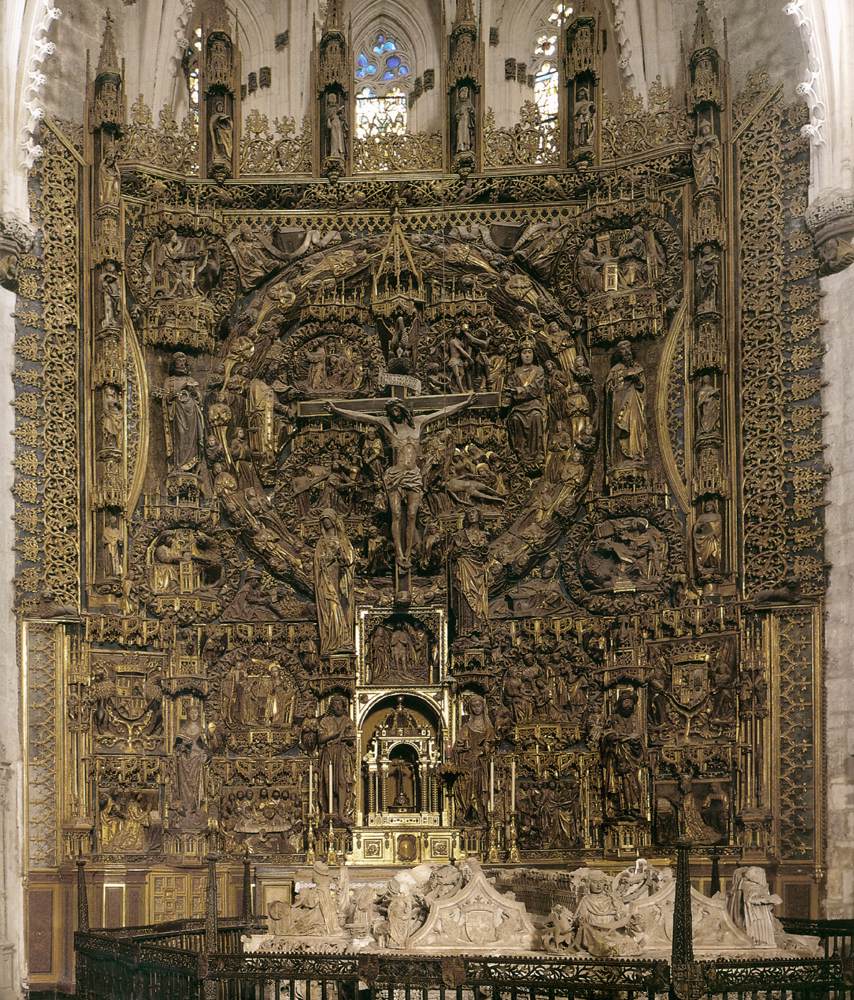
Main Altar, Monastery of Miraflores, Burgos, Gil de Siloé (1496-99)


Readings (New American Bible: Philippines, USA) 

Readings (Jerusalem Bible: Australia, England & Wales, India [optional], Ireland, New Zealand, Pakistan, Scotland, South Africa) 

Gospel John 6:60-69 (Revised Standard Version – Catholic Edition)

Many of the disciples of Jesus, when they heard it, said, "This is a hard saying; who can listen to it?" But Jesus, knowing in himself that his disciples murmured at it, said to them, "Do you take offense at this? Then what if you were to see the Son of man ascending where he was before? It is the spirit that gives life, the flesh is of no avail; the words that I have spoken to you are spirit and life. But there are some of you that do not believe." For Jesus knew from the first who those were that did not believe, and who it was that would betray him. And he said, "This is why I told you that no one can come to me unless it is granted him by the Father." After this many of his disciples drew back and no longer went about with him. Jesus said to the twelve, "Do you also wish to go away?" Simon Peter answered him, "Lord, to whom shall we go? You have the words of eternal life; and we have believed, and have come to know, that you are the Holy One of God." 


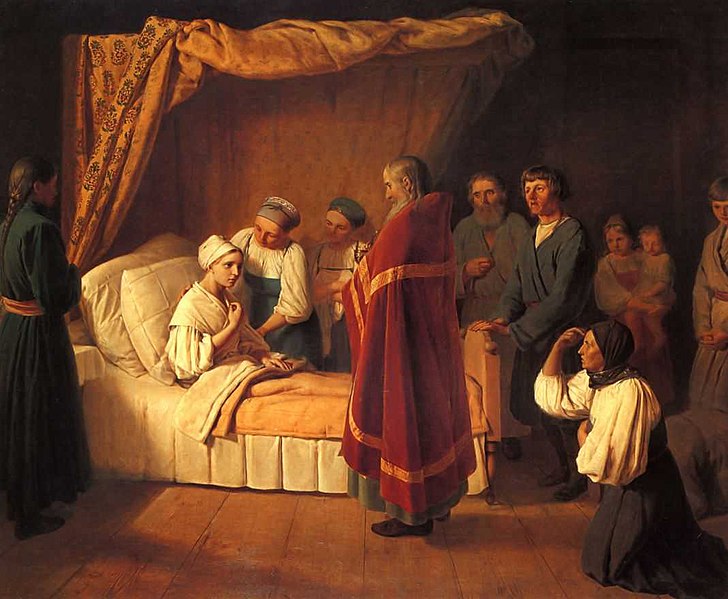
Alexey Venetsianov, 19th century

Some time before Easter 1993 when I was in the relatively remote parish of Lianga, Surigao del Sur, on the east coast of Mindanao, one of our volunteer catechists came on a Saturday afternoon to tell me that her father was asking for the Bread of Life. She told me he was fully conscious. I went immediately to the house, heard his confession, gave him the Sacrament of the Sick and Holy Communion in the presence of his family. The man himself participated fully and joyfully.

I discovered that his family was somewhat unusual. He had been widowed twice and married three times. There were children from his three marriages there, some with their children, including a babe in arms.

At the end of the celebration of the three sacraments I asked those who were closest to the sick person to lay hands on him so that we could continue with our own prayer over him. But he turned this into something far more beautiful. He took his youngest grandchild to his breast and embraced him before embracing each of his family who were present. It was an occasion where the joy was tangible.

It is not usual in the Philippines to offer the priest something to eat when he goes on a sick call. But on this occasion the family did and it was fitting.

Next morning, before Sunday Mass, the catechist came to tell me that her father had just died. along with her sadness she felt greatly consoled because her father had received the Bread of Life as his last meal before he died.

During these last five Sundays the Church has been proclaiming Chapter Six of St John's Gospel when Jesus teaches us very clearly that he is the Bread of Life. The Church has always understood that each time we celebrate the Eucharist the bread and wine, through the power of the Holy Spirit working in the priest, who is called to be an alter Christus, another Christ, become the Body and Blood of Christ. As the Catechism of the Catholic Church No 1374 teaches, In the most blessed sacrament of the Eucharist 'the body and blood, together with the soul and divinity, of our Lord Jesus Christ and, therefore, the whole Christ is truly, really, and substantially contained'.

There were many listening to Jesus who couldn't accept his teaching. This is a hard saying; who can listen to it? many asked. They walked away, probably in good faith. But when Jesus asked the twelve, Do you also wish to go away? Peter answered on behalf of the group, Lord, to whom shall we go? You have the words of eternal life; and we have believed, and have come to know, that you are the Holy One of God.

Our faith is pure gift from God, not a reward for 'being good'. It is a gift that a person may lose. It is a gift that a whole community may lose. It would seem that in the last few decades that gift has been lost by many in the Western world, places such as Ireland, Belgium, the Netherlands, Quebec, all of them sending missionaries to the ends of the earth until recently and now with their seminaries empty and their churches bereft of young people on Sundays.

Our faith, especially our faith in the Eucharist, is something we must thank God for each day.  In my Reflections for the 15th Sunday I featured a video of an 87-year-old priest, Fr Ralph Beiting, preaching on a street last summer in Kentucky. I learned only last Sunday that Father Beiting died after a short illness on 9 August. On the website of the Father Beiting Appalachian Mission Center there is a recording of him saying, It’s not been an easy road. It’s been for a little  hardship, headaches, anxieties and the desire to quit. But the joy has been overwhelming, to be able to say Mass every day in these hills and offer it up for the good and benefit of its people. That gives me power that I never have any other way.

Father Beiting made his own the choice his bishop made for him more than 60 years ago when he assigned the young priest to an area as big as the state of Rhode Island in eastern Kentucky, an area where there was widespread poverty among both black and white people, an area where there were only a handful of Catholics, an area where there was great ignorance about Catholics. Father Beiting once told me that when he built the church in Mount Vernon, where I served during Holy Week and Easter Week in 1970, he deliberately had clear windows from the ground up so that people could see that Catholics didn't sacrifice children, that they didn't have cloven hooves. I think that those days have long gone, largely because of the daily choices Father Beiting made to be a faithful priest, working for all the people, working so that each family could put bread on the table each day, working so that the Catholics could receive the Bread of Life every Sunday, working so that others might see the truth of the Catholic faith.

The first reading today is about making a choice for God. Jesus asks each of us directly to make a choice: Do you also wish to go away? My parishioner in an out of the way place in the Philippines knew the choice he should make before he died: to ask for the Bread of Life.


Communio

Qui manducat carnem meam

et bibit sanguinem meum
in me maneat, et eo in ego, dicit Dominus.

Communion Antiphon  Cf John 6:54

Whoever eats my flesh and drinks my blood
has eternal life, says the Lord,
and I will raise him up on the last day.

Ave Regina caelórum! The Queenship of the Blessed Virgin Mary


The Coronation of the Virgin, Velásquez, 1645

Entrance Antiphon    Cf Psalm 44;10

At your right hand stands the queen in robes of gold,
finely arrayed. 


Ave Regina caelórum!
Ave, Dómina angelórum;
Salve radix, salve porta
Exqua mundo lux est orta.

Gaude, Virgo gloriósa,
Super omnes speciósa.
Vale, O valde decóra!
Et pro nobis Christum exóra.


Hail, Queen of Heaven, beyond compare,
To whom the angels homage pay;
Hail, Root of Jesse, Gate of Light,
That opened for the world’s new Day.

Rejoice, O Virgin unsurpassed,
In whom our ransom was begun,
For all your loving children pray
To Christ, our Saviour, and your Son.  
              
                                                          Stanbrook Abbey.


20 August 2012

'To be able to say Mass every day . . . gives me power that I never have any other way': Fr Ralph W. Beiting RIP

Monsignor Ralph W. Beiting (1 January 1924 - 9 August 2012)

On 16 July I posted Fr Ralph Beiting, an outstanding priest. Four days before that I had featured in Sunday Reflections a video of him street-preaching last summer, something he had been doing for years.

I learned yesterday from a friend in Chicago of Father Beiting's death on 9 August after a brief illness.

On the home page of the website of Father Beiting Appalachian Mission Center you can hear his voice: It’s not been an easy road. It’s been for a little  hardship, headaches, anxieties and the desire to quit. But the joy has been overwhelming, to be able to say Mass every day in these hills and offer it up for the good and benefit of its people. That gives me power that I never have any other way.

This short video of Father Beiting preaching last summer, aged 87, shows the kind of priest he was. It also expresses an awareness of his own mortality. 


I worked with Father Beiting on four occasions as a young priest when, a greenhorn from Ireland, I was studying near New York City. I wrote about that on my post on 16 July. I remember him very much as a 'man's man'. He loved his street-preaching missions accompanied by seminarians. I recall that a favourite song of his was Stouthearted Men. Like the character Charles Vizier in New Moon he had the ability to inspire young people, men and women, to give themselves generously in the service of others.


When Father Beiting started his ministry in Easter Kentucky more than 60 years ago there were very few Catholics and quite a bit of anti-Catholic sentiment. Yet the people, part of the 'American Bible-belt' were deeply religious. Father Beiting had great respect for them, one of the reasons he began his street-preaching, an old Protestant tradition that was beginning to die out. On one occasion he was driven out of a town at gunpoint but appeared again the following day, though not to preach. He preached the basics of the Creed that most Christians subscribe to.

He had  a love too for the popular hymns of the people he served. One of these was The Old Rugged Cross, written by George Bennard, a Methodist evangelist. Here it is sung by Johnny Cash, another 'man's man' and a singer whom I have discovered is a favourite of men and women from very diverse backgrounds.


May our loving and merciful God grant to this stouthearted priest, who joyfully and generously clung to the old rugged cross for so many years, the crown for which he hoped to exchange it some day. 

17 August 2012

'The strength that empowered me was the Eucharist.' Sunday Reflections, 20th Sunday in Ordinary Time Year B

Sandhill Mass Rock ('Carraig an Aifrinn', in Irish), County Donegal, Ireland.

During the 17th century, when Catholics in Ireland were persecuted, Mass was often celebrated in remote places, with a Mass rock as the altar.

Readings (New American Bible: Philippines, USA) 

Readings (Jerusalem Bible: Australia, England & Wales, India [optional], Ireland, New Zealand, Pakistan, Scotland, South Africa) 

Gospel John 6:51-58 (Revised Standard Version – Catholic Edition)

Jesus said to the crowds: “I am the living bread which came down from heaven; if any one eats of this bread, he will live for ever; and the bread which I shall give for the life of the world is my flesh." The Jews then disputed among themselves, saying, "How can this man give us his flesh to eat?" So Jesus said to them, "Truly, truly, I say to you, unless you eat the flesh of the Son of man and drink his blood, you have no life in you; he who eats my flesh and drinks my blood has eternal life, and I will raise him up at the last day. For my flesh is food indeed, and my blood is drink indeed. He who eats my flesh and drinks my blood abides in me, and I in him. As the living Father sent me, and I live because of the Father, so he who eats me will live because of me. This is the bread which came down from heaven, not such as the fathers ate and died; he who eats this bread will live for ever." 


The Holy Sacrifice of the Mass has been central to the lives of Catholic Christians from the very beginning. The Catechism of the Catholic Church, in Article 3, The Sacrament of the Eucharist, No 1382 says The Mass is at the same time, and inseparably, the sacrificial memorial in which the sacrifice of the cross is perpetuated and the sacred banquet of communion with the Lord's body and blood. But the celebration of the Eucharistic sacrifice is wholly directed toward the intimate union of the faithful with Christ through communion. To receive communion is to receive Christ himself who has offered himself for us.

Mass stone, Scotland

Some are called to share in the sacrifice in a very real way. In the video above there is a scene of a priest in mid-17th century Ireland celebrating Mass on a Mass rock. In Scotland these were known as Mass stones.

A Mass in the trenches during the Great War (1914-18)


Fr William Doyle SJ (3 March 1873 - 16 August 1917)

In a letter to his father in Dublin Father William Doyle SJ, a chaplain with the British Army in Belgium wrote about one of the last times he celebrated the Holy Sacrifice of the Mass. He himself was killed by a German shell on 16 August 1917.

Close beside us I had found the remains of a dug-out which had been blown in the previous day and three men killed. I made up my mind to offer up Mass there for the repose of their souls. In any case I did not know a better hole to go to, and to this little act of charity I attribute the saving of my life later on in the day. I had barely fitted up my altar when a couple of shells burst overhead, sending the clay tumbling down. For a moment I felt very tempted not to continue as the place was far from safe. But later I was glad I went on for the Holy Souls certainly came to my aid as I did to theirs.


Death at the end of Mass in China


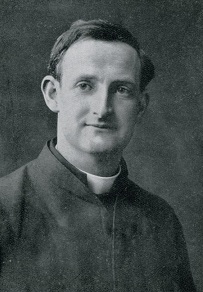
In his book The Laughter and the Weeping Columban Fr Luke O'Reilly describes the last Mass of Fr Timothy Leonard (photo above), the first Columban to die violently. Father time was ordained for the Diocese of Limerick in 1918 and immediately joined the newly established Society of St Columban. He was a member of the first group of Columbans to go to China in 1920.

(Fr) Tim Leonard, the first Columban martyr, was killed by the communists in July 1929. He was pastor of Nanfeng, about 30 miles from Nancheng. the communist guerrillas had made a raid on the town and his information seemed to have been that they had left at dawn on this particular day in July (17 July). He decided to ring the bell to inform that people that morning Mass would take pace as usual. The bell attracted the attention of some of the communist stragglers and they decided to fire shots through a window into the church. (Father) Mick Moran, who was a curate (assistant priest) in the Nanfeng area at the time, told me afterwards that Mao Tse Tung (Mao Zedong) was in the party who fired the shots that July morning. Anyhow, some of the party entered the church, around the time of Communion, presumably, because they scattered the Sacred Hosts on the floor and Tim Leonard tried to prevent them physically from desecrating the Blessed Sacrament. the communists stabbed him and took him away and we do not know how long he lived but it does seem that they hacked him to death. The Nanfeng Catholics regarded Tim Leonard as a martyr.

A Mass in Belsen Concentration Camp


Memorial Stone at Bergen-Belsen Concentration Camp, Germany

Retired Northern Ireland politician James Molyneaux, now Lord Molyneaux, was among the British soldiers who liberated Bergen-Belsen concentration camp in May 1945. He wrote about this in The Daily Telegraph (London) on 27 January 2004. I have seldom read a more powerful testimony to the centrality of the Mass in our lives than what he wrote:

The most moving experience came on the second morning as I was walking from what had been the luxury SS barracks which our troops had transformed into a hospital. My attention was drawn to two packing cases covered by a worn red curtain. A young Polish priest was clinging to this makeshift altar with one hand, while celebrating Mass. Between his feet lay the body of another priest who probably died during the night. No one had had the energy to move the body.

I had no difficulty in following the old Latin Mass, having been educated at St James's Roman Catholic School in County Antrim, and, although an Anglican, I had gained a working knowledge of all the rituals. Still supporting himself against the altar, the young priest did his best to distribute the consecrated elements. Some recipients were able to stumble over the rough, scrubby heathland. Others crawled forward to receive the tokens and then crawled back to share them with others unable to move. Some almost certainly passed on to another - probably better - world before sunset. Whatever one's race or religion one can only be uplifted and impressed by that truly remarkable proof of the ultimate triumph of good over evil. 

As an Anglican James Molyneaux has a different understanding of 'the consecrated elements' than Catholics have. We believe that the bread and wine become the Body and Blood of Christ. But his deep reverence for what he saw - prisoners who had been starved sharing the Body of Christ with one another - is very evident.

Celebrating Mass in a Vietnamese Prison
'The strength that empowered me was the Eucharist'


In Preaching Hope from Prison François-Xavier Cardinal Nguyên Van Thuán, Coadjutor Archbishop of Thành-Phô Hô Chí Minh (formerly Saigon), writes about celebrating Mass in prison:

The day I was arrested I had to leave everything behind me. The following day I was allowed to write and ask my friends to bring my clothes, toothpaste and other personal needs. I also asked them to include some wine ‘as medicine.’ My friends understood. They sent me a little bottle of Mass-wine labeled ‘Medicine for Stomach Aches’ and also some hosts hidden in a little burner used to keep the humidity at bay.


Every night I kept a tiny piece of bread for the following day’s Eucharist. And so every day for many years I had the joy of celebrating Mass with three drops of wine and one of water in my palm. This was my altar, my cathedral. For me it was the true medicine of body and soul something to stave off death in order to live for ever in Christ.

A Joyful Celebration of Mass Amidst Drug Wars in Mexico

Fr Kevin Mullins is an Australian Columban who is parish priest of our only parish in Mexico, in Ciudad Juarez, just over the border from El Paso, Texas, USA, where the Columbans also work. Father Kevin was featured recently on the news in Australia.


For my flesh is food indeed, and my blood is drink indeed. He who eats my flesh and drinks my blood abides in me, and I in him. 


16 August 2012

'I am no longer myself, I am Jesus, Jesus crucified.' The testimony of the life and death of Fr William Doyle SJ


Fr William Doyle SJ, from Dublin, was killed by a German shell in the Great War on this day 95 years ago in the Third Battle of Ypres, also known as the Battle of  Passchendaele. It was ten days after my maternal grandmother's brother, Corporal Lawrence Dowd, died in the same battle. I wonder if Father Doyle attended to my Uncle Larry before he died?

Remembering Fr William Doyle SJ, a truly inspiring blog, in the entry for 10 August gives an extract from a letter Father Willie wrote to his father in Dublin six days before his death.

A sad morning as casualties were heavy and many men came in dreadfully wounded. One man was the bravest I ever met. He was in dreadful agony, for both legs had been blown off at the knee. But never a complaint fell from his lips, even while they dressed his wounds, and he tried to make light of his injuries. Thank God, Father, he said, I am able to stick it out to the end. Is it not all for little Belgium? The Extreme Unction, as I have noticed time and again, eased his bodily pain. I am much better now and easier, God bless you, he said, as I left him to attend a dying man. He opened his eyes as I knelt beside him: Ah! Fr. Doyle, Fr. Doyle, he whispered faintly, and then motioned me to bend lower as if he had some message to give.  As I did so, he put his two arms round my neck and kissed me. It was all the poor fellow could do to show his gratitude that he had not been left to die alone and that he would have the consolation of receiving the Last Sacraments before he went to God. Sitting a little way off I saw a hideous bleeding object, a man with his face smashed by a shell, with one if not both eyes torn out. He raised his head as I spoke. Is that the priest? Thank God, I am all right now. I took his blood-covered hands in mine as I searched his face for some whole spot on which to anoint him. I think I know better now why Pilate said Behold the Man when he showed our Lord to the people.


In the afternoon, while going my rounds, I was forced to take shelter in the dug-out of a young officer belonging to another regiment. For nearly two hours I was a prisoner and found out he was a Catholic from Dublin, and had been married just a month. Was this a chance visit, or did God send me there to prepare him for death, for I had not long left the spot when a shell burst and killed him? I carried his body out the next day and buried him in a shell hole, and once again I blessed that protecting Hand which had shielded me from his fate.


Fr William Doyle SJ (3 March 1874 - 16 August 1917)

Prayer for Priests by Fr Doyle

O my God, pour out in abundance Thy spirit of sacrifice upon Thy priests. It is both their glory and their duty to become victims, to be burnt up for souls, to live without ordinary joys, to be often the objects of distrust, injustice, and persecution.
The words they say every day at the altar, "This is my Body, this is my Blood," grant them to apply to themselves: "I am no longer myself, I am Jesus, Jesus crucified. I am, like the bread and wine, a substance no longer itself, but by consecration another."
O my God, I burn with desire for the sanctification of Thy priests. I wish all the priestly hands which touch Thee were hands whose touch is gentle and pleasing to Thee, that all the mouths uttering such sublime words at the altar should never descend to speaking trivialities.
Let priests in all their person stay at the level of their lofty functions, let every man find them simple and great, like the Holy Eucharist, accessible to all yet above the rest of men. O my God, grant them to carry with them from the Mass of today, a thirst for the Mass of tomorrow, and grant them, ladened themselves with gifts, to share these abundantly with their fellow men. Amen.

15 August 2012

'The babe in my womb leaped for joy.' The Assumption

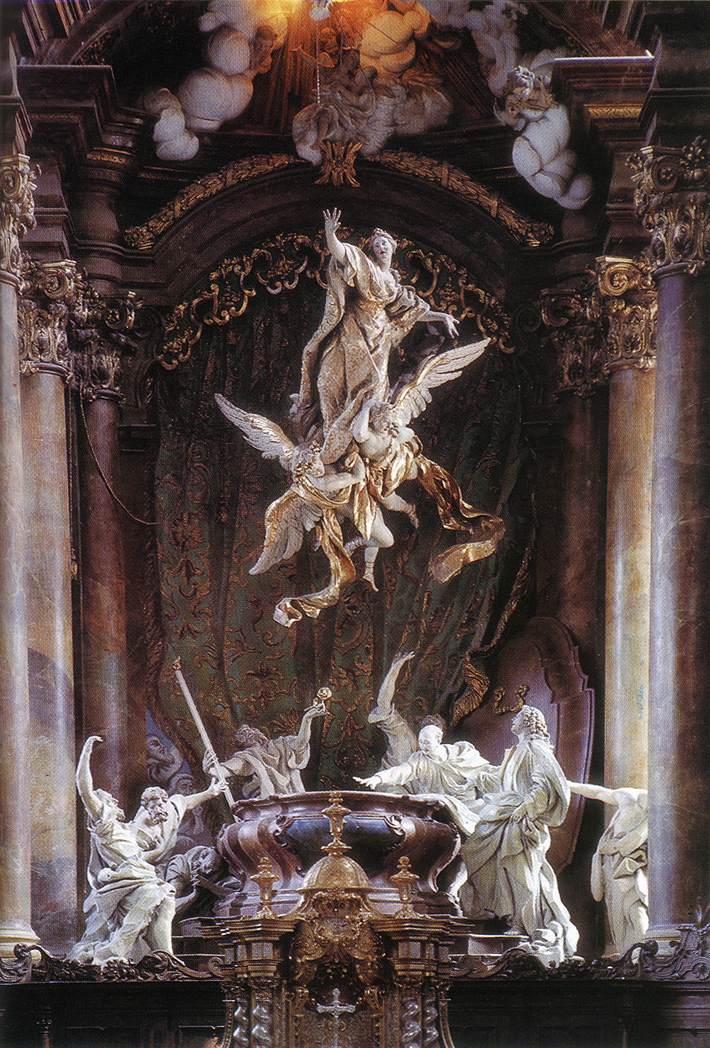
Assumption of the Virgin, Egid Quirin Asam (sculpted 1717-1725)

The Assumption is a fest that celebrates what we profess in the Nicene Creed, I look forward to the resurrection of the dead, and in the Apostles' Creed, I believe in . . . the resurrection of the body. We rejoice in the fact that what we hope for at the end of time, the resurrection of our bodies in glory, has already happened to Mary.

I was really struck at Mass this morning at the fact that the gospel was about the beginning of life, not the end of life, Luke 1:39-56. And when Elizabeth heard the greeting of Mary, the babe leaped in her womb; and Elizabeth was filled with the Holy Spirit and she exclaimed with a loud cry, "Blessed are you among women, and blessed is the fruit of your womb! And why is this granted me, that the mother of my Lord should come to me? For behold, when the voice of your greeting came to my ears, the babe in my womb leaped for joy"(Luke 1:41-44, RSV CE).  

Some years ago after celebrating Mass on the feast of the Visitation, when this same gospel is read, I gave a blessing to a girl in her teens, not married and pregnant. She found it very difficult to accept the baby as her own. After I had blessed her and her baby she told me that she could feel the child moving in her womb and that she felt at peace with the situation.


Yesterday two married friends  posted the photo above of their first but not yet born child on Facebook. Remember Sean and Hara and their 23-week-old baby still 'in hiding' in your prayers.

Today's feast is a celebration of our dignity as bodily beings created by God, human beings whose lives are sacred from the moment of conception.


Irish soprano Regina Nathan sings Hail, Queen of Heaven by Fr John Lingard at the Faith of Our Fathers concert in Dublin in 1997.