01 February 2013

Feast of St Brigid, the first day of spring in Ireland. And elsewhere? 'It might as well be spring!'

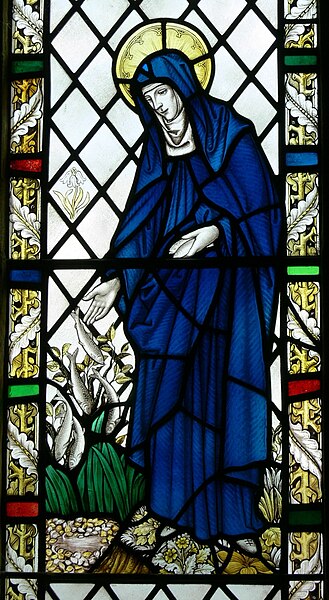
St Brigid  (c.451 - 525), St Non's Chapel, St David's, Wales

Today is observed in Ireland as Lá Fhéile Bhríde, the Feast of St Brigid of Kildare. She is one of the patrons of Ireland and is often referred to as 'Muire na nGael' or 'Mary of the Irish'.

You can find some prayers and resources for celebrating the Feast of St Brigid, including a video on how to make a St Brigid's Cross, on the website of the Diocese of Kildare and Leighlin in Ireland.

Cros Bríde, St Brigid's Cross

Collect

Merciful God,
origin and reward of all charity, 
you called Saint Brigid to teach the new commandment of love 
through her life of hospitality and her care of the needy; 
give to your people, by her intercession, 
a generous spirit, 
so that, with hearts made pure, 
we may show your love to all.
Through our Lord Jesus Christ, your Son, 
who lives and reigns with you in the unity of the Holy Spirit, 
one God, for ever and ever.

The first day of spring

According to the ancient Irish reckoning today, 1 February, is the first day of spring in the temperate regions of the Northern Hemisphere. In most places in those regions 21 March, the equinox, is considered the first day of that season of new growth and hope. Even after more than 41 years in the tropical Philippines the four seasons that I grew up with are still 'in my bones' and I always get a 'lift' when St Brigid's Day comes around. The very cold weather, at least in Ireland, is usually over and the days are growing longer.

The stained glass image of St Brigid above is in a chapel in the southwest of Wales, a country that you can see from parts of the east coast of Ireland on a clear day. In the video below is a singer from a tiny hamlet in the northwest of Wales, Bryn Terfel, with my wish for you whether or not you live in the temperate regions of the Northern Hemisphere or elsewhere, whether or not you consider 1 February or 21 March as the first day of spring. Well, It might as well be spring! 

I don't know of a better version of this classic, a combination of the clever lyrics of Oscar Hammerstein II and the tuneful music of Richard Rodgers.


31 January 2013

'Let us be ashamed to assume an attitude of superiority.' St John Bosco on discipline


Since my teenage years I've had a great admiration for St John Bosco and even gave a passing thought at that time to joining the Salesians, the congregation that he founded.

As a priest I became very familiar with the Second Reading in the Office of Readings on his feast day, 31 January. I have worked with young people in one way or another for most of the more than 45 years that I have been a priest. I see in this letter from St John Bosco his great respect for young people but also his understanding of those who take care of them, teachers, parents and guardians, and of his awareness, no doubt from his own experience, that the same young persons can at times test the patience of those in charge of them.

The word 'discipline' comes from 'discipleship'. It is learning from the example of the mentor how to follow the mentor's way of life. Jesus didn't beat up his disciples, though they often tested his patience and on occasion he scolded them.

Years ago a girl of 15 or so on a weekend retreat in her school, a girls' school run by Sisters, who had been behaving rather immaturely came to me in floods of tears and said, 'My parents give me everything I ask for. But they never ask me how I'm doing in school - and they never even scold me'.

Nobody likes to be scolded but most young people recognise it as an expression of concern, of care, of love - when it's not heavy-handed.

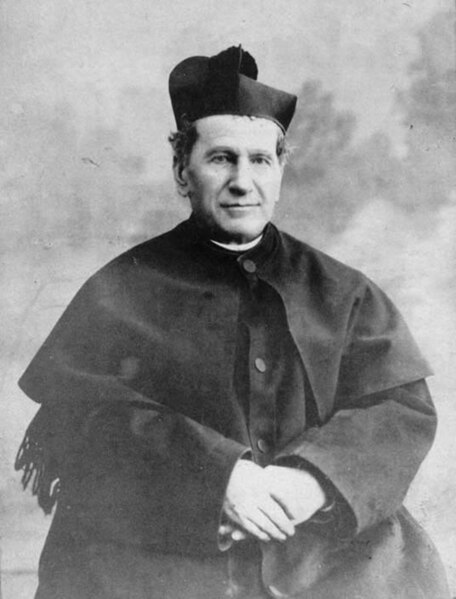
I've always liked that fact that in photos and portraits of St John Bosco his hair is slightly untidy!

St John Bosco (16 August 1851 - 31 January 1888)

From a letter by Saint John Bosco, priest
I have always laboured out of love
First of all, if we wish to appear concerned about the true happiness of our foster children and if we would move them to fulfil their duties, you must never forget that you are taking the place of the parents of these beloved young people. I have always laboured lovingly for them, and carried out my priestly duties with zeal. And the whole Salesian society has done this with me.

My sons, in my long experience very often I had to be convinced of this great truth. It is easier to become angry than to restrain oneself, and to threaten a boy than to persuade him. Yes, indeed, it is more fitting to be persistent in punishing our own impatience and pride than to correct the boys. We must be firm but kind, and be patient with them.

I give you as a model the charity of Paul which he showed to his new converts. They often reduced him to tears and entreaties when he found them lacking docility and even opposing his loving efforts.

See that no one finds you motivated by impetuosity or wilfulness. It is difficult to keep calm when administering punishment, but this must be done if we are to keep ourselves from showing off our authority or spilling out our anger.

Let us regard those boys over whom we have some authority as our own sons. Let us place ourselves in their service. Let us be ashamed to assume an attitude of superiority. Let us not rule over them except for the purpose of serving them better.

This was the method that Jesus used with the apostles. He put up with their ignorance and roughness and even their infidelity. He treated sinners with a kindness and affection that caused some to be shocked, others to be scandalised, and still others to hope for God’s mercy. And so he bade us to be gentle and humble of heart.

They are our sons, and so in correcting their mistakes we must lay aside all anger and restrain it so firmly that it is extinguished entirely.

There must be no hostility in our minds, no contempt in our eyes, no insult on our lips. We must use mercy for the present and have hope for the future, as is fitting for true fathers who are eager for real correction and improvement.

In serious matters it is better to beg God humbly than to send forth a flood of words that will only offend the listeners and have no effect on those who are guilty.


30 January 2013

'A quirky kind of prayer' from the late Fr Tom Cahill SVD

Fr Tom Cahill SVD (1946 - 2013)

This morning at breakfast I was reading the February 2013 issue of Intercom, the monthly 'Pastoral and Liturgical Resource' of the Irish Catholic Bishops' Conference. It had an article, Year of Faith, Year of Thanks, by Fr Tom Cahill SVD, whom I've known since our schooldays and with whom I kept in touch over the years, from his time in Flores, Indonesia, to his many years back in Ireland. Father Tom died on 15 January, a few days after getting a massive stroke. The photo above was taken in 2011 at a gathering in St Patrick's, Maynooth, of the ordination class of 1971.

In his article, Father Tom emphasized the importance of thanking God each day. He wrote, Someone wryly remarked that the most difficult arithmetic to learn is the one that teaches us how to count our blessings. We can't be joyful without being thankful. He goes on to say, We didn't ask to be born yet don't regret that we were. Thanking God daily for this most precious gift helps us start each day with joy in our heart and not gripe in our belly. Happily acknowledging that our intelligence and abilities are gifts freely given, ensures that they are spurs to service and not prods to pride.

Further on Father Tom says, There are still more: gifts of faith in God and hope in his promises. Not only is our present life a gift but also our future eternal life is an even greater one. What would life be like without anything to hope for after death?

He came across what he describes as 'a quirky kind of prayer' and followed the advice of the late Irish comedian Hal Roach who, when he got a gale of laughter from his audience would say, Write it down; it's a good one!  This is what Father Tom wrote down:

Dear God, we rejoice and give thanks for earthworms, bees, ladybirds and broody hens; for humans tending their gardens, talking to animals, cleaning their homes and singing to themselves; for the rising of the sap, the fragrance of growth, the invention of the wheelbarrow and the existence of the teapot, we give thanks. We celebrate and give thanks. Amen.


The other day I came across an article in the December 2012 issue of Catholic Mountain Star, the newspaper of the Diocese of Nelson, British Columbia, Canada, by Fr Harry Clarke, an Irish friend of mine who is a parish priest there. He was sharing Impressions of the Eucharistic Congress, held in Dublin last June. Father Harry wrote:

The Abbot of Glenstal, drew our attention to an insight of Dublin writer, James Joyce. Joyce observed that the Church must deal with Irish people as they really are and know what they are like - an ordinary man, on an ordinary day, with ordinary thoughts and temptations, surrounded by ordinary people. 

It seems to me that he is right in this. Ireland was invaded by “devotional religion” from Europe after 1860. From then on preaching was so often not connecting with the ordinary person’s daily life. As the story goes one farmer, after Sunday Mass, put it like this: “a more ignorant priest would have suited us better”. The 10,000 or so who attended each day, mostly salt of the earth Irish, were not honored or valued in this way by the homilies I heard at daily Mass.

As I wasn't present at the Congress I can't say whether or not I agree with Father Harry's final sentence in the quotation. But I fully agree with the importance of the Irish people as they really are and know what they are like - an ordinary man, on an ordinary day, with ordinary thoughts and temptations, surrounded by ordinary people.

I remember Fr Ronan McGrath in my first year in the seminary, back in 1961-62, drawing to our attention that when we went home at the end of the year we would find the same people doing the same things, the milkman, the bread man and others doing their daily rounds, part of the fabric of life. He spoke about St Joseph in his carpenter's shop, probably getting complaints from some customers.

A basic black teapot (essential to every Irish home!)

And when we did go home, we found what Fr McGrath said to be true. And we found ourselves invited to the inevitable 'cuppa' whenever we visited relatives and friends and the teapot came out.

My friend Fr Tom Cahill wrote for many Catholic publications and often did the 'God spot' on radio on RTÉ, Ireland's national broadcasting service. He had the gift of seeing God's presence in incidents that to most would seem insignificant. I don't know if he was familiar with what our fellow Dubliner James Joyce wrote, as mentioned by the Abbot of Glenstal. But he certainly followed his advice.

And Father Tom would have been familiar with this delightful song by American folk musician and singer-songwriter Bill Staines, sung here by Irish singers Liam Clancy and Tommy Makem, both of whom died in recent years.


Even the sparrow finds a home, and the swallow a nest for herself, where she may lay her young, at thy altars, O LORD of hosts, my King and my God (Psalm 84:3, RSV Catholic Edition).

May Father Tom find his 'Place in the Choir' and experience in the fulness of gratitude and joy the truth of his own words, Not only is our present life a gift but also our future eternal life is an even greater one.

27 January 2013

Kimchi-flavoured haggis?


The first Korean meal I had was in New York City in 1968 or 1969 when, as a young priest, I was studying music near there. My host was an Irish Columban based in NYC at the time who had spent his early years as a priest in Korea. I wouldn't swear in court that I tried kimchi on that occasion, but I probably did. I have eaten it many times since, on three visits to Korea and on occasion here in the Philippines.


Until last year I thought kimchi was exclusive to Korea but discovered that it's also popular in Vietnam, and with the same name. I was giving a weekly class to aspirants of the Capuchin Tertiary Sisters of the Holy Family here in Bacolod and used to have lunch with the group afterwards. Some were Vietnamese and I was surprised when they produced kimchi one day. When the realised that I liked it they had some almost every week.

I tried haggis, a very Scottish dish, also for the first time in New York in 1970-71, with a Finnish-American friend who was my mentor in the public elementary school where I was practice-teaching for a few months. A few weeks after starting in the school I moved into the parish as a resident priest. But that's another story. 

I was rather disappointed. All I can I remember is the mashed turnip or Swede, not my favourite vegetable, that is usually served along with mashed potatoes and the haggis (below).


However, during the five months I was based in Glasgow, Scotland, in 2002 I had the chance to eat haggis again when the priest in a rural parish where I was doing a mission appeal for the Columbans took me out for lunch. I decided to give haggis another chance - and enjoyed it. some time later I drove some Filipino friends to Edinburgh and suggested to them that we try haggis for lunch. We all loved it - and the price was very reasonable in the pub where we had it. I learned that it was the poor person's meal in times past.


The texture of haggis reminds me of that of a Filipino dish, sisig, though the two are made from different ingredients. But there is for me another connection between haggis and the Philippines. Haggis in the past was made from the leftover parts of the sheep. In the Visayan languages of the central and southern Philippines the word for breakfast is pamahaw, the root word being bahaw, leftovers. Part of this is often fried rice, which is rice that had been boiled the day before but not all eaten.

Robert Burns. Painting by Alexander Nasmyth.

Many Scottish people at home and around the world celebrate Burns Night on or around 25 January, the birthday of Scottish poet Robert Burns (1759 - 1786). Haggis is so central to the Burns Night supper that it is piped in and then addressed with a poem that Burns wrote.


I have heard that the definition of a Scottish gentleman is a man who can play the bagpipes - but doesn't. I have also heard that the Irish gave the bagpipes to the Scots as a joke - and the Scots haven't seen the joke yet! But to many of us from Ireland and Scotland, or of Irish or Scottish heritage - and the Latin word Scotus originally meant 'Irish', there is something special about the bagpipes.

Where does the kimchi fit in? One of Burns' most popular poems/songs is My Love is Like a Red, Red Rose. While doing research for today's Sunday Reflections I came across a video of a Korean choir singing it (video at the top).

Here are the words of the song:

O my Luve's like a red, red rose
That’s newly sprung in June;
O my Luve's like the melodie
That’s sweetly play'd in tune.

As fair art thou, my bonnie lass,
So deep in luve am I:
And I will luve thee still, my dear,
Till a’ the seas gang dry:

Till a’ the seas gang [go] dry, my dear,
And the rocks melt wi’ the sun:
I will luve thee still, my dear,
While the sands o’ life shall run.

And fare thee well, my only Luve
And fare thee well, a while!
And I will come again, my Luve,
Tho’ it were ten thousand mile.

Here is the song sung by the late Scottish tenor, Kenneth McKellar. It's not his original recording but one made when he was 67.

25 January 2013

'Today this scripture has been fulfilled in your hearing.' Sunday Reflections, Third Sunday in Ordinary Time Year C


An extract from Franco Zeffirelli's Jesus of Nazareth.[Today's gospel ends at 2:28.]

Readings (New American Bible: Philippines, USA)

Readings (Jerusalem Bible: Australia, England & Wales, India [optional], Ireland, New Zealand, Pakistan, Scotland, South Africa)

Gospel Luke 1:1-4; 4:14-21 (Revised Standard Version – Catholic Edition)

Inasmuch as many have undertaken to compile a narrative of the things which have been accomplished among us, just as they were delivered to us by those who from the beginning were eyewitnesses and ministers of the word, it seemed good to me also, having followed all things closely for some time past, to write an orderly account for you, most excellent Theophilus, that you may know the truth concerning the things of which you have been informed. 

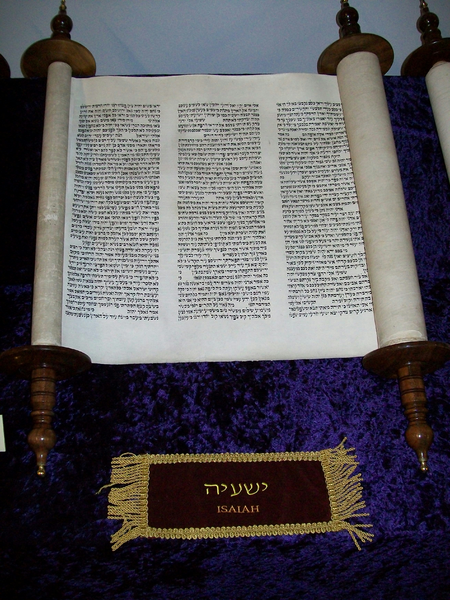
Jesus returned in the power of the Spirit into Galilee, and a report concerning him went out through all the surrounding country. And he taught in their synagogues, being glorified by all. And he came to Nazareth, where he had been brought up; and he went to the synagogue, as his custom was, on the sabbath day. And he stood up to read; and there was given to him the book of the prophet Isaiah. He opened the book and found the place where it was written, "The Spirit of the Lord is upon me, because he has anointed me to preach good news to the poor. He has sent me to proclaim release to the captives and recovering of sight to the blind, to set at liberty those who are oppressed, to proclaim the acceptable year of the Lord." And he closed the book, and gave it back to the attendant, and sat down; and the eyes of all in the synagogue were fixed on him. And he began to say to them, "Today this scripture has been fulfilled in your hearing."


Jesus returned in the power of the Spirit into Galilee St Luke tells us. Thirty years ago in the Diocese of Bacolod on the island of Negros where I now live in the Philippines the Spirit led nine men to jail, three priests and six laymen, all falsely charged with multiple murder. Fourteen months were to pass before the nine were released.

Two of the priests were Columbans, Fr Brian Gore from Australia and the late Fr Niall O'Brien from Ireland. The third was a diocesan priest, Fr Vicente Dangan, now deceased.

The six laymen, all working for the Church during the very difficult Martial Law years in the Philippines, were Jesus S. Arzaga, Peter Cuales, Lydio J. Mangao, Conrado Muhal (RIP), Geronimo T. Perez (RIP) and Ernesto Tajones. They became known as The Negros Nine and you can find their photos here. 

While the Negros Nine were in jail in Bacolod City the late Bishop Antonio Y. Fortich appointed the three priests as chaplains there. The vast majority of prisoners were from poor backgrounds and their cases were being constantly put back. The three priests, as well as ministering to the spiritual needs of the prisoners were able to get lawyer-friends to follow up on the cases of many of those languishing, wondering if they would ever get out.

As a result of this, many of them did. He has sent me to proclaim release to the captives . . . to set at liberty those who are oppressed . . .

+++

I'm writing this on 25 January. Later today the 40th annual March for Life will take place in Washington DC. 40 = 55M says the March for Life website, indicating the 55 million babies who have been legally aborted in the USA since the Roe v Wade decision by the Supreme Court 40 years ago.

Last Saturday 25,000 turned out at a peaceful rally outside the Irish parliament in Dublin to let politicians know that they don't want abortion to be legalised in the Republic of Ireland.

One of the charges often made is that those who are pro-life when it comes to the unborn and abortion are really only 'pro-birth' and not interested in the lives of children once they are born.

My friend Lala and her friend Jordan, whom I also know, might dispute this if they had the ability to express themselves in such a way. Lala was left in a garbage bin after birth and raised by the Daughters of Charity in Cebu City. Lala was born with Trisomy 21 (Down's Syndrome) and Jordan with intellectual and physical disabilities. They now live in the L'Arche community near Manila. Over the years those who have chosen to live with Lala, Jordan and others for long periods, enabling them to live normal lives, have come from as far away as Germany and Japan.

Lala helping Jordan

The late King Baudouin of the Belgians, about whom I've written in the two previous Sunday Reflections wrote in a letter to a young mother about a children's party that he and Queen Fabiola had hosted: 

In one corner there was a group of handicapped children, several of them with Down's Syndrome. I brought a plateful of toffees to a little girl who had scarcely any manual control. With great difficulty, she succeeded in taking a toffee but, to my astonishment, she gave it to another child. then for a long time, without ever keeping one for herself, she distributed these sweets to all the healthy children who could not believe their eyes. What a depth of love there is in these physically handicapped bodies . . .

Lala and the little girl who astonished King Baudouin are truly sisters in Christ. He has anointed me to preach good news to the poor. King Baudouin and the able-bodied children with whom the little girl with the disabilities shared her toffees were poor in spirit in the sense that St Matthew means in the first of the Beatitudes, ie, they knew their need of God. They recognised God's presence at the party, just as those who know Lala, especially those who live in L'Arche with her, recognise that the scripture has been fulfilled in their presence and is being fulfilled each day.

The Negros Nine were involved in organising Christian Communities where people would work together for the peace and justice that the Gospel demands in an area of awful poverty for many, poverty caused by greed. They suffered with the people because of the demands of the Gospel. Those of the Negros Nine who remain continue to work for justice and peace through the Negros Nine Human Development Foundation. Among other things the foundation is involved in trying to prevent the trafficking of women and minors. To set at liberty those who are oppressed . . .

While looking for a musical setting of the Entrance Antiphon I discovered Cantate Domino in B-flat, a setting of part of Psalm 96 (95) in Latin from which the Antiphon is taken, by Japanese composer Ko Matsushita. This came out of the Sing for Japan Choir Project, an international response to the earthquake and tsunami of 11 March 2011. I had not heard of Ko Matsushita nor had I heard of the Sing for Japan Choir Project. I discovered quite a few videos of Cantate Domino and finally settled on one featuring the Kaohsiung Chamber Choir from southern Taiwan.


The Entrance Antiphon is taken from Psalm 95 (96) 1, 6. The above is Cantate Domino in B-flat, a setting of verses 1, 2, 4, 5 ,6, 11 by Japanese composer Ko Matsushita. Verses 1 and 6 are highlighted.

Cantate Domino canticum novum,
cantate Domino omnis terra.
Cantate Domino benedicite nomini eius,
adnuntiate diem de die salutare eius;
quoniam magnus Dominus et laudabilis valde
terribilis est super omnes deos;
quoniam omnes dii gentium daemonia
at vero Dominus caelos fecit.
Confessio et pulchritudo in conspectu eius, 
sanctimonia et magnificentia in sanctificatione eius.
Laetentur caeli et exultet terra
commoveatur mare et plenitudo eius.

Entrance Antiphon

O sing a new song to the Lord, 
sing to the Lord, all the earth. 
In his presence are majesty and splendour, 
strength and honour in his holy place.

The Spirit of the Lord is upon me, because he has anointed me to preach good news to the poor . . .

And in so many ways, if we have eyes to see and ears to hear, we can say with Jesus, Today this scripture has been fulfilled in your hearing.

24 January 2013

St Francis de Sales, Patron of the Deaf; Father Cyril Axelrod CSsR, a deaf-blind priest


I originally posted the following on 24 January 2009.

Today is the feast of St Francis de Sales (1567-1622), Bishop and Doctor of the Church, patron of journalists and of the Deaf. So he is my patron on both counts, since I edit Misyon and have been working with the Deaf on a part-time basis since 1992 and frequently celebrate Mass in Sign Language. Above all, he was a man who lived the fulness of the priesthood as a bishop faithfully. Maybe he would be a blogger if he were around today.

The following information, which I found here, is from the National Catholic Office for the Deaf, located in Washington, DC.

St Francis De Sales: Patron of the Deaf and Hearing-impaired

In 1605, an indigent young man named Martin, a deaf-mute from birth, came almost daily to a house in Roche, France, where Bishop de Sales was staying, to ask for alms. He was a strong young man fit for all kinds of work, and the Bishop's housekeeper often allowed him to help her in payment for the Bishop's generosity. One day a servant introduced Martin to the Bishop.

As a result of his handicap, Martin, who was about 25 years old, had never received any kind of education -- or instruction in the Catholic faith. (It was presumed by all of the educated people of that age, the 17th century, that a deaf-mute was a mentally handicapped person and that trying to educate or trying to communicate religios truths to such a person would be a waste of time.)

At the time of their meeting, St Francis de Sales was visibly disturbed and touched with pity for the unfortunate Martin. St Francis realized that the poor man would remain forever ignorant of God and the rich mysteries of the Faith and that his lack of instruction would forever keep him from receiving the Sacraments of Penance and the Eucharist.

After considering young Martin's deprived condition for a time, St. Francis determined that he would undertake the instruction of the young man.
By using signs that he formed with his hands and fingers, St Francis personally began to teach Martin about the Catholic Faith. Martin, as was soon clear, was highly intelligent and a very good pupil. After a period of time, through his gentle patience and persistence and with the signs and gestures he had invented for the purpose, St Francis succeeded in instructing Martin about God and His love for all men. All went so well that eventually Martin was able to receive the Holy Eucharist for the first time in 1606. Two years later, Martin was confirmed.

St Francis eventually hired Martin as his gardener and brought him along with him when he returned to his episcopal household in Annecy, France.
Martin's devotion to the Bishop of Geneva was second only to his devotion to God. Martin prayed fervently, examining his conscience every evening before retiring, regularly confessed his sins to the Bishop, and assisted devoutly at the Bishop's Mass whenever he could.

Sixteen years later, no one would be more affected by the death of St Francis de Sales than his faithful servant Martin, who would visit his master's last resting place almost every day until the day he himself died.

The above account uses a term that is not used anymore: 'deaf-mute'. As a literal matter of fact, people who are deaf aren't mute, since they have voices and many can learn to speak.
The word 'handicap' too isn't used much now but rather 'disability'. I don't like the term 'differently-abled'. It cannot hide the reality that a person who is deaf or blind, for example, does have a disability. Deaf people prefer the word 'Deaf', with a capital 'D' to describe themselves as a group. Being profoundly deaf from birth is different from becoming hearing-impaired from old age, for example.

Those of us who can see and hear tend to think that blindness is a greater disability than deafness. But deafness, whether from birth or coming with old age, is a disability that isolates in a way that blindness doesn't. Most deaf people here in the Philippines don't share a language even with their own family. And the only 'native signers' I know here are the hearing children of deaf parents.

St Francis saw how isolated Martin was and broke through that isolation.

+++

I am adding this on 24 January 2013. Here is the only deaf-blind priest, Fr Cyril Axelrod CSsR, speaking to seminarians and priests.


Fr Cyril Axelrod CSsR

I have posted about Father Cyril before: 'Don't shout; I am Deaf'. Father Cyril is on Facebook.


22 January 2013

'The Miracle Girls' and 'A Poem of Purity: Blessed Laura Vicuña, patron of those who have been abused

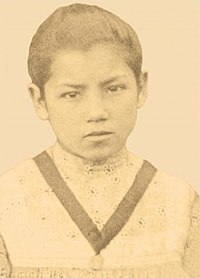
Blessed Laura Vicuña (5 April 1891 – 22 January 1904)

Last evening I celebrated Mass  for the Feast of St Agnes (c.291 - c.304) with 'The Miracle Girls'. St Agnes, among other things, is the patron saint of victims of rape. My homily was mostly about the life of Blessed Laura Vicuña, whose life and dates of birth and death parallel those of the Roman martyr. Blessed Laura is the patron of abuse victims. Today is her feast day.

For some years now in Holy Family Home for Girls we have celebrated these two young girls who have been recognised by the Church for their holiness. Sometimes we have the Mass on the 21st, sometimes on the 22nd. Many, though not all, of 'The Miracle Girls' have been victims, some within their own families.

Some of 'The Miracle Girls' and friends.

I told the girls how the brutal treatment of her step-father led to Blessed Laura's death. her father had died when she was three and her mother, Mercedes, who was left with little means, then lived with a landowner but without marrying him. Before she died Laura told her mother that she had offered her life to God for her conversion. Mercedes began to live a life according to God's will.

Mercedes Pino, the mother of Blessed Laura

Both St Agnes and Blessed Laura made a choice to offer their lives on order to 'buy the field where the treasure was', to 'buy the pearl of great price', as Matthew 13:44-46, the gospel suggested for the feast of St Agnes, which we read, tells us. We can under-estimate the power of God's grace in young persons. yet there are many great examples in the history of the Church, especially among the martyrs.

St Paul tells us in 1 Corinthians 1:26-31, the First Reading, God chose the foolish of the world to shame the wise, and God chose the weak of the world to shame the strong, and God chose the lowly and despised of the world, those who count for nothing, to reduce to nothing those who are something, so that no human being might boast before God.

Young Agnes and young Laura were prepared to accept death for the sake of Jesus Christ. Blessed Laura'a offering of her life for the conversion of her mother parallels the example of her older contemporary, St Thérèse of Lisieux who, when she was about 14, made her first mission the conversion of a notorious criminal named Pranzini who was due to be executed. God listened to her prayers too.

Though St Agnes and Blessed Laura were powerless at one level, in the depths of their being they were free, through God's grace, and able to make choices that astound us. Yet the same grace is available to all of us. These two young holy people bring hope, rooted in their awareness of God's love, to all of us who are struggling to follow Jesus faithfully. And, as a friend of mine keeps telling me, it's in the struggle that we become saint.

Fr John Murray, a parish priest in Belfast, told the story of Blessed Laura some years ago in The Sacred Heart Messenger, an excellent popular monthly that the Jesuits in Ireland have been publishing now for 125 years. We published it, with permission, in Misyon, the Columban magazine in the Philippines that I edit. Here is Father Murray's article.


Although she was only twelve when she died, Laura Vicuña had grown to a maturity of faith well beyond her years. Fr John Murray sees the life of this young girl whose feast is 22 January as an inspiration.

Throughout his pontificate, Pope John Paul II endeavored to offer to the Church and the world at large, models for Christian living: people we can imitate and learn from, as we try to make our own way through the maze and pitfalls of life. In an age of sexual license, when often girls and young women can be at the mercy of sexual predators, the life of Laura Vicuña has something to say in our own day.

Painful experiences

Laura was born in Santiago, Chile, on 5 April 1891.Soon after her birth, her father had to flee the country because of political upheavals, and when she was only three he himself passed away. Bereft of support, her mother, Mercedes, sadly entered into a relationship with a local ranch owner, one Manuel Mora.

He offered to pay for the care and schooling of her children at a Salesian boarding school, if Mercedes became his mistress. Laura attended the Salesian mission school with her sister, Julia. With a maturity beyond her years, Laura often helped the younger children with their tasks, and acted almost like a mother to them, combing their hair and mending their clothing.

Even then, Mora would try to molest her, especially when he was drunk. She made her First Holy Communion when she was ten, but was always afraid of Mora, because of his lewd desires on her. When she fought off his first assault, the ranch owner refused to pay for her school tuition, but despite that the Sisters continued to educate her.

Offering up her life

Despite her young age, Laura was conscious that her mother was not living as God would want, and she had already decided to offer her life to God for her mother’s conversion.

At this stage, her own health was delicate, and in the winter of 1902 Mercedes left the Mora’s hacienda in order to care for her ailing daughter.

At this time, they were living in Argentina.However, in January 1904, Mora arrived on their doorstep to demand that Laura surrender to his lusts. When she refused him, he whipped and kicked her, and then threw her brutally across the saddle of his horse to carry her back to his ranch. Aware that the local people were watching him, he dumped her body in a ditch and left. Laura lingered on until 22 January, when she died of severe internal injuries.

Just before she died, she told her mother that she had given her life to bring about a conversion in her. ‘Mama,’ she said. ‘I am dying, but I’m happy to offer my life for you. I asked our Lord for this’. After Laura’s death, Mercedes made a good confession, left Mora, and became a devout Catholic again.

Beatification

In September 1988, Pope John Paul II beatified Laura, calling her a ‘Eucharistic flower . . . whose life was a poem of purity, sacrifice and filial love’. In many ways, her life parallels that of St Maria Goretti, whose life and death may be better known to many people. She too fought off the advances of a young man with lustful desires.

Maria died but was able eventually to achieve the conversion of her murderer, and when she was later canonized in 1950, he was present at the ceremony. (Note: I saw a TV documentary on St Maria Goretti on EWTN recently and it stated that he wasn't present, though he was still alive at the time and living in a Capuchin friary in Italy as a member of the Capuchin Third Order.)

Like Maria, Laura did not let the sordidness of Mora destroy her innocence, nor did she allow her heart to become embittered. Instead, she prayed for her mother and also for her lover. We can but hope that Mora too experienced the conversion which Laura prayed for her mother. Her life is a testimony to the words of St Paul: ‘However much sin increased, grace was always greater’ (Rom 5:20).