Showing posts with label Capuchin Tertiary Sisters of the Holy Family. Show all posts

27 August 2016

'But when you give a banquet, invite the poor . . .' Sunday Reflections, 22nd Sunday in Ordinary Time, Year C

Baptism, Confirmation and First Holy Communion at Holy Family Home for Girls, Bacolod City


Readings (New American Bible: Philippines, USA)

Readings (Jerusalem Bible: Australia, England & Wales, India [optional], Ireland, New Zealand, Pakistan, Scotland, South Africa)


On one occasion when Jesus was going to the house of a leader of the Pharisees to eat a meal on the sabbath, they were watching him closely.

When he noticed how the guests chose the places of honor, he told them a parable.  “When you are invited by someone to a wedding banquet, do not sit down at the place of honor, in case someone more distinguished than you has been invited by your host; and the host who invited both of you may come and say to you, ‘Give this person your place,’ and then in disgrace you would start to take the lowest place. But when you are invited, go and sit down at the lowest place, so that when your host comes, he may say to you, ‘Friend, move up higher’; then you will be honored in the presence of all who sit at the table with you. For all who exalt themselves will be humbled, and those who humble themselves will be exalted.”

He said also to the one who had invited him, “When you give a luncheon or a dinner, do not invite your friends or your brothers or your relatives or rich neighbors, in case they may invite you in return, and you would be repaid. But when you give a banquet, invite the poor, the crippled, the lame, and the blind. And you will be blessed, because they cannot repay you, for you will be repaid at the resurrection of the righteous.”
Responsorial Psalm (NAB Lectionary, Philippines, USA)

But when you give a banquet, invite the poor, the crippled, the lame, and the blind. And you will be blessed . . . 
Last Sunday I experienced this after Mass at Holy Family Home for Girls (HFH) here in Bacolod City. Kathy wished to share her birthday joy - the day itself was actually the day before - with the girls at Holy Family Home along with her family and co-workers. Most of the more than 30 girls in Holy Family Home have had traumatic experiences in their lives and the majority are from poor families.
Kathy and her husband Hernan have been celebrating their birthdays with the girls at HFH and the Capuchin Tertiary Sisters of the Holy Family who run it for some years now. There are other families who have been doing the same, some in HFH, some in orphanages or homes for the aged in Bacolod City.
And you will be blessed, because they cannot repay you . . .
Kathy, whose father died suddenly when she was only three months old, spoke briefly at the end of the programme after the catered lunch but asked Hernan to take over. (The programme included a magician, some games and dances by the girls.) He told us how blessed his whole family was simply by the joy they saw in the faces of the girls. That has been my own experience since I became involved with HFH nearly 14 years ago. That involvement has been one of the greatest blessings of my life, an ongoing one and all the greater because it was something I had never expected when I returned to the Philippines in 2002 after a two-year stint in Britain that was supposed to be a four-year one.
Most of these girls have had experiences that no child or young person should ever have. But in HFH they get the best of truly caring professional help that enables them to feel the healing power of God's love. Much of that healing comes form their interaction with each other and from their shared responsibilities. For example, each cubicle for personal hygiene is used by three girls, who also have to maintain it. And something that touched me when I first began to go to HFH and given the 'grand tour' was to learn that each new girl, whether still a child or already an adolescent, is given a cuddly toy which she keeps on her bed. There are two large dormitories, again maintained by the girls. And they make their bed first thing in the morning, have an early breakfast, gather for prayers and then go off to the local elementary and high schools, both within walking distance.

Columban Fr Michael Sinnott visits HFH

The girls had been praying their hearts out for Fr Sinnott, then 79, after he was kidnapped in October 2009. He came to visit them later. This was their reaction when I told them of his release:


Hernan reminded us in his 'few words' of Jesus and children: Let the little children come to me, and do not stop them; for it is to such as these that the kingdom of heaven belongs (Matthew 19:14).

The First Reading and the Gospel remind me of a line in the Handbook of the Legion of MaryAlways will the legionary bear in mind that he is visiting not as a superior to an inferior, not as one equal to another, but as an inferior to his superior, as the servant to the Lord. This is the opposite of what I have heard many well-meaning people say: We must go down to the level of the poor (or whoever). Jesus identifies himself with the 'outsider', with the 'other', whoever the 'other' may be. And the king will answer them, ‘Truly I tell you, just as you did it to one of the least of these who are members of my family, you did it to me' (Matthew 25:40)

Children's Games, Pieter Bruegel the Elder, 1559-60
Kunsthistorisches Museum, Vienna [Web Gallery of Art]

'Alleluia' by Ronald Raz
Quezon City, Philippines


09 February 2013

'But at your word . . .' Sunday Reflections, 5th Sunday in Ordinary Time Year C


Readings (New American Bible: Philippines, USA)

Readings (Jerusalem Bible: Australia, England & Wales, India [optional], Ireland, New Zealand, Pakistan, Scotland, South Africa) 

Gospel Luke 5:1-11 (Revised Standard Version – Catholic Edition)

While the people pressed upon him to hear the word of God, he was standing by the lake of Gennesaret. And he saw two boats by the lake; but the fishermen had gone out of them and were washing their nets. Getting into one of the boats, which was Simon's, he asked him to put out a little from the land. And he sat down and taught the people from the boat. And when he had ceased speaking, he said to Simon, "Put out into the deep and let down your nets for a catch." And Simon answered, "Master, we toiled all night and took nothing! But at your word I will let down the nets." And when they had done this, they enclosed a great shoal of fish; and as their nets were breaking, they beckoned to their partners in the other boat to come and help them. And they came and filled both the boats, so that they began to sink. But when Simon Peter saw it, he fell down at Jesus' knees, saying, "Depart from me, for I am a sinful man, O Lord." For he was astonished, and all that were with him, at the catch of fish which they had taken; and so also were James and John, sons of Zebedee, who were partners with Simon. And Jesus said to Simon, "Do not be afraid; henceforth you will be catching men." And when they had brought their boats to land, they left everything and followed him. 


The painter Raphael captures something of the awe of St Peter when he saw how much fish he and his companions had caught, despite their misgivings as experienced fishermen in following the advice of someone they knew to be a carpenter from the mountains of Galilee. St Peter, who had a long way to go in his formation as a follower of Jesus, recognised the utter generosity of God's providence.

Columban Fr John Griffin, a New Zealander who worked for many years both in the Philippines and Chile tells a story about St Alberto Hurtado SJ (1901 - 1952) and his trust in God's providence in A priest, I bless you - Alberto. (I've used this story before but it fits in with today's Gospel).

Providence was always on his side. At a meeting one night his board of directors was unwilling, for lack of funds, to approve a new project. In the midst of discussions there was an unexpected call for Fr Hurtado to attend to someone at his front door. He had a brief conversation with the caller who said she wanted to leave a gift to help the great work he was doing.

He gratefully put her envelope in his pocket, wished her a good evening and returned to his meeting. He looked at the contents of the envelope as he sat down. Then he tossed a check onto the table saying, ‘There you are, ye of little faith!’ It was for one million pesos – worth about US$30,000 at that time. 


Postage stamps issued in Chile in 2001 for the centennial of the birth of the then Blessed Alberto Hurtado SJ

I recently experienced something of God's providence. I was asked to write an article for the Columban magazine in the USA, Columban Mission. So I wrote The Miracle Girls! and it was published last October. 


I got the title from one of the girls at Holy Family Home for Girls, Bacolod City,after the release of kidnapped Columban Fr Michael Sinnott in the Philippines in 2009. I had asked the girls to pray for Fr Sinnott's safe release. When I told them that God had heard their fervent prayers - and fervent they were - one of them came up to me and said, 'Father, we are the miracle girls!' [They were actually part of an international 'prayer brigade'].

She was expressing something like St Alberto, a total trust in God's providence.

I was happy when my article was published but had no idea how many readers would respond with generosity, a generosity that will enable the Capuchin Tertiary Sisters of the Holy Family to continue to take care of the girls whom God sends their way just as God continues, more than 60 years after his death, to provide for the Hogar de Cristo (Home of Christ) movement that San Alberto started and that has spread to other countries.

Like many of 'The Miracle Girls' Father Alberto came from a background of poverty and of violence. But that didn't stop him from hearing God's call. He wanted to be a lawyer in order to help the poor. God answered his desire to help the poor of Chile, not as a lawyer but as a Jesuit priest. God called Peter and his companions to let go of their fears and of their work: Do not be afraid; henceforth you will be catching men.

St Luke tells us directly and simply how Peter and Andrew, James and John, responded to the words of Jesus: And when they had brought their boats to land, they left everything and followed him. 

They didn't become saints overnight. They failed Jesus many times and Peter even betrayed him. But Jesus never abandoned them and their hope and trust in him never vanished.

St Peter's words can encourage us when we can't see things clearly, when we are disheartened, when we've nowhere to turn to: But at your word . . .

+++


After today we won't be singing or praying the Gloria on Sunday until Easter. Above is the new English translation of the Gloria adapted to the Gregorian chant setting of the Gloria in Mass XV, Dominator Deus. You can find the Latin setting, with a literal English translation, here and the organ accompaniment here.

You will find settings of the Mass in both Latin and the new English translation on Musica Sacra, Church Music Association of America.

Here the monks of St Peter's Abbey of Solesmes, France, sing the Gloria from Mass XV in the original Latin.


27 January 2013

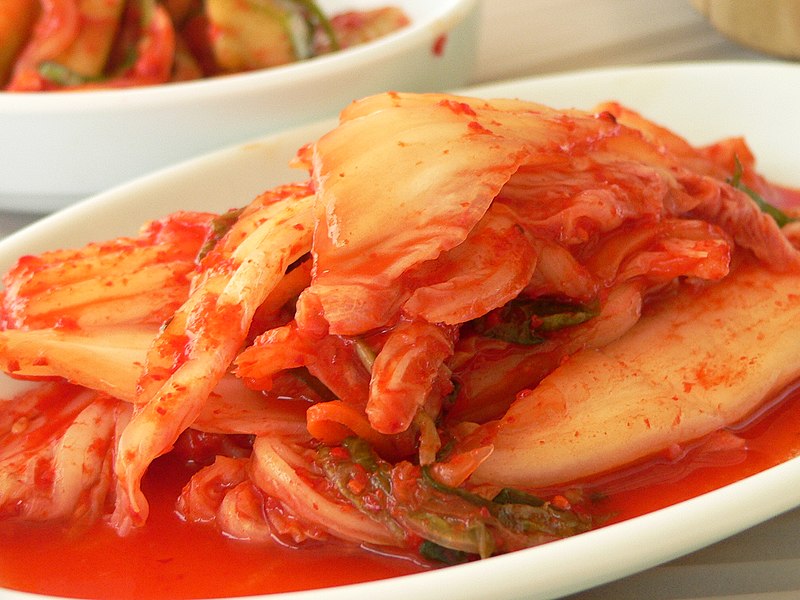
Kimchi-flavoured haggis?


The first Korean meal I had was in New York City in 1968 or 1969 when, as a young priest, I was studying music near there. My host was an Irish Columban based in NYC at the time who had spent his early years as a priest in Korea. I wouldn't swear in court that I tried kimchi on that occasion, but I probably did. I have eaten it many times since, on three visits to Korea and on occasion here in the Philippines.


Until last year I thought kimchi was exclusive to Korea but discovered that it's also popular in Vietnam, and with the same name. I was giving a weekly class to aspirants of the Capuchin Tertiary Sisters of the Holy Family here in Bacolod and used to have lunch with the group afterwards. Some were Vietnamese and I was surprised when they produced kimchi one day. When the realised that I liked it they had some almost every week.

I tried haggis, a very Scottish dish, also for the first time in New York in 1970-71, with a Finnish-American friend who was my mentor in the public elementary school where I was practice-teaching for a few months. A few weeks after starting in the school I moved into the parish as a resident priest. But that's another story. 

I was rather disappointed. All I can I remember is the mashed turnip or Swede, not my favourite vegetable, that is usually served along with mashed potatoes and the haggis (below).


However, during the five months I was based in Glasgow, Scotland, in 2002 I had the chance to eat haggis again when the priest in a rural parish where I was doing a mission appeal for the Columbans took me out for lunch. I decided to give haggis another chance - and enjoyed it. some time later I drove some Filipino friends to Edinburgh and suggested to them that we try haggis for lunch. We all loved it - and the price was very reasonable in the pub where we had it. I learned that it was the poor person's meal in times past.


The texture of haggis reminds me of that of a Filipino dish, sisig, though the two are made from different ingredients. But there is for me another connection between haggis and the Philippines. Haggis in the past was made from the leftover parts of the sheep. In the Visayan languages of the central and southern Philippines the word for breakfast is pamahaw, the root word being bahaw, leftovers. Part of this is often fried rice, which is rice that had been boiled the day before but not all eaten.

Robert Burns. Painting by Alexander Nasmyth.

Many Scottish people at home and around the world celebrate Burns Night on or around 25 January, the birthday of Scottish poet Robert Burns (1759 - 1786). Haggis is so central to the Burns Night supper that it is piped in and then addressed with a poem that Burns wrote.


I have heard that the definition of a Scottish gentleman is a man who can play the bagpipes - but doesn't. I have also heard that the Irish gave the bagpipes to the Scots as a joke - and the Scots haven't seen the joke yet! But to many of us from Ireland and Scotland, or of Irish or Scottish heritage - and the Latin word Scotus originally meant 'Irish', there is something special about the bagpipes.

Where does the kimchi fit in? One of Burns' most popular poems/songs is My Love is Like a Red, Red Rose. While doing research for today's Sunday Reflections I came across a video of a Korean choir singing it (video at the top).

Here are the words of the song:

O my Luve's like a red, red rose
That’s newly sprung in June;
O my Luve's like the melodie
That’s sweetly play'd in tune.

As fair art thou, my bonnie lass,
So deep in luve am I:
And I will luve thee still, my dear,
Till a’ the seas gang dry:

Till a’ the seas gang [go] dry, my dear,
And the rocks melt wi’ the sun:
I will luve thee still, my dear,
While the sands o’ life shall run.

And fare thee well, my only Luve
And fare thee well, a while!
And I will come again, my Luve,
Tho’ it were ten thousand mile.

Here is the song sung by the late Scottish tenor, Kenneth McKellar. It's not his original recording but one made when he was 67.

21 April 2011

Holy Thursday. 'For I have given you an example, that you also should do as I have done to you.'

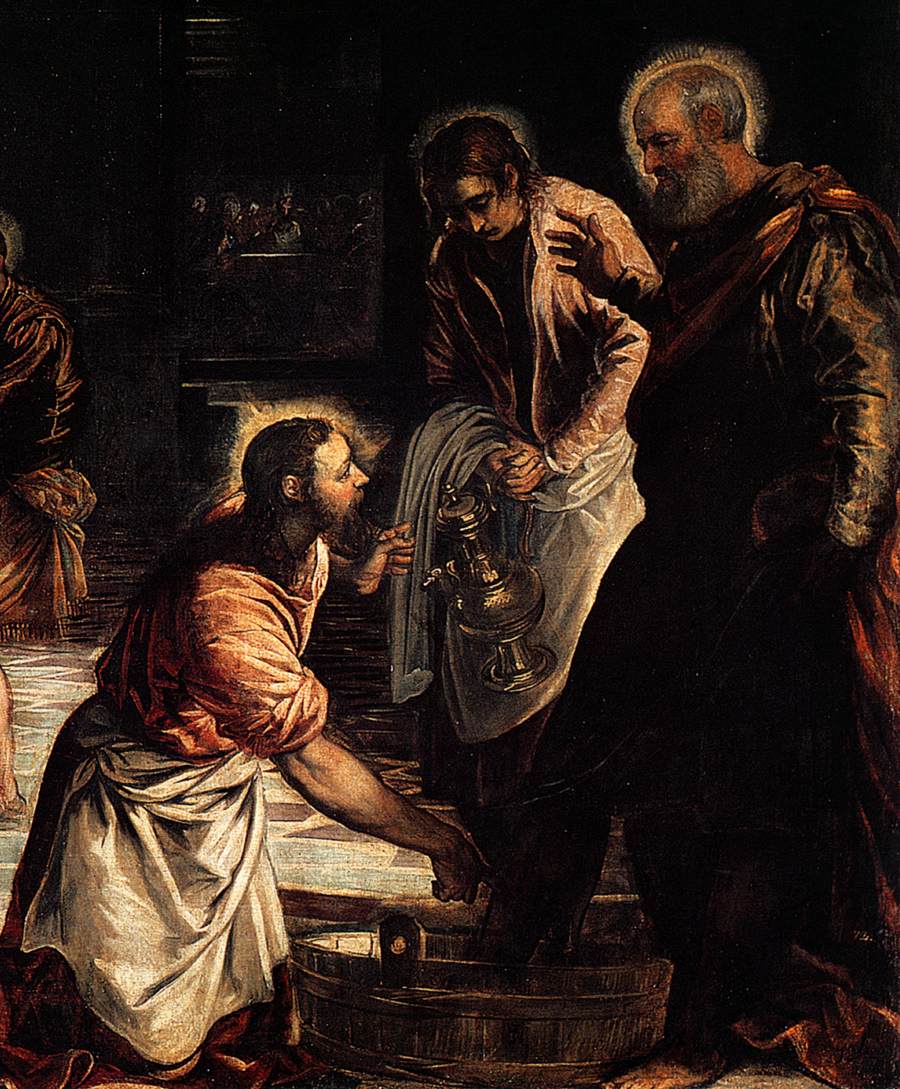
Christ Washing the Feet of His Disciples (detail), Tintoretto, c,1547

Readings for the Evening Mass of the Lord's Supper (New American Bible: Philippines, USA)

Gospel (John 13:1-15. RSV-Catholic Edition)

Now before the feast of the Passover, when Jesus knew that his hour had come to depart out of this world to the Father, having loved his own who were in the world, he loved them to the end. And during supper, when the devil had already put it into the heart of Judas Iscariot, Simon's son, to betray him, Jesus, knowing that the Father had given all things into his hands, and that he had come from God and was going to God, rose from supper, laid aside his garments, and girded himself with a towel. Then he poured water into a basin, and began to wash the disciples' feet, and to wipe them with the towel with which he was girded. He came to Simon Peter; and Peter said to him, "Lord, do you wash my feet?" Jesus answered him, "What I am doing you do not know now, but afterward you will understand." Peter said to him, "You shall never wash my feet." Jesus answered him, "If I do not wash you, you have no part in me." Simon Peter said to him, "Lord, not my feet only but also my hands and my head!" Jesus said to him, "He who has bathed does not need to wash, except for his feet, but he is clean all over; and you are clean, but not every one of you." For he knew who was to betray him; that was why he said, "You are not all clean." When he had washed their feet, and taken his garments, and resumed his place, he said to them, "Do you know what I have done to you? You call me Teacher and Lord; and you are right, for so I am. If I then, your Lord and Teacher, have washed your feet, you also ought to wash one another's feet. For I have given you an example, that you also should do as I have done to you.

AN SOISCÉAL (Eoin 13:1-15. Bíobla Mhaigh Nuad ) [Irish language]

Roimh fhéile na Cásca, ó bhí a fhios ag Íosa go raibh a uair tagtha chun imeacht as an saol seo go dtí an tAthair, agus ó thug sé grá dá mhuintir féin a bhí ar an saol, thug sé grá thar na bearta dóibh feasta.

Le linn an tsuipéir agus tar éis don diabhal a chur ina chroí ag Iúdás, mac Shíomóin Isceiriót, go mbraithfeadh sé é – ó bhí a fhios ag Íosa go raibh gach uile ní tugtha isteach ina lámha dó, ag an Athair, agus gur ó Dhia a ghabh sé amach, agus gur ar Dhia a bhí a thriall, d’éirigh sé ón suipéar, agus leag sé uaidh a chuid éadaigh, agus cheangail sé tuáille faoina choim. Ansin chuir sé uisce sa bháisín agus thosaigh ag ní cosa na ndeisceabal agus á dtiormú leis an tuáille a bhí faoina choim.


Tháinig sé chomh fada le Síomón Peadar agus dúirt seisean leis: “Tusa a ní mo chos-sa, a Thiarna!” D’fhreagair Íosa é: “Ní fios duit anois cad tá ar siúl agam,” ar sé leis, “ach tuigfidh tú ar ball é.” Dúirt Peadar leis: “Ní nífidh tú mo chosa-sa choíche!” D’fhreagair Íosa é: “Mura ndéanfaidh mé thú a ní, ní bheidh aon chuid agat díom.” Dúirt Síomón Peadar leis: “A Thiarna, ní amháin mo chosa, ach nigh fós mo lámha agus mo cheann!” Dúirt Íosa leis: “Duine tar éis a fholctha, ní gá dó a ní [ach a chosa]; tá sé glan go hiomlán. Agus tá sibhse glan, ach níl gach duine agaibh glan.” Mar bhí a fhios aige cé a bhí chun é bhrath; sin é an fáth a ndúirt sé: “Níl gach duine agaibh glan.”


Ansin, tar éis dó a gcosa a ní, agus a chuid éadaigh a chur air, shuigh sé chun boird arís agus dúirt sé leo: “An dtuigeann sibh cad tá déanta agam daoibh? Deir sibh: ‘A Mháistir’ liom agus ‘A Thiarna’, agus is le ceart é, óir is mé sin. Má rinne mise bhur gcosa a ní agus gur mé bhur dTiarna agus bhur Máistir, ba chóir daoibhse chomh maith cosa a chéile a ní. Tá sampla tugtha agam daoibh, faoi mar atá déanta agam daoibhse, go ndéanfadh sibhse mar an gcéanna.

+++

When I see Jesus washing the feet of the apostles, done on the occasion of his instituting the Holy Eucharist, the Mass, I think of Marilyn, one of those who attends my weekday Masses and whose husband Ramonito was incapacitated by a stroke nearly two years ago, and of the loving care she shows him every day although he cannot respond.

I remember my late father who, before he went to work on building sites each day went to early Mass and then came home to prepare my mother's breakfast and bring it to her in bed.

I think of the Capuchin Tertiary Sisters of the Holy Family who welcome young girls who have been traumatized to Holy Family Home here in Bacolod City. I think of the girls themselves, with whom I celebrate Mass most Sundays, and how they welcome a newcomer and stay with a girl full of anger and maybe despair until she begins to see the hope that Jesus offers.

I think of Columban Father Tony Kelly whose obituary I posted here the other day and what the writer said about him: 'in his typical quiet, unobtrusive fashion, provided many small but essential services for his fellow-Columbans in the Retirement Home'.
I think of the Columban priests, and many others, who were jailed in China after the Communist takeover in 1949 before being expelled, celebrating Mass secretly in their cells with the minimum of ceremony but certain that when they said 'This is my body . . . this is my blood', the bread and wine became the Body and Blood of the Risen Lord Jesus Christ.


Fr Thomas Rosica CSB, Toronto, on Holy Thursday

13 April 2011

Religious Professions in Belgium and the Philippines yesterday

Sr Marie Elizabeth of the Divine Mercy OCD (standing)

Yesterday Sr Marie Elizabeth of the Divine Mercy, from the Philippines, pronounced her first vows in the Carmel of Our Lady of Consolation, Vilvoorde, Belgium, the oldest existing community of Discalced Carmelite nuns in the world, founded in 1469 by Blessed John Soreth. Her companion in the photo, Sr Marie Paul Therese, also from the Philippines will make her profession, God willing, within this year. The officiaiting priest was Fr Paul De Bois OCD, a former provincial of the Discalced Carmelites in Belgium.

I visited the Carmel in Vilvoorde in 2005.

A group of Capuchin Tertiary Sisters of the Holy Family in the Philippines

Meanwhile, another Discalced Carmelite, Fr Alan Rieger OCD, an American, was the celebrant at a Mass in the Diocese of Bacolod, where I live, when seven young women made their first profession as Capuchin Tertiary Sisters of the Holy Family. I was unable to be there as I am directing some retreatants at the Carmelite Retreat House, Ozamiz City, across the road from the Carmelite Monastery. The retreat house is right on the sea-shore. Father Alan is no stranger here as he has come a number of times on official visitation.

At our Mass yesterday morning we prayed for the new Sisters in Vilvoorde and here in the Philippines.

Sr Juliet Mantos TC, after her final profession in July 2009 in Cagayan de Oro Cathedral, with Sr Maria Elena S. Echavarren TC, Superior of the Vice-Province.

The Capuchin Tertiary Sisters of the Holy Family came to the Philippines in 1982 and are now part of the Vice-Province of St Clare, with its headquarters in Cebu City. The Vice-Province includes missions in South Korea and in India. There are plans to establish a community in Sri Lanka. There are now Filipino Sisters working in Korea, India and Tanzania. The Vice-Province has Sisters from China who have had their formation here, made their professions here and are working here. Their are also eight young women from Vietnam in the Philippines who are preparing to enter the aspirancy shortly. Sr Juliet Mantos, above, is the Directress of Aspirants in Bacolod City.

The newly-professed are Sisters Ronalyn C. Moreno, Megan M. Nudalo, Soseth P. Soliva, Maricel L. Fuerzas, Markris B. Bios, Myra F. Grijaldo and Maris Stella D. Magno.

The Sisters in the group photo above are wearing the normal 'working' habit. Sisters Juliet and Elena are wearing the darker habit, worn on special occasions.

You can read about Holy Family Home, Makati City, here and about Holy Family Home, Bacolod City, where I'm unofficial chaplain and where the joy of the Sisters and of the girls they take care of gives me a real taste of the joy of the Lord, here. 'The Lord takes delight in his people' (Ps 149:4).

Every month, usually on the night of the first Saturday, the Capuchin Tertiary Sisters in Bacolod hold a two-hour vigil in the presence of the Blessed Sacrament exposed, a vigil to which the girls in Holy Family Home are invited, for vocations. As far as I know, the Sisters hold a similar vigil in their other houses.


15 January 2011

Sunday Reflections. Feast of the Sto Niño (Philippines); Second Sunday in Ordinary Time Year A (elsewhere), 16 January 2011

Christ Blessing the Children, Nicolas Maes, 1652-53

This Sunday, 16 January 2011, is the Feast of the Sto Niño (Holy Child) in the Philippines. Elsewhere it is the Second Sunday in Ordinary Time Year A.

The readings for the Feast of the Sto Niño are:
Isaiah 9:1-6; Ephesians 1:3-6, 15-18; Matthew 18:1-5, 10.

Gospel (Mt 18:1-5, 10; New American Bible, used in the Lectionary in the Philippines)

At that time the disciples approached Jesus and said, "Who is the greatest in the kingdom of heaven?"
He called a child over, placed it in their midst, and said, "Amen, I say to you, unless you turn and become like children, you will not enter the kingdom of heaven.
Whoever humbles himself like this child is the greatest in the kingdom of heaven.
And whoever receives one child such as this in my name receives me.
"See that you do not despise one of these little ones, for I say to you that their angels in heaven always look upon the face of my heavenly Father.

+++

Holy Family Home, Bacolod City

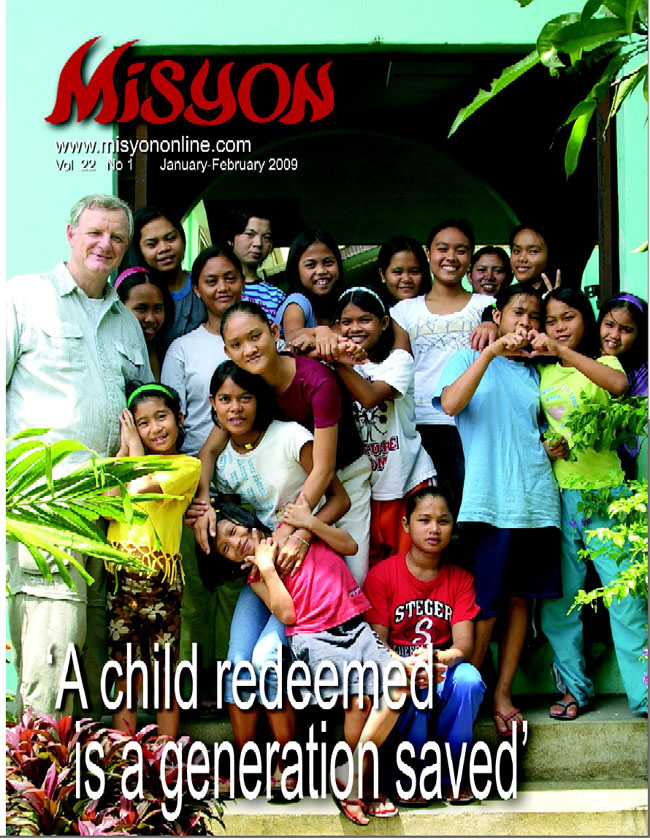
In the context of the gospel above you might like to read A Safe Haven by Fr Gary Walker that appeared in Misyon in January-February 2009. The video version is here. Read also A Child Redeemed is a Generation Saved by Richelle Verdeprado, from Misyon July-August 2008. The video version is here.

+++

Second Sunday in Ordinary Time Year A

The Preaching of St John the Baptist, Alessandro Allori, 1601-03

Readings

Gospel (John 1:29-34, New American Bible)

John the Baptist saw Jesus coming toward him and said,
“Behold, the Lamb of God, who takes away the sin of the world.
He is the one of whom I said,
‘A man is coming after me who ranks ahead of me
because he existed before me.’
I did not know him,
but the reason why I came baptizing with water
was that he might be made known to Israel.”
John testified further, saying,
“I saw the Spirit come down like a dove from heaven
and remain upon him.
I did not know him,
but the one who sent me to baptize with water told me,
‘On whomever you see the Spirit come down and remain,
he is the one who will baptize with the Holy Spirit.’
Now I have seen and testified that he is the Son of God.”

+++

Recognizing Agnus Dei, Agna Dei and Martyrdom

Biblical Reflection for the 2nd Sunday in Ordinary Time A

By Father Thomas Rosica, CSB

TORONTO, JAN. 11, 2011 (Zenit.org).- In today's Gospel passage (John 1:29-34), the figure of John the Baptist appears once again almost as if to send us back to Advent to look carefully at the evidence of the Baptizer and of Jesus, and to make some decisions about our own lives.

The evangelist John’s account of the Baptism of Jesus is very different from the other three evangelists, and the historical situation explains why. John’s gospel text shows no knowledge of the tradition (Luke 1) about the kinship of Jesus and John the Baptist. In the Fourth Gospel, John's baptism is not connected with forgiveness of sins; its purpose is revelatory, that Jesus may be made known to Israel. For John, a simple chronicle of events is never enough; the important thing is that events excite a personal testimony about Jesus.

The evangelist John is very intent on counteracting a movement that regarded John the Baptist as superior to Jesus. He does not narrate the baptism event; instead, he puts the meaning of the baptism into John the Baptist's testimony. He has the Baptizer publicly profess his raison d’être: "The reason why I came...was that he [Jesus] might be made known."

Full text here.

16 October 2010

'Pray always . . .' 29th Sunday of Ordinary Time Year C, 17 October 2010

I left Dublin on Thursday night to fly back to Manila via Abu Dhabi. It will probably take a day or two to get over jet-lag which hits you more when you're flying for west to east. when you fly from east to west you are essentially going to bed very late when you reach your destination. But when you go the other way you miss a night's sleep and your internal 'clock' is confused.


Readings


New American Bible (Philippines, USA)

Jerusalem Bible (Australia, England & Wales, Ireland, Scotland)

Gospel (Luke 18:1-8, NAB)

Jesus told his disciples a parable about the necessity for them to pray always without becoming weary. He said, "There was a judge in a certain town who neither feared God nor respected any human being. And a widow in that town used to come to him and say, 'Render a just decision for me against my adversary.'

For a long time the judge was unwilling, but eventually he thought, 'While it is true that I neither fear God nor respect any human being, because this widow keeps bothering me I shall deliver a just decision for her lest she finally come and strike me.'"

The Lord said, "Pay attention to what the dishonest judge says. Will not God then secure the rights of his chosen ones who call out to him day and night? Will he be slow to answer them? I tell you, he will see to it that justice is done for them speedily. But when the Son of Man comes, will he find faith on earth?"

+++

I am often astonished when persons who have asked me to pray for them come to me later and thank me for my prayers. I find this especially in the Philippines. It makes me feel humble. I bring all of these intentions into the Mass and into the Liturgy of the Hours (the Breviary or Divine Office) since this is the official prayer of the Church and involves not only me but the whole Church, the angels and saints in heaven, the souls in purgatory and all Christians here on earth. Most of all it is the prayer of Jesus Christ the Risen Lord.

Our personal prayers are powerful too. As I first wrote this the 33 trapped Chilean miners were being rescued. People around the world had been praying for them while the rescuers used their professional knowledge and expertise. Prayer practical efforts, not necessarily by ourselves, go together. For example, when we pray for someone who has to have surgery we can and should include the medical personnel involved in our prayer.

This time last year when my Columban colleague Fr Michael Sinnott was kidnapped in the southern Philippines people around the world were praying for his release, as so many have been praying for the Chilean miners. Among those praying for Father Michael were my young friends in Holy Family Home, Bacolod City, which we have featured a number of times in Misyon, eg, here and here (video). You can see the response of the girls to the release of Father Michael here. On that occasion one of the girls approached me and sai, 'Father, we are the miracle girls'. God had answered her prayers and those of her companions. Their prayers too helped all those involved behind the scenes in obtaining the release of Father Sinnott. The greatest miracle of all was that despite his lack of medicines for a heart condition he suffered no discomfort whatever healthwise. And, of course, his own prayers helped.

While waiting at Dublin airport on Thursday evening for my flight back to Manila via Abu Dhabi a young Filipina approached me and asked me to give her a blessing for a safe journey. She was delighted when I told her I was on the same flight. After blessing her I turned around and there saw Fr Michael Sinnott who was also on the same flight, though I hadn't known. Both he and I were wearing our Roman collars. This led, in my case, to a number of conversations during the trip and while waiting for more than an hour before I reached an immigration officer in Manila, due to the volume of passengers.

One of 'The Miracle Girls'

03 August 2010

New website of Holy Family Home, Makati City, Philippines

A Child Redeemed is a Generation Saved
Capuchin Tertiary Sisters of the Holy Family

From time to time I've posted, as far as I can recall about Holy Family Home in Bacolod City where the Capuchin Tertiary Sisters of the Holy Family take care of girls and young women who come from backgrounds of abuse and/or poverty. The Sisters also have a home for girls in Makati City, where the financial centre of the Philippines is located. Makati is part of the Metro Manila complex.
In one of the outer parts of Makati City you can find Holy Family Home where the Sisters take in young girls whos families are living in extreme poverty. They have just set up a website. This is basically a source of information about the various services offered at Holy Family Home, which depends on the support of benfactors within the Philippines and overseas.

The Capuchin Tertiary Sisters of the Holy Family came to the Philippines in 1982 from Spain. Many of the Sisters were from Colombia and from some of the Central American nations such as Panama, Costa Rica and Guatemala. Now the majority are young Filipino Sisters and the congregation has Filipino Sisters in Tanzania, India and Korea.
Cooking lessons are conducted by Hands-on-Manila volunteers every 3rd Saturday of the month, while the Latin American Women’s Club (Club de Damas Latinas), which has been helping Holy Family Home Foundation since 1997, teaches the girls how to make accessories from beads. The finished products are sold to augment the income of the center. Sister Luz Maria Buitrago TC, right, is from Colombia.

I believe that God is blessing the Sisters because they live an authentic religious life. They live in community, wear simple habits, have prayer, including prayer specifically for vocations, at the centre of their lives and get on with the job. The have a noticeable Franciscan joy about them.

Please keep these wonderful Sisters and the girls and young women they serve in your prayers. And check out http://holyfamilyhome.org/

13 November 2009

'The Miracle Girls'

My young friends in Holy Family Home, Bacolod City, who have appeared in Misyon, here (video) and here (video), have been praying their hearts out for Fr Michael Sinnott. when I returned from Australia recently the first question of the younger ones was 'Komusta si Father Michael?' 'How is Father Michael?' They were quite ecstatic yesterday when they heard of his release and have a welcome for him on the homepage of Misyon. One of the girls whispered to me wiht a smle on her face, 'We are the miracle girls'. The fact that Father Sinnott had no medical problems whatever in captivity, even though he's 79, had a heart bypass four years ago and had no medication for about ten days, indicates that God was indeed listening to the heartfelt prayers of 'The Miracle Girls'.


Knowing Father Michael's 'weakness' for ice-cream I promised Sister Alma TC, the one in charge of Holy Family Home, that I'd get ice-cream for the girls when he was released.

01 November 2009

'Out of the mouths of babes . . .'

Still from video of Fr Michael Sinnott in captivity, 24 October, issued 31 October

'Out of the mouths of babes and infants you have drawn a defense against your foes, to silence enemy and avenger' (Ps 8:2) is quoted by Jesus in Mt 21:16. The girls of Holy Family Home, Cabug, here in Bacolod City, are the joy of my life. When I went there this mroning to celebrate Mass, my first visit in eight weeks because of my visit to Australia, the first thing the younger girls asked me, even as they greeted me excitedly, was 'How is Father Michael?' They ahve been praying regularly for the safe release of Fr Michael Sinnott, three weeks in captivity now since his kidnapping outside the Columban house in Pagadian on the evening of 11 October.

I spoke about him during Mass as one whose life is a living out of the Beatitudes, the gospel for today, all Saints' Day.

After Mass some of the younger ones 'ambushed' me and ask me to tell them more about Father Michael. Many of these girls have suffered greatly and surely God is responding to their prayers.

You can see video versions of two articles about Holy Family Home that have appeared in Misyon. A Safe Haven is by Fr Gary Walker, editor of The Far East, the Columban magazine in Australia and New Zealand, 'A Child Redeemed is a Generation Saved' is by Richelle Verdeprado, one of the older girls. She reads her own article.

Please pray that the Capuchin Tertiary Sisters will be able to take care of all the girls who are referred to them.

Cover of Misyon, January-February 2009. Fr Gary Walker with some of the girls at Holy Family Home.

15 September 2009

A Safe Haven

Fr Gary Walker at Holy Family Home, Bacolod City

My Columban colleague Fr Gary Walker, editor of The Far East, the Columban magazine for Australia and New Zealand wrote an article about Holy Family Home, Bacolod City, A Safe Haven, after visiting there last year. You can read it here in the August issue of The Far East.

We have Father Gary's article as our featured video at the moment on Misyon.

In July-August 2008 we had another article about Holy Family Home, 'A Child Redeemed is a Generation Saved' by Richelle Verdeprado, whom the Capuchin Tertiary Sisters of the Holy Family have enabled to study at third level. Richelle is now in her third year of a four-year course in Social Work at the University of Negros Occidental - Recoletos (UNO-R), run by the Augustinian Recollects, known in the Philippines as the Recoletos. She has been involved in campus journalism since her elementary days and works in our office during vacations.

31 July 2009

Final profession of Sister Juliet Mantos TC

Last Saturday, 25 July, Sr Juliet Mantos TC (left in photo with Sr Maria Elena S. Echavarren TC) made her final profession as a member of the Capuchin Tertiary Sisters of the Holy Family in Cagayan de Oro City, located in northern Mindanao.

As Sister Juliet offered her life for ever to God two of her companions, Sr Neri Rama TC and Sr Wennie Puyco TC, shower petals on her in St Augustine Metropolitan Cathedral.


Sister Juliet makes her vows in the presence of Sr Maria Elena, the superior of the Vice Province that includes the Philippines along with a community in India and another in Korea. Sister Elena is a former Superior General of the congregation and is from Spain. Also in the phots is Sr Luz Maria Buitrago from Colombia.

Archbishop Antonio J. Ledesma SJ of Cagayan de Oro places the ring on Sister Juliet's finger.

The Sisters sing their Congregational Hymn during the ceremony.

Sister Juliet with her parents and other members of her family after Mass.

Taken on 8 February at Mater Dolorosa Formation House, Talisay City, Negros Occidental after the first profession of Sr Antonieta Napone TC . She is the shortest Sister in the middle row and, at 57, became the oldest Filipino Sister. She is an inspiration to the young women, some of them from China, preparing to follow in her footsteps and those of Sister Juliet.
God has been blessing the Capuchin Tertiary Sisters abundantly since they came to the Philippines in 1982.


I had my first assignment in the Philippines, even if only for Holy Week in 1972 while I was still studying the Cebuano language in Ozamiz City, in St Augustine's Cathedral. Archbishop Patrick Cronin, a Columban, was the second archbishop, serving from 1970 until 1988. For 15 years before going to Cagayan de Oro he had been the first bishop of Ozamiz. He was one of the first batch of Columbans to go to Mindanao in 1938.

Archbishop Cronin was truly loved by priests, religious and people. He spent the years of the Second World War in the mountains, sharing the hardships of the people and had a wonderful memory for names.

When I arrived in the Philippines in 1971 the Columbans had quite a few parishes in the archdiocese, most of them taken over from the Jesuits, as far as I know, in the early 1950s. We have only one parish now, in the city itself.

Thanks to Sr Alma Alovera TC for the photos.

26 February 2009

Ash Wednesday and Lent


Yesterday I had two Ash Wednesday Masses, one in the chapel across the road from where I live and where I celebrate Mass from Tuesday to Saturday, the other at Holy Family Home, run by the Capuchin Tertiary Sisters of the Holy Family, for girls who come from dangerous or deprived situations. For the first time in years I used the traditional ‘Remember, man, you are dust and to dust you will return’ rather than ‘Turn away from sin and be faithful to the gospel’ (Mk 1:15).

Each Lent I remember growing up in Dublin in the ‘50s and the packed churches every morning of Lent, workers and students, all going to daily Mass without anyone forcing them to. Now the churches in Ireland are bereft of adolescents and young adults on Sundays.

I don’t know why there has been such a colossal falling away from the faith in the last 40 years. What I do know is that there was much more participatio actuosa, or active participation, in the Mass when I was young than now, when there is often more activity, but less participation. In the 1980s a classmate of mine, the late Fr Desmond Hartford, was appointed apostolic administrator of the Prelature of Marawi in Mindanao, one of very few church jurisdictions in the Philippines with a majority of Muslims – about 95 percent. A group of us went to meet him at the airport in Cagayan de Oro. Father Des had made it clear that he wanted a ‘low-key welcome’. Due to a miscommunication he didn’t arrive at all and one of my companions said ‘You can’t get more low-key than that’.

Well you can’t get lower participation in Mass when nobody attends.

One of my memories from my young days is the ‘acclamation of faith’ after the consecration and elevation. It wasn’t called such nor mentioned in the rubrics but it was a powerful expression of faith – the cough of the whole congregation releasing its tension knowing that something truly awesome had just happened.

Father Desmond replaced Bishop Bienvenido Tudtud, who died in a plane crash in 1987 and who, with the full encouragement and blessing of Pope Paul VI, pioneered what he called ‘Dialogue of Life’ between Christians and Muslims in an area where there had been centuries of hostility and sometimes outright war. He started Duyog Ramadan, ‘Accompanying Ramadan, to heighten the awareness of Christians about the holy season of Muslims and to ask them to pray for them. Since then some attempt has been made, I think, to encourage Muslims to engage in a form of Duyog Cuaresma, or ‘Accompanying Lent’.
But surely there’s an anomaly when, on the one hand, we have become more aware of the religious practices of others and are respectful of them, but, on the other hand, we have ditched our own. The Lenten fast means little now, though I was pleasantly surprised while in Britain from 2000 to 2002 that there was still some awareness of Lent as a Christian observance.

We know that Muslims and Jews don’t eat pork and we would never offer it to them. But in our ‘wisdom’ we have dropped Friday abstinence, a common act of penance throughout the year that was universal except, I think, in the former Spanish Empire, where there had been a dispensation.

Archbishop Charles J. Chaput OFMCap, in his homily for last Sunday – you can find the link to the audio here - reminds his people that going out for lobster on Friday during Lent is not quite in the spirit of Lenten abstinence.

However, as this morning’s readings (Thursday) remind us, we can still choose to make Lent a time for personal renewal and for the renewal of the whole Church as we prepare to celebrate the Resurrection.

09 February 2009

Newest and oldest Filipino Sister in her congregation

Newly professed Sr Antonieta Navarro Napone TC

Yesterday, Sunday, Sr Antonieta N. Napone TC became both the newest and the oldest Filipino professed sister in the Capuchin Tertiary Sisters of the Holy Family . At 57 she is also the oldest ever in the congregation to take her first vows. Sister Tonet, as she is known, came to Bacolod to work with the Sisters seven years ago as a house mother to the college students whom they look after in Holy Family Home. Most of the college girls live in a house in the city proper. You can read about this aspect of the Sisters’ work in Misyon, the Columban online magazine I edit, here and here .
Sister Antonieta’s experience with the girls prepared her for the great surprise of being asked directly by the Sisters if she would like to join them. And it happens that we have a mutual friend who took her first vows as a member of the contemplative branch of Blessed Mother Teresa’s Missionaries of Charity on 12 December, the feast of Our Lady of Guadalupe, as Sister Mary Anthony MC. She too is in her 50s. So I was very happy to see three Missionaries of Charity at Sister Antonieta’s profession yesterday at Mater Dolorosa Formation House, Talisay City, just north of Bacolod City. (There’s another Talisay City just south of Cebu City.)
Sr Antonieta with her mother and other family members.
The Capuchin Tertiary Sisters came to the Philippines 27 years ago and on the occasion of their Silver Jubilee in March 2007 the delegation, as the unit was called, was raised to a vice-province that includes a community in Korea and one in India. There are now nearly 30 Filipino Sisters and more than twenty in formation as aspirants, postulants and novices.


With Sister Antonieta, center, Missionaries of Charity and Sr Reinalda Zapata, a Colombian, of the Franciscan Sisters of St Anthony.

As I have come to know them, the Sisters live a simple and joyful Franciscan life in community, give importance to both liturgical and personal prayer, wear a simple habit and get on with their work which, in the Philippines, is mainly with girls who are poor and many of whom have suffered deeply.

The choir consisted of girls from Holy Family Home and the lunch afterwards was prepared by some of the college students who are studying Hotel and Restaurant Management.

Sister Antonieta is from Medina, Misamis Oriental, Mindanao, a parish that was run by Columbans during her younger years.

The profession of Sister Tonet was a truly joyful event. In my homily I mentioned Fr Nicolaus Kao Se-tsien from China who, after 49 years as a diocesan priest joined the Trappists in Hong Kong, made his final vows at 100 and spent 35 years as a monk before peacefully passing on at the age of 110 in December 2007. I put before Sister Antonieta the hope of celebrating her Golden Jubilee!

Capuchin Terciary Sisters of the Holy Family with novices and aspirants after Sister Tonet's profession.