09 February 2013

'But at your word . . .' Sunday Reflections, 5th Sunday in Ordinary Time Year C


Readings (New American Bible: Philippines, USA)

Readings (Jerusalem Bible: Australia, England & Wales, India [optional], Ireland, New Zealand, Pakistan, Scotland, South Africa) 

Gospel Luke 5:1-11 (Revised Standard Version – Catholic Edition)

While the people pressed upon him to hear the word of God, he was standing by the lake of Gennesaret. And he saw two boats by the lake; but the fishermen had gone out of them and were washing their nets. Getting into one of the boats, which was Simon's, he asked him to put out a little from the land. And he sat down and taught the people from the boat. And when he had ceased speaking, he said to Simon, "Put out into the deep and let down your nets for a catch." And Simon answered, "Master, we toiled all night and took nothing! But at your word I will let down the nets." And when they had done this, they enclosed a great shoal of fish; and as their nets were breaking, they beckoned to their partners in the other boat to come and help them. And they came and filled both the boats, so that they began to sink. But when Simon Peter saw it, he fell down at Jesus' knees, saying, "Depart from me, for I am a sinful man, O Lord." For he was astonished, and all that were with him, at the catch of fish which they had taken; and so also were James and John, sons of Zebedee, who were partners with Simon. And Jesus said to Simon, "Do not be afraid; henceforth you will be catching men." And when they had brought their boats to land, they left everything and followed him. 


The painter Raphael captures something of the awe of St Peter when he saw how much fish he and his companions had caught, despite their misgivings as experienced fishermen in following the advice of someone they knew to be a carpenter from the mountains of Galilee. St Peter, who had a long way to go in his formation as a follower of Jesus, recognised the utter generosity of God's providence.

Columban Fr John Griffin, a New Zealander who worked for many years both in the Philippines and Chile tells a story about St Alberto Hurtado SJ (1901 - 1952) and his trust in God's providence in A priest, I bless you - Alberto. (I've used this story before but it fits in with today's Gospel).

Providence was always on his side. At a meeting one night his board of directors was unwilling, for lack of funds, to approve a new project. In the midst of discussions there was an unexpected call for Fr Hurtado to attend to someone at his front door. He had a brief conversation with the caller who said she wanted to leave a gift to help the great work he was doing.

He gratefully put her envelope in his pocket, wished her a good evening and returned to his meeting. He looked at the contents of the envelope as he sat down. Then he tossed a check onto the table saying, ‘There you are, ye of little faith!’ It was for one million pesos – worth about US$30,000 at that time. 


Postage stamps issued in Chile in 2001 for the centennial of the birth of the then Blessed Alberto Hurtado SJ

I recently experienced something of God's providence. I was asked to write an article for the Columban magazine in the USA, Columban Mission. So I wrote The Miracle Girls! and it was published last October. 


I got the title from one of the girls at Holy Family Home for Girls, Bacolod City,after the release of kidnapped Columban Fr Michael Sinnott in the Philippines in 2009. I had asked the girls to pray for Fr Sinnott's safe release. When I told them that God had heard their fervent prayers - and fervent they were - one of them came up to me and said, 'Father, we are the miracle girls!' [They were actually part of an international 'prayer brigade'].

She was expressing something like St Alberto, a total trust in God's providence.

I was happy when my article was published but had no idea how many readers would respond with generosity, a generosity that will enable the Capuchin Tertiary Sisters of the Holy Family to continue to take care of the girls whom God sends their way just as God continues, more than 60 years after his death, to provide for the Hogar de Cristo (Home of Christ) movement that San Alberto started and that has spread to other countries.

Like many of 'The Miracle Girls' Father Alberto came from a background of poverty and of violence. But that didn't stop him from hearing God's call. He wanted to be a lawyer in order to help the poor. God answered his desire to help the poor of Chile, not as a lawyer but as a Jesuit priest. God called Peter and his companions to let go of their fears and of their work: Do not be afraid; henceforth you will be catching men.

St Luke tells us directly and simply how Peter and Andrew, James and John, responded to the words of Jesus: And when they had brought their boats to land, they left everything and followed him. 

They didn't become saints overnight. They failed Jesus many times and Peter even betrayed him. But Jesus never abandoned them and their hope and trust in him never vanished.

St Peter's words can encourage us when we can't see things clearly, when we are disheartened, when we've nowhere to turn to: But at your word . . .

+++


After today we won't be singing or praying the Gloria on Sunday until Easter. Above is the new English translation of the Gloria adapted to the Gregorian chant setting of the Gloria in Mass XV, Dominator Deus. You can find the Latin setting, with a literal English translation, here and the organ accompaniment here.

You will find settings of the Mass in both Latin and the new English translation on Musica Sacra, Church Music Association of America.

Here the monks of St Peter's Abbey of Solesmes, France, sing the Gloria from Mass XV in the original Latin.


08 February 2013

Appeal from the Bishop of Myitkyina, Myanmar (Burma)


S
Skyline of Myitkyina

The Columbans first went to what was then Burma in October 1936 and went to the mountainous area of the north where the Kachins live. Priests of the Paris Foreign Missions Society had already been there for many years. The area the Columbans were asked to take care of has become two dioceses, Myitkyina [MITCH in awe] and Banmaw, also known as Bhamo.

There has been an ongoing conflict in the Kachin area for many years, a second phase beginning in June 2011. It is in the context of that conflict that the Diocese of Myitkyina issued this statement the other day.

DIOCESE OF MYITKYINA, MYANMAR
St. Columban's Cathedral, Aungnan Yeiktha, Myitkyina 01011
Tel: (+95)-74-23017, Fax (+95)-74-23016, Email: myitkyinabishop@gmail.com
 Call from the Catholic Church in Myitkyina to all parties in Conflict in Kachin Region  to halt hostilities and begin the Journey  towards  Peace Based on Justice
Date : 3 February 2013
---------------------------------------------------------
We, the Catholic Faithful,   guided by the Bishop of Diocese,  Rev Dr Francis, Priests  and religious of Myitkyina Diocese, urgently release this message  to all parties in the ongoing conflict in Kachin Areas :

We
Uphold the principle ''Church and State are separate” and has no political agenda in its structure and function yet called to collaborate in peace and justice and the human development of all.   Church is Catholic – that is open to all people, their needs, their aspirations and their desire for human dignity.

Are guided by the teachings of Christ and the bible, inspired by the Catholic Social teaching handed over by the Popes, specially the New Year Peace Day message of the Pope, which urge all Christians to work for peace and promotion of harmony among communities

Desire to collaborate with all like minded men and women, structures that work for promotion of peace and human dignity.

Are concerned deeply about the year long violent conflict in Kachin area. As a church we walk with our displaced people, watch  their life being destroyed by war,  their families fragmented by  depressing life in the displaced  camps.

Are deeply concerned about the escalation of war in the recent weeks, use of heavy weaponry, aerial bombing, increasing lack of clarity about conflict zones and civilian areas, unequal warfare waged during holy days of our faith, unacceptable conflict practice that force thousands to be displaced  exposing children and women to life threatening sickness  in the acute winter.

Wish to point out to all parties in conflict that we are all brothers and sisters in this God given land and ferocity of war of the strong one against the weak, the principle of might is right never brings peace, but more conflict and more displacement and closes all avenues of peaceful resolution of  major issues forcing generations after generation to indulge in a war without any result to anyone.

Are  guided by the international human rights instruments, our faith that seeks justice and we strongly condemn all human rights abuses by anyone – murder, violation to the integrity of a person, subhuman living conditions, arbitrary  detentions, deportation, disappearance, recruitment of children into conflict.
Strongly  Urge all parties to return to the peace negotiation, since peace is possible, peace is the only way, knowing that five decades of war has yielded nothing but more hatred, more agony.

Support all peace efforts that takes into consideration a peace making that is built on true justice, the peace dividends of the 1994 cease fire agreements, the consensus arrived at Panglong to accept  the ‘unity and diversity’ principle.

Urge all parties the root causes of the present conflict, the favoritism shown to one race and religion and language that opened a festering wound in the cultural heart of many communities that can be healed only by true federalism,  a meaningful participation in decision making and the sharing of resources.

Are strengthened by our Faith that peace is possible and human beings are brothers and sisters to one another and in this land we can live in peace and prosperity since God has blessed this golden land with too many resources.

As members of the church and Citizens of this Country, this is  our appeal to all the parties and urge all to  cease war and return to negotiating table.  We are intensely involved in the  care and comfort of the victims of war in the camps and in remote villages.  Despite our  meager  resources we have reached out our suffering poor with support from well wishers and local people.  We want our people to go back home. That is possible only when the war gets over and that is possible when  a peace based on Justice is initiated through talks.

On behalf of the Faithful

BISHOP OF MYITKYINA  and Church Leaders  

+++

Here is a video that shows many parts of Myitkyina, including St Columban's Cathedral.


In the September-October 2011 issue of Misyon, the online magazine I edit for the Columbans in the Philippines, we carried an article by Arlenne B. Villahermosa, Remembering the Columbans. Arlenne is a Columban Lay Missionary from Talisay City, Cebu. The article includes the following video of the visit in 2009 of Bishop Michael Smith of Meath, Ireland, to the Diocese of Banmaw. St Columban's, Dalgan Park,Navan, where the Irish headquarters of the Columbans, where most Irish - and some American - Columbans studied, where many older Columbans are now living, is located in the Diocese of Meath.

Bishop Smith mentions Columbans who are buried in Burma. Many of those buried in Dalgan Park in his diocese worked as missionaries in the Diocese of Banmaw that he was visiting and in the Diocese of Myitkyina from which it was carved.

06 February 2013

Same-sex 'marriage' and 'The Emperor's New Clothes'


The British Parliament yesterday voted in favour of a bill that would legalise same-sex 'marriage' in England and Wales. A majority of the Conservative Party that governs in a coalition with the much smaller Liberal Democrats, voted against the bill which still has a few hurdles to jump over before it becomes law. 

Three days earlier the French Parliament voted in favour of a similar bill, though it too has some way to go.


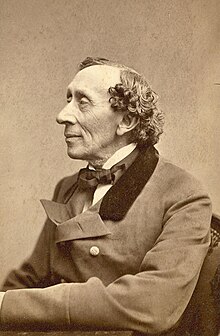
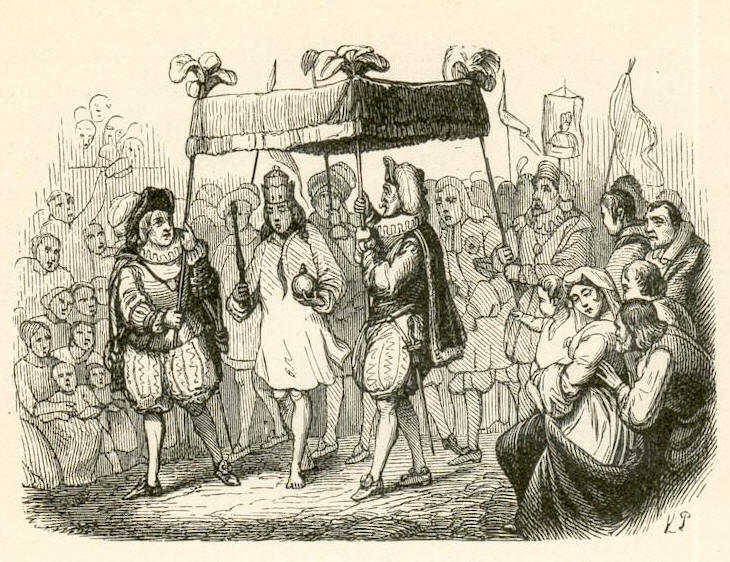
It might be good if those who voted in favour of the absurdity of same-sex 'marriage' would either read Hans Christian Andersen's The Emperor's New Clothes or listen to Frank Loesser's musical rewriting of the story [video above] for Danny Kaye to sing as he played Hans Christian Andersen in the 1952 movie of the same name.

Illustration by Vilhelm Pedersen, Andersen's first illustrator.

When will enough 'little boys' see and expose 'same-sex "marriage" as a "human right"' for the universal con-job that it has become?

04 February 2013

Violence against women in India and elsewhere


This video presents the newly-launched campaign by the Archdiocese of Bombay to raise awareness and initiate change in the attitude toward and the treatment of women in India, in the aftermath of a horrific gang-rape of a young woman in December last year.
This video and report were posted by UCANews on 28 January. A diya is an oil lamp, usually made from clay, widely used in India, especially during certain religious festivals.
Nature seems to provide 103 - 108 boys to 100 girls at birth. The video gives figures for three locations in India:
Delhi: 866 girls / 1,000 boys;
Haryana: 877 girls / 1,000 boys;
Chanidgarh: 818 girls / 1,000 boys. 
It is thought that sex-selection abortion and the killing of newborn girls are factors in skewing the natural proportion between males and females in India and in some other countries.
The '37,000,000 Diyas' campaign of the Archdiocese of Bombay - it retains the old name for 'Mumbai' - is for the excess of 37,000,000 males over females in India in 2011.
However, violence towards women and children is universal but seems to be made worse where there isn't a natural proportion between males and females.
A now deceased Columban priest once told me that years ago a young Protestant man here in the Philippines preparing to marry a Catholic girl told him that his Catholic male friends had advised him, 'Beat her up a few times and you'll have no problems'. I've no idea how prevalent this attitude is here or elsewhere. But it is very wrong.

02 February 2013

The Presentation in the Temple and the Menin Gate

From Franco Zeffirelli's mini-series Jesus of Nazareth (1977)

Luke 2: 22-40 (RSV Catholic Edition)

And when the time came for their purification according to the law of Moses, they brought him up to Jerusalem to present him to the Lord (as it is written in the law of the Lord, "Every male that opens the womb shall be called holy to the Lord") and to offer a sacrifice according to what is said in the law of the Lord, "a pair of turtledoves, or two young pigeons." 

Now there was a man in Jerusalem, whose name was Simeon, and this man was righteous and devout, looking for the consolation of Israel, and the Holy Spirit was upon him. And it had been revealed to him by the Holy Spirit that he should not see death before he had seen the Lord's Christ. And inspired by the Spirit he came into the temple; and when the parents brought in the child Jesus, to do for him according to the custom of the law, he took him up in his arms and blessed God and said, "Lord, now lettest thou thy servant depart in peace, according to thy word; for mine eyes have seen thy salvation which thou hast prepared in the presence of all peoples, a light for revelation to the Gentiles, and for glory to thy people Israel." And his father and his mother marveled at what was said about him; and Simeon blessed them and said to Mary his mother, "Behold, this child is set for the fall and rising of many in Israel, and for a sign that is spoken against (and a sword will pierce through your own soul also), that thoughts out of many hearts may be revealed." 

And there was a prophetess, Anna, the daughter of Phanuel, of the tribe of Asher; she was of a great age, having lived with her husband seven years from her virginity, and as a widow till she was eighty-four. She did not depart from the temple, worshiping with fasting and prayer night and day. And coming up at that very hour she gave thanks to God, and spoke of him to all who were looking for the redemption of Jerusalem. 

And when they had performed everything according to the law of the Lord, they returned into Galilee, to their own city, Nazareth. And the child grew and became strong, filled with wisdom; and the favor of God was upon him. 

The Prophetess Anna, Rembrandt, 1631

When I was reading the Gospel above at Mass this morning, the Feast of the Presentation of the Lord, I recalled an experience in September 2001. At the time I was based in England and was invited to officiate at a Belgian-Filipino wedding of two friends, Stefaan and Joy, near Ieper/Ypres in Belgium. I had heard that every evening in Ieper members of the local fire brigade sounded the Last Post at the Menin Gate to remember the tens of thousands of young men who died in that area in the Great War of 1914 - 1918. 

The day after I arrived in Belgium Stefaan helped me locate the grave of my great-uncle Corporal Lawrence Dowd who was killed on 6 August 1917, ten days before Fr William Doyle SJ, a saintly and heroic Irish chaplain in the British army was killed in the same area.

The evening before the wedding a Belgian friend of Joy and Stefaan took me to the Menin Gate for the ceremony. I had already realised how the memory of the tragic deaths of so many young men on both sides of the conflict nearly 90 years earlier was part of the people living in and near Ieper.

After the sounding of the Last Post a very old man laid a wreath. He might have been one of the few survivors of the Great War still living at the time. But what moved me deeply was that a woman standing near me was carrying an infant that looked no more than a week or so old. Jesus in today's Gospel who was forty days old. 

The child at the Menin Gate was already being brought into the communal memory of a conflict that had occurred long before the vast majority of those present at the ceremony were even born.

Simeon's Song of Praise, Aert de Gelder, around 1700 - 1710.

In the Gospel two elderly people of faith recognise Jesus as the Messiah. They are bridges between the Old and New Testaments. Simeon blesses God for the grace he has received and then blesses Mary and Joseph. Anna is the first person to preach the Gospel: she gave thanks to God, and spoke of him to all who were looking for the redemption of Jerusalem.

I thought of the old people who quietly and without being aware of it spoke of him to me when I was a child. Whenever I dropped into the church on my way home from school I would always see some of them, including my grandfather, praying quietly before the Blessed Sacrament. Some of the old men I used to see had survived the Great War and all of the people had come through hard times.

But they lived lives of faith and hope, like Simeon and Anna. Like the mother of the infant at the Menin Gate and the very old man who laid the wreath passing on the memory of the young lives lost in the Great War, they, like Simeon and Anna, were quietly passing on their faith in Jesus Christ to me and my contemporaries.

01 February 2013

'Is not this Joseph's son?' Sunday Reflections, 4th Sunday in Ordinary Time Year C


Readings (New American Bible: Philippines, USA)

Readings (Jerusalem Bible: Australia, England & Wales, India [optional], Ireland, New Zealand, Pakistan, Scotland, South Africa)

Gospel Luke 4:21 30 (Revised Standard Version – Catholic Edition)

Jesus began to say to them, "Today this scripture has been fulfilled in your hearing." And all spoke well of him, and wondered at the gracious words which proceeded out of his mouth; and they said, "Is not this Joseph's son?" 

And he said to them, "Doubtless you will quote to me this proverb, 'Physician, heal yourself; what we have heard you did at Capernaum, do here also in your own country.'" And he said, "Truly, I say to you, no prophet is acceptable in his own country. But in truth, I tell you, there were many widows in Israel in the days of Elijah, when the heaven was shut up three years and six months, when there came a great famine over all the land; and Elijah was sent to none of them but only to Zarephath, in the land of Sidon, to a woman who was a widow.  And there were many lepers in Israel in the time of the prophet Elisha; and none of them was cleansed, but only Naaman the Syrian." 

When they heard this, all in the synagogue were filled with wrath. And they rose up and put him out of the city, and led him to the brow of the hill on which their city was built, that they might throw him down headlong. But passing through the midst of them he went away. 


I left home for the first time when I was 11, though only for a month. It was during the summer of 1954 and I spent the four weeks in an Irish-speaking part of County Galway in the west of Ireland, just beyond An Spidéal (Spiddal) on the northern shore of Galway Bay.


I was one of around 100 children aged between 10 and 14, all sons and daughters of members of trade unions in Dublin which sponsored a summer-school / holiday each year so that the youngsters involved could become more fluent in the Irish language (Gaelic), which we all studied at school. We used to have outdoor classes in the mornings, unless it rained, and were free in the afternoon. We all stayed in groups of three or four boys or girls with local families. We were excused from class if we went to the bog with our hosts when they were cutting turf.

In the house where I stayed with two other boys a family from Dublin came down for their annual holiday. I had never met them before and they didn't know me. The husband/father, whom I later learned was named Paddy O'Neill, asked me the first time he met me if I was the son of John Coyle. At that time I knew nothing about where we come from, though I knew that children often looked like one or other of their parents but had no idea why. I felt a surge of pride as I said 'Yes' to Mr O'Neill. 

He had seen my father's face in mine. Then he told me that he had worked as a young carpenter with my father, who was older than he was, and that he had found my Dad very helpful to him. Over the years others were to tell me the same thing, how my father was such a great mentor to young men learning their trade. Dad was a carpenter too but became first a foreman of the carpenters and later a general foreman on the building/construction sites where he worked for 54 years.

My father in turn often spoke with great respect and affection of foremen he had worked under and who had helped him. I remember Ned Boyle, who lived near us. He had a big moustache, as I recall, and his wife had beautiful white hair and a lovely smile. The looked like every child's favourite grandparents. My mother often described them as a real 'Darby and Joan' couple. In the song The Folks Who Live on the Hill Oscar Hammerstein II's lyrics to Jerome Kern's music include these lines:

We'll sit and look at the same old view,
Just we two.
Darby and Joan who used to be Jack and Jill,
The folks who like to be called,
What they have always been called,
'The folks who live on the hill'.

I remember Dad talking about Mr Grace, another foreman under whom he worked. I never knew him, though I had some contact with some of his sons, all of whom were older than me. Two of them, Fr Ronald and Fr John, became Capuchin priests and were assigned to what is now Zambia. Another, Mick, died in an accident while building a church in Dublin. I got the impression from my father that Mr Grace was a man of great integrity and of nobility. I could see something of that in his sons.

I could see it in my father and how foremen such as Mr Boyle and Mr Grace had helped to form him as a person, without even being aware of it.


St Joseph the Carpenter, Georges de la Tour, 1640s.

As I grow older I see more clearly how my parents and others formed me. Very often when I'm writing I think of John Galligan, my teacher in Fourth Class (Grade Four) who gave us a great grounding in the grammar of both Irish and English, encouraged us to read the newspaper critically and gave us many opportunities to write. But above all, he shared his faith as he prepared us for confirmation and as he spoke so often about his wife Mary. I came to know them years later as a friend and saw in them a real 'Darby and Joan' couple.

Is not this Joseph's son? the people in the synagogue asked in wonder before they turned against Jesus and tried to kill him. There's a gap of 18 years between the time when Mary and Joseph, sick with worry, went back to Jerusalem to try to find the 12-year-old Jesus in the Temple, where in his humanity his sense of his vocation was beginning to awake. The First Reading, from Jeremiah, has the word of the Lord saying to the prophet, Before I formed you in the womb I knew you, and before you were born I consecrated you; I appointed you a prophet to the nations. Further on the Lord tells Jeremiah, They will fight against you; but they shall not prevail against you, for I am with you, says the LORD, to deliver you (Jer 1:5, 19).

God the Father had the mission of his Son Jesus, God who became Man, in mind from from all eternity. He knew that many would fight against Jesus, but they shall not prevail against you . . . And the Father called two human beings to prepare Jesus for his mission, Mary to be his very mother and Joseph, her husband, to be like a father to him.

Jesus in his humanity learned from St Joseph how to be a responsible man. The years when Jesus went down with them and came to Nazareth, and was obedient to them and increased in wisdom and in stature, and in favor with God and man (Luke 2:51, 52) were the years when Joseph and Mary were preparing Jesus for his mission, Mary keeping all these things in her heart but probably neither of them fully realising the importance of daily life in the house, in the carpenter's shop, in preparing Jesus for his mission.

Mr Boyle and Mr Grace were among those who formed my father as an upright man of deep faith. I doubt if any of them ever spoke to each other about their faith, just as my father rarely spoke about it to me. They simply lived it. I'm prouder now, more than 25 years after his death, to be known as 'John Coyle's son' because I can see how much he has influenced me as a priest.

Our influence on each other is for good and for bad. Those who hear it asked about them as a compliment Isn't this the son/daughter of . . .? are blessed. Those of whom it is said that they are saintly, not because they are 'pious' but because their is something Christ-like about their lives, are blessed and are a blessing to others.

When Jesus heard the people in the synagogue ask Is not this Joseph's son? I'm certain that in his humanity he felt deeply blessed because the love and care of Joseph had been central to the loving plan of God the Father for his Son, God who became Man.


Communion Antiphon Cf Psalm 30:17-18. [Latin]

Illúmina fáciem tuam super servum tuum, 
et salvum me fac in tua misericórdia. 
Dómine, non confúndar, quóniam invocávi te.

Let your face shine on your servant. 
Save me in your merciful love.
O Lord, let me never be put to shame, for I call on you.

In the video above the antiphon is sung in Latin in Gregorian chant. Below is a setting of the Latin text for five voices by Carlo Gesualdo da Venosa (1566 - 1613) sung by a choir in Brno in the Czech Republic.


+++

I mentioned above the song The Folks Who Live on the Hill. I came across this version by Liverpool-born singer Michael Holliday who took his own life at the age of 38 in 1963, a couple of years after he had a nervous breakdown. It seems he suffered badly from stage fright, as his hands during his introduction to the song seem to indicate. Remember him in your prayers.

Feast of St Brigid, the first day of spring in Ireland. And elsewhere? 'It might as well be spring!'

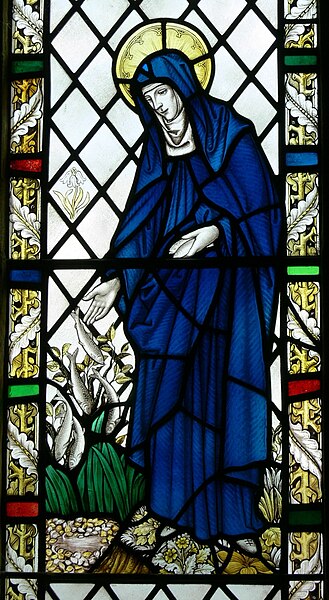
St Brigid  (c.451 - 525), St Non's Chapel, St David's, Wales

Today is observed in Ireland as Lá Fhéile Bhríde, the Feast of St Brigid of Kildare. She is one of the patrons of Ireland and is often referred to as 'Muire na nGael' or 'Mary of the Irish'.

You can find some prayers and resources for celebrating the Feast of St Brigid, including a video on how to make a St Brigid's Cross, on the website of the Diocese of Kildare and Leighlin in Ireland.

Cros Bríde, St Brigid's Cross

Collect

Merciful God,
origin and reward of all charity, 
you called Saint Brigid to teach the new commandment of love 
through her life of hospitality and her care of the needy; 
give to your people, by her intercession, 
a generous spirit, 
so that, with hearts made pure, 
we may show your love to all.
Through our Lord Jesus Christ, your Son, 
who lives and reigns with you in the unity of the Holy Spirit, 
one God, for ever and ever.

The first day of spring

According to the ancient Irish reckoning today, 1 February, is the first day of spring in the temperate regions of the Northern Hemisphere. In most places in those regions 21 March, the equinox, is considered the first day of that season of new growth and hope. Even after more than 41 years in the tropical Philippines the four seasons that I grew up with are still 'in my bones' and I always get a 'lift' when St Brigid's Day comes around. The very cold weather, at least in Ireland, is usually over and the days are growing longer.

The stained glass image of St Brigid above is in a chapel in the southwest of Wales, a country that you can see from parts of the east coast of Ireland on a clear day. In the video below is a singer from a tiny hamlet in the northwest of Wales, Bryn Terfel, with my wish for you whether or not you live in the temperate regions of the Northern Hemisphere or elsewhere, whether or not you consider 1 February or 21 March as the first day of spring. Well, It might as well be spring! 

I don't know of a better version of this classic, a combination of the clever lyrics of Oscar Hammerstein II and the tuneful music of Richard Rodgers.