Since we are travellers and pilgrims in the world, let us ever ponder on the end of the road, that is of our life, for the end of our roadway is our home (St Columban, 8th sermon).
The British Parliament yesterday voted in favour of a bill that would legalise same-sex 'marriage' in England and Wales. A majority of the Conservative Party that governs in a coalition with the much smaller Liberal Democrats, voted against the bill which still has a few hurdles to jump over before it becomes law.
Three days earlier the French Parliament voted in favour of a similar bill, though it too has some way to go.
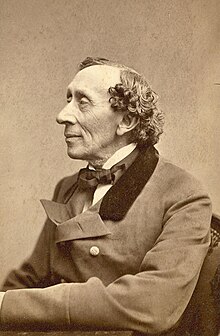
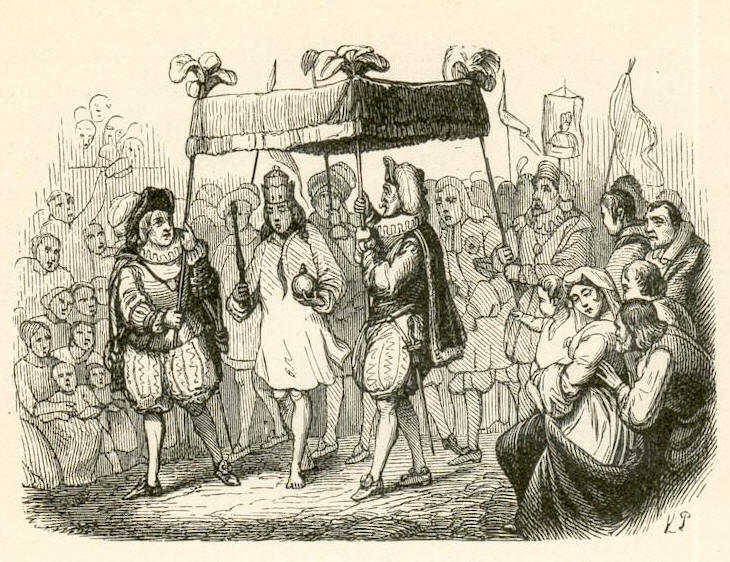
It might be good if those who voted in favour of the absurdity of same-sex 'marriage' would either read Hans Christian Andersen's The Emperor's New Clothes or listen to Frank Loesser's musical rewriting of the story [video above] for Danny Kaye to sing as he played Hans Christian Andersen in the 1952 movie of the same name.
Illustration by Vilhelm Pedersen, Andersen's first illustrator.
When will enough 'little boys' see and expose 'same-sex "marriage" as a "human right"' for the universal con-job that it has become?
Queen Elizabeth II of the United Kingdom of Great Britan and Northern Ireland was in the Republic of Ireland on a state visit from 17 to 20 May, the first time a British monarch has visited that part of Ireland since it became independent in 1922 and known then as The Irish Free State. Ireland and Britain have a tangled history and yet there are no two countries in the world that have closer practical ties. You don't need a passport to travel from one to the other. Irish citizens living in the UK have full voting rights there and British subjects - technically they aren't citizens but subjects of the reigning monarch - living in the Irish Republic have full voting rights there.
On the first day of her visit Queen Elizabeth visited the Garden of Remembrance in the centre of Dublin to lay a wreath in honour of those who had fought for the independence of Ireland. These had all fought against the British authorities. There were no speeches but by bowing after laying the wreath Queen Elizabeth spoke eloquently to most Irish people. For the majority it was a moment of healing, of reconciliation.
On the second day of the visit Queen Elizabeth laid a wreath at the Irish National War Memorial in Islandbridge, Dublin, dedicated to the 49,400 Irishmen who died in the Great War (1914-18) in the forces of the United Kingdom, which included the whole of Ireland at the time. The wreath was made of poppies, the symbol of the loss of life in Belgium and France. President Mary McAleese laid a laurel wreath.
Again, there were no speeches but the symbols spoke to Irish people. For decades the Irish involvement in World War I was airbrushed out of Irish history. Many Irishmen who joined the UK forces did so that Ireland and other countries might be free.
I'm in Dublin at the moment on a family visit. I am struck once again by the power of symbols in the context of rituals. At a time when the celebration of Mass and other liturgies is so often banal I think we can learn from ceremonies such as those at the Garden of Remembrance and at the Irish National War Memorial.