Showing posts with label Willem Isaacsz van Swanenburg. Show all posts

07 November 2025

Sunday Reflections, Dedication of the Lateran Basilica, 9 November 2025


Archbasilica of St John Lateran 

The full name of the church is: Archbasilica of the Most Holy Saviour and Saints John the Baptist and the Evangelist at the Lateran. It is the Cathedral of the Diocese of Rome.

The Feast of the Dedication of the Lateran Basilica, as a feast of the Lord, takes precedence over the 32nd Sunday in Ordinary Time.

Readings (Jerusalem Bible: Australia, Ireland, New Zealand)

Readings (English Standard Version, Catholic Edition: (England & Wales, Scotland)

Readings (New American Bible: Philippines, USA)

Gospel John 2:13-22 (English Standard Version, Anglicised)
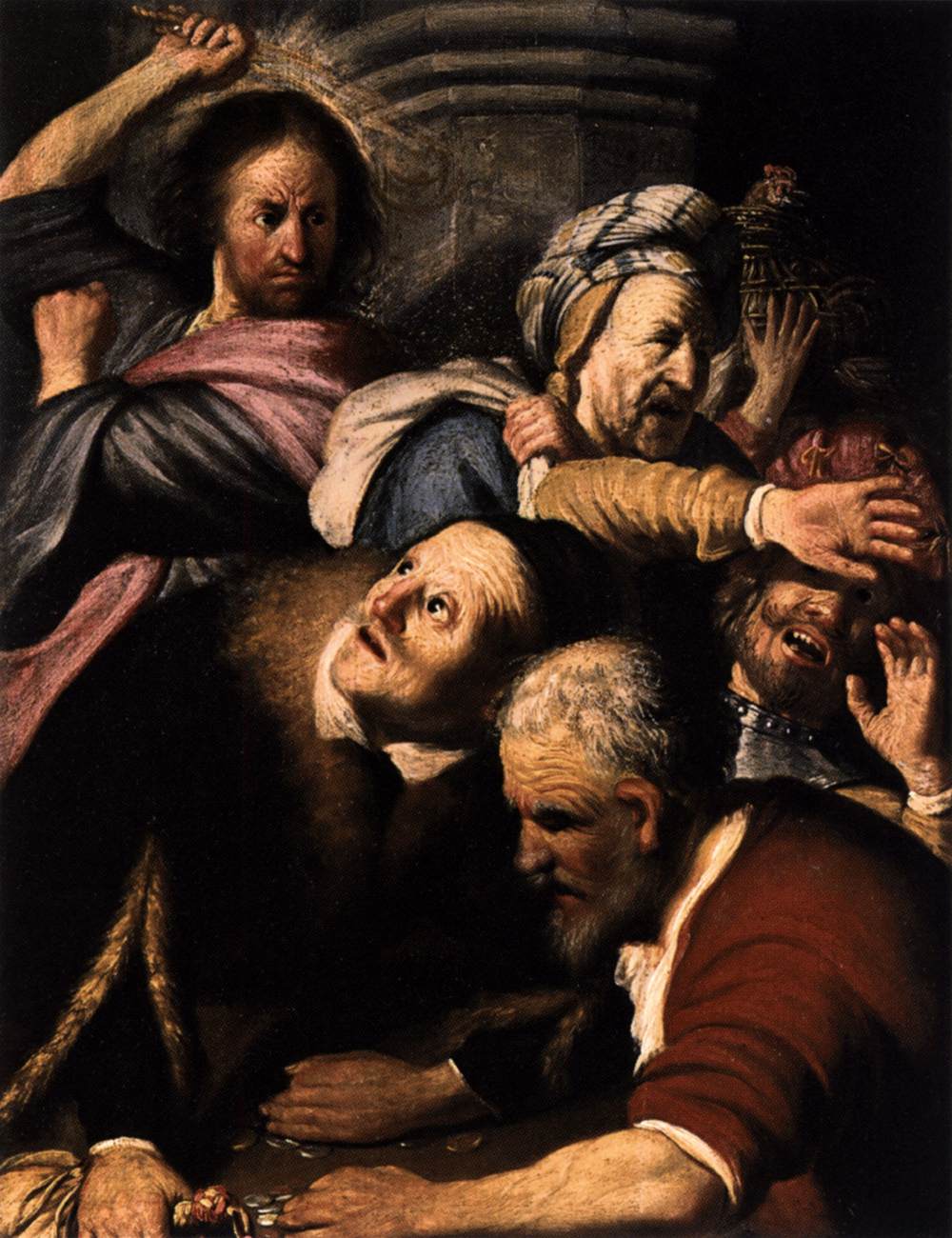
The Passover of the Jews was at hand, and Jesus went up to Jerusalem. In the Temple he found those who were selling oxen and sheep and pigeons, and the money-changers sitting there. And making a whip of cords, he drove them all out of the Temple, with the sheep and oxen. And he poured out the coins of the money-changers and overturned their tables. And he told those who sold the pigeons, ‘Take these things away; do not make my Father’s house a house of trade.’ His disciples remembered that it was written, ‘Zeal for your house will consume me.’

So the Jews said to him, ‘What sign do you show us for doing these things?’ Jesus answered them, ‘Destroy this temple, and in three days I will raise it up.’ The Jews then said, ‘It has taken forty-six years to build this Temple, and will you raise it up in three days?’ But he was speaking about the temple of his body. When therefore he was raised from the dead, his disciples remembered that he had said this, and they believed the Scripture and the word that Jesus had spoken.

Léachtaí i nGaeilge


Christ driving the money-changers from the Temple 
Rembrandt [Web Gallery of Art]

And making a whip of cords, he drove them all out of the Temple, with the sheep and oxen (John 2:15; Gospel).

This Sunday we celebrate the dedication of the Cathedral of Rome. In a real sense it is the Mother Church for Catholics.

In a homily in Spain on 3 November 1982 Pope St John Paul II said: Any church is your house, and the house of God. Value it as the place where we encounter our common Father. For most of us  the church where first we were able to encounter our common Father was the church or chapel where our parents and godparents brought us to be baptised. The First Reading, from the Prophet Ezekiel, which speaks of the life-giving waters flowing out from the Temple, reminds us of the waters of baptism which cleanse away sin and give us the life of God himself. The response to the psalm reflects this: The waters of a river give joy to God’s city, the holy place, the abode of the Most High.

The First Reading and the Responsorial Psalm are connected with the fact that St John the Baptist is one of the patron saints of the Pope's Cathedral.

St Paul in the Second Reading tells us what baptism accomplishes in us: Do you not know that you are God’s temple and that God’s Spirit dwells in you? We become sons and daughters of God the Father, brothers and sisters of Jesus and brothers and sisters of one another. We are a living community, sharing in the mission of the Church to preach the Gospel to every creature. The Church becomes alive when we gather together in the church building, especially to celebrate the Holy Sacrifice of the Mass. 

Many years after my ordination I realised that I learned what family is from being together each day for our evening meal and for our special Sunday lunch. In the same way I learned what the Church is from my parents taking me to Sunday Mass when I was a young child until I was old enough to go on my own. We all went to Sunday Mass, though not together. The term 'Family Mass' wasn't used when I was growing up in Dublin.

The words of Jesus in today's Gospel, Take these things away; do not make my Father’s house a house of trade, always made sense to me since my experience of the church, the building, was that it was the place where we gathered for Mass, especially on Sunday, and where people went to pray during the week, old people like my paternal grandfather for long periods, workers and school children dropping in for a few minutes on their way home from work or school. In other words, the church building truly was my Father's house. And it usually was a house of beauty that invited one to pray. 

Something we can do today is to recall and thank God for the significant churches in our lives: the church where we were baptised, the church where we made our First Holy Communion, the church where we were confirmed, the church where we went to confession regularly, the church where we were married or ordained. For some, all of these important events happened in the same church, for others not so. But on all of these occasions we were able to encounter our common Father and in every church where the Blessed Sacrament is in the tabernacle we meet our Risen Saviour Jesus Christ our Brother.


The papal cathedra in St John Lateran 


Traditional Latin Mass

What earlier generations held as sacred, remains sacred and great for us too, and it cannot be all of a sudden entirely forbidden or even considered harmful (Benedict XVI). 

Dedication of the Archbasilica of our Saviour

The Complete Mass in Latin and English is here. (Adjust the date at the top of that page to 11-09-2025 if necessary).

Lesson: Revelations 21:2-5Gospel: Luke 19:1-10.

Zacchaeus
Willem Isaacsz van Swanenburg [Web Gallery of Art]

Jesus said to Zacchaeus, 'Today salvation has come to this house, since he also is a son of Abraham. For the Son of man came to seek and to save the lost' ((Luke 19:10; Gospel).

30 October 2019

'God’s mercy is infinitely greater than any guilt of ours.' Sunday Reflections, 31st Sunday in Ordinary Time, Year C

Zacchaeus, Willem Isaacsz van Swanenburg [Web Gallery of Art]


Readings (New American Bible: Philippines, USA)

Readings (Jerusalem Bible: Australia, England & Wales, India [optional], Ireland, New Zealand, Pakistan, Scotland, South Africa)

Gospel Luke 19:1-10 (New Revised Standard Version, Anglicised Catholic Edition, Canada)  

Jesus entered Jericho and was passing through it. A man was there named Zacchaeus; he was a chief tax-collector and was rich. He was trying to see who Jesus was, but on account of the crowd he could not, because he was short in stature. So he ran ahead and climbed a sycomore tree to see him, because he was going to pass that way. When Jesus came to the place, he looked up and said to him, ‘Zacchaeus, hurry and come down; for I must stay at your house today.’ So he hurried down and was happy to welcome him. All who saw it began to grumble and said, ‘He has gone to be the guest of one who is a sinner.’ Zacchaeus stood there and said to the Lord, ‘Look, half of my possessions, Lord, I will give to the poor; and if I have defrauded anyone of anything, I will pay back four times as much.’ Then Jesus said to him, ‘Today salvation has come to this house, because he too is a son of Abraham. For the Son of Man came to seek out and to save the lost.’


Luke 19:1-10 in Filipino Sign Language


I'll 'hand over' to Pope Benedict XVI who reflected on today's gospel in his Angelus talk in Rome on 31 October 2010. I have highlighted parts of the Pope's talk.

Dear Brothers and Sisters!

The Evangelist St Luke pays special attention to the theme of Jesus' mercy. In fact, in his narration we find some episodes that highlight the merciful love of God and of Christ, who said that he had come to call, not the just, but sinners (cf. Lk 5:32). Among Luke's typical accounts there is that of the conversion of Zacchaeus, which is read in this Sunday's Liturgy. 

Zacchaeus is a publican (tax-collcctor), indeed, he is the head of the publicans of Jericho, an important city on the River Jordan. The publicans were the tax collectors who collected the tribute that the Jews had to pay to the Roman Emperor, and already for this reason they were considered public sinners. What is more, they often took advantage of their position to extort money from the people. Because of this Zacchaeus was very rich but despised by his fellow citizens. So when Jesus was passing through Jericho and stopped at the house of Zacchaeus, he caused a general scandal

The Lord, however, knew exactly what he was doing. He wanted, so to speak, to gamble, and he won the bet: Zacchaeus, deeply moved by Jesus' visit, decided to change his life, and promised to restore four times what he had stolen. 'Today salvation has come to this house', Jesus says, and concludes: 'The Son of Man came to seek and to save the lost'.

God excludes no one, neither the poor nor the rich. God does not let himself be conditioned by our human prejudices, but sees in everyone a soul to save and is especially attracted to those who are judged as lost and who think themselves so. 

Jesus Christ, the Incarnation of God, has demonstrated this immense mercy, which takes nothing away from the gravity of sin, but aims always at saving the sinner, at offering him the possibility of redemption, of starting again from the beginning, of converting. 

In another passage of the Gospel Jesus states that it is very difficult for a rich man to enter the Kingdom of Heaven (cf. Mt 19:23). In the case of Zacchaeus we see that precisely what seems impossible actually happens: 'He', St Jerome comments, 'gave away his wealth and immediately replaced it with the wealth of the Kingdom of Heaven' (Homily on Psalm 83:3). And St Maximus of Turin adds: 'Riches, for the foolish, feed dishonesty, but for the wise they are a help to virtue; for the latter they offer a chance of salvation, for the former they procure a stumbling block and perdition' (Sermons, 95).

Dear Friends, Zacchaeus welcomed Jesus and he converted because Jesus first welcomed him! He did not condemn him but he met his desire for salvation. Let us pray to the Virgin Mary, perfect model of communion with Jesus, to be renewed by his love, so that we too may experience the joy of being visited by the Son of God, of being renewed by his love and of transmitting his mercy to others.


Zacchaeus Receives Jesus
Church of the Good Shepherd, Jericho [Wikipedia]

In an address to confessors on 7 March 2008 Pope Benedict said: Those, on the other hand, who recognize that they are weak and sinful entrust themselves to God and obtain from him grace and forgiveness.

It is precisely this message that must be transmitted: what counts most is to make people understand that in the Sacrament of Reconciliation, whatever the sin committed, if it is humbly recognized and the person involved turns with trust to the priest-confessor, he or she never fails to experience the soothing joy of God’s forgiveness . . . 

It is not sin which is at the heart of the sacramental celebration but rather God’s mercy, which is infinitely greater than any guilt of ours.


Confessional, Parma Cathedral, Italy [Wikipedia]

Kyrie, Mass for Four Voices
William Byrd

Kyrie eleison 
Christe eleison 
Kyrie eleison

Lord, have mercy
Christ, have mercy
Lord, have mercy

A Thiarna, déan trócaire
A Chríost, déan trócaire
A Thiarna, déan trócaire