12 September 2014

'So must the Son of Man be lifted up.' Sunday Reflections, The Exaltation of the Holy Cross.

Art Museum, Cincinnati, USA [Web Gallery of Art]

Readings (New American Bible: Philippines, USA)

Readings (Jerusalem Bible: Australia, England & Wales, India [optional], Ireland, New Zealand, Pakistan, Scotland, South Africa) 


Jesus said to Nicodemus:
No one has ascended into heaven except the one who descended from heaven, the Son of Man. And just as Moses lifted up the serpent in the wilderness, so must the Son of Man be lifted up, that whoever believes in him may have eternal life.
 “For God so loved the world that he gave his only Son, so that everyone who believes in him may not perish but may have eternal life.
“Indeed, God did not send the Son into the world to condemn the world, but in order that the world might be saved through him.
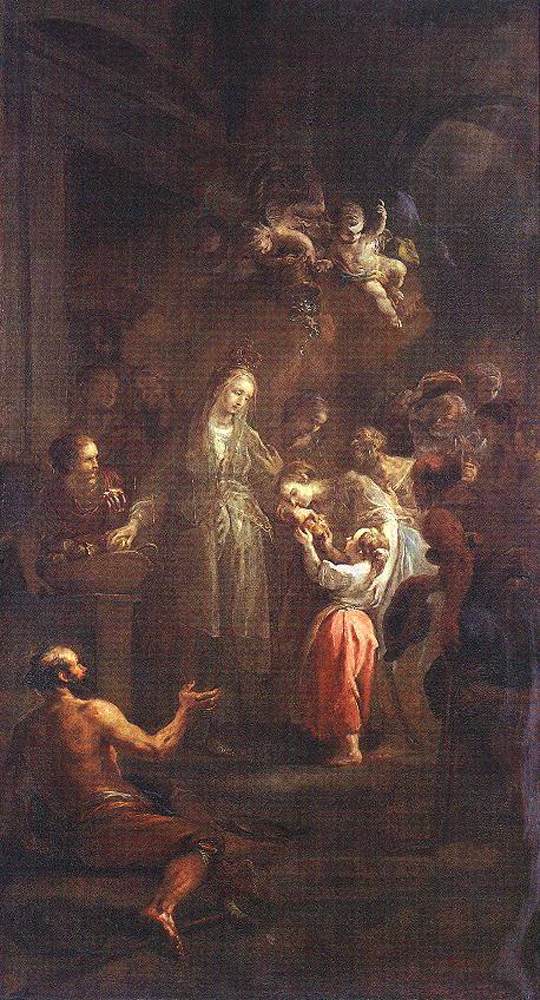
 Nicodemus, Unknown Master, Flemish
Museum voor Schone Kunsten, Ghent, Belgium [Web Gallery of Art]

The Catholic Bishops' Conference of the Philippines has designated the Feast of the Exaltation of the Holy Cross this year as National Day of Prayer for Peace in Iraq and Syria. Archbishop Socrates B. Villegas of Lingayen-Dagupan, President of the CBCP, wrote to his fellow bishops: In all our Masses on the feast of the Holy Cross, let us unite ourselves with our suffering brothers and sisters, commending to the God who is our hope their pains, their shattered lives and dreams, their bereavement and their loss. He also asked for a special collection at all Masses, the money to be sent by the CBCP to the charity aid of the Apostolic Nunciatures in Iraq and Syria.

Fr Ragheed Aziz Ganni
(20 January 1972 - 3 June 2007)

For me the face of the suffering Christians in Iraq and Syria, Catholic and Orthodox, is that of Fr Ragheed Ganni. This article by Ed West published in the Catholic Herald, a weekly in England, on 20 December 2013 and that has a very personal dimension, gives as good an account of Father Ragheed as any I've read.

Ed West writes: Fr Ragheed was one of 1,000 Iraqi Christians murdered during the pogrom that began after the Coalition invasion of 2003. The persecution culminated in October 31 2010, with the massacre of 52 worshippers at a Catholic church in Baghdad. In the words of one Chaldean bishop, this is a 'Calvary' that has largely been ignored in the western media, outside of the Christian press . . .

It has been a shocking and horrific ordeal for one of the world’s oldest Christian communities, which has been all but driven out of its homeland. A pre-war population of a million is now somewhere in the region of 150,000, many of them elderly, and more than 60 churches have been bombed.  That figure has got smaller in recent months and the ancient city of Mosul, in many ways the heart of the Christian faith in Iraq and Syria, has been emptied of its Christians by ISIS.

The article describes First Holy Communion day in Father Ragheed's parish in 2006: The atmosphere in Ragheed’s home town had become terrifying. On 4 August 2006, when 80 children of his parish of the Holy Spirit received their first Holy Communion, battles broke out in the street outside, and the children cowered from the sounds of guns and rockets.

The good shepherd helped them through. He told AsiaNews: 'Although people are used to it and remained reasonably calm, they started to wonder whether they were going to make it back to their homes or not. I was aware of the immense joy of the 80 children receiving their first Communion so I turned the subject into a joke and said to them: "Do not panic, these are fireworks. The city is celebrating with us." And at the same time I gave them instructions to leave the church quietly and quickly.'

The author further notes: Friends later recalled that he had become increasingly weary and broken by the demands of the priesthood amid such terror. After an attack on his parish, on Palm Sunday 2007, he wrote: 'We empathise with Christ, who entered Jerusalem in full knowledge that the consequence of His love for mankind was the cross. Thus while bullets smashed our church windows, we offered up our suffering as a sign of love for Christ.'

Shortly before his death Fr Ganni wrote in an email: 'Each day we wait for the decisive attack, but we will not stop celebrating Mass; we will do it underground, where we are safer. I am encouraged in this decision by the strength of my parishioners. This is war, real war, but we hope to carry our cross to the very end with the help of Divine Grace.'

This young Iraqi priest of the Chaldean Catholic Church, an engineer by profession, was murdered on Trinity Sunday, 3 June 2007, along with three subdeacons, Basman Yousef Daud, Gassan Isam Bidawed and Wahid Hanna Isho after he had celebrated Mass in Mosul, the city of his birth.

At a Eucharistic Congress in Bari, Italy, in 2005 Father Ragheed said, There are days when I feel frail and full of fear. But when, holding the Eucharist, I say ‘Behold the Lamb of God Behold, who takes away the sin of the world’, I feel His strength in me. When I hold the Host in my hands, it is really He who is holding me and all of us, challenging the terrorists and keeping us united in His boundless love. He also said, Without Sunday, without the Eucharist, the Christians in Iraq cannot survive.

To put some time perspective on the Christian faith in Iraq and Syria: in 2021 the Church in the Philippines will celebrate 500 years of the Catholic Christian faith in this country, a great occasion for thanking God for that precious gift. The Christian faith has been lived in Iraq and Syria for four times as long as that, since the time of the Apostles. Mass was celebrated for 2,000 years in Mosul until a couple of months ago when Christians were driven from their ancestral homeland by ISIS.

Father Raqheed's words, But when, holding the Eucharist, I say ‘Behold the Lamb of God Behold, who takes away the sin of the world’, I feel His strength in me, reflect the words of Jesus to Nicodemus in today's Gospel: And just as Moses lifted up the serpent in the wilderness, so must the Son of Man be lifted up, that whoever believes in him may have eternal life.

A Muslim friend of Fr Ragheed, Adnam Mokrani, professor of Islamic Studies at the Pontifical Gregorian University in Rome, said that on his ordination day, 13 October 2001, recalled that the new priest said, Today, I have died to self. St Paul in today's Second Reading tells us, Christ Jesus, who, though he was in the form of God did not regard equality with God has something to be exploited, but emptied himself, taking the form of a slave and that he became obedient to the point of death—even death on a cross.
    
As we celebrate the Exaltation of the Holy Cross and as we pray for persecuted Christians, particularly in Iraq and Syria, may we thank God for the gift of our Christian faith and ask him for the courage to live it as Father Ragheed and countless others have done, becoming obedient to the point of death.


From what I understand, this hymn to Our Blessed Mother in Arabic is sung by Father Ragheed and was played during his funeral procession. This is  the translation given with the video: We honor you with hymns O Mother of God, you are the pride of the whole earth, because the Word of God whom the Father sent, chose to take His human body from you. The generations call you blessed, all nations and people's honor you and ask for mercy by your prayers. You are a generous earth in which plants of joy always grow.
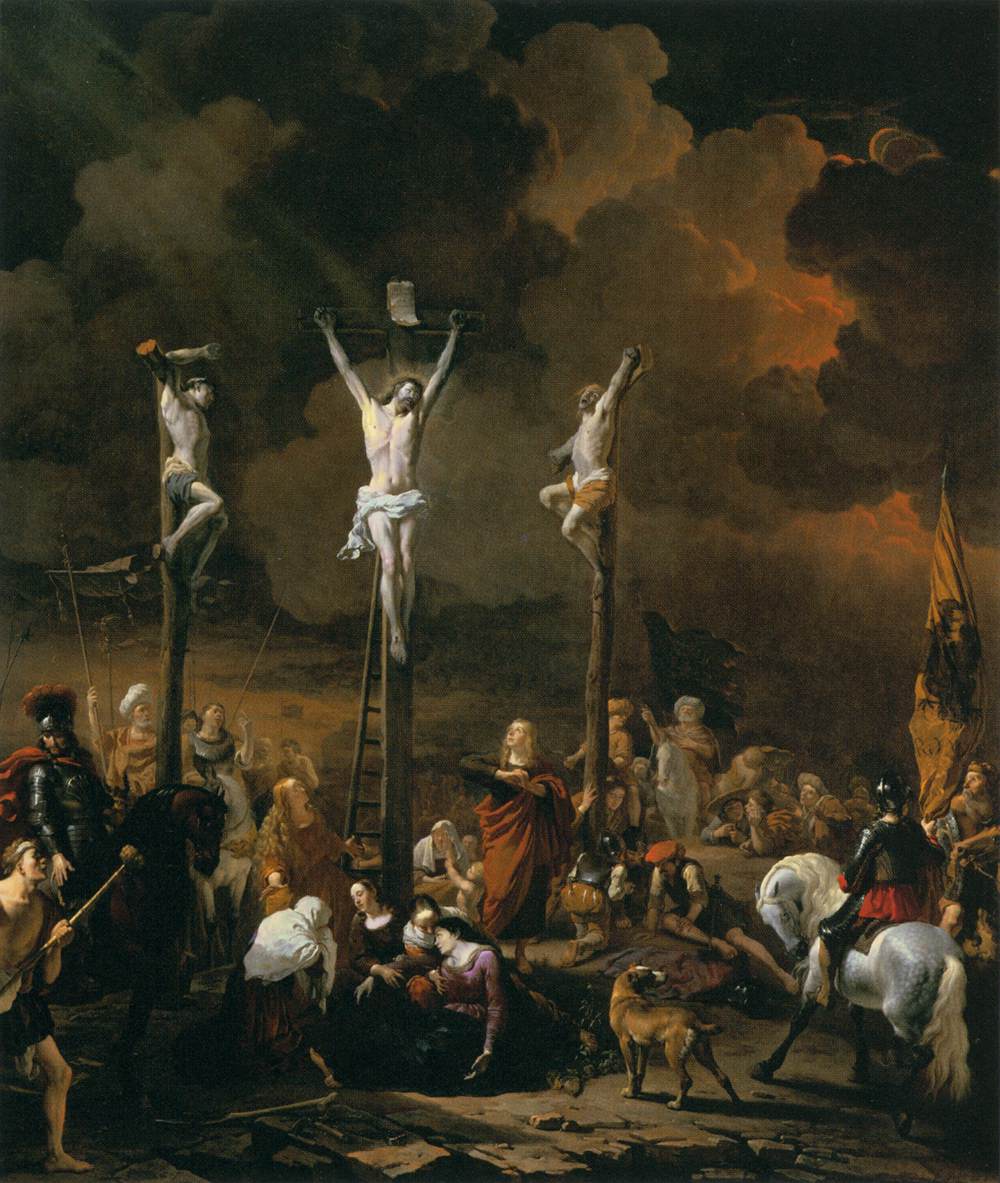


Calvary, Karel Dujardin, 1661
Musée du Louvre, Paris  [Web Gallery of Art]

Calvaire 
Calvary

le/by Pádraig Ó Croiligh

Ag barr na gcéimeanna
In Eaglais an tSlánaitheora
Tá séipéal tógtha ar rian na croise.
An dara stáisiún déag dearaithe ar a chúl
Agus poll sa talamh faoi
San áit a mbíodh an chrois
Ag an am ar tharla an crith talún.

Ach níl an tarlú féin ná an duine
I láthair anseo anois,
Ach in áiteanna brúite buartha
Ár fud na cruinne
Agus i láthair an uaignis.

An fear a fuair bás anseo,
Den bhás a rinneadh anseo,
Tá sé beo agus aiséirithe.
Tá Íosa ina Chríost go fóill!

At the top of the steps
In the Church of the Saviour
There’s a chapel built on the site of the cross.
The twelfth station painted at the back
And a hole in the ground underneath
In the place where the cross was
At the time of the earthquake.

But neither the event itself nor the person
Are present here now,
But in crushed sorrowful places
Throughout the world
And in the midst of loneliness.

The man who died here,
From the death that was wrought here,
He is alive and risen.
Jesus is still the Christ!

The poet is a priest of the Diocese of Derry, Ireland. The non-poetic English translation from the Irish (Gaelic) is my own. The poem is taken from Brúitíní Creidimh (Mashed Potatoes of Faith) by Pádraig Ó Croiligh, published by Foilseacháin Ábhair Spioradálta, Dublin, 2006.


Antiphon ad introitum     Entrance Antiphon  Cf Galatians 6:14
Nos autem gloriari oportet
We should glory 
in cruce Domini Nostri Jesu Christi, 
in the Cross of our Lord Jesus Christ,
in quo est salus, vita et resurrectio nostra,
in whom is our salvation, life and resurrection, 
per quem salvati et liberati sumus.
through whom we are saved and delivered.


10 September 2014

'Incremental genocide of a generation': statement by three Catholic bishops in northerm Myanmar/Burma

Mother and child in a camp for displaced persons at Kutkai in Lashio

This article appeared in the 31 August 2014 edition of Sunday Examiner, the English-language weekly of the Catholic Diocese of Hong Kong and is used with permission. The dioceses of Myitkyina ["MITCHinah"] and Banmaw cover the Kachin State, where Columbans first went to work in 1936. Bishop Zahawang of Lashio, in the neighbouring Shan State, was formerly Auxiliary Bishop of Myitkyina.

HONG KONG (SE): “This incremental genocide of a generation has not attracted the needed attention of concerned people, raising doubts whether there is a deliberate attempt to destroy the youth of our lands,” the bishops of three dioceses in the Union of Myanmar say in a statement issued on August 20. [Full statement here.]

Bishop Francis Daw Tang, from Myitkyina; Bishop Raymond Sumlut Gam from Banmaw; and Bishop Philip Zahawng, from Lashio; say in their statement, “The prevalence of human trafficking and drug trafficking is an undeclared war on our people.”

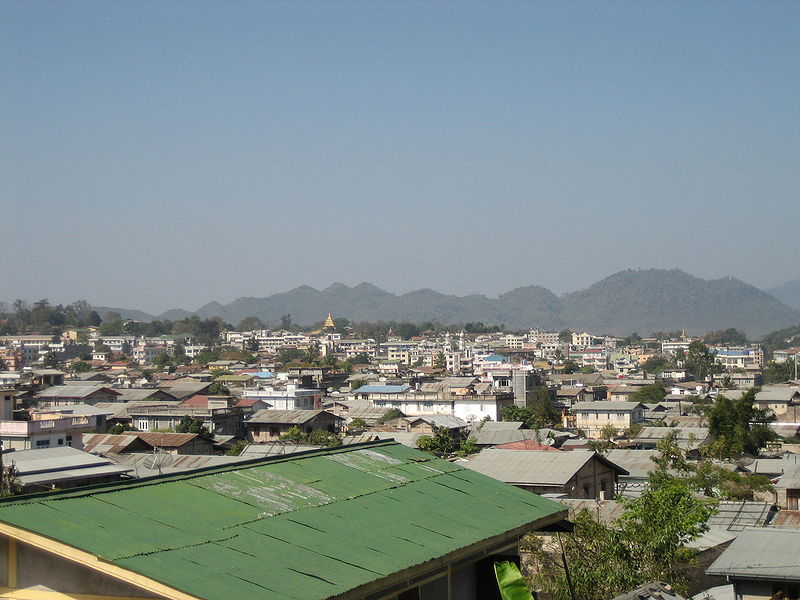
Lashio [Wikipedia]

The bishops are pointing out that a silent war has been raging in their dioceses for over three years, since a ceasefire agreement with the Myanmese Army broke down and hostilities resumed in 2011.

“We have seen the hundreds of innocent people killed and buried in unknown graves, thousands displaced to inhuman camps, destroying their dignity and raising serious questions about their future,” the bishops continue, calling the interludes of peace nothing but an illusion bringing frustrating disappointment.

A former drug educator with Caritas in Myitkyina, Peter Nlam Hkun Aung, told the Sunday Examiner in 2011 that he believes that drugs are one form of artillery being used by the Myanmese Military against the Kachin people.

“Soldiers offer cigarettes and candy laced with drugs to primary school children,” he said. “The children do not know what they are, they just take them. This is part of the war being waged by the military, they just want to turn our people into a mob of zombies.”

Banmaw [Wikipedia]

Apart from the drug war, the bishops believe that human trafficking is another weapon used to break up the cohesion of the social structure of the Kachin as a people.

“Poor and innocent Kachin women are commoditised by human traffickers and hundreds are forced into modern day slavery and sold across borders,” the three bishops say, adding, “War has wiped out the livelihoods of our people, forcing our young men to seek risky livelihoods.”

Father Cirineo "Dodong" Matulac witnessed the wholesale rape of the Kachin economy during a visit to the city of Muse, just across the porous border from the Chinese city of Ruili in Yunnan province. [Editor's note: Fr Matulac is a Filipino Columban priest who worked in China before and is now based in Quezon City, Philippines.]

Myitkyina [Wikipedia]

“Thousands of people and hundreds of trucks cross the border every day to trade,” he explained. “Hardwood like teak, precious gemstones like jade and rubies come from the Myanmar side of the border in exchange for cheap and non-durable manufactured goods from China.”

He also visited a camp for displaced people in nearby Manhkan, near the border with the Shan State and the controversial Dapein Hydroelectric Power Plant.

When the government began an expansion of the power plant in 2011 the Kachin Independence Army (KIA) intervened and the government moved against them, bringing an end to the fragile peace that had survived for some 17 years.

Father Matulac said that in the camp he met 56-year-old Hpadau Brang Mai, who talked freely with him as he remembered Father Matulac’s fellow Columban priests who were in the area when he was young.

“He is only one of hundreds of people in the displaced persons’ camp,” Father Matulac explained. “He has five children, but his 23-year-old son was killed by the military when he was working in the field on their farm.”

Brang said that he and his family fled, as they were afraid of the military as they shoot at the people indiscriminately.

Brang has been in the camp for two years and wants to go home, but the war situation prevents him.

Father Matulac said that Brang introduced him to a woman who told him, “There are many families here in this camp who have lost their sons and daughters to the army,’ and Brang added, ‘We don’t know the reason why they shoot us. I think they want to kill us because we are Kachin’.”

Kachin traditional dress [Wikipedia]

Father Peter Maran Tawng, from Caritas Myanmar, says that all up there are over 100,000 people living in displaced persons’ camps, but nobody knows the real number of people driven from their homes, as many parts of the country are inaccessible.

Father Maran said that the mega projects of the Chinese are certainly one reason for the tension with the government. He cited the partially completed Myitsone Hydro-Electric Dam, construction of which is currently on hold, but the people are upset because over 90 per cent of the power generated will go to China.

Gas pipelines into China and a railway line from Yangon to Kunming are also on the planning board and, Father Maran commented, “It seems that the Myanmar government has launched a campaign to slowly wipe out any opposition to these projects.”

Pagoda in Banmaw [Wikipedia]

Father Matulac added that on a visit to the pristine mountain resort of the Stone Village with seminarians, he was told that in November 2011 the army sent troops there and hundreds of local people died.

“The seminarians told me that some of these young soldiers are taken by force and enlisted in the army and sent to the Kachin state to fight,” Father Matulac said, adding that international agencies estimate that there are as many as 70,000 child soldiers used by the Burmese army and ethnic freedom fighters.

He added that records show a systematic recruitment and even trafficking of children as soldiers by the Myanmese military.

He explained that the seminarians told him, “The young soldiers are only trained to shoot. They fire at anyone, if they see a Kachin man, they think that he is KIA. The soldiers strafe the houses and rape the women, even pregnant women.”

Father Matulac added, “A young man named Columban told me his friend was also killed by the army. He was riding his motorcycle when he happened to pass by a troop of Burmese soldiers and he was shot in the head. Another young man said that his house was strafed by the soldiers. All of them had a similar story.”

Rural scene, Banmaw [Wikipedia]

The three bishops believe that the rape of natural resources is the reason behind the genocide. “Colonial era laws are enacted to usurp traditional ethnic lands,” they say. “Land questions may ultimately decide the future of peace in this land.”

They add, “We note with great concern attempts to grab the lands of those who are displaced.”

They insist that peace based on justice is the only way forward, but Father Matulac says that a new military vision will be necessary to achieve this.

He points to a sign posted on the military headquarters in Mandalay, which reads, “Tatmadaw (military) and the people cooperate and thrash all those who are harming the union.”

The Filipino missionary says that the operative word is union, as ethnic groups like the Kachin are not regarded as being an integral part of it.

“The silent war in the Kachin villages rages on, while the ordinary people are caught in between,” he concludes.


One of a number of songs celebrating in 2011 the 75th anniversary of the arrival of the Columbans in Banmaw (Bhamo) and the 50th anniversary of the building of St Patrick's, now the cathedral of the Diocese of Banmaw.

Prayer Intentions of Pope Francis for September 2014


St Elizabeth (of Hungary) Distributing Alms, Martin Johann Schmidt, c.1778
Parish Church, Veresegyhás, Hungary [Web Gallery of Art]

Universal Intention - Mentally Disabled

That the mentally disabled may receive the love and help they need for a dignified life.


Read Another Myeong Sek: the Road to Emmaus by Columban Fr Noel O'Neill in the current issue of MISYONonline.com.

Fr O’Neill with Myeong Sek

With Myeong Sek at the grave of You Ha

Myeon Sek's funeral Mass


 Evangelization Intention - Service to the Poor

That Christians, inspired by the Word of God, may serve the poor and suffering. 

Death is Stark for the Poor, (MISYONonline.com, November-December 2013) Columban Sr Mary Dillon (right) from Ireland, tending to a person with AIDS.

What Comes After Dusk, (MISYONonline.com, July-August 2014)
Kwaderno, an initiative started by the staff of MISYONonline.com, reaches out to children in the Philippines who cannot afford to buy notebooks.

Rattno's Story (MISYONonline.com, March-April 2014)
Australian Columban Fr Robert McCulloch with 12-year-old Rattno, a Hindu in predominantly Muslim Pakistan.

'The hope of Shivji and Shonti, Rattno's parents, turned to disaster when their children were lighting a kerosene pressure lamp which exploded. Saiba, Lakhnu and Shonti, aged from 7 to 15, died in the fire. Rattno survived.' 

Beauty in Suffering (MISYONonline.com September-October 2007) 
Columban Sr Anne Carbon, a mental health nurse from the Philippines, with children traumatized by years of terrorism in Peru.


09 September 2014

Another Myeong Sek: The Road to Emmaus

Columban Fr Noel O'Neill with Myeong Sek in Korea

The Universal Prayer Intention of Pope Francis for September is That the mentally disabled may receive the love and help they need for a dignified life.

Fr Noel O'Neill is a Columban priest from Limerick, Ireland, who has been in Korea since 1957. In this article from the September-October 2014 issue of MISYONonline.com, the magazine of the Columbans in the Philippines that I have been editing for 12 years now, he shows how he has been living this prayer intention - and how he himself has received love and help for a dignified life from two persons in particular, among others, whom he describes as 'differently abled' and who were on the fringes of society because others didn't recognise the gifts that God had given them.

Myeong Sek, Theresa, was special. She was special because she was differently abled.
She was special because it was she who accompanied me as together we first began to walk the Road to Emmaus. After 25 years in parish ministry I sought permission from my superiors to begin a new apostolate, a ministry to persons with special needs.
With Myeong Sek at the grave of You Ha
Myeong Sek had been abandoned by her parents when she was a few years old and ended up in ‘The Beggars Camp’, Mudeong Institution, which I frequently visited while in parish ministry. After much negotiation with the authorities there I succeeded in getting permission for Myeong Sek to leave and to join with me and a volunteer as we moved into a two-story house in a residential part of the city. It was October 1981. This was the first attempt in Korea of offering people with special needs the opportunity of living in the local community.
Myeong Sek’s funeral Mass
Early in 2012 Myeong Sek was diagnosed with cancer. She spent the last ten days of her life in a hospice. A hospice and Emmaus have something in common. A hospice is for people dying whose ailment cannot be cured. Emmaus is for intellectually disabled people whose disability cannot be cured. A visit to either one alerts us to the preciousness of each moment of life; it arouses within us a sense of gratitude.
While Myeong Sek was in the hospice I visited her every day. As I sat beside her bedside and held her tiny hand, we reminisced about the funny incidents we had shared together throughout the previous 30 years, the times we used to sing Kaptori Wa Kapsoni (a Korean popular duet) and dance the hokey pokey.

Kaptori Wa Kapsoni
As she laid back on her bed she would break into a broad smile, a loving smile, sending me a message that no words could express. They were happy moments, happy days, happy years.
That smile also hid the many wounds and hurts she had endured in her lifetime. I was only too well aware of those painful wounds. Watching the peaceful look on her face I felt she already sensed the heavenly welcome. She could almost make the dying words of St Thérèse, the Little Flower, her own: ‘I am not dying, I am entering into life’.
Myeong Sek was waked for three days at the funeral home. Those who had lived with her in the group home were dressed in mourning black dress, and they greeted those who came to pay their respects, present and former staff members who had known her for many years. Many Catholic friends and sponsors came who were touched and moved by their relationship with Myeong Sek. This tiny, fragile woman had the gift to make them feel loved and at peace with themselves as they struggled with their problems.
Myeong Sek often said, ‘When I die, those who come to the wake, feed them well’. They came in large numbers to pay their respects and all ate well. Before leaving as each one ate and departed you could almost sense the presence of Myeong Sek as she said kamsahamnida,’thank you, thank you’.

At the cemetery
The funeral Mass was held at the parish church Myeong Sekused to attend. Six priests concelebrated for a packed congregation. I chose for the Gospel the story of the two disciples on the Road to Emmaus. As the two disciples eyes were opened at seeing Jesus break the bread, so also my eyes were opened by my relationship with Myeong Sek. This tiny, fragile woman, who could not read or write, who had no concept of time or money, was my teacher, my professor. We need to invite and welcome more Myeong Seks into our society because they will surprise us with the manner they can touch our inner selves and help us to welcome our weaknesses, our old age with graceful and peaceful courage. Yes, Myeong Sek was differently abled.
Mass with the Emmaus Community, Myeong Sek in grey

07 September 2014

Iraqi MP's heartfelt plea for the Yazidi people and other minorities


Vian Dakhil MP  is the only Yazidi member of the Iraqi parliament. Though she gave this speech on 5 August I came across it only yesterday. It speaks for itself.

The MP was injured a week later when an Iraqi helicopter on a mission to help the besieged Yazidi people crashed, killing the pilot.

06 September 2014

'If the member listens to you, you have regained that one.' Sunday Reflections, 23rd Sunday in Ordinary Time Year A

The Repentant Peter, El Greco, c.1600
Phillips Collection, Washington [Web Gallery of Art]

Readings (New American Bible: Philippines, USA)

Readings (Jerusalem Bible: Australia, England & Wales, India [optional], Ireland, New Zealand, Pakistan, Scotland, South Africa) 


Jesus said to his disciples:

“If another member of the church sins against you, go and point out the fault when the two of you are alone. If the member listens to you, you have regained that one.  But if you are not listened to, take one or two others along with you, so that every word may be confirmed by the evidence of two or three witnesses.  If the member refuses to listen to them, tell it to the church; and if the offender refuses to listen even to the church, let such a one be to you as a Gentile and a tax collector.  Truly I tell you, whatever you bind on earth will be bound in heaven, and whatever you loose on earth will be loosed in heaven.  Again, truly I tell you, if two of you agree on earth about anything you ask, it will be done for you by my Father in heaven.  For where two or three are gathered in my name, I am there among them.”


Today's gospel looks at forgiveness, mainly from the point of view of helping someone to acknowledge a wrongdoing and thereby asking for and receiving forgiveness. During this week I kept thinking about a Christian Brother who taught me in Dublin and one incident involving him that I witnessed and another I heard about years later. I'll simply copy from a previous post, with one or two slight changes.

During my primary school years I came to know an exceptional person, Brother Mícheál. S. Ó Flaitile, known as ‘Pancho’ from the sidekick of the Cisco Kid, a syndicated comic-strip [above] that we used to read in The Irish Press, a no longer existing Irish daily newspaper. Our 'Pancho', like the Cisco Kid's friend, was on the pudgy side, though minus the hair and moustache. He organized an Irish-speaking club and arranged for me to be secretary. I don’t think I was too happy at the time to get that job but I realized later that he had spotted my ability to write. Other teachers had encouraged me in this too.

My class was blessed to have had Brother Ó Flaitile in our last two years in secondary school, 1959 to 1961, when we were preparing for our all-important Leaving Certificate examination. He taught us Irish and Latin. He probably should have been teaching at university level. What I remember most of all about him was his character. Everyone described him as ‘fear uasal’, the Irish for 'a noble man' – as distinct from 'a nobleman’. A stare from him made you feel humbled, but not humiliated. He had the kind of authority that Jesus had, as we read in the gospels.

I remember one event in our last year. ‘Pancho’ used to take the A and B sections for religion together in our last class before lunch every day for religion class. One day he scolded a student in the B section for something trivial or other and the student himself and the rest of us took it in our stride and forgot about it. We were nearly 70 boys aged between 16 and 18. 'Pancho' was probably around 60 then. The next day Brother Ó Flaitile apologized to the boy in question and to the rest of us because he had discovered that the student hadn’t done what he had accused him of. Whatever it was, it had been very insignificant. But ‘Pancho’’s apology was for me a formative moment. I mentioned it to him many years later when he was in his 80s. He told me he didn’t remember the incident, but he smiled. He died in the late 1980s.

Some years ago a classmate told me about an incident between himself and Brother Ó Flaitile in 1959 when we were on a summer school/holiday in an Irish-speaking part of County Galway. If my friend had told me the story at the time I would not have believed him. He got angry with ‘Pancho’ over something or other and used a four-letter word that nobody would ever express to an adult, least of all to a religious brother and teacher whom we revered. The lad stormed back to the house where he was staying and before too long felt remorse. He went back to ‘Pancho’ and apologized. The Brother accepted this totally and unconditionally and never referred to the incident again.

After my father, I don't think that anyone else influenced me more for good when I was young than 'Pancho'.

Looking back on the first incident I figure that the student in question must have gone to 'Pancho' afterwards and explained to him what had really happened. Brother Ó Flaitile was the kind of authority figure whom you felt free to approach in such a situation. If that is what happened, and I believe it was, then the opening words of today's gospel were what we all experienced in class the following day: If another member of the church sins against you, go and point out the fault when the two of you are alone. If the member listens to you, you have regained that one. 

Brother Ó Flaitile's asking for forgiveness that day was all the more powerful because he was more than three times our age, an authority figure, a religious brother and a truly revered person. What he did showed why he was revered, as did the 'four-letter word incident' with my classmate.

For me 'Pancho' exemplified the Christian leadership that Jean Vanier, founder of L'Arche and, with Marie-Hélène Mathieu, co-founder of Faith and Light, talks about in the video below. He knew and called each of us by name and loved each of us, especially when we were 'the enemy', wrongdoing or perceived to be such, and led us by example, most powerfully of all when he asked our forgiveness for having judged one of us wrongly.


+++

Schola Bellarmina, Brussels, Belgium

Antiphona ad introitum  Entrance Antiphon  Ps 118[119]:137, 124

Iustus es, Domine et rectum iudicium tuum;
You are just, O Lord, and your judgement is right;
fac cum servo tuo secundum misericordiam tuam.
treat your servant in accord with your merciful love.

Ps 118[119]:1. Beati immaculati in via: qui ambulant in lege Domini. 
Happy are those whose way is blameless, who walk in the law of the Lord.

Gloria Patri et Filio et Spiritui Sancto, sicut erat in principio et nunc et semper et in saecula saeculorum, Amen! 
Glory be to the Father, and to the Son, and to the Holy Spirit. As it was in the beginning, is now, and ever shall be, world without end, Amen!

Iustus es, Domine et rectum iudicium tuum;
You are just, O Lord, and your judgement is right;
fac cum servo tuo secundum misericordiam tuam.
treat your servant in accord with your merciful love.

[The text in bold is what is in the Ordinary Form of the Mass. The fuller text is used in the Extraordinary Form, the 'Tridentine Mass'. It may also be used in the Ordinary Form when it is sung.]


At his General Audience last Wednesday, 3 September, Pope Francis once again expressed his concern for the Christians of Iraq, many of whom have been driven from their homes. It cannot be stressed enough that their ancestors accepted the gift of our Christian faith in the time of the Apostles, that they are Arabs and that the places from which they have been driven by ISIS are the places where their ancestors have lived for thousands of years.

The Pope's words of encouragement and solidarity:

Today, I want to reassure my closeness to Christians, to the defenseless and persecuted. You are in the heart of the Church. The Church suffers with you and the Church is proud of you. It's proud to have sons and daughters like you. You are its strength and you offer a concrete and authentic testimony of salvation, forgiveness and love. I embrace all of you. May the Lord bless and protect you.

+Louis Raphael Sako
Patriarch of the Chaldean Catholic Church

Patriarch Louis Raphael Sako, head of the Chaldean Catholic Church, to which most Iraqi Catholics belong, published an impassioned statement on the website of the Church on 3 September. He calls what is happening 'genocide'. Some extracts:

. . . The curtains have been drawn on the painful events, and 120.000 Christians are uprooted from their historical homeland because the Political Islam does not want them there, and the world is silent, standing still, either because it approves or because it is incapable of acting . . . These people were living in their hometowns in prosperity, pride and dignity; in the blink of an eye, they were ousted from their homes, terrified and fleeing on foot in search of a shelter. It is a scene that takes us back to the dark centuries of the past although it has become a horrific reality of our present civilization!

What these peaceful Christians and loyal citizens experienced is a real genocide, a sad ending, and a proof of the privation of the religious, human, moral, and national values. Therefore, it is a shameful stain in history. Everybody should know is a threat for all.

Few days ago we saw the 13 year old girl on Ishtar satellite channel, screaming: 'I want to go back to my own town, Qaraqosh. I am tired of this life here; I would rather die for it rather than living here in humiliation'. It’s a loud call to the conscience of the world!

This BBC report was published 9 August

Let us, with Pope Francis, embrace our suffering Christian brothers and sisters in Iraq and others being persecuted there, at least through our prayers, most of all as we celebrate the Holy Sacrifice of the Mass.