24 March 2022

'Let us contemplate the Heart of the Father.' Sunday Reflections, 4th Sunday of Lent, Year C


The Return of the Prodigal Son, 

Rembrandt [Web Gallery of Art]


Readings (Jerusalem Bible: Australia, England & Wales, Ireland, New Zealand, Pakistan, Scotland, South Africa

Readings (New American Bible: Philippines, USA)

Gospel Luke 15:1-3, 11-32 (English Standard Version Anglicised: India)  

Now the tax collectors and sinners were all drawing near to hear Jesus. And the Pharisees and the scribes grumbled, saying, “This man receives sinners and eats with them.”

So he told them this parable:

“There was a man who had two sons. And the younger of them said to his father, ‘Father, give me the share of property that is coming to me.’ And he divided his property between them. Not many days later, the younger son gathered all he had and took a journey into a far country, and there he squandered his property in reckless living. And when he had spent everything, a severe famine arose in that country, and he began to be in need. So he went and hired himself out to one of the citizens of that country, who sent him into his fields to feed pigs. And he was longing to be fed with the pods that the pigs ate, and no one gave him anything.

 “But when he came to himself, he said, ‘How many of my father's hired servants have more than enough bread, but I perish here with hunger! I will arise and go to my father, and I will say to him, “Father, I have sinned against heaven and before you. I am no longer worthy to be called your son. Treat me as one of your hired servants.”’ And he arose and came to his father. But while he was still a long way off, his father saw him and felt compassion, and ran and embraced him and kissed him. And the son said to him, ‘Father, I have sinned against heaven and before you. I am no longer worthy to be called your son.’ But the father said to his servants, ‘Bring quickly the best robe, and put it on him, and put a ring on his hand, and shoes on his feet. And bring the fattened calf and kill it, and let us eat and celebrate. For this my son was dead, and is alive again; he was lost, and is found.’ And they began to celebrate.

“Now his older son was in the field, and as he came and drew near to the house, he heard music and dancing. And he called one of the servants and asked what these things meant. And he said to him, ‘Your brother has come, and your father has killed the fattened calf, because he has received him back safe and sound.’ But he was angry and refused to go in. His father came out and entreated him, but he answered his father, ‘Look, these many years I have served you, and I never disobeyed your command, yet you never gave me a young goat, that I might celebrate with my friends. But when this son of yours came, who has devoured your property with prostitutes, you killed the fattened calf for him!’ And he said to him, ‘Son, you are always with me, and all that is mine is yours. It was fitting to celebrate and be glad, for this your brother was dead, and is alive; he was lost, and is found.’”


Léachtaí i nGaeilge


The Gospel in Filipino Sign Language

Seven or eight years ago while still in the Philippines I met a woman from a Western country who told me that the first lie her parents told her was that Santa Claus existed. Had I been alert enough at the time I would have asked her, So Jesus lied to us about the Prodigal Son, about the Good Samaritan? They never 'existed'.

As Pope Benedict XVI said in his Angelus Talk on today's gospel on 14 March 20: This passage of St Luke constitutes one of the peaks of spirituality and literature of all time. Indeed, what would our culture, art and more generally our civilization be without this revelation of a God the Father so full of mercy?

We would never have had Rembrandt's powerful and deeply moving painting above.

Here is the full text of Pope Bendict's talk that day with my emphases added. (I find it difficult to add emphases to anything by Pope Benedict since I find that his talks are so deep, so clear and so uplifting.)

Dear Brothers and Sisters,

On this Fourth Sunday of Lent, the Gospel of the father and the two sons better known as the Parable of the ‘Prodigal Son’ (Lk 15:11-32) is proclaimed. This passage of St Luke constitutes one of the peaks of spirituality and literature of all time. Indeed, what would our culture, art and more generally our civilization be without this revelation of a God the Father so full of mercy? It never fails to move us and every time we hear or read it, it can suggest to us ever new meanings. Above all, this Gospel text has the power of speaking to us of God, of enabling us to know his Face and, better still, his Heart. After Jesus has told us of the merciful Father, things are no longer as they were before.

We now know God; he is our Father who out of love created us to be free and endowed us with a conscience, who suffers when we get lost and rejoices when we return. For this reason, our relationship with him is built up through events, just as it happens for every child with his parents: at first he depends on them, then he asserts his autonomy; and, in the end if he develops well he reaches a mature relationship based on gratitude and authentic love.

In these stages we can also identify moments along man's journey in his relationship with God. There can be a phase that resembles childhood: religion prompted by need, by dependence. As man grows up and becomes emancipated, he wants to liberate himself from this submission and become free and adult, able to organize himself and make his own decisions, even thinking he can do without God. Precisely this stage is delicate and can lead to atheism, yet even this frequently conceals the need to discover God's true Face. Fortunately for us, God never fails in his faithfulness and even if we distance ourselves and get lost he continues to follow us with his love, forgiving our errors and speaking to our conscience from within in order to call us back to him.

In this parable the sons behave in opposite ways: the younger son leaves home and sinks ever lower whereas the elder son stays at home, but he too has an immature relationship with the Father. In fact, when his brother comes back, the elder brother does not rejoice like the Father; on the contrary he becomes angry and refuses to enter the house. The two sons represent two immature ways of relating to God: rebellion and childish obedience. Both these forms are surmounted through the experience of mercy. Only by experiencing forgiveness, by recognizing one is loved with a freely given love a love greater than our wretchedness but also than our own merit do we at last enter into a truly filial and free relationship with God.

Dear friends, let us meditate on this parable. Let us compare ourselves to the two sons and, especially, contemplate the Heart of the Father. Let us throw ourselves into his arms and be regenerated by his merciful love. May the Virgin Mary, Mater Misericordiae, help us to do this.

The Return of the Prodigal Son (detail)
Rembrandt [Web Gallery of Art]

Some thoughts of my own

Part of the genius of this parable of Jesus is that it doesn't have an ending, but an invitation. We don't know whether or not the older, dutiful son joined the celebration. He can  only see at this moment the wasted life of his younger brother and the immense suffering this had brought to their father, suffering that Rembrandt captures so movingly. 

The father doesn't argue with his older son. He is well aware of that son's sense of responsibility. The father also hears his angry and dismissive 'this son of yours'. He gently points out, Son, you are always with me, and all that is mine is yours. It was fitting to make merry and be glad, for this your brother was dead, and is alive; he was lost, and is found.

The invitation in the parable is not only to the older son. It is to me. Is the Father inviting me to let go of sins that have separated me from him, a separation that he doesn't want, by asking his pardon, especially in the sacrament of confession? Or is the Father inviting me to let go of my self-righteousness, my lack of humility, my lack of gratitude for daily blessings, even though I am conscientious in doing what is right?

The Father has reserved a place for each of us at the celebration.

Communion Antiphon sung in Korean and Latin
Schola Gregoriana Abba Caelum, Seoul, Korea

Antiphona ad commuionem
Communion Antiphon Luke 15:32

Oportet te, fili, gaudere, quia frater tuus mortuus fuerat, et revixit; perierat, et inventus est.

You must rejoice, my son, for your brother was dead and has come to life; he was lost and is found.

Prayer for Ukraine
Sung by Chanticleer

Act of Consecration of Russia and Ukraine to the Immaculate Heart of Mary

Solemnity of the Annunciation, 25 March 2022

By Pope Francis with the Bishops of the World


O Mary, Mother of God and our Mother, in this time of trial we turn to you.  As our Mother, you love us and know us: no concern of our hearts is hidden from you.  Mother of mercy, how often we have experienced your watchful care and your peaceful presence!  You never cease to guide us to Jesus, the Prince of Peace.


Yet we have strayed from that path of peace.  We have forgotten the lesson learned from the tragedies of the last century, the sacrifice of the millions who fell in two world wars.  We have disregarded the commitments we made as a community of nations.  We have betrayed peoples’ dreams of peace and the hopes of the young.  We grew sick with greed, we thought only of our own nations and their interests, we grew indifferent and caught up in our selfish needs and concerns.  We chose to ignore God, to be satisfied with our illusions, to grow arrogant and aggressive, to suppress innocent lives and to stockpile weapons.  We stopped being our neighbour’s keepers and stewards of our common home.  We have ravaged the garden of the earth with war and by our sins we have broken the heart of our heavenly Father, who desires us to be brothers and sisters.  We grew indifferent to everyone and everything except ourselves.  Now with shame we cry out: Forgive us, Lord!


Holy Mother, amid the misery of our sinfulness, amid our struggles and weaknesses, amid the mystery of iniquity that is evil and war, you remind us that God never abandons us, but continues to look upon us with love, ever ready to forgive us and raise us up to new life.  He has given you to us and made your Immaculate Heart a refuge for the Church and for all humanity.  By God’s gracious will, you are ever with us; even in the most troubled moments of our history, you are there to guide us with tender love.


We now turn to you and knock at the door of your heart.  We are your beloved children.  In every age you make yourself known to us, calling us to conversion.  At this dark hour, help us and grant us your comfort.  Say to us once more: “Am I not here, I who am your Mother?”  You are able to untie the knots of our hearts and of our times.  In you we place our trust.  We are confident that, especially in moments of trial, you will not be deaf to our supplication and will come to our aid.


That is what you did at Cana in Galilee, when you interceded with Jesus and he worked the first of his signs.  To preserve the joy of the wedding feast, you said to him: “They have no wine” (Jn 2:3).  Now, O Mother, repeat those words and that prayer, for in our own day we have run out of the wine of hope, joy has fled, fraternity has faded.  We have forgotten our humanity and squandered the gift of peace.  We opened our hearts to violence and destructiveness.  How greatly we need your maternal help!


Therefore, O Mother, hear our prayer.
Star of the Sea, do not let us be shipwrecked in the tempest of war.
Ark of the New Covenant, inspire projects and paths of reconciliation.
Queen of Heaven, restore God’s peace to the world.
Eliminate hatred and the thirst for revenge, and teach us forgiveness.
Free us from war, protect our world from the menace of nuclear weapons.
Queen of the Rosary, make us realize our need to pray and to love.
Queen of the Human Family, show people the path of fraternity.
Queen of Peace, obtain peace for our world.


O Mother, may your sorrowful plea stir our hardened hearts.  May the tears you shed for us make this valley parched by our hatred blossom anew.  Amid the thunder of weapons, may your prayer turn our thoughts to peace.  May your maternal touch soothe those who suffer and flee from the rain of bombs.  May your motherly embrace comfort those forced to leave their homes and their native land.  May your Sorrowful Heart move us to compassion and inspire us to open our doors and to care for our brothers and sisters who are injured and cast aside.


Holy Mother of God, as you stood beneath the cross, Jesus, seeing the disciple at your side, said: “Behold your son” (Jn 19:26).  In this way he entrusted each of us to you.  To the disciple, and to each of us, he said: “Behold, your Mother” (v. 27).  Mother Mary, we now desire to welcome you into our lives and our history.  At this hour, a weary and distraught humanity stands with you beneath the cross, needing to entrust itself to you and, through you, to consecrate itself to Christ.  The people of Ukraine and Russia, who venerate you with great love, now turn to you, even as your heart beats with compassion for them and for all those peoples decimated by war, hunger, injustice and poverty.


Therefore, Mother of God and our Mother, to your Immaculate Heart we solemnly entrust and consecrate ourselves, the Church and all humanity, especially Russia and Ukraine.  Accept this act that we carry out with confidence and love.  Grant that war may end and peace spread throughout the world.  The “Fiat” that arose from your heart opened the doors of history to the Prince of Peace.  We trust that, through your heart, peace will dawn once more.  To you we consecrate the future of the whole human family, the needs and expectations of every people, the anxieties and hopes of the world.


Through your intercession, may God’s mercy be poured out on the earth and the gentle rhythm of peace return to mark our days.  Our Lady of the “Fiat”, on whom the Holy Spirit descended, restore among us the harmony that comes from God.  May you, our “living fountain of hope”, water the dryness of our hearts.  In your womb Jesus took flesh; help us to foster the growth of communion.  You once trod the streets of our world; lead us now on the paths of peace.  Amen.


[Video of prayer here]


Traditional Latin Mass

Fourth Sunday in Lent

The Complete Mass in Latin and English is here. (Adjust the date at the top of that page to 03-27-2022 if necessary).

Epistle: Galatians 4:22-31.  Gospel: John 6:1-15.

Feeding the Multitudes
Bernardo Strozzi [Wikipedia; source]


19 March 2022

'Unless you repent, you will all likewise perish.' Sunday Reflections, 3rd Sunday of Lent, Year C


Burning Bush
Sébastien Bourdon [Wikipedia; author]

When the Lord saw that he turned aside to see, God called to him out of the bush, “Moses, Moses!” And he said, “Here I am.” Then he said, “Do not come near; take your sandals off your feet, for the place on which you are standing is holy ground” (Exodus 3:4-5; First Reading). 

Readings (Jerusalem Bible: Australia, England & Wales, Ireland, New Zealand, Pakistan, Scotland, South Africa)

Readings (New American Bible: Philippines, USA)

Gospel Luke 13:1-9 (English Standard Version Anglicised: India)  

There were some present at that very time who told Jesus about the Galileans whose blood Pilate had mingled with their sacrifices. And he answered them, “Do you think that these Galileans were worse sinners than all the other Galileans, because they suffered in this way? No, I tell you; but unless you repent, you will all likewise perish. Or those eighteen on whom the tower in Siloam fell and killed them: do you think that they were worse offenders than all the others who lived in Jerusalem? No, I tell you; but unless you repent, you will all likewise perish.”

And he told this parable: “A man had a fig tree planted in his vineyard, and he came seeking fruit on it and found none. And he said to the vine dresser, ‘Look, for three years now I have come seeking fruit on this fig tree, and I find none. Cut it down. Why should it use up the ground?’ And he answered him, ‘Sir, let it alone this year also, until I dig round it and put on manure. Then if it should bear fruit next year, well and good; but if not, you can cut it down.’”


Léachtaí i nGaeilge


The Gospel in Filipino Sign Language

About 40 years ago  a friend brought me to visit a widow in her 80s in Long Island, New York. I was spending a month working in a parish near where she lived. I remember clearly that the woman, whom I never met again, was feisty and we had lively discussions on a number of matters, expressing different views but with good humour and respect.

But what I remember most clearly was that when I put something on top of her Bible on the sideboard she very gently but very clearly and firmly pointed out to me that that book was God's word and should be treated with the greatest respect. For the place on which you are standing is holy ground.

It was the same summer, 1982 if I remember correctly, when a fire broke out in a synagogue in Boston. It held precious copies of the Torah, the first five books of the Hebrew Bible (what Christians call the Old Testament), including the Book of Exodus from which today's First Reading is taken, and the rabbi wanted to save them. But the firefighters would not allow him to go inside because it was too dangerous. However, the Catholic chaplain of the fire department was there and insisted on going in. He was able to save these precious copies of God's word.

Both of these incidents, one personal the other public, reminded me of the respect we owe to copies of the Bible and to the lectionaries we use at Mass for the reading of God's word. Above all, we are called to respect and to take to heart the Word that these books contain.I felt chastened by the quiet reprimand of the elderly woman in Long Island and a great sense of pride and gratitude for what my brother priest in Boston had done. He risked his life to save precious copies of God's word.


In today's First Reading God reveals to Moses Who He is: God said to Moses, “I am who I am.” And he said, “Say this to the people of Israel, ‘I am has sent me to you.’” God also said to Moses, “Say this to the people of Israel, ‘The Lord, the God of your fathers, the God of Abraham, the God of Isaac, and the God of Jacob, has sent me to you.’ This is my name for ever, and thus I am to be remembered throughout all generations.

God also shows himself to be a God who hears and loves his people: Then the Lord said, “I have surely seen the affliction of my people who are in Egypt and have heard their cry because of their taskmasters. I know their sufferings, and I have come down to deliver them . . . 

The Responsorial Psalm reveals  a God who crowns you with love and compassion. The New English Bible, which is not used in any of our lectionaries, translates that line beautifully this way: God surrounds me with constant love, with tender affection.

A Fig Tree

We see the compassion of God in the parable of the fig tree that Jesus tells in today's gospel. The owner wants to cut it down as it hasn't given fruit for three years. But the vine-dresser intervenes: ‘Sir, let it alone this year also, until I dig round it and put on manure. Then if it should bear fruit next year, well and good; but if not, you can cut it down.’”

This is an open-ended parable that invites us, with God's grace, to help bring about a life-giving conclusion to the story. Jesus told this story just after saying, No, I tell you; but unless you repent, you will all likewise perish.

Jesus is not a cuddly teddy bear but One preparing to die for us on the Cross. He is the Word of God who became Man to reveal God's love for us to the greatest extent possible.

Lent is a time of repentance, a time of fasting, a time to go to confession, a time for priests to make it possible for the people they serve to do that. We priests are like the vine dresser in the parable, pleading with God on behalf of the people we serve, as Moses did. One of his greatest traits of was how often he prayed for his people while at the same time expressing his frustration with them for not following God's law.

With the free will that God has given us comes responsibility: No, I tell you; but unless you repent, you will all likewise perish.

This hard saying of Jesus is also an expression of the word of God from the Word who became flesh and dwelt among us.


Communion Antiphon Cf Ps 83 [84]:4-5

The sparrow finds a home, and the swallow a nest for her young: by your altars, O Lord of hosts, my King and my God.
Blessed are they who dwell in your house, for ever singing your praise.

Traditional Latin Mass

Third Sunday in Lent

The Complete Mass in Latin and English is here. (Adjust the date at the top of that page to 03-20-2022 if necessary).

Epistle: Ephesians 3:1-9.  Gospel: Luke 11:14-28.

St Paul Writing his Epistles
Valentin de Boulogne [Wikipedia]

11 March 2022

'May we all have the courage to live a Lent that will usher in true life for the world.' Sunday Reflections, 2nd Sunday of Lent, Year C


Transfiguration

Blessed Fra Angelico [Web Gallery of Art]


Readiings (Jerusalem Bible: Australia, England & Wales, Ireland, New Zealand, Pakistan, Scotland, South Africa)

Readings (New American Bible: Philippines, USA)

Gospel Luke 9:28-36 (English Standard Version Anglicised: India)  

Jesus took with him Peter and John and James and went up on the mountain to pray. And as he was praying, the appearance of his face was altered, and his clothing became dazzling white. And behold, two men were talking with him, Moses and Elijah, who appeared in glory and spoke of his departure, which he was about to accomplish at Jerusalem. Now Peter and those who were with him were heavy with sleep, but when they became fully awake they saw his glory and the two men who stood with him. And as the men were parting from him, Peter said to Jesus, “Master, it is good that we are here. Let us make three tents, one for you and one for Moses and one for Elijah”—not knowing what he said. As he was saying these things, a cloud came and overshadowed them, and they were afraid as they entered the cloud. And a voice came out of the cloud, saying, “This is my Son, my Chosen One; listen to him!” And when the voice had spoken, Jesus was found alone. And they kept silent and told no one in those days anything of what they had seen.


Léachtaí i nGaeilge


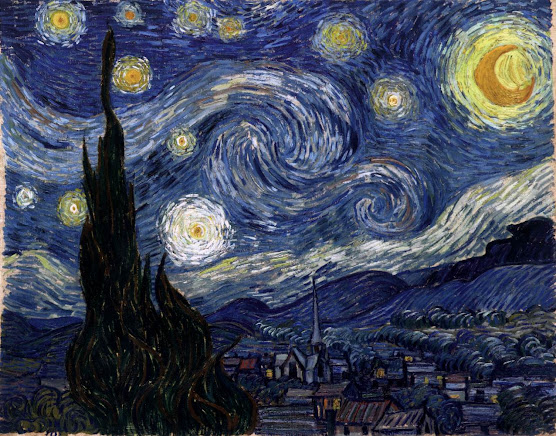
Starry Night 
Vincent van Gogh [Web Gallery of Art]

[The Lord] brought [Abram] outside and said, “Look towards heaven, and number the stars, if you are able to number them.” Then he said to him, “So shall your offspring be” (Genesis 15:5; First Reading).

+++

I am preparing this under the shadow of the invasion of Ukraine by Russia. That shadow covers the whole world. Today's gospel tells us: As [Peter] was saying these things, a cloud came and overshadowed them, and they were afraid as they entered the cloud. But there are breaks in that dark cloud where we can catch a glimpse of God's loving presence such as the story of Hassan Al-Khalaf, the 11-year-old boy who travelled on his own on a journey of 1,000 kms to safety in Slovakia where he was welcomed warmly. Another glimpse of God's loving presence is the wedding of a young couple in the middle of the invasion, Yaryna and Sviatoslav trusting in God with hope for the future. These two events are for me 'Transfiguration moments', two of many that we can glimpse in this war. 

Another such 'Transfiguration moment' is the story below. I have used it before because it reveals for me God's presence in the midst of so much that could lead us to despair.

+++

By the mystery of this water and wine may we come to share in the divinity of Christ who humbled himself to share in our humanity. 

The deacon or priest says these words quietly as he pours wine and a little water into the chalice during the Offertory of the Mass. In today's gospel Jesus, who humbled himself to share in our humanity, allowed Peter, James and John to get a glimpse of his divinity. Moses and Elijah spoke of what Jesus was to accomplish at Jerusalem. That was not only his death but his Resurrection and glorification.


Jesus calls us to share in his Resurrection and glorification, to share in the divinity that is his.

We don't share in the Resurrection, glorification and divinity of Jesus Christ only after death but also, as Peter, James and John did in the Transfiguration, in this life when we experience the gift of God's love in events that can transform us here and now.

My Australian fellow Columban, Fr Warren Kinne, who worked in Mindanao, Philippines, for a long time before spending many years in China, tells the story of Xiao Ai, who was in her early days a 'non-person'. But through the love and care of strangers, Chinese and foreign, she now has possibilities open to her that she never could have imagined. And Father Warren, who has some Chinese ancestry, sees her story as encapsulating in some ways the meaning of Lent and Easter. Here's how he tells it. It's taken from the January-February 2013 issue of MISYONonline.com, the Columban online magazine I used to edit in the Philippines. It is also on the website of the Columbans in Australia and New Zealand. 

Xiao Ai


by Fr Warren Kinne

Before the great Feast of Easter when we celebrate the death and resurrection of Jesus, the Church goes through a period of preparation by prayer and fasting. We call this Lent. In the northern hemisphere, where Christianity started, it was celebrated in spring and slowly, throughout that time, the dead of winter burst forth into the luxuriance of new growth, signifying life and the resurrection.

Xiao Ai is a young friend of mine. She was left at the steps of a convent about 2004 or 2005 in a remote village of Shan Xi Province, China. She was born with clubbed feet and abandoned. Xiao was brought to Shanghai where a group of foreigners provided money and logistical support for multiple operations.

During that period she was taken in by a family who took great care of her and eventually wanted to adopt her as their own. However there were many hurdles to be overcome. Xiao Ai did not have any identification as the convent was not a registered orphanage and so was not in a position to register her. Indeed people could only guess at her actual birth date. She was really a ‘non-person’.

After years of effort Xiao Ai has had all her paperwork completed and she now has a Chinese passport that will allow her to travel with her adopted family to Singapore. What happiness followed the long and anxious wait where a wonderful outcome was hoped for rather than expected.

Xiao Ai and Fr Warren Kinne
For the Lord takes delight in his people 
(Psalm 149:4, Grail translation)

Xiao’s struggle to me is a Lenten story that has become an Easter story; a fast that turned into a feast; a long journey in a desert that ended in freedom; a near death that heralded a resurrection, a new life.
Shanghai is a city of tinsel and glitter. Most people recognize the image of its iconic buildings and towering structures along the Huang Pu River. There are myriad neon signs and a ‘yuppie’ lifestyle for many expatriates who ride the wave of economic frenzy. But it has its under-belly.
The construction of this city has been done on the backs of migrant workers - currently seven million - who have travelled to the city to find work. They left their villages and often their families in order to make a little money on construction sites and in restaurants and factories.
These people do not have residency permits in Shanghai and so they cannot settle down where they work. Often they leave their children back in the village in the care of grandparents and may only get home once a year – during the Chinese New Year – to see how the family is going.
Children can resent their absence and may not appreciate the sacrifice of the parent or parents in order to better the whole family economically.
In the cities where they work they do not have equal access to medical and educational opportunities that are open to the local population.
Their sacrifice is a sort of ‘Lent’ lived in the hope of a better future for their family. Like Xiao Ai’s adopting parents or the migrant parents, they in fact live the admonition of God in Isaiah 58: 6-7: Is not this the fast that I choose: to share your bread with the hungry and bring the homeless poor into your house; when you see the naked, to cover him. [Editor's note: This is what is happening in Ukraine's neighbouring countries right no especialy in Poland.]
God brought the slaves out of the land of Egypt where they had made bricks for the ostentatious buildings of the Pharaohs. This same God made a covenant with them and subsequently with us that we might treat each other differently because in one way or another we have all been freed. The worship of the market and the God of money has caused many to suffer. May we all have the courage to live a Lent that will usher in true life for the world.

Xiao Ai in 2016
Just the other day Fr Kinne told me in an email that Xiao Ai is doing well in Singapore. He had been speaking to her mother the day before.

With Fr Kinne in 2016


+++

Beauty in Eastern Catholicism

St George's Cathedral, Lviv
Mother church of Ukrainian Greek Catholic Church

About two-thirds of Ukraine's population of more than 41 million (pre-invasion) are Orthodox Christians. Eleven per cent of the people are Catholics, most of them members of the Greek Ukrainian Catholic Church, in full communion Rome. Most of the Catholics live in the west of the country and Lviv is a predominantly Catholic city.

There are more than twenty Eastern Catholic churches in full communion with Rome, with their origins in Eastern Europe, the Middle East and India.


Traditional Latin Mass

Second Sunday in Lent

The Complete Mass in Latin and English is here. (Adjust the date at the top of that page to 03-13-2022 if necessary).

Epistle: 1 Thessalonians 4:1-7.  Gospel: Matthew 17:1-9.

Transfiguration of Christ
Paolo Veronese [Web Gallery of Art]

04 March 2022

'You shall worship the Lord your God, and him only shall you serve.' Sunday Reflections, 1st Sunday of Lent, Year C


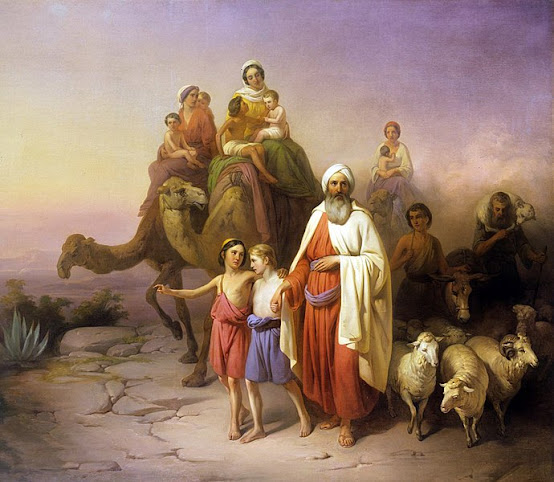
Abraham's Journey from Ur to Canaan
József Molnár [Wikipedia; source]

A wandering Aramean was my father. And he went down into Egypt and sojourned there, few in number, and there he became a nation, great, mighty, and populous (Deuteronomy 16:5; First Reading). 

Readings (Jerusalem Bible: Australia, England & Wales, Ireland, New Zealand, Pakistan, Scotland, South Africa)

Readings (New American Bible: Philippines, USA)

Gospel Luke 4:1-13 (English Standard Version Anglicised: India)  

Jesus, full of the Holy Spirit, returned from the Jordan and was led by the Spirit in the wilderness for forty days, being tempted by the devil. And he ate nothing during those days. And when they were over, he was hungry. The devil said to him, “If you are the Son of God, command this stone to become bread.” And Jesus answered him, “It is written, ‘Man shall not live by bread alone.’” And the devil took him up and showed him all the kingdoms of the world in a moment of time, and said to him, “To you I will give all this authority and their glory, for it has been delivered to me, and I give it to whom I will. If you, then, will worship me, it will all be yours.” And Jesus answered him, “It is written,

“‘You shall worship the Lord your God,
    and him only shall you serve.’”

And he took him to Jerusalem and set him on the pinnacle of the temple and said to him, “If you are the Son of God, throw yourself down from here, for it is written,

“‘He will command his angels concerning you,
    to guard you’,

and

“‘On their hands they will bear you up,
    lest you strike your foot against a stone.’”

And Jesus answered him, “It is said, ‘You shall not put the Lord your God to the test.’” And when the devil had ended every temptation, he departed from him until an opportune time.


Léachtaí i nGaeilge


Filling station, Romania

From 1973 till 1976 I was chaplain in the college department of a school run by religious sisters in Mindanao, Philippines. Part of my job was to teach religion, four semesters of which every student had to take. I remember one student in particular, whom I will call Bernadette (not her real name) who was taking a two-year secretarial course. She came from a large family and her parents earned just enough money to get by. They were both actively involved in the parish.

When Bernadette graduated she got a job as a bookkeeper in a filling station. Her salary, though small, was a great help to the family. She was asked by her employer to keep two different sets of books. She realised after some time that this was a way of avoiding paying taxes. Her conscience bothered her and she spoke to her parents about it. The three of them saw that Bernadette was being asked to take part in a sinful activity. So she, still in her late teens, resigned from her job. She had the full support of her parents who knew that the loss of Bernadette's salary was a sacrifice for the whole family. Man shall not live by bread alone.

I am preparing this on the Thursday after Ash Wednesday where the First Reading of the Mass (Deuteronomy 30: 15-20) says, I have set before you life and death, blessing and curse. Therefore choose life, that you and your offspring may live, loving the Lord your God, obeying his voice and holding fast to him, for he is your life and length of days . . .

Jesus, the Word [who] became flesh and dwelt among us, suffered temptation on our behalf in the desert and it is in his strength that we can find the grace to resist temptation in whatever way it may come. We can take to heart the words of Deuteronomy 6:13 that Jesus quotes to Satan in today's gospel: You shall worship the Lord your God, and him only shall you serve. That is what enables us to do what Bernadette and her parents did: choose life, that you and your offspring may live, loving the Lord your God, obeying his voice and holding fast to him . . .


Kyrie eleison
Sung by Kyiv Chamber Choir

Kyrie eleison - Christe eleison - Kyrie eleison

Lord, have mercy - Christ, have mercy - Lord, have mercy

Lent is a time of prayer, fasting and almsgiving. Many people try to attend Mass each day during Lent where that is possible. When I was growing up in Dublin our parish church was full every weekday morning at the seven o'clock Mass, with workers and with students at primary and secondary level. Each was there by choice, making a sacrifice by getting up earlier. At Mass we hear the word of God and can receive the Lord Jesus Himself, Body, Blood, Soul and Divinity, in Holy Communion

Lent is a time for repentance. The Lord Jesus left us a beautiful way to experience that: the Sacrament of Reconciliation (Confession Penance). The Church requires us to go to confession at least once a year and to receive Holy Communion at least once during the Easter period. In some countries the latter may be done between the First Sunday of Lent and Trinity Sunday. However, this is a bare minimum and not a level of commitment to be recommended no more than joining a family meal only once a year when one is living at home would seem to be recommended.

It is up to us priests to make it possible for people to confess their sins so that they can receive absolution with the words I absolve you from your sins in the name of the Father and of the Son and of the Holy Spirit. The priest is not forgiving us in his own name but in the Name of the Holy Trinity. The priest, through the sacrament of Holy Orders, is acting in persona Christi, to use the Church's traditional Latin expression, 'In the Person of Christ'.

Fasting can take many forms: eating less, reducing our time on the internet, abstaining from alcoholic drinks. etc. None of this is for show but to share in the forty days of fasting of the Lord Jesus in the desert before he began his public ministry. And it does bring life to others.

There are endless needs to be met by almsgiving. As I write this I'm conscious of how the authorities and ordinary people in Poland and in other countries are welcoming refugees from Ukraine. More than a million Ukrainians, mostly women and children, have fled their country in one week. Most of these have made their way to Poland. Some have relatives there while others are heading for other countries. The local authorities and volunteers in Ukraine's neighbouring countries have been welcoming these refugees. And the same is happening in far too many other parts of the world.

Queen of Peace, pray for us.


Traditional Latin Mass

First Sunday in Lent

The Complete Mass in Latin and English is here. (Adjust the date at the top of that page to 03-06-2022 if necessary).

Epistle: 2 Corinthians 6:1-10.  Gospel: Matthew 4:1-11.

The Temptation of  Christ,

Juan de Flandes [Web Gallery of Art]