Since we are travellers and pilgrims in the world, let us ever ponder on the end of the road, that is of our life, for the end of our roadway is our home (St Columban, 8th sermon).
During my seminary days I learned about and was inspired by Fr Werenfried van Straaten OPraem (17 January 1913 - 31 January 2003), known as 'The Bacon Priest'. He was born in the Netherlands on 17 January 1913 and joined the Norbertines in neighbouring Belgium. This order gets that name from its founder, St Norbert (c1080 - 6 June 1134), whose feast is today. Its other popular name, 'The Premonstratensians', is derived from the valley of Prémontré in northern France, where the saint set up his first foundation. The members are sometimes known as 'The White Canons', from their habit. The official name in English is 'Canons Regular of Prémontré'.
Father Werenfried [in photo with Blessed John Paul II], whose religious name means 'Warrior for Peace', discovered what he called his true vocation, to be 'a beggar for God's suffering children', through the response of people to an article he wrote for his abbey's Christmas newsletter in 1947, a year and a half after the Second World War had ended in Europe. He began with these words:
'Eighty miles to the east lies a town (in post-war Germany) in ruins. Almost the only thing still standing is a gigantic air-raid shelter, a bunker, like those the Germans built everywhere to protect the population from the bombings.
'All the poor people of the town who still remain alive dwell in this one bunker. Thousands are crowded together in pestilential stench. Each family, insofar as they can still be called families, lies huddled together on a few square yards of concrete.
'Here there is neither fire nor warmth, other than the warmth of bodies crowded together. Among these people too, Christ seeks to dwell in His purity, His love, His goodness. The shepherds worshipped Christ in a stable, but these people have not even a stable. By human standards Christ cannot live here. There is no room for Him.'
With Blessed Mother Teresa in 1959
The nickname 'The Bacon Priest' [Dutch: Spekpater], used to make his mother indignant! In his own words he tells how he acquired it:
'One of these invitations [from a parish priest] included a tea party at the local Women’s Institute. This pious society was celebrating its golden jubilee, and besides cakes and tarts and thick ham-and-cheese sandwiches, the farmers’ wives felt the need of an official speaker. I was invited to enlighten the well-to-do agricultural circles on the subject of the bitter distress suffered in Germany.
'I must have spoken well that afternoon. One hundred and fifty well-nourished country women forgot the fragrant coffee urns and the piles of tasty food and shed tears of pity for the hard fate of their sorely afflicted former enemies. When I ended my barrage on their tender country hearts, there was dead silence. Even the priest could not utter a word for the tears rolling down his cheeks.
'As nobody spoke, I rose once more and declared encouragingly that the time had now come for the collection. Parish priest and farmers’ wives unanimously nodded their agreement, but then a better idea suddenly struck me. I proposed that each of those present should take a not-too-small piece of bacon out of the chimney and deliver it to the presbytery some time in the next few days. At the end of the week I would come with the car to collect it. Everyone consented and the Battle of the Bacon had begun. 'In this first parish I collected more than a ton of bacon.'
Post-War Europe
This invitation was a consequence of a talk he gave to a group of priests on retreat at his abbey in Tongerlo, Belgium. At the end of it he passed around his hat, the first of many such collections using the same hat. Many of the priests then invited him to visit their parishes.
With his famous hat
All of this eventually led to Aid to the Church in Need, which continues to respond to needs in many parts of the world, both spiritual and material. These are often combined in the building of chapels, including boat-chapels for the Russian Orthodox Church that travel along rivers there enabling many communities to have a celebration of the Eucharist.
London's The Daily Telegraph published a fine obituary of Father Werenfried.
A group of Irish women hurt by abortion have launched a national billboard campaign to reach out to women with similar experiences.
The group, called Women Hurt, consists of women who experienced abortion and regret the decision but have found hope, help and healing over time. They hope to reach other women who have not previously been able to access help or tell their story.
Speaking to ciNews, one of the spokespersons for the group, Lyn Coles, from Co. Down, said that, while every woman's experience of abortion was different, there are a number of common factors.
She said that coercion, by parents, partners, boyfriends or husbands was very often a factor. “Women are told they'll be able to 'get on with their lives',” she said. But she said that, whatever the circumstances of the case, it is the abortion that is the damaging factor.
Involved in helping women hurt by abortion for 15 years, Lyn says that whether the pregnancy concerned was the result of rape, or whether the motivating factor was the desire for a career, the impact is similar. And while later term abortions tend to be more disturbing, abortions performed using drugs like RU-486 can be just as disturbing as earlier term surgical abortions.
For most women who have had abortions, she says, it is a subject they are extremely reluctant to talk about.
“Denial is a strong coping mechanism, and society won't talk to them about it, so the woman feels isolated,” Lyn says. In her own case, she says she was made to feel stupid for asking about whether she had woken up during the abortion.
“I decided there and then, that I would not ask any more questions about the abortion ever again. I would put it out of my mind as never having happened. That day, the walls went up and my voice was silenced,” Lyn says.
The impact of this on many women is akin to Post Traumatic Stress Disorder. Symptoms like depression, anger, guilt, flashbacks and insomnia are common, and memories of the procedure can be triggered by the child's birthday or Christmas.
Society implicitly tells women that they have no right to feel guilty over the decision, because it was their choice, Lyn says. That is why she and the other women involved in Women Hurt have chosen to launch this campaign, which is intended to encourage women to access their website, she adds.
“It is there as a portal, so women can access help if they need it. It allows them to tell their story anonymously,” Lyn says. She says that many women do not want anyone to know about their abortion, and suggests that is why it has taken so long for a group like Women Hurt to emerge.
Lyn stresses that the group has no political or religious agenda. She says that she has come across many women, who would be politically “pro-choice” and would have chosen to have their abortion in a calculating way, end up immediately regretting their abortion.
The billboard campaign, which is launched this week, is set to run around the country for a fortnight.
Rachel's Vineyard is a safe place to renew, rebuild and redeem hearts broken by abortion.
Healing Weekends offer you a supportive, confidential and non-Judgmental environment where women and men can express, release and reconcile painful post-abortive emotions to begin the process of restoration, renewal and Healing.
'These week-ends offer a supportive, confidential, emotionally safe environment where women and men can express, release and reconcile painful post-abortion emotions and begin the process of restoration, renewal and healing.
'Married couples, mothers, fathers, grandparents, and anyone affected by abortion have come to Rachel’s Vineyard in search of peace and inner healing.
'The weekend is a lot of work, but those who are willing to journey through their grief will experience the power of resurrection in their own lives. They will find meaning in what has happened and allow God to transform the experience into something that gives hope, liberation and peace.'
The links above are to the website of Rachel's Vineyard Ireland. Here are links to websites in other countries:
Readings(New American Bible, used in the Philippines and USA)
Gospel, Matthew 28:16-20 (NAB)
The eleven disciples went to Galilee,
to the mountain to which Jesus had ordered them.
When they saw him, they worshiped, but they doubted.
Then Jesus approached and said to them,
“All power in heaven and on earth has been given to me.
Go, therefore, and make disciples of all nations,
baptizing them in the name of the Father,
and of the Son, and of the Holy Spirit,
teaching them to observe all that I have commanded you.
And behold, I am with you always, until the end of the age.
Soiscéal, Matha 28:16-20 (Gaeilge, Irish)
D’imigh an t-aon deisceabal déag leo go dtí an Ghailíl, go dtí an sliabh a cheap Íosa mar ionad coinne dóibh, agus ar a fheiceáil dóibh d’umhlaigh siad dó, ach go raibh amhras ar chuid acu. Tháinig Íosa chucu agus labhair sé leo: “Tá gach údarás tugtha domsa ar neamh agus ar talamh. Imígí dá bhrí sin, déanaigí deisceabail de na náisiúin uile, á mbaisteadh in ainm an Athar agus an Mhic agus an Spioraid Naoimh, ag múineadh dóibh gach ní atá ordaithe agam a choinneáil. Agus féach, táim in éineacht libh i gcónaí go dtí deireadh an tsaoil.”
Today's gospel is a profoundly missionary one. As he leaves us in visible form Jesus commands us to 'make disciples of all nations'. From the beginning it has been at the heart of the nature of the Church to share the Good News of the Resurrection of our Lord Jesus to the end of the known world. The apostles went around the Mediterranean world and all but John were martyred. St Thomas reputedly went to India where he is venerated by Catholics of the Syro-Malabar rite and of the Syro-Malankara rite, which is particularly strong in Kerala.
It is not by accident that the Church chose the Solemnity of the Ascension, or the Sunday after the Ascension where the feast is celebrated on its proper day, Ascension Thursday, as World Communications Sunday. The internet became a reality for most of us only in the latter days of the papacy of Blessed John Paul II. Pope Benedict is very much aware of the opportunity the web offers for proclaiming the gospel. he has written and spoken about this many times, challenging young people especially to use it well in what he has called the 'Digital Continent'.
Some years ago I found myself by accident, or rather providentially, 'chatting' online with a friend on the other side of the world. I could sense immediately that my friend was going through a deep crisis and might do something drastic. I was able to get the person through the immediate crisis and to agree to meet with a priest in the area where my friend lived. I emailed a priest whom I didn't know but whose contact details I got from another person whom I knew only by email correspondence. The subsequent meeting of my friend and the priest proved to be life-saving.
This experience gave me a profound sense of the possibilities the internet offers. Pope Benedict writes in his message for this year's World Communications Sunday, the 45th: The new technologies are not only changing the way we communicate, but communication itself, so much so that it could be said that we are living through a period of vast cultural transformation. This means of spreading information and knowledge is giving birth to a new way of learning and thinking, with unprecedented opportunities for establishing relationships and building fellowship. [All emphases mine].
He further writes: As with every other fruit of human ingenuity, the new communications technologies must be placed at the service of the integral good of the individual and of the whole of humanity. If used wisely, they can contribute to the satisfaction of the desire for meaning, truth and unity which remain the most profound aspirations of each human being.
Pope Benedict is well aware both of the possibilities the internet offers and of its limitations: The new technologies allow people to meet each other beyond the confines of space and of their own culture, creating in this way an entirely new world of potential friendships. This is a great opportunity, but it also requires greater attention to and awareness of possible risks. Who is my 'neighbour' in this new world? Does the danger exist that we may be less present to those whom we encounter in our everyday life? Is there is a risk of being more distracted because our attention is fragmented and absorbed in a world 'other' than the one in which we live? Do we have time to reflect critically on our choices and to foster human relationships which are truly deep and lasting? It is important always to remember that virtual contact cannot and must not take the place of direct human contact with people at every level of our lives.
The internet enabled me to reach out to a friend in deep crisis because I had already established a personal relationship with that individual. Had I not known my friend through personal contact it is unlikely that the interaction we had would have been so fruitful.
Yet when we try to communicate with people through any medium we can profoundly affect their lives if we are conveying the truth, or an aspect of the truth. The Gospels themselves were written 2,000 years ago. Unlike other ancient writings they are the living word of God because they are inspired by the Holy Spirit. The Holy Spirit continues to speak to our hearts through the living word that is the Bible and through the teaching of the Church. (The Holy Spirit is invisible but so is cyberspace and maybe this reality can give us some sense of how the Holy Spirit speaks to us).
But God speaks to us not only through the Scriptures, not only through the teaching of the Church but through many other forms of communication. I have been deeply affected by novels I have read, by TV programmes I have watched, by movies I have seen, by music, by radio. I remember one occasion here in the Philippines when a social telegram I sent - telegrams used to be the main means of long-distance communication here - lifted a friend over a deep crisis. This was followed up by meeting the person.
The Holy Father continues: When people exchange information, they are already sharing themselves, their view of the world, their hopes, their ideals. It follows that there exists a Christian way of being present in the digital world: this takes the form of a communication which is honest and open, responsible and respectful of others. To proclaim the Gospel through the new media means not only to insert expressly religious content into different media platforms, but also to witness consistently, in one’s own digital profile and in the way one communicates choices, preferences and judgements that are fully consistent with the Gospel, even when it is not spoken of specifically. Furthermore, it is also true in the digital world that a message cannot be proclaimed without a consistent witness on the part of the one who proclaims it. In these new circumstances and with these new forms of expression, Christian are once again called to offera response to anyone who asks for a reason for the hope that is within them (cf. 1 Pet 3:15).
We don't have to be 'talking about Jesus' all the time. If we did, no one would listen to us. (On the other hand, when people expect us to speak about Jesus, eg, in a homily, and we don't, they'll soon stop listening to us). But the Pope is saying that everything in our lives and everything we try to communicate should spring from that living relationship with Jesus the Risen Lord who commanded us to tell the whole world about him and who also said as his parting words, 'behold, I am with you always, until the end of the age'.
Even when it is proclaimed in the virtual space of the web, the Gospel demands to be incarnated in the real world and linked to the real faces of our brothers and sisters, those with whom we share our daily lives. Direct human relations always remain fundamental for the transmission of the faith!
Not all of us are 'into' the web. But we cannot ignore it as a reality. Pope Benedict says, I would like then to invite Christians, confidently and with an informed and responsible creativity, to join the network of relationships which the digital era has made possible. This is not simply to satisfy the desire to be present, but because this network is an integral part of human life.
Before printing very few could have imagined that revolutionary change that would come about in terms of communication. Even twenty years ago I could not have imagined the internet as part of my daily life. When I was parish priest in Lianga, Surigao del Sur, in eastern Mindanao, in 1993-94, the mayor was promising that by the following year the town would have a telephone! Now everyone has a cellphone and some are using the internet.
One priest who blogs wrote that when he began to do so he saw it as something of a hobby. He soon realised that he should pray each time he posts.
Pope Benedict concludes with these words: I invite young people above all to make good use of their presence in the digital world. I repeat my invitation to them for the next World Youth Day in Madrid, where the new technologies are contributing greatly to the preparations. Throughthe intercession of their patron Saint Francis de Sales, [patron saint of journalists on whose feast, 24 January, the message was issued] I pray that God may grant communications workers the capacity always to carry out their work conscientiously and professionally. To all, I willingly impart my Apostolic Blessing.
You can find the full text of the Pope's message here.
+++
A medium that has always spoken to our hearts and minds is music. Here are the text and two settings of the Introit, or Opening Verse of today's Mass.
Men of Galilee, why do you stand looking in the sky? The Lord will return, just as you have seen him ascend, alleluia.
Viri Galilaei, quid admirámini aspiciéntes in cælum? Alleluia. Quæmádmodum vidistis eum ascendentem in caelum, ita veniet, Alleluia. (Latin)
Gregorian chant:
Here is a setting of the same text by Palestrina:
When I was preparing this in Manila I wasn't able to listen to the music, due to lack of speakers. I thought that the above was a polyphonic setting by Palestrina. It's not. But here is such a setting by this great composer:
Today's Irish Times carries a story, Fewer than one in five attend Sunday Mass in Dublin, which reports the words of Archbishop Diarmaid Martin of Dublin at the ordination yesterday of seven deacons. “Many young people, despite years of religious education, have only marginal interest in the message of Jesus. Many who come to us today possess only a sort of cultural Catholicism which can easily deceive us about the depth of people’s faith,” said the archbishop. “Faith in Jesus Christ and in his church is not a free-for-all of opinions in which anything goes. Faith in Jesus has content and context. It is about knowing Jesus intimately.
The archbishop said the years ahead must be ones of renewal for the Irish church and he urged the seven deacons to play a critical role in that renewal. “I encourage you to reach out to the coming generations, presenting them in unambiguous terms the teaching of Jesus and challenging them not to be afraid to let the message of Jesus change their hearts,” he said.
Recently Archbishop Martin said that in some areas as few as two percent attend Sunday Mass. these would be mostly poorer parts of the city.
Up to the 1970s more than 90 percent of the people went to Mass every Sunday. So what is happening now is a huge change.
General Post Office (GPO) in the heart of the city. I was approached by two beggars here the first time I went into the city centre on this visit.
But one thing hasn't changed. The priest is still a target for beggars and drunks in the city centre. I've gone there a number of times during my current brief visit to my native city. I wore my clerical collar each time except today. When I was wearing it beggars made their way to me, all addressing me as 'Father'. One was a young Irishman talking into his mobile phone and I waved at him while passing on. antoher was a young woman, probably from Romania, who, when I made an excuse and didn't stop said 'But you are a Father!' At one time I might have felt guilty. I did feel a mild pang of guilt but not enough to spoil the lunch with old school friends I was heading for.
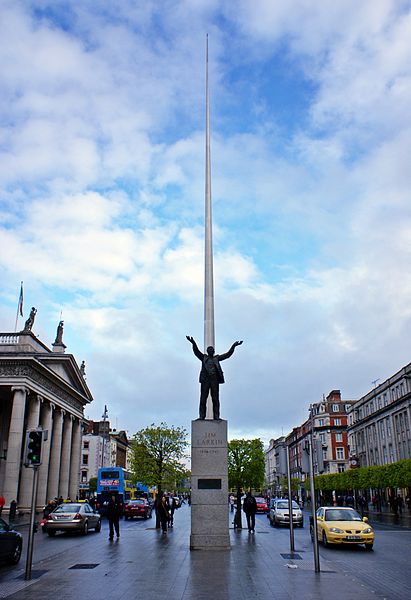
The Spire of Dublin in O'Connel St, behind the statue of Jim Larkin, a labour leader in the early part of the last century. The GPO is on the left. The Spire replaced Nelson's Pillar, blown up in 1966.
Last year as I was walking in another part of the city during the day a man in his 30s stopped me. He wasn't a beggar but if I had lit with a match the alcohol he was breathing out half of the city might have been destroyed in the ensuing explosion.
In my time in the seminary students wore a black suit and black tie when outside. We wore a soutane inside. Although students by definition hardly every have money to spare I was still a target for beggars and drunks. Sometimes the drunk was also a beggar. Sometimes he wanted to engage in an alcoholic discussion about theology or the Church. This happened more often on occasions such as wedding receptions.
For years I didn't wear my collar when going to the city centre, mainly because of beggars. I normally wear it now and simply keep going if a beggar tries to accost me. I've never been able to deal graciously with beggars or drunks, though on this visit I haven't been rude to any I have met.
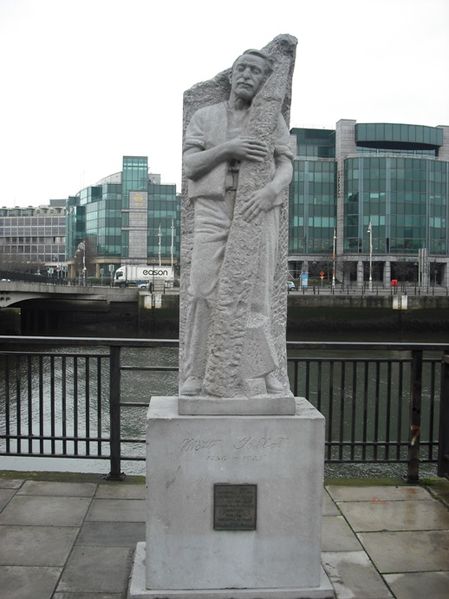
Statue of the Venerable Matt Talbot 1956-1925, who led a life of great austerity, under spiritual direction, for the last 40 years of his life after having been addicted to alcohol. You can read a brief biography of Matt here.
In the Philippines there have been occasions when individuals whom I saw simply as beggars became real persons for me when I listened to their story. In a couple of cases I would give a weekly 'allowance' on a fixed day. If they approached me on another day I'd smile and remind them of our agreement. In these situations both parties retained their dignity. These persons came to know me as an individual too and not someone to make feel guilty by a sort of 'blackmail', like the young woman in Dublin last week who reminded me that I was 'a Father'.
I prefer to channel what people give me to such projects as Holy Family Home for Girls in Bacolod City (above). I know too that many in Ireland are working with those on the margins there.
Readings (New American Bible, used in the Philippines and USA)
GOSPEL, John 14:15-21 (NAB)
Jesus said to his disciples:
“If you love me, you will keep my commandments.
And I will ask the Father,
and he will give you another Advocate to be with you always,
the Spirit of truth, whom the world cannot accept,
because it neither sees nor knows him.
But you know him, because he remains with you,
and will be in you.
I will not leave you orphans; I will come to you.
In a little while the world will no longer see me,
but you will see me, because I live and you will live.
On that day you will realize that I am in my Father
and you are in me and I in you.
Whoever has my commandments and observes them
is the one who loves me.
And whoever loves me will be loved by my Father,
and I will love him and reveal myself to him.”
AN SOISCÉAL Eoin 14:15-21 (Irish)
San am sin dúirt Íosa lena dheisceabail
'Má tá grá agaibh dom, coinneoidh sibh m’aitheanta. Agus iarrfaidh mé ar m’Athair é, agus tabharfaidh sé Abhcóide eile daoibh chun fanacht faraibh go deo – Spiorad na Fírinne, nach féidir don saol a ghlacadh, mar ní fheiceann sé é ná ní aithníonn sé é. Ach aithníonn sibhse é mar fanann sé faraibh, agus beidh sé ionaibh. Ní fhágfaidh mé in bhur ndílleachtaí sibh; tiocfaidh mé ar ais chugaibh. Tamall beag eile agus siúd é an saol agus gan radharc aige ormsa feasta; ach tá radharc agaibhse orm, óir táimse beo agus beidh sibhse beo chomh maith. An lá sin aithneoidh sibh go bhfuilimse i m’Athair, agus go bhfuil sibhse ionamsa, agus mise ionaibh. An té a bhfuil m’aitheantasa aige agus a choinníonn iad, sin é an té a bhfuil grá aige dom. An té a bhfuil grá aige dom, beidh grá ag m’Athair dó, agus beidh grá agam dó, agus taispeánfaidh mé mé féin dó.'
+++
Over the years I have met many young people who have been orphaned or who, for one serious reason or another, cannot enjoy a normal loving and safe family life. I have had young children from backgrounds like that tell me that they want me to be their father. That isn't possible in the usual sense but I amcalled to be a father in a very real way. I can be a father-figure, or grandfather-figure, to young people I know who don'at have a father.
But at a deeper level I am called as a priest to take proper care of those entrusted to me by the Church. I am called to point people towards our Lord Jesus Christ who in today's gospel speaks to us of God's desire to have an intimate relationship with us. Jesus is promising to send u the Holy Spirit who will draw us to the Father, who will bring us into the intimacy of the life of the Holy Trinity dwelling within us.
This can be difficult to grasp and can seem abstract but the evidence of the lives of those whom the Church formally recognises as holy is evidence of the joy that only god can give us and that he wanst each of us to have.
Today's gospel is taken from the words of Jesus at the Last Supper, the night before he died, in which he speaks to us of joy. This isn't something shallow but is in the depth of our souls, even when the surface isn't calm.
Jesus doesn't want us to be orphans. He wants each of us to come to know God as our loving Father. He wants our lives to be filled with joy so that they radiate with the truth that Jesus is truly risen, a joy that is evident in the Resurrection song below in a mall in Beirut.
Jesus is Risen
In a Beirut shopping Mall, Easter 2011
Thanks to Fr Tim Finigan for drawing this to my attention on his blog.
Most Catholics are unaware that many Arabs are Christians and have been so since the time of the Apostles, long before Islam came on the scene in the early part of the 7th century. Christian Arabs have suffered greatly in recent years in the Middle East and many have left the region. Performances such as that in the video above are called 'flash mobs'. I think it is a wonderfully joyful proclamation of the Resurrection in the marketplace, which the mall is in cities now throughout the world, in a country that has known much conflict in recent decades.
Below is a proclamation of the Resurrection in Arabic from the Byzantine Rite, produced in Canada by Catholics of the Melkite Rite and Orthodox Christians of the same rite.
Remember in your prayers all Christians living in the Middle East, most of whom are Arabs, that God's peace may reign in their hearts and in the hearts of Muslims and Jews living there for whom that part of the world is holy, as it is for us Christians.
Queen Elizabeth II of the United Kingdom of Great Britan and Northern Ireland was in the Republic of Ireland on a state visit from 17 to 20 May, the first time a British monarch has visited that part of Ireland since it became independent in 1922 and known then as The Irish Free State. Ireland and Britain have a tangled history and yet there are no two countries in the world that have closer practical ties. You don't need a passport to travel from one to the other. Irish citizens living in the UK have full voting rights there and British subjects - technically they aren't citizens but subjects of the reigning monarch - living in the Irish Republic have full voting rights there.
On the first day of her visit Queen Elizabeth visited the Garden of Remembrance in the centre of Dublin to lay a wreath in honour of those who had fought for the independence of Ireland. These had all fought against the British authorities. There were no speeches but by bowing after laying the wreath Queen Elizabeth spoke eloquently to most Irish people. For the majority it was a moment of healing, of reconciliation.
On the second day of the visit Queen Elizabeth laid a wreath at the Irish National War Memorial in Islandbridge, Dublin, dedicated to the 49,400 Irishmen who died in the Great War (1914-18) in the forces of the United Kingdom, which included the whole of Ireland at the time. The wreath was made of poppies, the symbol of the loss of life in Belgium and France. President Mary McAleese laid a laurel wreath.
Again, there were no speeches but the symbols spoke to Irish people. For decades the Irish involvement in World War I was airbrushed out of Irish history. Many Irishmen who joined the UK forces did so that Ireland and other countries might be free.
I'm in Dublin at the moment on a family visit. I am struck once again by the power of symbols in the context of rituals. At a time when the celebration of Mass and other liturgies is so often banal I think we can learn from ceremonies such as those at the Garden of Remembrance and at the Irish National War Memorial.
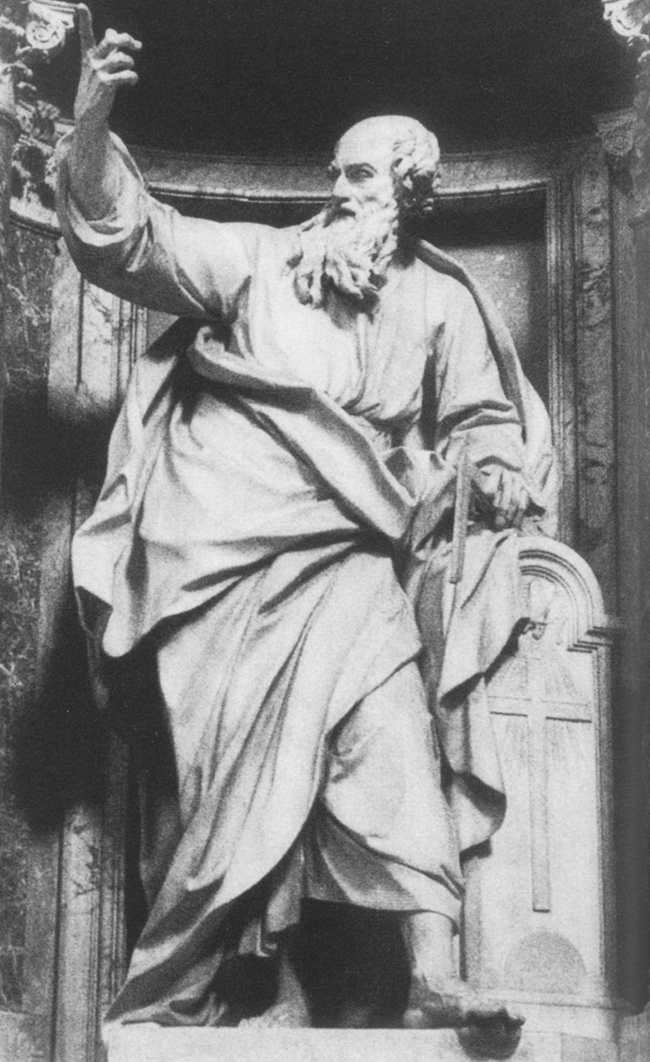
St Philip, Giuseppe Mazzuoli, marble in the Basilica of St John Lateran, the Pope's Cathedral, sculpted 1703-12
Readings (New American Bible, used in Philippines and USA)
Gospel John 14:1-12 (NAB)
Jesus said to his disciples: “Do not let your hearts be troubled. You have faith in God; have faith also in me. In my Father’s house there are many dwelling places. If there were not, would I have told you that I am going to prepare a place for you? And if I go and prepare a place for you, I will come back again and take you to myself, so that where I am you also may be. Where I am going you know the way.” Thomas said to him, “Master, we do not know where you are going; how can we know the way?” Jesus said to him, “I am the way and the truth and the life. No one comes to the Father except through me. If you know me, then you will also know my Father. From now on you do know him and have seen him.”
Philip said to him, “Master, show us the Father, and that will be enough for us.” Jesus said to him, “Have I been with you for so long a time and you still do not know me, Philip? Whoever has seen me has seen the Father. How can you say, ‘Show us the Father’? Do you not believe that I am in the Father and the Father is in me? The words that I speak to you I do not speak on my own. The Father who dwells in me is doing his works. Believe me that I am in the Father and the Father is in me, or else, believe because of the works themselves. Amen, amen, I say to you, whoever believes in me will do the works that I do, and will do greater ones than these, because I am going to the Father.”
+++
About seven years ago I was visiting Holy Family Home, Makati City, run by the Capuchin Tertiary Sisters of the Holy Family. Most of the girls there, about 25 of them, come from a background of extreme poverty, many of their fmailies living on the streets. On this occasion a girl of 14 or so - I'll call her Lucia - astounded me with a question that still resonates in my heart. I knew that Lucia had asthma and learned later that her father was a blind beggar. Her question was, 'How can I offer my life to God?'
I was speechless at first and then tried to explain something of the Little Way of StThérèse
of Lisieux, that everything we do when we do it with love is aready an offering of ourselves to God and that in time he would show her where he was calling her for the rest of her life.
Lucia was asking a question similar to that of St Thomas. Jesus was pointing the apostles towards the Father but had to spell it out for Thomas that he himself was 'the way, the truth and the life'. Lucia was a step ahead of the apostle. She wasn't asking the way but asking how she could offer her life to the Father.
Perhaps Lucia's question was closer to the request of St Philip, 'Show us the Father'. Again, Jesus pointed out that insofar as Philip and his companions knew him they knew the Father and that the Father was dwelling in him and working through him.
Pope Benedict in his various homilies, messages and so on is constantly telling us that our faith is in a Person, Jesus Christ. Jesus, God and Man, came to do the will of his Father and when he invites us to follow him he is asking us to desire nothing else except what the Father wills.
Lucia's was really asking what God's will was for her and how she could carry out the will of the Father. This young asthmatic girl, the daughter of a blind beggar, was going to the heart of the matter.
St Thomas the Apostle, Pierre Le Gros the Younger, marble in the Basilica of St John Lateran, sculpted 1705-11
+++
Entrance Antiphon
Sing to the Lord a new song, for he has done marvelous deeds; he has revealed to the nations his saving power, alleluia.(Ps 97:1-2)
Here is a setting of those words and succeeding verses of that psalm, which is Ps 96 in some versions of the Bible, by Spanish composer Sebastián de Vivanco (Ávila, 1551 - Salamanca, 1622). Performers: Orchestra of the Renaissance (Richard Cheetham)
Latin
Cantate Domino canticum novum,
quia mirabilia fecit, Jubilate Deo,
omnis terra, cantate et exsultate, et psallite. Psallite Domino in cithara et voce psalmi: in tubis ductilibus, et voce tubæ corneæ. Jubilate in conspectu regis Domini: moveatur mare, et plenitudo eius: orbis terrarum et qui habitant in eo.
English
Sing to the Lord a new song, for he hath done marvellous things.
Be joyful in God all lands, sing and exult and give praise.
Sing to the Lord with the harp and in psalms.
With trumpets and horns rejoice before the Lord the king.
Let the sea roar, and the fullness thereof,
all the world and they that dwell therein.
Castellano
Cantad al Señor una nueva canción, porque él ha hecho cosas maravillosas. Alégrense en Dios todas las tierras, canten, se exalten y den alabanzas. Cantar al Señor con el arpa y en los salmos. Con trompetas y cornos regocíjense ante el Señor, el Rey Que ruja el mar, en su plenitud, el mundo entero y todos los que en él viven.


.jpg/544px-Christ_Church_Cathedral_(Dublin).jpg)





.jpg)