Showing posts sorted by relevance for query Ragheed Ganni. Sort by date Show all posts

20 June 2019

'When I hold the Host in my hands, it is really He who is holding me and all of us.' Sunday Reflections, Corpus Christi, Year C

Pope Benedict elevating the Body of Christ at Mass [Wikipedia]


But when, holding the Eucharist, I say 'Behold the Lamb of God, who takes away the sin of the world', I feel His strength in me. When I hold the Host in my hands, it is really He who is holding me and all of us, challenging the terrorists and keeping us united in His boundless love (Fr Ragheed Ganni, Iraqi martyr).

Readings (New American Bible: Philippines, USA)

Readings (Jerusalem Bible: Australia, England & Wales, India [optional], Ireland, New Zealand, Pakistan, Scotland, South Africa)

Gospel Luke 9:11b-17 (New Revised Standard Version, Anglicised Catholic Edition, Canada)  

Jesus spoke to the crowds about the kingdom of God, and healed those who needed to be cured.
The day was drawing to a close, and the twelve came to him and said, ‘Send the crowd away, so that they may go into the surrounding villages and countryside, to lodge and get provisions; for we are here in a deserted place.’ But he said to them, ‘You give them something to eat.’ They said, ‘We have no more than five loaves and two fish—unless we are to go and buy food for all these people.’ For there were about five thousand men. And he said to his disciples, ‘Make them sit down in groups of about fifty each.’ They did so and made them all sit down. And taking the five loaves and the two fish, he looked up to heaven, and blessed and broke them, and gave them to the disciples to set before the crowd. And all ate and were filled. What was left over was gathered up, twelve baskets of broken pieces.


Twelfth Sunday in Ordinary Time, Year C
In countries where Corpus Christi is observed as a holyday of obligation on the Thursday after Trinity Sunday.
Readings (Jerusalem Bible

Luke 9:11b-17 in Filipino Sign Language


In the video above Bishop Robert E. Barron, auxiliary bishop of Los Angeles, tells a story about the young Flannery O'Connor (1925-1964), at the time a promising writer, and Mary McCarthy (1912-1989) an established writer. Mary Flannery O'Connor was a devout Catholic from the southern US state of Georgia where, at the time, Catholics were fewer than two percent of the population. Mary McCarthy, who lost both parents when a child and who had an unhappy upbringing, described herself when the two met as an ex-Catholic. She and her husband had invited the young Georgian for dinner. The latter was very shy. But when Mary McCarthy described the Eucharist as 'a very powerful symbol' Flannery O'Connor, overcoming her shyness, retorted almost violently, 'Well, if it's a symbol I say "to hell with it"'.
Bishop Barron goes on to speak of the Eucharist as ipse Christus, Christ himself, quoting St Thomas Aquinas, with whose writings Flannery O'Connor was very familiar. The bishop then speaks of Christ 'really, truly and substantially present'. 'Body, Blood, Soul and Divinity' is the Church's traditional way of speaking of the Real Presence of Jesus in the Eucharist. This is vastly different from being a symbol, though symbols can be powerful.

Servant of God, Fr Ragheed Ganni (1972-2007)

Chaldean Catholic priest Fr Ragheed Ganni was shot dead with three subdeacons, Basman Yousef Daud, Wahid Hanna Isho, and Gassan Isam Bidawed, in Mosul, Iraq, after celebrating Mass in Mosul, Iraq, on Trinity Sunday 2007. The cause for their beatification has begun.  Father Ragheed gave a powerful testimony on the Eucharist at a Eucharistic Congress in Bari, Italy, at a vigil there on 28 May 2005. I have posted this testimony a number of times but think that it is especially appropriate for the feast of Corpus Christi, the feast of the Body of Christ.


Fr Ragheed Ganni's Testimony

Mosul Christians are not theologians; some are even illiterate. And yet inside of us for many generations one truth has become embedded: without the Sunday Eucharist we cannot live.

This is true today when evil has reached the point of destroying churches and killing Christians, something unheard of in Iraq till now. In June 2004, a group of young women were cleaning the church to get it ready for Sunday service. My sister Raghad, who is nineteen, was among them. As she was carrying a pail of water to wash the floor, two men drove up and threw a grenade that blew up just a few yards away from her. She was wounded but miraculously, survived. And on that Sunday, we still celebrated the Eucharist. My shaken parents were also there. For me and my community, my sister’s wounds were a source of strength so that we, too, may bear our cross.

Last August in St Paul’s Church, a car bomb exploded after the 6 pm Mass. The blast killed two Christians and wounded many others. But that, too, was another miracle – the car was full of bombs but only one exploded. Had they all gone off together, the dead would have been in the hundreds since 400 faithful had come on that day. People could not believe what had happened. The terrorists might think they can kill our bodies or our spirit by frightening us, but, on Sundays, churches are always full. They may try to take our life, but the Eucharist gives it back.

On 7 December, the eve of the Immaculate Conception, a group of terrorists tried to destroy the Chaldean Bishop’s Residence, which is near Our Lady of the Tigris Shrine, a place venerated by both Christians and Muslims. They placed explosives everywhere, and a few minutes later blew the place up. This and fundamentalist violence against young Christians has forced many families to flee. Yet the churches have remained open and people continue to go to Mass, even among the ruins.

It is among such difficulties that we understand the real value of Sunday, the day when we meet the Risen Christ, the day of our unity and love, of our (mutual) support and help. There are days when I feel frail and full of fear. But when, holding the Eucharist, I say 'Behold the Lamb of God, who takes away the sin of the world', I feel His strength in me. When I hold the Host in my hands, it is really He who is holding me and all of us, challenging the terrorists and keeping us united in His boundless love.

In normal times, everything is taken for granted and we forget the greatest gift that is made to us. Ironically, it is thanks to terrorist violence that we have truly learnt that it is the Eucharist, the Christ who died and is risen, that gives us life. And this allows us to resist and hope


Apse of Chapel, Irish College, Rome
Fr Ragheed Ganni is on the far right, holding the palms of martyrdom.

Fr Ragheed Ganni lived in the Pontifical Irish College in Rome while he studied theology, before and after his ordination. He would have been familiar with the 17 Irish martyrs, a representative group, beatified by St John Paul II on 27 September 1992. Among them were four known as the Wexford Martyrs, Matthew Lambert, a baker, and three sailors, Robert Tyler, Edward Cheevers and Patrick Cavanagh, who were hanged, drawn and quartered in Wexford on 5 July 1591. The opening words of Father Ganni's testimony, Mosul Christians are not theologians; some are even illiterate, echo those of Matthew Lambert. He could not read or write and said in court under questioning, I am not a learned man. I am unable to debate with you, but I can tell you this, I am a Catholic and I believe whatever our Holy Mother the Catholic Church believes

This testimony was given by a baker who died for his belief in the Bread of Life and, to use the words of Fr Ragheed Ganni, the Eucharist, the Christ who died and is risen, that gives us life. 


The Supper at EmmausVelázquez [Web Gallery of Art]

Then they told what had happened on the road, and how he had been made known to them in the breaking of the bread (Luke 24:35).


Ego sum panis vivus. Patres vestri manducaverunt manna in deserto, et mortui sunt. Hic est panis de coelo descendens: si quis ex ipso manducaverit, non morietur. [Ioannes 6: 48-50]

I am the bread of life. 
Your ancestors ate the manna in the wilderness, 
and they died. 
This is the bread that comes down from heaven, 
so that one may eat of it 
and not die. [John 6:48-50]

04 June 2008

'I cannot shut God's house!' - Fr Ragheed Ganni's last words

The more I read about this young priest, Fr Ragheed Ganni, murdered on Pentecost Sunday 2007 in Mosul, Iraq, after celebrating Mass, the more I see a man who truly lived his priesthood, a man who was cheerful and who enjoyed life but was ready to die if necessary for his faith. In his case this wasn't just a resolution that many of us make in the fervor of a retreat, for example, but in the reality of the war in Iraq and threats by some against Christians.

We will be featuring Father Ragheed in the July-August issue of Misyon, which I edit. In the current May-June issue you can read about Father Rey Roda OMI, murdered here in the Philippines last January because, like Father Ragheed, he chose to stay with his people.

Check out the new website dedicated to Father Ragheed Ganni. It is in both English and Arabic, a gentle reminder to us that there have been Arab Christians since the time of the Apostles and that not all Arabs are Muslims. It's also a reminder to us that not all Catholics are members of the Latin or Roman Rite of the Catholic Church. Father Ragheed was a member of the Chaldean Rite of the Catholic Church.

AsiaNews published the story below yesterday. The Pontifical Irish College in Rome, where Father Ragheed stayed while studying for the priesthood, doesn't yet have a report on the even held on 31 May and mentioned below. However, their website has a page dedicated to Father Ragheed.

On the first anniversary of the murder of the Chaldean pastor of Mosul, the only witness to the killing speaks out: Ragheed was killed because he was not afraid. The woman, the widow of one of the three subdeacons slaughtered together with the priest, is living in Syria, waiting to start a new life with her children.

Damascus (AsiaNews) - He could have run away, saved himself, but he went to meet his destiny without fear. Fr Ragheed Gani, killed one year ago in Iraq, died because up until the very end he remained convinced that Christians should not be afraid, that "God's house cannot be closed!". On the first anniversary of the "martyrdom", the only witness to it is speaking out: Bayan Adam Bella, wife of one of the three subdeacons murdered in cold blood together with their pastor on June 3, 2007, in Mosul. This is the same diocese that last March lost its bishop, Faraj Rahho, also a victim of terrorism.

The woman, interviewed by Ankawa.com, is now a refugee in Syria together with her four children. They live with her brother-in-law's family. She suffers greatly and is full of questions over a fate that she is still not able to understand, and over her continuing difficulties in obtaining a visa. But now, twelve months later, she finally has the strength to give a more complete account of those tragic moments. After celebrating the Eucharist in his parish, the Church of the Holy Spirit, Fr Ragheed had departed by car together with one of the deacons, his cousin Basman Yousef Daud. Bayan was in a car behind them, together with her husband, Wahid Hanna Isho, and the other deacon, Gassan Isam Bidawed. Recently the three had begun to accompany the priest wherever he went in an effort to protect him after repeated death threats.

"At a certain point", the woman recounts, "the car was stopped by armed men. Fr Ragheed could have fled, but he did not want to, because he knew they were looking for him. They forced us to get out of the car, and led me away. Then one of the killers screamed at Ragheed, 'I told you to close the church, why didn't you do it? Why are you still here?'. And he simply responded, 'How can I close the house of God?' They immediately pushed him to the ground, and Ragheed had only enough time to gesture to me with his head that I should run away. Then they opened fire and killed all four of them". At this point, Bayan fainted. In the hours immediately after the killing, the bodies remained abandoned on the road because no one dared to get close to them. They were all buried in Karamles.

Bayan has many questions: "Why did they make me a widow, why did they tear the word 'papa' from the mouths of my children? What did we do wrong? What did my husband do?", she asks, addressing the terrorists. In August of 2007, she asked the UNHCR for humanitarian asylum in the West, but the difficulties are enormous. "At first no one believed my story. How can they shut the door in the face of such suffering?". In January of 2008, she met again with UN staff. Now she is waiting for nothing more than to start life over for herself and her children.

Ceremonies commemorating the four martyrs were held in northern Iraq. In Rome, the Pontifical Irish College organised a conference last May 31 entitled "Witnesses to Christ, Past and Present", to recall the sacrifice of Ragheed, a former student of the college. Cardinal Kasper, head of the Pontifical Council for the Promotion of Christian Unity, and Monsignor Parolin, undersecretary for relations with states, participated in the event.

14 July 2015

'I will raise up shepherds . . .' Sunday Reflections, 16th Sunday in Ordinary Time, Year B

Akademie der bildenden Künste, Vienna [Web Gallery of Art]
'They were like sheep without a shepherd.'


Readings (New American Bible: Philippines, USA)

Readings (Jerusalem Bible: Australia, England & Wales, India [optional], Ireland, New Zealand, Pakistan, Scotland, South Africa)


The apostles gathered around Jesus, and told him all that they had done and taught. He said to them, “Come away to a deserted place all by yourselves and rest a while.” For many were coming and going, and they had no leisure even to eat. And they went away in the boat to a deserted place by themselves. Now many saw them going and recognized them, and they hurried there on foot from all the towns and arrived ahead of them. As he went ashore, he saw a great crowd; and he had compassion for them, because they were like sheep without a shepherd; and he began to teach them many things.


Fr Ragheed Aziz Ganni 
(20 January 1972 - 3 June 2007)
I will raise up shepherds over them who will shepherd them, and they shall not fear any longer, or be dismayed, nor shall any be missing, says the Lord (Jeremiah 23:4. First Reading).

On at least six occasions during his recent nine-day pastoral visit to Ecuador, Bolivia and Paraguay, Pope Francis asked the people to pray for him, as he did when he addressed the people in St Peter's Square for the first time as pope in 2013. Perhaps he has constantly in mind two statements in today's First Reading from the Prophet Jeremiah: 'Woe to the shepherds who destroy and scatter the sheep of my pasture! says the Lord . . .  I will raise up shepherds over them who will shepherd them, and they shall not fear any longer, or be dismayed, nor shall any be missing, says the Lord.'

Jesus shows his concern for the apostles when they returned from the mission on which he had sent them as shepherds when 'He said to them, “Come away to a deserted place all by yourselves and rest a while.”'

Ballachulish, Scotland
'Come away to a deserted place all by yourselves and rest a while.'

Perhaps we can pray in a special way for our priests as we take part in Mass this Sunday. We have countless models of priests who have been worthy shepherds, evening to laying down their lives for the flock they were called to serve. One such shepherd is an Iraqi priest with Irish connections, Fr Ragheed Ganni, assassinated along with three subdeacons, his cousin Basman Yousef Daud, Wahid Hanna Isho, and Gassan Isam Bidawed, after celebrating Mass in Mosul, Iraq, on Trinity Sunday, 3 June 2007.

Apse of Chapel, Irish College, Rome
St Columban second from left, Fr Ragheed far right.
[Details at source]

An engineer by profession, Ragheed answered God's call to become a priest and studied theology in Rome, before and after his ordination in 2003. While there he stayed at the Pontifical Irish College where he became known as 'Paddy the Iraqi', 'Paddy' being a common nickname for men named Patrick, after Ireland's national patron, and a humorous generic name for any Irishman. As a priest still studying in Rome he spent part of his summers as a member of the staff at Lough Derg, known as St Patrick's Purgatory, a place of penitential pilgrimage in Ireland.

Mosaic of Fr Ragheed Ganni with palms of martyrdom, Chapel of Irish College, Rome [Source]

Yet this young Iraqi who, according to the statement of one friend after the priests' murder, 'knew where the best pizza in Rome was', chose to go back to his own country, knowing that his life might be in danger. He spoke of this at a Eucharistic Congress in Bari, Italy, two years before his death. The theme of the Congress was Without Sunday We Cannot Live, 'Sunday' meaning most especially the celebration of Holy Mass.

Basilica of St Nicholas, Bari [Wikipedia]

Fr Ragheed Ganni's Testimony

Mosul Christians are not theologians; some are even illiterate. And yet inside of us for many generations one truth has become embedded: without the Sunday Eucharist we cannot live.
This is true today when evil has reached the point of destroying churches and killing Christians, something unheard of in Iraq till now. In June 2004, a group of young women were cleaning the church to get it ready for Sunday service. My sister Raghad, who is nineteen, was among them. As she was carrying a pale of water to wash the floor, two men drove up and threw a grenade that blew up just a few yards away from her.
She was wounded but miraculously, survived. And on that Sunday, we still celebrated the Eucharist. My shaken parents were also there. For me and my community, my sister’s wounds were a source of strength so that we, too, may bear our cross.
Last August in St Paul’s Church, a car bomb exploded after the 6 pm Mass. The blast killed two Christians and wounded many others. But that, too, was another miracle – the car was full of bombs but only one exploded. Had they all gone off together, the dead would have been in the hundreds since 400 faithful had come on that day.
People could not believe what had happened. The terrorists might think they can kill our bodies or our spirit by frightening us, but, on Sundays, churches are always full. They may try to take our life, but the Eucharist gives it back.
On 7 December, the eve of the Immaculate Conception, a group of terrorists tried to destroy the Chaldean Bishop’s Residence, which is near Our Lady of the Tigris Shrine, a place venerated by both Christians and Muslims. They placed explosives everywhere, and a few minutes later blew the place up. This and fundamentalist violence against young Christians has forced many families to flee. Yet the churches have remained open and people continue to go to Mass, even among the ruins.
It is among such difficulties that we understand the real value of Sunday, the day when we meet the Risen Christ, the day of our unity and love, of our (mutual) support and help. There are days when I feel frail and full of fear. But when, holding the Eucharist, I say ‘Behold the Lamb of God, who takes away the sin of the world’, I feel His strength in me. When I hold the Host in my hands, it is really He who is holding me and all of us, challenging the terrorists and keeping us united in His boundless love.
In normal times, everything is taken for granted and we forget the greatest gift that is made to us. Ironically, it is thanks to terrorist violence that we have truly learnt that it is the Eucharist, the Christ who died and risen, that gives us life. And this allows us to resist and hope. 
[This appeared in The Sacred Heart Messenger (April 2008), a publication of the Irish Jesuits.]
(20 November 1942 - kidnapped 29 February, body found 13 March 2008) [Photo: The Path to Peace Foundation]

Father Ragheed was secretary to Archbishop Rahho, The Chaldean Archbishop of Mosul. Most Catholics in Iraq and Syria belong to the Chaldean Catholic Church, in full communion with Rome. 'The Eucharist, the Christ who died and risen, that gives us life' was celebrated every Sunday in Mosul for 1,600 years - until June 2014 when the ISIS forces drove out the remaining Christians.

The words of Jeremiah, 'I will raise up shepherds over them who will shepherd them', have surely been fulfilled in the lives and deaths of such priests as Fr Ragheed Ganni and Archbishop Rahho. As we thank God for them and for countless other faithful priest-shepherds, let us continue to pray for all our priests and for Christians who are being persecuted for their faith.

John Rutter's setting of The Lord is my shepherd, Psalm 22[23], which is used as today's Responsorial Psalm.

18 July 2018

'Without the Sunday Eucharist we cannot live.' Sunday Reflections, 16th Sunday in Ordinary Time, Year B

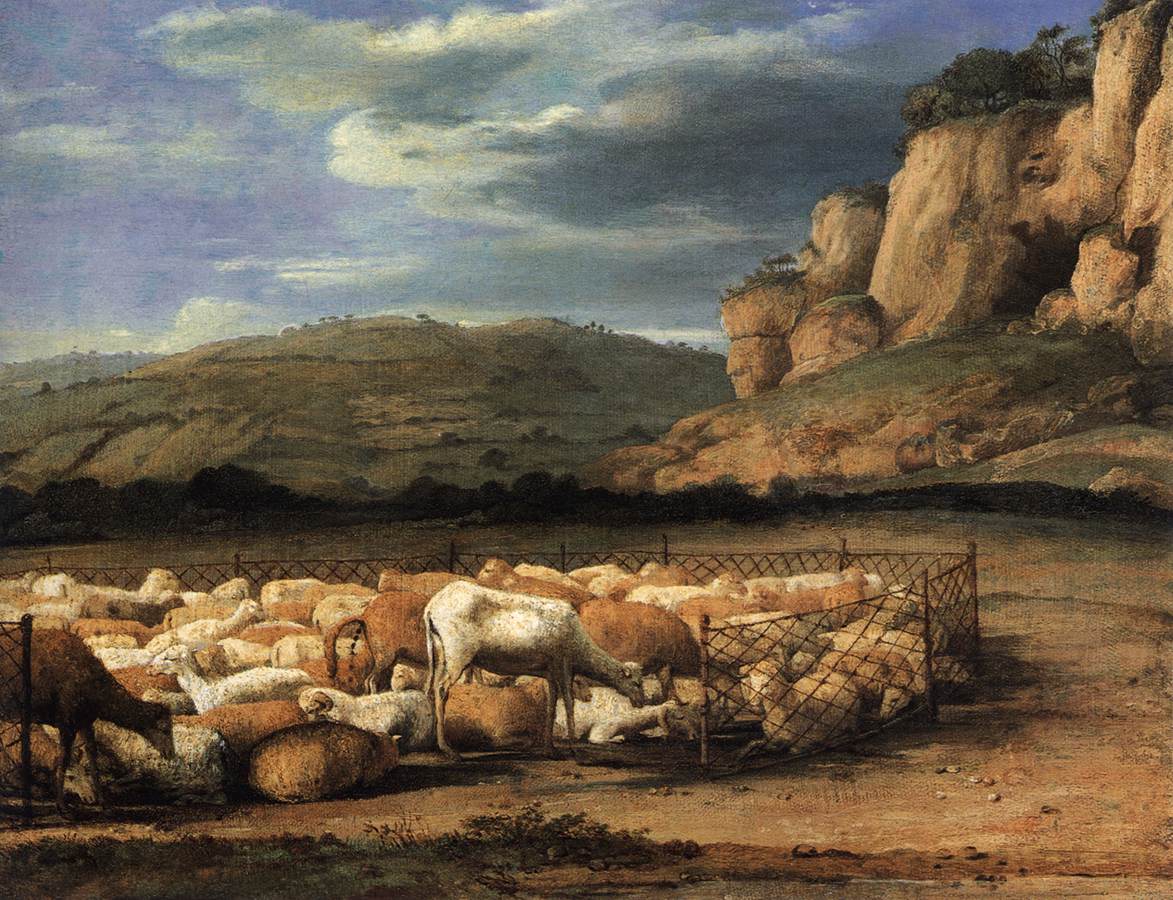
Cattle and Sheep in a Stormy Landscape, Paulus Potter 


Readings (New American Bible: Philippines, USA)

Readings (Jerusalem Bible: Australia, England & Wales, India [optional], Ireland, New Zealand, Pakistan, Scotland, South Africa)

Gospel Mark 6:30-34 (New Revised Standard Version, Anglicised Catholic Edition)

The apostles gathered around Jesus, and told him all that they had done and taught. He said to them, ‘Come away to a deserted place all by yourselves and rest a while.’ For many were coming and going, and they had no leisure even to eat. And they went away in the boat to a deserted place by themselves. Now many saw them going and recognized them, and they hurried there on foot from all the towns and arrived ahead of them. As he went ashore, he saw a great crowd; and he had compassion for them, because they were like sheep without a shepherd; and he began to teach them many things.


Fr Ragheed Aziz Ganni 

(20 January 1972 - 3 June 2007)
I will raise up shepherds over them who will shepherd them, and they shall not fear any longer, or be dismayed, nor shall any be missing, says the Lord (Jeremiah 23:4. First Reading).


On at least six occasions during his nine-day pastoral visit to Ecuador, Bolivia and Paraguay in 2015, Pope Francis asked the people to pray for him, as he did when he addressed the people in St Peter's Square for the first time as pope in 2013. Perhaps he has constantly in mind two statements in today's First Reading from the Prophet Jeremiah: 'Woe to the shepherds who destroy and scatter the sheep of my pasture! says the Lord . . .  I will raise up shepherds over them who will shepherd them, and they shall not fear any longer, or be dismayed, nor shall any be missing, says the Lord.'

Jesus shows his concern for the apostles when they returned from the mission on which he had sent them as shepherds when 'He said to them, “Come away to a deserted place all by yourselves and rest a while.”'

Ballachulish, Scotland
'Come away to a deserted place all by yourselves and rest a while.'

Perhaps we can pray in a special way for our priests as we take part in Mass this Sunday. We have countless models of priests who have been worthy shepherds, evening to laying down their lives for the flock they were called to serve. One such shepherd is an Iraqi priest with Irish connections, Fr Ragheed Ganni, assassinated along with three subdeacons, his cousin Basman Yousef Daud, Wahid Hanna Isho, and Gassan Isam Bidawed, after celebrating Mass in Mosul, Iraq, on Trinity Sunday, 3 June 2007. (The wife of Gassan Isam Bidawed was with them but was not shot).

Apse of Chapel, Irish College, Rome
St Columban second from left, Fr Ragheed far right.
[Details at source]

An engineer by profession, Ragheed answered God's call to become a priest and studied theology in Rome, before and after his ordination in 2003. While there he stayed at the Pontifical Irish College where he became known as 'Paddy the Iraqi', 'Paddy' being a common nickname for men named Patrick, after Ireland's national patron, and a humorous generic name for any Irishman. As a priest still studying in Rome he spent part of his summers as a member of the staff at Lough Derg, known as St Patrick's Purgatory, a place of penitential pilgrimage in Ireland.

Mosaic of Fr Ragheed Ganni with palms of martyrdom, Chapel of Irish College, Rome [Source]

Yet this young Iraqi who, according to the statement of one friend after the priests' murder, 'knew where the best pizza in Rome was', chose to go back to his own country, knowing that his life might be in danger. He spoke of this at a Eucharistic Congress in Bari, Italy, two years before his death. The theme of the Congress was Without Sunday We Cannot Live, 'Sunday' meaning most especially the celebration of Holy Mass.

Basilica of St Nicholas, Bari [Wikipedia]

Fr Ragheed Ganni's Testimony


Mosul Christians are not theologians; some are even illiterate. And yet inside of us for many generations one truth has become embedded: without the Sunday Eucharist we cannot live.
This is true today when evil has reached the point of destroying churches and killing Christians, something unheard of in Iraq till now. In June 2004, a group of young women were cleaning the church to get it ready for Sunday service. My sister Raghad, who is nineteen, was among them. As she was carrying a pale of water to wash the floor, two men drove up and threw a grenade that blew up just a few yards away from her.
She was wounded but miraculously, survived. And on that Sunday, we still celebrated the Eucharist. My shaken parents were also there. For me and my community, my sister’s wounds were a source of strength so that we, too, may bear our cross.
Last August in St Paul’s Church, a car bomb exploded after the 6 pm Mass. The blast killed two Christians and wounded many others. But that, too, was another miracle – the car was full of bombs but only one exploded. Had they all gone off together, the dead would have been in the hundreds since 400 faithful had come on that day.
People could not believe what had happened. The terrorists might think they can kill our bodies or our spirit by frightening us, but, on Sundays, churches are always full. They may try to take our life, but the Eucharist gives it back.
On 7 December, the eve of the Immaculate Conception, a group of terrorists tried to destroy the Chaldean Bishop’s Residence, which is near Our Lady of the Tigris Shrine, a place venerated by both Christians and Muslims. They placed explosives everywhere, and a few minutes later blew the place up. This and fundamentalist violence against young Christians has forced many families to flee. Yet the churches have remained open and people continue to go to Mass, even among the ruins.
It is among such difficulties that we understand the real value of Sunday, the day when we meet the Risen Christ, the day of our unity and love, of our (mutual) support and help. There are days when I feel frail and full of fear. But when, holding the Eucharist, I say ‘Behold the Lamb of God, who takes away the sin of the world’, I feel His strength in me. When I hold the Host in my hands, it is really He who is holding me and all of us, challenging the terrorists and keeping us united in His boundless love.
In normal times, everything is taken for granted and we forget the greatest gift that is made to us. Ironically, it is thanks to terrorist violence that we have truly learnt that it is the Eucharist, the Christ who died and is risen, that gives us life. And this allows us to resist and hope. 
[This appeared in The Sacred Heart Messenger (April 2008), a publication of the Irish Jesuits.]

(20 November 1942 - kidnapped 29 February, body found 13 March 2008) [Photo: The Path to Peace Foundation]

Father Ragheed was secretary to Archbishop Rahho, The Chaldean Archbishop of Mosul. Most Catholics in Iraq and Syria belong to the Chaldean Catholic Church, in full communion with Rome. 'The Eucharist, the Christ who died and risen, that gives us life' was celebrated every Sunday in Mosul for 1,600 years - until June 2014 when the ISIS forces drove out the remaining Christians. Mass was celebrated again on 30 October 2016 after the ISIS forces left.

The words of Jeremiah, 'I will raise up shepherds over them who will shepherd them', have surely been fulfilled in the lives and deaths of such priests as Fr Ragheed Ganni and Archbishop Rahho and in the lives and deaths of Basman Yousef Daud, Wahid Hanna Isho, and Gassan Isam Bidawed (described in some reports as 'deacons' and in others as 'subdeacons'). As we thank God for them and for countless other faithful priest-shepherds, let us continue to pray for all our priests and for Christians who are being persecuted for their faith. On 7 July this year on a pastoral visit to Bari Pope Francis appealed for peace in the Middle East. He met there with 19 heads of Christian churches in that region.

In a document signed last March the Congregation for the Causes of Saints gave permission for the process of the canonisation of Fr Ragheed Gannis and his three companions, his cousin Basman Yousef Daud, Wahid Hanna Isho, and Gassan Isam Bidawed, to begin.


John Rutter's setting of The Lord is my shepherd, Psalm 22[23], which is used as today's Responsorial Psalm.