Showing posts sorted by relevance for query Shahbaz Bhatti. Sort by date Show all posts

03 March 2011

'I only want a place at the feet of Jesus . . .' Catholic politician murdered in Pakistan


Shahbaz Bhatti, the first Federal Minister for Minorities in Pakistan, a position he held since 2 November 2008, was shot dead yesterday shortly after he left his mother's home in Islamabad. He came from a Catholic family deeply committed to justice. Of his work he said: 'I only want a place at the feet of Jesus. I want my life, my character, my actions to speak for me and say that I am a follower of Jesus Christ'.

The murdered minister a month ago in Dubai

Here is a report from Columban Father Robert McCulloch who has been in Pakistan since 1978 after spending eight years in Mindanao.

MURDER IN THE NAME OF RELIGION

Murder in the name of religion took a further ugly step in Pakistan today 2 March 2011 when Shahbaz Bhatti, Federal Minister for Minorities, was killed by 4 gunmen in Islamabad.

Shahbaz Bhatti, a member of the Pakistan People's Party of the slain Benazir Bhutto, had been minister for 3 years. He was 43 years old and unmarried. He had gone in mid-morning to visit his mother in Sector 8 of the residential area of Islamabad and was gunned down as he left his mother's home. Leaflets thrown at the place of the murder claim that it was carried out by Al Qaeda but real responsibility lies in the extensive Islamic extremist networks of urban violence which have been funded by Wahabi sources from Saudi Arabia.

Shahbaz Bhatti had insistently called for the amendment of the blasphemy laws which have been abused and mis-used in Pakistan since their introduction by the military dictator, Zia ul Haq. A solid legal opinion in Pakistan has declared that these laws are against the constititutional law of Pakistan and have no justification in the Islamic religious law.

The murdered federal minister had defended Aasia Bibi, the Christian woman who had been condemned to death on a charge of blasphemy because she refused to abandon her Christian faith and become a Muslim. Bhatti visited the Vatican in December 2010 and presented his appeal for justice to Pope Benedict XVI who then called for religious freedom and justice for persecuted Christians in Pakistan during his adddress in the first week of January 2011 to diplomats accredited to the Holy See.

The religiously-motivated murder of Shahbaz Bhatti follows on the murder of Salmaan Taseer, governor of the Punjab, on 4 January 2011, who had also called for a close re-examination of the discriminatory blasphemy laws.

Murder on religious grounds is propagated in Pakistan by Islamic extremists as an act pleasing to God which guarantees the immediate salvation of the murderer and his family. The perversion of the Pakistani education system and the distortion of religious values about which Pope Benedict alerted the world in his Regensberg address has arrived at its logical conclusion with these murders in Pakistan. How many more such muders will take place until honest Muslims in Pakistan and elsewhere and the world community at large take a stand against this evil and barbarous perversion of religion.

Fr Robert McCulloch SSC has worked in Pakistan since 1978. He sits on the administrative board for St Elizabeth’s Hospital with James Francis, the Administrator of St Elizabeth’s hospital and nephew of the murdered minister, Shahbaz Bhatti. He also sent this report:

CATHOLIC SCHOOLS IN PAKISTAN CLOSE FOR THREE DAYS PROTEST

All Catholic schools in Pakistan will close from Wednesday to Friday this week [March 3-5] in a nationwide protest against the religiously-motivated murder of Shahbaz Bhatti, Federal Minister for Minorities, in Islamabad on Tuesday.

Shahbaz Bhatti's murder was carried out by a group of four gunmen while he was visitng his mother. Leaflets scattered by the gunmen at the scene of the shooting claim that the gunmen were linked to Al Qaeda and the Taliban of Pakistan but any of the foreign-funded Islamic extremist groups in Pakistan could be responsible for the murder.

According to the leaflets left at the murder scene and shown on Pakistan television on Tuesday afternoon, the killing was carried out as part of a jihad [religious war] to eliminate a committee of people which had been formed to amend the laws of Pakistan about blasphemy. The leaflets said that Shahbaz Bhatti was killed because he was a Christian kaffir [unbeliever] and blasphemer who had become chairman of this committee. The leaflets threaten that the "by the grace of Allah, all the members of this committee will be killed one by one and sent to hell".

The Catholic Church has a wide network of schools throughout Pakistan including leading schools and colleges in the major cities and a system of primary and secondary schools in other towns and rural areas. Benazir Bhutto, murdered leader of the Pakistan People's Party, General Perwez Musharaf, recently ousted president of Pakistan, and Nawaz Sharif, leader of the powerful Pakistan Muslim League which is the governing party in the Punjab, all attended Catholic schools in Pakistan.

Bhatti's funeral will take place at his ancestral village of Khushpur in central Punjab near Faisalabad on Friday this week. Khushpur ["town of joy"] is a predominantly Catholic village of more than 1000 families. Amongst those attending will be two of the murdered minister's brothers, Dr Paul Bhatti, a pediatric surgeon who lives in Italy, and Peter Bhatti who lives in Canada and supports many Catholic charitable activities in Pakistan.

Shahbaz Batti meeting Pope Benedict last September

VATICAN CITY, 2 MAR 2011 (VIS) - Given below is the text of a declaration made this morning by Holy See Press Office Director Fr. Federico Lombardi S.J. concerning the assassination of Shabbaz Bhatti, the Pakistani minister for minorities.

"The assassination of Shahbaz Bhatti, Pakistani minister for minorities, is another terrible episode of violence. It shows how right the Pope is in his persistent remarks concerning violence against Christians and against religious freedom in general.

"Bhatti was the first Catholic to hold such an office. We recall how he was received by the Holy Father in September last year, and how he bore witness to his own commitment to peaceful coexistence among the religious communities of his country.

"Our prayers for the victim, our condemnation for this unspeakable act of violence, our closeness to Pakistani Christians who suffer hatred, are accompanied by an appeal that everyone many become aware of the urgent importance of defending both religious freedom and Christians who are subject to violence and persecution".

01 March 2024

'The Risen Christ was not an abstraction, or mere theological doctrine, to Shahbaz Bhatti.' Sunday Reflections, 3rd Sunday of Lent, Year B

Christ Cleansing the Temple
Luca Giordano [Web Gallery of Art]

And making a whip of cords, he drove them all out of the temple (John 2:15; Gospel).

Readings (Jerusalem Bible: Australia, England & Wales, Ireland, New Zealand, Pakistan, Scotland)

Readings (New American Bible: Philippines, USA)

Gospel John 2:13-25 (English Standard Version Anglicised, India)

The Passover of the Jews was at hand, and Jesus went up to Jerusalem. In the temple he found those who were selling oxen and sheep and pigeons, and the money-changers sitting there. And making a whip of cords, he drove them all out of the temple, with the sheep and oxen. And he poured out the coins of the money-changers and overturned their tables. And he told those who sold the pigeons, “Take these things away; do not make my Father's house a house of trade.” His disciples remembered that it was written, “Zeal for your house will consume me.”

So the Jews said to him, “What sign do you show us for doing these things?” Jesus answered them, “Destroy this temple, and in three days I will raise it up.” The Jews then said, “It has taken forty-six years to build this temple, and will you raise it up in three days?” But he was speaking about the temple of his body. When therefore he was raised from the dead, his disciples remembered that he had said this, and they believed the Scripture and the word that Jesus had spoken.


Léachtaí i nGaeilge


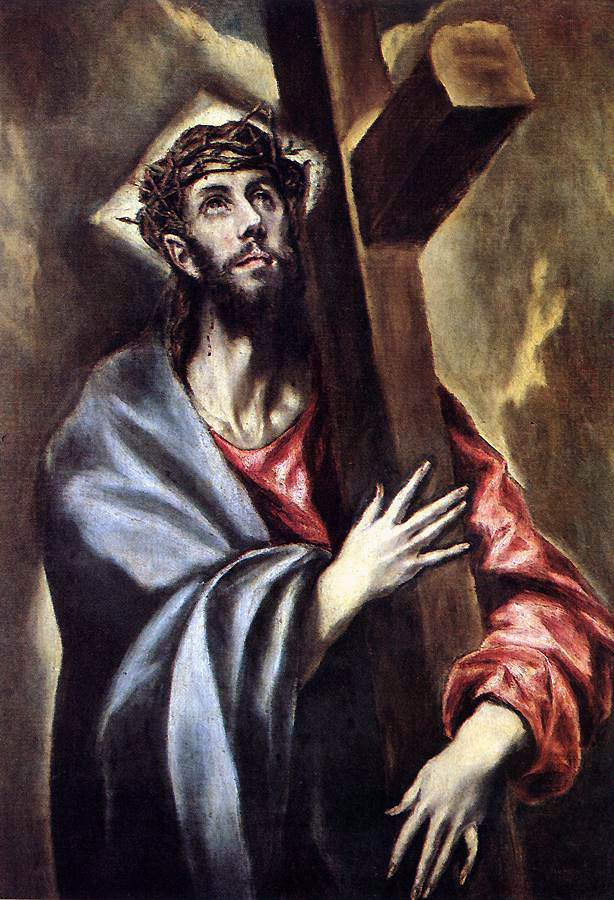
Christ in Agony on the Cross

Since I was a child, I was accustomed to going to church and finding profound inspiration in the teachings, the sacrifice, and the crucifixion of Jesus. It was his love that led me to offer my service to the Church (Shahbas Bhatti).

Last week I focused on the life and death of Shahbaz Bhatti,  assassinated in Pakistan on 2 March 2011. I want to do the same this week as I think that this man exemplifies what being a follower of Jesus is. Here are two quotations from him. 

The first:

I have been asked to put an end to my battle, but I have always refused, even at the risk of my own life. My response has always been the same. I do not want popularity, I do not want positions of power. I only want a place at the feet of Jesus. I want my life, my character, my actions to speak of me and say that I am following Jesus Christ.

The second:

I, as a humble servant of Jesus Christ, will continue to serve the suffering, victimised and persecuted communities, and am ready to even sacrifice my life to defend the principles of religious freedom, human equality and the rights of minorities.

These quotations are from a politician who was a Catholic and the only Christian in the cabinet of the national government in Pakistan. Not long after he spoke those latter words he was assassinated on 2 March 2011. His name was Clement Shahbaz Bhatti. He was 42.

The first quotation is from a testament published a few days after his death in La Civiltà Cattolica, the weekly magazine published in the Vatican, and also here. The second is what he said to the media after being re-appointed to the cabinet as Minister for Minorities’ Affairs on 11 February 2011, less that two weeks before his death.

Today’s First Reading from the Book of Exodus is the proclamation of the Ten Commandments, beginning with I am the Lord your God who brought you out of the land of Egypt, out of the house of slavery. You shall have no other gods before me.

The first three commandments have to do with our relationship with God, the other seven with our relationships to one another. Shahbaz Bhatti’s vision embraced both kinds of relationships. In his testimony he wroteMy name is Shahbaz Bhatti. I was born into a Catholic family. My father, a retired teacher, and my mother, a housewife, raised me according to Christian values and the teachings of the Bible, which influenced my childhood. Since I was a child, I was accustomed to going to church and finding profound inspiration in the teachings, the sacrifice, and the crucifixion of Jesus. It was his love that led me to offer my service to the Church. The frightening conditions into which the Christians of Pakistan had fallen disturbed me. I remember one Good Friday when I was just thirteen years old: I heard a homily on the sacrifice of Jesus for our redemption and for the salvation of the world. And I thought of responding to his love by giving love to my brothers and sisters, placing myself at the service of Christians, especially of the poor, the needy, and the persecuted who live in this Islamic country.

Shahbaz Bhatti had a profound sense of vocation as a follower of Jesus Christ serving the poorest. Jesus was at the heart of his life. I only want a place at the feet of Jesus. He uses this image again in the last paragraph of his testimony: I believe that the needy, the poor, the orphans, whatever their religion, must be considered above all as human beings. I think that these persons are part of my body in Christ, that they are the persecuted and needy part of the body of Christ. If we bring this mission to its conclusion, then we will have won a place at the feet of Jesus, and I will be able to look at him without feeling shame.

That evokes the words of Jesus to St Martha after she asked him to rebuke her sister Mary: It is Mary who has chosen the good portion, which will not to be taken from her.

It also expresses a deep sense of the Mystical Body of Christ, as does the previous paragraph of his testimony: I say that, as long as I am alive, until the last breath, I will continue to serve Jesus and this poor, suffering humanity, the Christians, the needy, the poor. I believe that the Christians of the world who have reached out to the Muslims hit by the tragedy of the earthquake of 2005 have built bridges of solidarity, of love, of comprehension, and of tolerance between the two religions.

Shahbaz Bhatti lived out the Ten Commandments as a follower of Jesus in the mission our Saviour proclaimed at the beginning of his public life: The Spirit of the Lord is upon me,  because he has anointed me to proclaim good news to the poor. He has sent me to proclaim liberty to the captives and recovering of sight to the blind, to set at liberty those who are oppressed, to proclaim the year of the Lord's favour.

One of Shahbaz Bhatti’s closest friends, a Muslim and a member of the same political party, was assassinated on 4 January 2011, Governor Salman Taseer of Punjab, murdered by one of his own bodyguards. These two politicians and friends opposed the blasphemy laws and asked for the release of Asia Bibi, the Christian woman falsely accused of breaking the blasphemy laws and sentenced to death. Her long ordeal ended only in 2019 when she was allowed to go to Canada. The following year she moved to France.


Servant of God Clement Shahbaz Bhatti [Wikipedia]
(9 September 1968 - 2 March 2011) 

The Diocese of Islamabad-Rawalpindi opened the cause for the beatification of Shahbaz Bhatti on the fifth anniversary of his death.

St Paul tells us in the Second Reading: For Jews demand signs and Greeks seek wisdom, but we preach Christ crucified. In a video interview with the BBC four months before his death, to be broadcast in the event of his death, Shahbaz Bhatti said: I want to share that I believe in Jesus Christ who has given his own life for us. I know what is the meaning of [the] Cross and I am following of the Cross and I am ready to die for a cause. I’m living for my community and suffering people and I will die to defend their rights.

El Greco's painting above shows the Crucifixion rooted in Toledo, the Spanish city where he spent the second half of his life. Jesus became one of us: The Word became flesh and dwelt among us (John 1:14) and died for us. Shahbaz Bhatti's words are a reflection of the truth that El Greco expresses in his painting: I’m living for my community and suffering people and I will die to defend their rights.

The possibility of his being assassinated was something he spoke about a number of times. But he was ready to accept it because of his deep faith in Jesus Christ who suffered and died for us on the Cross.

In the Gospel today Jesus drives the people engaged in commerce out of the Temple telling them: Take these things away; do not make my Father's house a house of trade. The whole thrust of Shahbaz Bhatti’s life from his student days was to resist and oppose false values that held people in servitude in Pakistan. This was his ways of making a whip out of cords and driving them all out of the temple. He did this with a deep sense of vocation, awakened in him by his parents and especially by the Good Friday homily he heard when he was 13. The sacrifice of Jesus was perhaps the deepest formative influence in his life.

The Gospel today also speaks of the Resurrection: Destroy this temple and in three days I will raise it up . . . and when therefore he was raised from the dead, his disciples remembered that he had said this, and they believed the Scripture and the words that Jesus had spoken. The response to today’s Psalm is You, Lord, have the message of eternal life. Shahbaz Bhatti lived out of his faith in the Resurrection: I only want a place at the feet of Jesus . . . If we bring this mission to its conclusion, then we will have won a place at the feet of Jesus, and I will be able to look at him without feeling shame.

Fr Raymond de Souza, a Canadian priest, said in a homily in Ottawa a few days after the killing of Shahbaz BhattiIn the face of death the Christian proclaims the truth of the Risen Christ. The Risen Christ was not an abstraction, or mere theological doctrine, to Shahbaz Bhatti. He knew that the Lord Jesus was at work in his life. He had a personal relationship with Him. He believed that his life was proceeding under the Lord’s Providence. He knew that the Risen Christ is the Lord of History. He knew that the time of his departure was close at hand; he knew that he had fought the good fight; he knew that his race was almost finished.

This sense that our true home is in heaven, when we will have won a place at the feet of Jesus, has become obscured and forgotten to a large degree today. Shahbaz Bhatti was probably not familiar with the 8th Sermon of St Columban, the great Irish missionary saint (c.540 - 625), but understood what he said there: Since we are travellers and pilgrims in the world, let us ever ponder on the end of the road, that is of our life, for the end of our roadway is our home.


Pope Benedict's Angelus Talk, 7 March 2011

Pope Benedict speaking about Shahbaz Bhatti five days after his assassination.


Traditional Latin Mass

Third Sunday in Lent

The complete Mass in Latin and English is here. (Adjust the date at the top of that page to 03-03-2024 if necessary).

Epistle: Ephesians 5:1-9Gospel: Luke 11:14-28. 

A Pair of Boots
Vincent van Gogh [Web Gallery of Art]

Walk in love, as Christ loved us and gave himself up for us (Ephesians 5:2; Epistle).


28 February 2014

'I only want a place at the feet of Jesus' - Shahbaz Bhatti. Sunday Reflections, 8th Sunday in Ordinary Time Year A

Clement Shahbaz Bhatti شہباز بھٹی
(9 September 1968 – 2 March 2011)
'I do not want popularity, I do not want positions of power. I only want a place at the feet of Jesus. I want my life, my character, my actions to speak of me and say that I am following Jesus Christ.'

Readings (New American Bible: Philippines, USA)                                  

Readings (Jerusalem Bible: Australia, England & Wales, India [optional], Ireland, New Zealand, Pakistan, Scotland, South Africa)

Gospel Matthew 6:24-34 (New Revised Standard Version,Catholic Edition, Canada) 

Jesus said to his disciples:

“No one can serve two masters; for a slave will either hate the one and love the other, or be devoted to the one and despise the other. You cannot serve God and wealth.

“Therefore I tell you, do not worry about your life, what you will eat or what you will drink,or about your body, what you will wear. Is not life more than food, and the body more than clothing? Look at the birds of the air; they neither sow nor reap nor gather into barns, and yet your heavenly Father feeds them. Are you not of more value than they? And can any of you by worrying add a single hour to your span of life? And why do you worry about clothing? Consider the lilies of the field, how they grow; they neither toil nor spin, yet I tell you, even Solomon in all his glory was not clothed like one of these. But if God so clothes the grass of the field, which is alive today and tomorrow is thrown into the oven, will he not much more clothe you—you of little faith? Therefore do not worry, saying, ‘What will we eat?’ or ‘What will we drink?’ or ‘What will we wear?’ For it is the Gentiles who strive for all these things; and indeed your heavenly Father knows that you need all these things. But strive first for the kingdom of God and his righteousness, and all these things will be given to you as well.


“So do not worry about tomorrow, for tomorrow will bring worries of its own. Today’s trouble is enough for today.


This Sunday, 2 March, is the third anniversary of the death of Shahbaz Bhatti, seen with Pope Benedict in the video above during an audience in September 2010. He was assassinated in Islamabad, Pakistan, shortly after leaving his mother's home. Mr Bhatti, a Catholic, was the first Christian to be appointed to the Cabinet in Pakistan and was responsible for minorities. The Pakistan Taliban claimed responsibility for his death.

Sandro Magister, one of the leading journalists covering the Vatican, wrote about the death of Shahbaz Bhatti on 14 April 2011 in A Lesson of Holiness from Remote Pakistan. Magister writes: 

The Bible that Shahbaz always had with him is now in Rome in the memorial for the martyrs of the past century, in the basilica of Saint Bartholomew on the Isola Tiberina.

One of the most informative and concerned articles on what his murder has meant in Pakistan and in the whole world is without a doubt the one published in La Civiltà Cattolica dated April 2, 2011.


An article that is all the more significant given that this magazine of the Rome Jesuits is printed after inspection and authorization by the Vatican secretariat of state. So it reflects the thinking of the Holy See in this regard.

In Pakistan, out of a population of 185 million inhabitants, Christians are 2 percent, one million of them Catholic. But among the Muslims as well there are minorities in danger: Shiites, Sufis, Ismaili, Ahmadis.
The article in La Civiltà Cattolica was written by Fr Luciano Larivera SJ and includes most of The spiritual testament of Shahbaz Bhatti. I have highlighted parts of this.
'My name is Shahbaz Bhatti. I was born into a Catholic family. My father, a retired teacher, and my mother, a housewife, raised me according to Christian values and the teachings of the Bible, which influenced my childhood. Since I was a child, I was accustomed to going to church and finding profound inspiration in the teachings, the sacrifice, and the crucifixion of Jesus. It was his love that led me to offer my service to the Church.
'The frightening conditions into which the Christians of Pakistan had fallen disturbed me. I remember one Good Friday when I was just thirteen years old: I heard a homily on the sacrifice of Jesus for our redemption and for the salvation of the world. And I thought of responding to his love by giving love to my brothers and sisters, placing myself at the service of Christians, especially of the poor, the needy, and the persecuted who live in this Islamic country.
'I have been asked to put an end to my battle, but I have always refused, even at the risk of my own life. My response has always been the same. I do not want popularity, I do not want positions of power. I only want a place at the feet of Jesus. I want my life, my character, my actions to speak of me and say that I am following Jesus Christ.
'This desire is so strong in me that I consider myself privileged whenever - in my combative effort to help the needy, the poor, the persecuted Christians of Pakistan - Jesus should wish to accept the sacrifice of my life. I want to live for Christ and it is for Him that I want to die. I do not feel any fear in this country. Many times the extremists have wanted to kill me, imprison me; they have threatened me, persecuted me, and terrorized my family.
'I say that, as long as I am alive, until the last breath, I will continue to serve Jesus and this poor, suffering humanity, the Christians, the needy, the poor. I believe that the Christians of the world who have reached out to the Muslims hit by the tragedy of the earthquake of 2005 have built bridges of solidarity, of love, of comprehension, and of tolerance between the two religions. If these efforts continue, I am convinced that we will succeed in winning the hearts and minds of the extremists. This will produce a change for the better: the people will not hate, will not kill in the name of religion, but will love each other, will bring harmony, will cultivate peace and comprehension in this region.
'I believe that the needy, the poor, the orphans, whatever their religion, must be considered above all as human beings. I think that these persons are part of my body in Christ, that they are the persecuted and needy part of the body of Christ. If we bring this mission to its conclusion, then we will have won a place at the feet of Jesus, and I will be able to look at him without feeling shame.'

Johannes Vermeer, 1654-55 (?) [Web Gallery of Art]
Can anyone fail to be moved by the testament of Shahbaz Bhatti who saw his vocation as a Christian to serve his people as a politician but whose only desire was to have a place at the feet of Jesus? Part of his serving his people was to choose not to marry. This is a member of a small, often despised minority, living out his Christian vocation as a politician and who can say I want to live for Christ and it is for Him that I want to die.


The British band Ooberfuse whose lead singer, Cherrie Anderson, is the daughter of a Filipina mother, wrote the song above for the first death anniversary of the death of Shahbaz Bhatti and sang it at a prayer rally organised by Christian Pakistanis in Britain and held in Trafalgar Square, London. They incorporated part of the last televised interview in English that Shahbaz Bhatti gave in which he said I know what is the meaning of [the] Cross.


The song above was written by Eric Sindhu who knew Shahbaz Bhatti. Fr Finbar Maxwell, a Columban who served in Pakistan for many years and is now here in the Philippines told me that the song is in Urdu and is in the traditional 'dirge' form of singing.  The lyrics refer to  Christian faith of Shahbaz, to his blood spilled, and to the 'book' of his life. Father Finbar echoed my own comment when he wrote: The tone, sentiment and beauty of the song indeed transcend the need for translation


Fr Tomás King and Gerard Bhatti

Fr Tomás King, an Irish Columban priest in Pakistan, met Gerard Bhatti, a brother of Shahbaz and wrote Shahbaz Bhatti: 'I know what is the meaning of Cross'.

After the death of Shahbaz the Pakistani government offered his position in the Cabinet to the family who decided that Paul, another brother, should take it. He is a medical doctor who worked for some years in Italy. He too has been receiving death threats.

No one can serve two masters, Jesus tells us in this Sunday's gospel. Shahbaz Bhatti described his Master in detail: I believe that the needy, the poor, the orphans, whatever their religion, must be considered above all as human beings. I think that these persons are part of my body in Christ, that they are the persecuted and needy part of the body of Christ

In his Mass in the chapel of Domus Sanctae Marthae on Monday 16 September Pope Francis asked us to Pray for politicians that they govern us well. One politician I don't pray for but pray to, every day, is this Pakistani martyr for the justice that our Catholic Christian faith demands is Clement Shahbaz Bhatti. I truly believe that he has won a place at the feet of Jesus.

25 February 2017

'I want my life, my character, my actions to speak of me and say that I am following Jesus Christ.' Sunday Reflections, 8th Sunday in Ordinary Time, Year A

Rest on the Flight into Egypt (detail), Caravaggio [Web Gallery of Art]


But Zion said, ‘The Lord has forsaken me,
    my Lord has forgotten me.’
Can a woman forget her nursing-child,
    or show no compassion for the child of her womb?
Even these may forget,
    yet I will not forget you. (Isaiah 49:14-15. First Reading).


Readings (New American Bible: Philippines, USA)

Readings (Jerusalem Bible: Australia, England & Wales, India [optional], Ireland, New Zealand, Pakistan, Scotland, South Africa)


Jesus said to his disciples:

 ‘No one can serve two masters; for a slave will either hate the one and love the other, or be devoted to the one and despise the other. You cannot serve God and wealth.
‘Therefore I tell you, do not worry about your life, what you will eat or what you will drink, or about your body, what you will wear. Is not life more than food, and the body more than clothing? Look at the birds of the air; they neither sow nor reap nor gather into barns, and yet your heavenly Father feeds them. Are you not of more value than they? And can any of you by worrying add a single hour to your span of life? And why do you worry about clothing? Consider the lilies of the field, how they grow; they neither toil nor spin, yet I tell you, even Solomon in all his glory was not clothed like one of these. But if God so clothes the grass of the field, which is alive today and tomorrow is thrown into the oven, will he not much more clothe you—you of little faith? Therefore do not worry, saying, “What will we eat?” or “What will we drink?” or “What will we wear?” For it is the Gentiles who strive for all these things; and indeed your heavenly Father knows that you need all these things. But strive first for the kingdom of God and his righteousness, and all these things will be given to you as well.
‘So do not worry about tomorrow, for tomorrow will bring worries of its own. Today’s trouble is enough for today.


Thursday 2 March is the sixth anniversary of the death of Shahbaz Bhatti, seen with Pope Benedict in the video above during an audience in September 2010. He was assassinated in Islamabad, Pakistan, shortly after leaving his mother's home. Mr Bhatti, a Catholic, was the first Christian to be appointed to the Cabinet in Pakistan and was responsible for minorities. The Pakistan Taliban claimed responsibility for his death.

Sandro Magister, one of the leading journalists covering the Vatican, wrote about the death of Shahbaz Bhatti on 14 April 2011 in A Lesson of Holiness from Remote Pakistan. [The link to this no longer works.] Magister writes:

The Bible that Shahbaz always had with him is now in Rome in the memorial for the martyrs of the past century, in the basilica of Saint Bartholomew on the Isola Tiberina.

One of the most informative and concerned articles on what his murder has meant in Pakistan and in the whole world is without a doubt the one published in La Civiltà Cattolica dated April 2, 2011.

An article that is all the more significant given that this magazine of the Rome Jesuits is printed after inspection and authorization by the Vatican secretariat of state. So it reflects the thinking of the Holy See in this regard.

In Pakistan, out of a population of 185 million inhabitants, Christians are 2 percent, one million of them Catholic. But among the Muslims as well there are minorities in danger: Shiites, Sufis, Ismaili, Ahmadis.

Clement Shahbaz Bhatti شہباز بھٹی
(9 September 1968 – 2 March 2011)

'I do not want popularity, I do not want positions of power. I only want a place at the feet of Jesus. I want my life, my character, my actions to speak of me and say that I am following Jesus Christ.'

The article in La Civiltà Cattolica was written by Fr Luciano Larivera SJ and includes most of The spiritual testament of Shahbaz BhattiI have highlighted parts of this.

'My name is Shahbaz Bhatti. I was born into a Catholic family. My father, a retired teacher, and my mother, a housewife, raised me according to Christian values and the teachings of the Bible, which influenced my childhood. Since I was a child, I was accustomed to going to church and finding profound inspiration in the teachings, the sacrifice, and the crucifixion of Jesus. It was his love that led me to offer my service to the Church.

'The frightening conditions into which the Christians of Pakistan had fallen disturbed me. I remember one Good Friday when I was just thirteen years old: I heard a homily on the sacrifice of Jesus for our redemption and for the salvation of the world. And I thought of responding to his love by giving love to my brothers and sisters, placing myself at the service of Christians, especially of the poor, the needy, and the persecuted who live in this Islamic country.

'I have been asked to put an end to my battle, but I have always refused, even at the risk of my own life. My response has always been the same. I do not want popularity, I do not want positions of power. I only want a place at the feet of Jesus. I want my life, my character, my actions to speak of me and say that I am following Jesus Christ.

'This desire is so strong in me that I consider myself privileged whenever - in my combative effort to help the needy, the poor, the persecuted Christians of Pakistan - Jesus should wish to accept the sacrifice of my life. I want to live for Christ and it is for Him that I want to die. I do not feel any fear in this country. Many times the extremists have wanted to kill me, imprison me; they have threatened me, persecuted me, and terrorized my family.
'I say that, as long as I am alive, until the last breath, I will continue to serve Jesus and this poor, suffering humanity, the Christians, the needy, the poor. I believe that the Christians of the world who have reached out to the Muslims hit by the tragedy of the earthquake of 2005 have built bridges of solidarity, of love, of comprehension, and of tolerance between the two religions. If these efforts continue, I am convinced that we will succeed in winning the hearts and minds of the extremists. This will produce a change for the better: the people will not hate, will not kill in the name of religion, but will love each other, will bring harmony, will cultivate peace and comprehension in this region.
'I believe that the needy, the poor, the orphans, whatever their religion, must be considered above all as human beings. I think that these persons are part of my body in Christ, that they are the persecuted and needy part of the body of Christ. If we bring this mission to its conclusion, then we will have won a place at the feet of Jesus, and I will be able to look at him without feeling shame.'

Christ in the House of Martha and Mary, Vermeer [Web Gallery of Art]

Can anyone fail to be moved by the testament of Shahbaz Bhatti who saw his vocation as a Christian to serve his people as a politician but whose only desire was to have a place at the feet of Jesus? This is a member of a small, often despised minority, living out his Christian vocation as a politician and who can say I want to live for Christ and it is for Him that I want to die.


The British band Ooberfuse whose lead singerCherrie Anderson, is the daughter of a Filipina mother, wrote the song above for the first death anniversary of the death of Shahbaz Bhatti and sang it at a prayer rally organised by Christian Pakistanis in Britain and held in Trafalgar Square, London. They incorporated part of the last televised interview in English that Shahbaz Bhatti gave in which he said I know what is the meaning of [the] Cross.


The song above was written by Eric Sindhu who knew Shahbaz Bhatti. Fr Finbar Maxwell, a Columban who served in Pakistan for many years and is now here in the Philippines told me that the song is in Urdu and is in the traditional 'dirge' form of singing.  The lyrics refer to  Christian faith of Shahbaz, to his blood spilled, and to the 'book' of his life. Father Finbar echoed my own comment when he wrote: The tone, sentiment and beauty of the song indeed transcend the need for translation

Fr Tomás King and Gerard Bhatti

Fr Tomás King, an Irish Columban priest in Pakistan, met Gerard Bhatti, a brother of Shahbaz and wrote Shahbaz Bhatti: 'I know what is the meaning of Cross.' 

After the death of Shahbaz the Pakistani government offered his position in the Cabinet to the family who decided that Paul, another brother, should take it. He is a medical doctor who worked for some years in Italy. He too has been receiving death threats.

No one can serve two masters, Jesus tells us in this Sunday's gospel. Shahbaz Bhatti described his Master in detail: I believe that the needy, the poor, the orphans, whatever their religion, must be considered above all as human beings. I think that these persons are part of my body in Christ, that they are the persecuted and needy part of the body of Christ

In his Mass in the chapel of Domus Sanctae Marthae on Monday 16 September 2013 Pope Francis asked us to Pray for politicians that they govern us well. One politician I don't pray for but pray to regularly is this Pakistani martyr for the justice that our Catholic Christian faith demands is Clement Shahbaz Bhatti. I truly believe that he has won a place at the feet of Jesus.