31 December 2010

'And Mary kept all these things . . . in her heart.' Solemnity of the Blessed Virgin Mary, the Mother of God

The Virgin Mary, El Greco, 1590s


Gospel (Luke 2:16-21)


The shepherds went in haste to Bethlehem and found Mary and Joseph,
and the infant lying in the manger.
When they saw this,
they made known the message
that had been told them about this child.
All who heard it were amazed
by what had been told them by the shepherds.
And Mary kept all these things,
reflecting on them in her heart.
Then the shepherds returned,
glorifying and praising God
for all they had heard and seen,
just as it had been told to them.

When eight days were completed for his circumcision,
he was named Jesus, the name given him by the angel
before he was conceived in the womb.

+++
Pope Benedict blessing members of Pueri Cantores (Boys' Choir Association), 30 December 2010

Pope Benedict’s Message for World Day of Peace 2011

Religious Freedom, the Path to Peace

Religious freedom in the world

14. Finally I wish to say a word to the Christian communities suffering from persecution, discrimination, violence and intolerance, particularly in Asia, in Africa, in the Middle East and especially in the Holy Land, a place chosen and blessed by God. I assure them once more of my paternal affection and prayers, and I ask all those in authority to act promptly to end every injustice against the Christians living in those lands. In the face of present difficulties, may Christ’s followers not lose heart, for witnessing to the Gospel is, and always will be, a sign of contradiction.

Let us take to heart the words of the Lord Jesus: “Blessed are those who mourn, for they shall be comforted … Blessed are those who hunger and thirst for righteousness, for they shall be satisfied … Blessed are you when men revile you and persecute you and utter all kinds of evil against you falsely on my account. Rejoice and be glad, for your reward is great in heaven” (Mt 5:4-12). Then let us renew “the pledge we give to be forgiving and to pardon when we invoke God’s forgiveness in the Our Father. We ourselves lay down the condition and the extent of the mercy we ask for when we say: ‘And forgive us our debts, as we have forgiven those who are in debt to us’ (Mt 6:12)”.[17] Violence is not overcome by violence. May our cries of pain always be accompanied by faith, by hope and by the witness of our love of God. I also express my hope that in the West, and especially in Europe, there will be an end to hostility and prejudice against Christians because they are resolved to orient their lives in a way consistent with the values and principles expressed in the Gospel. May Europe rather be reconciled to its own Christian roots, which are fundamental for understanding its past, present and future role in history; in this way it will come to experience justice, concord and peace by cultivating a sincere dialogue with all peoples.

Full text here.

+++

A Feast Rich in Names, Meaning and Mission

By Father Thomas Rosica, CSB

TORONTO, DEC. 24, 2010 (Zenit.org).- The Jewish Feast of Rosh Hashanah, meaning literally the “beginning of the year,” occurs on the first of the Hebrew month Tishre and inaugurates the solemn Jewish season that concludes with Yom Kippur.

In the Bible, the Jewish New Year Festival is called Day of the Sounding of the Shofar and Memorial of the Blowing of the Shofar (ram's horn). This instrument is designed to sound the alarm of the forthcoming solemn season, to awaken Jewry to prayer and repentance. It serves as a call to remember the historical events that made Israel a people, whether at Mount Sinai or on its entrance into Israel, or on the occasion of the proclamation of the Jubilee year. In Jewish liturgy, this feast also has two other names: Day of Memorial and Day of Judgment. Each of the different names of the festival conveys one of its special characteristics.

Full text here.

+++
The Virgin in Prayer, Sassoferrato, 1640-50

What's in a Name?

Fr Fabian Radcliffe OP

'Holy Mary, Mother of God': we say this whenever we say the Hail Mary. We say it so often that we can easily forget what a strong, startling, even shocking, phrase it is. How can Mary, or any woman for that matter, be literally Mother of God? God has no beginning. It is impossible for a human woman to be Mother of God. It sounds more like pagan myth than Christian doctrine.

But no: it is the Christian and Catholic faith that Mary is Mother of God; so it is necessary to understand it properly. The difficulty is overcome if instead we say that Mary is the 'God-bearer'. This is in fact what the Greek word theotokos means: 'God-bearer', and therefore 'Mother of God', because the one she bears is God. This title had been given her in popular devotion from the second century onwards, and it was confirmed by the Council of Ephesus in AD 431 as a sure way of asserting the full divinity of her Son.

We also hear this phrase in all the Eucharistic Prayers. There it is linked with her title 'Virgin' in such a way that the two tend to be merged into the paradoxical title 'Virgin-Mother'. Mary is indeed both virgin and mother. 'Virgin' expresses the initiative of God and therefore the full divinity of her Son. 'Mother' expresses Mary's full cooperation and therefore also His full humanity.

Full text here. 

28 December 2010

Rachel's Vineyard

Massacre of the Innocents, Guido Reni, 1611

Then Herod, when he saw that he had been tricked by the wise men, was in a furious rage, and he sent and killed all the male children in Bethlehem and in all that region who were two years old or under, according to the time which he had ascertained from the wise men. Then was fulfilled what was spoken by the prophet Jeremiah: "A voice was heard in Ramah, wailing and loud lamentation, Rachel weeping for her children; she refused to be consoled, because they were no more" (Mt 2:16-18).

These words end today's gospel for the Feast of the Innocents. St Matthew's text also gives the name to an international ministry that began in the USA some years ago, Rachel's Vineyard. The website carried this message by the founder, Dr Theresa Burke:

Rachel's Vineyard - A Message from our Founder


Dear friend,

I would like to personally welcome you to Rachel's Vineyard! 

If the emotional and spiritual wounds of a past abortion have been sapping faith, love and joy from your life, I can promise, that if you enter this process for healing, your life will begin to change. 
 A journey into Rachel's Vineyard is a gift only you can open your heart to receive.  The spiritual process of reconciliation with yourself, with God and your lost child will truly result in wholeness and freedom and a difference you will be able to feel inside your heart. This healing process will give you a deeper compassion for yourself.  It's also a journey that will give you a new appreciation of your strength and courage.

By traveling a path of healing in Rachel's Vineyard, you will experience an end to isolation, despair and hopelessness. You will have the potential to revisit abandoned goals and dreams, and articulate your truest and deepest desires for your future.

Whatever your fears or hesitations may be, I encourage you to take the steps toward receiving the healing and peace that you deserve.  Rachel's Vineyard provides a tried and true journey that over 100,000 women and men have traveled.  You can be confident that there are wonderful people in Rachel's Vineyard who are ready and eager to accompany you.

You are not alone.  A new chapter of your life awaits you.  Take courage, God is calling you towards peace, love, hope, and freedom.

Dr. Theresa Burke
Founder, Rachel's Vineyard Ministries
As far as I know, Rachel's Vineyard doesn't exist in the Philippines - yet. Though abortion is illegal in the Philippines the evidence is that it is widely practised.

Rachel's Vineyard is active in Ireland, where I got to know a little more about it during my recent home leave. I met the director there just after she had visited the Faroe Islands at the invitation of a mutual friend, Sr Maria Forrestal FMM.
 Bernadette Goulding from Cork, Ireland

The Irish website carries this statement:

Rachel's Vineyard is a safe place to renew, rebuild and redeem hearts broken by abortion.
Healing Weekends offer you a supportive, confidential and non-Judgmental environment where women and men can express, release and reconcile painful post-abortive emotions to begin the process of restoration, renewal and Healing.
Rachel's Vineyard can help you find your inner voice. It can help you experience God's love and compassion on a profound level. It creates a place where men and women can share, often for the first time, their deepest feelings about abortion. You are allowed to dismantle troubling secrets in an environment of emotional and spiritual safety.
Rachel's Vineyard is therapy for the soul. Participants, who have been trapped in anger toward themselves or others, experience forgiveness. Peace is found. Lives are restored. A sense of hope and meaning for the future is finally re-discovered.
Making the decision to attend a Rachel's Vineyard Healing Weekend can  be intimidating.
Fear of the unknown might be making it harder for you to reach out for help with the emotional and spiritual conflict you may be feeling after your abortion, whether your abortion was recent or decades ago.

Most of us at Rachels Vineyard are persons who have walked down the same path as you and have experienced the Healing power through a Rachel's Vineyard Healing Weekend.

+++
The weekends organized by Rachel's Vineyard also welcome men who have been directly affected by abortion. These may be fathers of aborted children who were not consulted or who put pressure on the mother to have an abortion. They may be husbands married to women who have had abortions in a previous relationship and whose marriage is affected by this.


26 December 2010

'Tweetings' of great joy!


Matt in The Daily Telegraph

I don't 'tweet' and I don't have an i-pod but this front-page cartoon from the English broadsheet with the widest circulation shows that the Good News is news!


25 December 2010

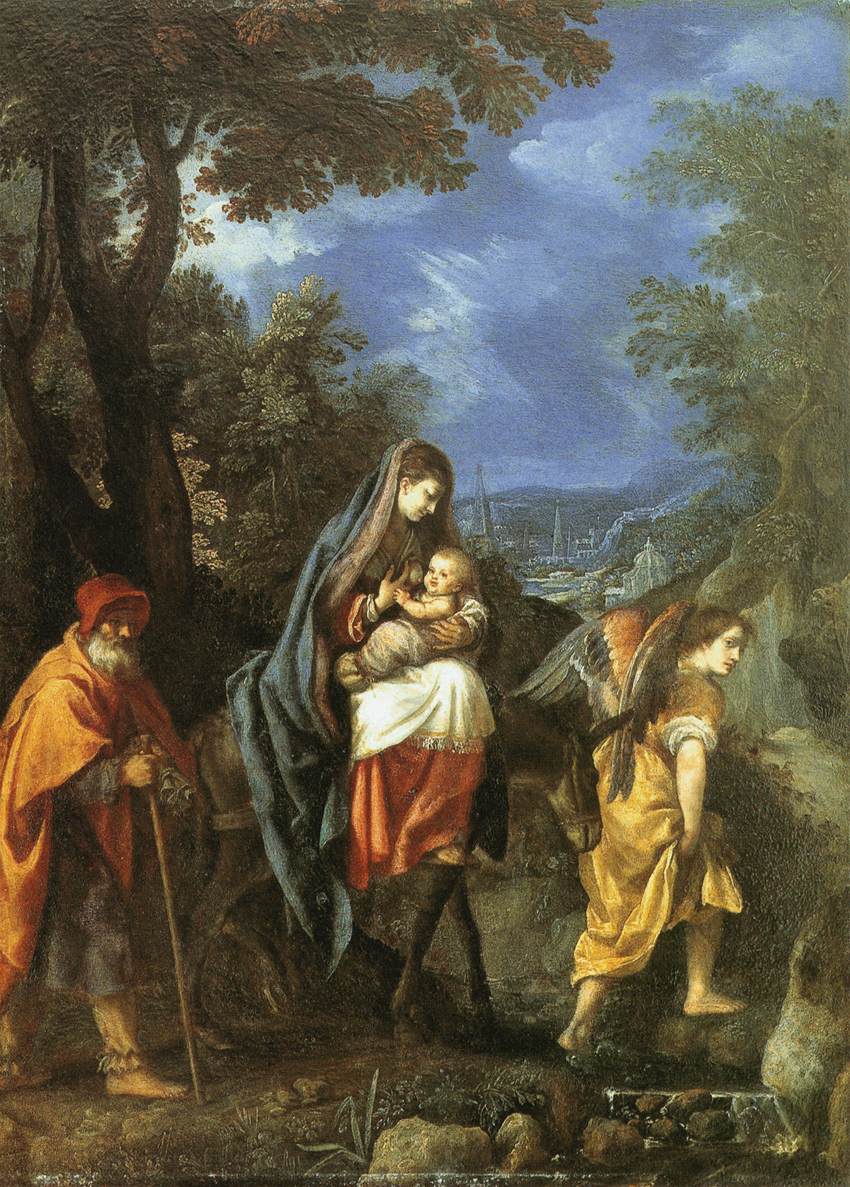
'He rose, took the child and his mother . . .' The Holy Family, Year A, 26 December 2010.

The Flight into Egypt, oil on copper, Cigoli, c.1608


Readings (New American Bible, used in the Philippines and the USA)

Gospel (Matthew 2:13-15, 19-23)

When the magi had departed, behold,
the angel of the Lord appeared to Joseph in a dream and said,
“Rise, take the child and his mother, flee to Egypt,
and stay there until I tell you.
Herod is going to search for the child to destroy him.”
Joseph rose and took the child and his mother by night
and departed for Egypt.
He stayed there until the death of Herod,
that what the Lord had said through the prophet might be fulfilled,
Out of Egypt I called my son.


When Herod had died, behold,
the angel of the Lord appeared in a dream
to Joseph in Egypt and said,
“Rise, take the child and his mother and go to the land of Israel,
for those who sought the child’s life are dead.”
He rose, took the child and his mother,
and went to the land of Israel.
But when he heard that Archelaus was ruling over Judea
in place of his father Herod,
he was afraid to go back there.
And because he had been warned in a dream,
he departed for the region of Galilee.
He went and dwelt in a town called Nazareth,
so that what had been spoken through the prophets
might be fulfilled,
He shall be called a Nazorean.

+++

St Joseph is central in the Christmas story as St Matthew tells it. His role is to be the husband of Mary. It is as such that he names Mary’s son and so becomes his legal father (Mt 1:21). It is as husband of Mary that he ‘took the child and his mother by night’ and fled to Egypt. It is as husband of Mary that he ‘took the child and his mother, and went to the land of Israel’. It was as husband of Mary that ‘he was afraid to go back there’ (Judea) and risk not only his own life but theirs and took them instead to Galilee

The major feast of St Joseph, on 19 March, honors him as ‘Husband of Mary’. I can’t help repeating that the primary vocation of a married couple is to be spouses, not parents. It is as loving spouses that they become loving parents. This was most clearly expressed for me by an 11-year-old boy at a family day of Worldwide Marriage Encounter here in Bacolod City during an activity for the pre-teens. They were asked what they loved most about their parents. He said, ‘What I love most about my parents is that they are always together’.

A wife can fail as a spouse by giving more attention to her children than to their father. Nobody questions the love of a mother. But it can be a temptation. If a husband, who has pledged his life to his wife ‘till death do us part’ feels that he is not any more the most important person in her life he may be more easily tempted to look elsewhere, with tragic consequences for the whole family.

So many married couples in the Philippines, and elsewhere, are separated by the fact that one is working overseas, sometimes both and possibly in different countries. It is vital that they have living and vibrant communication. Modern technology has made that possible in almost every part of the globe. I know one Filipino couple, where the husband is on a scholarship in Japan, who talk every night using their webcams and computers and their children have a chance to see and talk to their father as he sees and talks to them.


Flight into Egypt, Murillo, painted 1655-60.


Biblical Reflection for Dec. 26, Feast of the Holy Family, Year A

By Father Thomas Rosica, CSB

TORONTO, DEC. 22, 2010 (Zenit.org).- Today's readings for the Feast of the Holy Family take up the tension between rights and obligations. Our Scripture texts maintain that obligations have primacy over rights. Hence the truly human, genuinely Christian priority is not so much what others can do for me but rather what I can do for others.

Preoccupation with self must be set aside as we cast ourselves in the role of servant rather than served. Serving and selflessness are at the core of authentic family life . . .

. . . Joseph, the "foster-father" of the Lord reveals that fatherhood is more than a mere fact of biological generation. A man is a father most when he invests himself in the spiritual and moral formation of his children. Real fathers and real men are those who communicate paternal strength and compassion. They are men of reason in the midst of conflicting passions; men of conviction who always remain open to genuine dialogue about differences; men who ask nothing of others that they wouldn't risk or suffer themselves. Joseph is a chaste, faithful, hardworking, simple and just man. He reminds us that a family, a home, a community, and a parish are not built on power and possessions but goodness; not on riches and wealth, but on faith, fidelity, purity and mutual love.

Full reflection here.

24 December 2010

'Adeste Fideles' on this 'Holy Night'!


Growing up as a Catholic boy in Dublin I just loved 'Adeste Fideles', which we sang in Holy Family Church, Aughrim Street, during Christmas. I've always loved it as a rousing, manly hymn. John McCormack's version was played every year on the radio coming up to Christmas. And being a 'Good Irish Catholic', I have never warmed to the English version, 'O Come, all ye faithful', which I've always seen as somewhat 'Protestant'. Give me the original Latin anyday!

Andrea Bocelli has the backing of a choir and orchestra here, which the hymn calls for. I found two different videos of Andrea singing this. This one has more of 'the works'. Being Italian, he follows the Roman pronunciation of Latin, which the Church uses, with a soft rather than a hard 'g'.

I'm not familiar with the second and fourth stanzas below. Only the first two stanzas are sung here, with everyone singing the first again after the second.

Adeste Fideles
Laeti triumphantes
Venite, venite in Bethlehem
Natum videte
Regem angelorum
Venite adoremus
Venite adoremus
Venite adoremus
Dominum


En, grege relicto,
humiles ad cunas,
vocati pastores approperant;
et nos ovanti gradu festinemus.
Venite adoremus,
Venite adoremus,
Venite adoremus
Dominum


Cantet nunc io
Chorus angelorum
Cantet nunc aula caelestium
Gloria, gloria
In excelsis Deo
Venite adoremus
Venite adoremus
Venite adoremus
Dominum


Ergo qui natus
Die hodierna
Jesu, tibi sit gloria
Patris aeterni
Verbum caro factus
Venite adoremus
Venite adoremus
Venite adoremus
Dominum


I don't remember hearing 'O Holy Night' growing up in Ireland until the early 1960s, when I was in the seminary, when an Irish singer named Tommy Drennan recorded it. But now everyone in Ireland knows it. It is also enormously popular here in the Philippines, though I don't think that this wonderful recording by Leontyne Price - the very best version in my opinion - is known here. If the various stations of RTÉ, the Irish national broadcaster, didn't play this version every December there might be an uprising!

O Holy Night!
O Holy Night! The stars are brightly shining,
It is the night of the dear Saviour's birth.
Long lay the world in sin and error pining.
Till He appeared and the Spirit felt its worth.
A thrill of hope the weary world rejoices,
For yonder breaks a new and glorious morn.
Fall on your knees! Oh, hear the angel voices!
O night divine, the night when Christ was born;
O night, O Holy Night , O night divine!

Led by the light of faith serenely beaming,
With glowing hearts by His cradle we stand.
O'er the world a star is sweetly gleaming,
Now come the wisemen from out of the Orient land.
The King of kings lay thus lowly manger;
In all our trials born to be our friends.
He knows our need, our weakness is no stranger,
Behold your King! Before him lowly bend!

Truly He taught us to love one another,
His law is love and His gospel is peace.
Chains he shall break, for the slave is our brother.
And in his name all oppression shall cease.
Sweet hymns of joy in grateful chorus raise we,
With all our hearts we praise His holy name.
Christ is the Lord! Then ever, ever praise we,
His power and glory ever more proclaim!

In Ireland we say 'Happy Christmas!' rather than 'Merry Christmas!' In the language of my ancestors: 'Nollaig shona daoibh!' And in the language of the people among whom I live here in Bacolod City, Philippines: 'Malipayon nga Pascua sa inyo nga tanan!'

20 December 2010

43rd Ordination Anniversary


What does a snowball fight between young Dominican friars have to do with my ordination anniversary? The video was made recently in my native Dublin during the unseasonably wintry weather in late November and early December at St Saviour's, in the heart of Dublin. These young Dominicans studying for the priesthood are living there. The church attached to the priory is one of the best known in the city. My late father, John, used to take me to High Mass there on occasion when I was young. The white habit of the Dominicans was what first stirred my interest in being a priest, when I was six or seven, though I never considered being a Dominican when I began to think seriously about the priesthood when I was 13-14.

The video is from the excellent Irish Dominican Vocations of Fr Gerard Dunne OP, a blog that gives me hope for the Church in Ireland.

The painting is, I think, by Seán O'Sullivan

The Venerable Matt Talbot died just behind the church, in Granby Lane, on 7 June 1925 on his way to Mass in St Saviour's. Sometimes my mother would go into town, as she called the city centre, through Granby Lane and we would stop and say a prayer at the shrine on the spot where Matt collapsed. Today there is a plaque on the wall of a new building in the same place but it lacks something of the expression of faith that the simple shrine was. Matt was an alcoholic who, after giving up drink, lived an extremely ascetic life, similar to that of the monks of ancient Ireland, under spiritual direction, for many years while working as a labourer.
Ordination day 20 December 1967, St Mary's Pro-Cathedral, Dublin
With my father, John (+1987), my mother, Mary (+1970) and my brother Paddy.
Two of us are still here in the Philippines. Fr Michael Mohally from Cork city, is in charge of our seminarians from the Philippines and Fiji doing their spiritual formation year, the equivalent of a novitiate in religious orders and congregations, in Manila. We Columbans are not religious. We are secular priests belonging to a 'society of apostolic life'.
Fr Tom O' Reilly from Port Laoise, is now the Regional Director of the Columbans in Britain. He has taught Scripture and worked for some years in Pakistan where Fr Joe Joyce from Tullamore is still serving. He also has been in charge of our spiritual formation year in Chile and once, if my memory is correct, in Manila.
Fr Kieran Moloney from Coleraine is in Fiji while Frs Liam O'Keeffe from Ennistymon, County Clare, and Fr Pádraig Murphy from County Kerry are in Korea.
Fr Pat Raleigh from Limerick city, who worked in the Philippines before being sent to Pakistan in 1979 as one of the pioneers of our mission there, is now the Vice Director of the Columbans in Ireland.
Fr John Brannigan from Dundrum, County Down, is at the Filipino Center, St Columban's Parish, Los Angeles, while Fr John Hickey from County Tipperary, a veterinarian before he became a priest, is now in the Diocese of Clonfert, Ireland, after many years in Mindanao here in the Philippines. Fr Gerard Dunn, a doctor by profession, is in his native Glasgow.
A number of our class have gone to their reward: Fr Jim Doherty and Fr Joe Ruth from Donegal and Fr Morty Kelly from Gort, County Galway. Another died during the summer of 1966 while trying to rescue some cousins from drowning, Jack Walshe from County Sligo.
This year we Columbans, especially his classmates, were all shocked by the sudden death on 18 May of Fr Pat McCaffrey from Tempo, County Fermanagh, in Murree, Pakistan. May they all rest in peace.
Fr Pat McCaffrey

18 December 2010

'You are to name him Jesus.' Fourth Sunday of Advent Year A, 19 December 2010

The Dream of St Joseph, c.1640. Georges de la Tour

Readings (New American Bible, Philippines, USA) l


Gospel (Matthew 1:18-24)

This is how the birth of Jesus Christ came about.
When his mother Mary was betrothed to Joseph,
but before they lived together,
she was found with child through the Holy Spirit.
Joseph her husband, since he was a righteous man,
yet unwilling to expose her to shame,
decided to divorce her quietly.
Such was his intention when, behold,
the angel of the Lord appeared to him in a dream and said,
“Joseph, son of David, do not be afraid to take Mary your wife into your home.
For it is through the Holy Spirit
that this child has been conceived in her.
She will bear a son and you are to name him Jesus,
because he will save his people from their sins.”
All this took place to fulfill what the Lord had said through the prophet:
Behold, the virgin shall conceive and bear a son,
and they shall name him Emmanuel,
which means “God is with us.”
When Joseph awoke,
he did as the angel of the Lord had commanded him
and took his wife into his home.

+++
Vision of St Joseph, c.1694, marble. Domenico Guidi

The late Scripture scholar Fr Raymond E. Brown SS in his commentary on this passage speaks of Joseph as the legal father of Jesus, since he acknowledges the son of Mary as his own son by naming him. In Jewish law this is what happened. Father Brown prefers the term ‘legal father’ to ‘foster father’ or ‘adoptive father’, even though they are positive expressions.


St Joseph is the person who taught Jesus in his humanity how to grow into manhood. I remember when my late father, whose baptismal names, like my own, were John Joseph and who, like the saint, was a carpenter, visited the Philippines in 1981. He spent most of the time with me in Tangub City, Misamis Occidental, where I was in charge of Paul VI Formation House at the time. The seminarians there were on a spiritual/pastoral formation year. One evening, with some of the parishioners, I visited a family with my father. As we were slowly strolling home, someone pointed out that we were both walking in exactly the same way, with our hands behind our backs. I had never averted to this before but realized that I must have unconsciously learned this from the time I had learned to walk. My father often took me and my younger brother for a stroll on Sunday morning after Mass.

But I learned much more than how to walk on those Sunday mornings. When my brother was still very young and my parents could not attend the same Mass it was my father took me to church while my mother went to a later one. My mother did take me on occasion but it was usually my father.

I also learned from my father what respect for others means by the way he treated my mother, and everyone else, with courtesy. From both my parents I learned to be honest. If I found a coin I was first to try to find out who owned it before I could claim it as my own.

I saw my father go to Mass every day of his life very early in the morning. When my mother was alive he would come home after Mass, prepare my mother’s breakfast and bring it to her in bed, a treat. (For me that is something that happens when you’re sick. I would never dream of asking for breakfast in bed!) He did this even on occasions when relations between them were a little strained, as she always had his dinner ready when he came home for work. This was their way of loving each other, no matter what their day-to-day feelings were. One of the things we learn in Worldwide Marriage Encounter is that ‘Love is a Decision’. It isn’t a feeling, though feelings surround it.

The Church honors St Joseph above all as the Husband of Mary, the title that goes with his major feast day on 19 March. In other words, this was his vocation from God, to be Mary’s husband and, as such, to be the legal father of Jesus. The primary vocation of a married couple is to be spouses to each other. Within that vocation they are usually called to be parents. Being a parent is meant, in God’s plan, to be a consequence of being a spouse. I remember once coming across someone referring to ‘the love of my life’. I thought at first that she meant her husband. No. She meant their only child, a son. I felt sad.

There is no conflict in being a spouse and a parent. But there can be when the fruit becomes more important than the tree. The tree is marriage and the fruit is the children.

Today’s gospel focuses on Joseph’s call to be the legal father of Jesus – as the husband of Mary.

I am eternally grateful to God for the parents he gave me. I am especially grateful to God for my father. When I was young I used to be irritated by stories we read in schoolbooks where the father usually worked in an office. Mine didn’t. He worked with his hands on construction sites, and took great pride in his work, as I’m sure St Joseph did.

I still get annoyed at the stereotype of the mother as being the one who passes on the faith to the children. Both parents are called to do so. In my case my father had the deeper influence. He wasn’t ‘pious’ or demonstrative in the way he lived his faith. He lived it quietly. Last Sunday the disciples of St John the Baptist, on his behalf, asked Jesus if he was really the Messiah. Jesus told them to tell John what they saw: the blind see, the deaf hear and so on. That was the kind of evidence I saw in my father’s life.

Neither he nor my mother ever suggested that I should be a priest. They enabled me to have the best education they could afford and simply asked me when I was near the end of high school what I wanted to be. When I told them I wanted to be a Columban missionary priest they gave me their full blessing.

May St Joseph, Husband of Mary and legal father of Jesus, obtain for every married couple the grace to be loving and faithful spouses above all and, as such, to be loving parents.

+++

EMMANUEL: THE PLEA AND THE PROMISE


Biblical Reflection for 4th Sunday of Advent Year A 

By Father Thomas Rosica, CSB

TORONTO, DEC. 14, 2010 (Zenit.org).- On this Fourth Sunday of Advent, we listen attentively to the words of the prophet Isaiah, to the dream of Joseph, and the promise of the eternal God that takes flesh in the womb of the Virgin. The birth of Jesus into human history was the true fulfillment of the hopes and longings, dreams and desires of the people of ancient Israel.

Sign of Isaiah

In the first reading from the prophet Isaiah (7:10-14), King Ahaz expresses in a hypocritical way his preference for depending upon the might of Assyria rather than upon God (v 12). The sign proposed by Isaiah (v 14) was concerned with the preservation of Judah in the midst of distress but more especially with the fulfillment of God's earlier promise to David (2 Samuel 7:12-16) in the coming of Emmanuel as the ideal king (cf. Isaiah 9:5-6; 11:1-5).

The Church has always followed Matthew's Gospel story in seeing the fulfillment of this verse (7:14) in Christ and his Virgin Mother. The prophet Isaiah need not have known the full force hidden deep within his own words. Some have sought a preliminary and partial fulfillment in the conception and birth of the future King Hezekiah, whose mother, at the time Isaiah spoke, would have been a young, unmarried woman "almah" in Hebrew. The Holy Spirit was preparing, however, for another birth which would fulfill Emmanuel's mission, and in which the perpetual virginity of the Mother of God was to fulfill the words of this prophesy.

Full text here.

+++
How Inscrutable His Ways


Timothy Gardner OP


In his Letter to the Romans, several chapters after the portion appointed to be read as the second reading today, St Paul waxes lyrical over the utterly mysterious nature of God, 'O the depth of the riches and wisdom and knowledge of God! How unsearchable are his judgments and how inscrutable his ways!'


St Matthew, on the other hand, seems to have a rather matter of fact style - 'Now the birth of Jesus took place in this way…' - yet what he goes on to describe is mysterious, the central mystery of the Christian faith: the incarnation.

Full text here.