08 June 2013

'When the Lord saw her, he had compassion on her.' Sunday Reflections, Tenth Sunday in Ordinary Time Year C

(First Reading, 1 Kings: 17:17-24)

Readings (New American Bible: Philippines, USA)

Readings (Jerusalem Bible: Australia, England & Wales, India [optional], Ireland, New Zealand, Pakistan, Scotland, South Africa)

Gospel Luke 7:11 - 17 (Revised Standard Version – Catholic Edition)

Soon afterward Jesus went to a city called Nain, and his disciples and a great crowd went with him. As he drew near to the gate of the city, behold, a man who had died was being carried out, the only son of his mother, and she was a widow; and a large crowd from the city was with her. And when the Lord saw her, he had compassion on her and said to her, "Do not weep." And he came and touched the bier, and the bearers stood still. And he said, "Young man, I say to you, arise." And the dead man sat up, and began to speak. And he gave him to his mother.  Fear seized them all; and they glorified God, saying, "A great prophet has arisen among us!" and "God has visited his people!" And this report concerning him spread through the whole of Judea and all the surrounding country. 
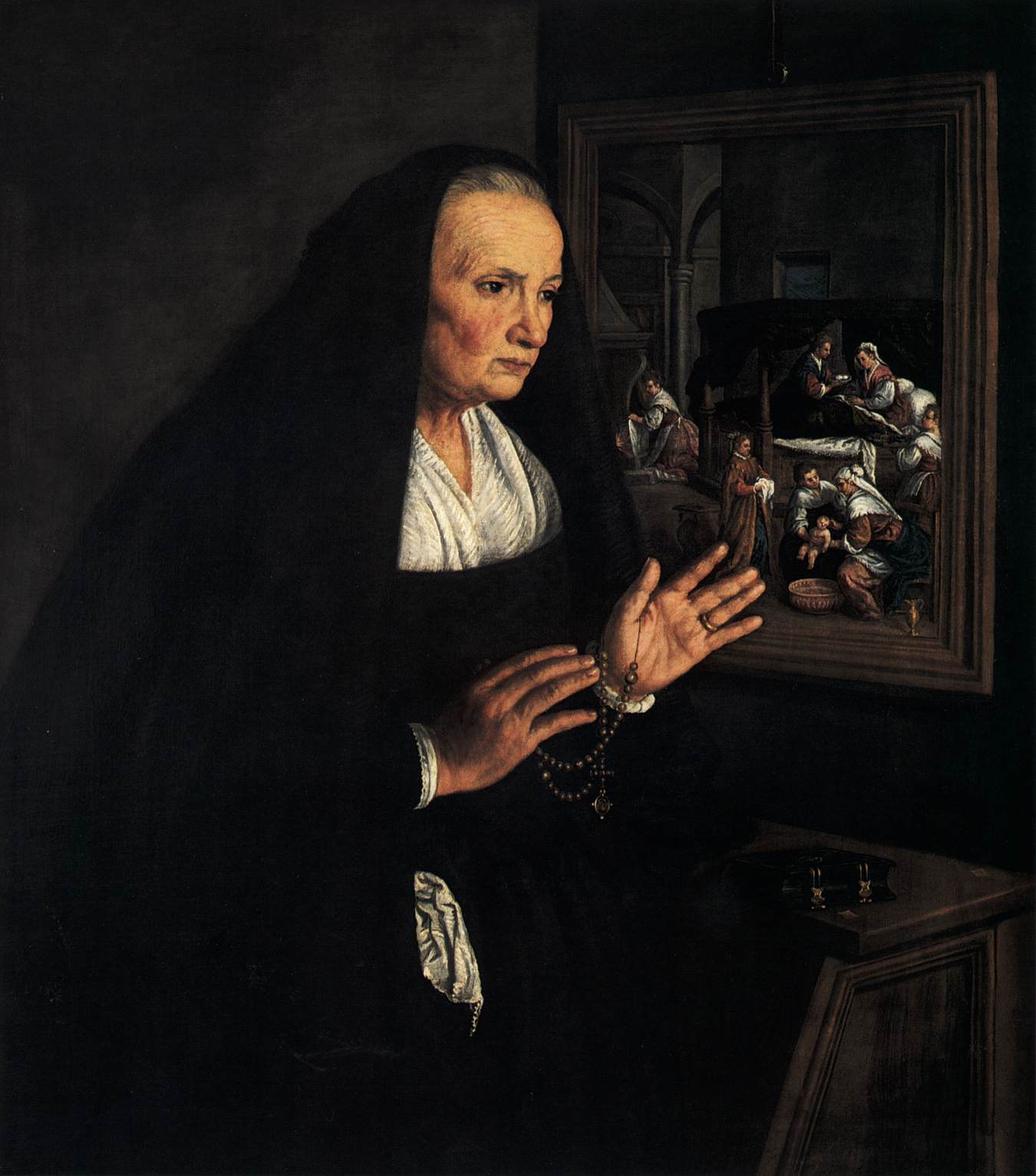
Portrait of a Widow at her Devotions, Leandro Bassano [Web Gallery of Art]


Back in the late 1970s when I was working in St Mary's Seminary, Ozamiz City, in northern Mindanao - an island that is bigger than Ireland - I used to celebrate Mass in one of the barrios (villages) nearby. There was one elderly woman who was there every Sunday but who never smiled, never greeted me. I filed her away in my mind under 'Grumpy Old Women'.

But on the Sunday that today's gospel was read the idea came into my mind of inviting all the widows in the congregation for a special blessing at the end of Mass. My 'Grumpy Old Woman' came up, along with others, with a huge smile on her face. Every Sunday after that she greeted me as if I was her long lost son.

Yesterday, Friday, the Solemnity of the Most Sacred Heart of Jesus, Pope Francis spoke about the tenderness of GodTenderness! But the Lord loves us tenderly. The Lord knows that beautiful science of caresses, the tenderness of God. He does not love us with words. He comes close - closeness - and gives us His love with tenderness. Closeness and tenderness! The Lord loves us in these two ways, He draws near and gives all His love even in the smallest things: with tenderness. And this is a powerful love, because closeness and tenderness reveal the strength of God’s love.

On 1 June 22 children being treated for cancer in the Agostino Gemelli Hospital in Rome came to visit Pope Francis. They recited the Hail Mary together and the Pope blessed them. He explained that his blessing is like a hug from God. A friend of mine in the Philippines who is a single mother once brought her cousin to meet me and told me later that her cousin had described the blessing I gave them in those very same words.

My 'Grumpy Old Woman' through the blessing I gave the widows at the end of Mass experienced something of God's tenderness, a 'hug from God', and it transformed her. It gave her a sense that she mattered to God as did the widow in today's gospel whose only son was returned to her, as did the widow who offered hospitality to Elijah and whose son was returned to her.

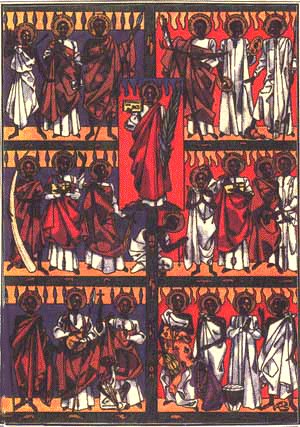
Royal Door, Unknown Icon Painter, Crete, 1450-1500 [Web Gallery of Art]

On 31 May Zenith.org told the extraordinary story of Pietro Maso, a young Italian who murdered his parents, Antonio and Rosa, in 1991 and how he was reconciled with his two sisters, Laura and Nadia, whom he had also tried to kill, I was dead and forgiveness resurrected me. It's a story that shows the truth of the words of Pope Francis above, And this is a powerful love, because closeness and tenderness reveal the strength of God’s love.

Pietro was released from prison in Milan last April after serving 22 years. During his first year in jail he heard Fr Guido Todeschini speak about him on the radio: What do we do, do we abandon him, do we bury him alive as he deserves or do we stretch our hand out to him and try to rescue him, taking into account his young age? Of course, at this moment it’s easier to be executioners than to be moved to pardon. But if we leave him there in prison, forgotten, we commit the same crime.

Father Guido, who didn't know Pietro personally, came to visit him in jail shortly after the broadcast and every Saturday after that made the trip of almost two hours each way from Verona to be with the young man and to bring him the Body of Christ. This eventually led to his being reconciled with his sisters, who had to go through their own struggles to forgive. Laura said on Father Guido's radio programme in 2008, We sisters, together with the loss of two parents had also lost a brother, and so we tried to begin a new and difficult path, with very strong inner suffering, because it’s not easy to forgive such a grave thing. We thank Father Guido for his help: he was the first to go to Pietro in prison and to follow him over these years. Thus we too, slowly, slowly reconstructed a beautiful relationship with the brother we had lost, as we had lost the whole family.

The article ends with a paragraph that is a contemporary expression of today's gospel and that shows the infinite mercy and compassion of God, which Pope Francis keeps reminding us of: Evil had transformed Pietro into a monster, but the forgiveness of God, of his sisters, of Father Guido worked the miracle. They brought back to life a youth who was dead and damned.


Antiphona ad Communionem, 1 Jn 4:16

Deus cáritas est, et qui manet in caritáte 
in Deo manet et Deus in eo.

Communion Antiphon, 1 John 4:16

God is love, and whoever abides in love 
abides in God, and God in him.

The Latin text is used as an antiphon in the video above and the setting is by Henryk Jan Botor. He composed this, as far as I can make out, for the 36th International Congress of Young Singers (XXXVI Congressus Internationalis Pueri Cantores) held in Rome that began on 28 December 2010 and ended with the Solemn Mass celebrated in St Peter's Basilica for the Solemnity of Mary, the Holy Mother of God, New Year's Day 2011. I'm not sure at which church in Rome this video was recorded.

06 June 2013

National Vigil for LIfe, Dublin, Saturday 8 June


Blurb with the video: The National Vigil for Life takes place at a key moment with the Government intending to introduce abortion in July. Get involved by attending yourself and inviting as many others as possible. Bring a car-load or even a bus-load. To organise a bus or get information on buses from your area please telephone Denise on (087) 266 8702 or Theresa on (085) 871 1100. Like National Vigil For Life on Facebook and Follow @natvigil4life on Twitter for updates. See you on 8th June!

The government of the Republic of Ireland is trying to introduce legislation that would legalise abortion. The most contentious part of the bill would allow abortion if the mother was threatening abortion. The medical and psychiatric advice given during consultations held in the Senate chamber earlier in the year dismissed as having no basis the idea that aborting a child was a 'cure' for suicidal ideation.

Fears too have been expressed that if this legislation is approved it would give a l'legitimacy' to suicide. And this at a time when suicide is the cause of the deaths of many young people, about 80 percent of them men.

Little or no attention has bee paid to the reality that in many cases having had an abortion has led women to suicide or to attempted suicide.

LifeZine, the official magazine of Family & Life in Dublin, states:

Right now the Irish government proposes dangerous and unjust abortion legislation. The Taoiseach says it's restrictive, that it's about saving lives, and that it won't actually change anything. Nothing could be further from the truth. The government plans to rush this legislation through in July - even avoiding a vote in the Dáil [Irish parliament] if possible. Your presence at the National Vigil For Life in Merrion Square, Dublin, this Saturday at 3pm is vital to challenge this. Before the Vigil, there will be a special Prayer Service for Life in Saint Andrew's Church, Westland Row, from 1.30 to 2.30 pm, led by Archbishop Diarmuid Martin. Please do as much as you can to make this event a success. Invite family, friends and colleagues. This may be your last chance to make your voice heard.

Though I am an Irish citizen, with no other citizenship, I cannot vote in Irish elections because I am living overseas, even though in the Philippines where I have permanent residency I cannot vote in elections at any level there either. I am outraged at the possibility that legislation dealing with life and death could possibly be passed without a vote.

Knock Shrine, Basilica in background

Archbishop Michael Neary of Tuam gave a powerful homily on the issue last Saturday in the Basilica in Knock, where the Blessed Mother appeared in 1879, and which is in his diocese. Here is the conclusion of his homily:

Clear Catholic Position
The Catholic bishops of Ireland point out that “the Bill as outlined represents a dramatic and morally unacceptable change to Irish law and is unnecessary to ensure that women receive the life-saving treatment they need during pregnancy”. The Pro-life commitment of the Church is reflected in her compassion for those who so often regret having had an abortion, her understanding for those who are facing difficult decisions, and her assistance for those who choose life. The work of CURA in this regard is a clear expression of the compassion, understanding and care with which the Church wishes to respond to every woman who faces difficulties or crisis in pregnancy.
Appeal to legislators!
Legislators are being asked to pass a law prescribing the death of innocent human beings. I ask that Legislators would reflect on the seriousness of the situation before voting. Is it really necessary to provide for Abortion in circumstances where evidence overwhelmingly indicates it is unnecessary and unjustified? Are we not crossing a moral Rubicon here?
As we consider something as fundamental as this we ought not to behave as if our faith could be divorced from our decision and left 'outside the room'. Our faith confirms the fundamental truth upon which every human right and the very future of humanity depends: that every human life is beautiful, every human life is precious and every human life is sacred. I conclude therefore by making this simple and urgent appeal to all our public representatives: Choose life!
The last paragraph highlights one of the most harmful heresies of our day, that our Christian faith has no bearing on our lives, that it is nothing more than a harmless hobby or indulgence that may make us feel good. That kind of 'Christianity' has no connection with the invitation of Jesus in Luke 7:23:  If any man would come after me, let him deny himself and take up his cross daily and follow me
The Visitation, El Greco, 1610-13 [Web Gallery of Art]

Archbishop Neary mentioned CURA, a crisis pregnancy programme that has the full support of the Irish bishops. Here is a short video about the services it offers.
Rachel's Vineyard is a ministry of healing for women and men who have been affected directly by abortion. It holds about five healing weekends per year in Ireland. The movement in Ireland has also organised weekends in the Faroe Islands and in the Republic of Korea. There is a weekend in Ireland this coming weekend, Please keep the participants in your prayers. These weekends are always held in private locations.

05 June 2013

Pope Francis's Prayer Intentions for June 2013

People in Plaza de Mayo, in front of the Cathedral in Buenos Aires, watching the inauguration of Jorge Mario Cardinal Bergogilo, their former archbishop, as Pope Francis, Bishop of Rome

General Intention

Mutual RespectThat a culture of dialogue, listening, and mutual respect may prevail among peoples.
Missionary Intention

New Evangelization. That where secularization is strongest, Christian communities may effectively promote a new evangelization.


03 June 2013

The Martyrs of Uganda and the current scandal in the Church


Today, 3 June, is the Memorial of Saint Charles Lwanga and Companions, Martyrs.

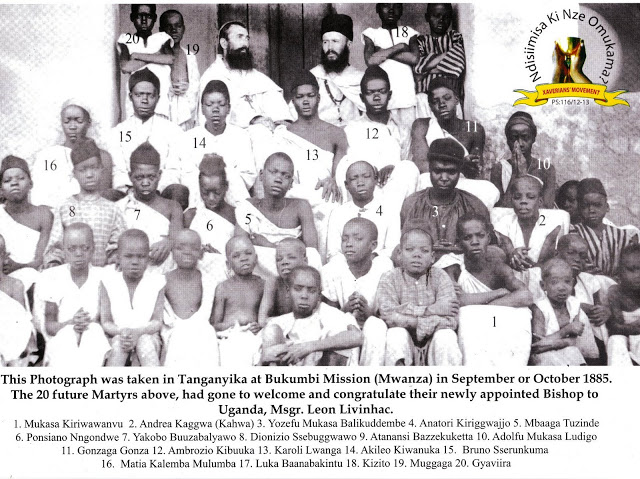
On 18 October 1964 Pope Paul VI canonised 22 young males - one, Kizito, was only 14 - martyred by King Mwanga II of Buganda, now part of Uganda, between 1885 and 1887. These men and boys were all pages of the king. In his homily at the canonisation the Pope spoke of some of the great saints of north Africa and of the Anglicans who were also martyred: Who could have predicted to the famous African confessors and martyrs such as Cyprian, Felicity, Perpetua and—the greatest of all—Augustine, that we would one day add names so dear to us as Charles Lwanga and Matthias Mulumba Kalemba and their twenty companions? Nor must we forget those members of the Anglican Church who also died for the name of Christ.

In 2010 there were more than 33 million people in Uganda of whom 41.9 percent were Catholics and 35.9 percent Anglican.


The Word Among Us carried an article by Bob French, The Uganda Martyrs; Their Countercultural Witness Still Speaks Today, in its August 2008 issue. Here are some extracts, emphasis added.


Unlike some missionaries of the day, the White Fathers took their time preparing people for baptism. They wanted their new converts to understand what it means to enter into new life with Jesus and to follow him.
Many Bugandans were hungry for their teaching and responded eagerly to this approach. “They were offered the living word of God, not just the historical facts of salvation,” says Caroli Lwanga Mpoza, a historian from Uganda. “They grabbed onto it, and it changed them.”
The depth of their faith became obvious during a three-year period when Mutesa’s hostility forced the White Fathers out of the country. The priests returned from exile after Mutesa’s death in 1884 and were pleased to find that their converts had taken it upon themselves to bring their families and friends to the Lord. Many had renounced polygamy and slavery and were devoting their energies to serving and caring for the needy around them.
Hero of the Faith. One exceptionally active convert was Joseph Mukasa, who served as personal attendant for both Mutesa and the new king, his son Mwanga. He had brought Christ to many of the five hundred young men and boys who worked as court pages, and they relied on his leadership and his clear grasp of the faith . . . 
Joseph Mukasa reprimanded the king for killing Anglican Bishop James Hannington, an Englishman.
Mukasa could have played it safe and chosen not to cross the king again. Instead, he enraged Mwanga even more by repeatedly opposing his attempts to use the younger pages as his sex partners. Mukasa not only taught the boys to resist but made sure they stayed out of Mwanga’s reach.
The Kabaka finally decided to make Mukasa an example, ordering him to be burned alive as a conspirator. But here, too, Mukasa proved the stronger and braver. He assured his executioner that “a Christian who gives his life for God has no reason to fear death… . Tell Mwanga,” he also said, “that he has condemned me unjustly, but I forgive him with all my heart.” The executioner was so impressed with Mukasa that he beheaded him swiftly before tying him to the stake and burning his body.
A Terrible Vengeance. Now on a rampage, King Mwanga threatened to have all his Christian pages killed unless they renounced their faith. This failed to intimidate them, however, for Mukasa’s example had inspired them. Even the catechumens among them followed Mukasa’s bravery by asking to be baptized before they died.
Among them was Charles Lwanga, who took over both Mukasa’s position as head of the pages and his role of spiritual leader. Like Mukasa, Lwanga professed loyalty to the king but fell into disfavor for protecting the boys and holding onto his faith . . .
The article concludes with these paragraphs:
Against the Grain. The martyrs of Uganda were young, but they were not seduced by the values of the royal court. They took a stand for God’s law, even when it meant defying the king himself. Out of allegiance to a higher king and a nobler law, they rejected the earthly security that could have been theirs had they given in to the king’s lusts.
Their example is extremely important today, Caroli Mpoza points out. It shows how faith can become a “rudder” that sustains us in times of trial and temptation. It also shows how critical it is to instill godliness in our children. If they learn to honor God and put him first, he says, they too will stand firm against the seductive values of our culture.
Like the parable of the sower, the story of the Uganda Martyrs invites us to examine our commitment to the Lord. Here are young people whose whole life of faith was marked by simple, luminous, joyful trust in God—even in the face of a gruesome death. They were “rich soil” indeed—not just for Africa, but for the whole church.
In 2010 there were more than 33 million people in Uganda of whom 41.9 percent were Catholics and 35.9 percent Anglicans.
The Murphy Report (2009) by the Irish Department of Justice examining the sexual abuse of minors by priest in the Archdiocese of Dublin was based on complaints in respect of over 320 children against the 46 priests in the representative sample. Substantially more of the complaints relate to boys – the ratio is 2.3 boys to 1 girl. [Emphasis added here and below.]
The John Jay Report of sexual abuse of minors by priests in the USA listed the main characteristics of the sex abuse incidents reported. These included:
-- An overwhelming majority of the victims, 81 percent, were males. The most vulnerable were boys aged 11 to 14, representing more than 40 percent of the victims. This goes against the trend in the general U.S. society where the main problem is men abusing girls.
-- A majority of the victims were post-pubescent adolescents with a small percentage of the priests accused of abusing children who had not reached puberty.
-- Most of the accused committed a variety of sex acts involving serious sexual offenses.
-- The most frequent context for abuse was a social event and many priests socialized with the families of victims.
-- Abuses occurred in a variety of places with the most common being the residence of the priest.


I thank Fr Ray Blake for this photo, which I found on his post today on the Ugandan Martyrs after I had published my post.
O God, who have made the blood of Martyrs 
the seed of Christians,
mercifully grant that the field which is your Church,
watered by the blood 
shed by Saints Charles Lwanga and his companions, 
may be fertile and always yield you an abundant harvest. 
Through our Lord Jesus Christ, your Son, 
who lives and reigns with you in the unity of the Holy Spirit, 
one God, for ever and ever.

31 May 2013

'You give them something to eat'. Sunday Reflections, Corpus Christi


Readings (Jerusalem Bible: Australia, England & Wales, India [optional], Ireland, New Zealand, Pakistan, Scotland, South Africa)

Gospel Luke 9:11b - 17 (Revised Standard Version – Catholic Edition)

Jesus welcomed the crowds and spoke to them of the kingdom of God, and cured those who had need of healing. Now the day began to wear away; and the twelve came and said to him, "Send the crowd away, to go into the villages and country round about, to lodge and get provisions; for we are here in a lonely place." But he said to them, "You give them something to eat." They said, "We have no more than five loaves and two fish--unless we are to go and buy food for all these people." For there were about five thousand men. And he said to his disciples, "Make them sit down in companies, about fifty each." And they did so, and made them all sit down. And taking the five loaves and the two fish he looked up to heaven, and blessed and broke them, and gave them to the disciples to set before the crowd. And all ate and were satisfied. And they took up what was left over, twelve baskets of broken pieces. 

In countries where Corpus Christi is celebrated on Thursday 30 May the Ninth Sunday in Ordinary Time Year C is observed on 2 June. Here are the readings:

Readings (Jerusalem Bible: Australia, England & Wales, India [optional], Ireland, New Zealand, Pakistan, Scotland, South Africa)


I'll take advantage of Pope Francis having celebrated Mass on the Solemnity of Corpus Christi, known officially now in English as The Most Holy Body and Blood of Christ, yesterday in the plaza outside the Basilica of St John Lateran, the cathedral of the Bishop of Rome. Here is the English translation of his homily, given in Italian, by Vatican Radio. I have highlighted parts that struck me. [The original Italian text is here. The translation does not seem to have been done by a native English-speaker. There is another translation on the Zenit website.]

Dear brothers and sisters,

In the Gospel we have just heard, there is an expression of Jesus that always strikes me: 
"You give them something to eat"  (Lk 9:13). Starting from this sentence, I let myself be guided by three words: discipleship, fellowship and sharing.

1. First of all: who are those to whom we are to give to eat? The answer is found at the beginning of the Gospel: it is the crowd, the multitude. Jesus is in the midst of the people: He welcomes them, talks to them, He cures them, He shows them the mercy of God. In their midst, he chooses the twelve Apostles to be with Him, and like Him, to immerse themselves in the concrete situations of the world. People follow Him, listen to Him, because Jesus speaks and acts in a new way, with the authority of someone who is authentic and consistent, who speaks and acts with truth, who gives the hope that comes from God, who is revelation of the face of a God who is love - and the people with joy, bless God.


This evening we are the crowd of [which] the Gospel [tells]: let us also strive to follow Jesus to listen to him, to enter into communion with Him in the Eucharist, to accompany Him and in order that He accompany us. Let us ask ourselves: how do I follow Jesus? Jesus speaks in silence in the Mystery of the Eucharist and every time reminds us that to follow Him means to come out of ourselves and make of our own lives, not a possession, but a gift to Him and to others.


2. Let us take a step forward: whence is born the invitation that Jesus makes to his disciples to feed the multitude themselves? It is born from two elements: first, the crowd, having followed Jesus, now finds itself in the open, away from inhabited areas, as evening falls, and then, because of the concern of the disciples, who asked Jesus to dismiss the crowd, that they might seek food and lodging in the nearby towns (cf. Lk 9:12). Faced with the neediness of the crowd, the solution of the disciples is that every man should take care of himself: “Dismiss the crowd!” [the disciples say]. How many times do we Christians have this temptation! We do not care for the needs of others, dismissing them with a pitiful, “God help you.” Jesus’ solution, on the other hand, goes in another direction, a direction that surprises the disciples: [He says], “You give them something to eat.” 


But how is it that we are to feed a multitude? “We have only five loaves and two fish, unless we go and buy food for all these people.” But Jesus is not discouraged. He asks the disciples to seat people in communities of fifty people, He raises his eyes to heaven, recites the blessing, breaks the loaves, and gives them to the disciples for distribution. 

It is a moment of profound communion: the crowd, whose thirst has been quenched by the word of the Lord, is now nourished by His bread of life – and they all ate their fill, the Evangelist tells us.


This evening, we too are gathered around the Lord’s table, the table of the Eucharistic Sacrifice, in which He gives us once again His body, makes present the one sacrifice of the Cross. It is in listening to his Word, in nourishing ourselves with his Body and his Blood, that He makes us go from being a multitude to being a community, from [being strangers] to being [in] communion. The Eucharist is the sacrament of communion, which brings us out from individualism to live together our journey in His footsteps, our faith in Him. We ought, therefore, to ask ourselves before the Lord: How do I live the Eucharist? Do I live it anonymously or as a moment of true communion with the Lord, [and] also with many brothers and sisters who share this same table? How are our Eucharistic celebrations?


3. A final element: whence is born the multiplication of the loaves? The answer lies in the invitation of Jesus to his disciples: “You yourselves give [to them]...,” “give,” share. What do the disciples share? What little they have: five loaves and two fishes. But it is precisely those loaves and fishes that in God’s hands feed the whole crowd


And it is the disciples, bewildered by the inability of their means, by the poverty of what they have at their disposal, who invite the people to sit down, and - trusting the Word of Jesus – distribute the loaves and fishes that feed the crowd. This tells us that in the Church, but also in society, a keyword that we need not fear is “solidarity,” that is, knowing how to place what we have at God’s disposal: our humble abilities, because [it is] only in the sharing, in the giving of them, that our lives will be fecund, will bear fruit. Solidarity: a word upon which the spirit of the world looks unkindly!


Tonight, once again, the Lord distributes for us the bread which is His body, He makes a gift of Himself. We, too, are experiencing the “solidarity of God” with man, a solidarity that never runs out, a solidarity that never ceases to amaze us: God draws near to us; in the sacrifice of the Cross He lowers Himself, entering into the darkness of death in order to give us His life, which overcomes evil, selfishness, death


Jesus this evening gives Himself to us in the Eucharist, shares our same journey – indeed, He becomes food, real food that sustains our life even at times when the going is rough, when obstacles slow down our steps. The Lord in the Eucharist makes us follow His path, that of service, of sharing, of giving – and what little we have, what little we are, if shared, becomes wealth, because the power of God, which is that of love, descends into our poverty to transform it.


Let us ask ourselves this evening, adoring the Christ truly present in the Eucharist: do I let myself be transformed by Him? Do I let the Lord who gives Himself to me, guide me to come out more and more from my little fence to get out and be not afraid to give, to share, to love Him and others?


Discipleship, communion and sharing. Let us pray that participation in the Eucharist move us always to follow the Lord every day, to be instruments of communion, to share with Him and with our neighbor who we are. Then our lives will be truly fruitful. Amen.


I don't recall such an event before, where Catholics in every time zone will be making a Holy Hour of adoration of the Blessed Sacrament at the same time as in Rome. Though the video emphasises cathedrals and religious houses, it will also take place in many other churches and chapels, including St Mun's, Ballachulish-Glencoe, Scotland, where I am at the moment.

Ths worldwide Holy Hour is in the context of the Year of Faith.

May this hour be a moment of great grace for the Church and the world.

A booklet in Italian and Latin for the Holy Hour to be observed in St Peter's, Rome, is on the Vatican website here. The English version is here on the Year of Faith website.


Marten Pepijn, 1637 [Web Gallery of Art]


29 May 2013

'Delay communions until adulthood, says priest' - Irish Examiner today


May is the month in Ireland when children make their First Holy Communion. Over the years it has become less and less a significant moment of faith in the lives of young Irish Catholics and more and more an extravagant family celebration where the Christian faith is no more than a background and very often lacking in the parents of the First Communicant.

Today's Irish Examiner carries a story under the headline Delay communions until adulthood, says priestFiachra Ó Cionnaith's report begins:

The claim has been made by a leading Catholic priest, who said the age-specific system has lost almost all connection to what is meant to be intended. 

Speaking on RTÉ Liveline programme [a very popular phone-in radio show on the main national station] yesterday, Fr Paddy Byrne said the modern-day version of the religious rites of passage has become a 'hostile' event involving families who do not want to be there. 

He said cultural changes in recent years mean many ceremonies now involve parents who have moved away from the Church, but feel peer pressure to allow their children to join the ceremonies. 

In other cases, he said, otherwise religious families see the events more as family parties and opportunities for their children to be given money and presents. 


The article quotes Fr Byrne: 85% of children taking first communion are not seen again by the Church. This figure may not be quite accurate as probably most of them will appear in church at least once after their First Holy Communion - for their Confirmation about five years later. Then for many, maybe most, it's 'Goodbye'.


TV3, a commercial station in Ireland, broadcast Modern Ireland - My First Holy Communion  (video above) in 2009. It looks at three families, two Irish and a Nigerian family now living in Dublin. Ironically, the immigrant family is the most comfortable financially. For all three families the First Holy Communion of one of their children is a very important family event. One father hopes that it will bring his separated parents together for the occasion. Sadly, it doesn't.

But it is only the Nigerian family that clearly sees the day above all as a celebration of their Catholic faith and an occasion they hope will be one of a deepening in his faith of the young boy making his First Holy Communion.

The excerpts from the Mass in County Louth shown in the video made me shudder.

First Communicants at Holy Family Home for Girls. I had just baptised and confirmed some of them. Most of these girls come from backgrounds of poverty and many have experienced far worse than that.

Though I'm not sure that I'd go along with the idea of leaving the sacraments of initiation until adulthood I think that Fr Byrne is highlighting the crisis of a widespread loss of the Catholic Christian faith in Ireland, something I've posted about before, also in the context of First Holy Communion.

Father Byrne observes that First Holy Communion and Confirmation are losing their meaning for Irish Catholics and notes, There’s a majority [of parents] who are quite unruly when it comes to the basic etiquette of how to behave. I’ve often been asked 'do you have wi-fi here, can people go on Facebook?'

How can someone who doesn't now the alphabet teach another how to read? How can parents or grandparents who have in effect lost the faith or for whom Mass is not important pass on the faith to their children and grandchildren? Pope Francis carries in his breviary a note from his paternal grandmother, born Rosa Margherita Vasallo and who emigrated from Italy to Argentina with his parents: May my grandchildren, to whom I have given my whole heart, have a long and happy life but if pain, sickness or loss of a loved one should fill them with sadness, may they remember that one breath taken at the Tabernacle, where the greatest and august martyr is present and one glance at Mary at the foot of the cross, will act like a balm that is able to heal the deepest and most painful wounds.

Where are the Rosa Margheritas in contemporary Ireland?


Céad míle fáilte romhat, a Íosa, a Íosa
A hundred thousand welcomes to you, o Jesus, o Jesus
A traditional Irish Communion / Christmas hymn

SA GHAEILGE / IN IRISH

Céad míle fáilte romhat, a Íosa, a Íosa,
Céad míle fáilte romhat, a Íosa,
Céad míle fáilte romhat, a Shlánaitheoir
Céad míle míle fáilte romhat, a Íosa, a Íosa...

Glóir agus moladh duit, a Íosa, a Íosa,
Glóir agus moladh duit, a Íosa,
Glóir agus moladh duit, a Shlánaitheoir,
Glóir, moladh agus buíochas duit, a Íosa, a Íosa...

Céad míle fáilte romhat, a Shlánaitheoir,
Céad míle míle fáilte romhat, a Íosa, a Íosa...

IN ENGLISH / SA BHÉARLA

A hundred thousand welcomes to you, o Jesus, o Jesus,
A hundred thousand welcomes to you, o Jesus,
A hundred thousand welcomes to you, o Saviour,
A hundred thousand welcomes to you, o Jesus, o Jesus...

Glory and praise to you, o Jesus, o Jesus,
Glory and praise to you, o Jesus,
Glory and praise to you, o Saviour,
Glory, praise and thanks to you, o Jesus, o Jesus...

A hundred thousand welcomes to you, o Saviour,
A hundred thousand welcomes to you, o Jesus, o Jesus...

26 May 2013

An Irish cat mothering ducklings


The domestic cat is surely one of God's most delightful creatures. Last Thursday The Irish Times carried this story: Purrfect Harmony: mother cat suckles ducklings. Whether or not the cat is suckling the ducklings she is certainly mothering them.

The wolf shall dwell with the lamb, and the leopard shall lie down with the kid, and the calf and the lion and the fatling together, and a little child shall lead them. The cow and the bear shall feed; their young shall lie down together; and the lion shall eat straw like the ox. The sucking child shall play over the hole of the asp, and the weaned child shall put his hand on the adder's den. They shall not hurt or destroy in all my holy mountain; for the earth shall be full of the knowledge of the LORD as the waters cover the sea (Isaiah11:6-8 RSV-CE).

Here's a Japanese choral version of Leroy Anderson's The Waltzing Cat.