19 September 2014

'Are you envious because I am generous?' Sunday Reflections, 25th Sunday in Ordinary Time Year A

Parable of the Workers in the Vineyard, Johann Christian Brand, 1769
Akademie der bildenden Künste, Vienna [Web Gallery of Art]

Readings (New American Bible: Philippines, USA)

Readings (Jerusalem Bible: Australia, England & Wales, India [optional], Ireland, New Zealand, Pakistan, Scotland, South Africa) 


Jesus said to his disciples:

“For the kingdom of heaven is like a landowner who went out early in the morning to hire laborers for his vineyard. After agreeing with the laborers for the usual daily wage, he sent them into his vineyard.  When he went out about nine o’clock, he saw others standing idle in the marketplace; and he said to them, ‘You also go into the vineyard, and I will pay you whatever is right.’ So they went.  When he went out again about noon and about three o’clock, he did the same.  And about five o’clock he went out and found others standing around; and he said to them, ‘Why are you standing here idle all day?’  They said to him, ‘Because no one has hired us.’ He said to them, ‘You also go into the vineyard.’ 

When evening came, the owner of the vineyard said to his manager, ‘Call the laborers and give them their pay, beginning with the last and then going to the first.’  When those hired about five o’clock came, each of them received the usual daily wage. Now when the first came, they thought they would receive more; but each of them also received the usual daily wage.  And when they received it, they grumbled against the landowner,  saying, ‘These last worked only one hour, and you have made them equal to us who have borne the burden of the day and the scorching heat.’  But he replied to one of them, ‘Friend, I am doing you no wrong; did you not agree with me for the usual daily wage?  Take what belongs to you and go; I choose to give to this last the same as I give to you.  Am I not allowed to do what I choose with what belongs to me? Or are you envious because I am generous?’  So the last will be first, and the first will be last.”

Vineyards in Languedoc-Roussillion region, France [Wikipedia]


I spent a grace-filled year in Toronto in 1981-82 doing a sabbatical at Regis College, a Jesuit school. The programme I was in was for persons with pastoral experience. Nearly all of us were priests or religious brothers and sisters, with one or two laypersons. One of the graces of that year was making new friends. 

Five or six of us men used to go for an hour's brisk walk almost every night after supper. One of them was Brother Luke Pearson FMS, a member of the Marist Brothers of the Schools, from New Jersey whose father was a Scottish Presbyterian and his mother an Irish Catholic. Brother Luke identified with his mother in terms of his faith but considered himself Scottish rather than Irish, even though he was American. He would surely have been following this week's referendum in Scotland, which has resulted in the people of that country opting to stay in the United Kingdom.

In the 1990s Brother Luke came to be a member of the staff at the Marist Asia-Pacific Center in Marikina City, part of the urban sprawl that is Metro Manila, where junior professed brothers from the region have ongoing formation. Sadly, he later died of cancer.

At the end of our academic year most of us went to Loyola House in Guelph, Ontario, for its 40-day Spiritual Exercises Institute, which includes a retreat of 30 days. Many of the retreatants were persons we hadn't met before. We got to know them a little during the preparatory days before we moved into the total silence of the 30-day retreat, apart from three separate 'repose days' when we were off silence from after breakfast until late afternoon.

I began to notice as each repose day came about that I was finding it harder to remember who had been on the nine-month programme in Toronto and who hadn't. In the silence we were gradually becoming a real community, even though after leaving most of us would never meet each other again.

At the beginning I saw myself and my companions from the Regis College programme as my core group who had borne the burden of the day and the scorching heat, as it were, while the others were those hired about five o’clock.

Unlike the parable, there was no sense of resentment but rather a sense of joy. We were all receiving an abundance of the Lord's unbounded generosity with the graces he was showering on each of us, and on all of us as a community growing in the silence of prayer. 

And my friendship with Brother Luke had grown deeper during that silence.

I recalled all of this while reflecting on and praying with today's Gospel. There's a great freedom in being able to acknowledge and to rejoice in the gifts that God has given others that may be different from those he has given me. When I can do that I will have a sense of gratitude to God not only for the gifts that others have but for those that I have. 

I remember reading an obituary of a Columban who had spent 53 years in Japan and who died in Ireland, Fr Bede Cleary. He was described as a happy, enthusiastic, committed missionary and that people were touched by his friendliness, hospitality and selfless dedication. Among other things, he was  involved with other Christians in bringing on pilgrimages of reconciliation to Japan former prisoners of war from Britain and other places who had suffered cruelly from Japanese soldiers during World War II and who carried bitterness and hatred in their hearts. One of the things that had led to these pilgrimages ws the discovery that young Japanese, born long after the War, were tending the graves of POWs who had died in Japan.

But what I remember most from the obituary written by another Columban in Japan, Fr Eamonn Horgan, was his description of three of the shortest books you could find in a library. One was How to Maintain a Car by Fr Bede Cleary. Father Bede was truly loved by his fellow Columbans as well as by the Japanese people he so faithfully served. But the Columbans in Japan could also see clearly that there were certain gifts he lacked! 

Being able to laugh at what we and others lack while recognizing and thanking God for the many gifts each has is one of the graces that God wants each of us to receive.

If we are truly grateful to God for everything that he has given us, and for what he has given others that we may not have, when we come to receive the usual daily wage, which, if we follow his will, will be eternal life, we won't provoke him to ask, Are you envious because I am generous?


Antiphona ad introitum     Entrance antiphon


Salus populi ego sum, dicit Dominus.
I am the salvation of the people says the Lord.
De quacumque tribulatione clamaverint ad me,
Should they cry to me in any distress,
exaudiam eos, et ero illorum Dominus in perpetuum.
I will hear them, and I will be their Lord for ever.

Ps. 77 [78]:1. Attendite, popule meus, legem meam:
Give ear, O my people, to my teaching;
inclinate aurem vestram in verba oris mei. 
incline your ears to the words of my mouth.
Gloria Patri, et Filio et Spiritui Sancto;
Glory to the Father, and to the Son and to the Holy Spirit;
sicut erat in principio, et nunc, et semper, in saecula saecolurm. Amen.
as it was in the beginning, is now, and will be for ever. Amen

Salus populi ego sum, dicit Dominus.
I am the salvation of the people says the Lord.
De quacumque tribulatione clamaverint ad me,
Should they cry to me in any distress,
exaudiam eos, et ero illorum Dominus in perpetuum.
I will hear them, and I will be their Lord for ever.

The text above in bold, in Latin and English, is used in Mass in the Ordinary Form. That and the rest is used in the Mass in the Extraordinary Form on the 19th Sunday After Pentecost.

Visit of Pope Francis to Tirana, Albania, 21 September


Logo for Apostolic Journey of Pope Francis to Tirana, Albania

Terminal of Tirana International Airport Nënë Tereza (Mother Teresa)
Aeroporti Ndërkombëtar i Tiranës Nënë Tereza (Albanian) [Wikipedia]

Catholics and other people of faith were cruellly persecuted between 1946 and 1997


Ati ynë, që je në qiell, 
u shenjtëroftë emri yt, 
ardhtë mbretëria jote, 
u bëftë vullnesa jote si në qiell ashtu në tokë.
Bukën tonë të përditshme na e jep sot; 
na i fal fajet tona, si i falim ne fajtorët tanë; 
e mos na lër të biem në tundim, 
por na liro nga i keqi.

The Pope will celebrate Mass in Latin, with responses, readings and part of Eucharistic Prayer III in Albanian, in Mother Teresa Square, Tirana. Blessed Mother Teresa, born in Skopje, now the capital of the Republic of Macedonia, was an ethnic Albanian.

Of Albania's 3,000,000 people 59 percent are Muslims, ten percent Catholics and seven percent Orthodox Christians. Catholics are a majority in northwestern Albania.

May the Calvary and Resurrection of the Christians of Albania give heart to the Christians of Iraq and Syria, as we continue to pray for them. Their Calvary, unlike that of the Christians of Albania who couldn't leave their country, is one of exile, being forced to leave the place where their ancestors have lived and died and celebrated the Holy Sacrifice of the Mass for 2,000 years but where it cannot be celebrated any more.

Plaque dedicated to Mother Teresa, Wenceslas Square, Olomouc, Czech Republic [Wikipedia]

Tirana [Wikipedia]

16 September 2014

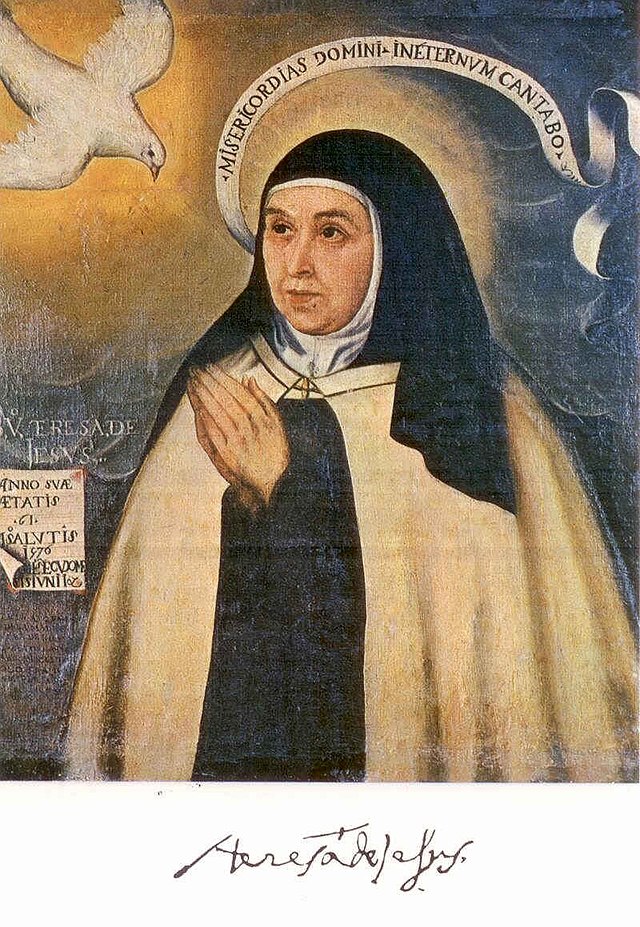
Virtual choir of Carmelite nuns sings St Teresa of Ávila's 'Nada te turbe', 'Let nothing disturb you'.


St Teresa of Ávila, Filippo della Valle, 1754
St Peter's Basilica, Vatican [Web Gallery of Art]

St Teresa of Ávila, who lived from 1515 to 1582 in Spain, could never have imagined the internet, though if she were around today I'm certain that she'd be involved in this digital continent, as Pope Benedict calls it, and as a woman who travelled considerably, despite being a contemplative nun, she would certain journey along the digital highways - las 'calles' digitales - of Pope Francis.

Eighty-three followers of St Teresa, Discalced Carmelite nuns from 24 countries, recently created a virtual choir to sing and record the saint's poem Nada te turbe - Let nothing disturb you. Sr Claire Sokol of the Carmelites in Reno, Nevada, wrote the music.


Nada te turbe   Let nothing disturb you

Nada te turbe,
nada te espante,  
todo se pasa,
Dios no se muda;
la paciencia
todo lo alcanza;
quien a Dios tiene
nada le falta:
Sólo Dios basta.

Let nothing disturb you,
let nothing frighten you,
everything passes,
but God stays.
Patience reaches it all;
he who has God
nothing lacks:
God alone suffices.

Eleva tu pensamiento,
al cielo sube,
por nada te acongojes,
nada te turbe.

Lift your thinking,
raise up to heaven,
let nothing anguish you,
let nothing disturb you.

A Jesucristo sigue
con pecho grande,
y, venga lo que venga,
nada te espante.

Follow Jesus Christ
with an open heart,
and, no matter what may come,
let nothing frighten you.

¿Ves la gloria del mundo?
Es gloria vana;
nada tiene de estable,
todo se pasa.

See the glory of the world?
It's vainglory;
it is not everlasting,
everything passes.

Aspira a lo celeste,
que siempre dura;
fiel y rico en promesas,
Dios no se muda.

Yearn for the celestial
that lasts forever:
faithful and rich in promises,
God doesn't change.

Ámala cual merece
bondad inmensa;
pero no hay amor fino
sin la paciencia.

Love it the way it deserves
immense kindness;
but there is not fine love
without the patience.

Confianza y fe viva
mantenga el alma,
que quien cree y espera
todo lo alcanza.

Confidence and alive faith
let the soul maintain,
that he who believes and hopes
reaches it all.

Del infierno acosado
aunque se viere,
burlará sus furores
quien a Dios tiene.

Although harassed by hell
one may see himself,
he who has God
will defeat its rage.

Vénganle desamparos,
cruces, desgracias;
siendo Dios tu tesoro
nada te falta.

Come abandonment,
crosses, misfortune;
God being your treasure,
you lack nothing.

Id, pues, bienes del mundo;
id dichas vanas;
aunque todo lo pierda,
sólo Dios basta.

Go, then, wordly goods
go, vain happiness;
even if everything is lost
God alone suffices.

Copy of an original painting by Fray Juan de la Miseria when St Teresa was 61.


My thanks to Sr Mary Carmela OCD of the Carmel of Vilvoorde, Belgium who sent me the link to the video. Sr Carmela belonged to the Carmel of Cebu and has written in MISYONonline.com, the magazine of the Columbans in the Philippines of which I am editor, of how three Filipino nuns left their communities to join that in Vilvoorde, founded in 1469 and the oldest existing community of Carmelite nuns in the world. Another article she wrote for MISYONonline.com, Touches of God, led Sr Marie Paul Thérèse From Iligan to Vilvoorde (via the Carmel in Cebu).


Sr Marie Paul Thérèse kneeling on right with Sr Mary Carmela standing behind her


English

15 September 2014

Our Lady of Sorrows, 15 September


The Crucifixion, El Greco, 1596-1600
Museo del Prado, Madrid

Gospel: John 19:25-27

Meanwhile, standing near the cross of Jesus were his mother, and his mother’s sister, Mary the wife of Clopas, and Mary Magdalene. When Jesus saw his mother and the disciple whom he loved standing beside her, he said to his mother, “Woman, here is your son.” Then he said to the disciple, “Here is your mother.” And from that hour the disciple took her into his own home.

Nationalmuseum, Stockholm

Alternative Gospel: Luke 2:33-35

And the child’s father and mother were amazed at what was being said about him. Then Simeon blessed them and said to his mother Mary, “This child is destined for the falling and the rising of many in Israel, and to be a sign that will be opposed so that the inner thoughts of many will be revealed—and a sword will pierce your own soul too.”

Our Lady of the Seven Sorrows, Adriaen Isenbrant, 1518-35
O.L. Vrouwekerk, Bruges, Belgium

Paintings from Web Gallery of Art.

12 September 2014

'So must the Son of Man be lifted up.' Sunday Reflections, The Exaltation of the Holy Cross.

Art Museum, Cincinnati, USA [Web Gallery of Art]

Readings (New American Bible: Philippines, USA)

Readings (Jerusalem Bible: Australia, England & Wales, India [optional], Ireland, New Zealand, Pakistan, Scotland, South Africa) 


Jesus said to Nicodemus:
No one has ascended into heaven except the one who descended from heaven, the Son of Man. And just as Moses lifted up the serpent in the wilderness, so must the Son of Man be lifted up, that whoever believes in him may have eternal life.
 “For God so loved the world that he gave his only Son, so that everyone who believes in him may not perish but may have eternal life.
“Indeed, God did not send the Son into the world to condemn the world, but in order that the world might be saved through him.
 NicodemusUnknown Master, Flemish
Museum voor Schone Kunsten, Ghent, Belgium [Web Gallery of Art]

The Catholic Bishops' Conference of the Philippines has designated the Feast of the Exaltation of the Holy Cross this year as National Day of Prayer for Peace in Iraq and Syria. Archbishop Socrates B. Villegas of Lingayen-Dagupan, President of the CBCP, wrote to his fellow bishops: In all our Masses on the feast of the Holy Cross, let us unite ourselves with our suffering brothers and sisters, commending to the God who is our hope their pains, their shattered lives and dreams, their bereavement and their loss. He also asked for a special collection at all Masses, the money to be sent by the CBCP to the charity aid of the Apostolic Nunciatures in Iraq and Syria.

Fr Ragheed Aziz Ganni
(20 January 1972 - 3 June 2007)

For me the face of the suffering Christians in Iraq and Syria, Catholic and Orthodox, is that of Fr Ragheed Ganni. This article by Ed West published in the Catholic Herald, a weekly in England, on 20 December 2013 and that has a very personal dimension, gives as good an account of Father Ragheed as any I've read.

Ed West writes: Fr Ragheed was one of 1,000 Iraqi Christians murdered during the pogrom that began after the Coalition invasion of 2003. The persecution culminated in October 31 2010, with the massacre of 52 worshippers at a Catholic church in Baghdad. In the words of one Chaldean bishop, this is a 'Calvary' that has largely been ignored in the western media, outside of the Christian press . . .

It has been a shocking and horrific ordeal for one of the world’s oldest Christian communities, which has been all but driven out of its homeland. A pre-war population of a million is now somewhere in the region of 150,000, many of them elderly, and more than 60 churches have been bombed.  That figure has got smaller in recent months and the ancient city of Mosul, in many ways the heart of the Christian faith in Iraq and Syria, has been emptied of its Christians by ISIS.

The article describes First Holy Communion day in Father Ragheed's parish in 2006: The atmosphere in Ragheed’s home town had become terrifying. On 4 August 2006, when 80 children of his parish of the Holy Spirit received their first Holy Communion, battles broke out in the street outside, and the children cowered from the sounds of guns and rockets.

The good shepherd helped them through. He told AsiaNews: 'Although people are used to it and remained reasonably calm, they started to wonder whether they were going to make it back to their homes or not. I was aware of the immense joy of the 80 children receiving their first Communion so I turned the subject into a joke and said to them: "Do not panic, these are fireworks. The city is celebrating with us." And at the same time I gave them instructions to leave the church quietly and quickly.'

The author further notes: Friends later recalled that he had become increasingly weary and broken by the demands of the priesthood amid such terror. After an attack on his parish, on Palm Sunday 2007, he wrote: 'We empathise with Christ, who entered Jerusalem in full knowledge that the consequence of His love for mankind was the cross. Thus while bullets smashed our church windows, we offered up our suffering as a sign of love for Christ.'

Shortly before his death Fr Ganni wrote in an email: 'Each day we wait for the decisive attack, but we will not stop celebrating Mass; we will do it underground, where we are safer. I am encouraged in this decision by the strength of my parishioners. This is war, real war, but we hope to carry our cross to the very end with the help of Divine Grace.'

This young Iraqi priest of the Chaldean Catholic Church, an engineer by profession, was murdered on Trinity Sunday, 3 June 2007, along with three subdeacons, Basman Yousef Daud, Gassan Isam Bidawed and Wahid Hanna Isho after he had celebrated Mass in Mosul, the city of his birth.

At a Eucharistic Congress in Bari, Italy, in 2005 Father Ragheed said, There are days when I feel frail and full of fear. But when, holding the Eucharist, I say ‘Behold the Lamb of God Behold, who takes away the sin of the world’, I feel His strength in me. When I hold the Host in my hands, it is really He who is holding me and all of us, challenging the terrorists and keeping us united in His boundless love. He also said, Without Sunday, without the Eucharist, the Christians in Iraq cannot survive.

To put some time perspective on the Christian faith in Iraq and Syria: in 2021 the Church in the Philippines will celebrate 500 years of the Catholic Christian faith in this country, a great occasion for thanking God for that precious gift. The Christian faith has been lived in Iraq and Syria for four times as long as that, since the time of the Apostles. Mass was celebrated for 2,000 years in Mosul until a couple of months ago when Christians were driven from their ancestral homeland by ISIS.

Father Raqheed's words, But when, holding the Eucharist, I say ‘Behold the Lamb of God Behold, who takes away the sin of the world’, I feel His strength in me, reflect the words of Jesus to Nicodemus in today's Gospel: And just as Moses lifted up the serpent in the wilderness, so must the Son of Man be lifted up, that whoever believes in him may have eternal life.

A Muslim friend of Fr Ragheed, Adnam Mokrani, professor of Islamic Studies at the Pontifical Gregorian University in Rome, said that on his ordination day, 13 October 2001, recalled that the new priest said, Today, I have died to self. St Paul in today's Second Reading tells us, Christ Jesus, who, though he was in the form of God did not regard equality with God has something to be exploited, but emptied himself, taking the form of a slave and that he became obedient to the point of death—even death on a cross.
    
As we celebrate the Exaltation of the Holy Cross and as we pray for persecuted Christians, particularly in Iraq and Syria, may we thank God for the gift of our Christian faith and ask him for the courage to live it as Father Ragheed and countless others have done, becoming obedient to the point of death.


From what I understand, this hymn to Our Blessed Mother in Arabic is sung by Father Ragheed and was played during his funeral procession. This is  the translation given with the video: We honor you with hymns O Mother of God, you are the pride of the whole earth, because the Word of God whom the Father sent, chose to take His human body from you. The generations call you blessed, all nations and people's honor you and ask for mercy by your prayers. You are a generous earth in which plants of joy always grow.


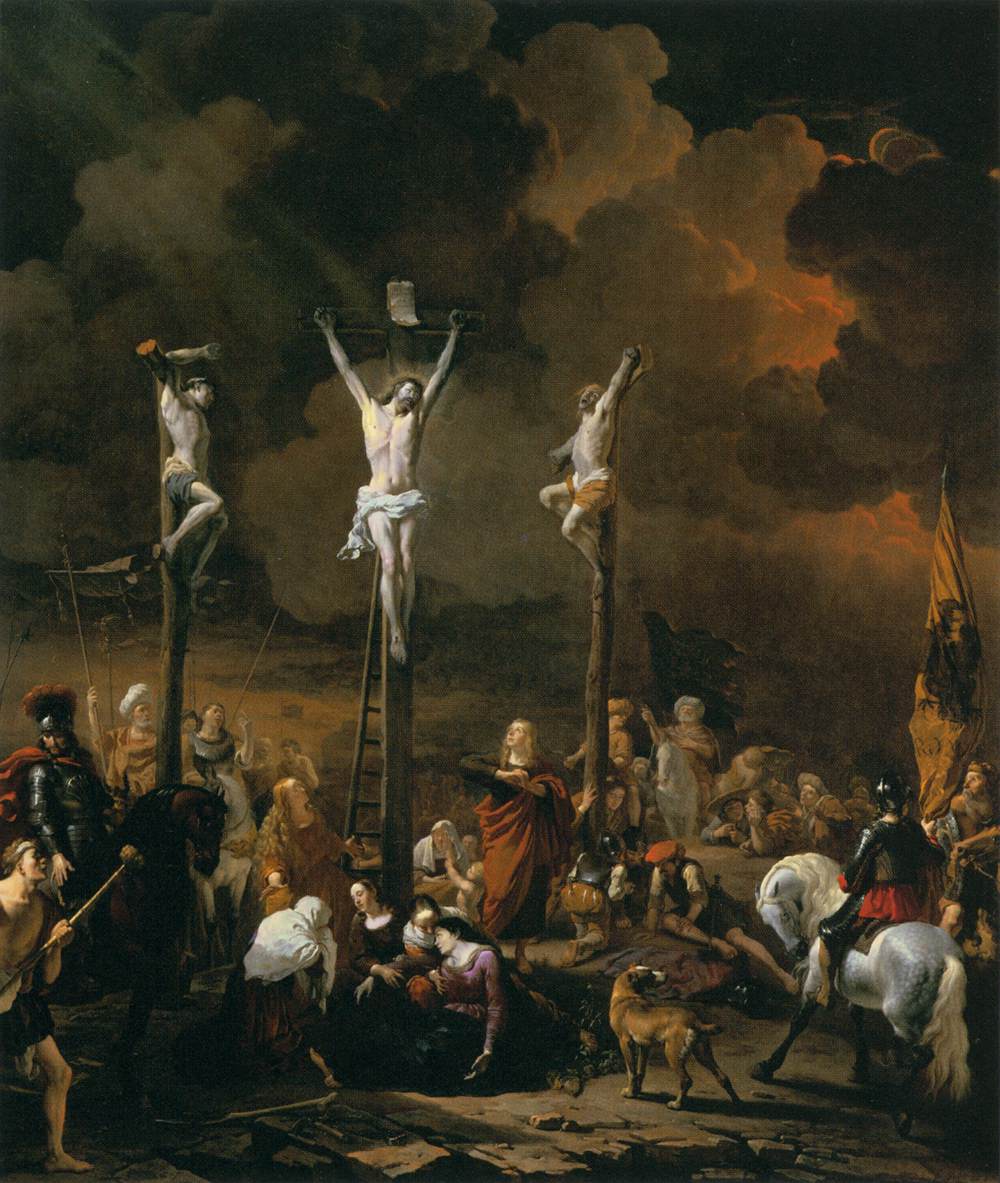
Calvary, Karel Dujardin, 1661
Musée du Louvre, Paris  [Web Gallery of Art]

Calvaire 
Calvary

le/by Pádraig Ó Croiligh

Ag barr na gcéimeanna
In Eaglais an tSlánaitheora
Tá séipéal tógtha ar rian na croise.
An dara stáisiún déag dearaithe ar a chúl
Agus poll sa talamh faoi
San áit a mbíodh an chrois
Ag an am ar tharla an crith talún.

Ach níl an tarlú féin ná an duine
I láthair anseo anois,
Ach in áiteanna brúite buartha
Ár fud na cruinne
Agus i láthair an uaignis.

An fear a fuair bás anseo,
Den bhás a rinneadh anseo,
Tá sé beo agus aiséirithe.
Tá Íosa ina Chríost go fóill!

At the top of the steps
In the Church of the Saviour
There’s a chapel built on the site of the cross.
The twelfth station painted at the back
And a hole in the ground underneath
In the place where the cross was
At the time of the earthquake.

But neither the event itself nor the person
Are present here now,
But in crushed sorrowful places
Throughout the world
And in the midst of loneliness.

The man who died here,
From the death that was wrought here,
He is alive and risen.
Jesus is still the Christ!

The poet is a priest of the Diocese of Derry, Ireland. The non-poetic English translation from the Irish (Gaelic) is my own. The poem is taken from Brúitíní Creidimh (Mashed Potatoes of Faith) by Pádraig Ó Croiligh, published by Foilseacháin Ábhair Spioradálta, Dublin, 2006.


Antiphon ad introitum     Entrance Antiphon  Cf Galatians 6:14
Nos autem gloriari oportet
We should glory 
in cruce Domini Nostri Jesu Christi, 
in the Cross of our Lord Jesus Christ,
in quo est salus, vita et resurrectio nostra,
in whom is our salvation, life and resurrection, 
per quem salvati et liberati sumus.
through whom we are saved and delivered.