06 August 2015

The Transfiguration 70 years ago in Hiroshima, 6 August 1945

Transfiguration of Christ, Paolo Veronese, 1555-56
Cathedral of Santa Maria, Montagnana, Italy [Web Gallery of Art]


A reflection by Maryknoll Fr William Grimm, publisher of ucanews.com, based in Tokyo. [5 August 2015]

August 6, besides being a feast of the Church, Transfiguration, is a terrible anniversary in human history.

Seventy years ago, at 8:15 on the morning of August 6, 1945, an atomic bomb exploded over Hiroshima, Japan.

Eyewitnesses to nuclear explosions describe them in terms similar to those used in the New Testament description of Jesus’ transfiguration, as a light as bright as the sun. However, in Hiroshima and three days later in Nagasaki, the light was followed by darkness as a cloud of smoke, dust and debris covered the sky.
The Hiroshima bombing was the first-ever use of an atomic weapon, and marked the beginning of decades of terror as various nations have joined the so-called ‘nuclear club’ and others work to develop their own nuclear weapons.

In fact, it is little-known that during World War II, Japan was also working to develop such a weapon at the Nishina Laboratory in Tokyo.

Uranium ore for the project was reportedly shipped by submarine from Europe, but the shipment never arrived and an incendiary raid on Tokyo by American B-29 bombers eventually destroyed the research facility on April 13, 1945. (The Nishina Laboratory continues to conduct nuclear research today in a suburb north of Tokyo.)

Though nuclear weapons have not been used since the two bombings in 1945, every one of us has been contaminated as nuclear tests and accidents have polluted our land, air, food, water and bodies with radioactivity. Radioactive pollution is so pervasive that in order to produce radiation-free medical tools, a fleet of sunken German warships from World War I has been ‘mined’ for their pre-atomic age steel.

We all suffer as incredible amounts of talent and treasure are wasted on weapons of mass destruction instead of being used to build solutions to poverty, ignorance, disease, environmental degradation, fear and hatred.

Yet, violence seems to be a part of our makeup. Whether we are children hitting one another, or nations warring against each other, or criminals attacking rivals or terrorists attacking strangers, humankind can legitimately be described as a violent species. Much of what passes for ‘entertainment’ is a glorification of violence. And, even though we use the verb ‘play’ to describe them, many of our sports and the attitudes of players and spectators are anything but playful.

Glorified children of God or demonic murderers — which are we? Are we both? The title ‘Killer Angels’ captures our plight.

Might the light of the transfiguration of Jesus before Peter, James and John offer us something to answer the brightness that ends in darkness for our violence-clouded world?

We must not forget that the one who was glorified on the mountain was the man Jesus. If it could happen to him, it could happen to us. Since God has created us for glory, living as glory-bound daughters and sons of God should be easy for us. It is what we are made for.

Yet, one of the mystifying things about us is that we devote so much energy to being what we are not.

Turning away from our brothers and sisters, turning away from God and turning away from our true selves presumably require extra effort. Yet, we (or to be more specific, I) continue to live the difficult way, the way of self-centredness, the way of selfishness, the way of competition, the way of violence.

The atomic bomb shows what we can be. The transfiguration of Jesus and this feast show us how we should be. If we could accept our destiny and live true to it, what a difference it would make for us and the world!

So, what would living toward glory look like? The life of Jesus, the transfigured one, shows us. Such a life would be at the disposal of others, the life of a servant. It would be a life in which violence toward others, including the quiet violence of using others for our own ends, would be unthinkable. It would be a life of confidence that God's love is stronger than anything we might fear, even death.
Can we live such a life? One man has, and his living it has opened the way to glory for us all.

August 6 shines a bright light on our possibilities both as a human race and as individuals. As individuals, nations and a world, we must choose the path of glory lest we go down the path of destruction.

Transfiguration of Christ, Unknown Cretan icon painter, c.1550
Ikonen-Museum, Recklinghausen, Germany [Web Gallery of Art]

Six days later, Jesus took with him Peter and James and John, and led them up a high mountain apart, by themselves. And he was transfigured before them, and his clothes became dazzling white, such as no one on earth could bleach them. And there appeared to them Elijah with Moses, who were talking with Jesus. Then Peter said to Jesus, “Rabbi, it is good for us to be here; let us make three dwellings, one for you, one for Moses, and one for Elijah.” He did not know what to say, for they were terrified. Then a cloud overshadowed them, and from the cloud there came a voice, “This is my Son, the Beloved; listen to him!” Suddenly when they looked around, they saw no one with them any more, but only Jesus.
As they were coming down the mountain, he ordered them to tell no one about what they had seen, until after the Son of Man had risen from the dead. So they kept the matter to themselves, questioning what this rising from the dead could mean.


27 July 2015

'Do not be content with anything less than Christ.' Sunday Reflections, 18th Sunday in Ordinary Time, Year B

From The Gospel of John (2003)  Directed by Philip Saville. Jesus played by Henry Ian Cusick; narrator, Christopher Plummer.
[John 6:24-35 is found between 2:36 and 4:24 in the video.]


Readings (New American Bible: Philippines, USA)

Readings (Jerusalem Bible: Australia, England & Wales, India [optional], Ireland, New Zealand, Pakistan, Scotland, South Africa)


When the crowd saw that neither Jesus nor his disciples were there, they themselves got into the boats and went to Capernaum looking for Jesus.
When they found him on the other side of the sea, they said to him, “Rabbi, when did you come here?” Jesus answered them, “Very truly, I tell you, you are looking for me, not because you saw signs, but because you ate your fill of the loaves. Do not work for the food that perishes, but for the food that endures for eternal life, which the Son of Man will give you. For it is on him that God the Father has set his seal.” Then they said to him, “What must we do to perform the works of God?”  Jesus answered them, “This is the work of God, that you believe in him whom he has sent.” So they said to him, “What sign are you going to give us then, so that we may see it and believe you? What work are you performing? Our ancestors ate the manna in the wilderness; as it is written, ‘He gave them bread from heaven to eat.’” Then Jesus said to them, “Very truly, I tell you, it was not Moses who gave you the bread from heaven, but it is my Father who gives you the true bread from heaven. For the bread of God is that which comes down from heaven and gives life to the world.” They said to him, “Sir, give us this bread always.”
Jesus said to them, “I am the bread of life. Whoever comes to me will never be hungry, and whoever believes in me will never be thirsty.


Antiphona ad Communionem  Communion Antiphon  Wisdom 16:20

Panem de caelo dedisti nobis, Domine,
You have given us, O Lord, bread from heaven,
habentem omne delectamentum, et omnem saporem suavitatis.
endowed with all delights and sweetness in every taste.


Fr Ragheed Aziz Ganni
(20 January 1972 - 3 June 2007)

I have featured Fr Ragheed Ganni a number of times on Sunday Reflections, most recently two weeks ago for the 16th Sunday in Ordinary Time, Year B. As a priest and as a Catholic Christian I am truly inspired by this man who was less than half the age I am now when he was assassinated.

‘He was a raconteur par excellence and a font of knowledge - we discussed everything and anything from the metaphysical to the trivial. A young and gauche student at the time, I learnt about Iraq and about theology; about the workings of the college in the summer and the best places to eat pizza. I was amazed at his command of English and Italian and his perennial good spirits and big smile - he was and will always be an inspiration’.

That is how an Irish student at the Pontifical Irish College in Rome described Fr Ragheed Ganni, a Chaldean Catholic priest murdered along with three subdeacons, Basman Yousef Daud,Wahid Hanna Isho, and Gassan Isam Bidawed, on 3 June 2007 just after the young priest had celebrated Mass in Holy Spirit parish, Mosul, Iraq. Fr Ganni, an engineer, studied theology in Rome, and stayed at the Irish College, where he was known as 'Paddy the Iraqi', 'Paddy' being a generic term for Irishmen, derived from the name of Ireland's - and Nigeria's - patron, St Patrick.


Pope Benedict XVI [Wikipedia]

Dear young people, do not be satisfied with anything less than Truth and Love, do not be content with anything less than Christ. Pope Benedict spoke these words at the prayer vigil on 20 August 2011 during the Madrid World Youth Day. He also said, we need to speak with courage and humility of the universal significance of Christ as the Saviour of humanity and the source of hope for our lives.

In these words he is echoing the answer of Jesus to the question put to him in today's gospel, What must we do, to be doing the works of God? His reply: This is the work of God, that you believe in him whom he has sent.

In Verbum Domini the Pope wrote, We cannot keep to ourselves the words of eternal life given to us in our encounter with Jesus Christ: they are meant for everyone, for every man and woman . . . It is our responsibility to pass on what, by God's grace, we ourselves have received. In his Angelus talk on 29 October 2006 Benedict said, The rediscovery of the value of one's own Baptism is at the root of every Christian's missionary commitment, because as we see in the Gospel, those who allow themselves to be fascinated by Christ cannot fail to witness to the joy of following in his footsteps. 

In that same talk, in which he commented on the gospel of that Sunday, Mark 10:46-52, Pope Benedict said, The decisive moment was the direct, personal encounter between the Lord and that suffering man. They found each other face to face:  God with his desire to heal and the man with his desire to be healed; two freedoms, two converging desires. He was speaking of the meeting between the blind Bartimaeus and Jesus.

One theme that comes through repeatedly in the teaching of Pope Benedict is that our faith is in a person, Jesus, God who became man. Jesus tells us clearly that it is his Father's will that we believe in him.

Another theme of Benedict is the joy that Jesus promised those who follow him. This was the theme of the Pope's message for World Youth Day 2012 held on Palm Sunday in Rome.

Pope Benedict uses a very striking term: those who allow themselves to be fascinated by Christ. I don't think I've heard it put that way before by anyone. Benedict insists so often that our faith is faith in the person of Jesus, not in a set of doctrines, though they come to us from Jesus through his Church.

Just over a year before his death Father Ragheed spoke at the Eucharistic Conference in Bari, Italy. He said, Mosul Christians are not theologians; some are even illiterate. And yet inside of us for many generations one truth has become embedded: without the Sunday Eucharist we cannot live.


In the context of the war in Iraq he spoke eloquently about the Sunday Eucharist: It is among such difficulties that we understand the real value of Sunday, the day when we meet the Risen Christ, the day of our unity and love, of our (mutual) support and help. There are days when I feel frail and full of fear. But when, holding the Eucharist, I say 'Behold the Lamb of God, who takes away the sin of the world', I feel His strength in me. When I hold the Host in my hands, it is really He who is holding me and all of us, challenging the terrorists and keeping us united in His boundless love.

In normal times, everything is taken for granted and we forget the greatest gift that is made to us. Ironically, it is thanks to terrorist violence that we have truly learnt that it is the Eucharist, the Christ who died and risen, that gives us life. And this allows us to resist and hope. 

This martyr of our times was clearly fascinated by Christ and understood that it is the Risen Lord himself whom we meet when we come together for Sunday Mass.

Jesus chides the people and questions their real reason for coming after him: Truly, truly, I say to you, you seek me, not because you saw signs, but because you ate your fill of the loaves. Yet he doesn't regret having fed them and he sees that for at least some of them their reason is somewhat deeper. He gives a straight answer to their question about the work of God: This is the work of God, that you believe in him whom he has sent. It is not being 'good', it is not being 'nice'. It is in accepting him for who he is, God who became man, who lived among us, died for us on the Cross, rose from the dead on Easter Sunday and is with us in an intimate and challenging way when we celebrate Mass, especially on Sunday.

All who met Father Ragheed described him as a joyful person. There is something very joyful, in the sense that Jesus meant, in a person who can not only tell you where the best pizza in Rome is, who is not content with anything less than Christ and who is prepared to go back to a very dangerous situation in order to be able to celebrate Mass with his people and to stay with them in the midst of war.

Read more about Fr Ragheed Ganni here and here.


Ave, verum corpus natum
ex Maria Virgine:
vere passum, immolatum
in cruce pro homine:
cuius latus perforatum
unda fluxit et sanguine:
esto nobis praegustatum,
in mortis examine.
O dulcis, O pie, O Jesu, Fili Mariae.
Miserere mei. Amen.


+++


Hail the true body, born
of the Virgin Mary:
You who truly suffered and were sacrificed
on the cross for the sake of man.
From whose pierced flank
flowed water and blood:
Be a foretaste for us
in the trial of death.
O sweet, O merciful, O Jesus, Son of Mary.
Have mercy on me. Amen. 


21 July 2015

'The young boy consented to give Christ his poor offering, not realizing that he would feed the multitude.' Sunday Reflections, 17th Sunday in Ordinary Time, Year B


John 6:1-15, from The Gospel of John (2003) Directed by Philip Saville. Jesus played by Henry Ian Cusick; narrator, Christopher Plummer.


Readings (New American Bible: Philippines, USA)

Readings (Jerusalem Bible: Australia, England & Wales, India [optional], Ireland, New Zealand, Pakistan, Scotland, South Africa)


After this Jesus went to the other side of the Sea of Galilee, also called the Sea of Tiberias. A large crowd kept following him, because they saw the signs that he was doing for the sick.  Jesus went up the mountain and sat down there with his disciples. Now the Passover, the festival of the Jews, was near. When he looked up and saw a large crowd coming toward him, Jesus said to Philip, “Where are we to buy bread for these people to eat?” He said this to test him, for he himself knew what he was going to do. Philip answered him, “Six months’ wages would not buy enough bread for each of them to get a little.” One of his disciples, Andrew, Simon Peter’s brother, said to him, “There is a boy here who has five barley loaves and two fish. But what are they among so many people?” Jesus said, “Make the people sit down.” Now there was a great deal of grass in the place; so they sat down, about five thousand in all. Then Jesus took the loaves, and when he had given thanks, he distributed them to those who were seated; so also the fish, as much as they wanted. When they were satisfied, he told his disciples, “Gather up the fragments left over, so that nothing may be lost.” So they gathered them up, and from the fragments of the five barley loaves, left by those who had eaten, they filled twelve baskets. When the people saw the sign that he had done, they began to say, “This is indeed the prophet who is to come into the world.”
When Jesus realized that they were about to come and take him by force to make him king, he withdrew again to the mountain by himself.


San Alberto Hurtado SJ (1901 - 1951)


St Alberto Hurtado SJ is a man who took today's gospel very seriously, He established the first Hogar de Cristo, Home of Christ, in Chile in 1944 to care for the many in Santiago who were homeless or had little to eat. There are now many such homes, not only in Chile and in other countries in South America but in the USA. Canonised in 2005 by Pope Benedict, he is still venerated in Chile as he was loved in his lifetime by the simple title of 'Padre Hurtado'.

He can speak to us with authority, as he does in this meditation he gave many years ago. His reference to the Venerable Matt Talbot comes from the time he spent in Dublin learning English.

Meditation during a retreat on the gift of self and cooperation.
Indecision, faintheartedness is the great obstacle in the plan of cooperation. We think: 'I’m not worth all that much', and from this comes discouragement: 'It makes no difference whether I act or fail to act. Our powers of action are so limited. Is my unpretentious work worthwhile? Does my abstaining from this have any meaning? If I fail to sacrifice myself nothing changes. No one needs me . . . A mediocre vocation?' How many vocations are lost. It is the advice of the devil that is partly true. The difficulty must be faced.
The solution
Five thousand men along with women and children have been hungry for three days . . . Food? They would need at least 200 denarii to feed them and this is the approximate yearly salary of a labourer.
In the desert! 'Tell them to go!' But Andrew, more observant says: 'There are five loaves and two fish, but what are these among so many?' Here we have our same problem: the disproportion.
And the loaves. Made of barley, hard as rocks (the Jews used wheat). And the fish. They were from the lake, small, rather mushy in texture, carried by a young boy in a sack that had lain on the ground for three days in the heat . . . not much of a solution. 
Did the Lord despise this offering? No, and with his blessing he fed all the hungry and had leftovers. Neither did he despise the leftovers: twelve baskets of the surplus were gathered, fish heads and bones, but even this he valued. 
The young boy consented to give Christ his poor offering, not realizing that he would feed the multitude. He believed that he had lost his small possession but he found instead that there was even a surplus and that he had cooperated for the good of the others. 
And me . . . like those fish (less than those loaves) bruised and perhaps decomposing but in the hands of Christ my action may have a divine scope a divine reach. 
Remember Ignatius, Augustine, Camillus de Lellis, and Matt Talbot, base sinners whose lives were converted into spiritual nourishment for millions who will continue to feed on their witness. 
My actions and my desires can have a divine scope and can change the face of the earth. I will not know it, the fish did not know it either. I can do a great deal if I remain in Christ; I can accomplish much if I cooperate with Christ . . .


St Alberto Hurtado SJ


Antiphona ad introitum      Entrance Antiphon (Psalm 67[68]: 6-7, 36)

Deus in loco sancto suo: 
God is in his holy place,
Deus, qui inhabitare facit unanimes in domo: 
God who unites those who live in his house;
ipse dabit virtutem et fortitudinem plebi suae.
he himself gives might and strength to his people.

Ps 67[68]: 2. Exurgat Deus, et dissipentur inimici eius: et fugiant, qui oderunt eum, a facie eius.
God arises; his enemies are scattered, and those who hate him flee before him. 
Gloria Patri, et Filio et Spiritu Sancto.
Glory to the Father and to the Son and to the Holy Spirit.  

Deus in loco sancto suo: 
God is in his holy place,
Deus, qui inhabitare facit unanimes in domo: 
God who unites those who live in his house;
ipse dabit virtutem et fortitudinem plebi suae.
he himself gives might and strength to his people.

The text in bold is that for the Mass of the 17th Sunday in Ordinary Time in the Ordinary Form while the complete text is that for the 11th Sunday after Pentecost in the Extraordinary form (the 'Old Mass').


14 July 2015

'I will raise up shepherds . . .' Sunday Reflections, 16th Sunday in Ordinary Time, Year B

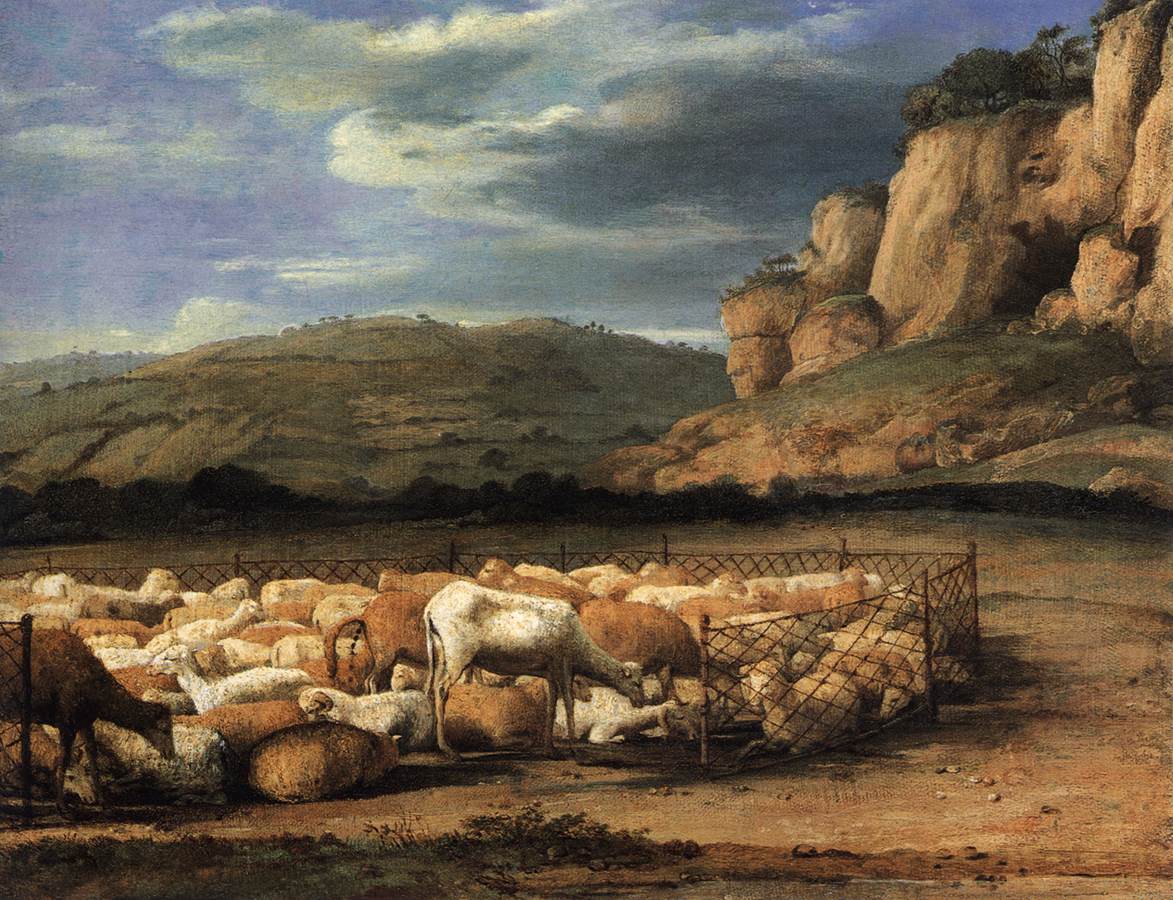
Akademie der bildenden Künste, Vienna [Web Gallery of Art]
'They were like sheep without a shepherd.'


Readings (New American Bible: Philippines, USA)

Readings (Jerusalem Bible: Australia, England & Wales, India [optional], Ireland, New Zealand, Pakistan, Scotland, South Africa)


The apostles gathered around Jesus, and told him all that they had done and taught. He said to them, “Come away to a deserted place all by yourselves and rest a while.” For many were coming and going, and they had no leisure even to eat. And they went away in the boat to a deserted place by themselves. Now many saw them going and recognized them, and they hurried there on foot from all the towns and arrived ahead of them. As he went ashore, he saw a great crowd; and he had compassion for them, because they were like sheep without a shepherd; and he began to teach them many things.


Fr Ragheed Aziz Ganni 
(20 January 1972 - 3 June 2007)
I will raise up shepherds over them who will shepherd them, and they shall not fear any longer, or be dismayed, nor shall any be missing, says the Lord (Jeremiah 23:4. First Reading).

On at least six occasions during his recent nine-day pastoral visit to Ecuador, Bolivia and Paraguay, Pope Francis asked the people to pray for him, as he did when he addressed the people in St Peter's Square for the first time as pope in 2013. Perhaps he has constantly in mind two statements in today's First Reading from the Prophet Jeremiah: 'Woe to the shepherds who destroy and scatter the sheep of my pasture! says the Lord . . .  I will raise up shepherds over them who will shepherd them, and they shall not fear any longer, or be dismayed, nor shall any be missing, says the Lord.'

Jesus shows his concern for the apostles when they returned from the mission on which he had sent them as shepherds when 'He said to them, “Come away to a deserted place all by yourselves and rest a while.”'

Ballachulish, Scotland
'Come away to a deserted place all by yourselves and rest a while.'

Perhaps we can pray in a special way for our priests as we take part in Mass this Sunday. We have countless models of priests who have been worthy shepherds, evening to laying down their lives for the flock they were called to serve. One such shepherd is an Iraqi priest with Irish connections, Fr Ragheed Ganni, assassinated along with three subdeacons, his cousin Basman Yousef Daud, Wahid Hanna Isho, and Gassan Isam Bidawed, after celebrating Mass in Mosul, Iraq, on Trinity Sunday, 3 June 2007.

Apse of Chapel, Irish College, Rome
St Columban second from left, Fr Ragheed far right.
[Details at source]

An engineer by profession, Ragheed answered God's call to become a priest and studied theology in Rome, before and after his ordination in 2003. While there he stayed at the Pontifical Irish College where he became known as 'Paddy the Iraqi', 'Paddy' being a common nickname for men named Patrick, after Ireland's national patron, and a humorous generic name for any Irishman. As a priest still studying in Rome he spent part of his summers as a member of the staff at Lough Derg, known as St Patrick's Purgatory, a place of penitential pilgrimage in Ireland.

Mosaic of Fr Ragheed Ganni with palms of martyrdom, Chapel of Irish College, Rome [Source]

Yet this young Iraqi who, according to the statement of one friend after the priests' murder, 'knew where the best pizza in Rome was', chose to go back to his own country, knowing that his life might be in danger. He spoke of this at a Eucharistic Congress in Bari, Italy, two years before his death. The theme of the Congress was Without Sunday We Cannot Live, 'Sunday' meaning most especially the celebration of Holy Mass.

Basilica of St Nicholas, Bari [Wikipedia]

Fr Ragheed Ganni's Testimony

Mosul Christians are not theologians; some are even illiterate. And yet inside of us for many generations one truth has become embedded: without the Sunday Eucharist we cannot live.
This is true today when evil has reached the point of destroying churches and killing Christians, something unheard of in Iraq till now. In June 2004, a group of young women were cleaning the church to get it ready for Sunday service. My sister Raghad, who is nineteen, was among them. As she was carrying a pale of water to wash the floor, two men drove up and threw a grenade that blew up just a few yards away from her.
She was wounded but miraculously, survived. And on that Sunday, we still celebrated the Eucharist. My shaken parents were also there. For me and my community, my sister’s wounds were a source of strength so that we, too, may bear our cross.
Last August in St Paul’s Church, a car bomb exploded after the 6 pm Mass. The blast killed two Christians and wounded many others. But that, too, was another miracle – the car was full of bombs but only one exploded. Had they all gone off together, the dead would have been in the hundreds since 400 faithful had come on that day.
People could not believe what had happened. The terrorists might think they can kill our bodies or our spirit by frightening us, but, on Sundays, churches are always full. They may try to take our life, but the Eucharist gives it back.
On 7 December, the eve of the Immaculate Conception, a group of terrorists tried to destroy the Chaldean Bishop’s Residence, which is near Our Lady of the Tigris Shrine, a place venerated by both Christians and Muslims. They placed explosives everywhere, and a few minutes later blew the place up. This and fundamentalist violence against young Christians has forced many families to flee. Yet the churches have remained open and people continue to go to Mass, even among the ruins.
It is among such difficulties that we understand the real value of Sunday, the day when we meet the Risen Christ, the day of our unity and love, of our (mutual) support and help. There are days when I feel frail and full of fear. But when, holding the Eucharist, I say ‘Behold the Lamb of God, who takes away the sin of the world’, I feel His strength in me. When I hold the Host in my hands, it is really He who is holding me and all of us, challenging the terrorists and keeping us united in His boundless love.
In normal times, everything is taken for granted and we forget the greatest gift that is made to us. Ironically, it is thanks to terrorist violence that we have truly learnt that it is the Eucharist, the Christ who died and risen, that gives us life. And this allows us to resist and hope. 
[This appeared in The Sacred Heart Messenger (April 2008), a publication of the Irish Jesuits.]
(20 November 1942 - kidnapped 29 February, body found 13 March 2008) [Photo: The Path to Peace Foundation]

Father Ragheed was secretary to Archbishop Rahho, The Chaldean Archbishop of Mosul. Most Catholics in Iraq and Syria belong to the Chaldean Catholic Church, in full communion with Rome. 'The Eucharist, the Christ who died and risen, that gives us life' was celebrated every Sunday in Mosul for 1,600 years - until June 2014 when the ISIS forces drove out the remaining Christians.

The words of Jeremiah, 'I will raise up shepherds over them who will shepherd them', have surely been fulfilled in the lives and deaths of such priests as Fr Ragheed Ganni and Archbishop Rahho. As we thank God for them and for countless other faithful priest-shepherds, let us continue to pray for all our priests and for Christians who are being persecuted for their faith.

John Rutter's setting of The Lord is my shepherd, Psalm 22[23], which is used as today's Responsorial Psalm.