Since we are travellers and pilgrims in the world, let us ever ponder on the end of the road, that is of our life, for the end of our roadway is our home (St Columban, 8th sermon).
Countries Receiving Refugees: That the countries which take in a great
number of displaced persons and refugees may find support for their efforts
which show solidarity.
Collaboration of Priests and Laity: That within parishes, priests and lay
people may collaborate in service to the community without giving in to the
temptation of discouragement.
Some Sadducees, those who say
there is no resurrection, came to Jesus(.)[and
asked him a question, ‘Teacher, Moses wrote for us that if a man’s brother
dies, leaving a wife but no children, the manshall marry the widow and raise up
children for his brother.Now there were seven brothers; the
first married, and died childless;then the secondand the third married her, and so in the same
way all seven died childless.Finally the woman also died.In the
resurrection, therefore, whose wife will the woman be? For the seven had
married her.’]
Jesus said
to them, ‘Those who belong to this age marry and are given in marriage;but those
who are considered worthy of a place in that age and in the resurrection from
the dead neither marry nor are given in marriage.Indeed they
cannot die any more, because they are like angels and are children of God,
being children of the resurrection.And the fact
that the dead are raised Moses himself showed, in the story about the bush,
where he speaks of the Lord as the God of Abraham, the God of Isaac, and the
God of Jacob.Now he is God not of the dead, but of the
living; for to him all of them are alive.’
Fr William Spicer (1949 - 2009)
Seven years agoa Columban colleague of mine, Fr Willie Spicer, died suddenly in Ireland at the age of 59. And in a very real sensehe preached at his own funeral. The homilist, Columban Fr Michael Scully, a very close friend of Father Willie because of their many years in Japan, told a remarkable story of how central the Resurrection was in the late priest's preaching at funerals and of how a man was led to the faith by this. Here ispart of the homilyof Father Scully. I have highlighted some passages.
Over that period of eight or nine years Willie and I enjoyed a
game of golf together on a regular basis even though we lived quite far apart.
Willie was pastor at the Church in Chigasaki City in the Diocese of Yokohama; I
was assigned to a church in the Archdiocese of Tokyo about 80 miles away from
where Willie lived. Sometimes before our game of golf I would stay overnight at
Willie’s house.
On one of those occasions I noticed a painting which I had not seen before on the wall of his living-room. So, I asked him where he got the painting. ‘There is a story behind that’ was his answer. I would like to tell that story as Willie told it to me. These are his words: ‘About a year ago I did a funeral Mass here in Chigasaki Church. And, as usual, during the homily I emphasized that death was not the end of everything; and then went on to talk of Christian hope in the resurrection of the dead’. At this point, Willie paused and turned towards me: ‘I think it is meaningless’ he said, ‘to preach a homily at a wake or funeral Mass if we don’t make some mention of the resurrection of Christ and our own hope in the resurrection. Isn’t that what our Christian faith is all about? It’s because of that faith that we are on mission!’
Those words of Willie were for my benefit, but, needless to say, I was in complete agreement with what he said. However, Willie’s story did not end there. ‘You know’, he said ‘after that funeral Mass an elderly man approached me and said to me “Today was the first time I ever heard a talk like the talk you gave at the Mass. Until now, I had never heard of the resurrection of the dead – and somehow, it makes a lot of sense to me. Thank you for giving me the opportunity to hear that homily. If I had a chance I’d like to study the Catholic faith. Do you know if there’s a Catholic Church close to where I live?” And Willie continued, ‘That was about a year ago – something that I did not know at that time was that that man was an artist who lived about a hundred miles away. That painting came from him to me as an expression of thanks – thanks for my homily at the funeral Mass, but also as an expression of profound gratitude for the fact that he was studying the Catholic faith, and in hoping to be baptized in the not too distant future in a church close to where he lives’.
I have told this story because I believe that if Willie Spicer had a chance to speak to us today, he would say to us: ‘It’s all right to feel sad and to grieve on this occasion. I would feel the same way if I were in your place. But, don’t be carried away by sadness and grief. Today’s sadness and grief cannot compare with the joy and the happiness and the glory that will be ours if we but believe that the God who loves us, loves us so much that He gave His only Son for us’.
Today's First Reading and the Gospel - they are always related by a common theme - look at the Resurrection. In the story of the martyrdom of the seven brothers in the Second Book of Maccabees the fourth brother When he was near death, he said, ‘One cannot but choose to die at the hands of mortals and to cherish the hope God gives of being raised again by him. But for you there will be no resurrection to life!(2 Maccabees 7:14).
The Gospel also has a story of seven brothers, in a situation put to Jesus by some Sadducees, a group that didn't believe in the resurrection, that strains credulity. This gives Jesus the opportunity to teach about the resurrection: And the fact that the dead are raised Moses himself showed, in the story about the bush, where he speaks of the Lord as the God of Abraham, the God of Isaac, and the God of Jacob.Now he is God not of the dead, but of the living; for to him all of them are alive.
St Columban's Cemetery, Dalgan Park, Ireland
I don't go along with the idea that seems to have crept in in recent years of a funeral Mass being 'a celebration of the life' of the deceased. There certainly is a place for celebrating a person's life during the wake or, in the Philippines, during the novena held in the home of the one who has died or when the family and other mourners gather to eat after the burial. Rather I see the funeral Mass as an occasion above all to pray that the one who has died will share fully in the life that God desires for everyone,
Preface I for the Dead puts it this way: In him [Christ] the hope of blessed resurrection has dawned, that those saddened by the certainty of dying might be consoled by the promise of immortality to come. Indeed for your faithful, Lord, life is changed not ended, and, when this earthly dwelling turns to dust, an eternal dwelling is made ready for them in heaven. Father Willie Spicer emphasised that belief in the Resurrection and the hope it gives when preaching at funerals. In Japan probably at every funeral Mass he celebrated there were people present who weren't Christians. To them he was proclaiming the central truth of our Christian faith. In the case of the artist he spoke about that proclamation of our faith and of the hope of the resurrection spoke to his heart and led him to Jesus the Risen Lord. In November we remember and pray for the dead in a special way. The readings in this Sunday's Mass can lead us to reflect on the reality that one day each of us will be remembered and prayed for by others. May the Collect for the first of the three Masses on The Commemoration of All the Faithful Departed, 2 November, help us in this: Listen kindly to our prayers, O Lord, and, as our faith in your Son, raised from the dead, is deepened, so may our hope of resurrection for your departed servants also find new strength. Through our Lord Jesus Christ, your Son, who lives and reigns with you in the unity of the Holy Spirit, one God, for ever and ever.
Antiphona ad Communionem
Communion Antiphon Cf.
Ps 22 [23]:1-2
Dóminus regit me, et nihil mihi déerit;
The
Lord is my shepherd, there is nothing I shall want
in loco páscuae ibi me collocávit,
Fresh
and Green are the pastures where he gives me repose,
Jesus entered Jericho and was passing through it.A man was there named Zacchaeus; he was a chief
tax-collector and was rich.He was trying to see who Jesus was, but on account of the
crowd he could not, because he was short in stature.So he ran ahead and climbed a sycomore tree to see him,
because he was going to pass that way.When Jesus came to the place, he looked up and said to him, ‘Zacchaeus,
hurry and come down; for I must stay at your house today.’So he hurried down and was happy to welcome him.All who saw it began to grumble and said, ‘He has gone to
be the guest of one who is a sinner.’Zacchaeus stood there and said to the Lord, ‘Look, half of
my possessions, Lord, I will give to the poor; and if I have defrauded anyone
of anything, I will pay back four times as much.’ Then Jesus said to him, ‘Today salvation
has come to this house, because he too is a son of Abraham.For the Son of Man came to seek out and to save the lost.’
TheBrothers in Blackwho produced Exclusive Interview with Zacchaeus, the video above, are seminarians from the USA studying in Rome.
'Zacchaeus' recounting his meeting with Jesus in the 'Exclusive Interview' above recalls, And he looked me right in the eyes. He goes on to repeat that.
In 2009, in a preface to a book on St Augustine,the then Jorge Mario Cardinal Bergoglio, Archbishop of Buenos Aires, now Pope Francis, wrote: The most striking image for me of how one becomes a Christian, as it emerges in this book, is the way in which Augustine recounts and comments on Jesus’ encounter with Zacchaeus. Zacchaeus is small, and wants to see the Lord pass, and so he climbs a sycamore. Augustine says: 'Et vidit Dominus ipsum Zacchaeum. Visus est, et vidit.' [And the Lord looked at Zacchaeus himself. He was seen, and saw.]
The then Cardinal Bergoglio comments [emphasis added here and below]: Some believe that faith and salvation come with our effort to look for, to seek the Lord. Whereas it’s the opposite: you are saved when the Lord looks for you, when He looks at you and you let yourself be looked at and sought for. The Lord will look for you first. And when you find Him, you understand that He was waiting there looking at you, He was expecting you from beforehand.
That is salvation: He loves you beforehand. And you let yourself
be loved.
Salvation is precisely this meeting where He works first. If this meeting does
not take place, we are not saved. We can talk about salvation. Invent
reassuring theological systems that turn God into a notary and His gratuitous
love into a due deed to which He is supposed to be forced by His nature. But we
never enter into the People of God. Whereas, when you look at the Lord
and you realize with gratitude that you are looking at Him because He is
looking at you, all intellectual prejudices go away, that elitism of the
spirit that is characteristic of intellectuals without talent and is ethicism
without goodness.
God's mercy has been one of the main themes of Pope Francis since he became Bishop of Rome. And when you find Him, you understand that He was waiting there looking at you, He was expecting you from beforehand. These words of his while still in Buenos Aires recall the story of the Prodigal Son. But while he was still far off, his father saw him and was filled with compassion; he ran and put his arms around him and kissed him (Luke 15:20).
I've often used today's gospel in retreats with young people in the context of preparing them for the sacrament of confession. Zacchaeus publicly acknowledges that he has cheated but is ready to give back fourfold what he has cheated people of. He has a joyful face-to-face meeting with Jesus that includes a celebratory meeting.
In his homily on 25 October 2013 in St Martha's, Vatican City, Pope Francis spoke once again about confession. He reminded those present that the sacrament is not like going to a psychiatrist or to a torture chamber. He also reminds us how far too easy it is to say I confess to God. That's like confessing by email, he comments. I say things and there's no face-to-face contact. He then goes on to speak of how concrete children are when they confess their sins.
The meeting of Jesus and Zacchaeus was a deeply personal experience for both. In all his meetings with individuals Jesus gave of himself. We see that starkly in the story of the healing of the woman who had been bleeding for 12 years and who was cured when she touched his garment: Immediately aware that power had gone forth from him, Jesus turned about in the crowd and said, ‘Who touched my clothes?’ (Mark 5:30).
Homily of Pope Francis, 25 October 2013
Pope Francis then went onto speak of the grace of being ashamed. But if there is one thing that is beautiful, it is when we confess our sins in the presence of God just as they are. We always feel the grace of being ashamed. To feel ashamed before God is a grace. It is a grace to say: 'I am ashamed'. Let us think about St Peter after Jesus' miracle on the lake: 'Depart from me Lord, for I am a sinner'. He was ashamed of his sin in the presence of Jesus Christ.
Going to confession, the Pope said, is 'going to an encounter with the Lord who forgives us, who loves us. And our shame is what we offer him: 'Lord, I am a sinner, but I am not so bad, I am capable of feeling ashamed'.
The Holy Father concluded: 'let us ask for the grace to live in the truth without hiding anything from the Lord and without hiding anything from ourselves'.
I remember an Irish Christian Brother who taught me in my last two years of secondary school, Brother Mícheál S. Ó Flaitile. We all revered him as a saintly man. The worst 'punishment' you could get from him was a stare when you did something wrong. It made you feel the kind of shame that Pope Francis speaks about. It didn't humiliate you. It was a face-to-face encounter that made you want to be better, to be true to the reality that you were made in God's image.
Jesus is saying to each of us today by name: hurry and come down; for I must stay at your house today. May each of us hurry and come down, and be happy to welcome him.
Antiphona ad introitum Entrance Antiphon Cf Psalm 37[38]:22-23
Ne derelinquas me, Domine Deus meus, ne discedas a me;
Forsake me not, O Lord, my God; be not far from me!
intende in adiutorium meum, Domine, virtus salutis meae.
Make hast and come to my help, O Lord, my strong salvation!
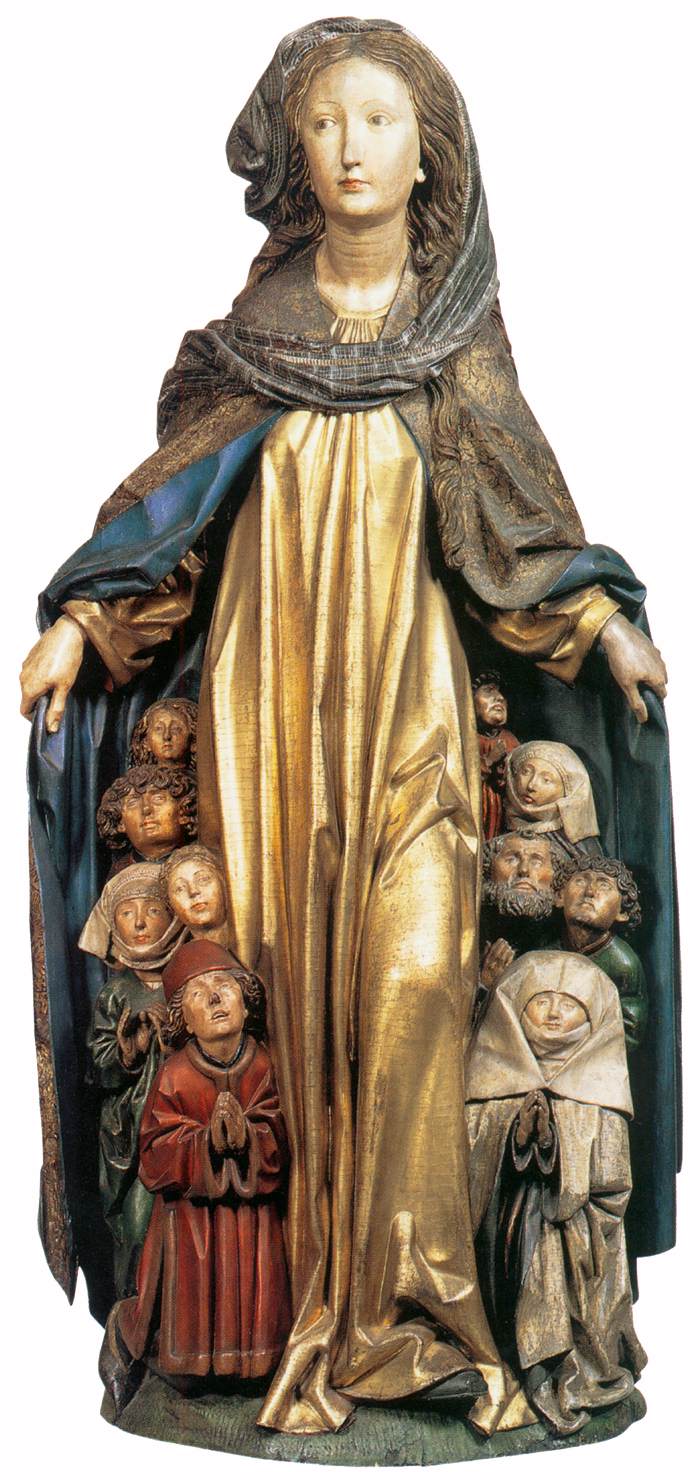
Ravensburg Madonna of Mercy, Michael Erhart, 1480s
The whole world before you is like a speck that tips
the scales, and like a drop of morning dew that falls on the ground.
But you are merciful to all, for you can
do all things, and you overlook people’s sins, so that they may repent.
For you love all things that exist, and detest none of the things that you have made, for you would not have made anything if you had hated it.
How would anything have endured if you
had not willed it? Or how would anything not called forth by you have been
preserved?
You spare all things, for they are yours,
O Lord, you who love the living. For your immortal spirit is in all things.
Therefore you correct little by little
those who trespass, and you remind and warn them of the things through which they
sin, so that they may be freed from wickedness and put their trust
in you, O Lord.
Jesus also told this parable to some who trusted in
themselves that they were righteous and regarded others with contempt:‘Two men went up to the temple to pray, one a Pharisee and the other a
tax-collector.The Pharisee, standing by himself, was praying thus, “God, I thank you
that I am not like other people: thieves, rogues, adulterers, or even like this
tax-collector.I fast twice a week; I give a tenth of all my income.”But the tax-collector, standing far off, would not even look up to
heaven, but was beating his breast and saying, “God, be merciful to me, a
sinner!”I tell you, this man went down to his home justified rather than the
other; for all who exalt themselves will be humbled, but all who humble
themselves will be exalted.’
World Mission Day
This Sunday is World Mission Day. The message of Pope Francis for the occasion, with the theme Missionary Church, Witness of Mercy, is here.
I remember when I was around 14 one of my father's fellow foremen on a building (construction) site came to visit us one evening. I'll call him Tom. My father went to Mass every morning, something he did until the day he died. At the time I was trying to emulate him. During the course of the evening Tom mentioned that he 'religiously received Holy Communion twice a year, at Christmas and at Easter'.
Some days later I remarked somewhat disapprovingly to my parents that Tom went to Holy Communion only twice a year. Both of them spoke to me very sharply and I realised that I was out of line, something like the Pharisee in today's gospel. And I did indeed feel a chastening sense of shame, something I still feel whenever I recall that moment.
Tom was an honest, hardworking family man, a man of faith who was still following the custom that prevailed until St Pius X (1903-1914) encouraged frequent Holy Communion. St Thérèse of Lisieux, who died six years before the election of that pope, wrote with gratitude in her Story of a Soul about the occasions when her confessor allowed her to go to Holy Communion. She understood what a great gift receiving the Lord in Holy Communion was. I wonder if most of us today have that same understanding. Indeed, surveys indicate that many Catholics don't believe that they are receiving the 'Body, Blood, Soul and Divinity' of the Risen Lord, as people of my generation learned from the catechism. What blocked the Pharisee from receiving God's blessing, from going down to his home justified wasn't his telling God the good things he had done - St Paul doesn't hesitate to say to Timothy in today's Second Reading, I have fought the good fight, I have finished the race, I have kept the faith (2Timothy 4:7) - but his self-righteous contempt for others whose inner struggles he seemed to be totally unaware of.
However, from my early days as a priest I have often thought that this parable should be slightly changed, with the tax-collector saying, God, I thank you that I am not like other people: thieves, rogues, adulterers, or even like this Pharisee. I don't think I've ever heard anyone condemning a sinner who has acknowledged his sins. But many times I've heard or read about individuals giving as an excuse for not going to Mass or even leaving the Church that there are 'too many hypocrites' there.
Ntarama Catholic Church, Rwanda
Over 5,000 people seeking refuge here were killed by grenade, machete, rifle, or burnt alive during the Rwandan Genocide in 1994. [Wikipedia]
A religious sister from Rwanda, Sr Genevieve Umawariya, speaking during the Synod on Africa held in Rome in 2009, the theme of which was The Church in Africa at the Service of Reconciliation, Justice and Peace, spoke of an incident that parallels today's gospel. Here is what she said: I am a survivor of the Tutsi genocide in Rwanda 1994.
A large part of my family was killed while in our parish church. The sight of this building used to fill me with horror and turned my stomach, just like the encounter with the prisoners filled me with disgust and rage.
It is in this mental state that something happened that would change my life and my relationships.
On August 27th 1997 at 1 p.m., a group from the Catholic association of the 'Ladies of Divine Mercy' led me to two prisons in the region of Kibuye, my birthplace. They went to prepare the prisoners for the Jubilee of 2000. They said: 'If you have killed, you commit yourself to ask for forgiveness from the surviving victim, that way you can help him free himself of the burden/weight of vengeance, hatred and rancor. If you are a victim, you commit yourself to offer forgiveness to those who harmed you and thus you free them from the weight of their crime and the evil that is in them'.
This message had an unexpected effect for me and in me . . .
After that, one of the prisoners rose in tears, fell to his knees before me, loudly begging: 'Mercy'. I was petrified in recognizing a family friend who had grown up and shared everything with us.
He admitted having killed my father and told me the details of the death of my family. A feeling of pity and compassion invaded me: I picked him up, embraced him and told him in a tearful voice: “You are and always will be my brother”.
Then I felt a huge weight lift away from me . . . I had found internal peace and I thanked the person I was holding in my arms.
To my great surprise, I heard him cry out: 'Justice can do its work and condemn me to death, now I am free!'
I also wanted to cry out to who wanted to hear: 'Come see what freed me, you too can find internal peace'.
From that moment on, my mission was to travel kilometers to bring mail to the prisoners asking for forgiveness from the survivors. Thus 500 letters were distributed; and I brought back mail with the answers of the survivors to the prisoners who had become my friends and my brothers . . . This allowed for meetings between the executioners and the victims . . . From this experience, I deduce that reconciliation is not so much wanting to bring together two persons or two groups in conflict. It is rather the re-establishment of each in love and allowing internal healing which leads to mutual liberation. And here is where the importance of the Church lies in our countries, since her mission is to offer the Word: a word that heals, liberates and reconciles. Pope Francis echoes this last sentence of Sr Genevieve in his message for this year's World Mission Day: Mercy finds its most noble and complete expression in the Incarnate Word. Jesus reveals the face of the Father who is rich in mercy.
Mother of the Word, Kibeho, Rwanda
Jesus speaks of God's mercy. In the video at the top we see a tax collector who understands exactly what Jesus is saying through his parable. Pope Francis has spoken about God's mercy and about the sacrament of confession many times. The man who killed the father of Sister Genevieve experienced God's mercy through her as she did through him. Each was freed of the very different but related burdens that they carried. And the man had no more fear of whatever punishment he might receive for his crime. Like the tax-collector in the gospel, he made no excuses. He simply asked for mercy.
The tax-collector (publican) in the parable, Sr Genevieve Umawariya and the man who had killed her father experienced the truth of the First Beatitude (Matthew 5:3) usually translated into English as Blessed are the poor in spirit: for theirs is the kingdom of heaven. For years I never quite understood what this meant until I read the translation in the New English Bible:How blest are those who know their need of God; the kingdom of Heaven is theirs.
May each of us, like the publican, like Sr Genevieve, like the man she forgave and who accepted her forgiveness, know our need of God and of his mercy.
Antiphona ad introitum
Entrance Antiphon Cf Psalm 104[105]:3-4
Laetetur cor quaerentium Dominum.
Let the hearts that seek the Lord rejoice;
Querite Dominum et confirmamini, quaerite faciem eius semper.
turn to the Lord and his strength; constantly seek his face.
Confitemini Domino; et invocate nomen eius; annuntiate inter gentes opera eius.
Give glory to the Lord, and call upon his name: declare his deeds among the Gentiles.
Laetetur cor quaerentium Dominum. Let the hearts that seek the Lord rejoice; Querite Dominum et confirmamini, quaerite faciem eius semper. turn to the Lord and his strength; constantly seek his face. The text in bold is used in the Ordinary Form of the Mass while the longer text is used in the Extraordinary Form, though it may also be used in the Ordinary Form.