Showing posts with label Michael Erhart. Show all posts

11 May 2020

The Rosary with the Great Artists: the Mysteries of Light

Virgin and Child with a Rosary


'The Rosary belongs among the finest and most praiseworthy traditions of Christian contemplation. Developed in the West, it is a typically meditative prayer, corresponding in some way to the “prayer of the heart” or “Jesus prayer” which took root in the soil of the Christian East.' [St John Paul II, Rosarium Virginis Mariae, No 5.]


The Rosary here is the formula prayed by members of the Legion of Mary, the way I prefer. There are various ways of beginning and ending the Rosary but the Five Mysteries are the heart of the prayer. 

In the name of the Father, and of the Son, and of the Holy Spirit. Amen. 

Come, O Holy Spirit, fill the hearts of Your faithful, and enkindle in them the fire of Your love.
v. Send forth Your Spirit, O Lord, and they shall be created.
R. And You shall renew the face of the earth.

Let us pray.

God our Father, pour out the gifts of Your Holy Spirit on the world. You sent the Spirit on Your Church to begin the teaching of the gospel: now let the Spirit continue to work in the world through the hearts of all who believe. Through Christ our Lord. Amen.


The Mysteries of Light 
(Thursday)

First Mystery 
The Baptism of Jesus

Baptism of Christ
El Greco [Web Gallery of Art]

Our Father, ten Hail Marys, Glory be

Second Mystery 
The Wedding at Cana

The Marriage at Cana
Marten de Vos [Web Gallery of Art]


Our Father, ten Hail Marys, Glory be

Third Mystery 
The Proclamation of the Kingdom of God

Christ as Saviour
El Greco [Web Gallery of Art]


Our Father, ten Hail Marys, Glory be

Fourth Mystery
The Transfiguration

Transfiguration of Christ
Paolo Veronese [Web Gallery of Art]


Our Father, ten Hail Marys, Glory be

Fifth Mystery
The Institution of the Eucharist

The Institution of the Eucharist
Federico Fiori Barocci [Web Gallery of Art]


Our Father, ten Hail Marys, Glory be


Hail, Holy Queen, Mother of Mercy; hail, our life, our sweetness and our hope. To you we cry, poor banished children of Eve, to you we send up our sighs, mourning and weeping in this valley of tears. Turn then, O most gracious advocate, your eyes of mercy towards us, and after this our exile, show us the blessed fruit of your womb, Jesus. O clement, O loving, O sweet Virgin Mary.

v. Pray for us, O holy Mother of God.

R. That we may be made worthy of the promises of Christ.

Let us pray.

O God, Whose only-begotten Son, by His life, death and resurrection, has purchased for us the rewards of eternal salvation; grant, we beseech You, that meditating upon these mysteries in the most holy Rosary of the Blessed Virgin Mary, we may imitate what they contain, and obtain what they promise. Through the same Christ our Lord. Amen.


v. Most Sacred Heart of Jesus R. Have mercy on us.
v. Immaculate Heart of Mary R. Pray for us.
v. St Joseph R. Pray for us.
v. St John the Evangelist R. Pray for us.
v. St Louis-Marie deMontfort R. Pray for us. 

In the name of the Father, and of the Son, and of the Holy Spirit. Amen. 


Salve Regina
Notre-Dame de Paris


Salve Regina is one of four seasonal Marian anthems sung or recited at the end of Compline (Night Prayer) in the Divine Office (Liturgy of the Hours, Breviary). It is traditionally sung as a seasonal anthem from the day after Pentecost Sunday until the first Sunday of Advent.


Salve, Regina, mater misericordiae;
vita, dulcedo et spes nostra, salve.
Ad te clamamus exsules filii Hevae.
Ad te suspiramus gementes et flentes
in hac lacrimarum valle.
Eia ergo, advocata nostra,
illos tuos misericordes oculos ad nos converte.
Et Iesum, benedictum fructum ventris tui,
nobis post hoc exsilium ostende.
O clemens, o pia, o dulcis Virgo Maria.

Hail, Holy Queen, Mother of Mercy; 
hail, our life, our sweetness and our hope. 
To you we cry, poor banished children of Eve,
 to you we send up our sighs, mourning and weeping 
in this valley of tears. 
Turn then, O most gracious advocate, 
your eyes of mercy towards us, 
and after this our exile, 
show us the blessed fruit of your womb, Jesus. 
O clement, O loving, O sweet Virgin Mary.

Salve Regina
Setting by Palestrina
Sung by The Sixteen, Harry Christophers


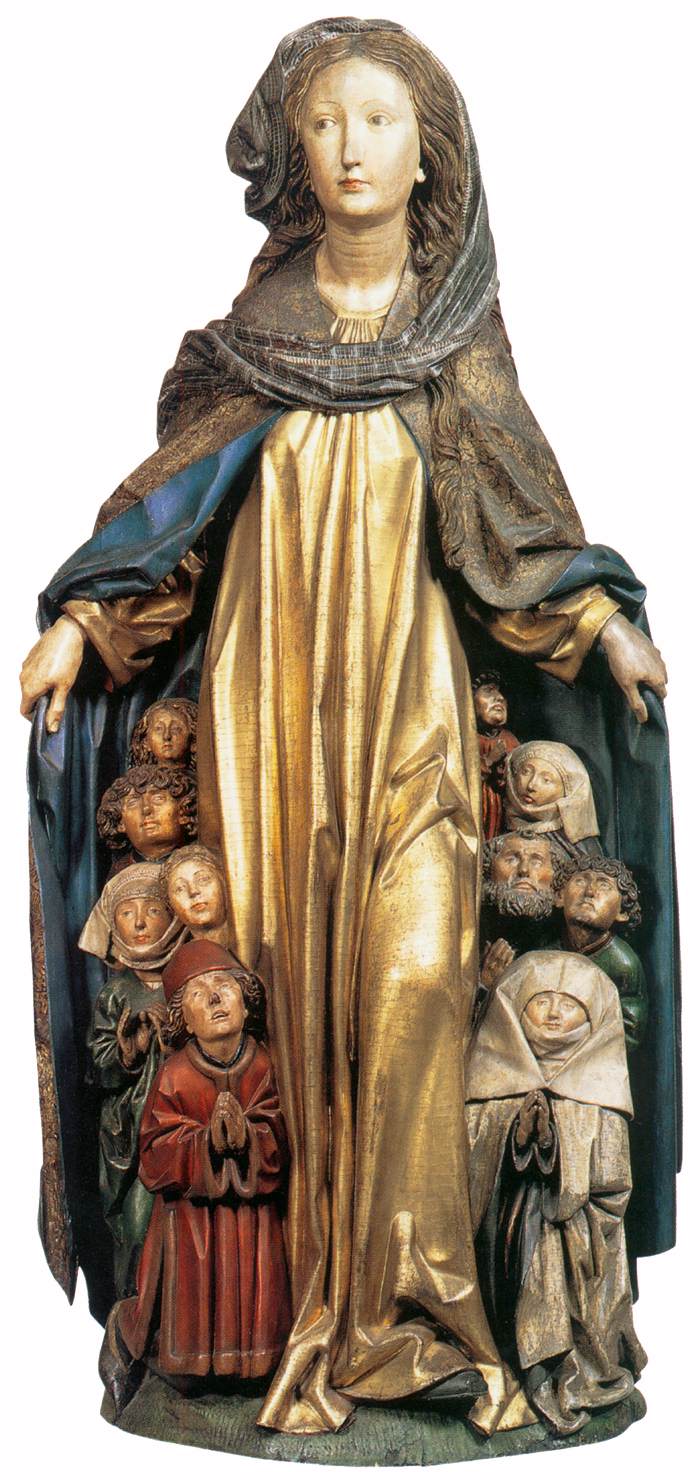
Ravensburg Madonna of Mercy
Michael Erhart [Web Gallery of Art]


27 October 2016

‘Zacchaeus, hurry and come down; for I must stay at your house today.’ Sunday Reflections, 31st Sunday in Ordinary Time, Year C

Zacchaeus's sycamore tree, Jericho [Wikipedia]


Readings (New American Bible: Philippines, USA)

Readings (Jerusalem Bible: Australia, England & Wales, India [optional], Ireland, New Zealand, Pakistan, Scotland, South Africa)


Jesus entered Jericho and was passing through it. A man was there named Zacchaeus; he was a chief tax-collector and was rich. He was trying to see who Jesus was, but on account of the crowd he could not, because he was short in stature. So he ran ahead and climbed a sycomore tree to see him, because he was going to pass that way. When Jesus came to the place, he looked up and said to him, ‘Zacchaeus, hurry and come down; for I must stay at your house today.’ So he hurried down and was happy to welcome him. All who saw it began to grumble and said, ‘He has gone to be the guest of one who is a sinner.’ Zacchaeus stood there and said to the Lord, ‘Look, half of my possessions, Lord, I will give to the poor; and if I have defrauded anyone of anything, I will pay back four times as much.’ Then Jesus said to him, ‘Today salvation has come to this house, because he too is a son of Abraham. For the Son of Man came to seek out and to save the lost.’

The Brothers in Black who produced Exclusive Interview with Zacchaeus, the video above, are seminarians from the USA studying in Rome.

'Zacchaeus' recounting his meeting with Jesus in the 'Exclusive Interview' above recalls, And he looked me right in the eyes. He goes on to repeat that.

In 2009, in a preface to a book on St Augustine, the then Jorge Mario Cardinal Bergoglio, Archbishop of Buenos Aires, now Pope Francis, wroteThe most striking image for me of how one becomes a Christian, as it emerges in this book, is the way in which Augustine recounts and comments on Jesus’ encounter with Zacchaeus. Zacchaeus is small, and wants to see the Lord pass, and so he climbs a sycamore. Augustine says: 'Et vidit Dominus ipsum Zacchaeum. Visus est, et vidit.' [And the Lord looked at Zacchaeus himself. He was seen, and saw.]

The then Cardinal Bergoglio comments [emphasis added here and below]: Some believe that faith and salvation come with our effort to look for, to seek the Lord. Whereas it’s the opposite: you are saved when the Lord looks for you, when He looks at you and you let yourself be looked at and sought for. The Lord will look for you first. And when you find Him, you understand that He was waiting there looking at you, He was expecting you from beforehand. 

That is salvation: He loves you beforehand. And you let yourself be loved. Salvation is precisely this meeting where He works first. If this meeting does not take place, we are not saved. We can talk about salvation. Invent reassuring theological systems that turn God into a notary and His gratuitous love into a due deed to which He is supposed to be forced by His nature. But we never enter into the People of God. Whereas, when you look at the Lord and you realize with gratitude that you are looking at Him because He is looking at you, all intellectual prejudices go away, that elitism of the spirit that is characteristic of intellectuals without talent and is ethicism without goodness.

God's mercy has been one of the main themes of Pope Francis since he became Bishop of Rome. And when you find Him, you understand that He was waiting there looking at you, He was expecting you from beforehand. These words of his while still in Buenos Aires recall the story of the Prodigal Son. But while he was still far off, his father saw him and was filled with compassion; he ran and put his arms around him and kissed him (Luke 15:20).


Zacchaeus receives Jesus
Church of the Good Shepherd, Jericho [Wikipedia]

I've often used today's gospel in retreats with young people in the context of preparing them for the sacrament of confession. Zacchaeus publicly acknowledges that he has cheated but is ready to give back fourfold what he has cheated people of. He has a joyful face-to-face meeting with Jesus that includes a celebratory meeting.

In his homily on 25 October 2013 in St Martha's, Vatican City, Pope Francis spoke once again about confession. He reminded those present that the sacrament is not like going to a psychiatrist or to a torture chamber. He also reminds us how far too easy it is to say I confess to GodThat's like confessing by email, he comments. I say things and there's no face-to-face contact. He then goes on to speak of how concrete children are when they confess their sins.

The meeting of Jesus and Zacchaeus was a deeply personal experience for both. In all his meetings with individuals Jesus gave of himself. We see that starkly in the story of the healing of the woman who had been bleeding for 12 years and who was cured when she touched his garment: Immediately aware that power had gone forth from him, Jesus turned about in the crowd and said, ‘Who touched my clothes?’ (Mark 5:30).


Homily of Pope Francis, 25 October 2013

Pope Francis then went on to speak of the grace of being ashamedBut if there is one thing that is beautiful, it is when we confess our sins in the presence of God just as they are. We always feel the grace of being ashamedTo feel ashamed before God is a graceIt is a grace to say: 'I am ashamed'. Let us think about St Peter after Jesus' miracle on the lake: 'Depart from me Lord, for I am a sinner'. He was ashamed of his sin in the presence of Jesus Christ.

Going to confession, the Pope said, is 'going to an encounter with the Lord who forgives us, who loves us. And our shame is what we offer him: 'Lord, I am a sinner, but I am not so bad, I am capable of feeling ashamed'.

The Holy Father concluded: 'let us ask for the grace to live in the truth without hiding anything from the Lord and without hiding anything from ourselves'.

I remember an Irish Christian Brother who taught me in my last two years of secondary school, Brother Mícheál S. Ó Flaitile. We all revered him as a saintly man. The worst 'punishment' you could get from him was a stare when you did something wrong. It made you feel the kind of shame that Pope Francis speaks about. It didn't humiliate you. It was a face-to-face encounter that made you want to be better, to be true to the reality that you were made in God's image.

Jesus is saying to each of us today by name: hurry and come down; for I must stay at your house today. May each of us hurry and come down, and be happy to welcome him. 


Antiphona ad introitum
Entrance Antiphon Cf Psalm 37[38]:22-23


Ne derelinquas me, Domine Deus meus, ne discedas a me;
Forsake me not, O Lord, my God; be not far from me!
intende in adiutorium meum, Domine, virtus salutis meae.
Make hast and come to my help, O Lord, my strong salvation!


Ravensburg Madonna of Mercy, Michael Erhart, 1480s
Staatliche Museen, Berlin [Web Gallery of Art]

First Reading    Wisdom 11:22 - 12:2

The whole world before you is like a speck that tips the scales, and like a drop of morning dew that falls on the ground.


But you are merciful to all, for you can do all things, and you overlook people’s sins, so that they may repent.

For you love all things that exist, and detest none of the things that you have made, for you would not have made anything if you had hated it.

How would anything have endured if you had not willed it? Or how would anything not called forth by you have been preserved?

You spare all things, for they are yours, O Lord, you who love the living. For your immortal spirit is in all things.

Therefore you correct little by little those who trespass, and you remind and warn them of the things through which they sin, so that they may be freed from wickedness and put their trust in you, O Lord.