Since we are travellers and pilgrims in the world, let us ever ponder on the end of the road, that is of our life, for the end of our roadway is our home (St Columban, 8th sermon).
Yesterday I posted videos of jazz violinist Stephane Grappelli and classical violinist Yehudi Menuhin in very different interpretations of Bach's Concerto for Two Violins. In the 1970s these two made some recordings of standards together, one of them Hoagy Carmichael's Skylark. Here is their beautiful rendition of a beautiful melody.
Stephane Grappelli and Yehudi Menuhin, 1976, photo by Allan Warren [Wikipedia]
Johnny Mercer wrote the lyrics. The song is interpreted here by English singer Dame Cleo Laine and flautist Sir James Galway from Northern Ireland.
Yesterday I came across the video above of Stephane Grappelli, Django Reinhardt and Eddie South improvising on the First Movement of Bach's Double Violin Concerto in D minor. I think it was in the autumn of 1981 when I was doing a sabbatical year in Toronto that I attended a concert by Stephane Grappelli. There was a full house, the audience ranging in age From one to ninety-two, to quote The Christmas Song. It was an occasion on which I felt I was in the presence of someone doing exactly what God had made him to do. that's the only way I can describe Grappelli.
There is a comment under this video that reads, This is beautiful. I'm sure the old man himself would appreciate. Here is the same music played as 'The Old Man' wrote it by two of the great classical violinists of our time, Yehudi Menuhin and David Oistrakh. Menuhin and Grappelli teamed up many years later to make some memorable recordings, blending their two very different styles.
I'm sure 'The Old Man' would also approve of this vocal arrangement of the same music by The Swingle Singers, from the 1960s.
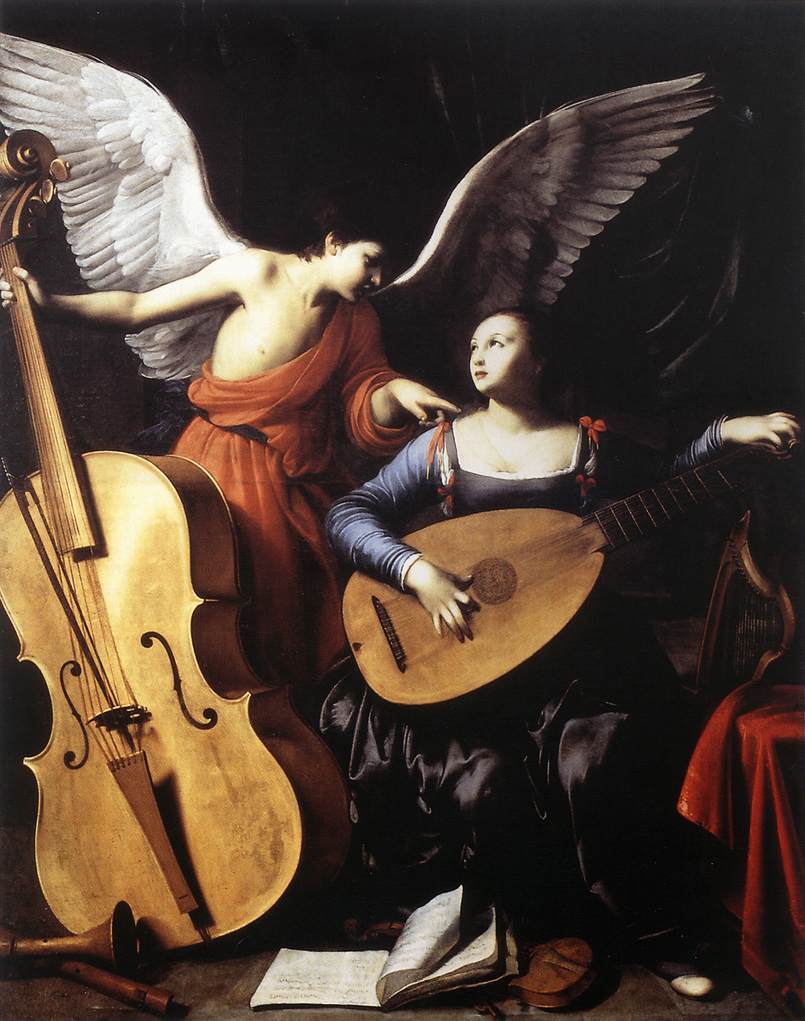
St Cecilia, whose feast day it is today,22 November, is the patron saint of musicians. She was martyred probably in Sicily between 176 and 180 and is included in the second list of martyrs in the Roman Canon (Eucharistic Prayer I). Whether the angels play only Bach praising God, I am not quite sure. I am sure, however, that en famille they play Mozart. So said Swiss Reformed theologian Karl Barth (1886 - 1968). A younger Swiss contemporary of Barth, Catholic theologian Fr Hans Urs von Balthasar (1905 - 1988) who died two days before Blessed Pope John Paul II was to have made him a cardinal, wrote: Before the beautiful—no, not really before but within the beautiful—the whole person quivers. He not only 'finds' the beautiful moving; rather, he experiences himself as being moved and possessed by it. Very recently I came across a Swiss cellist with a very 'un-Swiss' name, Wen-Sinn Yang, whose parents came from Taiwan. He is a cellist and his instrument is a cousin of that which the angel in Saraceni's painting is holding. That seems to be a six-stringed double bass. Modern instruments in the violin family have only four. Johann Sebastian Bach (1685 -1750) wrote an enormous amount of music, much of it for Sunday worship in the Lutheran churches in Leipzig. Among his works are six cello suites, which didn't really become known until the last century. Here Wen-Sinn Yang plays Bach's Cello suite No 1 in G major.
During the month of November we pray for the dead in a special way. I often think that we forget to pray for public and historical figures. We should pray for the soul of Johann Sebastian Bach and live in the hope that we will join him in praising God for all eternity. Praising God through music was at the very centre of his life on earth and his music continues to give us some experience of the beauty of God.
Thursday 22 November is the feast of St Cecilia, patron of musicians. The video above is a BBC Scotland production made in 2008. It was only last year or earlier this year that I first heard of Gustavo Dudamel or of El Sistema, 'The System', a product of the vision of Dr José Antonio Abreu. Both men are from Venezuela.
The programme has since been introduced to other countries such as Scotland and the Republic of Korea.
On 16 April 2007 Gustavo Dudamel conducted the Radio-Sinfonieorchester Stuttgart des SWR in a concert at the Vatican in honour of Pope Benedict XVI whose 80th birthday it was. Dudamel was only 26 at the time, an extraordinary young age for an internationally recognised conductor.
My ordination day, 20 December 1967, with Dad, Mam and my brother Paddy.
My late Dad, John Coyle, was born 99 years ago today - or possibly yesterday. He was never quite sure whether his birthday was the 26th or 27th but finally opted for the latter.
He is still the biggest influence in my life because of the quiet way he lived his deep faith as a husband, father, neighbour, carpenter and general foreman for many years on building sites. One of his strongest characteristics was his respect for others. He went to Mass every day, including the day he died suddenly, 11 August 1987.
Dad also influenced my taste in popular music. He loved a good tune. Sometimes he would 'doodle' on the piano but couldn't play it. One of his great favourites was Charlie Kunz, in the video above, an American-born bandleader and pianist who settled in England. He would sometimes tell me about the time he saw Charlie perform in the old Theatre Royal in Dublin before World War II.
He and my mother, Mary, were very good ballroom dancers. That is one of the reasons I'm able to write this blog. They had been going together for a while but split up amicably. Some time later my mother was given two tickets for a dress dance (a formal ball). She asked her mother what she should do with the tickets. She said, 'Invite Joe'. 'Joe' was the name my mother and her family used for Dad. To others he was 'John'. But Joseph was his second Christian name.
One of the photos on display in our house was of my parents at a dress dance my father looking elegant in his white bow-tie. It might well have been the occasion when they resumed their relationship. I'm almost certain it was taken before they were married in 1942.
He loved the music of Victor Silvester, featured in the video below. When he visited the Philippines in 1981, eleven years after my mother's death, the people in Tangub City, Misamis Occidental, Mindanao, put on a welcome party. He hadn't lost his ability to 'trip the light fantastic' and enjoyed himself immensely.
My mother used to say if we found ourselves in a crowded space such as a bus or a lift (elevator), 'If we've as much room in heaven we'll be all right'. May the light of heaven shine on my parents and on my grandmother Annie Dowd Collins for suggesting to her daughter Mary that she invite her former boyfriend Joe to that dress dance!
One of the advantages of the internet is that you can listen to good radio from stations around the world. The Philippines is a wasteland as far as radio is concerned. The FM stations play bland, often tuneless music aimed at people under 35. The AM stations broadcast a diet of 'soaps' in the regional languages and local politicians and their spokesmen holding forth, shouting into the microphone as if they were addressing a crowd in the plaza.
Another advantage is that you can usually listen to programmes anytime during the week after they are broadcast or, in some cases, long after that. One of my favourites is Alan Titchmarsh with Melodies for You, broadcast on Sunday nights on BBC Radio 2.
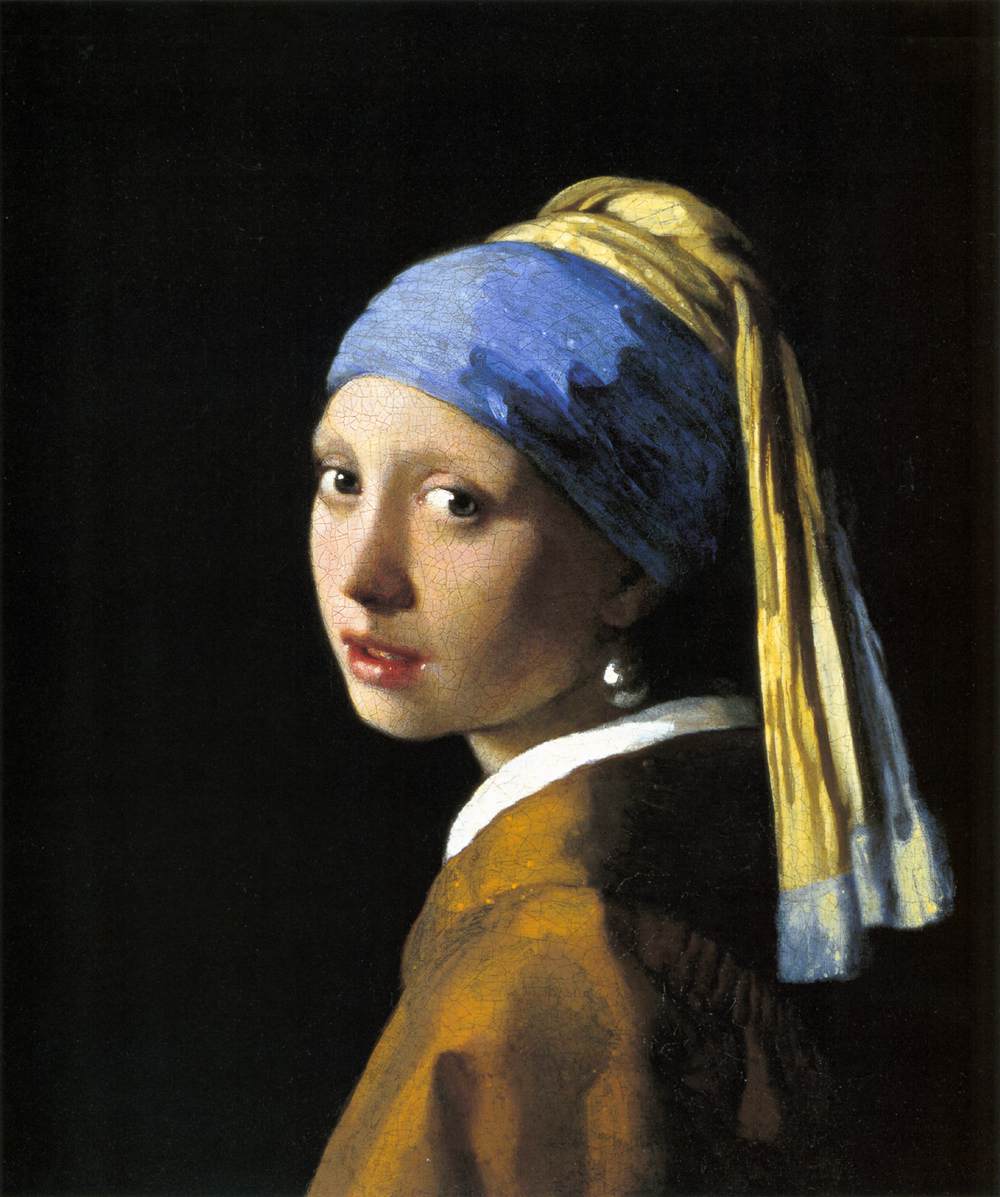
Last night he played a piece called Griet's Theme from Girl with the Pearl Earring. I've long been familiar with Vermeer's beautiful painting but didn't know until today that a movie had been made in 2003 with that title, based on a novel by Tracy Chevalier that was inspired by the painting. The music in the film is by Alexandre Desplat.
I took the painting from Web Gallery of Art. This is a quite amazing website that 'is a virtual museum and searchable database of European painting and sculpture from 11th to mid-19th centuries. It was started in 1996 as a topical site of the Renaissance art, originated in the Italian city-states of the 14th century and spread to other countries in the 15th and 16th centuries. Intending to present Renaissance art as comprehensively as possible, the scope of the collection was later extended to show its Medieval roots as well as its evolution to Baroque and Rococo via Mannerism. More recently the periods of Neoclassicism, Romanticism and Realism were also included'. It's where I get most of the paintings I use in Sunday Reflections.
The site has recordingd of music from the 12th to the 20th centuries, much of which you can include if you email any of the paintings in the form of a greeting.
Isn't Vermeer's painting utterly beautiful and alive?
My parents, John and Mary with my Auntie Nan, a younger sister of my mother, and her husband (or husband-to-be at the time) Joe Kiernan, all of them now gone to their reward, at Powerscourt, County Wicklow, south of Dublin, around 1940. My parents were married on 6 July 1942, Auntie Nan and Uncle Joe in 1941, I think.
My mother died quietly in her sleep at home in Dublin, early in the morning of 29 April 1970, exactly four hears after the death of her own mother, whom I knew as Granny Collins. I'm not sure how old I was when I learned that Granny Collins had been born Annie Dowd.
Mam had a lovely singing voice and appeared in a number or amateur productions in her single days. Her favourite singer was Deanna Durbin, born in Winnipeg, Canada, of Englihs parents but raised in southern California, who left the Hollywood scene after her last movie in 1948 and went to live in Paris where she is now in her 90th year. A song she sang at the end of a 1939 movie, Three Smart Girls Grow Up, that has been recorded by many opera singers, mostly tenors, was my mother's party piece, Because. It is sung in the context of a wedding and, as it happens, there's a big wedding today in London, that of Prince William and Kate Middleton. Clearly, there's some twist in the plot at the end of the movie but it's a happy one!
The last song I heard my mother singing, I'll Take You Home Again, Kathleen, has always been a great favourite in Ireland. As far as I can recall, she sang it at a farewell party for me before I left to study in the USA in September 1968, nine months or so after my ordination. 'Kathleen' is an anglicised form of 'Caitlín', a Gaelic form of 'Catherine', as is 'Caitríona'. The song was written in 1875 by a German-American, Thomas P. Westendorf. Deanna Durbin sang it in her last movie, For the Love of Mary, made in 1948.
My own favourite song by Deanna Durbin is Beneath the Lights of Home. It brings out clearly the purity of her voice. Deanna is playing a character named Jane Dana in the 1941 movie Nice Girl? who sings the song at a benefit concert for the Red Cross. Jane is having a somewhat complicated love-life at the time. Not surprisingly, this song became a great favourite with soldiers overseas during World War II.
There were great songs during the 1930s and 1940s but sometimes the toll on those who sang them in Hollywood movies was enormous. Deanna Durbin's very first movie, Every Sunday, a short one made in 1936, featured Judy Garland when they were both 14. Poor Judy's subsequent life was a mess, while Deanna simply left the artificial Hollywood 'lifestyle'.However, by the time she did so she had been divorced twice.
One of the blessings of my childhood was plenty of tuneful music.
Please remember in your prayers my mother, born Mary Collins, dying suddenly at the age of 55, and her mother, born Annie Dowd, dying from cancer at the age of 84, sharing the same death anniversary. May they rest in peace.