Showing posts sorted by date for query Ragheed Ganni. Sort by relevance Show all posts

12 September 2025

'We will not stop celebrating Mass.' Sunday Reflections, Feast of the Exaltation of the Holy Cross


Christ in Agony on the Cross

When the Feast of the Exaltation of the Holy Cross falls on a Sunday, as a feast of the Lord it replaces the celebration of the Sunday in Ordinary Time. So the Mass of the 24th Sunday in Ordinary Time is not celebrated this year.

Readings (Jerusalem Bible: Australia, Ireland, New Zealand)

Readings (English Standard Version, Catholic Edition: England & Wales, India, Scotland) 

Readings (New American Bible: Philippines, USA)

Gospel John 3:13-17 (English Standard Version, Anglicised)

At that time: Jesus said to Nicodemus, ‘No one has ascended into heaven except he who descended from heaven, the Son of Man. And as Moses lifted up the serpent in the wilderness, so must the Son of Man be lifted up, that whoever believes in him may have eternal life. For God so loved the world, that he gave his only begotten Son, that whoever believes in him should not perish but have eternal life. For God did not send his Son into the world to condemn the world, but in order that the world might be saved through him.’

Léachtaí i nGaeilge

.


Fr Ragheed Aziz Ganni
(20 January 1972 - 3 June 2007)

For me the face of the persecuted Christians in today's world is that of Fr Ragheed Ganni. An article by Ed West published in the Catholic Herald, now published monthly in England, on 20 December 2013 and that has a very personal dimension, gives as good an account of Father Ragheed as any I've read. (The link to the article that I used before no longer functions.)

Ed West writes: Fr Ragheed was one of 1,000 Iraqi Christians murdered during the pogrom that began after the Coalition invasion of 2003. The persecution culminated in October 31 2010, with the massacre of 52 worshippers at a Catholic church in Baghdad. In the words of one Chaldean bishop, this is a 'Calvary' that has largely been ignored in the western media, outside of the Christian press . . .

 It has been a shocking and horrific ordeal for one of the world’s oldest Christian communities, which has been all but driven out of its homeland. A pre-war population of a million is now somewhere in the region of 150,000, many of them elderly, and more than 60 churches have been bombed.  That figure has got smaller in recent months and the ancient city of Mosul, in many ways the heart of the Christian faith in Iraq and Syria, has been emptied of its Christians by ISIS.

The article describes First Holy Communion day in Father Ragheed's parish in 2006: The atmosphere in Ragheed’s home town had become terrifying. On 4 August 2006, when 80 children of his parish of the Holy Spirit received their first Holy Communion, battles broke out in the street outside, and the children cowered from the sounds of guns and rockets.

The good shepherd helped them through. He told AsiaNews: 'Although people are used to it and remained reasonably calm, they started to wonder whether they were going to make it back to their homes or not. I was aware of the immense joy of the 80 children receiving their first Communion so I turned the subject into a joke and said to them: "Do not panic, these are fireworks. The city is celebrating with us." And at the same time I gave them instructions to leave the church quietly and quickly.'

The author further notes: Friends later recalled that he had become increasingly weary and broken by the demands of the priesthood amid such terror. After an attack on his parish, on Palm Sunday 2007, he wrote: 'We empathise with Christ, who entered Jerusalem in full knowledge that the consequence of His love for mankind was the cross. Thus while bullets smashed our church windows, we offered up our suffering as a sign of love for Christ.'

Shortly before his death Fr Ganni wrote in an email: 'Each day we wait for the decisive attack, but we will not stop celebrating Mass; we will do it underground, where we are safer. I am encouraged in this decision by the strength of my parishioners. This is war, real war, but we hope to carry our cross to the very end with the help of Divine Grace.'

This young Iraqi priest of the Chaldean Catholic Church, an engineer by profession, was murdered on Trinity Sunday, 3 June 2007, along with three subdeacons, Basman Yousef Daud, Gassan Isam Bidawed and Wahid Hanna Isho after he had celebrated Mass in Mosul, the city of his birth.

At a Eucharistic Congress in Bari, Italy, in 2005 Father Ragheed said, There are days when I feel frail and full of fear. But when, holding the Eucharist, I say ‘Behold the Lamb of God Behold, who takes away the sin of the world’, I feel His strength in me. When I hold the Host in my hands, it is really He who is holding me and all of us, challenging the terrorists and keeping us united in His boundless love. He also said, Without Sunday, without the Eucharist, the Christians in Iraq cannot survive.

To put some time perspective on the Christian faith in Iraq and Syria: in 2021 the Church in the Philippines will celebrate 500 years of the Catholic Christian faith in that country, a great occasion for thanking God for that precious gift. The Christian faith has been lived in Iraq and Syria for four times as long as that, since the time of the Apostles. Mass was celebrated for 2,000 years in Mosul until a couple of months ago when Christians were driven from their ancestral homeland by ISIS.

Father Raqheed's words, But when, holding the Eucharist, I say ‘Behold the Lamb of God Behold, who takes away the sin of the world’, I feel His strength in me, reflect the words of Jesus to Nicodemus in today's Gospel: And just as Moses lifted up the serpent in the wilderness, so must the Son of Man be lifted up, that whoever believes in him may have eternal life.

A Muslim friend of Fr Ragheed, Adnam Mokrani, professor of Islamic Studies at the Pontifical Gregorian University in Rome, said that on his ordination day, 13 October 2001, recalled that the new priest said, Today, I have died to self. St Paul in today's Second Reading tells us, Christ Jesus, who, though he was in the form of God did not regard equality with God has something to be exploited, but emptied himself, taking the form of a slave and that he became obedient to the point of death—even death on a cross.

As we celebrate the Exaltation of the Holy Cross and as we pray for persecuted Christians, particularly in Iraq and Syria, parts of Nigeria and the Democratic Republic of the Congo and other places, may we thank God for the gift of our Christian faith and ask him for the courage to live it as Father Ragheed and countless others have done, becoming obedient to the point of death.                                   


Christ on the Cross
Velázquez [Web Gallery of Art]


Traditional Latin Mass 

What earlier generations held as sacred, remains sacred and great for us too, and it cannot be all of a sudden entirely forbidden or even considered harmful (Benedict XVI). 

 The Exaltation of the Holy Cross

The Complete Mass in Latin and English is here. (Adjust the date at the top of that page to 09-14-2025 if necessary).

Readings. Epistle: Philippians 5:2-11. Gospel: John 12:31-36.

Crucifixion (1596-1600)

And I, if I be lifted up from the earth, will draw all things to Myself (Gospel). 


02 August 2024

'We cannot keep to ourselves the words of eternal life given to us in our encounter with Jesus Christ.' Sunday Reflections, 18th Sunday in Ordinary Time, Year B


Man with Two Loaves of Bread
Jean-François Raffaëlli  [Web Gallery of Art]

Readings (Jerusalem Bible: Australia, England & Wales, Ireland, New Zealand, Pakistan, Scotland)

Readings (New American Bible: Philippines, USA)

Gospel John 6:24-35 (English Standard Version, Anglicised: India)

When the crowd saw that Jesus was not there, nor his disciples, they themselves got into the boats and went to Capernaum, seeking Jesus.

When they found him on the other side of the sea, they said to him, “Rabbi, when did you come here?” Jesus answered them, “Truly, truly, I say to you, you are seeking me, not because you saw signs, but because you ate your fill of the loaves. Do not labour for the food that perishes, but for the food that endures to eternal life, which the Son of Man will give to you. For on him God the Father has set his seal.” Then they said to him, “What must we do, to be doing the works of God?” Jesus answered them, “This is the work of God, that you believe in him whom he has sent.” So they said to him, “Then what sign do you do, that we may see and believe you? What work do you perform? Our fathers ate the manna in the wilderness; as it is written, ‘He gave them bread from heaven to eat.’” Jesus then said to them, “Truly, truly, I say to you, it was not Moses who gave you the bread from heaven, but my Father gives you the true bread from heaven. For the bread of God is he who comes down from heaven and gives life to the world.” They said to him, “Sir, give us this bread always.”

Jesus said to them, “I am the bread of life; whoever comes to me shall not hunger, and whoever believes in me shall never thirst.


Léachtaí i nGaeilge


Servant of God Fr Ragheed Aziz Ganni
(20 January 1972 - 3 June 2007)

I have featured Fr Ragheed Ganni a number of times on Sunday Reflections. As a priest and as a Catholic Christian I am truly inspired by this man who was less than half the age I am now when he was assassinated.

He was a raconteur par excellence and a font of knowledge - we discussed everything and anything from the metaphysical to the trivial. A young and gauche student at the time, I learnt about Iraq and about theology; about the workings of the college in the summer and the best places to eat pizza. I was amazed at his command of English and Italian and his perennial good spirits and big smile - he was and will always be an inspiration.

That is how an Irish student at the Pontifical Irish College in Rome described Fr Ragheed Ganni, a Chaldean Catholic priest murdered along with three married subdeacons, Basman Yousef Daud,Wahid Hanna Isho, and Gassan Isam Bidawed, on 3 June 2007 just after the young priest had celebrated Mass in Holy Spirit parish, Mosul, Iraq. (The cause for the canonisation of these four men officially opened in 2018.) Fr Ganni, an engineer, studied theology in Rome before and after ordination, and stayed at the Irish College, where he was known as 'Paddy the Iraqi', 'Paddy' being a generic term for Irishmen, derived from the name of Ireland's - and Nigeria's - patron saint, St Patrick.


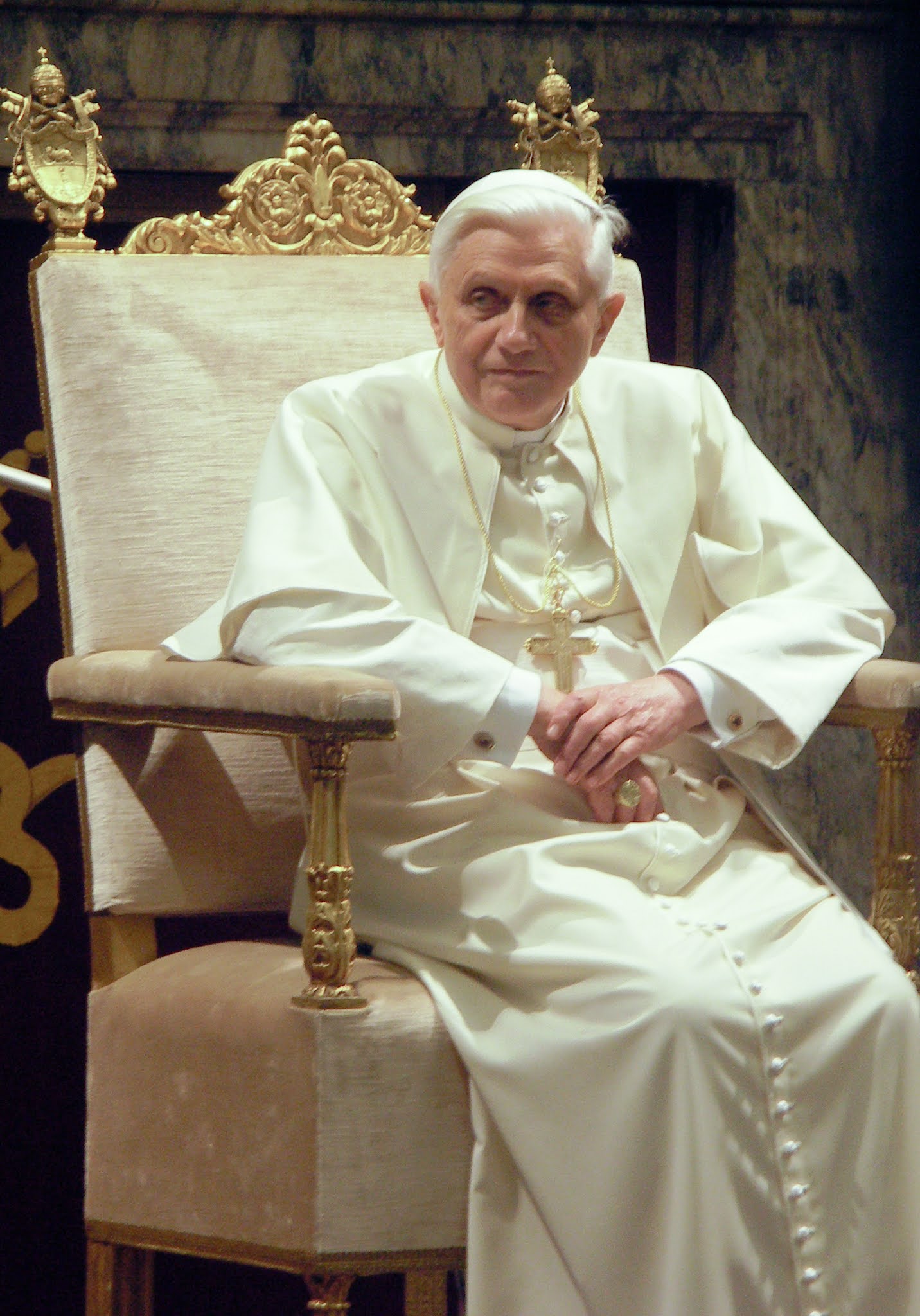
Pope Benedict XVI, 20 January 2006
[Wikipedia; photo by Sergey Khozhukhov]

Dear young people, do not be satisfied with anything less than Truth and Love, do not be content with anything less than Christ. Pope Benedict spoke these words at the prayer vigil on 20 August 2011 during the Madrid World Youth Day. He also said, we need to speak with courage and humility of the universal significance of Christ as the Saviour of humanity and the source of hope for our lives.

In these words he is echoing the answer of Jesus to the question put to him in today's gospel, What must we do, to be doing the works of God? His reply: This is the work of God, that you believe in him whom he has sent.

In Verbum Domini (2010) the Pope wrote, We cannot keep to ourselves the words of eternal life given to us in our encounter with Jesus Christ: they are meant for everyone, for every man and woman . . . It is our responsibility to pass on what, by God's grace, we ourselves have received

In his Angelus talk on 29 October 2006 Benedict said, The rediscovery of the value of one's own Baptism is at the root of every Christian's missionary commitment, because as we see in the Gospel, those who allow themselves to be fascinated by Christ cannot fail to witness to the joy of following in his footsteps[Emphasis added].

In that same talk, in which he commented on the gospel of that Sunday which tells the story of the meeting between the blind Bartimaeus and Jesus, Mark 10:46-52, Pope Benedict said, The decisive moment was the direct, personal encounter between the Lord and that suffering man. They found each other face to face:  God with his desire to heal and the man with his desire to be healed; two freedoms, two converging desires

One theme that comes through repeatedly in the teaching of Pope Benedict is that our faith is in a person, Jesus, God who became man. Jesus tells us clearly that it is his Father's will that we believe in him.

Another theme of Benedict is the joy that Jesus promised those who follow him. This was the theme of the Pope's message for World Youth Day 2012 held on Palm Sunday in Rome. Benedict insists so often that our faith is faith in the person of Jesus, not in a set of doctrines, though they come to us from Jesus through his Church and are central to the deposit of faith.

Just over a year before his death Father Ragheed spoke at the Eucharistic Congress in Bari, Italy. He saidMosul Christians are not theologians; some are even illiterate. And yet inside of us for many generations one truth has become embedded: without the Sunday Eucharist we cannot live.

In the context of the war in Iraq he spoke eloquently about the Sunday Eucharist: It is among such difficulties that we understand the real value of Sunday, the day when we meet the Risen Christ, the day of our unity and love, of our (mutual) support and help. There are days when I feel frail and full of fear. But when, holding the Eucharist, I say 'Behold the Lamb of God, who takes away the sin of the world', I feel His strength in me. When I hold the Host in my hands, it is really He who is holding me and all of us, challenging the terrorists and keeping us united in His boundless love.

In normal times, everything is taken for granted and we forget the greatest gift that is made to us. Ironically, it is thanks to terrorist violence that we have truly learnt that it is the Eucharist, the Christ who died and risen, that gives us life. And this allows us to resist and hope

This martyr of our times was clearly fascinated by Christ and understood that it is the Risen Lord himself whom we meet when we come together for Sunday Mass.

Jesus chides the people and questions their real reason for coming after him: Truly, truly, I say to you, you are seeking me, not because you saw signs, but because you ate your fill of the loaves. Yet he doesn't regret having fed them and he sees that for at least some of them their reason is somewhat deeper. He gives a straight answer to their question about the work of God: This is the work of God, that you believe in him whom he has sent. It is not being 'good', it is not being 'nice'. It is in accepting him for who he is, God who became man, who lived among us, died for us on the Cross, rose from the dead on Easter Sunday and is with us in an intimate and challenging way when we celebrate Mass, especially on Sunday.

All who met Father Ragheed described him as a joyful person. There is something very joyful, in the sense that Jesus meant, in a person who can not only tell you where the best pizza in Rome is, who is not content with anything less than Christ and who is prepared to go back to a very dangerous situation in order to be able to celebrate Mass with his people and to stay with them in the midst of war.

Read more about Fr Ragheed Ganni here and here.


Traditional Latin Mass 

Eleventh Sunday after Pentecost 

The Complete Mass in Latin and English is here. (Adjust the date at the top of that page to 08-04-2022 if necessary).

Epistle: 1 Corinthians 15:1-10.  GospelMark 7:31-37.

Crucified Christ
Blessed Fra Angelico [Web Gallery of Art]

For I delivered to you as of first importance what I also received, that Christ died for our sins in accordance with the scriptures (1 Corinthians 1:3; Epistle).


22 March 2024

St Óscar Romero's 44th anniversary. Sunday Reflections, Palm Sunday, Year B


Entry into Jerusalem (scene 1)
Duccio di Buoninsegna [Web Gallery of Art]

And those who went before and those who followed were shouting, ‘Hosanna! Blessed is he who comes in the name of the Lord! (Mark 11:9).

Palm Sunday, Year B

The Commemoration of the Lord’s Entrance into Jerusalem

Mark 11:1-10. (English Standard Version, Anglicised)

Now when they drew near to Jerusalem, to Bethphage and Bethany, at the Mount of Olives, Jesus sent two of his disciples and said to them, “Go into the village in front of you, and immediately as you enter it you will find a colt tied, on which no one has ever sat. Untie it and bring it. If anyone says to you, ‘Why are you doing this?’ say, ‘The Lord has need of it and will send it back here immediately.’” And they went away and found a colt tied at a door outside in the street, and they untied it. And some of those standing there said to them, “What are you doing, untying the colt?” And they told them what Jesus had said, and they let them go. And they brought the colt to Jesus and threw their cloaks on it, and he sat on it. And many spread their cloaks on the road, and others spread leafy branches that they had cut from the fields. And those who went before and those who followed were shouting, “Hosanna! Blessed is he who comes in the name of the Lord! Blessed is the coming kingdom of our father David! Hosanna in the highest!”

or

John 12:12-16. (English Standard Version, Anglicised)

The next day the large crowd that had come to the feast heard that Jesus was coming to Jerusalem. So they took branches of palm trees and went out to meet him, crying out, “Hosanna! Blessed is he who comes in the name of the Lord, even the King of Israel!” And Jesus found a young donkey and sat on it, just as it is written,

“Fear not, daughter of Zion;
behold, your king is coming,
    sitting on a donkey's colt!”

His disciples did not understand these things at first, but when Jesus was glorified, then they remembered that these things had been written about him and had been done to him.

Readings for Mass

Readings(Jerusalem Bible: Australia, England & Wales, Ireland, New Zealand, Pakistan, Scotland)

Readings (New American Bible: Philippines, USA)


Léachtaí i nGaeilge


The Adoration of the Name of Jesus

At the name of Jesus every knee should bow, in heaven and on earth and under the earth, and every tongue confess that Jesus Christ is Lord, to the glory of God the Father (Philippians 2:10-11; Second Reading).

This reflection is a slightly edited version of what I posted in 2012. This Sunday is the 44th anniversary of the murder of Archbishop Romero who was canonised on 14 October 2018 by Pope Francis. His feast day is 24 March.

There’s an expression in Irish, An té atá thuas óltar deoch air; an té atá thíos buailtear cos air (‘The one who succeeds is toasted; the one who fails is kicked’). On Palm Sunday Jesus was joyfully welcomed with people shouting ‘Hosanna!’ Five days later the mob that surely included at least some who had cried out ‘Hosanna!’ was shouting ‘Crucify him!’

The last century saw Hitler's ‘The Thousand Year Reich’ end in ruins after only twelve years, the overthrowing of many dictators, powerful politicians ending up in jail or on the gallows, statues that some of them had built in their own honour toppled from their pedestals.

Charles Dickens (1812-1870) in A Christmas Carol describes the reaction of a young woman when her husband comes home with news of the debt they owed.

He sat down to the dinner that had been hoarding for him by the fire; and when she asked him faintly what news (which was not until after a long silence), he appeared embarrassed how to answer.
'Is it good,' she said, 'or bad?' – to help him.
'Bad', he answered.
'We are quite ruined?'
'No. There is hope yet, Caroline.'
'If  he relents,' she said, amazed, 'there is! Nothing is past hope, if such a miracle has happened.'
'He is past relenting,' said her husband. 'He is dead.'
She was a mild and patient creature if her face spoke truth; but she was thankful in her soul to hear it, and she said so, with clasped hands. She prayed forgiveness the next moment, and was sorry; but the first was the emotion of her heart.

This took place after Scrooge, in the presence of the Ghost of Christmas Yet to Come had asked the Ghost, who had been showing him scenes around the death of someone unloved whom Scrooge had not yet recognized as himself, If there is any one person in the town, who feels emotion caused by this man’s death, show that person to me, Spirit, I beseech you!

The instinctive emotion was relief, as it always is, at least for a while, when a tyrant is overthrown. I remember my own feelings of relief and joy when dictator Ferdinand Marcos of the Philippines was overthrown in February 1986.

The story of the conversion of Scrooge is set at Christmastime but what underlies it is what we commemorate and celebrate during the coming week, the suffering, death and resurrection of Jesus, God who became Man. Jesus could see clearly through the adulation offered him on Palm Sunday. We’ve no reason to believe that the welcome the people gave him was insincere or that Jesus didn’t accept it. But, for some at least, the welcome they gave Jesus was surely shallow. The parable of the seeds was reflected in the responses showed during the coming week by those who welcomed him.

Overthrown or deceased tyrants are not usually remembered for being loving. Some children are unfortunate enough to have a parent who is tyrannical. Some have been affected for life by a teacher who has terrorized his students. Dickens’s novels provide us with many such characters, reflective of people in real life. They are full of children who have been abused in different ways. In recent years we have become all too familiar with a reality that many of us could never have imagined – the abuse of children by priests and religious. There is a growing awareness of the much wider reality of abuse of children in families.

But the death of Jesus led initially to great sorrow and remorse, a loss of hope, until the reality of his Resurrection became apparent to his closest followers. Then they began to see him and understand his mission in a new way. Then they began to see how he had always been on the side of the outsider – the blind, the lame, the deaf, the leper, the child. Even the animal he chose to ride on into Jerusalem is described by GK Chesterton in the poem below as The devil’s walking parody / On all four-footed things. But the humble donkey also had his hour.

When Óscar Arnulfo Romero y Galdámez was appointed Archbishop of San Salvador, El Salvador, on 23 February 1977 the governing authorities welcomed this. They gave him a sort of Palm Sunday welcome as someone they perceived to be pious and compliant. He was indeed a deeply pious person, in the full sense of one devoted to the will of God the Father, and this was the foundation on which the dramatic last years of his life were based. On 24 March 1980 agents of the state shot Archbishop Romero dead while he was celebrating Mass in a hospital chapel (photo below). His 'Holy Week' had lasted just over three years.

St Óscar Romero assassinated while celebrating Mass, 24 March 1980

In his final homily, just before he was murdered, Archbishop Romero concluded with these words, May this Body immolated and this blood sacrificed for Mankind nourish us also, that we may give our body and blood over to suffering and pain, like Christ – not for Self, but to give harvests of peace and justice to our people.

A few days earlier Archbishop Romero had said to a journalist, I need to say that as a Christian I do not believe in death without resurrection. If they kill me, I will rise again in the people of El Salvador . . . If they manage to carry out their threats, as of now, I offer my blood for the redemption and resurrection of El Salvador. If God accepts the sacrifice of my life, then may my blood be the seed of liberty and the sign that hope will soon become a reality. May my death, if it is accepted by God, be for the liberation of my people, as a witness of hope in what is to come. You can tell them that if they succeed in killing me, I pardon and bless those who do it. A bishop may die, but the Church of God, which is in the people, will never die.

In 1994 St John Paul II wrote in Tertio AdvenienteAt the end of the second millennium, the Church has once again become a Church of martyrs . . . It is a testimony that must not be forgotten. Among the Catholic martyrs of the new millennium are my close friend and Columban colleague Fr Rufus Halley, shot dead on 28 August 2001 having spent 20 years trying to be a bridge between Christians and Muslims in Mindanao, Fr Ragheed Aziz Ganni, shot dead in Iraq after celebrating Mass on Pentecost Sunday 2007 and Pakistani politician Clement Shahbaz Bhatti, murdered just after visiting his mother on 2 March 2011.

Palm Sunday, Holy Week and Easter bring hope into our lives. We can see our often shallow enthusiasm for Jesus echoed in the crowds greeting him on Palm Sunday. We can see our frequent betrayals of him in small matters and big as we listen to the Passion, this year that of St Mark, on Palm Sunday and again to St John’s version on Good Friday. But the reality that Jesus, God who became Man, the Son of God the Father, took on all of this so that we might have life to the full. Óscar Romero, Rufus Halley, Ragheed Ganni and Shahbaz Bhatti all walked with Jesus on Palm Sunday, walked with him to Calvary on Good Friday and now share in the joy of his Resurrection, bringing hope to the rest of us, a hope rooted in their faith in Jesus the Risen Lord.


Traditional Latin Mass

Palm Sunday

The complete Mass in Latin and English is here. (Adjust the date at the top of that page to 03-24-2024 if necessary).

The Blessing of Palms

Gospel: Matthew 21:1-9

The Mass

Epistle: Philippians 2:5-11. Gospel: Matthew 26:36-27:66. 


Christ Carrying the Cross


17 March 2023

To see the world with the eyes of Jesus as He saw the man born blind. Sunday Reflections, 4th Sunday of Lent, Year A


Blind Pensioner with a Stick
Vincent van Gogh [Web Gallery of Art]

Readings (Jerusalem Bible: Australia, England & Wales, Ireland, New Zealand, Pakistan, Scotland, South Africa)

Readings (New American Bible: Philippines, USA)

Gospel John 9:1-41 (English Standard Version Anglicised: India)  

[For the shorter form (9:1, 6-9, 13-17, 34-38) omit the text in brackets.]

 As Jesus passed by, he saw a man blind from birth. [ And his disciples asked him, “Rabbi, who sinned, this man or his parents, that he was born blind?” Jesus answered, “It was not that this man sinned, or his parents, but that the works of God might be displayed in him. We must work the works of him who sent me while it is day; night is coming, when no one can work. As long as I am in the world, I am the light of the world.”] Having said these things,] he spat on the ground and made mud with the saliva. Then he anointed the man's eyes with the mud and said to him, “Go, wash in the pool of Siloam” (which means Sent). So he went and washed and came back seeing.

The neighbours and those who had seen him before as a beggar were saying, “Is this not the man who used to sit and beg?” Some said, “It is he.” Others said, “No, but he is like him.” He kept saying, “I am the man.” [So they said to him, “Then how were your eyes opened?” He answered, “The man called Jesus made mud and anointed my eyes and said to me, ‘Go to Siloam and wash.’ So I went and washed and received my sight.” They said to him, “Where is he?” He said, “I do not know.”]

They brought to the Pharisees the man who had formerly been blind. Now it was a Sabbath day when Jesus made the mud and opened his eyes. So the Pharisees again asked him how he had received his sight. And he said to them, “He put mud on my eyes, and I washed, and I see.” Some of the Pharisees said, “This man is not from God, for he does not keep the Sabbath.” But others said, “How can a man who is a sinner do such signs?” And there was a division among them. So they said again to the blind man, “What do you say about him, since he has opened your eyes?” He said, “He is a prophet.”

[The Jews did not believe that he had been blind and had received his sight, until they called the parents of the man who had received his sight and asked them, “Is this your son, who you say was born blind? How then does he now see?” His parents answered, “We know that this is our son and that he was born blind. But how he now sees we do not know, nor do we know who opened his eyes. Ask him; he is of age. He will speak for himself.” (His parents said these things because they feared the Jews, for the Jews had already agreed that if anyone should confess Jesus to be Christ, he was to be put out of the synagogue.) Therefore his parents said, “He is of age; ask him.”

So for the second time they called the man who had been blind and said to him, “Give glory to God. We know that this man is a sinner.” He answered, “Whether he is a sinner I do not know. One thing I do know, that though I was blind, now I see.” They said to him, “What did he do to you? How did he open your eyes?” He answered them, “I have told you already, and you would not listen. Why do you want to hear it again? Do you also want to become his disciples?” And they reviled him, saying, “You are his disciple, but we are disciples of Moses. We know that God has spoken to Moses, but as for this man, we do not know where he comes from.” The man answered, “Why, this is an amazing thing! You do not know where he comes from, and yet he opened my eyes. We know that God does not listen to sinners, but if anyone is a worshipper of God and does his will, God listens to him. Never since the world began has it been heard that anyone opened the eyes of a man born blind. If this man were not from God, he could do nothing.” ] They answered him, “You were born in utter sin, and would you teach us?” And they cast him out.

Jesus heard that they had cast him out, and having found him he said, “Do you believe in the Son of Man?” He answered, “And who is he, sir, that I may believe in him?” Jesus said to him, “You have seen him, and it is he who is speaking to you.” He said, “Lord, I believe”, and he worshipped him. Jesus said, “For judgement I came into this world, that those who do not see may see, and those who see may become blind.” Some of the Pharisees near him heard these things, and said to him, “Are we also blind?” Jesus said to them, “If you were blind, you would have no guilt; but now that you say, ‘We see’, your guilt remains."


Léachtaí i nGaeilge 


Servant of God Jérôme Lejeune

Jesus heard that they had cast him out, and having found him he said, “Do you believe in the Son of Man?” He answered, “And who is he, sir, that I may believe in him?” Jesus said to him, “You have seen him, and it is he who is speaking to you.” He said, “Lord, I believe”, and he worshipped him

The blind man met Jesus, heard him and believed.

Our Christian faith is a gift that can be lost by an individual and by a whole community. The Church flourished in North Africa and in the Middle East before Islam came into being but the vast majority lost the gift of our faith. In our own lifetime the faith has been rapidly disappearing from places such as Belgium, Germany, Ireland, the Netherlands, Quebec. Sixty years ago these places were still sending missionaries to every part of the world and their seminaries were full. Now most of those seminaries have been closed. Just over 100 years ago CICM brothers and priests (Scheut Missionaries, Missionhurst) and ICM Sisters went to the mountains of northern Luzon in the Philippines from a part of Europe that is as flat as a billiard table, most of Belgium and the Netherlands. In February 2014 Belgium made it legal for sick children to be killed, to be put down like sick animals. There was little international reaction to this, though there was to the putting down of a healthy giraffe in a zoo in Denmark a few days earlier.

There still are people in these places and others like them who are living the Christian life faithfully, often heroically. Martyrs such as Fr Ragheed Ganni of Iraq and politician Shahbaz Bhatti of Pakistan are outstanding examples. Another is the late Professor Jérôme Lejeune, doctor and researcher, who in 1958 discovered the cause of Down Syndrome (trisomy 21).

In so many places in the gospel we find Jesus going out to those considered unimportant such as the blind man in today's gospel. In what is now largely a post-Christian Western world the opposite is happening. Children in the womb who are considered 'defective' in one way or another are aborted. Because of pre-natal testing the number of children being born with Down Syndrome has gone down considerably - because they have been killed in the womb. (See here.)

At the recent Oscar awards ceremony a short movie from Northern Ireland, An Irish Goodbye, won an Oscar. Its star, James Martin was celebrating his 31st birthday the same day. He is the first person with Down Syndrome to share in an Oscar award.

Dr Lejeune cared passionately for the lives of persons with Down Syndrome and feared that society would see them as worthless, not worthy of being born. He saidThe real danger is in mankind; in the increasingly worrisome imbalance between its power, which grows daily, and its wisdom, which sometimes seems to regress.

Some of the people around the blind man in today's were the ones who were truly blind, who could not see what was truly real. They could not see God's love for the man born blind. They saw the blind man as being punished for his sins and Jesus as a sinner for breaking the sabbath laws. Jesus overturned their very narrow world.

The video below invites us to overturn our own world, as the Gospel invites us to do, and to see it as Jérôme Lejeune did, with the eyes of Jesus as He saw the man born blind. And may we always treasure the gift of our Christian faith that gives us that sight.


Solemnity of St Joseph

This year the Solemnity of St Joseph is moved to Monday 20 March. The Sundays of Lent take precedence over solemnities.

Hymn to St Joseph
Produced by Fundación Canto Católico, Santiago, Chile


Traditional Latin Mass

Fourth Sunday in Lent

The Complete Mass in Latin and English is here. (Adjust the date at the top of that page to 03-19-2023 if necessary).

Epistle: Galatians 4:22-31Gospel: John 6:1-15.

Miracle of the Loaves and Fishes
Lambert Lombard [Web Gallery of Art]

Jesus then took the loaves, and when he had given thanks, he distributed them to those who were seated; so also the fish, as much as they wanted (John 6:11; Gospel).