08 April 2014

Pope Francis meets with persons who are deaf and persons who are blind


On Saturday 29 March Pope Francis had a special audience with persons who are deaf and with persons who are blind. Some at the audience were both deaf and blind, including Fr Cyril Axelrod CSsR, the only deaf and blind priest in the world, a South African born of Jewish parents.

Here is the text of the News.va report, with my emphasis added.

Vatican City, 29 March 2014 (VIS) – “Witnesses to the Gospel for a culture of encounter” is the theme of the Day of Sharing organised by the Apostolic Movement of the Blind, with the participation of the Gualandi Mission for the Deaf (the Little Mission for the Deaf), as well as the Italian Union of the Blind and Partially-Sighted. These organisations were received in audience this morning by Pope Francis, who commented on the theme of the Day.

“The first thing I observe is that this expression ends with the word 'encounter', but first this presupposes another encounter, the one with Christ. Indeed, to be witnesses of the Gospel, it is necessary to have encountered Him, Jesus. … Like the Samaritan woman. … A witness to the Gospel is someone who has encountered Jesus Christ, who knows him, or rather, who feels known by him: recognised, respected, loved, forgiven, and this encounter … fills him with a new joy, a new meaning for life. And this shines through, is communicated, is transmitted to others”.

“I have mentioned the Samaritan woman because she offers a clear example of the type of person Jesus liked to meet, to make them his witnesses: marginalised, excluded, disdained people. The Samaritan woman was this type, inasmuch as she was a woman, and a Samaritan – the Samaritans were despised by the Jews. But let us think also of the many that Jesus wished to encounter, especially people affected by illness and disability, to cure them and to restore their full dignity to them. It is very important that precisely these people become witnesses to a new attitude, that we can call a culture of encounter. A typical example is the man blind from birth … marginalised in the name of a false idea that he had received a divine punishment. Jesus radically refuses this way of thinking – truly blasphemous! - and performs an act of God, giving him the gift of sight. But the important thing is that this man, as soon as this happens to him, becomes a witness to Jesus and His work, that is the work of God, of life, love and mercy. While the Pharisees, from their safe distance, judges both him and Jesus as 'sinners'; the cured blind man, with disarming simplicity, defends Jesus and in the at the end professes his faith in Him, and also shares his fate: Jesus is excluded, and he is excluded too. But in reality the man enters into a new community, based on faith in Jesus and on brotherly love”.

“Here we have the two opposing cultures. The culture of encounter and the culture of exclusion, of prejudice. The sick or disabled person, precisely because of his or her frailty and limits, may become a witness to this encounter: the encounter with Jesus, that opens us to life and faith, and to the encounter with others, with the community. Indeed, only those who recognise their own fragility and their own limits can build bonds of fraternity and unity, in the Church and in society”, concluded the Holy Father.

Fr Cyril Axelrod CSsR

When I was young the term 'deaf and dumb' was widely used. 'Deaf-mute' is a term still used by some, including this Vatican report which referred to the 'Little Mission for the Deaf Mute'. Indeed, that is the historical name of this congregation whose ministry is exclusively with the Deaf. But the words 'dumb' and mute' come from a misconception of hearing people that those who are deaf are not able to speak. Profoundly deaf people have the capability of speech but very often that is never brought to life because they cannot hear. But youngsters who are profoundly deaf can be taught how to speak.

The word 'dumb' has come to mean 'stupid' because profoundly deaf people were often seen to be such because they shared no common language even with their own family. Deafness isolates, much more so than any other physical disability.

Some persons without any severe disabilities speak of others as being 'differently-abled'. I've never liked that term because it's not true. Deaf people and blind people have the same wide range of abilities as everyone else. Stevie Wonder, Ray Charles and Andrea Bocelli are three singers who come to mind who have the disability of blindness. but that hasn't prevented them from having successful careers in music. 
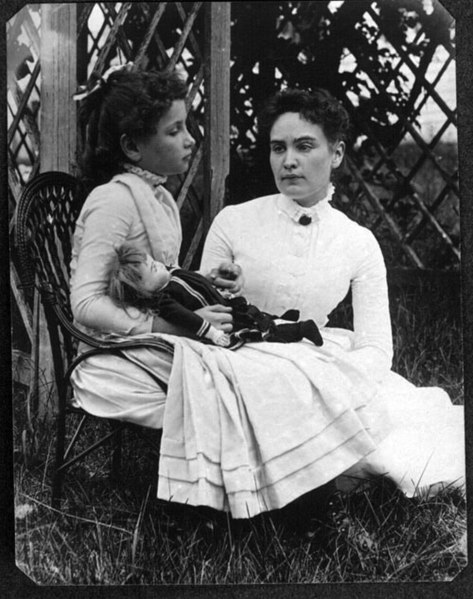

Helen Keller, precisely because she was deaf and blind, had an enormous influence on others once she discovered her gifts through the patience of Anne Sullivan, her tutor.

Portrait by Josef Karl Stieler [Wikipedia]

And Beethoven had become totally deaf by the time he composed his revolutionary Ninth Symphony, the first symphony ever to include singers, with Schiller's Ode to Joy in the last movement. But he didn't hear that music with his ears, only with his mind and memory. Beethoven wasn't 'differently-abled'. He was a musical genius who acquired the disability of deafness as he grew older. This began when he was about 30. For the last ten of his 57 years he was almost totally deaf but continued to compose.

When I was a young priest I studied for a degree in musical education and spent some months as a practice-teacher in two public schools in New York State. The students I had in First Year High School were almost impossible to keep in check. But when I was able to get across to them, despite the noise level, that Beethoven had no hearing when he wrote The Ninth they quietened down and listened, quite awe-struck, to the music. The concluding words of Pope Francis, in a sense, had come true in that instance: Indeed, only those who recognise their own fragility and their own limits can build bonds of fraternity and unity, [in the Church] and in society.

There were no flashmobs in Beethoven's day but I'm sure he wouldn't be unhappy with the Ode to Joy section of his 'Ninth' being played in a public square in Catalonia, Spain, bringing joy to young and old, his music, written nearly 200 years ago when he was already deaf, bringing musicians, singers and listeners out of themselves as it did those noisy 14-year-olds I was trying to teach 42 years ago.


05 April 2014

'I am the resurrection and the life.' Sunday Reflections. 5th Sunday of Lent Year A


Readings (New American Bible: Philippines, USA)                                  

Readings (Jerusalem Bible: Australia, England & Wales, India [optional], Ireland, New Zealand, Pakistan, Scotland, South Africa)

Gospel John 11:1-45 [or John 11:3-7, 20-27, 33B-45] (New Revised Standard Version, Catholic Edition, Canada) [Shorter form of the Gospel: omit what is in square brackets]

[Now a certain man was ill, Lazarus of Bethany, the village of Mary and her sister Martha. Mary was the one who anointed the Lord with perfume and wiped his feet with her hair; her brother Lazarus was ill.] 

So the sisters sent a message to Jesus, “Lord, he whom you love is ill.” But when Jesus heard it, he said, “This illness does not lead to death; rather it is for God’s glory, so that the Son of God may be glorified through it.” Accordingly, though Jesus loved Martha and her sister and Lazarus, after having heard that Lazarus was ill, he stayed two days longer in the place where he was.

Then after this he said to the disciples, “Let us go to Judea again.” 

[The disciples said to him, “Rabbi, the Jews were just now trying to stone you, and are you going there again?” Jesus answered, “Are there not twelve hours of daylight? Those who walk during the day do not stumble, because they see the light of this world.  But those who walk at night stumble, because the light is not in them.”  After saying this, he told them, “Our friend Lazarus has fallen asleep, but I am going there to awaken him.”  The disciples said to him, “Lord, if he has fallen asleep, he will be all right.”  Jesus, however, had been speaking about his death, but they thought that he was referring merely to sleep.  Then Jesus told them plainly, “Lazarus is dead.  For your sake I am glad I was not there, so that you may believe. But let us go to him.”  Thomas, who was called the Twin, said to his fellow disciples, “Let us also go, that we may die with him. When Jesus arrived, he found that Lazaruz had already been in the tomb four days. Now Bethany was near Jerusalem, some two miles away,  and many of the Jews had come to Martha and Mary to console them about their brother.]

When Martha heard that Jesus was coming, she went and met him, while Mary stayed at home. Martha said to Jesus, “Lord, if you had been here, my brother would not have died.  But even now I know that God will give you whatever you ask of him.”  Jesus said to her, “Your brother will rise again.”  Martha said to him, “I know that he will rise again in the resurrection on the last day.”  Jesus said to her, “I am the resurrection and the life. Those who believe in me, even though they die, will live,  and everyone who lives and believes in me will never die. Do you believe this?”  She said to him, “Yes, Lord, I believe that you are the Messiah, the Son of God, the one coming into the world.”

[ When she had said this, she went back and called her sister Mary, and told her privately, “The Teacher is here and is calling for you.”  And when she heard it, she got up quickly and went to him.  Now Jesus had not yet come to the village, but was still at the place where Martha had met him. The Jews who were with her in the house, consoling her, saw Mary get up quickly and go out. They followed her because they thought that she was going to the tomb to weep there. When Mary came where Jesus was and saw him, she knelt at his feet and said to him, “Lord, if you had been here, my brother would not have died.”  When Jesus saw her weeping, and the Jews who came with her also weeping,]

He (Jesus) was greatly disturbed in spirit and deeply moved. He said, “Where have you laid him?” They said to him, “Lord, come and see.”  Jesus began to weep. So the Jews said, “See how he loved him!”  But some of them said, “Could not he who opened the eyes of the blind man have kept this man from dying?”

Then Jesus, again greatly disturbed, came to the tomb. It was a cave, and a stone was lying against it.  Jesus said, “Take away the stone.” Martha, the sister of the dead man, said to him, “Lord, already there is a stench because he has been dead four days.”  Jesus said to her, “Did I not tell you that if you believed, you would see the glory of God?”  So they took away the stone. And Jesus looked upward and said, “Father, I thank you for having heard me.  I knew that you always hear me, but I have said this for the sake of the crowd standing here, so that they may believe that you sent me.” When he had said this, he cried with a loud voice, “Lazarus, come out!”  The dead man came out, his hands and feet bound with strips of cloth, and his face wrapped in a cloth. Jesus said to them, “Unbind him, and let him go.”

Many of the Jews therefore, who had come with Mary and had seen what Jesus did, believed in him.


From The Gospel of John

I think it was back in the 1980s when I was at home in Ireland on a visit that I heard a young diocesan priest being interviewed on national radio about his work as a prison chaplain. He spoke about an occasion when he spent an hour in a cell with one prisoner who was there for stealing on a large scale. The priest got no response whatever - until he was about to leave. He then looked at the young man, put his arms around him and said, 'I love you', adding the man's name.

The prisoner broke down and began to open up to the priest. Over a period of time they became friends. After he was released the young man set up a successful security agency, no doubt drawing on his 'professional skills'.

In Worldwide Marriage Encounter we say 'Love is a decision'. At times it may be accompanied by warm feelings, at other times the very opposite. It is easy for a young man and a young woman who find each other attractive to feel 'love'. This may lead to 'until death do us part', a very solemn decision to love one another.


Last Wednesday in his general audience Pope Francis reminded married couples of this, gently, humorously and clearly. The secret is that love is stronger than an argument. And therefore I always advise married couples, 'Don't end your day without making peace.

Here the Pope was saying 'Love is a decision'. He added humorously: It's not necessary to call the United Nations and have them come to your house to broker the peace. A little gesture will do, a caress, a 'Goodnight, see you tomorrow'. And tomorrow you start over. This is life, carry on! Go forward with the courage to want to live together. This is great, it's beautiful. What Pope Francis is saying here is that love is a decision, a major decision made on one's wedding day that demands many daily 'minor' decisions. The same applies to anyone called to a commitment.

The young priest visiting the prisoner in Ireland wasn't experiencing any feelings of love for the prisoner and the latter probably felt deep anger towards him, maybe even hatred. But the priest made a decision to love that man, no matter how difficult it was, no matter what he was feeling at the time.

Van Gogh, May 1890, Saint-Rémy [Web Gallery of Art]

In the gospel we find Jesus making a number of decisions, all expressions of love:
  • He decided not to go immediately to visit the gravely ill Lazarus when he got news of this: Though Jesus loved Martha and her sister and Lazarus, after having heard that Lazarus was ill, he stayed two days longer in the place where he was.
  • He then decided to go back to Judea despite the fears of his disciples that harm would come to him.
  • He accepted the reproaches of both Martha and Mary: Lord, if you had been here, my brother would not have died. He made no attempt to 'explain' why he hadn't come.
  • He told the people: Take away the stone.
The purpose of Jesus in all these decisions was to lead the disciples and Martha and Mary into a deeper faith:
  • To the disciples and later to Martha: Lazarus is dead.  For your sake I am glad I was not there, so that you may believe.
  • To the Father: Father, I thank you for having heard me.  I knew that you always hear me, but I have said this for the sake of the crowd standing here, so that they may believe that you sent me. 
It is clear from the gospels that Jesus had a special, though not exclusive, affection for Martha, Mary and Lazarus. Maybe he felt free to drop into their home at any time and not be 'on duty'. (As an aside, in more than 40 years in the Philippines I have rarely seen a bishop invited to any kind of occasion except to 'do something', to be 'on duty'.) The friendship Jesus had with the three gave them the freedom to be open with him and to be true to themselves.  Luke 10:38-42 shows us Martha scolding Mary in front of Jesus in a way that happens with someone considered part of the family. The Lord, if you had been here . . . of both Martha and Mary can be read as a reproach mingled with hope to someone deeply trusted. 

Jesus invites each of us into that kind of warm, trusting relationship that is expressed in the story about St Teresa of Avila: Once, when she was travelling to one of her convents, St Teresa of Ávila was knocked off her donkey and fell into the mud, injuring her leg. 'Lord', she said, 'you couldn’t have picked a worse time for this to happen. Why would you let this happen?' And the response in prayer that she heard was, 'That is how I treat my friends'. Teresa answered, 'And that is why you have so few of them!'

But above all in the raising of Lazarus, which points towards the death and Resurrection of Jesus himself, we see the resurrection and the life who was greatly disturbed in spirit and deeply moved confronting death and conquering it. The death he was conquering wasn't only physical death but the sickness and death brought about by sin. Jesus calls us to faith and hope in him and to make decisions to love based on that faith and hope.

It was such faith that gave that young priest in the prison cell the courage to express his love, rooted in the love of Jesus for both, for the prisoner in deed and then in word. And it was that expression of love, in deed and in word, rooted in the love of the resurrection and the life for both, that enabled the man to walk out of the prison cell he had created for himself in his own heart.

The decision of the priest to stay with the prisoner despite the lack of response and the eventual decision of the prisoner to believe in God's love for him were both examples of love being a decision, decisions based on trust in God's love for them, the kind of trust that Martha and Mary had in Jesus.


Antiphona ad Introitum Cf Ps 42 (43) 1-2

Iudica me, Deus
et discerne causam meam de gente non sancta,
ab homine iniquo et doloso eripe me,
qui tu es Deus meus et fortitudo mea.

Entrance Antiphon  Cf Ps 42 (43) 1-2

Give me justice, O God,
and plead my cause against a nation that is faithless.
From the deceitful and cunning rescue me,
for you, O God, are my strength.

01 April 2014

'If you forgive the sins of any, they are forgiven them; if you retain the sins of any, they are retained' (John 20:23).


28 March 2014

POPE FRANCIS
GENERAL AUDIENCE
Saint Peter's Square
Wednesday, 19 February 2014
[Emphasis added]

Dear Brothers and Sisters, Good morning!

Through the Sacraments of Christian Initiation — Baptism, Confirmation and the Eucharist — man receives new life in Christ. Now, we all know that we carry this life “in earthen vessels” (2 Cor 4:7), we are still subject to temptation, suffering, and death and, because of sin, we may even lose this new life. That is why the Lord Jesus willed that the Church continue his saving work even to her own members, especially through the Sacrament of Reconciliation and the Anointing of the Sick, which can be united under the heading of “Sacraments of Healing”. The Sacrament of Reconciliation is a Sacrament of healing. When I go to confession, it is in order to be healed, to heal my soul, to heal my heart and to be healed of some wrongdoing. The biblical icon which best expresses them in their deep bond is the episode of the forgiving and healing of the paralytic, where the Lord Jesus is revealed at the same time as the physician of souls and of bodies (cf. Mk 2:1-12; Mt 9:1-8; Lk 5:17-26).

1. The Sacrament of Penance and Reconciliation flows directly from the Paschal Mystery. In fact, on the evening of Easter the Lord appeared to the disciples, who were locked in the Upper Room, and after addressing them with the greeting, “Peace be with you!”, he breathed on them and said: “Receive the Holy Spirit. If you forgive the sins of any, they are forgiven” (Jn 20:21-23). This passage reveals to us the most profound dynamic contained in this Sacrament.

First, the fact that the forgiveness of our sins is not something we can give ourselves. I cannot say: I forgive my sins. Forgiveness is asked for, is asked of another, and in Confession we ask for forgiveness from Jesus. Forgiveness is not the fruit of our own efforts but rather a gift, it is a gift of the Holy Spirit who fills us with the the wellspring of mercy and of grace that flows unceasingly from the open heart of the Crucified and Risen Christ. Secondly, it reminds us that we can truly be at peace only if we allow ourselves to be reconciled, in the Lord Jesus, with the Father and with the brethren. And we have all felt this in our hearts, when we have gone to confession with a soul weighed down and with a little sadness; and when we receive Jesus’ forgiveness we feel at peace, with that peace of soul which is so beautiful, and which only Jesus can give, only Him.

2. Over time, the celebration of this Sacrament has passed from a public form — because at first it was made publicly — to a personal one, to the confidential form of Confession. This however does not entail losing the ecclesial matrix that constitutes its vital context. In fact, the Christian community is the place where the Spirit is made present, who renews hearts in the love of God and makes all of the brethren one thing in Christ Jesus. That is why it is not enough to ask the Lord for forgiveness in one’s own mind and heart, but why instead it is necessary humbly and trustingly to confess one’s sins to a minister of the Church. In the celebration of this Sacrament, the priest represents not only God but also the whole community, who sees itself in the weakness of each of its members, who listens and is moved by his repentance, and who is reconciled with him, which cheers him up and accompanies him on the path of conversion and human and Christian growth. One might say: I confess only to God. Yes, you can say to God “forgive me” and say your sins, but our sins are also committed against the brethren, and against the Church. That is why it is necessary to ask pardon of the Church, and of the brethren in the person of the priest. 


“But Father, I am ashamed ...”. Shame is also good, it is healthy to feel a little shame, because being ashamed is salutary. In my country when a person feels no shame, we say that he is “shameless”; a “sin verguenza”. But shame too does good, because it makes us more humble, and the priest receives this confession with love and tenderness and forgives us on God’s behalf. Also from a human point of view, in order to unburden oneself, it is good to talk with a brother and tell the priest these things which are weighing so much on my heart. And one feels that one is unburdening oneself before God, with the Church, with his brother. Do not be afraid of Confession! When one is in line to go to Confession, one feels all these things, even shame, but then when one finishes Confession one leaves free, grand, beautiful, forgiven, candid, happy. This is the beauty of Confession! 

I would like to ask you — but don’t say it aloud, everyone respond in his heart: when was the last time you made your confession? Everyone think about it ... Two days, two weeks, two years, twenty years, forty years? Everyone count, everyone say ‘when was the last time I went to confession?’. And if much time has passed, do not lose another day. Go, the priest will be good. Jesus is there, and Jesus is more benevolent than priests, Jesus receives you, he receives you with so much love. Be courageous and go to Confession!

3. Dear friends, celebrating the Sacrament of Reconciliation means being enfolded in a warm embrace: it is the embrace of the Father’s infinite mercy. Let us recall that beautiful, beautiful parable of the son who left his home with the money of his inheritance. He wasted all the money and then, when he had nothing left, he decided to return home, not as a son but as a servant. His heart was filled with so much guilt and shame. The surprise came when he began to speak, to ask for forgiveness, his father did not let him speak, he embraced him, he kissed him, and he began to make merry. But I am telling you: each time we go to confession, God embraces us. God rejoices! Let us go forward on this road. May God bless you!


29 March 2014

'Surely we are not blind, are we?' Sunday Reflections, 4th Sunday of Lent Year A


Readings (New American Bible: Philippines, USA)                                  

Readings (Jerusalem Bible: Australia, England & Wales, India [optional], Ireland, New Zealand, Pakistan, Scotland, South Africa)

Gospel John 9:1-41 [or John 9:1, 6-9, 13-17, 34-38] (New Revised Standard Version, Catholic Edition, Canada)  [Shorter form of the Gospel: omit what is in square brackets]

As Jesus walked along, he saw a man blind from birth. 

[His disciples asked him, “Rabbi, who sinned, this man or his parents, that he was born blind?”  Jesus answered, “Neither this man nor his parents sinned; he was born blind so that God’s works might be revealed in him. We must work the works of him who sent me while it is day; night is coming when no one can work.  As long as I am in the world, I am the light of the world.”] 

When he had said this, he spat on the ground and made mud with the saliva and spread the mud on the man’s eyes, saying to him, “Go, wash in the pool of Siloam” (which means Sent). Then he went and washed and came back able to see. The neighbors and those who had seen him before as a beggar began to ask, “Is this not the man who used to sit and beg?” Some were saying, “It is he.” Others were saying, “No, but it is someone like him.” He kept saying, “I am the man.” 

[ But they kept asking him, “Then how were your eyes opened?” He answered, “The man called Jesus made mud, spread it on my eyes, and said to me, ‘Go to Siloam and wash.’ Then I went and washed and received my sight.”  They said to him, “Where is he?” He said, “I do not know.”]

They brought to the Pharisees the man who had formerly been blind. Now it was a sabbath day when Jesus made the mud and opened his eyes. Then the Pharisees also began to ask him how he had received his sight. He said to them, “He put mud on my eyes. Then I washed, and now I see.” Some of the Pharisees said, “This man is not from God, for he does not observe the sabbath.” But others said, “How can a man who is a sinner perform such signs?” And they were divided.  So they said again to the blind man, “What do you say about him? It was your eyes he opened.” He said, “He is a prophet.”

[The Jews did not believe that he had been blind and had received his sight until they called the parents of the man who had received his sight and asked them, “Is this your son, who you say was born blind? How then does he now see?” His parents answered, “We know that this is our son, and that he was born blind;  but we do not know how it is that now he sees, nor do we know who opened his eyes. Ask him; he is of age. He will speak for himself.”  His parents said this because they were afraid of the Jews; for the Jews had already agreed that anyone who confessed Jesus to be the Messiah would be put out of the synagogue. Therefore his parents said, “He is of age; ask him.”

So for the second time they called the man who had been blind, and they said to him, “Give glory to God! We know that this man is a sinner.” He answered, “I do not know whether he is a sinner. One thing I do know, that though I was blind, now I see.” They said to him, “What did he do to you? How did he open your eyes?” He answered them, “I have told you already, and you would not listen. Why do you want to hear it again? Do you also want to become his disciples?” Then they reviled him, saying, “You are his disciple, but we are disciples of Moses.  We know that God has spoken to Moses, but as for this man, we do not know where he comes from.” The man answered, “Here is an astonishing thing! You do not know where he comes from, and yet he opened my eyes.  We know that God does not listen to sinners, but he does listen to one who worships him and obeys his will. Never since the world began has it been heard that anyone opened the eyes of a person born blind.  If this man were not from God, he could do nothing.”]
  
They answered him, “You were born entirely in sins, and are you trying to teach us?” And they drove him out.

Jesus heard that they had driven him out, and when he found him, he said, “Do you believe in the Son of Man?” He answered, “And who is he, sir? Tell me, so that I may believe in him.” Jesus said to him, “You have seen him, and the one speaking with you is he.” He said, “Lord, I believe.” And he worshiped him.  Jesus said, “I came into this world for judgment so that those who do not see may see, and those who do see may become blind.” Some of the Pharisees near him heard this and said to him, “Surely we are not blind, are we?” Jesus said to them, “If you were blind, you would not have sin. But now that you say, ‘We see,’ your sin remains.


In his homily on the Solemnity of the Annunciation Pope Francis said, Salvation cannot be bought and sold; it is given as a gift, it is free . . . We cannot save ourselves, salvation is a totally free gift.  The Pope continued: Since it cannot be bought, in order for this salvation to enter into us we need a humble heart, a docile heart, an obedient heart like Mary's. Moreover, the model on this journey of salvation is God himself, his Son, who did not count equality with God something to be grasped, but emptied himself, and was obedient unto death, even death on a cross.

All of the people in this Sunday's gospel had been given the gift of faith but only the man who received the gift of sight from Jesus professed his faith openly, his faith in Jesus: Lord, I believe. Not only that, he began to share the gift of his faith with others, most especially the Pharisees who were trying to intimidate him. They proclaimed themselves as disciples of Moses. As such, they should have been prepared for the coming of the Messiah who was now among them.

But they had developed a sense of 'proprietorship' of their faith, a righteous complacency that blinded them to the extent that they dismissed a man who was born blind as a sinner with nothing from which they could learn. The man born blind, on the other hand, has an acute sense of being gifted, by the gift of sight and by the gift of faith. He is an embodiment of the thrust of Pope Francis' apostolic exhortation, Evangelii Gaudium, The Joy of the Gospel.

Our Christian faith is a gift that can be lost by an individual and by a whole community. The Church flourished in North Africa and in the Middle East before Islam came into being but the vast majority lost the gift of our faith. In our own lifetime the faith has been rapidly disappearing from places such as Belgium, Ireland, the Netherlands, Quebec. Fifty years ago these places were sending missionaries to every part of the world and their seminaries were full. Now most of the seminaries have been closed down. Just over 100 years ago CICM brothers and priests (Scheut Missionaries, Missionhurst) and ICM Sisters came to the mountains of northern Luzon from a part of Europe that is as flat as a billiard table, most of Belgium and the Netherlands. Recently Belgium made it legal for sick children to be killed, to be put down like sick animals. There was no international reaction to this, though there was to the putting down of a healthy giraffe in a zoo in Denmark.

There still are people in these places and others like them who are living the Christian life faithfully, often heroically. Martyrs such as Fr Ragheed Ganni of Iraq and politician Shahbaz Bhatti of Pakistan are outstanding examples. Another is the late Professor Jérôme Lejeune, doctor and researcher, who in 1959 discovered the cause of Down syndrome (trisomy 21). 


In so many places in the gospel we find Jesus going out to those considered unimportant such as the blind man in today's gospel. Pope Francis is to have an audience today, Saturday 29 March, with people who are deaf and with people who are blind, the first ever such gathering in the Vatican. And there will probably be some present who are both deaf and blind.

John Milton, who went blind as an adult, in his poem On His Blindness (below) shows an acceptance of what he calls his mild yoke and a sense of our sight and everything else being gifts from God.

Pope Francis in Evangelii Gaudium No 264 gives us some pointers:

We need to implore his grace daily, asking him to open our cold hearts and shake up our lukewarm and superficial existence . . . How good it is to stand before a crucifix, or on our knees before the Blessed Sacrament, and simply to be in his presence!

The best incentive for sharing the Gospel comes from contemplating it with love, lingering over its pages and reading it with the heart.

Sometimes we lose our enthusiasm for mission because we forget that the Gospel responds to our deepest needs, since we were created for what the Gospel offers us: friendship with Jesus and love of our brothers and sisters.

The words of Pope Francis suggest a basic attitude of gratitude to God such as we see in the man who tells everyone, One thing I do know, that though I was blind, now I see. 

Somewhat different from the Pharisees' Surely we are not blind, are we?

Which statement/question reflects my stance before God?


       On His Blindness
       by John Milton
       
       When I consider how my light is spent

Ere half my days in this dark world and wide,
And that one talent which is death to hide
Lodg'd with me useless, though my soul more bent
To serve therewith my Maker, and present
My true account, lest he returning chide,
"Doth God exact day-labour, light denied?"
I fondly ask. But Patience, to prevent
That murmur, soon replies: "God doth not need
Either man's work or his own gifts: who best
Bear his mild yoke, they serve him best. His state
Is kingly; thousands at his bidding speed
And post o'er land and ocean without rest:
They also serve who only stand and wait."


Antiphona ad introitum  Cf Isaiah 66:10-11

Laetare Jerusalem, et conventum facite, omnes qui diligitis eam; 

gaudete cum laetitia, qui in tristitia fuistis, 
ut exsultetis, et satiemini ab uberibus consolationis vestrae. 

Entrance Antiphon  Cf Isaiah 66:10-11

Rejoice, Jerusalem, and all who love her.
Be joyful, all who were in mourning;
exult and be satisfied at her consoling breast.

25 March 2014

'Behold the handmaid of the Lord.' The Annunciation

The Annunciation, El Greco, 1595-1600 [Web Gallery of Art]

Behold the handmaid of the Lord; be it done to me according to thy word.

Fr Donnchadh Ó Floinn (1902 - 1968) was a priest of the Archdiocese of Dublin who wrote 201 short meditations in Irish Gaelic for The Far East, the monthly magazine of the Columbans in Ireland, from March 1949 till April 1967. In 2003 they were published by Foilseacháin Ábhair Spioradálta, which specializes in spiritual books in Irish and is run by the Jesuits, under the title Aibhleoga Crábhaidh, ‘Sparks of Devotion’. Fifty of these had come out in book form before under the same publisher in 1957 with the title Caoga Árdú Meanman, which could be translated as 'Fifty Raisings of the Spirit’. The editor of Aibhleoga Crábhaidh was Fr Iognáid Ó Maoleachlainn of the Diocese of Ardagh and Clonmacnoise.


Father Ó Floinn’s spirituality was suffused with a deep devotion to Mary and many of his short articles were reflections on the mysteries of the rosary, though not in a systematic way. He sometimes returned to the same mystery a number of times. His reflection on The Handmaid of the Lord is below.


The Annunciation, El Greco, 1603-05 [Web Gallery of Art]

Like Father Ó Floinn, El Greco was drawn to the theme of the Annunciation. Web Gallery of Art has ten of his paintings of this scene done between 1568 and  1614.

The Handmaid of the Lord

Banóglach an Tiarna

‘The angel of the Lord declared unto Mary’ – imagine that bright and glorious spirit in conversation with the young girl in the little town of Nazareth, and listen carefully to her answer. What should a person say when she receives a message from heaven? Should she say nothing at all? Or a lot, putting herself down? Mary gave as an answer only a dozen or so words, but those dozen words were full of the wisdom of the Holy Spirit.

‘Behold the handmaid of the Lord’ – there are two things to note about that answer: firstly, it is the first thing every creature should say, because it shows the most basic root of our nature; secondly, it is an answer that embraces the whole life of the Virgin Mary- from Nazareth to heaven and from that March day to the edge of eternity.

Each person is by nature a slave of God. But it’s mostly to creatures that we are slaves: we are slave to ourselves, we are slaves to the gods of gold and silver, we are slaves to things that are insignificant, or to things, however noble and beautiful, that are passing – what wonder then that we become anxious when we’re at war with our own nature?

But Mary - who never spent a moment as a slave except to her Son: in Nazareth taking care of their little house; in Jerusalem watching during the Passion; waiting patiently to be taken to heaven; yes, and even in heaven today, the Queen of angels, isn’t she still the Handmaid of the Lord, guiding the Church and sharing graces?

Ecce Virgo concipiet 
SATTB motet by William Byrd (c. 1540-1623)
Performed by Stile Antico on their CD of English Tudor music for the seasons of Advent and Christmas. 

Antiphona ad communionem  Isaiah 7:14

Ecce Virgo concipiet, 
    et pariet Filium; 
et vocabitur nomen 
    eius Emmanuel.

Communion Antiphon  Isiaiah 7:14

Behold, a Virgin shall conceive 
    and bear a son; 
and his name will be 
    called Emmanuel.

[This is a re-working of a post I published on 9 October 2009.]