10 November 2013

Devastation in Tacloban City, Philippines


It has become clear that Super Typhoon Haiyan ('Yolanda' in the Philippines) has caused enormous destruction and, very possibly, many deaths. Tacloban City, on the island of Leyte in the eastern Visayas, the group of large islands in the centre of the country, looks as if a bomb had been dropped on it. I have visited it a number of times.

Much of the damage was caused by a storm surge, which is similar to a tsunami. I heard an official of PAGASA, the national weather bureau, explain on television today that where the seas is shallow, as it is in Tacloban City,  such surges tend to be much higher than where the sea is deep and therefore much more destructive.

Part of downtown Tacloban City


There are now reports that more than 10,000 may have died as a result of the storm. Reuters quotes a senior police official on this.


At 1.47 in the video above you can see the damage done to Daniel Z. Romualdez Airport. Below is a photo of the main building.


Although the airport buildings, including the control tower, as far as I know, have been badly damaged the runway has now been cleared of debris and military aircraft carrying supplies and troops have been able to land. President Aquino also visited today.

Reports indicate that it may be months before normal electricity services can be resumed.

There has been some looting in Tacloban City but scenes on TV showed this to be an 'orderly' process, if one can describe it as such. And footage shows people queuing up in orderly fashion at the airport, hoping for relief goods and, in some cases, hoping to get out. However, police and soldiers have been brought in to bring about order. One can well imagine that if people don't get basics such as food, drinking water, shelter and medical care, that matters could get out of hand.

One striking characteristic of Filipinos is their resilience. I've seen this over and over again. People pick up the pieces and start again.

Pope Francis sent the following telegram through Secretary of State Archbishop Pietro Parolin to President Aquino:

Deeply saddened by the destruction and loss of life caused by the super typhoon, His Holiness Pope Francis expresses his heartfelt solidarity with all those affected by this storm and its aftermath. He is especially mindful of those who mourn the loss of their loved ones and of those who have lost their homes. In praying for all the people of the Philippines, the Holy Father likewise offers encouragement to the civil authorities and emergency personnel as they assist the victims of this storm. He invokes divine blessings of strength and consolation for the Nation.

Basilica of Sto Niño de Tacloban

The Patron of Tacloban City is the Sto Niño de Tacloban, the Holy Child of Tacloban. May God show his love in a special way to the many children who have been traumatised by their experience in those places in the Philippines that bore the brunt of the typhoon. And may Mary and her husband St Joseph obtain for parents and others in positions of authority the strength and generosity to do what needs to be done to bring about a life-giving normality.


May the faith of the people of Tacloban City and other affected areas, expressed in the hymn above to the Sto Niño de Tacloban asking his blessing and mercy, touch the Merciful Heart of our loving Saviour Jesus Christ.

Photos from Wikipedia.

06 November 2013

Pope Francis' Prayer Intentions for November 2013


[Images from Wikipedia]

General Intention

Suffering Priests 

That priests who experience difficulties may find comfort in their suffering, support in their doubts, and confirmation in their fidelity.


Mission Intention

Latin American Churches 

That as fruit of the continental mission, Latin American Churches may send missionaries to other Churches.


02 November 2013

'I must stay at your house today.' Sunday Reflections, 31st Sunday in Ordinary Time Year C


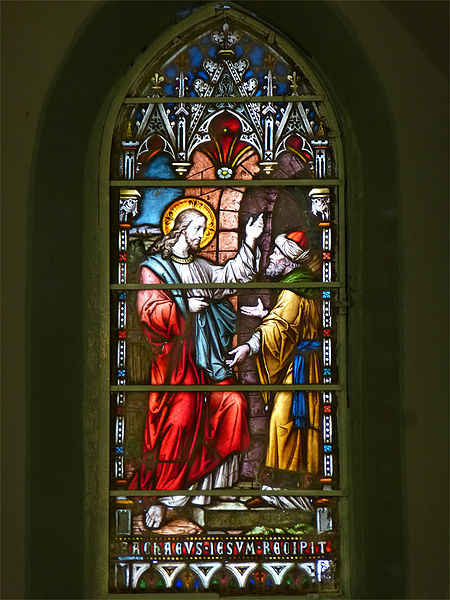
Zacchaeus receives Jesus, Church of the Good Shepherd, Jericho [Wikipedia]

Readings (New American Bible: Philippines, USA)                                  

Readings (Jerusalem Bible: Australia, England & Wales, India [optional], Ireland, New Zealand, Pakistan, Scotland, South Africa)


Jesus entered Jericho and was passing through. And there was a man named Zacchaeus; he was a chief tax collector, and rich. And he sought to see who Jesus was, but could not, on account of the crowd, because he was small of stature. So he ran on ahead and climbed up into a sycamore tree to see him, for he was to pass that way. And when Jesus came to the place, he looked up and said to him, "Zacchaeus, make haste and come down; for I must stay at your house today." So he made haste and came down, and received him joyfully. And when they saw it they all murmured, "He has gone in to be the guest of a man who is a sinner." 

And Zacchaeus stood and said to the Lord, "Behold, Lord, the half of my goods I give to the poor; and if I have defrauded any one of anything, I restore it fourfold." And Jesus said to him, "Today salvation has come to this house, since he also is a son of Abraham. For the Son of man came to seek and to save the lost."


The Brothers in Black who produced Exclusive Interview with Zacchaeus, the video above, are seminarians from the USA studying in Rome.

'Zacchaeus' recounting his meeting with Jesus in the 'Exclusive Interview' above recalls, And he looked me right in the eyes. He goes on to repeat that.

In 2009, in a preface to a book on St Augustine, the then Jorge Mario Cardinal Bergoglio, Archbishop of Buenos Aires, now Pope Francis, wroteThe most striking image for me of how one becomes a Christian, as it emerges in this book, is the way in which Augustine recounts and comments on Jesus’ encounter with Zacchaeus. Zacchaeus is small, and wants to see the Lord pass, and so he climbs a sycamore. Augustine says: 'Et vidit Dominus ipsum Zacchaeum. Visus est, et vidit.' [And the Lord looked at Zacchaeus himself. He was seen, and saw.]

The then Cardinal Bergoglio comments [emphasis added here and below]: Some believe that faith and salvation come with our effort to look for, to seek the Lord. Whereas it’s the opposite: you are saved when the Lord looks for you, when He looks at you and you let yourself be looked at and sought for. The Lord will look for you first. And when you find Him, you understand that He was waiting there looking at you, He was expecting you from beforehand. 

That is salvation: He loves you beforehand. And you let yourself be loved. Salvation is precisely this meeting where He works first. If this meeting does not take place, we are not saved. We can talk about salvation. Invent reassuring theological systems that turn God into a notary and His gratuitous love into a due deed to which He is supposed to be forced by His nature. But we never enter into the People of God. Whereas, when you look at the Lord and you realize with gratitude that you are looking at Him because He is looking at you, all intellectual prejudices go away, that elitism of the spirit that is characteristic of intellectuals without talent and is ethicism without goodness.

God's mercy has been one of the main themes of Pope Francis since he became Bishop of Rome. And when you find Him, you understand that He was waiting there looking at you, He was expecting you from beforehand. These words of his while still in Buenos Aires recall the story of the Prodigal Son. But while he was yet at a distance, his father saw him and had compassion, and ran and embraced him and kissed him (Luke 15:20).


I've often used today's gospel in retreats with young people in the context of preparing them for the sacrament of confession. Zacchaeus publicly acknowledges that he has cheated but is ready to give back fourfold what he has cheated people of. He has a joyful face-to-face meeting with Jesus that includes a celebratory meeting.

In his homily on 25 October in St Martha's, Vatican City, Pope Francis spoke once again about confession. He reminded those present that the sacrament is not like going to a psychiatrist or to a torture chamber. He also reminds us how far too easy it is to say I confess to God. That's like confessing by email, he comments. I say things and there's no face-to-face contact. He then goes on to speak of how concrete children are when they confess their sins.

The meeting of Jesus and Zacchaeus was a deeply personal experience for both. In all his meetings with individuals Jesus gave of himself. We see that starkly in the story of the healing of the woman who had been bleeding for 12 years and who was cured when she touched his garment: And Jesus, perceiving in himself that power had gone forth from him, immediately turned about in the crowd, and said, "Who touched my garments?" (Mark 5:30).

Homily of Pope Francis, 25 October 2013

Pope Francis then went on to speak of the grace of being ashamedBut if there is one thing that is beautiful, it is when we confess our sins in the presence of God just as they are. We always feel the grace of being ashamed. To feel ashamed before God is a grace. It is a grace to say: 'I am ashamed'. Let us think about St Peter after Jesus' miracle on the lake: 'Depart from me Lord, for I am a sinner'. He was ashamed of his sin in the presence of Jesus Christ.

Going to confession, the Pope said, is 'going to an encounter with the Lord who forgives us, who loves us. And our shame is what we offer him: 'Lord, I am a sinner, but I am not so bad, I am capable of feeling ashamed'.

The Holy Father concluded: 'let us ask for the grace to live in the truth without hiding anything from the Lord and without hiding anything from ourselves'.

I remember an Irish Christian Brother who taught me in my last two years of secondary school, Brother Mícheál S. Ó Flaitile. We all revered him as a saintly man. The worst 'punishment' you could get from him was a stare when you did something wrong. It made you feel the kind of shame that Pope Francis speaks about. It didn't humiliate you. It was a face-to-face encounter that made you want to be better, to be true to the reality that you were made in God's image.

Jesus is saying to each of us today by name: make haste and come down; for I must stay at your house today. May each of us make haste and come down, and receive him joyfully.

Responsorial Psalm [New American Bible Lectionary]


01 November 2013

Columban Fr John O'Connell who died recently in Peru

Fr John O'Connell (1933 - 2013)
by Fr Leo Donnelly 

Fr Leo Donnelly writes about his close friend Fr John O'Connell who died recently in Lima, Peru. Father John is one of a small number of Columbans who have served as Regional Director in two different countries. A regional director is the equivalent of provincial superior in religious life. We are not religious but secular priests, members of a society of apostolic life. That means that we don't take a vow of poverty nor are we required to live in community.
I've added a memory of my own. So many of our happy memories are connected with music and with festive gatherings. I don't know if anyone else who was present remembers what I recall below. But memories of 'little things' are very personal. 
Fr Leo Donnelly, an Australian Columban, was ordained in 1957, the same year as the late Fr John O'Connell was. Father Leo has been in Peru all his life as a priest. The photo above was taken at adespedida for Father John in Túpac Amaru District, Lima, in 2011.
Fr John Joseph O´Connell died in hospital in Lima the morning of Thursday, 24 October aged 80. Father John, a Kerryman to his fingertips, often sported Kerry jerseys around his parish of San Pedro y San Pablo, Payet, Independencia, Lima.
The crest of the Kerry Gaelic Football and Hurling teams. The boat is a symbol of St Brendan the Navigator, one of Ireland's early missionaries and, like Father John, a Kerryman. 'Kerry' is the anglicized form of the original Irish, 'Ciarraí'. [Image from Wikipedia]
Ordained in December 1957 in St Columban’s, Dalgan Park, Ireland, and assigned to Perú, he was sent to Spain for a three-month course in Spanish. Then he ‘walked down’ to Lima, as the late Columban Fr Dan Boland put it, arriving in late March 1959.  His first assignment was as an assistant in the new Columban parish of Blessed Martin de Porres’.    He wasn´t three years in Lima when given the almighty task of building the basilica under the name of its patron.  Blessed Martin was coming up for canonization in 1962, so it was a very popular though expensive project which he fulfilled, and he was present at the canonization under Blessed John XXIII.

Christmas Midnight Mass at St Martin de Porres Church
Father John returned to Ireland in 1980, serving as a member of the Mission Promotion team and then as Regional Director. He returned to Perú in 1996 and worked in the parish of San Pedro y San Pablo, Payet.
Father John inspired people. He inspired his fellow priests. He inspired his people in the four parishes of Lima in which he served and gave his life for.  You only had to travel around Ireland with him to become aware of just how much he inspired his own people.    As a true Kerryman, this often meant going off visiting at about 11.00 at night.
Father John was a man aware of his own dignity as a person and this freed him to acknowledge our shared dignity with each and every other person. If there is any essential characteristic to being a missionary this aspect is basic when dealing with people born into an ambiance of being ‘a nobody’ in our world. It was in this ambiance that he proved himself a loyal friend to so many. Built on the person he was, his long-term appointments facilitated his relating to his people at this level.

Tribute and farewell to Fr John O'Connell, Parish of San Pedro y San Pablo, Túpac Amaru District (also known as 'Payet'), Lima, 2011

Like everyone else he took his share of knocks and misunderstandings in life. He was Regional Director in the late 1960s in the aftermath of Vatican II, which had given us a new awareness of Social Justice in a Gospel context.  Many of our group embraced this new vision and went bald-headed for promoting social change.  This in turn created tensions with those involved in the more traditional approach. Father John empathized with the argument for change, but was always kind, discreet and at pains to maintain the unity of the group. 
Father John proved himself one of our best and gave our people a great confidence in the man he was. Dealing with mostly poor and often semi-literate migrants, he helped so many to become aware of their dignity as persons and to trust one another. He countered the racism inherent in the culture while he empowered the despised ‘nobodies’ to achieve grassroots social change.
Finally, what gift in this prayerful man identified Father John as a priest for his people?   There was a warmth to the man that we don't all possess and on one occasion this was presented as he being likened to a peat fire in the hearth gently warming the room and its people.
+++
I didn't know Fr John O'Connell very well but have one very happy memory of him when he was Regional Director in Ireland. In 1986 the Columbans went to Belize and Jamaica. We worked in Belize till 1996 and in Jamaica till 1999. There was a mission-sending ceremony in St Columban's, Dalgan Park, Ireland. After Mass we had lunch followed by a short programme.
In recent years we Columbans have been emphasising the cross-cultural aspect of our missionary work, something that has always been there but is being reflected on more these days. Fr Leo Donnelly tells us in his obituary of his great friend being 'a Kerryman to his fingertips'. Kerry, one of Ireland's 32 counties, is in the south-west of Ireland. To the east of it is Cork. Cork and Kerry are great rivals in Gaelic Football. The unofficial 'anthem' of Cork is a song called The Banks of My Own Lovely Lee, colloquially known as 'De Banks'.
On that happy day when we were sending Columban priests to two new missions Father John, a proud Kerryman, crossed 'cultural boundaries' and gave one of the best renditions of 'De Banks' that I've ever heard.  And the whole occasion was an expression of the vision of our founders, Fr Edward Galvin and Fr John Blowick, to be like St Columban our patron,Peregrinos pro Christo, Pilgrims for Christ, and to proclaim the Gospel by the love we show one another.
May Father John be a member of the heavenly choir for all eternity.

While Father John's rendition of The Banks 0f My Own Lovely Lee was one of the very best I've heard he won't mind my saying that that of Seán Ó Sé, arranged by Seán Ó Riada, both Corkmen, is the best. (I'm a Dubliner!)


29 October 2013

Ronnie Delany: Irish Olympian grateful for ‘God-given talent’

Ronnie Delany of Ireland winning the 1500 metres in the Melbourne Olympics 1956

Since I was 13 Ronnie Delany has been a hero of mine. I posted about him in July 2012 under the heading Olympic Gold medallist: 'I had to say "thank you" to God for the gift I was given'. The Irish Catholic carries a story by Mags Gargan an dated 24 October 2013 under a very similar headline: Irish Olympian grateful for ‘God-given talent’

There you'll find what is an iconic photo for those of us who are Irish and remember Delany's win in Melbourne on 1 December 1956: his kneeling immediately afterwards to thank God. Some on the spot thought he had collapsed. He hadn't. In my previous post I quoted what he said in a radio interview some years ago in Ireland: I had to say 'thank you' to God for the gift I was given'. That's where the headline in The Irish Catholic comes from.

Down the years Ronnie Delany has spoken of the gift that God gave him and of his gratitude to God for it. To recognise a special gift from God and to develop and use that gift is real humility. Mags Gargan is reporting on a talk that he gave recently at a conference on Ethics and Sport organised by the Department of Religions and Theology in Trinity College Dublin.


"I have a great sense of faith. I didn’t pray so much to win, I did say ‘God give me the ability to run to the best of my ability’. I knew if He gave me that gift I would win, so it was a bit of a cheeky way to go about it,” he said.
“No apology. I prayed before 120,000 people, before the world, because I wanted to say thank you. Thank you for the gift. Thank you too for the ability to explore my talent because if I hadn’t that, if I hadn’t taken key decisions in my life, if I hadn’t listened to my coach, if I hadn’t done the work he asked me to do, history would not have been written in terms of my participation in the Olympics.”
The 78-year-old veteran also talked about the importance of respect in sport, saying it was one of the great lessons he learned. “Respect for the colours you wear, respect for your club, you county, your country, your province. Respect is an enormous attribute for the younger athlete I think. Now arrogance prevents that respect coming through.
“Often times they don’t have respect, they disrespect, their values are different,” he said.
Ronnie Delany speaks of another aspect of humility: listening to others who can help us develop whatever talents God has given us and doing what is necessary to develop them. His coach in Villanova University, Philadelphia, run by the Augustinians, where he had an athletic scholarship, was 'Jumbo' Elliott. Elliott never won an Olympic medal but without him Delany would never have won one either.


Delany also spoke eloquently about respect. At the end of the video above, where veteran Irish sports commentator Jimmy Magee looks back on what was a moment of glory for everyone in Ireland, we see genuine respect: the winner thanking God for his victory and then John Landy of Australia who came third and other runners warmly congratulating him.

Ronnie Delany showed that respect in an interview with Kerry O'Brien in Sydney on the occasion of the 2000 Olympics there when he spoke so warmly about John Landy as a friend and rival:

KERRY O'BRIEN: Racing against a local hero?

RON DELANEY: Yes, hero and friend, because John, I'd raced him in America the previous summer, I'd raced him in Compton, raced him in Fresno, and he beat me handsomely both times, so I had a certain fear in my heart.

The rumour was that he was slightly injured and he's an enormous gentleman, enormous sportsman, so he was my friend as well as my adversary on that day.

And I had the good fortune to beat him.

John, of course, got third and I think he hates being reminded of that because he's done so many other marvellous things.

He was probably the greatest miler in the world at that time.


John Landy showed his sportsmanship and respect for rivals in an extraordinary way in 1956. From WikipediaLandy is remembered for his performance in the 1500 metres final at the 1956 Australian National Championships prior to the Melbourne Olympic Games [photo above]. In the race, Landy stopped and doubled back to check on fellow runner Ron Clarke after another runner clipped Clarke's heel, causing him to fall early in the third lap of the race. Clarke, the then-junior 1500 metre world champion, who had been leading the race, got back to his feet and started running again; Landy followed. Incredibly, in the final two laps Landy made up a large deficit to win the race, something considered one of the greatest moments in Australian sporting history. Said the National Centre for History and Education in Australia, "It was a spontaneous gesture of sportsmanship and it has never been forgotten." A bronze sculpture of the moment when Landy helps Clarke to his feet is situated on the north west corner of Punt Road and Swan Street, Melbourne.

In August Pope Francis met the members of the Argentinian and Italian national football teams before they played against each other. He called on players to “live your sport as a gift from God, an opportunity not only to improve your talents, but also a responsibility”. And he returned to the idea that athletes should act as role models, encouraging them to set an example of loyalty, respect, and selflessness. “I have confidence,” he said, “in all the good you can do, especially among young people.”

Maybe Pope Francis had read or listened to interviews with Ronnie Delany! I don't think that the Irishman ever set out deliberately to be a role model. But by the way he lives his faith and with his deep sense of gratitude to God he is one even to young Irish people born long after he won his Olympic gold medal.

I had the pleasure of meeting Ronnie Delany in November 2011 at the annual dinner of the O'Connell Schools' Past Pupils Union. He is a man who still lives joyfully and still with that great sense of gratitude to God.

Stamp issued in Ireland on the 50th anniversary of Delany's win


26 October 2013

'God, be merciful to me a sinner!' Sunday Reflections, 30th Sunday in Ordinary Time Year C


Readings (New American Bible: Philippines, USA)                                  

Readings (Jerusalem Bible: Australia, England & Wales, India [optional], Ireland, New Zealand, Pakistan, Scotland, South Africa)


Jesus also told this parable to some who trusted in themselves that they were righteous and despised others: "Two men went up into the temple to pray, one a Pharisee and the other a tax collector. The Pharisee stood and prayed thus with himself, 'God, I thank thee that I am not like other men, extortioners, unjust, adulterers, or even like this tax collector. I fast twice a week, I give tithes of all that I get.' But the tax collector, standing far off, would not even lift up his eyes to heaven, but beat his breast, saying, 'God, be merciful to me a sinner!' I tell you, this man went down to his house justified rather than the other; for every one who exalts himself will be humbled, but he who humbles himself will be exalted." 


This Sunday is National Priesthood Sunday in the USA and Prison Awareness Sunday in the Philippines.

I remember when I was around 14 one of my father's fellow foremen on a building (construction) site came to visit us one evening. I'll call him Tom. My father went to Mass every morning, something he did until the day he died. At the time I was trying to emulate him. During the course of the evening Tom mentioned that he 'religiously received Holy Communion twice a year, at Christmas and at Easter'. 

Some days later I remarked somewhat disapprovingly to my parents that Tom went to Holy communion only twice a year. Both of them spoke to me very sharply and I realised that I was out of line, something like the Pharisee in today's gospel. And I did indeed feel a chastening sense of shame, something I still feel whenever I recall that moment.

Tom was an honest, hardworking family man, a man of faith who was still following the custom that prevailed until St Pius X (1903-1914) encouraged frequent Holy Communion. St Thérèse of Lisieux, who died six years before the election of Pope Pius X, wrote with gratitude in her Story of a Soul about the occasions when her confessor allowed her to go to Holy Communion. She understood what a great gift receiving the Lord in Holy Communion was. I wonder if most of us today have that same understanding. Indeed, surveys indicate that many Catholics don't believe that they are receiving the 'Body, Blood, Soul and Divinity' of the Risen Lord, as people of my generation learned from the catechism.

What blocked the Pharisee from receiving God's blessing, from going down to his house justified wasn't his telling God the good things he had done - St Paul doesn't hesitate to say to Timothy in today's Second Reading, I have fought the good fight, I have finished the race, I have kept the faith (2Timothy 4:7) - but his self-righteous contempt for others whose inner struggles he seemed to be totally unaware of.

However, from my early days as a priest I have often thought that this parable should be slightly changed, with the tax collector saying, God, I thank thee that I am not like other men, extortioners, unjust, adulterers, or even like this Pharisee. I don't think I've ever heard anyone condemning a sinner who has acknowledged his sins. But many times I've heard or read about individuals giving as an excuse for not going to Mass or even leaving the Church that there are 'too many hypocrites' there. 


A religious sister from Rwanda, Sr Genevieve Umawariya, speaking during the Synod on Africa held in Rome in 2009, the theme of which was The Church in Africa at the Service of Reconciliation, Justice and Peace, spoke of an incident that parallels today's gospel. Here is what she said:

I am a survivor of the Tutsi genocide in Rwanda 1994.

A large part of my family was killed while in our parish church. The sight of this building used to fill me with horror and turned my stomach, just like the encounter with the prisoners filled me with disgust and rage.

It is in this mental state that something happened that would change my life and my relationships.

On August 27th 1997 at 1 p.m., a group from the Catholic association of the 'Ladies of Divine Mercy' led me to two prisons in the region of Kibuye, my birthplace. They went to prepare the prisoners for the Jubilee of 2000. They said: 'If you have killed, you commit yourself to ask for forgiveness from the surviving victim, that way you can help him free himself of the burden/weight of vengeance, hatred and rancor. If you are a victim, you commit yourself to offer forgiveness to those who harmed you and thus you free them from the weight of their crime and the evil that is in them'.

This message had an unexpected effect for me and in me . . .

After that, one of the prisoners rose in tears, fell to his knees before me, loudly begging: 'Mercy'. I was petrified in recognizing a family friend who had grown up and shared everything with us.

He admitted having killed my father and told me the details of the death of my family. A feeling of pity and compassion invaded me: I picked him up, embraced him and told him in a tearful voice: “You are and always will be my brother”.

Then I felt a huge weight lift away from me . . . I had found internal peace and I thanked the person I was holding in my arms.

To my great surprise, I heard him cry out: 'Justice can do its work and condemn me to death, now I am free!'

I also wanted to cry out to who wanted to hear: 'Come see what freed me, you too can find internal peace'.

From that moment on, my mission was to travel kilometers to bring mail to the prisoners asking for forgiveness from the survivors. Thus 500 letters were distributed; and I brought back mail with the answers of the survivors to the prisoners who had become my friends and my brothers . . . This allowed for meetings between the executioners and the victims . . .


From this experience, I deduce that reconciliation is not so much wanting to bring together two persons or two groups in conflict. It is rather the re-establishment of each in love and allowing internal healing which leads to mutual liberation.

And here is where the importance of the Church lies in our countries, since her mission is to offer the Word: a word that heals, liberates and reconciles.


Rosa Mystica Choir, Holy Family Parish, Kigali, Rwanda

Jesus speaks of God's mercy. In the video we see a tax collector who understands exactly what Jesus is saying through his parable. Pope Francis has spoken about God's mercy and about the sacrament of confession many times.

The man who killed the father of Sister Genevieve experienced God's mercy through her as she did through him. Each was freed of the very different but related burdens that they carried. And the man had no more fear of whatever punishment he might receive for his crime. Like the tax collector in the gospel, he made no excuses. He simply asked for mercy.


Responsorial Psalm (New American Bible Lectionary)


18 October 2013

'When the Son of man comes, will he find faith on earth?' Sunday Reflections, 29th Sunday in Ordinary Time Year C. World Mission Day

St Francis Xavier Baptising Queen Neachile of India , 1701, Andrea Pozzo [Web Gallery of Art]

Readings (New American Bible: Philippines, USA)                                  

Readings (Jerusalem Bible: Australia, England & Wales, India [optional], Ireland, New Zealand, Pakistan, Scotland, South Africa)


Jesus told his disciples a parable, to the effect that they ought always to pray and not lose heart. He said, "In a certain city there was a judge who neither feared God nor regarded man; and there was a widow in that city who kept coming to him and saying, 'Vindicate me against my adversary.' 

"For a while he refused; but afterward he said to himself, 'Though I neither fear God nor regard man, yet because this widow bothers me, I will vindicate her, or she will wear me out by her continual coming.'" 

And the Lord said, "Hear what the unrighteous judge says. And will not God vindicate his elect, who cry to him day and night? Will he delay long over them? I tell you, he will vindicate them speedily. Nevertheless, when the Son of man comes, will he find faith on earth?"


St Thérèse of the Child Jesus [Wikipedia]

St Francis Xavier and St Thérèse of the Child Jesus are the patron saints of missionaries.


I remember vividly the day Father Woods came to our kindergarten school, Stanhope Street, Dublin, probably in 1950, the year I made my First Holy Communion. He was from our parish but was a missionary somewhere in Africa, a place unimaginably far away to me. I don't remember a word he said. He showed us some artifacts and, I think, a dehusked coconut that he probably bought in Kane's fruit and vegetable store just down the road.


I wasn't unfamiliar with the coconut in this form but it was more than 20 years later, when I came to the Philippines, that I discovered that this is not how coconuts look like on trees.


I certainly had no idea as I listened to Father Woods that, like him, I would one day live in a country where coconuts were abundant. But he made a profound impact on me by his presence.

I have emphasised parts of the quotations below from Pope Francis.

In his message for World Mission Sunday, published on 23 May, Pentecost, Pope Francis wrote: Faith is God’s precious gift, which opens our mind to know and love him. He wants to enter into relationship with us and allow us to participate in his own life in order to make our life more meaningful, better and more beautiful. God loves us! Faith, however, needs to be accepted, it needs our personal response, the courage to entrust ourselves to God, to live his love and be grateful for his infinite mercy. It is a gift, not reserved for a few but offered with generosity.

I remember the presence of Father Woods as a joyful one. Maybe that's precisely why I remember him so vividly. Pope Francis continues in his message: Everyone should be able to experience the joy of being loved by God, the joy of salvation! It is a gift that one cannot keep to oneself, but it is to be shared.

The Pope has frequently spoken about the joy of our faith in Jesus. It is a joy that he exudes in word and deed.


In his homily in Rio de Janeiro on 27 July (video above) Pope Francis spoke about vocation. Although he was speaking specifically to bishops, priests, religious and seminarians, what he said applies to all of us: Called by God – I believe that it is important to rekindle constantly an awareness of our divine vocation, which we often take for granted in the midst of our many daily responsibilities: as Jesus says, 'You did not choose me, but I chose you' (Jn 15:16). This means returning to the source of our calling.

Further on in his World Mission Day message Pope Francis said: The Second Vatican Council emphasized in a special way how the missionary task, that of broadening the boundaries of faith, belongs to every baptized person and all Christian communities . . . Each community is therefore challenged, and invited to make its own, the mandate entrusted by Jesus to the Apostles, to be his 'witnesses in Jerusalem, throughout Judea and Samaria and to the ends of the earth' (Acts 1:8) and this, not as a secondary aspect of Christian life, but as its essential aspect: we are all invited to walk the streets of the world with our brothers and sisters, proclaiming and witnessing to our faith in Christ and making ourselves heralds of his Gospel.


Everyone should be able to experience the joy of being loved by God, the joy of salvation! It is a gift that one cannot keep to oneself, but it is to be shared (Pope Francis).
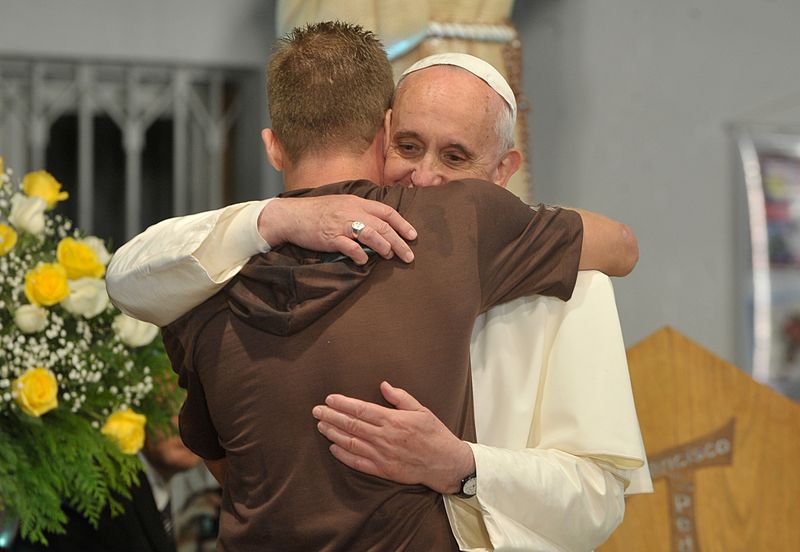
At a rehab centre in Rio de Janeiro during World Youth Day.

Then the Pope emphasises a fundamental point: It is urgent in our time to announce and witness to the goodness of the Gospel, and this from within the Church itself. It is important never to forget a fundamental principle for every evangelizer: one cannot announce Christ without the Church. Evangelization is not an isolated individual or private act; it is always ecclesial. 

Pope Francis spoke on this point again on Wednesday (16 October) during the Wednesday general audience. His talks are usually much shorter than those of his predecessors. Here is his complete talk: Dear Brothers and Sisters: In the Creed, we profess in faith that the Church is 'apostolic'. We can understand this in three ways. First, the Church is apostolic because Jesus founded her upon the Apostles whom he chose and sent forth to continue his work; thus Saint Paul compares the Church to a temple which has the Apostles as its foundation and Christ as its cornerstone (Eph 2:19-20). The Church is also apostolic because she preserves and hands down the fullness of Christ’s teaching and the means of salvation which he instituted. Finally the Church is apostolic because she accomplishes in history the mission which Christ entrusted to the Apostles: making disciples of all nations, baptizing them and teaching them his commands (cf. Mt 28:19-20). May we come to appreciate and love the Church as the place where we encounter the Risen Lord, who sends us forth as his missionaries, inviting all whom we meet to know the truth of the Gospel, the joy of faith and the promise of eternal life proclaimed by the Apostles.

Pope Francis reminds us forcefully that our faith is a gift, that God loves us and desires to be in relationship with us, that he calls each baptised person to share the gift of faith, not as one acting alone but as a member of the Church.

He also reminds us forcefully that it is in the Church that we find the fullness of what Christ taught and the full means to be saved, as God wants us to be.

Though I never spoke to Father Woods and never saw him again after his visit to our school in 1950, I see him now as one who embodied what Pope Francis said on Wednesday, one who had come to appreciate and love the Church as the place where we encounter the Risen Lord, who sends us forth as his missionaries, inviting all whom we meet to know the truth of the Gospel, the joy of faith and the promise of eternal life proclaimed by the Apostles.

When the Son of man comes, will he find faith on earth? (Luke 18:8).

The above prayer is by Blessed John XXIII


Photos from Wikipedia.