Since we are travellers and pilgrims in the world, let us ever ponder on the end of the road, that is of our life, for the end of our roadway is our home (St Columban, 8th sermon).
The link to 'Diocese of Banmaw' above gives an excellent summary of the Church in northern Burma, now known as Myanmar, and of the involvement of the Columbans there since 1936. [Thanks to UCANews.com]
The letter below was sent by Bishop Raymond Sumlut Gam of Banmaw (formerly Bhamo), a diocese created in 2006 when separated from the Diocese of Myitkyina. The two dioceses cover the Kachin State, the very mountainous and northernmost part of the country, an area a little larger than Ireland and a little smaller than Mindanao, the second largest island in the Philippines.
To put some perspective on the
situation the bishop is writing about, the population of the Kachin State,
which the Dioceses of Myitkyina and Banmaw cover, in 2012/2013 was around
1,450,000 and the Catholic population around 117,000, or 8.1 percent of the
total. As recently as 2006 the population was around 2,400,000. (Statistics
from Catholic-hierarchy.org).
The term 'IDPs' means 'Internally Displaced Persons', that is persons who are refugees in their own country.
It has been over 4 years since the
renewed armed conflict between the government troops and the Kachin
Independence Army broke out in Kachin State. To date there are more than 12000
IDPs in Kachin State and northern Shan State. No peace agreement has been reached
between government and the Kachin Independence Organization (KIO) in spite of
several rounds of peace negotiation between the two parties. The number of the
IDPs continues increasing due to sporadic fighting between the Government Army
and the Kachin Independence Army (KIA).
Recently the events of fierce
battles between the two parties took place near Sumpyi Yang and and Htingbai
Yang, Mali Yang in Putao and Sumpra Bum townships. It is reported that the
Government Army is launching offensive attack against KIA deploying thousands
of soldiers. These are provoking the displacement of several thousands of
people in the areas affected by the battles. No funding agencies or even local
organizations are allowed to go into the areas to help the IDPs.
The Church in Myanmar through
Karuna (Caritas) Myanmar has been taking care of 75% of the IDPs in Kachin
State and northern Shan State with the help of partners and funding agencies.
Now, UN Organizations and other major funding agencies are cutting off 20 % of the
support they were giving to the IDPs previously. Therefore, the church is very
much concerned for the future of the IDPs and the Bishops, Priests, Religious
and the laity met together on June 20, 2015 in Lashio and issued a Statement
(Issues and Directions) on the conflict and the IDPs.
Therefore, I would like to invite
all those people and organizations of good will to join with us in praying for
the victims of the armed conflict and in the efforts of building durable peace
in our country.
Bishop Raymond Sumlut Gam
Bishop of Banmaw
Fr Jehoon Augustine Lee, Bishop Francis Daw Tang of Myitkyina, Fr Euikyun Carlo Jung at Our Lady Queen of Heaven Church, Tanghpre
Fathers Jehoon and Euikyun are from Korea and were ordained last year. They are now based in Myanmar, Father Euikyun being the Spokesperson of a the Columban mission team there which consists of four priests, two from Ireland and two from Korea, and three lay missionaries, two form Korea and one from the Philippines.
One of a number of videos commemorating the Golden Jubilee of St Patrick's Cathedral, Banmaw, in 2012. It includes photos of the Columbans who worked in the Kachin State between 1936 and 1977.
Then Jesus returned from the region of Tyre, and went by way
of Sidon towards the Sea of Galilee, in the region of the Decapolis.They brought to him a deaf man who had an impediment in his
speech; and they begged him to lay his hand on him.He took him aside in private, away from the crowd, and put
his fingers into his ears, and he spat and touched his tongue.Then looking up to heaven, he sighed and said to him,
“Ephphatha,” that is, “Be opened.”And immediately his ears were opened, his tongue was
released, and he spoke plainly.Then Jesusordered them to tell no one; but the more he ordered them,
the more zealously they proclaimed it.They were astounded beyond measure, saying, “He has done everything
well; he even makes the deaf to hear and the mute to speak.”
In the Second Reading today St James asks in his blunt way, If a person with gold rings and in fine clothes comes into your assembly, and if a poor person in dirty clothes also comes in, and if you take notice of the one wearing the fine clothes and say, “Have a seat here, please,” while to the one who is poor you say, “Stand there,” or, “Sit at my feet,”have you not made distinctions among yourselves, and become judges with evil thoughts?
More than 30 years ago I spent three months working in a hospital in a city in the the US Midwest. I noticed that a particular nurse always wore a pro-life badge, for which I admired her. But in the three months I was there as chaplain to patients and staff on the floor we both worked on she never spoke to me except at a weekly staff meeting. I was curious rather than hurt by this and before I finished I asked her if we could meet. I told her what I had noticed and expressed my admiration for her quiet pro-life stand. She was quite taken aback, as she had never been conscious of ignoring me. It turned out that she had once had a bad experience with a priest and had 'tuned out' on all priests. We had a very good conversation and ended up hugging each other.
The nurse had been making distinctions but was far from being a judge with evil thoughts. We can be such, by deliberately shutting out another person or group of persons from our life. But very often we are unaware of others or of their needs.
Fr Joseph Coyle
(28 February 1937 - 18 December 1991)
One group of persons that is largely ignored in the Church, especially here in the Philippines, is the Deaf. Those who are profoundly deaf refer to themselves as a group as 'The Deaf', with an upper-case 'D'. One of my late Columban colleagues, Fr Joseph Coyle from the city of Derry in Northern Ireland, worked for many years in what is now the Diocese of Kabankalan, in the southern part of the province of Negros Occidental. Early in his time in remote parishes he became aware of the needs of persons who had lost limbs. He helped many to get artificial limbs.
But later he noticed that there were persons who were more or less totally isolated, even from their own families - persons who were profoundly deaf from birth or from early childhood. They did not even have a common language with their parents or siblings. Their deafness was experienced as an affliction by themselves and their families. They all felt a sense of powerlessness.
In English the word 'dumb' has come to mean 'stupid' because of the perception in the past that those who used to be described as 'deaf and dumb' were stupid.
Fr Joe Coyle then focused his ministry on the Deaf. Nearly 30 years ago he set up a residence in Bacolod City, Welcome Home, for out-of-town students so that they could attend schools with special education programmes for the Deaf. That particular need is now being met more and more in public schools in other cities and towns.
One of the services of Welcome Home Foundation, Inc. today is to send catechists to local public schools where there are profoundly deaf students. Some of these catechists are themselves profoundly deaf. Welcome Home also strongly encourages parents of profoundly deaf children to learn Sign Language and holds classes for them.
On the first Sunday of the month, during the academic year, the Deaf in Bacolod City are especially welcome at Sunday Mass in the public chapel of the University of Negros Occidental - Recoletos (UNO-R). On the second Sunday they have Mass in the public chapel attached to the Diocesan seminary. On the last Sunday they participate in one of the Masses at the Cathedral. On other Sundays they have Mass at Welcome Home. Quite often I celebrate that Mass, using my limited Sign Language and with the help of interpreters, some of them profoundly deaf.
But I know that there have been times when parishioners and priests in various places have complained that signing interpreters were a 'distraction'. In some instances the Deaf have been made clearly unwelcome at Mass. Maybe some of those who made them feel such are already in 'St James territory'.
I do not know the source of the sorrow of the old man in Van Gogh's painting, which expresses very painful isolation. But isolation is what many profoundly deaf persons feel, especially if they are seen as 'dumb' in the modern sense. And what must deaf persons feel if some don't even want to welcome them at the celebration of Holy Mass, our most important act of worship as Catholic Christians to our loving Father?
As in so many of the healing stories in the Gospel, we see Jesus giving his full attention to the person in need. We see him engaging physically with that person, using his very spittle in the act of enabling the man to hear and to speak clearly.
Again, as in so many of the healing stories, Jesus is bringing someone back into the circle. The man's deafness and speech impediment, a direct result of the former, isolated him to a large degree from his own family and community. Now he was fully part of it again.
I remember seeing the movie E.T. the Extra-Terrestial with a young friend, Glenn, who is profoundly, though not totally deaf, due to Usher's Syndrome, which also affects his sight. At the time he was about the same age as Elliott, the boy in the clip above. I watched the movie through Glenn's eyes, with a deeper appreciation of what is involved when a profoundly deaf person and a hearing person are trying to communicate. It can be very hard work, but rewarding.
More than twenty years ago I saw something very beautiful at the Home of Joy in Tayuman, Tondo, Manila, a home for children run by the Missionaries of Charity. I was looking for a particular girl who was profoundly deaf. I'll call her Maria. I found her playing with a group of other girls, all of them using Sign Language. But only Maria was deaf. Without being aware of it, she had invited her friends into her world of silence - and they, without being aware of it, had invited her into their world of sound. All were equal.
A very important detail in the gospel is that not only did the deaf man's friends bring him to Jesus but they begged him to lay his hand on him.
Many churches in the western world have what is called a 'loop system' whereby those who are hard of hearing and use hearing aids can participate fully in Mass and other services. Being hard of hearing is something that very often comes with growing old, and I am experiencing that myself now. but it is a very different reality from profound deafness, especially if that deafness has been since birth or early childhood.
Like the deer that yearns for running streams, so my soul is yearning for you, my God; my soul is thirsting for God, the living God (Cf. Psalm 41 [42]:2-3). These are the words of the Communion Antiphon from the Old Testament in today's Mass. The soul of a profoundly deaf person yearns for the living God just as much as the soul of a hearing person. But do we, the majority who are hearing, really allow the Deaf to slake that thirst by enabling them to participate fully in the Holy Mass?
In a letter dated 6 August 2015, the Feast of the Transfiguration, Pope Francis established the First of September each year as World Day of Prayer for the Care of Creation. He stated that the Catholic Church will be following what the Orthodox Church has been doing for some time.
The letter states: The ecological crisis thus summons us to a profound spiritual conversion: Christians are called to 'an ecological conversion whereby the effects of their encounter with Jesus Christ become evident in their relationship with the world around them'. For 'living our vocation to be protectors of God’s handiwork is essential to a life of virtue; it is not an optional or a secondary aspect of our Christian experience'. The quotations are from the Pope's recent encyclical Laudato Si', Nos 216 and 217 respectively.
You make springs gush forth in the valleys; they flow between the hills.
At the end of Laudato Si' , No 246, Pope Francis gives two prayers, with this introduction: At the conclusion of this lengthy reflection which has been both joyful and troubling, I propose that we offer two prayers. The first we can share with all who believe in a God who is the all-powerful Creator, while in the other we Christians ask for inspiration to take up the commitment to creation set before us by the Gospel of Jesus. Both echo the magnificent and tender Psalm 104 [103].
Laudato Si' and the Pope's letter establishing World Day of Prayer for the Care of Creation are both written in the context of our relationship with the Blessed Trinity and with Jesus Christ, God who became Man. Here is the second of those prayers.
A Christian prayer in union with creation
Father, we praise you with all your creatures. They came forth from your all-powerful hand; they are yours, filled with your presence and your tender love. Praise be to you!
Son of God, Jesus, through you all things were made. You were formed in the womb of Mary our Mother, you became part of this earth, and you gazed upon this world with human eyes. Today you are alive in every creature in your risen glory. Praise be to you!
Holy Spirit, by your light you guide this world towards the Father’s love and accompany creation as it groans in travail. You also dwell in our hearts and you inspire us to do what is good. Praise be to you!
Triune Lord, wondrous community of infinite love, teach us to contemplate you in the beauty of the universe, for all things speak of you. Awaken our praise and thankfulness for every being that you have made. Give us the grace to feel profoundly joined to everything that is.
God of love, show us our place in this world as channels of your love for all the creatures of this earth, for not one of them is forgotten in your sight. Enlighten those who possess power and money that they may avoid the sin of indifference, that they may love the common good, advance the weak, and care for this world in which we live. The poor and the earth are crying out. O Lord, seize us with your power and light, help us to protect all life, to prepare for a better future, for the coming of your Kingdom of justice, peace, love and beauty. Praise be to you! Amen.
Now when the Pharisees
and some of the scribes who had come from Jerusalem gathered around Jesus,they noticed that some
of his disciples were eating with defiled hands, that is, without washing them.(For
the Pharisees, and all the Jews, do not eat unless they thoroughly wash their
hands,thus observing the
tradition of the elders;and they do not eat
anything from the market unless they wash it;and
there are also many other traditions that they observe, the washing of cups,
pots, and bronze kettles.) So the Pharisees and the scribes asked
him, “Why do your disciples not liveaccording
to the tradition of the elders, but eat with defiled hands?”He said
to them, “Isaiah prophesied rightly about you hypocrites, as it is written,
‘This people honors me with
their lips, but their hearts are far from me; in vain do they worship me, teaching human precepts as doctrines.’
You abandon the
commandment of God and hold to human tradition.”
Then he
called the crowd again and said to them, “Listen to me, all of you, and
understand:there is nothing outside a person that by going in can
defile, but the things that come out are what defile.”
For it
is from within, from the human heart, that evil intentions come: fornication,
theft, murder,adultery, avarice, wickedness, deceit, licentiousness, envy,
slander, pride, folly.All these evil things come from within, and they defile a
person.”
Moses said to the people: 'So now, Israel, give heed to the statutes and ordinances that I am teaching you to observe, so that you may live to enter and occupy the land that the Lord, the God of your ancestors, is giving you. You must neither add anything to what I command you nor take away anything from it, but keep the commandments of the Lord your God with which I am charging you.' (First Reading).
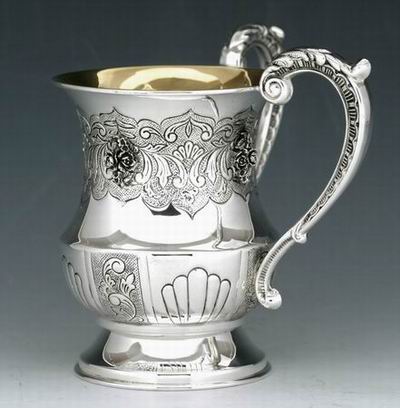
A silver cup for for netilat yadayim, the Jewish ritual washing of hands [Wikipedia]
Because of lack of time I shall use, with adaptations, some of the material I used for this Sunday three years ago.
The Indian Rupees 9,000 monthly rent mentioned in the video is the equivalent of about US$135 or Php6,000. More than three years ago I was speaking to a Filipino seminarian who had worked in Dubai for some years. He had been quite involved in his parish at home and wanted to visit a group of Catholics from Kerala, India, who lived in a labour camp in Dubai. His friends thought he was crazy but he went anyway. He simply wanted to befriend these men whose living conditions he had heard about. What he described was what I've found subsequently in videos such as the one above, which is from an Indian TV station, except that in my imagination I had pictured World War II-type wooden huts instead of big buildings not unlike apartment blocks in large cities. The men made him most welcome. The air inside was just as the reporter in the video described. His hosts were preparing a meal outside their crowded bedroom. They didn't see much need to wash their hands or their utensils and what they were preparing was somewhat more spicy than what Filipinos normally eat. But the young Filipino enjoyed being with his fellow Catholics, whom he knew were his brothers. He could see clearly their living conditions and was able to understand some of their stories. But what struck him most of all was their hospitality. The Pharisees and scribes in today's gospel ask Jesus, Why do your disciples not live according to the tradition of the elders, but eat with hands defiled?
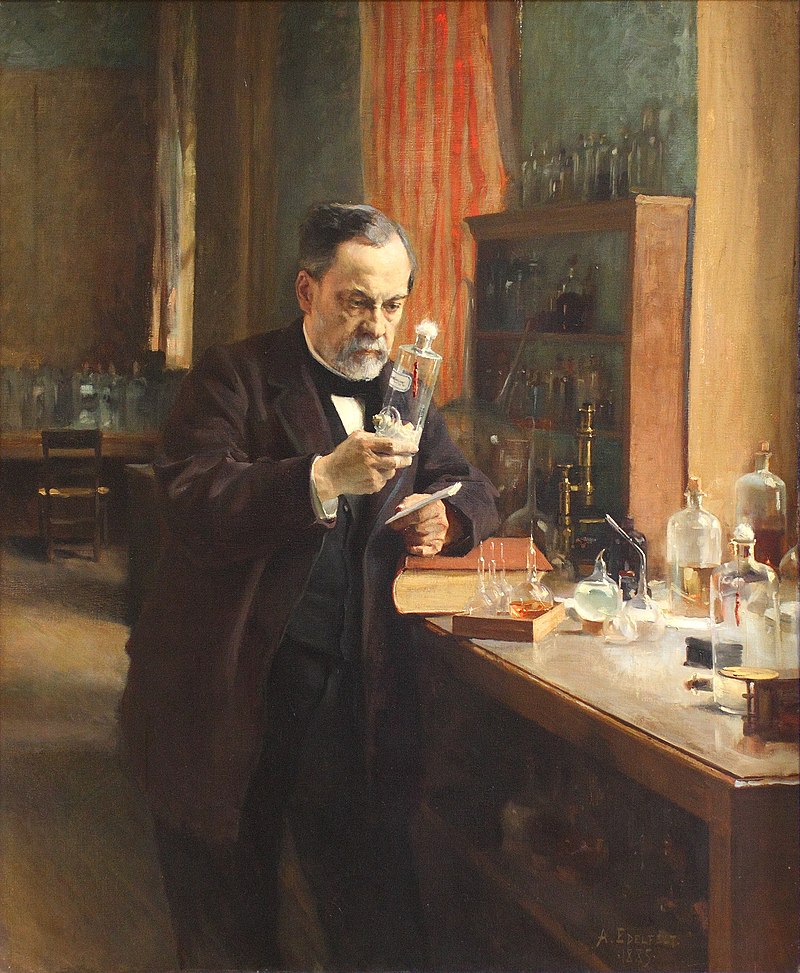
Louis Pasteur in his laboratory, Albert Ederfelt, 1885
I don't think that Jesusis telling us to be careless with food, in preparing it or eating it. Scientists such as Louis Pasteur have shown us the importance of doctors washing their hands and equipment before surgery, a connection that hadn't been seen before. But what Jesus is on about, I think, is the attitude of someone who would notice that the workers from Kerala in a 'villa' in Dubai didn't wash their hands before cooking and eating and would be critical of them - instead of asking why the washing facilities they shared with so many others were lacking. Someone who would fail to see the overcrowded living quarters and the underpaid workers, separated from their families, being exploited by their employers and by recruiting agencies in their own countries. The situation my young Filipino friend came across in Dubai can be found in many countries. The term 'OFW' is widely used here in the Philippines. It means 'Overseas Filipino Worker'. OFWs are often described by politicians as modern-day heroes. But too few politicians and others are asking why so many, probably a minority in the overall picture but yet a large number of individual real persons, are exploited by some agencies at home and by employers abroad. In reality, these are treated as anything but heroes. Nor is Jesus opposing tradition or traditions. He was a faithful Jew, as were Joseph and Mary and understood their importance. Tradition and traditions, even if we don't know their origins, are basically life-giving. The Pharisees and scribes in today's gospel - not all Pharisees and scribes were like these - have turned them into ways of sucking the lifeblood out of people. Reb Tevye in the extract from Fiddler on the Roof below says, And because of our traditions, every one of us knows who he is. The exploited workers from Kerala carried with them the tradition of hospitality they had inherited from their ancestors and welcomed a stranger from the Philippines in Dubai. Despite their appalling conditions they knew who they were. They lacked freedom in so many ways but they had the freedom to be welcoming. Hospitality is one of the most cherished experiences in the Bible, in both the Old and New Testaments. It is cherished in every culture and it is at the heart of following Jesus, who showed hospitality to others, rich and poor, and who graciously accepted it from others, rich and poor. Indeed, he was sometimes criticised for eating with the poor, as he is in today's gospel because his companions didn't wash their hands. I don't know if the workers from Kerala whom my friend met had a chance to go to Mass - he did as he lived very near a church. But the Prayer after Communion today fits in with their meeting in Dubai. Renewed by this bread from the heavenly table, we beseech you, Lord, that, being the food of charity, it may confirm our hearts and stir us to serve you in our neighbour. Through Christ our Lord.
Simon Peter answered him, “Lord, to whom can we go? You have the words of eternal life. We have come to believe and know that you are the Holy One of God.”
When many of Jesus’ disciples heard it, they said, “This teaching is
difficult; who can accept it?” But Jesus, being aware that his disciples
were complaining about it, said to them, “Does this offend you? Then what
if you were to see the Son of Man ascending to where he was before? It is
the spirit that gives life; the flesh is useless. The words that I have spoken
to you are spirit and life. But among you there are some who do not
believe.” For Jesus knew from the first who were the ones that did not believe,
and who was the one that would betray him. And he said, “For this reason I
have told you that no one can come to me unless it is granted by the Father.”
Because of this many of his disciples turned back and no longer went
about with him. So Jesus asked the twelve, “Do you also wish to go away?”Simon Peter answered him, “Lord, to whom can we go? You have the words
of eternal life. We have come to
believe and know that you are the Holy One of God.”
Pope Francis in Palo, Leyte, Philippines, 17 January 2015
[Wikipedia]
This Sunday's gospel concludes the Eucharistic Discourse of Chapter 6 of St John's Gospel. The teaching of Jesus that many of his disciples could not accept was what we heard last Sunday: "I am the living bread that came down from heaven. Whoever eats of this bread will live forever; and the bread that I will give for the life of the world is my flesh.”
The Jews then disputed among themselves, saying, “How can this man give us his flesh to eat?” So Jesus said to them, “Very truly, I tell you, unless you eat the flesh of the Son of Man and drink his blood.
St Peter today speaks on behalf of those who stay with Jesus: Lord, to whom can we go? You have the words of eternal life. We have come to believe and know that you are the Holy One of God.
In his Angelus audience last Sunday Pope Francis spoke these words which are very relevant to today's gospel. I have highlighted parts of the text.
In
these Sundays, the Liturgy proposes to us, from the Gospel of John, Jesus'
discourse on the Bread of Life, that is He Himself and that is also the
Sacrament of the Eucharist. Today's passage (Jn. 6, 51-58) presents the last
part of that discourse, and refers to some of those among the people who are
scandalized because Jesus said: "Whoever eats my flesh and drinks my blood
has eternal life, and I will raise him on the last day" (Jn. 6,54).
The
astonishment of those listening is understandable; in fact, Jesus uses the
typical style of the prophets to provoke in the people – and also in us –
questions and, in the end, to make a decision. The first of the questions is:
What does "eat Jesus' flesh and drink his blood" mean? Is it only an
image, a way of saying, a symbol, or does it indicate something real? To answer
this, one needs to guess what is happening in Jesus' heart while he breaks the
bread for the hungry crowd. Knowing that He must die on the cross for us, Jesus
identifies Himself with that broken and shared bread, and that becomes for Him
the "sign" of the Sacrifice that awaits Him. This process culminates
in the Last Supper, where the bread and wine truly become His Body and His
Blood.
It is
the Eucharist where Jesus leaves us a precise purpose: that we can become one
with Him. In fact, he says: "Whoever eats my flesh and drinks my blood
remains in me and I in him" (v.56). To remain: Jesus in us and us in Him.
Communion is assimilation: eating Him, we become Him. But this requires our "yes",
our adherence to the faith.
At
times, during the Holy Mass, it may happen to feel this objection: "What
is the purpose of the Mass? I go in Church when I feel like it, and I pray
better alone." But the Eucharist is not a private prayer or a beautiful
spiritual experience, it is not a simple commemoration of what Jesus has done
in the Last Supper: we say, to understand well, that the Eucharist is a
"memorial", that is, an act that actualizes and makes present the
event of the death and resurrection of Jesus: the bread is truly His Body given
to us; the wine is truly His Blood that has been shed.
The
Eucharist is Jesus who gives Himself entirely to us. By nourishing ourselves
from Him and remaining in Him through the Eucharistic Communion, if we do it
with faith, it transforms our life; it transforms it into a gift to God and a
gift to our brothers. To nourish ourselves from that "bread of life"
means being in tune with the heart of Christ, to assimilate His choices, His
thoughts, His behavior. It means entering into a dynamic of sacrificial love
and become a person of peace, of forgiveness, of reconciliation of sharing in
solidarity. It is the same as Jesus has done.
Jesus
concludes his discourse with these words; "Whoever eats this bread will
live forever" (Jn. 6,58). Yes, living in a concrete, real communion with
Jesus on this earth makes us pass from death to life. The heavens begin
precisely in this communion with Jesus.
In
Heaven, Mary our Mother awaits us – yesterday we celebrated this mystery. May
She obtain for us the grace of nourishing ourselves always with faith in Jesus,
the Bread of Life.
I came to know of Fr Emil Kapaun in my teenage years when I read a biography I came across in a public library in Dublin. I was inspired by his heroism as a chaplain in the US forces during the Korean War. I was delighted to discover that this heroic priest shared a birthday with me, 20 April, and 'cancelled out' another born on that date - Adolf Hitler. (St Rose of Lima, a secondary patroness of the Philippines whose feast coincides with this Sunday, is another on the 'plus' side!)
In the video below it is clear how Father Kapaun, who is being considered for beatification, lived the words of Pope Francis about the Eucharist: To nourish ourselves from that "bread of life" means being in tune with the heart of Christ, to assimilate His choices, His thoughts, His behavior. It means entering into a dynamic of sacrificial love and become a person of peace, of forgiveness, of reconciliation of sharing in solidarity. It is the same as Jesus has done.
In the video [5:38 - 5:56] we hear Fr Kapaun's own voice echoing the words of St Peter in today's gospel: We can be sure to expect that in our own lives there will come a time when we must make a choice that between being loyal to the true faith or of giving allegiance to something else which is either opposed to or not in alliance with our faith.
One cannot but be moved by the description of how Fr Kapaun saved Herbert Miller, a wounded American soldier [2:53 - 3:51]. 'He picked me up and carried me' . . . 'So he carried him for 30 miles.' It means entering into a dynamic of sacrificial love, as Pope Francis said last Sunday.
In the video below it is clear that Chaplain Kapaun utterly believed that in the celebration of the Holy Sacrifice of the Mass Jesus the Risen Lord becomes truly present among us and not just symbolically. He put thousands of miles on his jeep to bring the presence of Christ in the Eucharist to the front lines. He often celebrated Mass for them on the hood of his jeep [0:59 - 1:06].
In the prison of war camp Fr Kapaun was like a mother to all the soldiers . . . He'd help keep them clean. He'd wash their clothes. He'd lead them in prayer services. He'd celebrate Mass in secret when he could [2:27 - 2:53].
The last thing they saw him do in this life was bless the men who were taking him to his death and pray out loud, 'Father, forgive them for they know not what they do' [3:33 - 3:44].
The crucifix in the background to those words of Jesus that Fr Kapaun repeated was carved later in his memory by one of his companions in the camp - a Jew.
Surely this heroic priest lived the words of Pope Francis: It means entering into a dynamic of sacrificial love and become a person of peace, of forgiveness, of reconciliation of sharing in solidarity. It is the same as Jesus has done.
The life and death of Fr Emil Joseph Kapaun expressed fully the response of Simon Peter to Jesus, Lord, to whom can we go? You have the words of eternal life. We have come to believe and know that you are the Holy One of God.
A footnote about Fr Kapaun
Fr Kapaun has a Columban connection. He wrote to the Columbans in Omaha, Nebraska, inquiring about the possibility of becoming one. However, his vocation was to be a diocesan priest. In the chapel of the central house of the Columbans in Seoul is a plaque with the names of priests who died during the Korean War as chaplains in the US forces, some of whom used to visit our house. And some of them surely knew some of the seven Columban priests who died in the Korean War and who are being proposed for beatification by the Catholic Church in Korea.
In the two videos above Fr Kapaun's surname is pronounced in different ways: 'capAWN', 'CAPE-un', 'cape-AWN'. As far as I know, the first is correct.