Showing posts with label Adeste Fideles. Show all posts

21 December 2015

Christmas - 'Christ's Mass'. 'And the Word became flesh and lived among us.'

Adoration of the Shepherds, Caravaggio, 1609
Museo Regionale, Messina, Italy [Web Gallery of Art]

The Solemnity of the Nativity of the Lord has four different Mass formularies, each with its own prayer and readings. Any of the four fulfills our obligation to attend Mass. These are:

Vigil Mass, celebrated 'either before or after First Vespers (Evening Prayer) of the Nativity'; that means starting between 5pm and 7pm.
Mass During the Night, known before as 'Midnight Mass'. In many parts of the world it does begin at midnight but here in the Philippines since the 1980s it begins earlier, usually at 8:30pm or 9pm.
Mass at Dawn.
Mass During the Day.

When you click on 'Readings' below from the New American Bible you will find links to the readings for each of the four Masses. The readings from the Jerusalem Bible for the four Masses are all on one page.

Readings (New American Bible: Philippines, USA)

Readings (Jerusalem Bible: Australia, England & Wales, India [optional], Ireland, New Zealand, Pakistan, Scotland, South Africa)


In the beginning was the Word, and the Word was with God, and the Word was God. He was in the beginning with God. All things came into being through him, and without him not one thing came into being. What has come into being in him was life, and the life was the light of all people. The light shines in the darkness, and the darkness did not overcome it.
There was a man sent from God, whose name was John. He came as a witness to testify to the light, so that all might believe through him. He himself was not the light, but he came to testify to the light. The true light, which enlightens everyone, was coming into the world.
He was in the world, and the world came into being through him; yet the world did not know him. He came to what was his own, and his own people did not accept him. But to all who received him, who believed in his name, he gave power to become children of God, who were born, not of blood or of the will of the flesh or of the will of man, but of God.
And the Word became flesh and lived among us, and we have seen his glory, the glory as of a father’s only son, full of grace and truth. (John testified to him and cried out, ‘This was he of whom I said, “He who comes after me ranks ahead of me because he was before me.”’) From his fullness we have all received, grace upon grace. The law indeed was given through Moses; grace and truth came through Jesus Christ. No one has ever seen God. It is God the only Son, who is close to the Father’s heart, who has made him known.

Adeste fideles læti triumphantes,
O come, all ye faithful, joyful and triumphant!
Venite, venite in Bethlehem.
O come ye, O come ye to Bethlehem.
Natum videte Regem angelorum:
Come and behold him born the King of Angels:
Venite adoremus, venite adoremus, venite adoremus Dominum.
O come, let us adore Him, O come, let us adore Him, O come let us adore Him, Christ the Lord.

What Christmas is All About

From A Charlie Brown Christmas by Charles M. Schultz

And there were in the same country shepherds abiding in the field, keeping watch over their flock by night. And, lo, the angel of the Lord came upon them, and the glory of the Lord shone round about them: and they were sore afraid. And the angel said unto them, Fear not: for, behold, I bring you good tidings of great joy, which shall be to all people. For unto you is born this day in the city of David a Saviour, which is Christ the Lord. And this shall be a sign unto you; Ye shall find the babe wrapped in swaddling clothes, lying in a manger. And suddenly there was with the angel a multitude of the heavenly host praising God, and saying, Glory to God in the highest, and on earth peace, good will toward men.(Luke 2:8-14, KJV).

Adoration of the Shepherds, Murillo, 1646-50
The Hermitage, St Petersburg [Web Gallery of Art]


Oíche Chiúin / Silent Night / Stille Nacht


Christmas Concerto, Arcangelo Corelli (1653 - 1713)
Freiburg Baroque Orchestra

25 December 2012

A Midnight Mass during the Great War in 1916

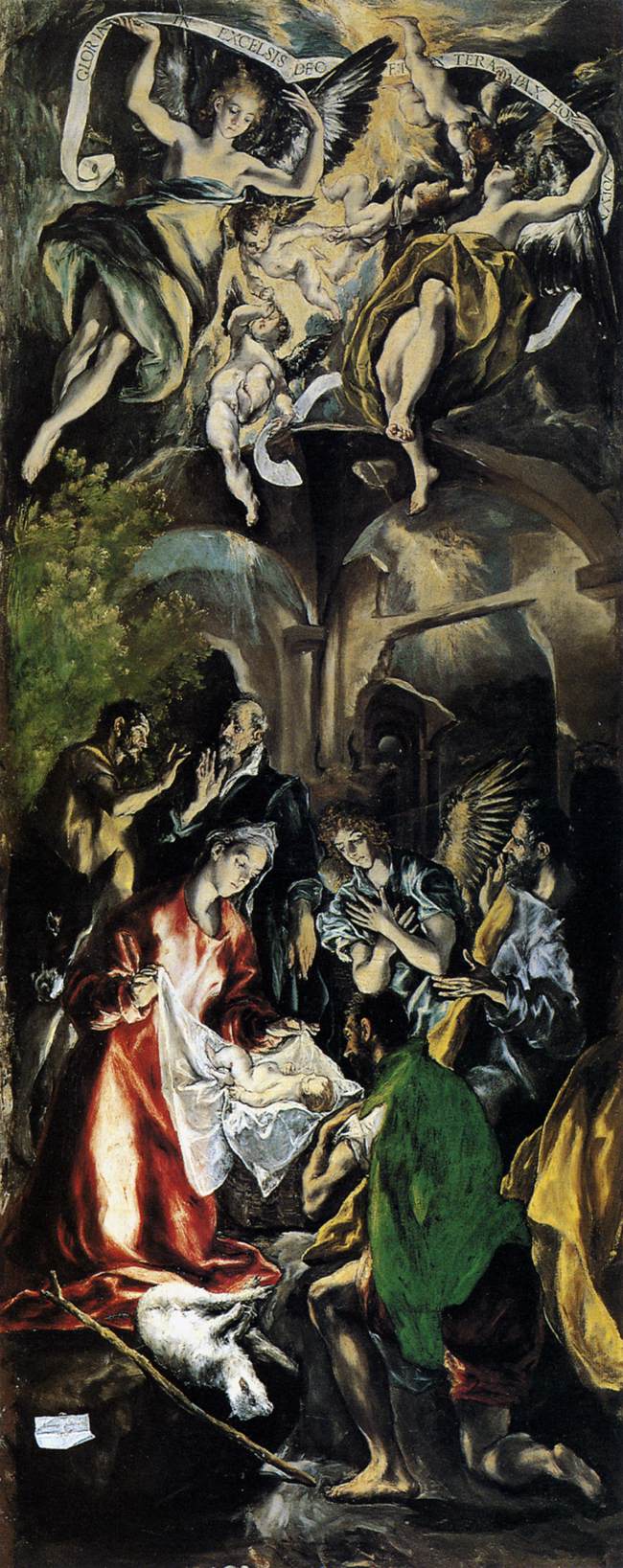
Adoration of the Shepherds, El Greco, painted 1596-1600 (Web Gallery of Art)

Fr William Doyle SJ (3 March 1873 - 16 August 1917)

Remembering Fr William Doyle SJ is an inspiring blog worth exploring. My kindergarten principal in Stanhope St, Dublin, Sr Margaret Stanislaus, was for ever talking to us about two priests, Fr Damien de Veuster SsCc, a Belgian, now St Damien of Molokai, and Fr Willie Doyle SJ, a Dubliner who died in Belgium during the Great War (1914-1918).

The posts in the blog usually feature an extract from writings of Father Doyle, very often letters he wrote from the trenches, or from Father William Doyle SJ by Professor Alfred O'Rahilly, who later became a priest.


Here are extracts from yesterday's post describing Father Willie's last Christmas on earth.

Christmas itself Fr. Doyle had the good luck of spending in billets. He got permission from General Hickie to have Midnight Mass for his men in the Convent. The chapel was a fine large one, as in pre-war times over three hundred boarders and orphans were resident in the Convent; and by opening folding-doors the refectory was added to the chapel and thus doubled the available room. An hour before Mass every inch of space was filled, even inside the altar rails and in the corridor, while numbers had to remain in the open. Word had in fact gone round about the Mass, and men from other battalions came to hear it, some having walked several miles from another village. Before the Mass there was strenuous Confession-work. “We were kept hard at work hearing confessions all the evening till nine o’clock” writes Fr. Doyle, “the sort of Confessions you would like, the real serious business, no nonsense and no trimmings. As I was leaving the village church, a big soldier stopped me to know, like our Gardiner Street friend, ‘if the Fathers would be sittin’ any more that night.’  He was soon polished off, poor chap, and then insisted on escorting me home. He was one of my old boys, and having had a couple of glasses of beer — ‘It wouldn’t scratch the back of your throat, Father, that French stuff’ — was in the mood to be complimentary . . . 

I reached the Convent a bit tired, intending to have a rest before Mass, but found a string of the boys awaiting my arrival, determined that they at least would not be left out in the cold. I was kept hard at it hearing Confessions till the stroke of twelve and seldom had a more fruitful or consoling couple of hours’ work, the love of the little Babe of Bethlehem softening hearts which all the terrors of war had failed to touch.”

Father Doyle described his experience:

“I sang the Mass, the girls’ choir doing the needful. One of the Tommies, from Dolphin’s Barn, sang the Adeste beautifully with just a touch of the sweet Dublin accent to remind us of home, sweet home, the whole congregation joining in the chorus. It was a curious contrast: the chapel packed with men and officers, almost strangely quiet and reverent (the nuns were particularly struck by this), praying and singing most devoutly, while the big tears ran down many a rough cheek: outside the cannon boomed and the machine-guns spat out a hail of lead: peace and good will — hatred and bloodshed!
“It was a Midnight Mass none of us will ever forget. A good 500 men came to Holy Communion, so that I was more than rewarded for my work.”
What comes through is Father Willie's great zeal, especially for the sacrament of confession, and his love for the men he served, with a strong flavour of a sense of humour that shows an understanding of human nature, especially in the midst of danger.
Yesterday I featured the Christmas Truce along parts of the Western Front in 1914. I found this extract from a French movie inspired by that in which a German soldier walks across No Man's Land singing Adeste Fideles. I can't remember not knowing this great Christmas hymn and have always preferred the original Latin. Father Willie was clearly touched by hearing the Adeste sung by a 'Tommy' (the generic nickname for the ordinary soldier in the British army) with just the touch of the sweet Dublin accent. (Not too many, including Dubliners themselves, of which I'm proudly one, would describe what we call the real Dublin accent as 'sweet'! Father Willie himself, being from a middle-class family, would have had a somewhat different Dublin accent). Perhaps Father Willie was unwittingly expressing his loneliness being far away from home and caught up in the horror of war.  
The subtitles in this video are Korean. That, and the fact that a Mexican singer, Rolando Villazón, now a French citizen, plays a German soldier singing a Christmas hymn in Latin, one known to soldiers on both sides of that awful war, symbolises the truth in the last line of the song Christmas in the Trenches, 'And on each end of the rifle we're the same'.
(With Father Willie's gentle sense of understanding of the Irish soldier with the couple of glasses of beer, that French stuff that wouldn't scratch the back of your throat, we can forgive the singer's mispronunciation of 'adoremus', which he pronounces 'adoramus'!)

I'm not sure if Father Willie was familiar with this traditional carol in Irish Gaelic, Don Oíche Úd i mBeithil, To That Night in Bethlehen.