Showing posts with label Albrecht Dürer. Show all posts

29 May 2026

Sunday Reflections, Trinity Sunday Year A, 31 May 2026


The Coronation of the Virgin
Velázquez [Web Gallery of Art]

For God so loved the world, that he gave his only begotten Son, that whoever believes in him should not perish but have eternal life (John 3:16, Gospel).

Readings (Jerusalem Bible: Australia, Ireland, New Zealand)

Readings (English Standard Version, Catholic Edition: England & Wales, Scotland, India)

Readings (New American Bible: Philippines, USA)

Gospel John 3:16-18 (English Standard Version, Anglicised)

Jesus said to Nicodemus:

For God so loved the world, that he gave his only begotten Son, that whoever believes in him should not perish but have eternal life. For God did not send his Son into the world to condemn the world, but in order that the world might be saved through him. Whoever believes in him is not condemned, but whoever does not believe is condemned already, because he has not believed in the name of the only begotten Son of God.

Léachtaí i nGaeilge


The Adoration of the Holy Trinity (Landauer Altar)
Albrecht Dürer [Web Gallery of Art]

Three years ago I visited a parish in Dublin for a mission appeal on behalf of the Columbans with Angie Escarsa, a Columban lay missionary from Zambales, Philippines, who has been here in Ireland since the late 1990s. I concelebrated and preached at the Saturday evening Mass.

I noticed a young man in a hospital-style wheelchair-bed up near the altar-rails with his parents. I observed how they cared for him during Mass, with devotion and tenderness. I briefly met the family afterwards and learned that the young man had been very badly injured in an accident. It was clear that he needed full-time care.

On Sunday morning another Columban, Fr Dermot Carthy, concelebrated and preached. He is a native of the parish who came home four years ago from Peru where he had worked for 62 years. I simply attended Mass and stayed at the back of the church. (This can be a good experience for a priest from time to time.) I noticed an elderly couple two pews in front of me, both of them white-haired and not very tall. The wife helped her husband a number of times to stand, doing so in a way that indicated a tender love for the man she had spent most of her life with - 61 years as I learned when I met them after Mass. I told them that they had made my day, which they had. The face of the wife lit up when I said this. 

I noticed a young family at the Mass, husband, wife and four children, three girls and a boy. The eldest was in her white First Communion dress, as she had made her First Holy Communion the day before. I saw only one other girl in her Communion dress. When I made my First Holy Communion in 1950 every child would be at Mass the following Sunday, the girls in their white dresses, the boys in their new suits with a white rosette attached to the left lapel of their jacket. I met the family briefly after Mass and told the parents that they too had made my day, which they had.

I saw in each of these couples and families a reflection of the Holy Trinity. We are made in God's image and God is a Community of Three Persons, eternally generating life and drawing us into that life. Each of the three couples I met had shared in that power of generating life through marriage. The elderly couple had grown old gracefully, no doubt with many difficulties as well as joys along the way, but clearly loving each other with the love of Jesus the Risen Lord whom they had given to each other in the Sacrament of Matrimony. Their serenity spoke to me of God's love, of the life-giving Trinity in whom I find my origin and with whom I hope to spend eternity.

The middle-aged couple were carrying a heavy load, but with great love. They had generated their son with God's own loving power of creating which He had shared with them through their marriage. Now they were sharing together in carrying the cross with Jesus whom they had given to each other as the source of their love for each other when they exchanged their marriage vows. They understand the meaning of the words for better, for worse in those vows. The extraordinary love for their adult son who cannot look after himself comes from the heart of the Blessed Trinity.

I constantly marvel at the willingness of young married couples to bring children into the world and to raise them. This speaks particularly powerfully to me when I see parents raising their children in the Faith. I am blessed to know such couples and families and am aware that it is not at all uncommon for couples to have a child - or a parent - who needs special care.

In the lives of each of us there are individuals, married couples and families, often unaware that they are gifts of God to others, who draw us into the eternal life of the Blessed Trinity.

Blessed are your eyes, for they see, and your ears, for they hear (Matthew 13:16).


For Irish Readers

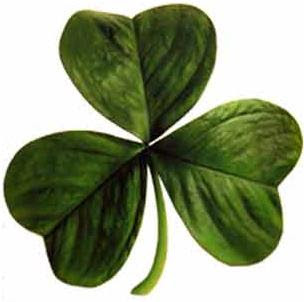
The legend is that St Patrick explained the Trinity by holding up a shamrock. There are three leaves but only one shamrock.

Preamble to the Constitution of Ireland

In the Name of the Most Holy Trinity, from Whom is all authority and to Whom, as our final end, all actions both of men and States must be referred,

We, the people of Éire,

Humbly acknowledging all our obligations to our Divine Lord, Jesus Christ, Who sustained our fathers through centuries of trial,

Gratefully remembering their heroic and unremitting struggle to regain the rightful independence of our Nation,

And seeking to promote the common good, with due observance of Prudence, Justice and Charity, so that the dignity and freedom of the individual may be assured, true social order attained, the unity of our country restored, and concord established with other nations,

Do hereby adopt, enact, and give to ourselves this Constitution.

The Preamble has no legal force but is an expression of values. In 2015 the voters of Ireland changed the Constitution so that same-sex 'marriage' could be introduced. In doing so they removed  any connection between marriage and bringing new life into the world. In 2018 the voters, the majority baptised and confirmed Catholics, amended the Constitution to allow the killing of babies in their mothers' wombs. Both decisions were implicitly a rejection of the eternally life-giving Holy Trinity. Explicitly they were a rejection of life-giving and and of life.

Benedictus sit Deus
Setting by Mozart who composed this music when he was twelve.

Antiphona ad introitum   Entrance Antiphon (Cf. Tobit 12:6)

Benedictus sit Deus Pater, Unigenitusque Dei Filius, Sanctus quoque Spiritus, quia fecit nobisum misericordiam suam.

Blest be God the Father, and the Only Begotten Son of God, and also the Holy Spirit, for he has shown us his merciful love.

Traditional Latin Mass

Trinity Sunday

The Complete Mass in Latin and English is here. (Adjust the date at the top of that page to 05-31-2026 if necessary).

Epistle: Romans 11:33-36. Gospel: Matthew 28:18-20.

Holy Trinity and the Saints in Glory
Sebastiano Conca [Web Gallery of Art]

Go therefore and make disciples of all nations, baptizing them in the name of the Father and of the Son and of the Holy Spirit (Matthew 28:19; Gospel).


04 March 2016

'So he set off and went to his father.' Sunday Reflections, 4th Sunday of Lent Year C

Museo del Prado, Madrid [Web Gallery of Art]

Readings (New American Bible: Philippines, USA)

Readings (Jerusalem Bible: Australia, England & Wales, India [optional], Ireland, New Zealand, Pakistan, Scotland, South Africa)

Now all the tax collectors and sinners were coming near to listen to Jesus. And the Pharisees and the scribes were grumbling and saying, “This fellow welcomes sinners and eats with them.”
So he told them this parable:
“There was a man who had two sons. The younger of them said to his father, ‘Father, give me the share of the property that will belong to me.’ So he divided his property between them. A few days later the younger son gathered all he had and traveled to a distant country, and there he squandered his property in dissolute living. 
Departure of the Prodigal Son, stained glass window, c.1210
Bourges Cathedral, France [Web Gallery of Art]

When he had spent everything, a severe famine took place throughout that country, and he began to be in need. So he went and hired himself out to one of the citizens of that country, who sent him to his fields to feed the pigs. He would gladly have filled himself with the pods that the pigs were eating; and no one gave him anything. 
The Prodigal Son, Albrecht Dürer, c.1496
Staatliche Kunsthalle, Karlsruhe, Germany [Web Gallery of Art]
But when he came to himself he said, ‘How many of my father’s hired hands have bread enough and to spare, but here I am dying of hunger! I will get up and go to my father, and I will say to him, “Father, I have sinned against heaven and before you; I am no longer worthy to be called your son; treat me like one of your hired hands.” So he set off and went to his father. 
But while he was still far off, his father saw him and was filled with compassion; he ran and put his arms around him and kissed him.  Then the son said to him, ‘Father, I have sinned against heaven and before you; I am no longer worthy to be called your son.’ But the father said to his slaves, ‘Quickly, bring out a robe—the best one—and put it on him; put a ring on his finger and sandals on his feet. And get the fatted calf and kill it, and let us eat and celebrate; for this son of mine was dead and is alive again; he was lost and is found!’ And they began to celebrate.
National Gallery of Art, Washington DC [Web Gallery of Art]

“Now his elder son was in the field; and when he came and approached the house, he heard music and dancing. He called one of the slaves and asked what was going on. He replied, ‘Your brother has come, and your father has killed the fatted calf, because he has got him back safe and sound.’ Then he became angry and refused to go in. His father came out and began to plead with him. But he answered his father, ‘Listen! For all these years I have been working like a slave for you, and I have never disobeyed your command; yet you have never given me even a young goat so that I might celebrate with my friends. But when this son of yours came back, who has devoured your property with prostitutes, you killed the fatted calf for him!’ Then the father said to him, ‘Son, you are always with me, and all that is mine is yours. But we had to celebrate and rejoice, because this brother of yours was dead and has come to life; he was lost and has been found.’”
The Return of the Prodigal Son, Rembrandt, c.1669
The Hermitage, St Petersburg [Web Gallery of Art]

A priest-friend, now deceased, told me a story about three priests whom he knew in his own country. I'll call them Father Andy, Father Bert and Father Chris. Father Chris, younger than the other two who were quite well on in years, no longer used the title 'Father' as he had left the priesthood.

Father Andy was in hospital and knew he was nearing death. Father Bert went to visit him. The dying man asked his friend for his blessing. But he got a response that he had never expected. 'When you forgive Chris, then I will bless you'. Father Bert knew that his dying friend had been deeply hurt when Father Chris had left the priesthood. He also knew that he still carried resentment in his heart towards the younger man.

The tears welled up in Father Andy's eyes and he asked his friend to invite Chris to visit him. He let go of his hurt and resentment, was fully reconciled with Chris - and received from Father Bert the blessing he had asked for, a blessing far greater than he ever could have imagined.

Part of the genius of this parable of Jesus is that it doesn't have an ending, but an invitation. We don't know whether or not the older, dutiful son joined the celebration. He can  only see at this moment the wasted life of his younger brother and the immense suffering this had brought to their father, suffering that Rembrandt captures so movingly. 


The father doesn't argue with his older son. He is well aware of that son's sense of responsibility. The father also hears his angry and dismissive 'this son of yours'. He gently points out, Son, you are always with me, and all that is mine is yours. It was fitting to make merry and be glad, for this your brother was dead, and is alive; he was lost, and is found.

The invitation in the parable is not only to the older son. It is to me. Is the Father inviting me to let go of sins that have separated me from him, a separation that he doesn't want, by asking his pardon, especially in the sacrament of confession? Or is the Father inviting me to let go of my self-righteousness, my lack of humility, my lack of gratitude for daily blessings, even though I am conscientious in doing what is right?

The Father has reserved a place for each of us at the celebration.


Pope Francis: 'When was the last time you went to confession?'


14 April 2014

The Stations of the Cross with the Masters; Reflections by Fr William Doyle SJ


Tintoretto, 1566-67, Scuola Grande di San Rocco, Venice


Around the judgement seat are grouped a motley crowd. Men and women of every rank, the high-born Jewish maiden, the rough Samaritan woman; haughty Scribes and proud Pharisees mingle with the common loafer of the great city. Hatred has united them all for one common object; hatred of One Who ever loves them and to their wild fury has only opposed acts of gentle kindness. A mighty scream goes up, a scream of fierce rage and angry fury, such a sound as only could be drawn from the very depths of hell. “Death to Him! Death to the false prophet!” He has spent His life among you doing good – Let Him die! He has healed your sick, given strength to the palsied, sight to your blind – Let Him die! He has raised your dead – Let death be His fate!


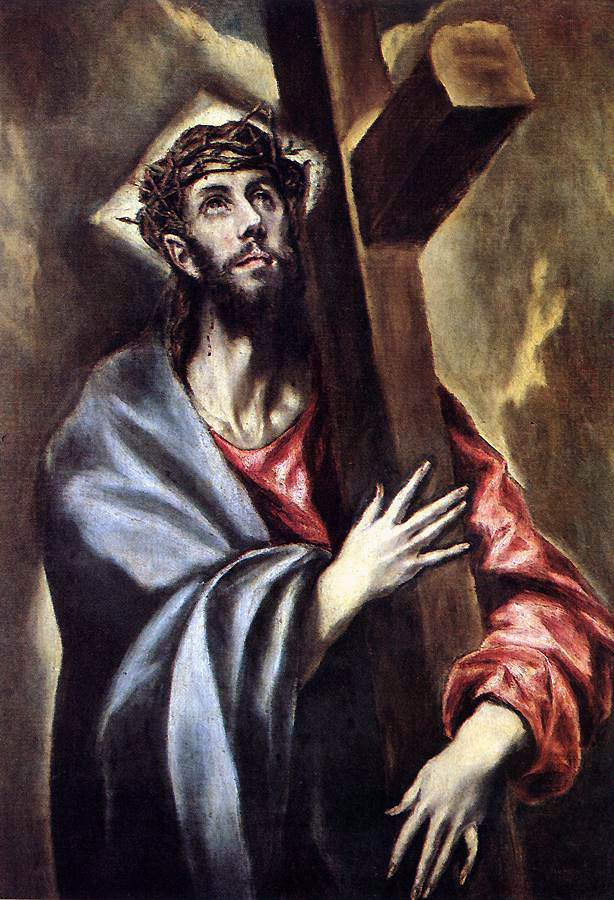
El Greco, 1600-05, Museo del Prado, Madrid


Away from the palace now a sad procession is winding. On the faces of the multitude a fiendish joy is written, they have had their wish and now issue forth to glut their eyes on the dying struggles of the suffering innocent One. Painfully He is toiling up the long narrow street, narrower still from the crowds that line the way; each step is agony, each yard of ground He covers a fresh martyrdom of ever increasing suffering. With a refinement of cruelty His enemies have placed upon His shoulders the heavy, rough beams which will be His last painful resting place.

Cruelly the heavy beam weighs upon His mangled flesh and cuts and chafes a long, raw sore deep to the very bone.


Raphael, 1517, Museo del Prado, Madrid


Bravely has our Lord borne the galling weight of His cross; bravely has He struggled on, tottering and stumbling, longing for a moment’s rest, yearning for a respite however short. But rest He will not, that He may teach us how unfalteringly we must press on to our goal. But nature will have its way. His sight grows dim; His strength fails and with a crash our Saviour lies extended on the ground. Oh! if you have not hearts of stone let Him lie even thus, poor, crushed and broken thing. If you have but one spark of compassion left, one tender feeling of sympathy urge Him not on awhile, so spent, so weary. On a poor maimed brute you have pity – think of the sorrow of Him extended there.

Fourth Station: Jesus meets his Blessed Mother

The Seven Sorrows of the Virgin: Mother of Sorrows
Albrecht Dürer, c.1496, Alte Pinakothek, Munich


To sensitive souls the pain they cause others is far worse than any sufferings they may endure themselves. They may have much to endure, but to see others in pain causes them deeper grief. Jesus and Mary meet. Alone He could have suffered with joy so that she, His dearest Mother, might have been spared the agony of seeing all He must endure. With one look of pity Jesus reads the anguish of that cruelly lacerated heart; with one long gaze of infinite love and pity Mary sees the depth of her Son’s woe, His long hours of torture, His utter weariness, His sorrow, His grief, His anguish. May she not help Him? At least lift for one moment that cross?

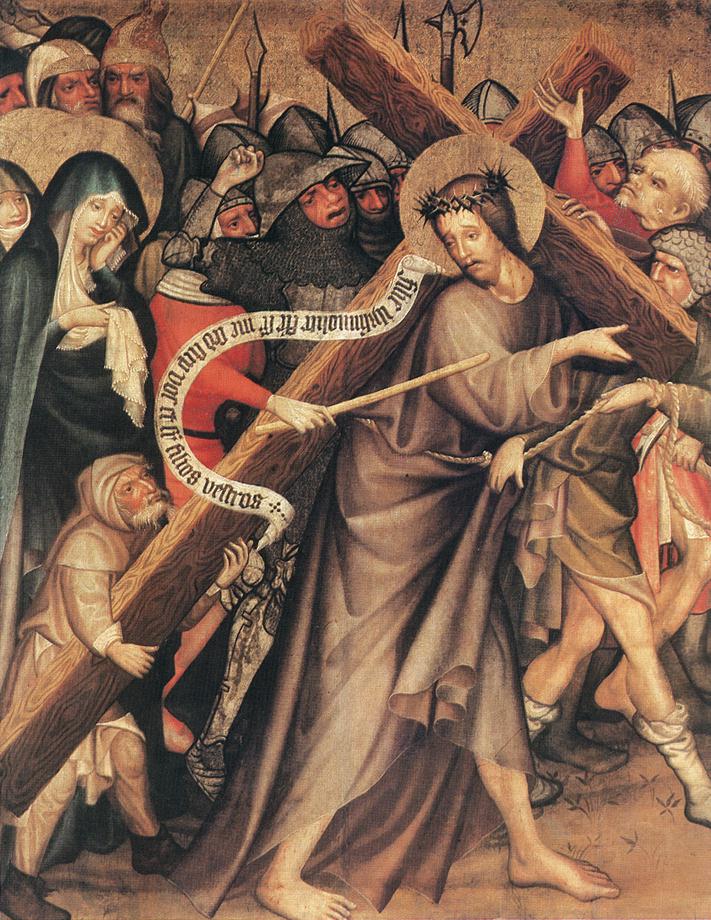
Master Thomas de Coloswar, 1427, Christian Museum, Esztergom

When God lays a cross upon us, some misfortune, some unexpected burden, instead of thanking Him for this precious gift, too often we rebel against His will. We forget that our Saviour never sends a cross alone, but ever sweetens its bitterness, lightens its weight by His all-powerful grace. With reluctance, with unwillingness, Simon bears the cross of His Master. At first his spirit revolted against this injustice, his pride rebelled against this ignominy. But once he accepted with resignation, his soul was filled with heavenly sweetness, he felt not the weight of the heavy beams, he heeded not the jibes of the multitude but pressed on after His Master, proud to be His follower.


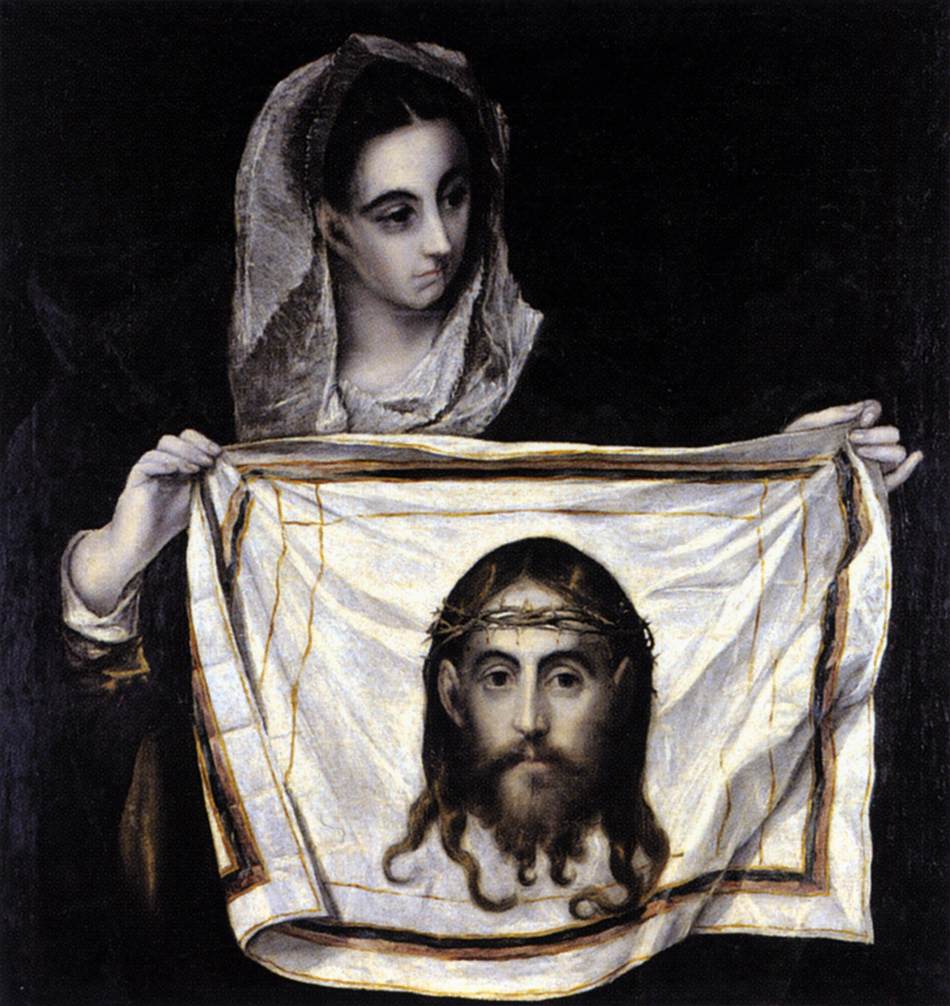
El Greco, c.1580, Museo de Santa Cruz, Toledo

As the sorrowful procession moves slowly on, a woman, who with anxious gaze has watched its approach, steps forward and wipes the sacred face of Jesus. It is a simple action, yet reveals the kindly thoughtfulness of a charitable heart. Gladly would Veronica have done all in her power to lessen the sufferings of the Lord, to ease the dreadful burden which was crushing Him, to show some mark of sympathy and compassion. That little act of love touched the broken Heart of Jesus; He wipes the clotted blood and streaming sweat from His Face, leaving His sacred image stamped on the veil of Veronica; but deeper and more clear cut did He impress on her heart the memory of His passion.


Rubens, 1634-37, Musées Royaux des Beaux-Arts, Brussels

Jesus falls a second time, crushed beneath the weight of His awful sufferings which are fast draining His strength. Exhausted and spent He lies upon the rough-paved ground, a cruel resting place for His bleeding, lacerated body. Vainly He tries to rise, for love impels Him on to the consummation of the sacrifice, but His tottering limbs will not support Him and once again He falls upon the ground. Again the soldiers with fiendish brutality drag Him to His feet with coarse jibes and mocking laughter, with kicks and blows they drive Him on, pulling Him now forward, now back, striving if possible to add to the sufferings of the patient victim.


Jacopo Bassano, 1550-55, Szépmûvészeti Múzeum, Budapest

The disciples of Jesus have deserted their Master, and fearful for their own safety, have abandoned Him to His fate. Peter who would die for Him, Matthew who left all to follow Him, are far from Him now and dread to be pointed to as His friends. Yet Jesus is not alone. A few, a faithful few, remain beside Him still, poor, weak women, but strong with the courage of love. The brutal crowd surge round, inflamed with hate and lust for blood; but they offer Him the tribute of a woman's heart the silent tears of sympathy.

“Weep not for Me,” He says, “weep rather for those who unlike these My executioners will one day crucify Me again with full knowledge of what they do.”


Ninth Station: Jesus falls the third time

Christ Carrying the Cross
Hieronymus Bosch, Palacio Real, Madrid


The hill of Calvary is almost reached, the hour of the great sacrifice is at hand. Still the heart of Jesus thirsts for suffering to show His great, His all devouring love for us. Again He falls! With limbs all bruised and broken, with a body all one raw, red, quivering sore, each step He took was agony. But to fall thus helpless on the ragged ground, to be kicked and beaten as He lay with nerveless limbs all paralyzed with pain must have been to His high-strung, delicate frame a thousand-fold martyrdom. The executioners were alarmed. Was death going to rob them of their victim and cheat them of the joy they promised themselves as their victim writhed in the agonies of death?

Tenth Station: Jesus is stripped of his garments

The Disrobing of Christ (El Espolio)
El Greco, 1577-79, Sacristy of the Cathedral, Toledo


At last He stands upon the hill of shame to pay the price of our redemption. In the eyes of His Eternal Father, a sinner laden with the crimes of a wicked world; before men, the most abject and abandoned of creatures. A brutal soldier advances. He lays his hand upon the garment of Jesus and roughly tears it from His sacred shoulders. The cloth has sunk deeply into the gaping wounds left by the recent scourging, and driven deeper still by the weight of the cross and the oft-repeated blows. With a horrid, rending sound the wounds are torn open afresh, the sacred blood gushes forth anew and bathes His limbs in its ruddy stream. It is a moment of awful agony.

Eleventh Station: Jesus is nailed to the Cross

Christ in Agony on the Cross
El Greco, 1600s, Art Museum, Cincinnati


Upon His last resting place Jesus lays Himself down. No soft bed, no easy couch to ease the agony of His aching limbs, but a hard, rough beam must be His place of death. Meekly He extends His arms, those arms ever open to welcome back the repentant sinner, and offers His hands to be pierced as the Prophet had foretold. A long, blunt nail is placed upon the palm: a heavy, dull thud, the crunch of parting flesh and rending muscle, the spouting crimson blood which covers the face and hands of the hardened soldier and Jesus is fastened to the cross. Come, sinner, gaze upon your work for you have nailed Him there! Your sins it was which flung your Saviour down, your sins which drove the iron deep into His sacred flesh.

Twelfth Station: Jesus dies on the Cross

Christ on the Cross, with the two Marys and St John
El Greco, c.1588, National Gallery, Athens


Upon the cross He hangs now, the most abject and despised of all men, the butt for vile jests, a common mark for all to hurl their jibes at. There He hangs, in agony no human lips can tell, no mind conceive, an impostor, a vile hypocrite, a failure. “He came to make Himself a King! See, we have crowned His brow with a royal, sparkling diadem. He sought a kingdom! From that elevated throne let Him look upon the land which will never be His now. He threatened our Scribes with woes and punishments, let Him look to His own fate and if He has that power which some say was His, let Him come down now from the cross and we too shall believe in His word.”

Thirteenth Station: Jesus is laid in the arms of His Mother

Pietà (The Lamentation of Christ)
El Greco, 1571-76, Philadelphia Museum of Art, Philadelphia


Mary stands at the foot of the cross to receive in her arms the lifeless body of her Son. Once more His head is resting on her bosom as it used to do long years ago when a little child He nestled to His Mother#s breast. But now that sacred head is bruised and swollen, stamped with the cruel mark of the mocking diadem; His hair all clotted with the oozing blood, tangled and in disorder. Even she, upon whose heart is stamped every lineament of her Son’s dear face, can scarcely recognise His features now. On every line is marked the anguish of long drawn agony, of torture and agonizing pain, of woe, unutterable woe, of sorrow, suffering and abandonment.

Fourteenth Station: Jesus is laid in the tomb

The Entombment of Christ
El Greco, 1560s, Alexandros Soutzos Museum, Athens


The final scene of the awful tragedy is drawing to a close. Reverently the faithful few bear the dead Christ down the hill of shame, that body from which all the care of loving hands cannot remove the marks of the cruel scourge, the rending nails, the lance’s gaping thrust. Into the tomb they bear Him, the burial place of a stranger, best suited to Him Who during His life had not where to lay His head. Reverently they lay Him down; one last, fond embrace of His own Mother before they lead her hence, and then in silence and in sorrow they leave Him, their dearest Master, to the watchful care of God’s own angels. Sin has done its work! Sin has triumphed, but its very triumph will prove its own undoing.
+++
All paintings from Web Gallery of Art

Reflections by Fr William Doyle SJ from Remembering Fr William Doyle SJ


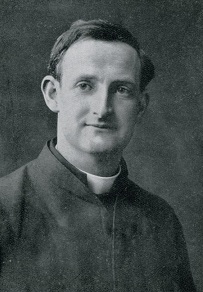
Fr William Doyle SJ was finally appointed during World War I chaplain of the 16th Irish Division, serving with 8th Royal Irish Fusiliers, Royal Inniskilling Fusiliers, 9th Royal Dublin Fusiliers, 6th Royal Irish Rifles and the 7th Royal Irish Rifles. Having fulfilled his priestly duties in an outstanding fashion for almost two years, he was killed in the Battle of Ypres on August 16, 1917, having run “all day hither and thither over the battlefield like an angel of mercy.” This good shepherd truly gave his life for his sheep.
Fr Doyle’s body was never recovered.
Fr William Doyle SJ (3 March 1873 - 16 August 1917)
Many thanks to Pat Kenny, blogmaster of Remembering Fr William Doyle SJ.

23 May 2013

'When the Spirit of truth comes, he will guide you into all the truth.' Sunday Reflections, Trinity Sunday


Readings (New American Bible: Philippines, USA)

Readings (Jerusalem Bible: Australia, England & Wales, India [optional], Ireland, New Zealand, Pakistan, Scotland, South Africa)

Gospel John 16:12-15 (Revised Standard Version – Catholic Edition)

Jesus said to his disciples: "I have yet many things to say to you, but you cannot bear them now. When the Spirit of truth comes, he will guide you into all the truth; for he will not speak on his own authority, but whatever he hears he will speak, and he will declare to you the things that are to come. He will glorify me, for he will take what is mine and declare it to you. All that the Father has is mine; therefore I said that he will take what is mine and declare it to you.


Albrecht Dürer, 1511 [Web Gallery of Art]

The two paintings above, like many others, depict the Holy Trinity with the crucified, dead Christ. The Catechism of the Catholic Church quotes St Caesarius of ArlesThe faith of all Christians rests on the Trinity.

Though it is a mystery that we can never fully understand, the Trinity shows God's total involvement in our lives. Without the Creator we wouldn't be. Without God becoming Man in the Jesus Christ, the Second Person of the Trinity, we would not have the possibility of eternal life. Without the coming of the Holy Spirit at Pentecost we would never understand who we are, the beloved sons and daughters of God the Father, the beloved brothers and sisters of Jesus and therefore of one another.

And none of this would be possible if Jesus had not lived among us and died for us. The paintings show us the price that God was willing to pay that we would know him and return his love.

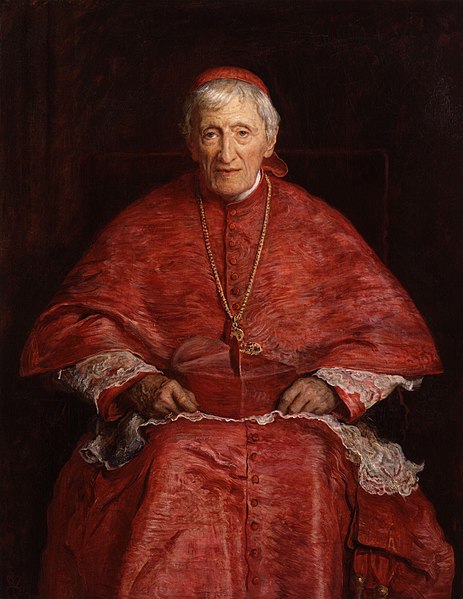
Blessed John Henry Cardinal Newman expresses the central mysteries of our faith in Firmly I believe and truly, taken from his extended poem The Dream of Gerontius. Sir Edward Elgar later set this to music, though the setting below is by Ralph Vaughan Williams.

We Christians begin almost every prayer, liturgical or otherwise, with the words In the name of the Father and of the Son and of the Holy Spirit or with Glory to the Father . . . The Catechism tells us: Christians are baptized in the name of the Father and of the Son and of the Holy Spirit: not in their names, for there is only one God, the almighty Father, his only Son and the Holy Spirit: the Most Holy Trinity.

Like the painters Carracci and Dürer, Newman draws us to the Incarnation, the reality of God becoming Man, and the Paschal Mystery, the death and resurrection of Jesus:


And I next acknowledge duly
Manhood taken by the Son.

And I trust and hope most fully
In that Manhood crucified
.


The Second Person of the Trinity becoming one of us, living among us, dying for us in a most humiliating way, and being raised from the dead is the source of our hope. It is by following Jesus wholeheartedly that we too are bearers of this hope to others. As Pope Francis said in his homily last WednesdayJesus was 'promoted' to the Cross. He was 'promoted' to humiliation. That is true promotion, that which makes us seem more like Jesus.


In the fourth stanza, not sung here, Newman brings us to the central fact that the Holy Spirit, who will guide you into all the truth, does so above all through the Church:


And I hold in veneration,
For the love of Him alone,
Holy Church as His creation,
And her teachings are His own.


Last Sunday, Pentecost, Pope Francis in ending his homily referred to 'the harmony of the Church'. As Christians we cannot go it alone. God, the Holy Trinity, is a Community, the Perfect Community, Three Persons but One God. We are made in God's image, which means we are made to be part of a community. Here are the closing words of the Pope's homily:


Today’s liturgy is a great prayer which the Church, in union with Jesus, raises up to the Father, asking him to renew the outpouring of the Holy Spirit. May each of us, and every group and movement, in the harmony of the Church, cry out to the Father and implore this gift. Today too, as at her origins, the Church, in union with Mary, cries out: 'Veni, Sancte Spiritus! Come Holy Spirit, fill the hearts of your faithful, and kindle in them the fire of your love!' Amen.


Words: Blessed John Henry Newman, from  The Dream of Gerontius
Music: Shipston, traditional English melody arranged by Ralph Vaughan Williams

Firmly I believe and truly
God is Three, and God is One;
And I next acknowledge duly
Manhood taken by the Son.

And I trust and hope most fully
In that Manhood crucified;
And each thought and deed unruly
Do to death, as He has died.

Simply to His grace and wholly
Light and life and strength belong,
And I love supremely, solely,
Him the holy, Him the strong.

[And I hold in veneration,
For the love of Him alone,
Holy Church as His creation,
And her teachings are His own.

And I take with joy whatever
Now besets me, pain or fear,
And with a strong will I sever
All the ties which bind me here.]

Adoration aye be given,
With and through the angelic host,
To the God of earth and Heaven,
Father, Son and Holy Ghost.


Blessed John Henry Cardinal Newman, John Everett Millais, 1891