Since we are travellers and pilgrims in the world, let us ever ponder on the end of the road, that is of our life, for the end of our roadway is our home (St Columban, 8th sermon).
Showing posts with label Andrea del Sarto. Show all posts
Showing posts with label Andrea del Sarto. Show all posts
This Mass is celebrated in places where the Ascension is observed on Ascension
Thursday: England & Wales, Scotland and in these ecclesiastical provinces
in the USA: Boston, Hartford, New York, Newark, Omaha, Philadelphia.
You will find Sunday Reflections for The Ascension here.
Readings, (Jerusalem Bible:
Australia, England & Wales, India [optional], Ireland, New Zealand,
Pakistan, Scotland, South Africa)
Gospel, John 17:20-26 (English Standard Version
Anglicised: India)
Jesus lifted up his eyes to
heaven and said:
“I do not ask for these only, but also for
those who will believe in me through their word,that they may all be one, just as you, Father, are in
me, and I in you, that they also may be in us, so that the
world may believe that you have sent me.The glory that you have given me I
have given to them, that they may be one even as we are one,I in them and you in me, that they may
become perfectly one, so that the world may know that you sent me
and loved them even as you loved me.Father, I desire that they also, whom you
have given me, may be with me where I am, to see my glory that
you have given me because you loved me before the foundation of the world.O righteous Father, even though the
world does not know you, I know you, and these know that you have sent me.I made known to them your name, and I will
continue to make it known, that the love with which you have loved me may
be in them, and I in them.”
But Stephen, full of the Holy Spirit, gazed into heaven and saw the glory of God, and Jesus standing at the right hand of God (Acts 7:55; First Reading).
Father, I desire that they also, whom you have given me, may be with me where I am, to see my glory that you have given me because you loved me before the foundation of the world (John 17:24; Gospel).
Since we are travellers and
pilgrims in the world, let us ever ponder on the end of the road, that is of
our life, for the end of our roadway is our home (St Columban, 8th sermon).
Come down, O love divine
Translated
from the Italian of Bianco da Siena by Richard Frederick Littledale; music
by Ralph Vaughan Williams
A hymn
to the Holy Spirit sung between the Ascension and Pentecost.
Traditional Latin Mass
Sunday After the Ascension
The Complete Mass in Latin and English is here. (Adjust the date at the top of that page to 05-29-2022 if necessary).
Epistle: 1 Peter 4:7-11 . Gospel: John 15:26 - 16:1-4.
Readings(Jerusalem Bible: Australia,
England & Wales, India [optional], Ireland, New Zealand, Pakistan,
Scotland, South Africa)
GospelJohn 15:9-17 (New Revised Standard
Version, Anglicised Catholic Edition)
Jesus
said to his disciples:
‘As the
Father has loved me, so I have loved you; abide in my love. If you keep my commandments, you will abide in my love,
just as I have kept my Father’s commandments and abide in his love. I have said these things to you so that my joy may be in
you, and that your joy may be complete.
‘This
is my commandment, that you love one another as I have loved you. No one has greater love than this, to lay down one’s life
for one’s friends. You are my friends if you do what I command you. I do not call you servants any longer, because the
servant does not know what the master is doing; but I have called you
friends, because I have made known to you everything that I have heard from my
Father. You did not choose me but I chose you. And I appointed you
to go and bear fruit, fruit that will last, so that the Father will give you
whatever you ask him in my name. I am giving you these
commands so that you may love one another.’
If ye love me, keep my commandments, and I will pray the Father, and he shall give you another comforter, that he may 'bide with you forever, e'en the spirit of truth. (John 14:15-17)
This is a setting by Thomas Tallis (c.1505 - 1585) of today's Communion Antiphon, with the first part of John 14:17 added.
Communion Antiphon Antiphona ad communionem (Jn 14:15-16)
If you love me, keep my commandments, says the Lord,
Si diligitis me, mandata mea servate, dicit Dominus.
and I will ask the Father and he will send you another Paraclete,
Et ego rogabo Patrem, et alium Paraclitum dabit vobis,
In May 2015 I gave a retreat to the Missionary Sisters of the Catechism in Lipa City, south of Manila. The Sisters have a house dedicated to Our Lady of Guadalupe where they take care of elderly and sick women whom they refer to as the lolas, the 'grandmas'. In another part of the compound they had at the time a group of orphans, five young boys and six young girls. (If my memory is correct the Sisters were planning to build an orphanage). Four of the boys served Mass every morning, including 'Zacchaeus', as the Sisters called him, the youngest of the boys and small, proudly wearing his white cassock like the others. 'Zacchaeus' wasn't yet old enough to make his First Holy Communion or First Confession. His role as a server was to hold up the small white towel - and he really has to stretch to do so - when the priest washes his hands during the Offertory.
The youngest of the girls was Chiara, aged four or five at the time. The children were present at lunch on the last day of the retreat, which had a celebratory air to it. I noticed after I had said Grace Before Meals that Chiara was somewhat tearful. Then I discovered that on such occasions she led the community in a Hail Mary as part of Grace. so the Sisters encouraged her to do so today even though the visiting priest had pre-empted her. After a little hesitation and the drying of her tears she prayerfully led us all in the Hail Mary and then invoked the protectors of the Congregation - Mother of Good Counsel, St Joseph, St Veronica Giuliani, St Gemma Galgani and St Bernadette Soubirous.
During the retreat I told a number of stories of seemingly insignificant events where God had revealed himself to me through the actions of children and of older persons without their being aware of it. Then on the way back to Manila after the retreat Sister Evelyn Cortes SMC, whose family I have I have known since she was in high school in Tangub City, Misamis Occidental, and Sister Eppie Resano SMC told me a story about Chiara where she showed an understanding of what this Sunday's Second Reading is all about, without being aware of it.
Beloved, let us love one another, because love is from God; everyone who loves is born of God and knows God. Whoever does not love does not know God, for God is love. God’s love was revealed among us in this way: God sent his only Son into the world so that we might live through him. In this is love, not that we loved God but that he loved us and sent his Son to be the atoning sacrifice for our sins (1 John 4:7-10).
Some time before I gave the retreat a missionary priest visited the Sisters and celebrated Mass for them. Little Chiara saw him as being very severe in his demeanour. After Mass she tugged on his cassock and asked him, Father, are you angry with God? It seems that the following morning he wasn't quite as severe looking!
Some may be angry with God. I don't think that God is too perturbed about that when he knows that the source of our anger may be bewilderment over tragedies in our lives, for example, just as we allow those whom we love to vent their anger on us because basically they trust us and we have some idea of the source of their anger.
Perhaps a more common experience, especially among persons who are serious about following Jesus faithfully but who try to live as if God's love had to be earned - as if it could be earned - is the idea that God is angry with us.
St John tells us so beautifully what the situation really is: In this is love, not that we loved God but that he loved us and sent his Son to be the atoning sacrifice for our sins.
Most of the Gospel readings on the Sundays and weekdays of Easter are taken from John 13-17, the Last Supper Discourse in which Jesus speaks to each of us with intense love about the intimacy into which he calls each of us through our baptism. In today's Gospel Jesus says to each of us, speaking from his heart to ours - Cor ad cor loquiter, 'Heart speaks to heart', as Blessed John Henry Cardinal Newman emphasised on his coat-of-arms - As the Father has loved me, so I have loved you; abide in my love . . . this is my commandment, that you love one another as I have loved you . . . you are my friends . . . you did not choose me but I chose you . . .
The initiative comes from God. Love comes from God and our loving response to that love is itself a gift from God. We do not and cannot earn God's love. God who is love gives us himself as pure gift.
How can such a God be angry with us and how can we be angry - choosing to remain angry as distinct from a spontaneous feeling - with such a God? In this is love, not that we loved God but that he loved us and sent his Son to be the atoning sacrifice for our sins (1 John 4:10).
For the LORD takes delight in his people; he crowns the poor with salvation (Psalm 149:4, Grail translation).
You may read an article by Eileen Kane on this painting in the May 2018 issue of The Sacred Heart Messengerhere.
O Mary we
crown thee with blossoms today!
Queen of the Angels and Queen of the May.
Bring Flowers of the Rarest (Queen
of the May) Composed by Mary E. Walsh.
Bring flowers of the
rarest bring blossoms the fairest, from garden and woodland and hillside and dale; our full hearts are swelling, our glad voices telling the praise of the loveliest flower of the vale!
Refrain: O Mary we crown thee with blossoms today! Queen of the Angels and Queen of the May. O Mary we crown thee with blossoms today, Queen of the Angels and Queen of the May.
Their lady they name thee, Their mistress proclaim thee, Oh, grant that thy children on earth be as true as long as the bowers are radiant with flowers, as long as the azure shall keep its bright hue
Refrain
Sing gaily in chorus; the bright angels o'er us re-echo the strains we begin upon earth; their harps are repeating the notes of our greeting, for Mary herself is the cause of our mirth.
Readings (Jerusalem Bible: Australia, England & Wales, India [optional], Ireland, New Zealand, Pakistan, Scotland, South Africa)
Gospel Mark 10:17-30 (New Revised Standard Version – Catholic Edition, Canada)
As Jesus was setting out on a journey, a
man ran up and knelt before him, and asked him, “Good Teacher, what must I do
to inherit eternal life?”Jesus said to him, “Why
do you call me good? No one is good but God alone.You know the commandments: ‘You shall not
murder; You shall not commit adultery; You shall not steal; You shall not bear
false witness; You shall not defraud; Honor your father and mother.’”He said to him, “Teacher, I have kept all these since my
youth.”Jesus, looking at him, loved him and said, “You lack one
thing; go, sell what you own, and give the moneyto the
poor, and you will have treasure in heaven; then come, follow me.”When he heard this, he was shocked and
went away grieving, for he had many possessions.
Then Jesus looked around and said to his disciples, “How
hard it will be for those who have wealth to enter the kingdom of God!”And the disciples were perplexed at these words. But Jesus
said to them again, “Children, how hard it isto
enter the kingdom of God!It is easier for a camel to go through
the eye of a needle than for someone who is rich to enter the kingdom of God.” They were greatly
astounded and said to one another,“Then who can be saved?”Jesus
looked at them and said, “For mortals it is impossible, but not for God; for
God all things are possible.”
Peter began to say to him, “Look, we have left everything
and followed you.”Jesus said, “Truly I tell you, there is
no one who has left house or brothers or sisters or mother or father or
children or fields, for my sake and for the sake of the good news,who will not receive a hundredfold now in
this age—houses, brothers and sisters, mothers and children, and fields, with
persecutions—and in the age to come eternal life."
+++
This incident is also recounted in the gospels of St Matthew and St Luke. It is Matthew who tells us that the man who approached Jesus was young. Luke describes him as a ruler or aristocrat, depending on the translation. But it is only Mark who writes, Jesus, looking at him, loved him . . .
During my second summer vacation after entering the seminary, the summer of 1963,the biggest story in Britain and Ireland was that of a senior member of the Conservative Party and of the British government, John Profumo.He had served with distinction in the British army in World War II, reaching the rank of Brigadier (General). He was independently wealthy. He became involved with a prostitute, Christine Keeler, who also had relations with the senior Soviet naval attaché in London. Profumo denied in parliament that he had an improper relationship with Keeler. This was later shown to be untrue. He was later forced to resign for having lied to parliament. Before resigning from all his positions he confessed to his wife, Valerie Hobson, and she stood by him.
John Profumo disappeared from public life and spent many years as a volunteer cleaning toilets in a place called Toynbee Hall, a charity in the East End of London. I do not know anything about the faith of John Profumo, whose paternal ancestors were Italian aristocrats. He had the inherited title 'Fifth Baron Profumo', though he didn't use it. But Lord Longford (1905 - 2001), a Labour politician and social reform campaigner whose Catholic faith - he was a convert from Anglicanism - was the bedrock of everything he did, was quoted as saying that he, felt more admiration [for Profumo] than [for] all the men I've known in my lifetime'.
Unlike the man in the gospel, John Profumo had sinned. He lost his reputation but regained it as years later people came to know what he had been doing.
Fr Charles de Foucauld was assassinated in the Sahara on 1 December 1916 when John Profumo was almost two. Like Profumo, he was born into wealth. Unlike the man in the gospel, he became a notorious playboy and was thrown out of the French army because of his behaviour. He went through a conversion experience at 28 and, again unlike the man in today's gospel, gave up everything. His subsequent journey in the Catholic faith led him to the priesthood and to the Sahara to live the life of Nazareth as he understood it.
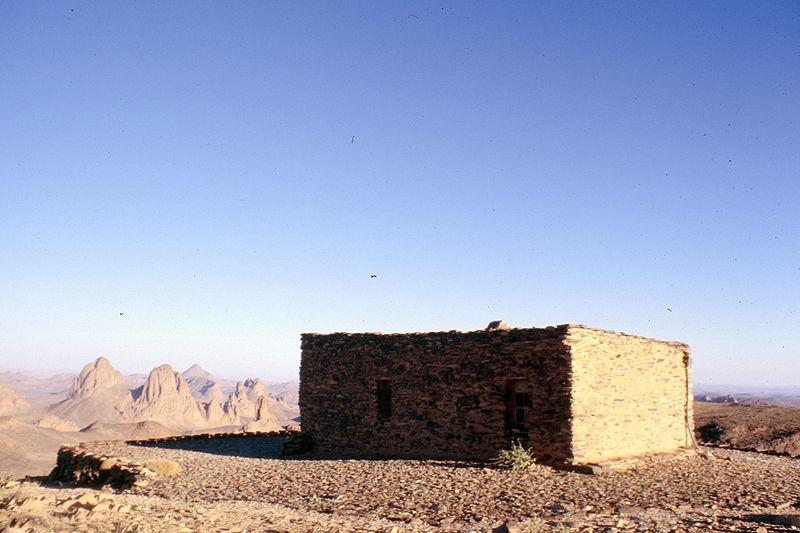
Hermitage of Blessed Charles de Foucauld in southern Algeria
Brother Charles, as he was known, died alone. He had drawn up a rule for a religious congregation to live the life of Nazareth in the desert. I think that one person joined him for a short while. But in the 1920s his life and writings led to the founding of two religious congregations, the Little Brothers of Jesus and the Little Sisters of Jesus, both of which are here in the Philippines. There are a number of other congregations that adapted the rule that Brother Charles wrote.
The Little Brothers and the Little Sisters live among the poor, support themselves by taking manual jobs. The January-February 2005 issue of Misyon carried an article, Working Sisters, in which Little Sister Goneswary Subramaniam LSJ from Sri Lanka writes about working as a sewer in a garment factory in Quezon City, Metro Manila, and Little Sister Annarita Zamboni LSJ from Italy about working as a lavandera, a laundry woman. Adoration of the Blessed Sacrament is at the heart of the life of each community of the Little Brothers, some of whom are priests, and of the Little Sisters and neighbours are invited to join.
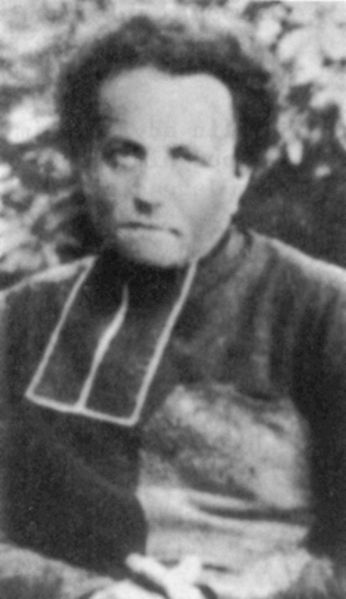
Blessed Charles was a diocesan priest, though definitely not a conventional one. But a more conventional diocesan priest, played a central role in his conversion, Fr Henri Huvelin.
Among the groups inspired by Blessed Charles is the Jesus Caritas Fraternity of Priests, a movement that adapts his spirituality to the lives of pastoral priests, mainly diocesan, though not exclusively. [That website has links to other branches of the De Foucauld family, including the Little Brothers and the Little Sisters.]
Peter, troubled by the words of Jesus, said, Look, we have left everything and followed you. Jesus replied, Truly I tell you, there is no one who has left house or brothers or sisters or mother or father or children or fields, for my sake and for the sake of the good news,who will not receive a hundredfold now in this age—houses, brothers and sisters, mothers and children, and fields, with persecutions—and in the age to come eternal life. Charles de Foucauld experienced the joy of doing God's will, with persecutions in his violent death, but the houses and brothers and sisters . . . didn't come till some years after his death. And when Cardinal José Saraiva Martins beatified Brother Charles in Rome on 13 November 2005 the Church confirmed that he had indeed attained eternal life from the moment of his death and that he was a model of holiness who could guide us as we try to follow Jesus. Blessed Charles saw clearly what the young man in the gospel, who didn't sin but had no idea of the riches he was spurning, didn't see - that Jesus was looking upon him and loved him.
1959 French stamp in honour of Charles de Foucauld [Wikipedia]
Prayer of Abandonment of Blessed Charles de Foucauld
Father,
I abandon myself into your hands;
do with me what you will.
Whatever you may do, I thank you:
I am ready for all, I accept all.
Let only your will be done in me,
and in all your creatures -
I wish no more than this, O Lord.
Into your hands I commend my soul:
I offer it to you with all the love of my heart,
for I love you, Lord, and so need to give myself,
to surrender myself into your hands without reserve,
and with boundless confidence,
for you are my Father.
This coming 19-23 October, the members of the Jesus Caritas Fraternity of Priests in the Philippines will have their annual gathering in Dumaguete City, Negros Oriental. Unfortunately, I'll be unable to attend as I'm having a cataract removed that week. (I must confess that I have been a 'lapsed' member in recent years.) Please keep the members in your prayers.
A friend of mine in Cebu City, Simeon Dumdum Jr, a married man with adult children and a judge who has written a number of books of poetry and beautiful prose, had a column some time ago in the Cebu Daily News on the spirituality of Blessed Charles, Desert. It is well worth reading.
On Saturday 3 October, at the Vigil before the opening of the ongoing Synod on the Family, Pope Francis referred to Brother Charles: Charles de Foucauld, perhaps like few others, grasped the import of the spirituality which radiates from Nazareth . . . To understand the family today, we too need to enter - like Charles de Foucauld – into the mystery of the family of Nazareth, into its quiet daily life, not unlike that of most families, with their problems and their simple joys, a life marked by serene patience amid adversity, respect for others, a humility which is freeing and which flowers in service, a life of fraternity rooted in the sense that we are all members of one body.
Jesus, Mary and Joseph, in you we contemplate the splendor of true love, to you we turn with trust.
Holy Family of Nazareth, grant that our families too may be places of communion and prayer, authentic schools of the Gospel and small domestic Churches.
Holy Family of Nazareth, may families never again experience violence, rejection and division: may all who have been hurt or scandalized find ready comfort and healing.
Holy Family of Nazareth, may the approaching Synod of Bishops make us once more mindful of the sacredness and inviolability of the family, and its beauty in God's plan.
Jesus, Mary and Joseph, graciously hear our prayer.
,%20WGA.jpg)