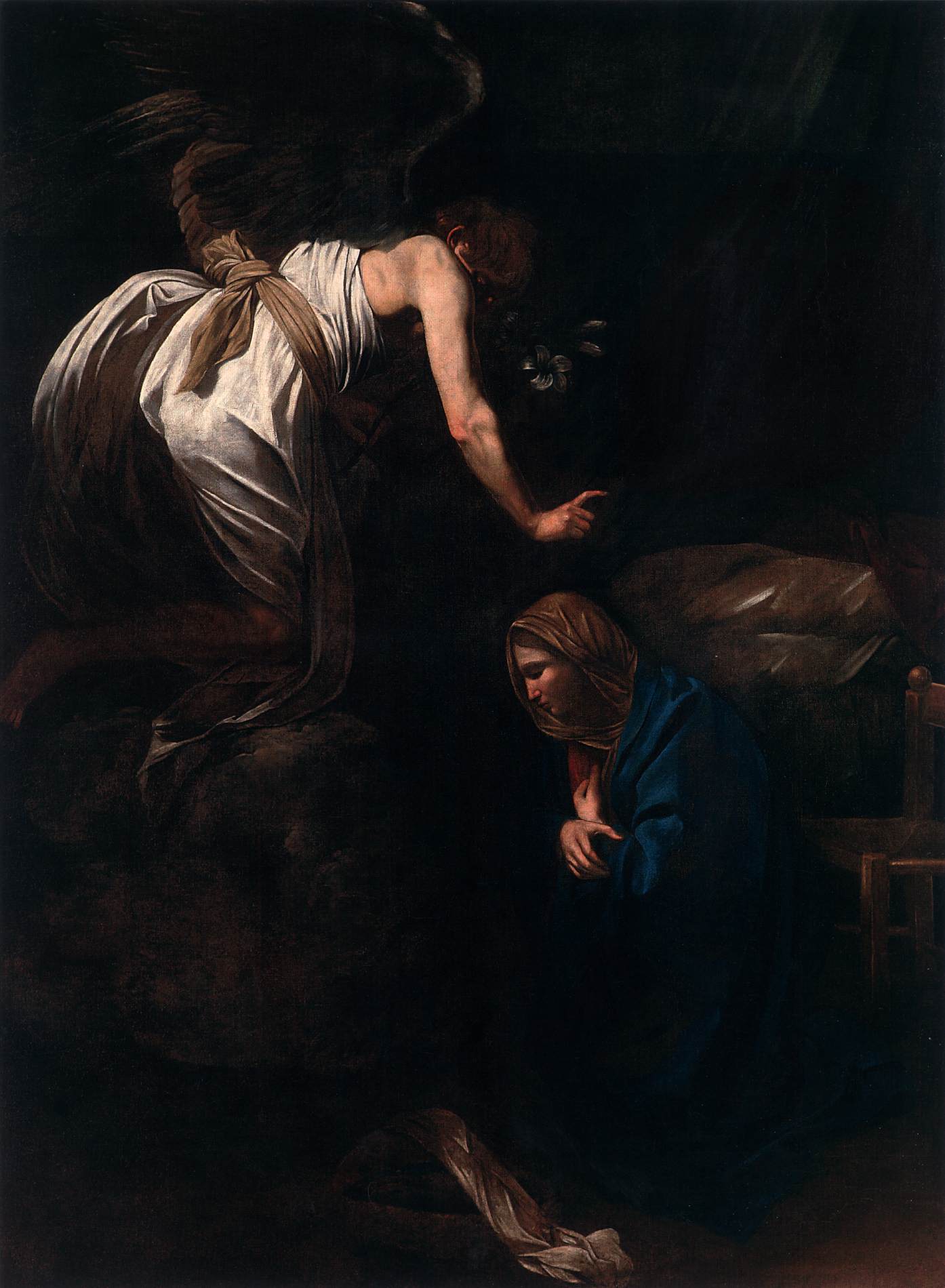
Since we are travellers and pilgrims in the world, let us ever ponder on the end of the road, that is of our life, for the end of our roadway is our home (St Columban, 8th sermon).
In the sixth month the angel Gabriel was sent by
God to a town in Galilee called Nazareth, to a virgin engaged to a man whose name was Joseph, of
the house of David. The virgin’s name was Mary. And he came to her and said, ‘Greetings, favoured one!
The Lord is with you.’But she was much perplexed by his words
and pondered what sort of greeting this might be. The angel said to her, ‘Do not be afraid, Mary, for
you have found favour with God. And now, you will conceive in your womb and bear a
son, and you will name him Jesus. He will be great, and will be called the Son of the
Most High, and the Lord God will give to him the throne of his ancestor David. He
will reign over the house of Jacob for ever, and of his kingdom there will be
no end.’ Mary said
to the angel, ‘How can this be, since I am a virgin?’The angel said to her, ‘The Holy Spirit will come
upon you, and the power of the Most High will overshadow you; therefore the
child to be born will be holy; he will be called Son of God. And now, your relative Elizabeth in her old age has
also conceived a son; and this is the sixth month for her who was said to be
barren. For
nothing will be impossible with God.’ Then Mary said, ‘Here am I, the servant of the Lord;
let it be with me according to your word.’ Then the angel departed from her.
In both paintings above Mary has the word of God, the Hebrew Bible, what we Christians call the Old Testament, open in front of her. And when she says, let it be with me according to your word, she is accepting the Word. The opening words of St John's Gospel, read at the Mass During the Day on Christmas Day and read at the end of every Mass in the Extraordinary Form, tells us who the Word is: In the beginning was the Word, and the Word was with God, and the Word was God. Further on, in Verse 14, St John writes those magnificent words that are at the centre of our faith: And the Word became flesh and lived among us.
The Catechism of the Catholic Church quotes what St John of the Cross said about this: In giving us his Son, his only Word (for he possesses no other), he spoke everything to us at once in this sole Word - and he has no more to say. . . because what he spoke before to the prophets in parts, he has now spoken all at once by giving us the All Who is His Son. Any person questioning God or desiring some vision or revelation would be guilty not only of foolish behavior but also of offending him, by not fixing his eyes entirely upon Christ and by living with the desire for some other novelty.
'Silence' is not what most of us associate with the days coming up to Christmas. But the Church invites us to enter into an inner silence during these days, difficult though that may be. The above is on a parchment, part of a Missal, which in the old days included the readings during Mass. Fra Angelico, a Dominican friar, was declared 'Blessed' by St John Paul II in 1982. This work again invites us into contemplation of the wondrous event of the Annunciation, the moment of the Incarnation when God became Man in the womb of Mary.
Julian of Vézelay (c.1080 - 1165), a French Benedictine monk, reflects on the silence into which Jesus entered, the silence that Mary bore in our heart, the silence that God invites us to enter at this time:
There came a deep silence. Everything was still. The voices of prophets and apostles were hushed, since the prophets had already delivered their message, while the time for the apostles' preaching had yet to come. Between these two proclamations a period of silence intervened, and in the midst of this silence the Father's almighty Word leaped down from his royal throne. There is a beautiful fitness here: in the intervening silence the Mediator between God and the human race also intervened, coming as a human being to human beings, as mortal to mortals, to save the dead from death.
I pray that the Word of the Lord may come again today to those who are silent, and that we may hear what the Lord God says to us in our hearts. Let us silence the desires and importunings of the flesh and the vainglorious fantasies of our imagination, so that we can freely hear what the Spirit is saying. Let our ears be attuned to the voice that is heard above the vault of heaven, for the Spirit of life is always speaking to our souls; as scripture says, a voice is heard above the firmament which hangs over our heads.But as long as we fix our attention on other things, we do not hear what the Spirit is saying to us.
Collect
Pour forth, we beseech you, O Lord,
your grace into our hearts,
that we, to whom the Incarnation of Christ your Son
was made known by the message of an Angel,
may by his Passion and Cross
be brought to the glory of the Resurrection.
Who lives and reigns with you in the unity of the Holy Spirit,
one God, for ever and ever.
1. The angel Gabriel from heaven came His wings as drifted snow his eyes as flame ‘All hail’ said he ‘thou lowly maiden Mary, Most highly favored lady,’ Gloria!
2. ‘For know a blessed mother thou shalt be, All generations laud and honor thee, Thy Son shall be Emanuel, by seers foretold Most highly favored lady,’ Gloria!
3. Then gentle Mary meekly bowed her head ‘To me be as it pleaseth God,’ she said, ‘My soul shall laud and magnify his holy name.’ Most highly favored lady. Gloria!
4. Of her, Emmanuel, the Christ was born In Bethlehem, all on a Christmas morn And Christian folk throughout the world will ever say: ‘Most highly favored lady,’ Gloria!
The Solemnity of the Nativity of the Lord has four different Mass formularies, each with its own prayer and readings. Any of the four fulfills our obligation to attend Mass. These are:
Vigil Mass, celebrated 'either before or after First Vespers (Evening Prayer) of the Nativity'; that means starting between 5pm and 7pm.
Mass During the Night, known before as 'Midnight Mass'. In many parts of the world it does begin at midnight but here in the Philippines since the 1980s it begins earlier, usually at 8:30pm or 9pm.
Mass at Dawn.
Mass During the Day.
When you click on 'Readings' below from the New American Bible you will find links to the readings for each of the four Masses. The readings from the Jerusalem Bible for the four Masses are all on one page.
Behold the handmaid of the Lord; be it done to me according to thy word.
Fr Donnchadh Ó Floinn (1902 - 1968) was a priest of the Archdiocese of Dublin who wrote 201 short meditations in Irish Gaelic for The Far East, the monthly magazine of the Columbans in Ireland, from March 1949 till April 1967. In 2003 they were published by Foilseacháin Ábhair Spioradálta, which specializes in spiritual books in Irish and is run by the Jesuits, under the title Aibhleoga Crábhaidh, ‘Sparks of Devotion’. Fifty of these had come out in book form before under the same publisher in 1957 with the title Caoga Árdú Meanman, which could be translated as 'Fifty Raisings of the Spirit’. The editor of Aibhleoga Crábhaidh was Fr Iognáid Ó Maoleachlainn of the Diocese of Ardagh and Clonmacnoise.
Father Ó Floinn’s spirituality was suffused with a deep devotion to Mary and many of his short articles were reflections on the mysteries of the rosary, though not in a systematic way. He sometimes returned to the same mystery a number of times. His reflection on The Handmaid of the Lord is below.
Like Father Ó Floinn, El Greco was drawn to the theme of the Annunciation. Web Gallery of Art has ten of his paintings of this scene done between 1568 and 1614.
The Handmaid of the Lord
Banóglach an Tiarna
‘The angel of the Lord declared unto Mary’ – imagine that bright and glorious spirit in conversation with the young girl in the little town of Nazareth, and listen carefully to her answer. What should a person say when she receives a message from heaven? Should she say nothing at all? Or a lot, putting herself down? Mary gave as an answer only a dozen or so words, but those dozen words were full of the wisdom of the Holy Spirit.
‘Behold the handmaid of the Lord’ – there are two things to note about that answer: firstly, it is the first thing every creature should say, because it shows the most basic root of our nature; secondly, it is an answer that embraces the whole life of the Virgin Mary- from Nazareth to heaven and from that March day to the edge of eternity.
Each person is by nature a slave of God. But it’s mostly to creatures that we are slaves: we are slave to ourselves, we are slaves to the gods of gold and silver, we are slaves to things that are insignificant, or to things, however noble and beautiful, that are passing – what wonder then that we become anxious when we’re at war with our own nature?
But Mary - who never spent a moment as a slave except to her Son: in Nazareth taking care of their little house; in Jerusalem watching during the Passion; waiting patiently to be taken to heaven; yes, and even in heaven today, the Queen of angels, isn’t she still the Handmaid of the Lord, guiding the Church and sharing graces?
Ecce Virgo concipiet SATTB motet by William Byrd (c. 1540-1623) Performed by Stile Antico on their CD of English Tudor music for the seasons of Advent and Christmas.
Antiphona ad communionem Isaiah 7:14
Ecce Virgo concipiet,
et pariet Filium;
et vocabitur nomen
eius Emmanuel.
Communion Antiphon Isiaiah 7:14
Behold, a Virgin shall conceive
and bear a son;
and his name will be
called Emmanuel.
[This is a re-working of a post I published on 9 October 2009.]
In the sixth month the angel Gabriel was sent from God to a city of Galilee named Nazareth, to a virgin betrothed to a man whose name was Joseph, of the house of David; and the virgin's name was Mary. And he came to her and said, "Hail, full of grace, the Lord is with you!" But she was greatly troubled at the saying, and considered in her mind what sort of greeting this might be. And the angel said to her, "Do not be afraid, Mary, for you have found favor with God. And behold, you will conceive in your womb and bear a son, and you shall call his name Jesus. He will be great, and will be called the Son of the Most High; and the Lord God will give to him the throne of his father David, and he will reign over the house of Jacob for ever; and of his kingdom there will be no end." And Mary said to the angel, "How shall this be, since I have no husband?" And the angel said to her, "The Holy Spirit will come upon you, and the power of the Most High will overshadow you; therefore the child to be born * will be called holy, the Son of God. And behold, your kinswoman Elizabeth in her old age has also conceived a son; and this is the sixth month with her who was called barren. For with God nothing will be impossible." And Mary said, "Behold, I am the handmaid of the Lord; let it be to me according to your word." And the angel departed from her.
The 'O Antiphon' for the Magnificat at Vespers on 20 December.
O Key of David, O royal Power of Israel controlling at your will the gate of heaven: come, break down the prison walls of death for those who dwell in darkness and the shadow of death; and lead your captive people into freedom.
The painting of the Annunciation is one of many by El Greco.
Luke 1:26-38(Revised Standard Version - Catholic Edition)
In the sixth month the angel Gabriel was sent from God to a city of Galilee named Nazareth, to a virgin betrothed to a man whose name was Joseph, of the house of David; and the virgin's name was Mary. And he came to her and said, "Hail, full of grace, the Lord is with you!" But she was greatly troubled at the saying, and considered in her mind what sort of greeting this might be. And the angel said to her, "Do not be afraid, Mary, for you have found favor with God. And behold, you will conceive in your womb and bear a son, and you shall call his name Jesus. He will be great, and will be called the Son of the Most High; and the Lord God will give to him the throne of his father David, and he will reign over the house of Jacob for ever; and of his kingdom there will be no end." And Mary said to the angel, "How shall this be, since I have no husband?" And the angel said to her, "The Holy Spirit will come upon you, and the power of the Most High will overshadow you; therefore the child to be born will be called holy, the Son of God. And behold, your kinswoman Elizabeth in her old age has also conceived a son; and this is the sixth month with her who was called barren. For with God nothing will be impossible." And Mary said, "Behold, I am the handmaid of the Lord; let it be to me according to your word." And the angel departed from her.
O God,
who willed that your Word
should take on the reality of human flesh
in the womb of the Virgin Mary,
grant, we pray,
that we, who confess our Redeemer to be God and man,
may merit to become partakers even in his divine nature.
Who lives and reigns with you in the unity of the Holy Spirit,
And in the sixth month, the angel Gabriel was sent from God into a city of Galilee, called Nazareth, To a virgin espoused to a man whose name was Joseph, of the house of David; and the virgin's name was Mary. And the angel being come in, said unto her: Hail, full of grace, the Lord is with thee: blessed art thou among women. Who having heard, was troubled at his saying, and thought with herself what manner of salutation this should be. And the angel said to her: Fear not, Mary, for thou hast found grace with God.
Behold thou shalt conceive in thy womb, and shalt bring forth a son; and thou shalt call his name Jesus. He shall be great, and shall be called the Son of the most High; and the Lord God shall give unto him the throne of David his father; and he shall reign in the house of Jacob for ever. And of his kingdom there shall be no end. And Mary said to the angel: How shall this be done, because I know not man? And the angel answering, said to her: The Holy Ghost shall come upon thee, and the power of the most High shall overshadow thee. And therefore also the Holy which shall be born of thee shall be called the Son of God.
And behold thy cousin Elizabeth, she also hath conceived a son in her old age; and this is the sixth month with her that is called barren: Because no word shall be impossible with God. And Mary said: Behold the handmaid of the Lord; be it done to me according to thy word. And the angel departed from her.
The Angelus, Jean-François Millet, painted 1857-59
The Angel of the Lord declared to Mary: And she conceived of the Holy Spirit.
Hail Mary, full of grace, the Lord is with thee; blessed art thou among women and blessed is the fruit of thy womb, Jesus. Holy Mary, Mother of God, pray for us sinners, now and at the hour of our death. Amen.
Behold the handmaid of the Lord: Be it done unto me according to Thy word.
Hail Mary . . .
And the Word was made Flesh: And dwelt among us.
Hail Mary . . .
Pray for us, O Holy Mother of God, that we may be made worthy of the promises of Christ.
Let us pray:
Pour forth, we beseech Thee, O Lord, Thy grace into our hearts; that we, to whom the incarnation of Christ, Thy Son, was made known by the message of an angel, may by His Passion and Cross be brought to the glory of His Resurrection, through the same Christ Our Lord.
Fr Donnchadh Ó Floinn was a priest of the Archdiocese of Dublin who wrote 201 short meditations in Irish Gaelic for The Far East, the monthly magazine of the Columbans in Ireland, from March 1949 and April 1967. In 2003 they were published by Foilseacháin Ábhair Spioradálta, which specializes in spiritual books in Irish and is run by the Jesuits, under the title Aibhleoga Crábhaidh, ‘Sparks of Devotion’. Fifty of these had come out in book form before under the same publisher in 1957 with the title Caoga Árdú Meanman, which could be translated as 'Fifty Raisings of the Spirit’. The editor of Aibhleoga Crábhaidh was Fr Iognáid Ó Maoleachlainn of the Diocese of Ardagh and Clonmacnoise.
Father Ó Floinn’s spirituality was suffused with a deep devotion to Mary and many of his short articles were reflections on the mysteries of the rosary, though not in a systematic way. He sometimes returned to the same mystery a number of times.
During this month of October I’ll try to post translations of some of these. I’ll start with the First Joyful Mystery, the Annunciation.
The Annunciation, El Greco, painted between 1595 and 1600. Like Father Ó Floinn, El Greco was drawn to this theme and did paintings of it in 1568 and between 1608 and 1614.
The Handmaid of the Lord Banóglach an Tiarna
‘The angel of the Lord declared unto Mary’ – imagine that bright and glorious spirit in conversation with the young girl in the little town of Nazareth, and listen carefully to her answer. What should a person say when she receives a message from heaven? Should she say nothing at all? Or a lot, putting herself down? Mary gave as an answer only a dozen or so words, but those dozen words were full of the wisdom of the Holy Spirit.
‘Behold the handmaid of the Lord’ – there are two things to note about that answer: firstly, it is the first thing every creature should say, because it shows the most basic root of our nature; secondly, it is an answer that embraces the whole life of the Virgin Mary- from Nazareth to heaven and from that March day to the edge of eternity.
Each person is by nature a slave of God. But it’s mostly to creatures that we are slaves: we are slave to ourselves, we are slaves to the gods of gold and silver, we are slaves to things that are insignificant, or to things, however noble and beautiful, that are passing – what wonder then that we become anxious when we’re at war with our own nature?
But Mary - who never spent a moment as a slave except to her Son: in Nazareth taking care of their little house; in Jerusalem watching during the Passion; waiting patiently to be taken to heaven; yes, and even in heaven today, the Queen of angels, isn’t she still the Handmaid of the Lord, guiding the Church and sharing graces?
The Annunciation was a favourite theme of El Greco
The Solemnity of the Annunciation is an appropriate time to highlight the sacredness of the life of the pre-born. A tireless defender of the rights of all human beings, especially those still in their mothers' wombs is Archbishop Charles J. Chaput OFMCap of Denver, Colorado.
Archbishop of Denver Charles J. Chaput delivered a speech on Saturday reflecting on the significance of the November 2008 election. Warning that media “narratives” should not obscure truth, he blamed the indifference and complacency of many U.S. Catholics for the country’s failures on abortion, poverty and immigration issues.
He also advised Catholics to “master the language of popular culture” and to refuse to be afraid, saying “fear is the disease of our age.”
The archbishop’s comments were delivered in his keynote address at the Hands-On Conference Celebrating the Year of St. Paul, which was hosted at the Sacred Heart Major Seminary in Detroit.
Archbishop Chaput is media-savvy and speaks calmly but clearly. He is not the caricature often depicted of those who defend the right of the pre-born to be born but who, allegedly, don't care for the child once its born. Here is one part of the report with my emphases and comments:
Noting that there was no question about President Barack Obama’s views on abortion “rights,” embryonic stem cell research and other “problematic issues,” he commented:
“Some Catholics in both political parties are deeply troubled by these issues. But too many Catholics just don’t really care. That’s the truth of it. If they cared, our political environment would be different. If 65 million Catholics really cared about their faith and cared about what it teaches, neither political party could ignore what we believe about justice for the poor, or the homeless, or immigrants, or the unborn child. If 65 million American Catholics really understood their faith, we wouldn’t need to waste each other’s time arguing about whether the legalized killing of an unborn child is somehow ‘balanced out’ or excused by three other good social policies.” (I've heard this point of view from priests, none of whom would ever say that abortion is right or good. But there seems to be an unwillingness to look at the horror of what it is).
Offering a sober evaluation of the state of American Catholicism, he added:
“We need to stop over-counting our numbers, our influence, our institutions and our resources, because they’re not real. We can’t talk about following St. Paul and converting our culture until we sober up and get honest about what we’ve allowed ourselves to become. We need to stop lying to each other, to ourselves and to God by claiming to ‘personally oppose’ some homicidal evil -- but then allowing it to be legal at the same time.” (I've often heard Archbishop Chaput speak on the internet and he is a mild-mannered person, but his language here isn't fuzzy).
Commenting on society’s attitude towards Catholic beliefs, Archbishop Chaput said, “we have to make ourselves stupid to believe some of the things American Catholics are now expected to accept.”
You can listen to Archbishop Chaput's Sunday homilies in Denver Cathedral here and, starting only with last Sunday's homily, listen to and view them here.