Showing posts with label Child abuse. Show all posts

22 January 2013

'The Miracle Girls' and 'A Poem of Purity: Blessed Laura Vicuña, patron of those who have been abused

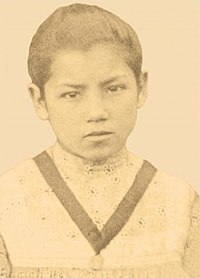
Blessed Laura Vicuña (5 April 1891 – 22 January 1904)

Last evening I celebrated Mass  for the Feast of St Agnes (c.291 - c.304) with 'The Miracle Girls'. St Agnes, among other things, is the patron saint of victims of rape. My homily was mostly about the life of Blessed Laura Vicuña, whose life and dates of birth and death parallel those of the Roman martyr. Blessed Laura is the patron of abuse victims. Today is her feast day.

For some years now in Holy Family Home for Girls we have celebrated these two young girls who have been recognised by the Church for their holiness. Sometimes we have the Mass on the 21st, sometimes on the 22nd. Many, though not all, of 'The Miracle Girls' have been victims, some within their own families.

Some of 'The Miracle Girls' and friends.

I told the girls how the brutal treatment of her step-father led to Blessed Laura's death. her father had died when she was three and her mother, Mercedes, who was left with little means, then lived with a landowner but without marrying him. Before she died Laura told her mother that she had offered her life to God for her conversion. Mercedes began to live a life according to God's will.

Mercedes Pino, the mother of Blessed Laura

Both St Agnes and Blessed Laura made a choice to offer their lives on order to 'buy the field where the treasure was', to 'buy the pearl of great price', as Matthew 13:44-46, the gospel suggested for the feast of St Agnes, which we read, tells us. We can under-estimate the power of God's grace in young persons. yet there are many great examples in the history of the Church, especially among the martyrs.

St Paul tells us in 1 Corinthians 1:26-31, the First Reading, God chose the foolish of the world to shame the wise, and God chose the weak of the world to shame the strong, and God chose the lowly and despised of the world, those who count for nothing, to reduce to nothing those who are something, so that no human being might boast before God.

Young Agnes and young Laura were prepared to accept death for the sake of Jesus Christ. Blessed Laura'a offering of her life for the conversion of her mother parallels the example of her older contemporary, St Thérèse of Lisieux who, when she was about 14, made her first mission the conversion of a notorious criminal named Pranzini who was due to be executed. God listened to her prayers too.

Though St Agnes and Blessed Laura were powerless at one level, in the depths of their being they were free, through God's grace, and able to make choices that astound us. Yet the same grace is available to all of us. These two young holy people bring hope, rooted in their awareness of God's love, to all of us who are struggling to follow Jesus faithfully. And, as a friend of mine keeps telling me, it's in the struggle that we become saint.

Fr John Murray, a parish priest in Belfast, told the story of Blessed Laura some years ago in The Sacred Heart Messenger, an excellent popular monthly that the Jesuits in Ireland have been publishing now for 125 years. We published it, with permission, in Misyon, the Columban magazine in the Philippines that I edit. Here is Father Murray's article.


Although she was only twelve when she died, Laura Vicuña had grown to a maturity of faith well beyond her years. Fr John Murray sees the life of this young girl whose feast is 22 January as an inspiration.

Throughout his pontificate, Pope John Paul II endeavored to offer to the Church and the world at large, models for Christian living: people we can imitate and learn from, as we try to make our own way through the maze and pitfalls of life. In an age of sexual license, when often girls and young women can be at the mercy of sexual predators, the life of Laura Vicuña has something to say in our own day.

Painful experiences

Laura was born in Santiago, Chile, on 5 April 1891.Soon after her birth, her father had to flee the country because of political upheavals, and when she was only three he himself passed away. Bereft of support, her mother, Mercedes, sadly entered into a relationship with a local ranch owner, one Manuel Mora.

He offered to pay for the care and schooling of her children at a Salesian boarding school, if Mercedes became his mistress. Laura attended the Salesian mission school with her sister, Julia. With a maturity beyond her years, Laura often helped the younger children with their tasks, and acted almost like a mother to them, combing their hair and mending their clothing.

Even then, Mora would try to molest her, especially when he was drunk. She made her First Holy Communion when she was ten, but was always afraid of Mora, because of his lewd desires on her. When she fought off his first assault, the ranch owner refused to pay for her school tuition, but despite that the Sisters continued to educate her.

Offering up her life

Despite her young age, Laura was conscious that her mother was not living as God would want, and she had already decided to offer her life to God for her mother’s conversion.

At this stage, her own health was delicate, and in the winter of 1902 Mercedes left the Mora’s hacienda in order to care for her ailing daughter.

At this time, they were living in Argentina.However, in January 1904, Mora arrived on their doorstep to demand that Laura surrender to his lusts. When she refused him, he whipped and kicked her, and then threw her brutally across the saddle of his horse to carry her back to his ranch. Aware that the local people were watching him, he dumped her body in a ditch and left. Laura lingered on until 22 January, when she died of severe internal injuries.

Just before she died, she told her mother that she had given her life to bring about a conversion in her. ‘Mama,’ she said. ‘I am dying, but I’m happy to offer my life for you. I asked our Lord for this’. After Laura’s death, Mercedes made a good confession, left Mora, and became a devout Catholic again.

Beatification

In September 1988, Pope John Paul II beatified Laura, calling her a ‘Eucharistic flower . . . whose life was a poem of purity, sacrifice and filial love’. In many ways, her life parallels that of St Maria Goretti, whose life and death may be better known to many people. She too fought off the advances of a young man with lustful desires.

Maria died but was able eventually to achieve the conversion of her murderer, and when she was later canonized in 1950, he was present at the ceremony. (Note: I saw a TV documentary on St Maria Goretti on EWTN recently and it stated that he wasn't present, though he was still alive at the time and living in a Capuchin friary in Italy as a member of the Capuchin Third Order.)

Like Maria, Laura did not let the sordidness of Mora destroy her innocence, nor did she allow her heart to become embittered. Instead, she prayed for her mother and also for her lover. We can but hope that Mora too experienced the conversion which Laura prayed for her mother. Her life is a testimony to the words of St Paul: ‘However much sin increased, grace was always greater’ (Rom 5:20).

22 September 2011

'The Return to the Dark Ages'


For many years my Columban colleague Fr Shay Cullen has been fighting agains the exploitation of women and children in the Philippines and has won a number of awards for this. He has spoken to legislators in a number of Western countries, some of which have brought in laws enabling them to charge their own citizens for crimes against children in other countries. Father Shay writes a weekly 'Reflections' column that is published in a number of countries. Reflections No 553, his latest, is below.

The news-clip above was made a few years when Rodrigo Duterte was Mayor of Davao City. Father Cullen mentions him, though not by name, in his column. As he was ineligible to run again last year for Mayor he had his daughter run instead while he ran for Vice Mayor. Both were elected. That is how power is passed on in most parts of the Philippines.


Fr Shay Cullen's columns are published in The Manila Times,
in publications in Ireland, the UK, Hong Kong, and online.

It’s back to the dark ages for the hysterical tabloid press in Metro Manila where the bellowing newscasters and commentators are condemning street children and children in conflict with the law as criminals. The most strident commentators call for the children to be charged and jailed and to reduce the age of criminal liability to 12 or younger. They demand that the Juvenile Justice Welfare Act be changed.

This act, Republic Act 9344, is a landmark piece of legislation of compassion that seeks to restore the deprived life of children in conflict with the law. It says that children younger than 15 have an alternative to harsh, cruel prison life where enough of them have been raped, abused, beaten and starved in sub-human conditions. They can be helped, given a chance of an education and rehabilitation through meeting their basic human rights, nutritional needs and education. However, up to a million children and minors from the teeming slums frequent the streets and join gangs to survive. Many hundreds of youth are still jailed in conditions not even fit for animals.

Those who advocate the repeal of the law don't know the reality. They are branding the street children as the tools of the criminal syndicates which the police are either too scared to oppose or are in cahoots with. Instead of exposing the criminal syndicates and their wealthy masterminds, the irresponsible commentators are setting up the street kids as targets for death squads.

Not only that, a few commentators, after giving tirades condemning the street kids over the radio or TV and arousing fear and hatred against them, launch their own text-in surveys, then use this survey result to justify their continued condemnation of the children. The one straightforward solution is to feed and educate the young and give jobs with a living wage to the older teenage youth.

The death squads too are busy killing hundreds of street youth in recent years and doing their bloody butchering work with a nods and winks from their political backers and incompetent police. The latest, most gruesome, has been the killing of three youths, 13 and 14, tied, gagged, tortured and stabbed a hundred times and thrown as garbage in a ditch in Zamboanga City, to the eternal shame of the politicians, police and citizens. Their muffled screams still cry out for justice and mercy. But there is none.

Cebu and Davao cities are the most notorious for the extermination of street youth. Ten years ago, I called on the then Mayor of Davao City to defend human rights and stop the killings of street youth. Instead, he charged me with libel and had me hailed to court.

It was a proud moment indeed to be able to take a stand for the kids in court but what¹s even more amazing was the crowd of street children that came to Davao City airport to surround me with their malnourished bodies to protect me from the assassins’ guns and escort me to a van away from danger. In the end, the Mayor was persuaded to drop the baseless charge. The death squads rule by fear but the politicians call it democracy. If the majority of the people approve by their silence, then I suppose it is. It is the democracy of death and the death of democracy.

There will be no end to the thousands homeless urchins that challenge our conscience and religious beliefs until the root cause is dealt with. That is the corrupt system of government and the insurmountable inequality of society. There is the unbridgeable gap between the tiny group of luxuriously living rich and the masses of struggling poor. It’s a society where two percent of the population own about 70 percent of the natural wealth and the millions of hungry slum dwelling people are barely surviving from day to day.

Poverty, mass unemployment and hunger drive the children from these slums on to the streets to a miserable life of hunger and hopelessness. They go begging, and cannot resist stealing when they are hungry and smell the aroma of the delicious foods that wafts out from the fast food restaurants. The hungry children are driven crazy with the desire for a decent meal. Most of the time they live on left-overs from garbage cans. The government has no homes to care for them and deliver their basic human rights. They are the abandoned and forgotten until they are forced to steal in order to eat. Then they are condemned to prison.

This is the fundamental failure of the Church, politicians, society and humanity - to remain indifferent to the hungry needy children and allow them to be condemned as criminals. We have to come to their defense and give them a life of dignity and decency. END

04 September 2011

Vatican's response to Irish Government


The Irish Times carries the video above of Archbishop Diarmuid Martin of Dublin giving his comments to the press on the Response of the Holy See to the Government of IrelandTaoiseach (Prime Minister) Enda Kenny alleged in the Dáil (Irish parliament) that the Holy See had attempted 'to frustrate an Inquiry in a sovereign, democratic republic as little as three years ago, not three decades ago'. Foreign Minister Eamon Gilmore told Papa Nuncio Archbishop Giuseppe Leanza 'that the Vatican had intervened to effectively have priests believe they could in consicence evade their responsibilities under Irish law'.

The response of the Holy See is measured and lacking rancour. Archbishop Martin says of Mr Kenny's comments in the Dáil and the subsequent comments by is office 'merits explanation'.

I think that Mr Kenny's speech acted as a conduit for the anger that so many Irish people felt, including those who have stayed in the Church - and the Taoiseach spoke as one of them - and perhaps brought it home to some in the Vatican that this whole situation has done enormous damage to the Church and to its ability to carry out its mission.

Archbishop Martin notes favourably that the new Irish government is the first in the history of the state to set up a cabinet ministry for children. (The cabinet is constitutionally limited to 14 members).

I hope that this diplomatic row has cleared the air to some degree and that it will help Church and State to work together for the sake not only of those who have already been hurt but for the sake of children in the future. I hope too that all involved directly will listen to Archbishop Martin's plea that this not become another opportunity for polemics, which helps no one, least of all those who have been abused.

But more reports are on their way, that of the Diocese of Raphoe in the north-west of the country and one of the Garda Síochána, the Irish police force, that has been looking at records of their own going back 80 or 90 years.

The 'one or two bad apples' doesn't wash anymore. But I know that the vast majority of Irish priests are upright and honest men. We have seen from examples in Belgium, Austria and the USA that it is possible for a man to imprison and abuse his own children for years without the next door neighbours knowing. But it's also possible for a community to turn its eyes from awful abuse within families, as two recent examples in Ireland, where the perpetrator was the mother, have shown. Mr Kenny referred to one such case in his Dáil speech. There have been similar cases in England in recent years when social workers could have prevented the deaths of children but didn't.

And the awful reality remains that the victims of priests in Ireland are fewer that four percent of all victims of sexual abuse, according to the 2002 Savi Report, Sexual Abuse and Violence in Ireland.


24 July 2011

Jesus himself would be reported by many today to the police

Christ Blessing the Children, Nicolaes Maes, 1652-53

'It is hard going out on the altar these days after Cloyne and Enda Kenny clearly has read the national mood re Vatican etc . . .' In an email from a friend who is a parish priest in Dublin and is much younger than I am.

Three bishops have come out in support of Taoiseach (Prime Minister) Enda Kenny's speech in the Dáil (Irish parliament) last Wednesday. Patsy McGarry quotes the bishops in an article in yesterday's Irish Times, Kenny reflected anger, says bishop. Bishop Noel Treanor of Down and Connor, which includes Belfast and is the second largest diocese in Ireland in terms of general and Catholic population, though Catholics are in a minority, said the Taoiseach had 'accurately reflected the dismay and anger felt by many, many Catholics in Ireland'. He was further quoted as saying he was 'shocked and devastated by the content of the Cloyne report and by the failure to implement the basic national guidelines imposed by the church within that diocese. Let me state once again that the protection of and care for our children is our absolute priority. The events described in the Cloyne report simply should not have happened'.

Mr McGarry's article quotes Bishop John McAreavy of Dromore who said that the Taoiseach's address  'accurately reflects the deep anger of the people of Ireland at the contents of the Cloyne report and underlines the huge challenges ahead for the Catholic Church as a whole'.

Auxiliary Bishop Gerard Clifford of Armagh is quoted as saying  that while he was 'taken aback at the force and wide sweeping nature of the Taoiseach’s address in the Dáil' he acknowledged 'the reason for the intensity of feeling expressed given the awful findings of the report'.

Whether it has any significance or not I don't know but the Diocese of Down and Connor and the Diocese of Dromore are the only two of Ireland's 26 that are totally within Northern Ireland, over which Mr Kenny's government has no jurisdiction, while Armagh is one of a number that is partly in Northern Ireland and partly in the Irish Republic.

Kathy Sheridan wrote in yesterday's Irish Times about how the Cloyne Report has affected priests in Ireland, The fearful Fathers. The article begins, Angry, isolated, paranoid and ageing, many of Ireland’s ‘ordinary’ Catholic priests feel failed and abandoned by the church hierarchy. But where were the ‘good priests’ when they were needed? Ms Sheridan quotes Fr Brendan Hoban of Ballina, one of the leaders of the Association of Catholic Priests, which has about 500 members, about ten percent of the country's priests, presenting a pastoral dilemma: 'A woman comes to the door who may have psychiatric problems . . . What do I do? Take a chance by letting her into my front room? There is no doubt that priests have withdrawn, that they’ve become ultracareful and ultrasensitive on how they might be compromised'. Irish parishes, unlike those in the USA and the Philippines, for example, don't usually have an office. Priests meet people in their presbytery.

I'm not sure how fair Kathy Sheridan's question is: But where were the ‘good priests’ when they were needed? I was ordained in December 1967. I know that we must have touched on the question of the abuse of children in moral theology classes in the seminary but it was never part of my experience or awareness until the 1980s when reports about abuse by priests began to emerge from North America. I had never heard a whisper of it growing up in Ireland. I remember reading Irish author Walter Macken's novel published in 1962, The Silent People, set in the time of the Great Famine in Ireland of the 1840s, where a pre-adolescent girl is abused by a neighbour and the horror when this was discovered. As a child I remember clearly the canonisation of St Maria Goretti in 1950. I'm not sure to what extent I really understood what she went through.

One of the great joys in my life is my involvement with a home for girls here in Bacolod City, Philippines, where most of the girls have experienced abuse, mainly from family members or close relatives. This morning I celebrated Mass there followed by a simple celebratory lunch in gratitude to God for a group who recently passed the Social Work Licensure Examination. One was Sr Jenemer Torio TC, Director of Holy Family Home. Three others were young women who have been in the home for some years. One of them, Richelle Verdeprado, came second in the Philippines. Her background is simply one of poverty and she is now employed by an NGO in Manila that is fighting the trafficking of women.  I am conscious that the sense of joy I find there would not be possible in the Ireland of today or in North America or in other English-speaking countries.

The appalling reality is that Jesus himself would be reported by many today to the police: 'Truly, I say to you, whoever does not receive the kingdom of God like a child shall not enter it.' And he took them in his arms and blessed them, laying his hands upon them (Mark 10:15-16).

22 July 2011

'The kingdom of heaven is like a merchant looking for fine pearls.' Sunday Reflections, 17th Sunday in Ordinary Time Year A, 24 July 2011

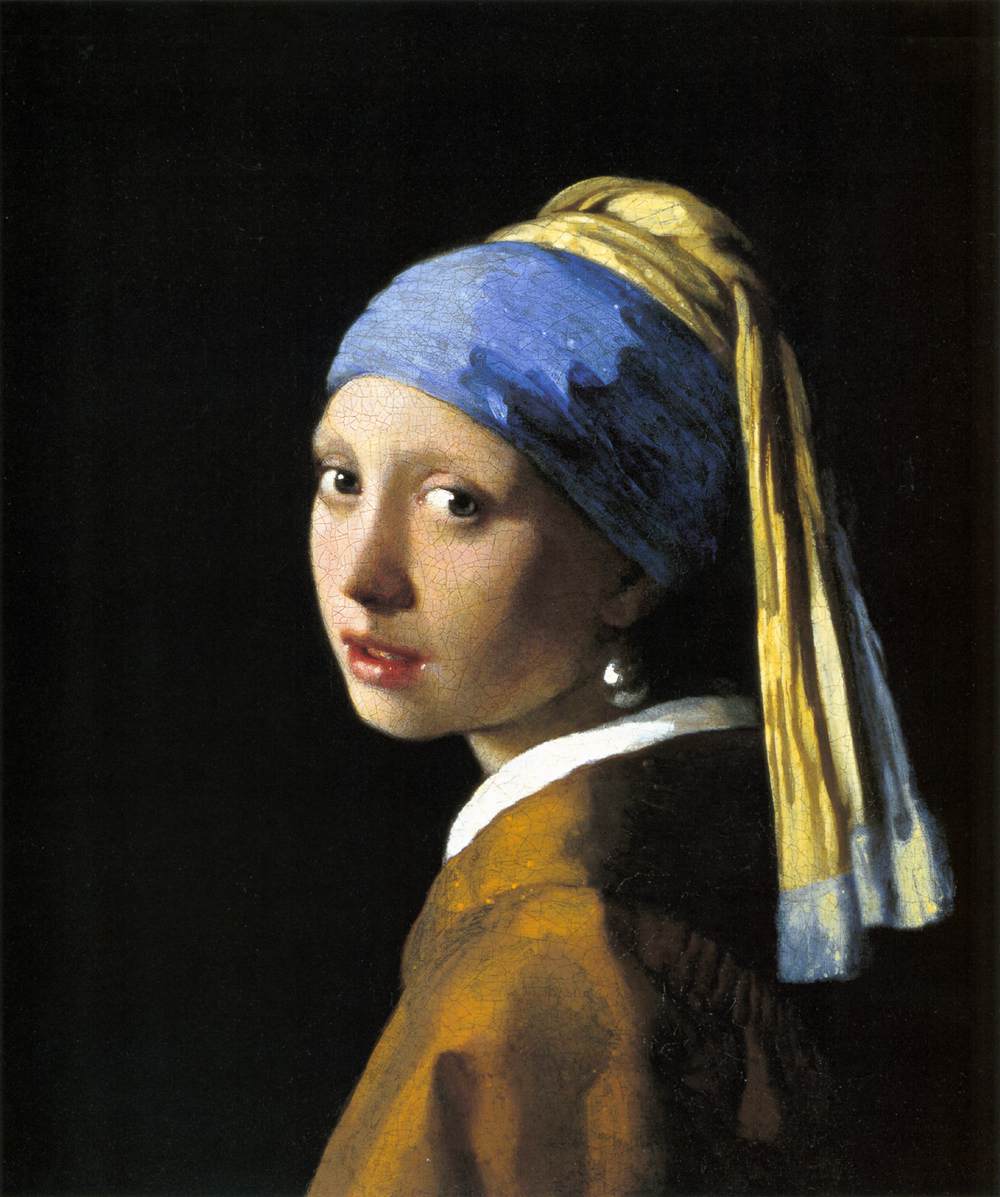
Girl with a Pearl Earring, Johannes Vermeer, c.1665

Readings (New American Bible: Philippines, USA)

Gospel Matthew 13:44-52 (Jerusalem Bible: Australia, England and Wales, Ireland, Scotland)

'The kingdom of heaven is like treasure hidden in a field which someone has found; he hides it again, goes off happy, sells everything he owns and buys the field.

'Again, the kingdom of heaven is like a merchant looking for fine pearls; when he finds one of great value he goes and sells everything he owns and buys it.

'Again, the kingdom of heaven is like a dragnet cast into the sea that brings in a haul of all kinds. When it is full, the fishermen haul it ashore; then, sitting down, they collect the good ones in a basket and throw away those that are no use. This is how it will be at the end of time: the angels will appear and separate the wicked from the just to throw them into the blazing furnace where there will be weeping and grinding of teeth.

'Have you understood all this?' They said, 'Yes'. And he said to them, 'Well then, every scribe who becomes a disciple of the kingdom of heaven is like a householder who brings out from his storeroom things both new and old'.

Soiscéal, Matha 13:44-52 (Gaeilge, Irish)
San am sin dúirt Íosa lena dheisceabail: “Is cosúil ríocht na bhflaitheas le stór a bhí i bhfolach i ngort, agus an fear a d’aimsigh é d’fholaigh, gur imigh le barr áthais ag díol a raibh aige gur cheannaigh an gort sin.

“Nó fós, is cosúil ríocht na bhflaitheas le ceannaí a bhí ag lorg péarlaí breátha. Tharla aon phéarla amháin leis a bhí róluachmhar, agus d’imigh agus dhíol a raibh aige gur cheannaigh sé é.

“Nó fós, is cosúil ríocht na bhflaitheas le heangach a cuireadh san fharraige agus a ghabh gach uile shórt. Ar bheith lán di, tharraing siad aníos ar an gcladach í, shuigh siad síos ansin ag cnuasach gach tairbhe i soithí agus ag caitheamh na dramhaíola uathu. Sin mar a bheidh i ndeireadh an tsaoil: rachaidh na haingil amach agus scarfaidh siad na drochdhaoine ó na fíréin agus teilgfidh siad san fhoirnéis tine iad. Is ann a bheidh gol agus díoscán fiacla.

“Ar thuig sibh na nithe sin uile?” “Thuigeamar,” ar siad leis. Dúirt sé leo: “Sin an fáth, gach scríobhaí a bhíonn ina dheisceabal de ríocht na bhflaitheas, gur cosúil é le fear tí a thógann amach as a stór nithe nua agus sean.”


Ag Críost an síol

Ag Críost an síol, ag Críost an fómhar;
in iothlainn Dé go dtugtar sinn.

Ag Críost an mhuir, ag Críost an t-iasc;
i líonta Dé go gcastar sinn.

Ó fhás go haois, ó aois go bás,
do dhá láimh, a Chríost, anall tharainn.

Ó bhás go críoch nach críoch ach athfhás,
i bParthas na ngrás go rabhaimid.

(Translation by Thomas Kinsella)

To Christ the seed, to Christ the crop,
in barn of Christ may we be brought.

To Christ the sea, to Christ the fish,
in nets of Christ may we be caught.

From growth to age, from age to death,
Thy two arms here, O Christ, about us.

From death to end — not end but growth,
in blessed Paradise may we be.

Fifty years ago the Church in Ireland observed a Patrician Year, to observe the 1,500th anniversary of the death of St Patrick in 461. He first came to Ireland as a kidnapped 16-year-old and managed to escape after six years. He came back years later as a missionary bishop, in answer to a clear call from God.
 
In the summer of 1961 the Archdiocese of Dublin held a special congress. In the foreword to a booklet, St Patrick's Achievement, Archbishop John Charles McQuaid wrote, The Dublin Congress of the Patrician Year has one purpose: to express to God our gratitude for the gift of the Faith . . . It is by a singular grace of God that we have been enabled to retain the Faith throughout the centuries.

When I entered the Columban seminary in Ireland that year there were more than 190 studying there for the missionary priesthood. Many other seminaries in Ireland had similar numbers.Today the Columban seminary and all but one of the others are closed. The Church is reviled by some and seen as irrelevant by many others, especially young people. There are many reasons for this. One is the failure of Church authorities to the abuse of children and adolescents by a small number of priests. I would say that the vast majority of people, including priests, were unaware of anything of this kind until it began to come to light in North America in the 1980s and in more recent years in Ireland. But there is a perception that even now some Church leaders are not prepared to take the necessary steps to punish those involved and to make sure it never happens again.

The first two parables tell us what someone is ready to pay when he discovers a treasure. Vermeer's painting shows us why a person would want to own a precious pearl, not to hide it away but to use it to enhance the beauty of a human being made in God's image.

But sometimes we can sell the field with the treasure or the pearls for a pittance, with utter disregard for the value of what we are throwing away. There is much historical evidence of whole communities losing the gift of the Faith, for whatever reason. The whole of Saharan Africa is one example. Modern Europe is another. Quebec in Canada and Ireland are two very recent examples of places where the faith has to a large extent ceased to be a factor or a formative influence in the lives of people.

As a missionary in the Philippines I have a fear that what has happened in my own country since I came here 40 years ago may happen here too. When I left Ireland bishops were still very powerful figures of whom politicians were afraid. We boasted of our 'Spiritual Empire'. There was some truth in that and there was a sense of gratitude to God too. There was enormous growth in the missionary dimension of the Church in Ireland in the first two/thirds of the last century.Churches were packed every Sunday and, at least in Dublin where I grew up, on weekdays during Lent.

Perhaps the boasting about our 'Spiritual Empire' led to hubris and a lack of gratitude for the precious pearl of the Faith that St Patrick had, through God's grace, brought to us.

In recent weeks the bishops and the State in the Philippines have been at odds over vehicles given to seven dioceses by the Philippines Charity Sweepstakes Office, a government agency. While the bishops concerned have all returned the vehicles and were treated with deference when they appeared before a Senate committee you have to ask if they have lost much of their moral authority. The Philippine bishops are at odds with the government over proposed Reproductive Health legislation, aspects of which are contrary to the Church's teaching. Will people listen to them if they perceive that some of them have been too cozy with politicians?

Like last week, there is a sting in the tail of one of the short parables. The net catches some fish that are of no use. These will be thrown out. Jesus is reminding us that it is possible for us to reject him.

The Irish hymn above prays, 'i líonta Dé go gcastar sinn - in nets of Christ may we be caught'. Will I be among the fish put in a basket or will I be thrown back into the sea as useless? Will my community be among the fish put in a basket or will we be thrown back into the sea as useless?

If we constantly express to God our gratitude for the gift of the Faith  and remember that It is by a singular grace of God that we have been enabled to retain the Faith throughout the centuries I don't think we have need to fear.

21 July 2011

'Today, that Church needs to be a penitent Church'


In the Dáil (Irish parliament) yesterday Taoiseach (Prime Minister) Enda Kenny made a blistering attack on the Vatican during a debate on the recently issued Cloyne Report that criticised former Bishop John Magee and his Vicar General Monsignor Denis O'Callaghan for the way they handled allegations about the abuse of children by priests of the diocese.

In his speech the Taoiseach spoke of some of the effects of clericalism: Clericalism has rendered some of Ireland’s brightest, most privileged and powerful men, either unwilling or unable to address the horrors cited in the Ryan and Murphy Reports. This Roman Clericalism must be devastating for good priests.... some of them old... others struggling to keep their humanity....even their sanity........as they work so hard.....to be the keepers of the Church’s light and goodness within their parishes...... communities... the human heart.

Mr Kenny identified himself as a practising Catholic - and he grew up in County Mayo in the west of Ireland, a place where the Catholic faith was particularly strong and that produced such figures as Fr John Blowick, co-founder of the Columbans: As a practising Catholic, I don’t say any of this easily. Growing up, many of us in here learned we were part of a pilgrim Church. Today, that Church needs to be a penitent Church. A church, truly and deeply penitent for the horrors it perpetrated, hid and denied. In the name of God. But for the good of the institution.

The Prime Minister spoke of the supremacy of the law of the State: Where the law - their law - as citizens of this country, will always supercede canon laws that have neither legitimacy nor place in the affairs of this country.

Both the Cloyne Report and the Dublin Report criticise bishops for not having implemented canon law. If they had held canonical trials for priests accused of abusing minors quite probably much subsequent suffering would have been averted. And there is no intrinsic conflict between the law of the state and canon law. The state can put a priest in prison but cannot laicise him. The Church can do the latter, as it has done in many instances.

Mr Kenny acknowledged what the Church has been doing: I must note the Commission is very positive about the work of the National Board for Safeguarding Children, established by the Church to oversee the operation by Dioceses and religious orders. The Commission notes that all Church authorities were required to sign a contract with the National Board agreeing to implement the relevant standards and that those refusing to sign would be named in the Board’s Annual Report. Progress has been in no small measure to the commitment of Ian Elliott and others. [Note: Ian Elliott, appointed by the Irish bishops, is a Presbyterian.]

He also acknowledged the failure of the State in some instances: Just last week we saw a case of the torture of children, within the family, come before the courts. Just two days ago, we were repulsed by the case of a Donegal registered sex offender…and school caretaker

Full text of speech. A video of the Taoiseach's speech, with the text, is available here. [I'm not sure how long RTÉ will leave the link there.]

Archbishop Diarmuid Martin of Dublin, interviewed on RTÉ's Six One News on TV after Mr Kenny's speech asked What sort of a cabal is in there and still refusing to recognise the norms of the church? He was referring to officials in Ireland and in the Vatican. A video of the interview by Bryan Dobson is here. [I don't know how long it will be available.]

Both Mr Kenny and Archbishop Martin are saying things that need to be said. What has been happening in the Church in Ireland has done enormous damage not only to victims of priests but to the faith and trust of good people.

[For non-Irish readers of this blog: the 'Six One News' is so called because it starts at 6:01pm, after the Angelus bell is played. Some want that to go.]


17 July 2011

Archbishop of Dublin on Cloyne Report


Here are the homily notes of Archbishop Diarmuid Martin of Dublin (above), posted on the website of the Archdiocese of Dublin. I have highlighted some parts of the text and added [comments].

SIXTEENTH SUNDAY 2011


Homily Notes of
Most Rev. Diarmuid Martin
Archbishop of Dublin and Primate of Ireland

Pro-Cathedral, Dublin, 17th July 2011

Only a few months ago, here in Dublin’s Pro-Cathedral, we celebrated a liturgy of lament and repentance reflecting on the shattering facts regarding the wide-ranging abuse of children by priests and religious in this diocese and about the manner in which the Church in this diocese responded to that abuse. [This liturgy wasn't a Mass].

It was for me a moment of hope. The liturgy had been prepared by survivors of abuse and survivors took part in the carrying out of the liturgy. Courageously, men and women who had been abused spoke out about their hurt and their hopes. It was a moment which I know brought healing to many and gave them renewed strength in themselves and some sense of renewed hope in the Church which had not believed them or had even betrayed them. At that liturgy I saw many faces that I knew in tears; I watched others whose names I will never know sit alone in silence and sadness.

My first thoughts on reading the Cloyne report went back to that liturgy and to those who organized it and took part in it. I asked myself: what are they thinking today? Are they asking themselves if that entire liturgy was just an empty show? Were they being used just to boost the image of the Church? Were their renewed hopes just another illusion about a Church which seems unable to reform itself? Was their hurt just being further compounded?

As I reflected, the first emotion that came to me was one of anger:

anger at what had happened in the diocese of Cloyne and at response – or non-response - that was made to children whose lives had been ruptured by abuse;

anger at the fact that children had been put at risk well after agreed guidelines were in place which were approved by all the Irish bishops;

anger at how thousands of men and women in this diocese of Dublin must feel, who have invested time and training to ensure that the Church they love and hope can be different would truly be a safe place for children;

anger at the fact that there were in Cloyne - and perhaps elsewhere - individuals who placed their own views above the safeguarding of children, and seemingly without any second thought placed themselves outside and above the regime of safeguarding to which their diocese and the Irish bishops had committed themselves.

Paradoxically, appealing somehow to their own interpretation of Canon Law they had put themselves even above and beyond the norms which the current Pope himself has promulgated for the entire Church.

Some years ago I was criticized in some Church circles for speaking of strong forces still present in the Church which “would prefer that the truth did not emerge”. “There are signs”, I said, “of subconscious denial on the part of many about the extent of the abuse which occurred within the Church of Jesus Christ in Ireland and how it was covered up. There are other signs of rejection of a sense of responsibility for what had happened. There are worrying signs that despite solid regulations and norms these are not being followed with the rigour required”.

Much has, thank God, been undertaken within the Catholic Church to address the facts of the past and to improve safeguarding procedures. The Catholic Church in Ireland is a much safer place today than it was even in the recent past. [Until I began to read in the 1980s about abuse by priests I had always presumed that the Church, especially in its bishops, priests and religious, was a safe place].

Much is being said, on the other hand, that despite words the Church has not learned the lessons. Both statements are true. At our liturgy of lament and reconciliation I stressed that that event was only a first step. “It would be easy for all of us”, I said, ”to go away this afternoon somehow feeling good but feeling also ‘that is that now’, ‘it’s over’, ‘now we can get back to normal’”. I repeat once again what I said on that occasion “The Church can never rest until the day in which the last victim has found his or her peace and he or she can rejoice in being fully the person that God in his plan wants them to be”.

That is a challenge not just for bishops and Church leaders. It is a challenge for all. Obviously in this diocese it is a challenge to me personally. I know my own inadequacies and I do not wish to present myself as being better or more expert than anyone else. Like all of us, I need to have the courage to address my responsibilities with the utmost honesty day by day.

All of us need to have in place systems of verification and review which help us to identify mistakes made or areas where more can be done or things can be done better. We need to continue to build a cooperative climate where all the institutions of the Church work in a constructive way together and with the institutions of the State, which bears the primary responsibility for child safeguarding in the country.

I thank the priests and lay persons in this diocese who have committed themselves to implementing our child safeguarding policies and I appeal to them not to be become frustrated or indifferent. The Church needs you. The children who frequent our Churches need you. Parents need to be reassured by your presence. Public recognition is due to the mobilisation within the Church of so many volunteers who are in the front line in our parishes and organizations in child safeguarding.

Those priests who have ministered untarnished and generously over years – indeed for an entire lifetime - should not be made scapegoats and objects of hate. Priests deserve recognition for the good they do and they need the support of their people. I appeal to those priests who have become demoralised and half-hearted not to give in to cynicism but to heed the Lord’s call to renewal and conversion.

However, those in Church and State who have acted wrongly or inadequately should assume accountability.

What is at stake here is not just the past, but the future of our children and our young people and the need to foster a healthy environment across the board in which our upcoming generations are cherished and can grow to maturity. This is a huge challenge and cannot be addressed in a patchwork manner. The early results of the most recent census indicate that there will be a significant growth in the numbers and the proportion of children and young people in our population in the coming years. This will inevitably require significant investment.

While recognising the challenges of our current economic crisis, our long-term economic planning cannot overlook the need to provide not just protection but also vision, hope and opportunity for this future generation. The Proclamation of 1916 contained a vision of solidarity and inclusivity which dreamt not just of the freedom for Ireland’s people, but also of their welfare; it hoped for “equal rights and equal opportunities for all its citizens”; it dreamt of a society “where all the children of the nation would be cherished”. These are perennial goals for our nation which must at all times be a clear focal point for future economic and social planning.

The same proclamation and vision of those who founded our republic recognised that religious and civil liberty of all was to be fostered. A republic is not indifferent to the faith of its citizens. A republic respects the specific rights of believers. It recognises the role of believers in contributing to the common good as they journey with others in search of that hope to which we are all called as human beings and believers.

Great damage has been done to the credibility of the Church in Ireland. Credibility will only be regained by the Church being more truly what the Church is. Renewal will not be the work of sleek public relations moves. Irish religious culture has radically changed and has changed irreversibly. There will be no true renewal in the Church until that fact is recognised.

The Church cannot continue to be present in society as it was in the past. That is not to say that the Church will be renewed by that changed culture or should simply adapt itself to the vision of that new culture. The Gospel reading reminds us that the Church lives its life in the midst of different cultures and indeed with the presence of sin in its own midst.

As believers we know that in the long-term Christ who sows the good seed in our midst will work tirelessly to see that those forces “that provoke offence and who do evil” will not prevail but will face judgement on their lives. It would however be false to interpret the Gospel reading as if we should simply sit back and allow good and evil to grow together in the hope that in the end the good will win out. It is reminding us that fidelity to the message of Jesus is the way in which we will ensure the victory of the good.

The Gospel reading cries out: “Listen”, anyone who has ears”. Rarely more often than in our day are we as believers called to listen, to take note, to be alert and on our guard, so that the virtuous life will shine through us in our world. To do that we must renew ourselves and, as the second reading reminds us, allow the spirit of God to put into our lives a goodness and a love that cannot be summed up in our words. It is only then if we love good that we will drive evil away from us. ENDS.

16 July 2011

Threat to seal of confession by Irish government

Thanks to Fr Ray Blake's Blog for photo

The Irish media reports that Taoiseach (Prime Minister) Enda Kenny and Minister for Children and Youth Affairs Frances Fitzgerald intend to introduce legislation that would require priests to break the seal of confession in order to report anyone who confesses the sin of abusing a minor or vulnerable adult.

Social workers have already expressed their concern over mandatory reporting of suspected abuse,as The Irish Times reports today.

I am inclined to think that the proposal about the seal of confession is a non-starter and that the comments of Mr Kenny and of Ms Fitzgerald are an expression of disgust, a disgust which many of us Irish feel. When the matter is debated in a calmer atmosphere I think that what is being proposed will be seen as a form of abuse parallel to the abuse it is trying to stamp out.

Today’s Irish Examiner carries this front-page story: ‘THE HSE [Health Service Executive] has ordered an investigation into how social services failed to intervene in what a judge described as the "torture" of eight children by their mother over seven years’. Read more here.

In other words, Irish government workers, and the wider community, failed to do anything about a horrific situation that was known to the authorities and to at least some in the wider community. There was a similar case last year where even the town couldn’t be named for legal reasons when the trial of a mother was held. She too was found guilty.


I have written on this blog before about a Columban priest from New Zealand, Fr Francis Vernon Douglas (above), was tortured and killed by the Japanese in the Philippines in 1943 quite probably because he refused to break the seal of confession.

Recently I came across this moving account of hearing confessions by Fr John Blowick, co-founder of the Columbans, to which I belong, while the first batch of Columbans were on their way to China in 1920. I found this in The Chinese Batch by Fr Bernard T. Smyth, a now deceased Columban. I have highlighted some parts.

Frs Edward Galvin, John Blowick and Owen MacPolin, all mentioned below, shortly after their arrival in China.

The next afternoon found the Carmania only ten miles off the coast of Ireland; then out to open sea.

The crossing was quiet. Saturday, 3 April, was Holy Saturday, so Father Galvin [the other co-founder of the Columbans] went to the captain to make arrangements for Catholic sailors to go to Confession and Holy Communion for Easter. About Confession there was no great trouble, provided the men were not on duty. But Mass and Holy Communion on Sunday – that was quite another matter and quite opposed to the traditions of the service. First, the men were ‘unspeakably dirty’ and secondly it was a thing unheard of to allow them into places reserved for the use of passengers, specially first and second class passengers! But Edward Galvin was not a man to be easily baulked by the traditions, however venerable, of the service; and finally it was arranged that the men could come to Mass provided they were first well scrubbed. Fathers Blowick and MacPolin proceeded ‘below’, to hear the confessions of the crew. An extract from John Blowick’s diary describes Holy Saturday on the Carmania.

Father MacPolin and I went into the depths to hear their confessions this afternoon. We were descending till we thought we should never see the surface again and then we were shown into two little rooms, wet and dirty. The passage leading to the door of the room which I occupied was ankle deep in water and it was edifying to see the poor fellows standing in that mess waiting for their turn; they were being rounded up by one of the officers who was a Catholic, and so well did he do his work that when we went up to dinner at six o’clock there was not one single Catholic member of the ship’s crew who had not been to confession.

Hard work you may say, repulsive even sitting down there near the engines, in water and dirt and just trying to keep from getting sick. Yes, all that but the consolation of being able to bring the mercy of God into the lives of these poor fellows was a full reward was it not? And, as we passed through their quarters afterwards, the smile of recognition and respect and gratitude is something that you would do a good deal to merit.

After dinner Father Tierney heard confessions in the second [class] cabin, Father O’Doherty in the first and the others in the third where the Catholics were most numerous. In this latter place were our three young priests who then for the first time sat in the sacred judgment seat dispensing the mercy of God to His children. Father Galvin acted as a marshal, escorting them in to the room in which the priests were and showing them out. As each one left the room after confession, they knelt outside in the passage, saying their prayers and their penances and the publicity of the place and the presence of crowds of non-Catholics looking on with a sort of superstitious curiosity did not seem to have any effect on the fervor of their prayers. Every Catholic on board went to confession tonight.


14 July 2011

The Cloyne Report: another moment of shame for the Catholic Church in Ireland

Interior of St Colman's Cathedral, Cobh, County Cork, Diocese of Cloyne

The main story in the Irish media today is the publication yesterday by the Irish Government on the Cloyne Report. The Commission that carried out the Dublin Report published in November 2009 was asked by the government to make a similar report on 'all complaints, allegations, concerns and suspicions of child sexual abuse made to the diocesan and other Catholic Church authorities and public and State authorities in the period 1 January 1996 - 1 February 2009'.

The homepage of the website of the Diocese of Cloyne carries links to the full text of the Report and has statements by the former bishop, Bishop John Magee, the Apostolic Administrator, Archbishop Dermot Clifford of Cashel and other diocesan officials.

I haven't read the Report yet but the newspapers report that it is scathing about Bishop Magee and also highly critical of the Vatican. The Irish Times says Papal nuncio 'distressed' by report. The Nuncio, Archbishop Giuseppe Leanza, met Foreign Minister and Deputy Prime Minister Eamon Gilmore at the latter's request today.

The Irish Times also reports on the reaction of Taoiseach (Prime Minister) Enda Kenny: The Vatican’s approach to clerical abuse inquiries in Ireland has been branded a disgrace by the Taoiseach today.

In the wake of the report into the Catholic Church’s response to allegations of abuse in the diocese of Cloyne, Enda Kenny warned new laws would not be stopped by canon rules.
The Taoiseach said the Government’s concerns must now be dealt with. “I think this is absolutely disgraceful that the Vatican took the view that it did in respect of something that’s as sensitive and as personal with such long-lasting difficulties for persons involved,” he said.

"The law of the land should not be stopped by a collar or a crozier," Mr Kenny said. Full report here.

I would say that by this stage apologies from Church leaders ring hollow with many people, including myself, even if they are sincere. Enormous damage has been done to the many individuals abused. Enormous damage has been done to the Church's ability to preach the Gospel. One of the most striking things in the Gospels is the people's response to Jesus: 'Here is a man who speaks with authority'. He had no position of authority. The people were comparing the inner authority that Jesus had to the lack of it that the 'authorities' had. For many Irish people, including those who have remained faithful, the bishops no longer have any authority.

Maybe part of the way forward is for all of the bishops to offer their resignations. The Church in Ireland needs radical surgery. Those who have been abused need our prayers.

If we take seriously that the priest by virtue of his ordination is an alter Christus, 'another Christ', the implication of that is victims can see themselves as having been abused by Christ himself.

28 April 2010

'I'll vote for you for priest!'


Grace - not her real name - is 19, comes from a background of extreme poverty and has a case in court against a man, a relative, who took advantage of her when she was younger.She got her chance to go to school when she was welcomed by the Capuchin Tertiary Sisters of the Holy Family to Welcome Home here in Bacolod City. She was then 13 or 14, couldn't read or write, sing or dance, nor had she made her First Holy Communion. She ws prepared by the Sisters for that and can sing and dance and has grown in self-confidence.

Grace is thankful to God for the new life she has been given. One part of her ongoing suffering is that so many times when she has gone to court for a hearing - she always asks me to pray for her when one is scheduled - is that so often these hearings have been postponed for trivial reasons. I see this as a form of abuse.

We have elections coming up here in the Philippines on 10 May for every office from President down to local councillor. Before Mass last Sunday, which was Good Shepherd Sunday and vocations Sunday, I said jokingly to Grace 'Vote for me!' 'Para ano, for what? she asked. I responded 'Para Presidente, para Mayor, para Gobernador, para sa tanan, For President, for Mayor, for Governor, for everything!'

I was taken aback and touched by her riposte, 'Para pari, for priest!'

I referred to this during my homily, which was based on the Gospel. Two Sundays before Bishop Joseph Nacua OFMCap of Ilagan, in Luzon, had celebrated the Golden Jubilee Mass of Srs Maria Elena Echavarren TC and Encarnación Arangueren TC. He mentioned at the beginning of his homily that some of the girls had asked where his episcopal staff was. He explained that only the bishop of the diocese uses it during Mass. I used this to explain how shepherds used their staff to rescue strayed sheep. And then I said that Grace had got to the heart of the matter when she made it clear she would 'vote' for me 'for priest'.

 Fr Michael Sinnott with the Capuchin Tertiary Sisters and aspirants at Holy Family Home. The aspirants did a traditional Filipino dance in his honour at a short programme.

I've been going to Holy Family Home for more than seven years now. The girls know me as a father-figure and they feel free to joke with me. But they know me even more as a priest who celebrates Mass with them on most Sundays and on other special occasions. Some of them will remind me that they want to confess their sins. Grace is one of the most regular in availing of this sacrament.

The Sisters and the girls prayed their hearts out for Fr Michael Sinnott, my Columban confrere, when he was kidnapped last October. They were overjoyed when he visited them to celebrate Mass with them and to thank them in February.

At times I feel discouraged by what is happening in the Catholic Church and by the almost total lack of vision among candidates at every level for the forthcoming election. But Grace's assurance that she would 'vote' for me 'Para pari, for priest', lifted my heart and reminded me once again of the great grace I have received from God through my vocation.

 These children certainly know who is getting their vote 'for priest'!

13 April 2010

How the Church deals with cases of sexual abuse of minors by priests


VATICAN CITY, 12 APR 2010 (VIS) - Today the Vatican website, under the section called "Focus", published a guide to understanding the procedures of the Congregation for the Doctrine of the Faith [CDF] on sexual abuse allegations towards minors. These are the regulations in force since 2001.

I have highlighted some parts of the document and added [comments].

The applicable law is the Motu Proprio Sacramentorum sanctitatis tutela (MP SST) of 30 April 2001 together with the 1983 Code of Canon Law. This is an introductory guide which may be helpful to lay persons and non-canonists. [The Code of Canon Law is the collection of the laws of the Church that have been enacted over the centuries in the Latin or Roman Rite of the Catholic Church. the varous laws were put together and promulgated in 1917, when the title Codex Iuris Canonici, Latin for 'Code of Canon Law', was first used. It ws revised in 1983. The Code deals with purely Church matters and is not in conflict with the civil laws of any country.]
A:  Preliminary Procedures
The local diocese investigates every allegation of sexual abuse of a minor by a cleric.
If the allegation has a semblance of truth the case is referred to the CDF.  The local bishop transmits all the necessary information to the CDF and expresses his opinion on the procedures to be followed and the measures to be adopted in the short and long term.
Civil law concerning reporting of crimes to the appropriate authorities should always be followed. [The Church, ie, Churth authorities, has been criticized, in many cases deservedly, for not reporting crimes to the civil authorities. The Dublin Report, published a few months ago in Ireland, was highly critical of a number of archbishops of Dublin for not applying canon law  well as not reporting crimes to the civil authorities. Had priests been punished by the Church very likely many minors would not have suffered as they did.]
During the preliminary stage and until the case is concluded, the bishop may impose precautionary measures to safeguard the community, including the victims. Indeed, the local bishop always retains power to protect children by restricting the activities of any priest in his diocese.  This is part of his ordinary authority, which he is encouraged to exercise to whatever extent is necessary to assure that children do not come to harm, and this power can be exercised at the bishop's discretion before, during and after any canonical proceeding[In other words, no bishop needs Rome's 'permission' to do what he is supposed to do.] 
B: Procedures authorized by the CDF
The CDF studies the case presented by the local bishop and also asks for supplementary information where necessary.
The CDF has a number of options:
B1 Penal Processes
The CDF may authorize the local bishop to conduct a judicial penal trial before a local Church tribunal. Any appeal in such cases would eventually be lodged to a tribunal of the CDF.
The CDF may authorize the local bishop to conduct an administrative penal process before a delegate of the local bishop assisted by two assessors. The accused priest is called to respond to the accusations and to review the evidence.  The accused has a right to present recourse to the CDF against a decree condemning him to a canonical penalty.  The decision of the Cardinals members of the CDF is final.
Should the cleric be judged guilty, both judicial and administrative penal processes can condemn a cleric to a number of canonical penalties, the most serious of which is dismissal from the clerical state[This is a punishment by the Church. The Church can dismiss a man from the priesthood but can't put him in jail. The civil authorities can put him in jail for the same crime but can't dismiss him from the priesthood. There is no conflict between Church law and civil law.] The question of damages can also be treated directly during these procedures.
B2 Cases referred directly to the Holy Father
In very grave cases where a civil criminal trial has found the cleric guilty of sexual abuse of minors or where the evidence is overwhelming, the CDF may choose to take the case directly to the Holy Father with the request that the Pope issue a decree of "ex officio" dismissal from the clerical state.  There is no canonical remedy against such a papal decree. [In this situation the Church accepts the findings of the civil courts and dismisses a man from the priesthood without his having to go through a Church trial. Both State and Church punish according to the laws proper to them.]
The CDF also brings to the Holy Father requests by accused priests who, cognizant of their crimes, ask to be dispensed from the obligation of the priesthood and want to return to the lay state.  The Holy Father grants these requests for the good of the Church ("pro bono Ecclesiae").
B3 Disciplinary Measures
In cases where the accused priest has admitted to his crimes and has accepted to live a life of prayer and penance, the CDF authorizes the local bishop to issue a decree prohibiting or restricting the public ministry of such a priest.  Such decrees are imposed through a penal precept which would entail a canonical penalty for a violation of the conditions of the decree, not excluding dismissal from the clerical state.  Administrative recourse to the CDF is possible against such decrees.  The decision of the CDF is final. [For example, a priest may be forbidden from celebrating Mass publicly and from engaging in any pastoral work.]
C. Revision of MP SST
For some time the CDF has undertaken a revision of some of the articles of Motu Proprio [This can be translated 'on his own impulse' and is a document coming form the Pope's own initiative and signed by him. It may apply to the whole church or to a groupw within the Church.] Sacramentorum Sanctitatis tutela, in order to update the said Motu Proprio of 2001 in the light of special faculties granted to the CDF by Popes John Paul II and Benedict XVI. The proposed modifications under discussion will not change the above-mentioned procedures (A, B1-B3).