Showing posts with label Dirck van Delen. Show all posts

31 July 2026

Sunday Reflections, 18th Sunday in Ordinary Time, Year A, 2 August 2026


The Miracle of the Loaves and Fishes
Lambert Lombard [Web Gallery of Art]

Readings (Jerusalem Bible: Australia, Ireland, New Zealand)  

Readings (English Standard Version, Catholic Edition: England & Wales, Scotland, India)

Readings (New American Bible: Philippines, USA)

Gospel Matthew 14:13-21 (English Standard Version)

At that time: When Jesus heard of the death of John the Baptist, he withdrew in a boat to a desolate place by himself. But when the crowds heard it, they followed him on foot from the towns. When he went ashore he saw a great crowd, and he had compassion on them and healed their sick.

Now when it was evening, the disciples came to him and said, ‘This is a desolate place, and the day is now over; send the crowds away to go into the villages and buy food for themselves.’ But Jesus said, ‘They need not go away; you give them something to eat.’ They said to him, ‘We have only five loaves here and two fish.’ And he said, ‘Bring them here to me.’ Then he ordered the crowds to sit down on the grass, and taking the five loaves and the two fish, he looked up to heaven and said a blessing. Then he broke the loaves and gave them to the disciples, and the disciples gave them to the crowds.

And they all ate and were satisfied. And they took up twelve baskets full of the broken pieces left over. And those who ate were about five thousand men, besides women and children.

Léachtaí i nGaeilge


Stamp issued in Chile for the beatification of Fr Alberto Hurtado SJ, 16 October 1994

The late Fr John Griffin, a Columban colleague from New Zealand, who after many years in the Philippines went to work in Chile, wrote an article for our Columban magazines about a great saint of our times, San Alberto Hurtado SJ (1901-1952), a native of that country.

One story in the article is a perfect expression of what happened in today's gospel. But first a little background to it:

Overall, Fr Hurtado is best known and remembered throughout Chile for his Hogar de Cristo (Christ’s Home) Foundation. The seed for this was sown late one night when he was on his way home to San Ignacio. He met a man who was in poor health, had eaten nothing all day and had nowhere to go.

This was the priest’s first encounter with such poverty and it moved him greatly. He did what he could for the man and then asked: ‘What are our Catholics doing for those who have no roof over their heads?’ He began asking this question during his retreats and so was born the idea of ‘Hogar de Cristo’. He formed a board of directors from people eager to help – six men and 30 women. Land was available alongside the Jesuit parish of Jesus the Worker and the first night-shelters were built and an appeal for funds began. By 1945 there were five shelters that had been able to house 12,000 poor men. Now it was time to do something for the numerous ‘street kids’ who spent their nights under the many bridges over the Mapocho River which runs for miles through Santiago. These youngsters needed educations as well as shelter and land was donated for this purpose a few miles to the north of the city near Colina railway station and a children’s home was built.

Today's gospel tells us: But Jesus said, 'They need not go away; you give them something to eat.'

Fr Griffin continues about San Alberto: 

Providence was always on his side. At a meeting one night his board of directors was unwilling, for lack of funds, to approve a new project. In the midst of discussions there was an unexpected call for Fr Hurtado to attend to someone at his front door. He had a brief conversation with the caller who said she wanted to leave a gift to help the great work he was doing.

He gratefully put her envelope in his pocket, wished her a good evening and returned to his meeting. He looked at the contents of the envelope as he sat down. Then he tossed a cheque onto the table saying, ‘There you are, you of little faith!’ It was for one million pesos – worth about US$30,000 at that time.
The directors on the board of Hogar de Cristo were being prudent, as they were supposed to be and, in being so, following what Jesus teaches us elsewhere in the gospels. But Father Alberto was listening to what Jesus said to the Apostles today: They need not go away; you give them something to eat.
I'm sure that when Father Alberto threw the check on the table and said 'There you are, you of little faith' he did so with a smile that expressed both irony and gratitude and that the board members saw the irony and felt the same sense of gratitude.
Once again we find the presence of Jesus in the needs of others - and in one who joyfully lives the Gospel.


Hogar de Cristo dining hall
[Wikimedia Commons; photo]       

The Multiplication of the Loaves

This is a meditation on the gift of self and cooperation given by San Alberto during a retreatSome of the details here are found in St John’s Gospel.
     

Indecision, faintheartedness is the great obstacle in the plan of cooperation.  We think: I’m not worth all that much, and from this comes discouragement: It makes no difference whether I act or fail to act.  Our powers of action are so limited.  Is my unpretentious work worthwhile? Does my abstaining from this have any meaning? If I fail to sacrifice myself nothing changes.  No one needs me . . . A mediocre vocation?  How many vocations are lost. It is the advice of the devil that is partly true.  The difficulty must be faced.

The solution

 5,000 men along with women and children have been hungry for three days… Food? They would need at least 200 denarii to feed them and this is the approximate yearly salary of a labourer.

 In the desert!  Tell them to go! But Andrew, more observant says: There are 5 loaves and 2 fish, but what are these among so many! Here we have our same problem: the disproportion.

And the loaves.  Made of barley, hard as rocks (the Jews used wheat).  And the fish.  They were from the lake, small, rather mushy in texture, carried by a young boy in a sack that had lain on the ground for three days in the heat . . . not much of a solution. 

Did the Lord despise this offering? No, and with his blessing he fed all the hungry and had leftovers. Neither did he despise the leftovers: 12 baskets of the surplus were gathered, fish heads and bones, but even this he valued. 

The young boy consented to give Christ his poor offering, not realizing that he would feed the multitude.  He believed that he had lost his small possession but he found instead that there was even a surplus and that he had cooperated for the good of the others. 

And me . . . like those fish (less than those loaves) bruised and perhaps decomposing but in the hands of Christ my action may have a divine scope a divine reach. 

Remember Ignatius, Augustine, Camillus de Lellis, and Matt Talbot, base sinners whose lives were converted into spiritual nourishment for millions who will continue to feed on their witness. 

My actions and my desires can have a divine scope and can change the face of the earth.  I will not know it, the fish did not know it either. I can do a great deal if I remain in Christ; I can accomplish much if I cooperate with Christ . . .      


A Hymn to Alberto Hurtado SJ
Written by Pablo Coloma for the beatification of Blessed Alberto on 16 October 1994, Sung by Pablo Coloma and Ximena Concha


Alberto, hoy resuena tu nombre                        
Se escucha tu palabra encendida
Tu rostro hoy recorre las calles
Tu huella marca un nuevo camino
Profeta que anunciaste el Reino
Supiste denunciar el dolor
Reíste con un canto a la vida
Mostraste un camino mejor.

Alberto, your name resounds today,
your enlightening word is heard, 
your face is seen today on the streets,
your footprints mark a new path.
A prophet who proclaimed the Kingdom,
who knew about pain,
who laughed with a song to life,
who showed a better way.

Alberto contemplé tu figura
incendiando las calles de una oscura ciudad.
Y vi que mil rostros reían
y otros más comprendían que era el paso de Dios.
Alberto has tocado nuestra alma
y ya siento que enciende ese fuego de Dios.
Tu vida fue un regalo divino,
una historia que hizo de este Chile un hogar.

Alberto, I watched you
lighting up the streets of a dark city.
And I saw a thousand faces laughing
and others who understood that that was the way of God.
Alberto, you have touched our soul
and I feel that I am lit by the fire of God.
Your life was a divine gift,
a story that made this Chile a home.

Maestro que enseñaste a vivir
la vida como lo hizo Jesús,
mirando en los hombres que sufren
su cuerpo castigado en la cruz.

A teacher who taught how to live
as Jesus did,
looking at those who suffer,
his body punished on the cross.

Apóstol, compañero de pobres,
viviste en tu carne el dolor
de tantos que viván despreciados,
tus manos fueron pan y un hogar.

Apostle, companion of the poor, 
you lived in your flesh the pain
of the many who are despised,
your hands were bread and a home.

Alberto contemplé tu figura
incendiando las calles de una oscura ciudad.
Y vi que mil rostros reían
y otros más comprendían que era el paso de Dios.
Alberto has tocado nuestra alma
y ya siento que enciende ese fuego de Dios.
Tu vida derramada en las calles
se alsa inmensa hasta el cielo en las manos de todos.

Alberto, I watched you
lighting up the streets of a dark city.
And I saw a thousand faces laughing and others who understood
that that was the way of God.
Alberto, you have touched our soul
and I feel that I am lit by the fire of God.
Your life poured out on the streets
is infinitely raised to heaven in the hands of all.

Just as St Teresa of Kolkata is known to everyone simply as 'Mother Teresa' and St Pius of Pietrelcina as 'Padre Pio', San Alberto Hurtado is known to Chileans still as 'Padré Hurtado'.

Traditional Latin Mass

Tenth Sunday After Pentecost

The Complete Mass in Latin and English is here. (Adjust the date at the top of that page to 08-02-2026 if necessary).

Epistle: 1 Corinthians 12:2-11. Gospel: Luke 18:9-14.

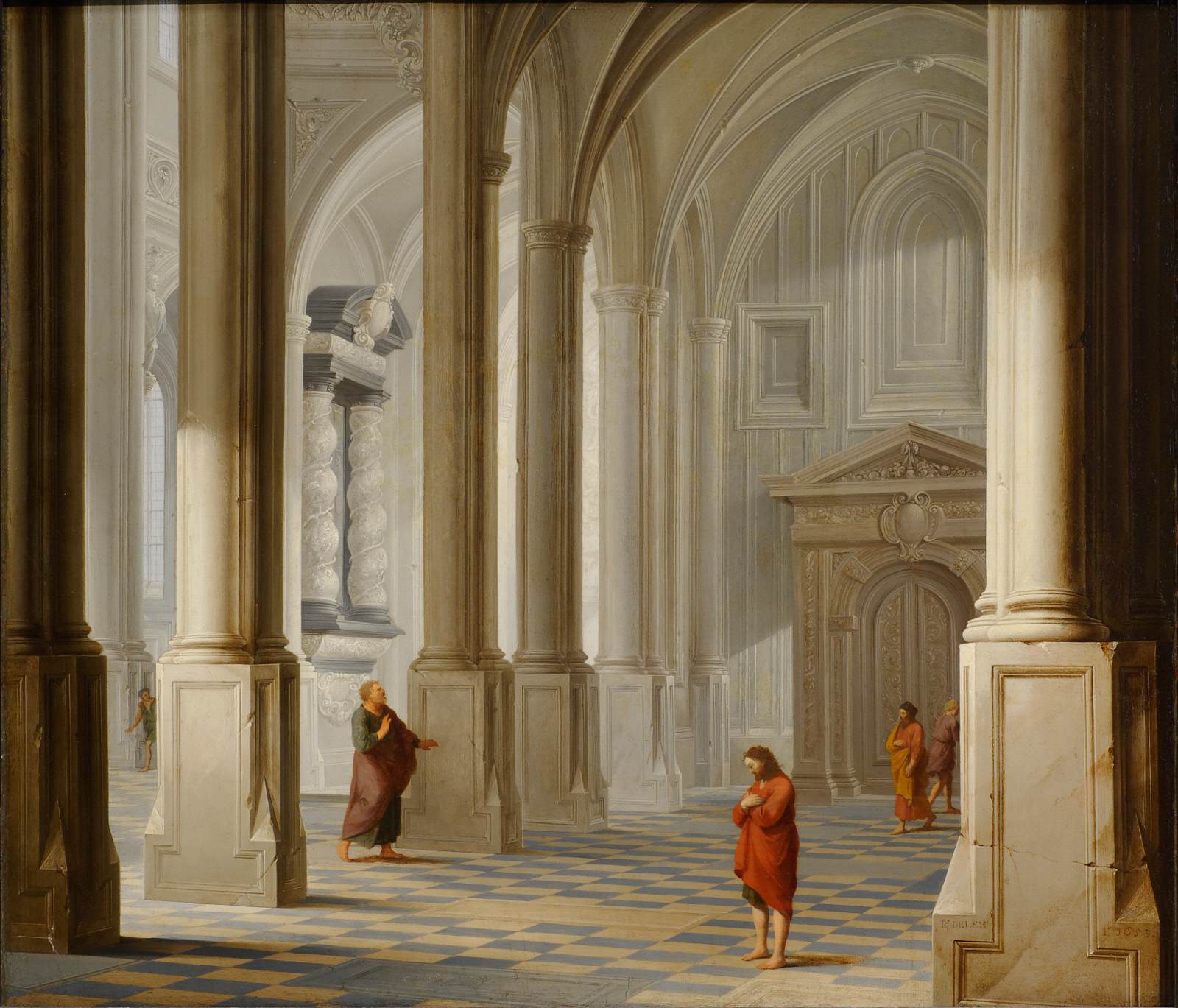
The Parable of the Pharisee and the Publican
Dirck van Delen [Web Gallery of Art]

But the tax collector, standing far off, would not even lift up his eyes to heaven, but beat his breast, saying, ‘God, be merciful to me a sinner!’ (Luke 18:13; Gospel)


24 October 2025

Sunday Reflections, 30th Sunday in Ordinary Time, Year C, 26 October 2025


Church Interior with the Parable of the Pharisee and the Publican
Dirck van Delen [Web Gallery of Art]

Readings (Jerusalem Bible: Australia, Ireland, New Zealand)

Readings (English Standard Version, Catholic Edition: England & Wales, India, Scotland) 

Readings (New American Bible: Philippines, USA)

Gospel Luke 18:1-8 (English Standard Version, Anglicised)

At that time: Jesus told this parable to some who trusted in themselves that they were righteous, and treated others with contempt: ‘Two men went up into the Temple to pray, one a Pharisee and the other a tax collector. The Pharisee, standing by himself, prayed thus: “God, I thank you that I am not like other men, extortioners, unjust, adulterers, or even like this tax collector. I fast twice a week; I give tithes of all that I get.” But the tax collector, standing far off, would not even lift up his eyes to heaven, but beat his breast, saying, “God, be merciful to me, a sinner!” I tell you, this man went down to his house justified, rather than the other. For everyone who exalts himself will be humbled, but the one who humbles himself will be exalted.’

Léachtaí i nGaeilge


Model of The Second Temple


The tax collector ('publican' in older translations) acknowledges his sinfulness when he prays, God, be merciful to me, a sinner! Jesus tells us, This man went down to his house justified. That means that God had forgiven him and lifted the burden of his guilt from him.

The tax collector asked God for mercy and received it. The parable calls us to ask for mercy and to give it when we are asked for it, in that way sharing God's mercy with another. The act of asking for mercy and the act of showing mercy both lead us to an inner freedom.

The story below from Rwanda is a powerful witness to God's mercy shown through a murderer begging for forgiveness from the daughter of the man he killed and through her forgiving him. 

Ntarama Church, Rwanda
Over 5,000 people seeking refuge here were killed by grenade, machete, rifle, or burnt alive during the Rwandan Genocide in 1994.

A religious sister from Rwanda, Sr Genevieve Umawariya, speaking during the Synod on Africa held in Rome in 2009, the theme of which was The Church in Africa at the Service of Reconciliation, Justice and Peace, spoke of an incident that parallels today's gospel. Here is what she said:

I am a survivor of the Tutsi genocide in Rwanda 1994.

A large part of my family was killed while in our parish church. The sight of this building used to fill me with horror and turned my stomach, just like the encounter with the prisoners filled me with disgust and rage.

It is in this mental state that something happened that would change my life and my relationships.

On August 27th 1997 at 1 p.m., a group from the Catholic association of the 'Ladies of Divine Mercy' led me to two prisons in the region of Kibuye, my birthplace. They went to prepare the prisoners for the Jubilee of 2000. They said: 'If you have killed, you commit yourself to ask for forgiveness from the surviving victim, that way you can help him free himself of the burden/weight of vengeance, hatred and rancor. If you are a victim, you commit yourself to offer forgiveness to those who harmed you and thus you free them from the weight of their crime and the evil that is in them'.

This message had an unexpected effect for me and in me . . .

After that, one of the prisoners rose in tears, fell to his knees before me, loudly begging: 'Mercy'. I was petrified in recognizing a family friend who had grown up and shared everything with us.

He admitted having killed my father and told me the details of the death of my family. A feeling of pity and compassion invaded me: I picked him up, embraced him and told him in a tearful voice: 'You are and always will be my brother'.

Then I felt a huge weight lift away from me . . . I had found internal peace and I thanked the person I was holding in my arms.

To my great surprise, I heard him cry out: 'Justice can do its work and condemn me to death, now I am free!'

I also wanted to cry out to who wanted to hear: 'Come see what freed me, you too can find internal peace'.

From that moment on, my mission was to travel kilometers to bring mail to the prisoners asking for forgiveness from the survivors. Thus 500 letters were distributed; and I brought back mail with the answers of the survivors to the prisoners who had become my friends and my brothers . . . This allowed for meetings between the executioners and the victims . . .


From this experience, I deduce that reconciliation is not so much wanting to bring together two persons or two groups in conflict. It is rather the re-establishment of each in love and allowing internal healing which leads to mutual liberation.


And here is where the importance of the Church lies in our countries, since her mission is to offer the Word: a word that heals, liberates and reconciles
.

Pope Francis echoes this last sentence of Sr Genevieve in his message for World Mission Day 2016: Mercy finds its most noble and complete expression in the Incarnate Word. Jesus reveals the face of the Father who is rich in mercy. 

The man who killed Sister Genevieve's father experienced God's mercy through her as she did through him. Each was freed of the very different but related heavy burdens that they carried. And the man had no more fear of whatever punishment he might receive for his crime. Like the tax-collector in the gospel, he made no excuses. He simply asked for mercy.

The tax-collector in the parable, Sr Genevieve Umawariya and the man who had killed her father experienced the truth of the First Beatitude (Matthew 5:3) usually translated into English as Blessed are the poor in spirit: for theirs is the kingdom of heaven. For years I never quite understood what this meant until I read the translation in the New English Bible: How blest are those who know their need of God; the kingdom of Heaven is theirs.

May each of us, like the tax collector, like Sister Genevieve, like the man she forgave and who accepted her forgiveness, know our need of God and of his mercy. 

Alleluia from Exsultate jubilate
Composed by Wolfgang Amadeus Mozart (1756 - 1791)
Sung by Patricia Janečková (1998 - 2023); organist: Petr Cech

Alleluia (Hallelujah) is a joyful Hebrew word that means 'Praise God'.

I end with a prayer from a Psalm, Psalm 27[26]: 'One thing have I asked of the Lord, that will I seek after; that I may dwell in the house of the Lord all the days of my life, to behold the beauty of the Lord, and contemplate his temple' (v. 4). Let us hope that the Lord will help us to contemplate his beauty, both in nature and in works of art, so that we, moved by the light that shines from his face, may be a light for our neighbour. (Pope Benedict XVI, General Audience, 31 August 2011)


Traditional Latin Mass

What earlier generations held as sacred, remains sacred and great for us too, and it cannot be all of a sudden entirely forbidden or even considered harmful (Benedict XVI). 

Feast of the Kingship of Our Lord Jesus Christ

The Complete Mass in Latin and English is here. (Adjust the date at the top of that page to 10-26-2025 if necessary).

Epistle: Colossians 1:12-20Gospel: John 18:33-37.

Christ Before Pilate
Mihály Munkácsy [Web Gallery of Art]

Pilate entered the praetorium again and called Jesus, and said to him, 'Are you the King of the Jews?' (John 18:33; Gospel). 

Christus vincit, Christus regnat, Christus imperat!
Christ conquers, Christ reigns, Christ rules!

Misericordia Catholic Choir, Sibiu, Romania


15 August 2025

'Take hold of the eternal life to which you were called.' Sunday Reflections, 20th Sunday in Ordinary Time, Year C


Blessed Margaret Ball and Blessed Francis Taylor
St Mary's Pro-Cathedral, Dublin [Wikipediaphoto]

Readings (Jerusalem Bible: Australia, Ireland, New Zealand, Pakistan,)

Readings (English Standard Version, Catholic Edition: England & Wales, India, Scotland) 

Readings (New American Bible: Philippines, USA)

Gospel Luke 12:49-53 (English Standard Version, Anglicised)

At that time: Jesus said to his disciples, ‘I came to cast fire on the earth, and would that it were already kindled! I have a baptism to be baptised with, and how great is my distress until it is accomplished! Do you think that I have come to give peace on earth? No, I tell you, but rather division. For from now on in one house there will be five divided: three against two and two against three. They will be divided, father against son and son against father; mother against daughter and daughter against mother; mother-in-law against her daughter-in-law, and daughter-in-law against mother-in-law.’

Léachtaí i nGaeilge


Jeremiah Lamenting the Destruction of Jerusalem
Rembrandt [Web Gallery of Art]

Then the officials said to the king, ‘This man should be put to death’ . . . Then the king commanded Ebed-Melek the Cushite, ‘Take thirty men from here with you and lift Jeremiah the prophet out of the cistern before he dies’ (Jeremiah 38: 4, 10; First Reading).

Margaret Bermingham (1515-1584) was born near where I live in County Meath, Ireland, into a prosperous Catholic family. In her mid-teens she married Bartholomew Ball, becoming part of another prosperous Catholic family. Some sources say that the couple had twenty children, others ten. But only five survived into adulthood. Bartholomew served as Lord Mayor of Dublin for a while. Two of his sons were to find themselves in the same position, as did Francis Taylor, who married Gennet Shelton, a granddaughter of Margaret. Both Margaret and her grandson-in-law were to meet a similar fate and are numbered among the 17 Irish Martyrs beatified by St John Paul II on 22 September 1992.

It was a time when Queen Elizabeth I carried out a persecution of Catholics in England and Ireland who would not submit to her as head of the Church of England and the Church of Ireland, the members of which were called Protestants. Walter Ball, the eldest son of Margaret and Bartholomew, became a zealous Protestant and in 1577 was appointed Commissioner for Ecclesiastical Causes, a position, as far as I can make out, the main responsibility of which was to persecute Catholics.

Margaret's home in Dublin was a safe house for bishops and priests where they could celebrate Mass, something they could not do publicly. When Walter became Lord Mayor in 1580, while still retaining his previous position, a higher one, he had  his mother, who suffered greatly from arthritis, arrested and dragged through the streets of Dublin tied to a wooden pallet and taken to the prison in Dublin Castle, the seat of English rule in Ireland. This was the method often used to bring prisoners to the gallows. Walter said that his mother deserved to be executed for her Catholic faith but that he had spared her.

Two years later Walter's younger brother Nicholas became Lord Mayor. He had remained faithful to the Catholic faith but was powerless to release his mother as Walter outranked him by his royal appointment as Commissioner for Ecclesiastical Causes. However, he visited his mother regularly, bringing her food, clothing and some furniture. But the appalling conditions gradually wore Margaret down and she died in 1584.

She had consistently prayed for her son Walter and did not disinherit him.

Eleven years later Francis Taylor, who had married Margaret's granddaughter Gennet Shelton, both of them faithful Catholics, became Lord Mayor of Dublin in 1595 but was imprisoned for his faith in Dublin Castle, like his grandmother-in-law, and died seven years later in 1613 from the harsh conditions that had gradually worn him down.

Both Margaret and Francis were beatified with 15 other Irish Martyrs on 27 September 1992 by St John Paul II. In his homily the Pope saidAll sectors of God’s people are represented among these seventeen Servants of God: Bishops, priests both secular and religious, a religious brother and six lay people, including Margaret Bermingham Ball, a woman of extraordinary integrity who, together with the physical trials she had to endure, underwent the agony of being betrayed through the complicity of her own son.

Further on St John Paul said: The Martyrs’ significance for today lies in the fact that their testimony shatters the vain claim to live one’s life or to build a model of society without an integral vision of our human destiny, without reference to our eternal calling, without transcendence. The Martyrs exhort succeeding generations of Irish men and women: 'Fight the good fight of the faith; take hold of the eternal life to which you were called . . . keep the commandments unstained and free from reproach until the appearing of our Lord Jesus Christ'.

It is unbelievable how cruelly Walter Ball treated his mother and his family. We can hope that his mother's prayers obtained for him the grace of repentance before he died.

For from now on in one house there will be five divided, three against two and two against three.

Faith of our Fathers

Words by Fr Frederick William Faber 

Sung by Frank Patterson

With the Irish Philharmonic Orchestra and Chorus

Fr Faber wrote the words of this hymn to honour the Catholic martyrs of England and Ireland who died during the Reformation. The word 'Fathers' is used in an inclusive sense, meaning 'ancestors'. The version above uses the traditional tune Sawston, the one most common in Britain and Ireland. The tune normally used in the USA is called St Catherine and was written by Henri Hemy.

Up to the 1960s this hymn used to be sung before the national anthem at Gaelic Football and Hurling finals in Ireland.

The final stanza of the hymn expresses for me the faith of Blessed Margaret Ball and her love for her son Walter, despite what he had done to her:

Faith of our Fathers! we will love
Both friend and foe in all our strife:
And preach thee too, as love knows how
By kindly words and virtuous life
.

Faith of our fathers' holy faith! We will be true to thee till death!


 Traditional Latin Mass

Tenth Sunday after Pentecost

The Complete Mass in Latin and English is here. (Adjust the date at the top of that page to 08-17-2025 if necessary).

Epistle: 1 Corinthians 12:2-11Gospel: Luke 18:9-14

The Parable of the Pharisee and the Publican
Dirck van Delen [Web Gallery of Art]

But the tax collector, standing far off, would not even lift up his eyes to heaven, but beat his breast, saying, ‘God, be merciful to me a sinner!’ (Luke 18:13; Gospel)