Showing posts with label Faroes. Show all posts

01 August 2013

'Christ is all, and in all.' Sunday Reflections, 18th Sunday in Ordinary Time Year C

Apse mosaic (detail), Italian mosaic artist, 1145-60 [Web Gallery of Art]

Readings (New American Bible: Philippines, USA)                                  

Readings (Jerusalem Bible: Australia, England & Wales, India [optional], Ireland, New Zealand, Pakistan, Scotland, South Africa)

Gospel Luke 12:13-21 (Revised Standard Version – Catholic Edition)

One of the multitude said to Jesus, "Teacher, bid my brother divide the inheritance with me." But he said to him, "Man, who made me a judge or divider over you?" And he said to them, "Take heed, and beware of all covetousness; for a man's life does not consist in the abundance of his possessions."

And he told them a parable, saying, "The land of a rich man brought forth plentifully; and he thought to himself, 'What shall I do, for I have nowhere to store my crops?' And he said, 'I will do this: I will pull down my barns, and build larger ones; and there I will store all my grain and my goods. And I will say to my soul, Soul, you have ample goods laid up for many years; take your ease, eat, drink, be merry.' But God said to him, 'Fool! This night your soul is required of you; and the things you have prepared, whose will they be?' So is he who lays up treasure for himself, and is not rich toward God." 


Here there cannot be Greek and Jew, circumcised and uncircumcised, barbarian, Scythian, slave, free man, but Christ is all, and in all (Colossians 3:11, Second Reading). 


One of the most characteristic features of international World Youth Days is groups of young pilgrims proudly carrying their national flags, not with a sense of trying to express superiority but rather with a sense of being part of a wider and deeper reality. That reality is the Church, a Church given the mission by Jesus to Go and make disciples of all nations (Matthew 28:19), the theme of WYD Rio2013 that ended last Sunday.

St Cyril of Jerusalem in his instructions to catechumens describes the Church this way:

The Church, Catholic or universal, gets her name from the fact that she is scattered through the whole world from the one end of the earth to the other, and also because she teaches universally and without omission all the doctrines which are to be made known to mankind, whether concerned with visible or invisible things, with heavenly or earthly things. Then again because she teaches one way of worship to all men, nobles or commoners, learned or simple; finally because she universally cures and heals every sort of sin which is committed by soul and body. Moreover there is in her every kind of virtue in words and deeds and spiritual gifts of every sort (Office of Readings, Wednesday, 17th Week of Ordinary Time).

The young people in the video who welcomed Pope Francis to Copacabana beach on the evening of 25 July showed The Church, Catholic or universal, by carrying their countries' flags. On the following Sunday morning in the same place they showed that same universality in a different way by lowering their flags before Mass began as they engaged in one way of worship, as the Church had taught them.

On the evening of the 25th Pope Francis said:

I greet you with affection. All of you assembled here from the five continents and, through you, all young people of the world, in particular those who wanted to come to Rio de Janeiro but weren’t able to come. To those who are following us by means of radio, television and internet, to everyone I say: Welcome to this feast of faith! In several parts of the world, at this very moment, many young people have come together to share this event with us: let us all experience the joy of being united with each other in friendship and faith. And be sure of this: my heart embraces all of you with universal affection. Because what is most important today is your gathering here and the gathering together of all the young people who are following us through various forms of media. From the summit of the mountain of Corcovado, Christ the Redeemer welcomes you and embraces you in this beautiful city of Rio!

Christ the Redeemer was embracing them as one. This embrace of Christ was symbolised beautifully a few days later when a little boy wearing a Brazilian football shirt made his way to the popemobile and whispered his secret to the Argentinian Bishop of Rome, I have a very important message for you . . . I want to become a priest.

These photos were taken in Rio. I came across them on Facebook and they're from the FB of Zenit, one of the leading Catholic news agencies. Here is the story that goes with the photos.

I spent much of the summer of 2000 in the Faroe Islands in the north Atlantic. The first settlers came there from central Norway around AD 1000 but the islands, while semi-autonomous, are under the sovereignty of Denmark. Out of the 50,000 or so population there were only about 100 or so Catholics, the only church being in the capital, Tórshavn. But I celebrated Mass one Saturday in Klaksvík, the second largest town in the Faroes. We had to take a ferry on the last leg of our journey, though a tunnel has since been opened. 


We celebrated Mass in the home of a Filipina. There were about 15 of us but we had no common language. Sr Marisa FMM was from Malta, there was a Canadian woman, some university students from Poland working in a fish factory for the summer and one or two other nationalities. (Sr Marisa is still in the Faroes). The Mass was mostly in English, which not all understood, and we had a reading in Tagalog. However, all participated fully. (If I were in that situation today I would use some Latin). We experienced the truth of the words of St Cyril of Jerusalem in the quotation above: the Church teaches one way of worship to all men, nobles or commoners, learned or simple.

After Mass we had lunch, which consisted mostly of Filipino dishes, a new treat for some present.

Despite our lack of a common language we were totally united in our celebration as Catholic Christians of the Holy Sacrifice of the Mass. This is where we find our deepest identity, where we 'lower our flags' as we engage in one way of worship as sons and daughters of our heavenly Father, as brothers and sisters of Jesus, God who became Man, as brothers and sisters of one another, where Christ is all, and in all.


02 November 2012

'Silent No More' - and dangerous advice to pregnant women in Ireland


The video above is a production of The Silent No More Campaign. It is coming more and more to light that abortion, apart from being fatal to the child and sometimes to the mother, leaves a scar on the lives of many mothers and fathers of aborted children.


Groups such as Rachel's Vineyard reach out to such persons through weekend retreats where healing can begin. Only last weekend Bernadette Goulding (photo above) of Rachel's Vineyard Ireland let a retreat in Tórshavn, the capital of the beautiful Faroe Islands in the north Atlantic, a country of just under 50,000 people and under the jurisdiction of Denmark. I spent about six weeks there during the summer of 2000. There is no permanent priest there, though there is a permanent deacon. The islands come under the Diocese of Copenhagen, which includes three countries in two continents, Denmark, the Faroes and Greenland.

Tinganes, the old part of Tórshavn

While Bernadette was conducting the retreat in the Faroes the most widely read newspaper in Ireland, the Irish Independent, carried two stories of how some pregnant women in the Republic of Ireland, where abortion is illegal, have been given advice by counsellors that could put their lives in danger. One story was under the headline Revealed: the abortion advice that could put lives at risk. (The reality that abortion is almost always fatal to the child, though occasionally one survives, is usually overlooked.)

Gemma O'Doherty reports: STAFF at some taxpayer-funded pregnancy counselling services are putting women's lives at risk and breaking the law, an undercover probe has revealed.
The investigation was carried out over several months by a team of women, some from the pro-life movement, who secretly recorded counsellors at 11 locations around the country.
Some of the advice they gave about abortion was illegal, according to a leading lawyer, and some was medically dangerous, a top doctor says.
In several instances, women were told to hide their abortions from their doctors, a course of action that could endanger life if post-surgery abortion complications remain undiagnosed. (Full report here. The HSE mentioned in the story is the Health Service Executive, a government agency.)

The second story in the Irish Independent on the same date, 27 October, carries the headline Shocking breach of good medical practice, says Rotunda chief. The Rotunda Hospital (above), in the heart of Dublin, is the oldest of three major maternity hospitals in the Irish capital, which is said to be one of the safest places in the world for pregnant women.
This story begins: A LEADING obstetrician has warned that advice given by some taxpayer-funded pregnancy-counselling services is putting women's lives in danger.
Sam Coulter Smith, clinical professor of obstetrics and gynaecology at the Royal College of Surgeons, said he was "shocked and very disappointed" to learn that Irish women who travel to Britain for abortions are being told they should hide this from their doctors.
The findings, which emerged as part of an undercover investigation into crisis-pregnancy counselling services, are now the subject of an HSE probe.
At the HSE-run Crisis Pregnancy Support Service in Ballinasloe, Co Galway, a woman was told that "going on to have future pregnancies, there is no onus on you to disclose that you've had a termination.
"There is no direct relationship between termination, future pregnancy, anything like that. They don't need to know. They will ask you the same general question: is this your first pregnancy? You can say 'Yes'." (Full report here.)
There is a great need for political activity to ensure that every person, born and unborn, will have first-class medical care. There is need for public advocacy to ensure that the laws of every country will recognise the right to life of every human being, born and unborn, to fight against the twisted sense of the 'right' to kill an unborn child.
But as we see on every page of the Gospels, Jesus showed us how to live by the way he related to each suffering person he met. Some of us are called to be political and social activists, for want of a better term, but some are called specifically to enable individual women and men, persons with an individual name and an individual history, to experience the power of God's healing. 
Those involved in Rachel's Vineyard and similar groups, many of whom have experienced such healing, are called by God to meet the individual with compassion and with a message of hope.

26 October 2012

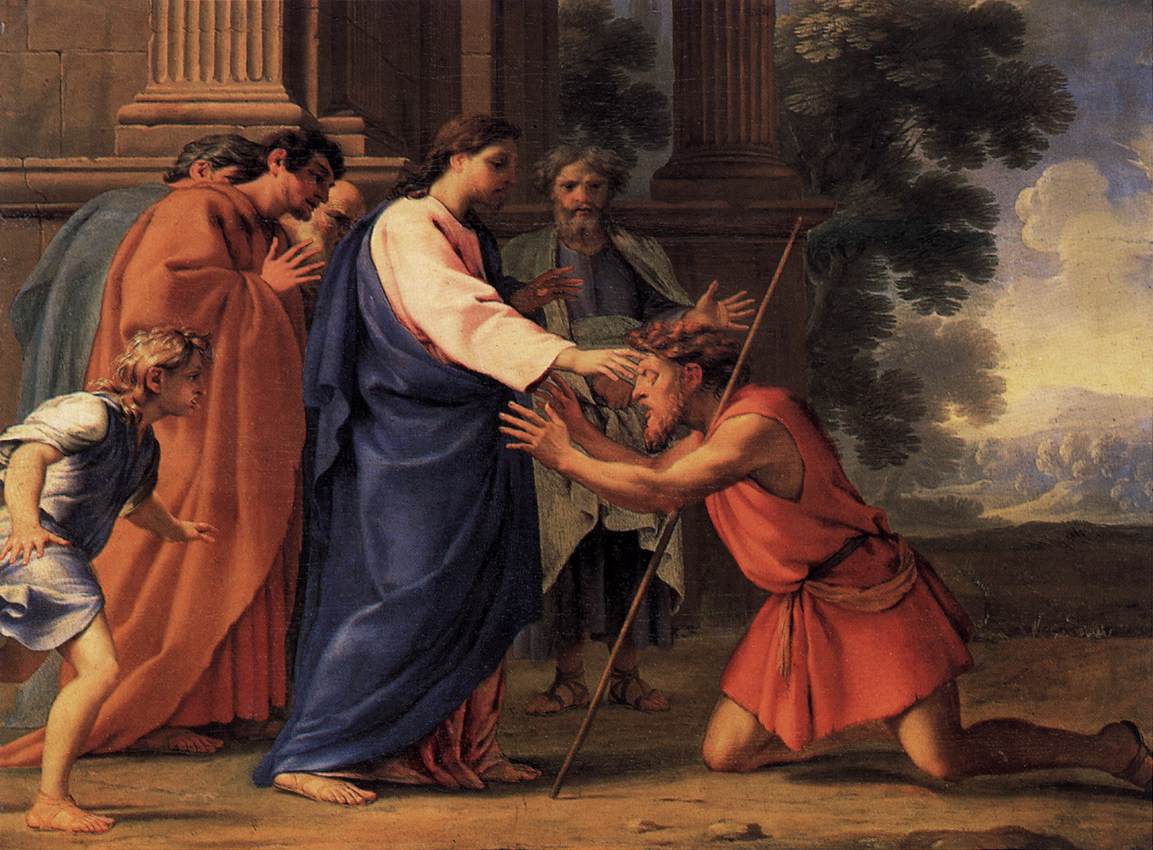
'What do you want me to do for you?' Sunday Reflections. 30th Sunday in Ordinary Time Year B

Christ healing the Blind Man, Eustache Le Sueur 
[Web Gallery of Art]  


Readings (New American Bible: Philippines, USA) 

Readings (Jerusalem Bible: Australia, England & Wales, India [optional], Ireland, New Zealand, Pakistan, Scotland, South Africa) 


Gospel Mark 10:46-52 (Revised Standard Version – Catholic Edition)

As Jesus was leaving Jericho with his disciples and a great multitude, Bartimaeus, a blind beggar, the son of Timaeus, was sitting by the roadside. And when he heard that it was Jesus of Nazareth, he began to cry out and say, "Jesus, Son of David, have mercy on me!" And many rebuked him, telling him to be silent; but he cried out all the more, "Son of David, have mercy on me!" And Jesus stopped and said, "Call him." And they called the blind man, saying to him, "Take heart; rise, he is calling you." And throwing off his mantle he sprang up and came to Jesus. And Jesus said to him, "What do you want me to do for you?" And the blind man said to him, "Master, let me receive my sight." And Jesus said to him, "Go your way; your faith has made you well." And immediately he received his sight and followed him on the way.
+++


Fr John Burger is an American Columban who has just finished six years as a member of the Columban General Council. He spent the early years of his priesthood in Japan and tells a wonderful story about a blind man who was a member of a prayer group in a parish where he served. Each week the group met to share on the following Sunday’s gospel and to pray. Father John was a little nervous when this Sunday’s gospel came up, wondering how his blind friend would respond.


He and the others were astonished when the man shared that this was one of his favourite passages in the gospels. Why? Because Jesus asked Bartimaeus, What do you want me to do for you? The blind parishioner went on to say that he was quite happy as he was. He had his own apartment and he knew his way around. But if the Lord were to ask him directly, What do you want me to do for you? He would tell him that there were parts of his life where he would like Jesus to shed his light, even though he would hesitate to ask him to do so.


Probably the blind Japanese man had experienced people, with every good intention, wanting to help him when he needed no help. On a pilgrimage to Lourdes in Easter Week 1991 with a group of persons with physical disabilities I shared a room with our leader, Joe, able-bodied, like myself, and Tony and Tom who weren’t. Both needed help in some very personal matters. However, I learned very quickly from Tom not to do something for him when he could do it himself. That was a very good lesson for me.


Jesus didn’t presume that Bartimaeus wanted his sight back. He asked him, What do you want me to do for you? The blind man, who had shouted Jesus, Son of David, a title indicating he was the Messiah, answered, Master, let me receive my sight.


Do I allow Jesus to ask me, What do you want me to do for you? And if I allow him do I have the faith of Bartimaeus to tell him what I want him to do for me? Jesus responded to the faith of the blind man: Go your way; your faith has made you well. And the blind beggar’s response to this was a further expression of his faith: And immediately he received his sight and followed him on the way.


On 11 October in his homily at the Mass marking the opening of the Year of Faith and the 5oth anniversary of the opening of the Second Vatican Council Pope Benedict said, The Year of Faith which we launch today is linked harmoniously with the Church’s whole path over the last fifty years: from the Council, through the Magisterium of the Servant of God Paul VI, who proclaimed a Year of Faith in 1967, up to the Great Jubilee of the year 2000, with which Blessed John Paul II re-proposed to all humanity Jesus Christ as the one Saviour, yesterday, today and forever. Between these two Popes, Paul VI and John Paul II, there was a deep and profound convergence, precisely upon Christ as the centre of the cosmos and of history, and upon the apostolic eagerness to announce him to the world. Jesus is the centre of the Christian faith. The Christian believes in God whose face was revealed by Jesus Christ. He is the fulfilment of the Scriptures and their definitive interpreter. Jesus Christ is not only the object of the faith but, as it says in the Letter to the Hebrews, he is “the pioneer and the perfecter of our faith” (12:2).


Bartimaeus seemed to have grasped something of this, calling Jesus by a Messianic title, Son of David, putting his faith in him and following him on the way.


+++

Father Cyril Axelrod CSsR  is the only deaf-blind priest in the world. He was born profoundly deaf but became blind more than ten years ago from Usher Syndrome. He ministers to people who are deafblind and to people who are deaf. You can read about him here. In this video Father Cyril speaks to seminarians


When I was in secondary school we studied some of the poetry of John Milton, most of which I disliked. But his sonnet On His Blindness was an exception.


+++


Bernadette Goulding of Rachel's Vineyard Ireland with Sr Maria Forrestal FMM, an Irish Sister based in the Faroes. Bernadette was speaking about Rachel's Vineyard during a visit two years ago.

Please pray for the Rachel’s Vineyard retreat this weekend in the FaroeIslands, where I worked in the summer of 2000. It is an outreach of Rachel’s Vineyard Ireland


The carving of Our Lady of Kirkjubøur is a copy of the original carving
which is to be found on one of the Kirkjubøur benches,
and currently on display in the National Museum.
This carving is the handwork of parishioner, Ole Jacob Nielsen,
and is carved in Faroese wood.

04 August 2011

'"Come" said Jesus.' Sunday Reflections, 19th Sunday in Ordinary Time Year A, 7 August 2011


Come

Jesus says, ‘Come, through all the turmoil,
the storms which threaten to engulf me.
He calls out to me.
He wants to pull me towards him.

Jesus is present in the storms of my life.
He is in the boat with me.
He says, ‘Trust me!’

He is also saying, ‘I need you.
We’re a balancing act, dancing together!

I need you to believe in me.
I need you to be me on earth.

You need my power and love to grow
and reveal me
to your brothers and sisters.

When you don’t trust,
you sink!
You are swallowed up
in life’s sorrows.
You block my power
to work through you’.

The painting and reflection above are by Sr Maria Forrestal, an Irish Franciscan Missionary of Mary who has worked in the Faroe Islands in the North Atlantic for many years. Among other things, Sister Maria maintains the excellent website of the Catholic Church in the Faroes.
 
Readings (New American Bible, used in the Philippines and the USA).
 
Gospel (Matthew 14:22-33; Jerusalem Bible, used in Australia, England & Wales, Ireland, Scotland)

Jesus made the disciples get into the boat and go on ahead to the other side while he would send the crowds away. After sending the crowds away he went up into the hills by himself to pray. When evening came, he was there alone, while the boat, by now far out on the lake, was battling with a heavy sea, for there was a head-wind. In the fourth watch of the night he went towards them, walking on the lake, and when the disciples saw him walking on the lake they were terrified. 'It is a ghost' they said, and cried out in fear. But at once Jesus called out to them, saying, 'Courage! It is I! Do not be afraid.' lt was Peter who answered. 'Lord,' he said 'if it is you, tell me to come to you across the water.' 'Come' said Jesus. Then Peter got out of the boat and started walking towards Jesus across the water, but as soon as he felt the force of the wind, he took fright and began to sink. 'Lord! Save me!' he cried. Jesus put out his hand at once and held him. 'Man of little faith,' he said 'why did you doubt?' And as they got into the boat the wind dropped. The men in the boat bowed down before him and said, 'Truly, you are the Son of God'.

Soiscéal (Matha 14:22-33, Gaeilge, Irish)

San am sin chuir Íosa d’fhiacha ar na deisceabail dul ar bord agus imeacht roimhe go dtí an taobh thall fad a bheadh sé féin ag scaoileadh na sluaite uaidh. Agus tar éis a scaoilte dó, chuaigh sé an sliabh suas ar leithligh chun guí, agus nuair a bhí an tráthnóna ann bhí sé ansiúd ina aonar. Bhí an bád faoin am sin mórán staideanna amach ón talamh, á bocadh ag na farraigí, mar bhí an ghaoth contrártha. Sa cheathrú faire den oíche, tháinig sé chucu ag siúl ar an bhfarraige. Nuair a chonaic na deisceabail é, agus é ag siúl ar an bhfarraige, bhí siad buartha: “Taibhse atá ann!” ar siad, agus scread siad amach le barr eagla. Ach labhair Íosa leo láithreach: “Bíodh misneach agaibh!” ar seisean, “mise atá ann, ná bíodh eagla oraibh.” D’fhreagair Peadar é: “A Thiarna,” ar seisean, “más tú atá ann, ordaigh mé a theacht chugat ar bharr an uisce.” Dúirt Íosa: “Tar!” Agus tháinig Peadar amach as an mbád agus shiúil ar bharr an uisce ag déanamh ar Íosa. Ach nuair a d’airigh sé chomh borb agus a bhí an ghaoth, rug an eagla air; thosaigh ag dul faoi uisce agus scread sé amach: “A Thiarna, saor mé!” ar seisean. Shín Íosa amach a lámh láithreach, agus ag breith greama air dúirt: “A fhir an bheagán creidimh, cén fáth ar tháinig amhras ort?” Ar dhul isteach sa bhád dóibh, thit an ghaoth. Agus iad seo a bhí sa bhád, d’umhlaigh siad síos ina láthair ag rá: “Go dearfa, is tú Mac Dé.”

+++

Sister Maria's painting evokes in me a sense of my vocation. Jesus invited Peter to step out. Peter did but then hesitated. Each person's vocation is unique. Some know from their childhood where God is calling them, some from early adolescence, as was my experience, some at a much later stage. But however one experiences God's call at some stage one has to step out.

A priest I knew here in the Philippines, the late Fr Vincent San Juan SJ, spent most of his life as a priest in the family life apostolate, working particularly with couples. I heard him speak of ballroom dancing as an image of the relationship of a husband and wife. The man usually leads, though not always, the woman following his moves. When I reached adolescence in the mid-1950s rock 'n' roll hat hit the scene and ballroom dancing disappeared for my generation. I used to envy my parents, uncles and aunts when I'd see them dancing with such skill, teamwork and enjoyment!

Sister Maria shows Jesus and Peter involved in a dance. Jesus is holding Peter's hand even before he steps out. I remember how my father taught me to swim and to ride a bicycle. He held his hand under my chest in the water, giving me a sense of security. Then on one occasion I realised his hand wasn't there anymore. I was swimming on my own. It was the same with cycling. My Dad kept a grip on the saddle until he judged that I could manage on my own. I remember the great joyful sense of freedom I felt on both occasions. But I would never have learned to swim or ride a bike without 'stepping out' as Peter did, even though he then lost his nerve.

Fr Gerard Dunne OP sees the present crisis in the Church in Ireland as a time for a young person to answer God's call to the priesthood or religious life. I quote here from a recent post in his blog, Irish Dominican Vocations, Why consider a vocation in the midst of a crisis?

The church and its people are not just survivors who grit their teeth in the face of either internal turmoil or external opposition. The church doesn't just survive - it lives. It lives because Jesus Christ lives in and through the church. In the midst of this present crisis we must humbly admit that we are the recipients of the graciousness and unconditional love of Jesus Christ who promised never to abandon his disciples: "And know that I am with you always; yes, to the end of time." (Matthew 28:10) The church has existed and lived these 2000 years because of God's grace manifested through the guidance of the Holy Spirit.

During these dark days I am often reminded of the words of Blessed John Paul II in Toronto during a World Youth Day event when he addressed the young people saying: "At difficult moments in the church's life, the pursuit of holiness becomes even more urgent. And holiness is not a question of age; it is a matter of living in the Spirit......We are not the sum of our weaknesses and failures; we are the sum of the Father's love for us and our real capacity to become the image of his Son."

While many might argue that this is the worst time ever to consider a religious vocation, I see it as the most desirable time to discern life as a sister, brother, nun, priest and indeed Dominican. Here's a few reasons:

Firstly, God continues to call and invite people to a life of service and community, especially when the church faces and unprecedented crisis like the one we presently face. Our history proves this. In the middle of the great injustices of the Spanish Inquisition God called St Teresa of Avila to a life of mysticism and ultimately of reform of her Carmelite order; Saint Francis had a dream of rebuilding God's house and in response chose to live a life of radical simplicity through simplicity, prayer and penance - in stark contrast to the wealth and corruption of the twelfth century church. A couple of hundred years later when there was unrest in the church and a divided papacy Saint Catherine of Siena responded to God's call to live the Dominican life and later became a mediator for peace and the reunification of the papacy.

The church still benefits from the virtue of these heroic men and women and the many more like them who heard God's call and invitation to live a radical Gospel life in the midst of a church in turmoil. I am confident that with the help of God's grace that we will be telling similar stories in the future of today's heroic men and women who responded to the challenges of religious life.

Another reason to consider a religious vocation is that our church needs the creativity, idealism, faith and spirituality of a new generation. In the midst of our crisis the poor in our world continue to suffer from a lack of education, healthcare, social services. In a culture that suffers from inequalities, violence and disregard for human life, people need to hear the prophetic message of justice, peace and dignity. And in the middle of the crisis that the church now faces, people more than any other time in history need to hear the Gospel preached.

One further reason: the church needs more than just service. In a society that glamourises wealth, sex, power and money the church needs the continued witness of young people (and not so young) who are willing to give their all for holiness by living a life of chastity, obedience and poverty. Because we are a sacramental church we need priests to preach the Word with integrity and minister in times of joy and pain with sensitivity. When the world is plagued by polarization and division we need the hope for the Christian community that is inspired by people who come together to live and share their faith, values and mission.

By considering a religious vocation, there is nothing to lose. Why? Because all vocations are oriented towards holiness and a deepening of a relationship with God. I would continue to encourage people to consider religious life for the sheer joy that it can bring. Of course there are challenges and sacrifices but there is a deep consolation in knowing that you are following God's will or plan for you and that you are making a significant contribution to the life of the church and those that you live with and serve.
These are definitely trying times for the church especially in Ireland. But they are not the first, nor will they be the last. Keep on considering your vocation - and do not be afraid.

The full text of Father Gerard's post is here.


Nicene Creed

Credo in unum Deum, I believe in one God,
Patrem omnipoténtem, the Father almighty,
factórem caeli et terrae, maker of heaven and earth,
visibílium ómnium et invisibílium. of all things visible and invisible

Et in unum Dóminum Iesum Christum, I believe in one Lord Jesus Christ,
Fílium Dei Unigénitum, the Only Begotten Son of God,
et ex Patre natum ante ómnia saecula. born of the Father before all ages.
Deum de Deo, lumen de lúmine, God from God, Light from Light,
Deum verum de Deo vero, true God from true God,
génitum, non factum, consubstantiálem Patri: begotten, not made, consubstantial with the Father;
per quem ómnia facta sunt. through him all things were made.

Qui propter nos hómines et propter nostram salútem For us men and for our salvation
descéndit de caelis. he came down from heaven,
Et incarnátus est de Spíritu Sancto ex María Vírgine, and by the Holy Spirit was incarnate of the Virgin Mary,
et homo factus est. and became man.

Crucifíxus étiam pro nobis sub Póntio Piláto; For our sake he was crucified under Pontius Pilate,
passus et sepúltus est, he suffered death and was buried,
et resurréxit tértia die, and rose again on the third day
secúndum Scriptúras, in accordance with the Scriptures.
et ascéndit in caelum, He ascended into heaven
sedet ad déxteram Patris.and is seated at the right hand of the Father.
Et íterum ventúrus est cum glória, He will come again in glory
iudicáre vivos et mórtuos, to judge the living and the dead
cuius regni non erit finis. and his kingdom will have no end.

Et in Spíritum Sanctum, Dóminum et vivificántem: I believe in the Holy Spirit, the Lord, the giver of life,
qui ex Patre Filióque procédit. who proceeds from the Father and the Son,
Qui cum Patre et Fílio simul adorátur et conglorificátur: who with the Father and the Son is adored and glorified,
qui locútus est per prophétas. who has spoken through the prophets.

Et unam, sanctam, cathólicam et apostólicam Ecclésiam. I believe in one, holy, catholic and apostolic Church.
Confíteor unum baptísma in remissiónem peccatórum. I confess one Baptism for the forgiveness of sins
Et exspécto resurrectiónem mortuórum, and I look forward to the resurrection of the dead
et vitam ventúri saeculi. Amen. and the life of the world to come. Amen.


Here in the Philippines the Nicene Creed is rarely used at Mass, a great pity. The English translation above is the new one that will come into effect in most English-speaking countries on the First Sunday of Advent. The Philippines isn't an English-speaking country, though it is widely used in Mass, especially in the larger cities. It is one of the official languages of the country. I haven't heard any official announcement from the bishops as to when the new translation will be implemented here. I will probably use the opportunity of the change to introduce people to the Nicene Creed, which is the 'default' one for Mass.

View of the Catholic church (Mariukirkjan) and convent (Kerit) from Varðagøta, Torshavn, capital of the Faroes.


06 December 2010

A new perspective, from the Faroe Islands, on 'The CATechism' - and something more serious

I believe that when God created the first cat He smiled. The photo above brought more than a smile to my face. It made me laugh. I found it in the Facebook account of my friend Sr Maria Forrestal FMM in the Faroe Islands. She is from County Wexford, Ireland, Through her I spent six or seven weeks in the Faroes in the summer of 2000. There's no permanent priest there. The Faroes come under the Diocese of Copenhagen, which includes all of Denmark, the Faroe Islands and Greenland, probably the only diocese in the world now that covers three countries in two continents.

Here are Sister Maria's own words to accompany the photo: Hehe, naughty but nice! Must confess to having "borrowed" the photo from another profile... There is a play of words.The title of the book the cat is "reading" is a send up of a book called "The God Delusion" by English evolutionary biologist and atheist, Richard Dawkins. He argues that God is a delusion. So here we have God spelt backwards (dog) and a cat being "persuaded" that dogs don´t exist!!! We know the answer to that one.

This reminds me of the then eleven-year-old son of one of my closest friends in Dublin who asked me if I had heard about the dyslexic, insomniac agnostic. I hadn't. My young friend informed me that he had spent the whole night awake wondering if there was a dog.

Sister Maria works through art. She conducted days on Art and Prayer on 13 and 20 November. Here is how she describes the experience:

A day during which participants relax in silence,
reflect and meditate on their lives in the light of the Word of God,
enjoy the beauty of nature in the nearby park
and the beauty of the architecture in Mariukirkjan,
discover and explore their creative talents,
share their experience together,
get to know each other
and enjoy some good food!

Here is the image, painted by Sister Maria, which inspired the day:


"Believe"
John 1:4-5

The Church and Sisters' convent in Torshavn, Faroes

You can get a brief history of the Church in the Faroes here with links to the many interesting pages, in English, Danish and Faroese, on the website of the Church there. One of the most interesting is FOCUS ON "FORBIDDEN GRIEF" (RACHEL´S VINEYARD) IN MARIUKIRKJAN Sunday, 3rd. October.

Sr Maria (right) introducing Mrs Bernadette Goulding of Rachel's Vineyard, Ireland, in the Faroes.

When I was at home in Dublin a while back I had a long chat with Fr Laurence Kettle OFMCap, who grew up there who told me about Bernadette the day before he returned to Seoul. I contacted her and when it was possible for me to visit her in Cork, where she lives, I discovered she was in the Faroes at the invitation of Sister Maria. Bernadette and I met for lunch the day after she returned. I don't know yet where all of this is leading.

Bernadette gave me Forbidden Grief, which I'm reading at the moment. There is a review of the book, with many links, on the website of the Church in the Faroes here.

I had no idea that the feline philosopher/theologian at the top would lead me here. This post is all over the place, in more senses than one - but that is how life is.


05 November 2009

5 November, Day 25: update on kidnapping of Fr Michael Sinnott


County Wexford is one of Ireland's 32 counties and is in the south-east. Fr Sinnott is from near the town of Wexford.

Fr MICHAEL SINNOTT – DAY 25
5 November 2009, 10:40pm Philippine time, 2:40pm GMT

Fr Patrick O’Donoghue, Columban Superior, Philippines

Today is Fr Mick Sinnott’s 25th day in captivity. The time continues to grow longer. But God’s faithfulness remains unchanged and the Responsorial Psalm in today’s Liturgy once again focuses our minds and hearts: ‘I am sure I shall see the Lord’s goodness in the land of the living. Hope in him, hold firm and take heart. Hope in the Lord!’ [Ps 26]. We are to be people of hope at all times.

Today’s Gospel [Luke15] is also filled with hope. Using the parables of the lost sheep and the lost coin, Jesus tries to convince us of the intensity of God’s desire to hold all of us safely in his embrace. Jesus told these parables in response to the complaint of the Pharisees and Scribes that he ‘welcomes sinners and eats with them’. God does not just forgive; God goes in search of the ‘lost’ with determination and does not give up till he has found the one he is searching for.

Reading the Gospel I immediately had the image of God going off into the mountain area where Father Mick is being held and bringing him back with rejoicing. I feel that God is indeed doing something like that. But as I re-read the parable about the lost sheep I began to see it differently. ‘What man among you . . . would leave the ninety-nine in the wilderness and go after the missing one?’ I don’t know how many would. The word wilderness struck me forcefully. The ‘good’ sheep were left in the wilderness while the Shepherd goes after the straying one. They are not left in pleasant pasture lands but in a ‘wilderness’ and they have to wait for the return of the Shepherd with the ‘lost’ one on his shoulders. And they don’t know how long the search will last. One might reasonably question the shepherd’s sense of responsibility. But the shepherd knows what he is doing.

People all around the world continue to pray earnestly for Mick. He is in the ‘wilderness’. But he is not the ‘straying sheep’. He is safe in God’s heart even now. Is God leaving him in the wilderness while he goes in search of those who are ‘astray’, who are ‘lost’ in all kinds of ways? And if he is, how do we feel about it? Is God ‘using’ Father Mick’s trustful waiting to go and find others who need him ‘more’ at this time? What is the ‘greater good’ in God’s scheme of things? If Jesus’ parables turned his hearers world ‘upside down’ in that they challenged the prevailing ‘wisdom’ and practice of those times, we should not be surprised that our ‘wisdom’ will be equally challenged now. We, rightly, want God to hear our prayers and bring Father Mick safely home. God is, I believe, hearing our prayers and is holding him safe in his heart. If we allow God to draw us into his heart, he will assure us of that; God shares our hearts’ desires, he shares our longing. But does God want us to share his heart’s desires too? And is God, this day, asking us to enter into his longing to seek out and find his ‘lost ones’? And, if so, how? It is at least worth pondering as we wait for God to bring Mick, and all those others whom he seeks, safely home.

It has been a relatively quiet day and the internet was again out of action for the afternoon. There were few phone calls from the media – not a bad thing in itself. Father Mick is still very much in the news, however, as the on-going ‘exchange of words’ between some government people and the MILF continues. It is to be hoped that this will not delay the efforts to have Father Mick released quickly. Some diocesan priests called today offering their support. Father Mick is the Spiritual Director of one of them. I also had a conversation with the bishop. We continue to do what we can. Everything counts in these efforts. I am reminded of a song that Fr Frank Nally (a Columban based in London who has worked in Mindanao) included in an email today called the ‘The Power of One’. Part of it is as follows: ‘One vote can change a nation, one sunbeam lights a room. One candle wipes out darkness, one laugh will conquer gloom . . . One voice can speak with wisdom; one heart can know what is true’. Yes, everything counts, especially the little, and not so little, efforts of many anonymous people, and the multitude of prayers from so many others whom Father Mick or we will never know. But God knows all and that is enough for now.

Wuhan, China


Fr Kevin O’ Neill emailed me to tell me about their Special Day of Prayer last Wednesday in Wuhan, China, the ‘cradle’ of the Society. Frs Gerry Neylon, Dan Troy and Kevin did a full fast. They also used the chapter on the ‘Spirituality for Columban Mission’, from the 2006 General Assembly, as part of their prayer and reflection. Fr Eamon Sheridan (a member of the Columban General Council, based in Hong Kong) also emailed me from Fiji, where he is on visitation. I quote:
This morning I visited the local Catholic Primary and Secondary schools attached to the Parish. Fr Frank Hoare was bringing me around. All of the Children where aware of Father Mick's kidnapping and at their assembly they always pray for him. Last night I was welcomed by the companions in Mission here and all were asking about Father Mick. He is in the prayers of many people in many parts of the world.’

A shrine in Fiji


God does hear all these prayers gladly. Many thanks once more to all of you who continue to hold Father Mick in your hearts and prayers with unflagging energy. Thanks also for your prayers for us here.

And so, Father Mick is now in his 26th night of captivity. Good Shepherd, may you come to him in his weariness this night, may you raise him on your shoulders and bring him safely back to us. May we all rejoice in your goodness and love.

Processional crucifix standing to the right of the altar in Mariukirkjan, Torshavn, Faroe Islands

Your editor today had an email from Sr Maria Forrestal FMM, based in the Faroe Islands in the North Atlantic, where I worked in the summer of 2000, who , like Father Mick, is from County Wexford, Ireland. The Franciscan Missionaries of Mary and the small Catholic community in the Faroes are praying for him.

And so Pagadian, Wuhan, Fiji, the Faroe Islands and Wexford are all caught up in prayer for a man who is living his missionary priesthood to the full.

03 September 2009

Poll: many Asian Youth don't understand Eucharist


John Paul II, World Youth Day, Manila, 1995

CBCP News, the newsagency of the Catholic Bishops' Conference of the Philippines, reported yesterday that a poll shows that many Asian youth don't understand the Eucharist.

I'm not surprised by this. I find that many older people, not only in the Philippines, but in Ireland and elsewhere, seem to lack an awareness that the bread and wine brought up at the offertory of the Mass becomes the Body and Blood of Christ. I frequently hear Catholics referring to the Precious Blood as 'the wine'. Very few seem to genuflect when the enter a church.

The five recent Sundays when the Gospel reading was taken from John 6 was an opportunity to teach people the basics, an opportunity that I took. I also heard Archbishop Charles J, Chaput OFM Cap of Denver do the same in his homilies during that period and which can be heard online.

A couple of years ago when I did the same one Sunday in the parish where I now go home to in Ireland. Afterwards a man around my own age came to me and thanked me.

Here is the CBCP News report:

MANILA, Sept 2, 2009—In this modern age, still many young Asian Catholics do not fully understand what the Eucharist is all about, according to a survey.

This situation has served as an “eye opener” for the Catholic hierarchy to make theological and pastoral reflections on the Eucharist and the young faithful.

The poll, they said, also provided them a more “factual look” at the youth who are not just the future of the Church “but the hope of the present.”

Initiated by the Youth Desk of the Federation of Asian Bishops’ Conferences (FABC), the survey showed how young people have taken the Eucharist out of context.

In the 1, 033 youth respondents aged 15 to 35 from 12 Asian countries including the Philippines, 30 percent believe that it protects them from harm and 17 percent think that it is a mean to obtain luck.

Infanta Bishop Rolando Tirona, however, said the result should not be a cause alarm because a bulk of those surveyed has a “tremendous” appreciation of the Mass.

“Majority of them or 65 percent believe that they are receiving the body of Christ in Holy Communion,” the survey said.

Also, half of the respondents have recognized that the Eucharist “help them grown in their relationship with God.”

The Youth Desk was organized under the Office of the Laity, chaired by Bishop Tirona, as the official arm of FABC that responds to the needs and concerns of Asian youth.
Little influence

While majority of them claimed of actively participating and have ‘adequate’ understanding in the Eucharist, still some said it really doesn’t have much weight into their daily lives.

“Though young Catholics generally rated themselves as adequate in terms of their understanding(2.2 mean rating) and average in their participation (7.06 mean rating ) in the Eucharist, they also revealed that it has had a very little influence on their daily activities (1.97 mean rating),” the survey showed.

Only 0.6 percent of Asian Catholic youth acknowledge the parish as their source of information and understanding on the Eucharist and more than 50 percent claimed to have known through “personal readings”.

When asked about their reasons for attending the Mass, majority expressed their desire to worship, give thanks and pray.

“This has more weight compared to the community dimension and the formative component that the Mass offers,” the FABC said.

“61% of the respondents maintain that silence before the Eucharist helps them to prepare for the celebration. There may be a need however, to support them in preparing through reflection on the Sunday readings (33%) going on a Eucharistic fast (37%) and going to confession (33%),” it added.

Challenge

Bishop Tirona said what the Church now wants to do if for the young faithful realized that the Eucharist is a “very powerful force” that can move them to be “agents of transformation.”

“That is the challenge,” said the chairman of FABC’s Office of the Laity.

One way of doing this, according to him, is for the Church to come up with a “creative liturgy”.
In other words, he added, the celebration of the Mass should speak to the young people.

AYD: A catalyst

The survey book was launched during the 9th FABC plenary assembly last August 2009 at the Pope Pius XII Catholic Center in Manila.

It is hoped that the study may be considered in evaluating catechesis for the young as well as pastoral programs that aim to instill a “Eucharistic spirituality” among them.

The survey will also serve as a major resource paper to be used in the upcoming Asian Youth Day to be held in the Diocese of Imus from November 20 to 30, 2009.

“We hope that this event would serve as a catalyst,” Bishop Tirona said. “We really want them to help the Church in its mission to transform.”

San Fernando Auxiliary Bishop Roberto Mallari said Asian Youth Day is a pilgrimage of faith, where young people from diverse backgrounds meet and experience the love of God.

“We wanted to bring together young Catholics from Asia to celebrate and learn about their faith on a more regular basis,” he said.

He said the Catholic festival is a way to reach out to the next generation of Catholics and ensure that the core teachings of Christ are transmitted and lived. (Roy Lagarde)

World Youth Day, Manila, 1995, Closing Mass


Tabernacle in Mariukirkjan, the Church of Mary, Torshavn, the only Catholic church in the Faroe Islands. Designed by Ole Jacob Nielsen, a parishioner.

I came across an article on Adoration of the Blessed Sacrament on KATÓLSKA KIRKJEN, Tórshavn, Føroyar (Faroe Islands), the website of the tiny Catholic community there. It teaches the basics.
COME, LET US ADORE HIM!

On the last Sunday of each month, there is Adoration of the Blessed Sacrament in the parish church (Mariukirkjan) between three and six o´clock in the afternoon, followed by Evening Prayer (Vespers) in Faroese. When the Wise Men followed the star to Bethlehem after the birth of Jesus, they fell down on their knees when they saw the child with his mother and adored him. Every time we hear about people in the Bible meeting God, we are told that they fall on their faces and adore God. Adoration is the reaction of a believer in an encounter with the almighty God.

Once, many years ago, a mother told me that she came into a Catholic church with her seven or eight-year-old son. They went to the tabernacle, where the Real Presence of Jesus under the form of consecrated Bread is kept. The boy threw himself down spontaneously in front of the Blessed Sacrament. The mother got embarrassed and looked around her to see if anyone had seen it. I asked her: “What did you feel?”. She replied: “I wanted to do the same, but didn´t dare!”

Jesus shows us his great love by making his dwelling amongst us under the form of bread, which is reserved in the tabernacle in the Catholic church: “And look, I am with you always; yes, to the end of time” (Matthew 28:20).
Why is Jesus really present in our Catholic churches in this way? In order to draw everyone to himself in a very “earthly” way. It is a place where we can go and meet Jesus today. The church is his dwelling, not just when we gather for Mass or prayer services, but all the time. The church is a holy place, because it is God´s house on earth.

We, Catholics, believe with all our heart, that the bread and wine really change during Mass to the Body and Blood of Jesus. The Bread is therefore the sign of Jesus´ real presence also after Mass. Faith in Jesus´ Sacramental and Real Presence has been deeply anchored in the hearts of Catholics for hundreds of years, with the result that we not only gather around him during Mass, but also have Adoration in front of the exposed Sacrament or privately seek him in the church for our personal prayer in front of the tabernacle.

There is a story about a priest who once came into a country church and saw an old man sitting quietly before the tabernacle at the altar. The priest had noticed him before. He asked him: What are you doing?” He answered. “I look at him and he looks at me, and then we ´re happy”. That is faith!

Benediction in Mariukirjan, Tórshavn

The individual and communal adoration of the Blessed Sacrament is a continuation of the Mass. It is as if we can never stop being together with Jesus whom we meet during Mass.

Just as it is Jesus himself (and not the priest) who invites us to come to Mass and to his table, it is also he who invites us to pay him a visit in the church during the day or during the course of the week.

The monthly adoration in our church is an invitation from the Lord to be together with him in order to receive his love and to adore him as our God. Come, therefore, as often as possible, even if it´s only for part of the time. Non-Catholics are also welcome!

It is the Church´s ancient tradition to close each day with Evening Prayer (Vespers), which is the liturgical evening prayer service. It is prayed daily in convents, but many parish churches also pray, for example, on Sunday, just as there are many lay people who pray it privately and unite themselves with the whole church in the daily praise of our Triune God. Therefore, we end Adoration with Evening prayer, so that our parish can also be united in this worldwide fellowship of prayer.