Showing posts with label Giuseppe Maria Crespi. Show all posts

22 May 2026

Sunday Reflections, Pentecost, Year A, 24 May 2026


Pentecost

Sir Anthony van Dyck [Web Gallery of Art]


Pentecost Sunday, at the Vigil Mass . 

NB: The Vigil Mass has its own prayers and readings. Those for the Mass During the Day on Sunday should not be used – though some priests seem to be unaware of this. It is incorrect to refer to this Vigil Mass as an ‘anticipated Mass’. It is a celebration proper to the evening before Pentecost Sunday and may be celebrated in an extended form. It also fulfils the Sunday obligation.  

Readings (New American Bible: Philippines, USA

Gospel John 7:37-39 (English Standard Version, Anglicised) 

On the last day of the feast, the great day, Jesus stood up and cried out, “If anyone thirsts, let him come to me and drink. Whoever believes in me, as the Scripture has said, ‘Out of his heart will flow rivers of living water.’” Now this he said about the Spirit, whom those who believed in him were to receive, for as yet the Spirit had not been given, because Jesus was not yet glorified.

Mass During the Day, Year A

Readings (Jerusalem Bible: Australia, Ireland, New Zealand)

Readings (English Standard Version, Catholic Edition: England & Wales, Scotland, India)

Readings (New American Bible: Philippines, USA)

Gospel John 20:19-23 (English Standard Version, Anglicised)

On the evening of that day, the first day of the week, the doors being locked where the disciples were for fear of the Jews, Jesus came and stood among them and said to them, ‘Peace be with you.’ When he had said this, he showed them his hands and his side. Then the disciples were glad when they saw the Lord. Jesus said to them again, ‘Peace be with you. As the Father has sent me, even so I am sending you.’ And when he had said this, he breathed on them and said to them, ‘Receive the Holy Spirit. If you forgive the sins of any, they are forgiven them; if you withhold forgiveness from any, it is withheld.’

Léachtaí i nGaeilge


Confession
Giuseppe Maria Crespi [Web Gallery of Art]

In the summer of 1982 I did a number of short supplies for priests in parishes in a diocese in the western USA. In one parish where I spent only a weekend I found a note that had been shoved under the front door on Monday morning and addressed to me. There was no signature but it was written in the style of a teenage girl.

Very often anonymous letters are negative and condemnatory of the receiver. This was the very opposite. I don’t remember what the gospel reading of the Sunday was but it highlighted the mercy of God and that is what I had preached about. Whatever I said touched the writer of the note profoundly. She wrote that for years she had hated God. I’ve no idea why or of what had been troubling her. She might well have been the victim of some awful act of another. But when at that Sunday Mass she heard the Good News that God is a forgiving God and that he loves each of us individually and unconditionally she was able to let go of the hatred, if that is what it really was, and of the anger in her heart and accept God’s love. She wrote that for the first time in years she went to Holy Communion.

As we celebrate the Descent of the Holy Spirit the gospel today tells us that the Risen Lord, appearing to the Apostles, breathed on them and said to them, Receive the Holy Spirit. If you forgive the sins of any, they are forgiven them; if you withhold forgiveness from any it is withheld. 

One of the greatest gifts of the Holy Spirit to the Church is the power to forgive in God’s name, to enable us to hear Jesus say to us what he said to the Apostles twice in today’s short gospel reading, Peace be with you. This is the gift he offered at the Last Supper.

This is the gift God gives us most especially in the Sacrament of Reconciliation, what many of us still call Confession or Penance.   It is the way in which God, through the Church and specifically through the sacrament of Holy Orders, brings back into communion with him those who have turned away from him through mortal sin, that is a sin involving grave matter, a clear awareness that it is such and full and deliberate consent to the act. To go to confession in that situation is a matter of urgency, to be done before we go to Holy Communion again. Then Holy Communion becomes a true celebration of the full communion that God wants each of us to have with him.

But the sacrament is also a great help to those who are faithfully following Jesus but who sometimes take to byways down which God is not calling them, byways that lead into sin. Though the Sacrament of Reconciliation is not essential for the forgiveness of such sins it is the special way given by God through the Holy Spirit for that. If you forgive the sins of any, they are forgiven them.

The priest too is a sinner and each time he goes to confession himself he understands the struggle to overcome shame of those who come to him to confess their sins and to receive from him the forgiveness of a merciful and understanding God.

I left that parish on Monday morning and did not know who had shoved the note under the door. I’ve no idea what became of the writer. Perhaps she went to confession shortly after. Very likely she hadn’t committed any grave sin but had suffered greatly because of the actions of another; But whatever the situation was she had a profound experience of God’s mercy that Sunday, something like that of Zacchaeus, like that of the woman caught in adultery, like that of the Prodigal Son.

The gospels don’t tell us what subsequently became of Zacchaues or of the woman caught in adultery. But we know that the Holy Spirit profoundly touched their hearts, healed their wounds and changed their lives as Jesus passed by. And I know that the Holy Spirit profoundly touched the heart and healed the wounds of that young woman in the western USA parish as Jesus ‘passed by’ that Sunday morning through a priest who spent only two nights there.

The Sequence in today’s Mass, Veni Sancte Spiritus, ‘Come, Holy Spirit’, expresses something of that in the seventh stanza:

Lava quod est sordidum, Heal our wounds, our strength renew,
Riga quod est aridum, On our dryness pour your dew,
Sana quod est saucium. Wash the stains of guilt away.


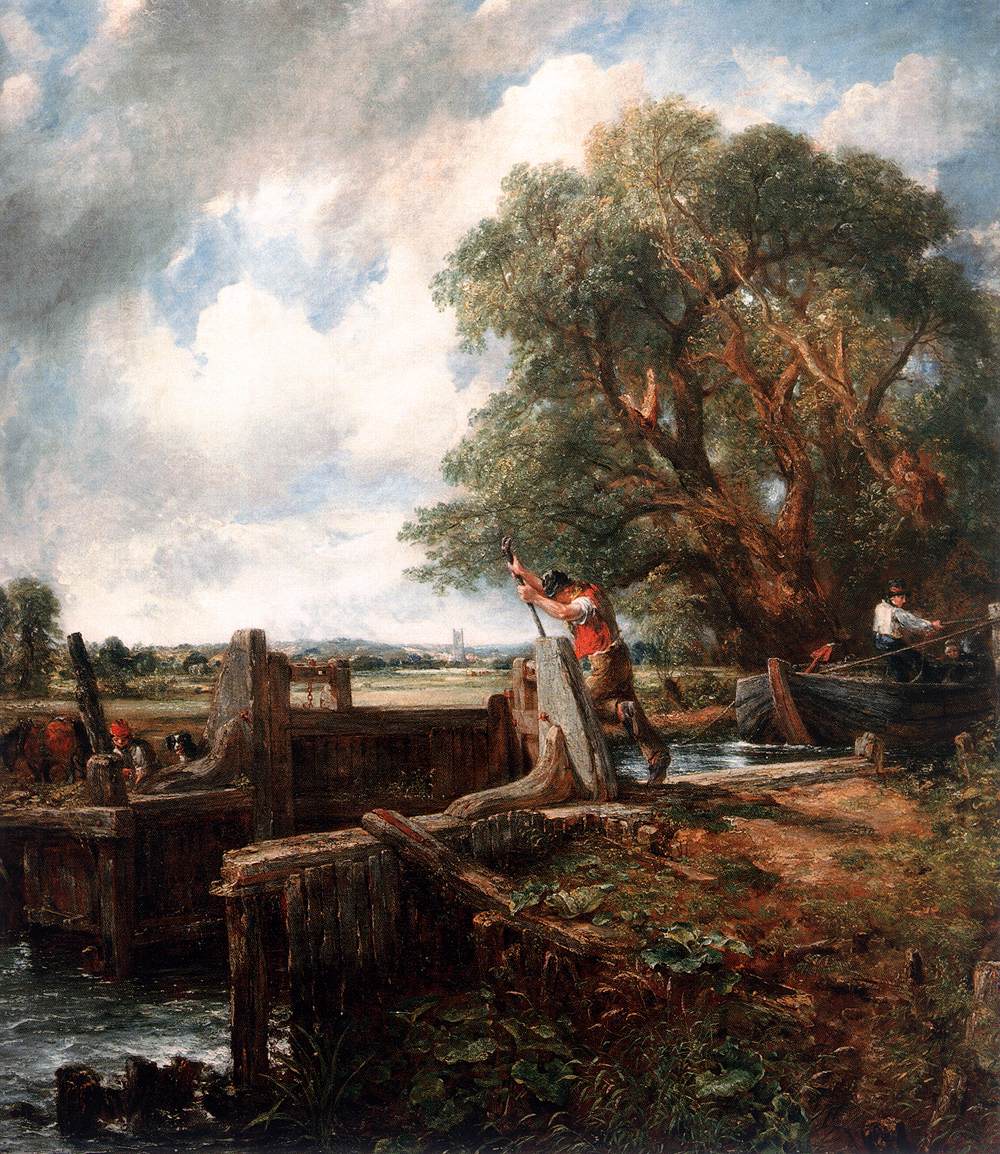
The Lock
John Constable [Web Gallery of Art]

The response for the Responsorial Psalm in the Sunday Mass is: Send forth your Spirit, O Lord, and renew the face of the earth. This is from Psalm 103 [104], the great psalm of creation, verses from which are used in the Responsorial Psalm, which includes these words: You send forth your spirit, they are created; and you renew the face of the earth. This is a reminder to us that as Christians we are called by the Holy Spirit to respect and take care of everything that God has created so that it may continue to bring life and not death. Six times in the account of creation in Genesis 1:1-31 we read, And God saw that it was good. The seventh time we read, And God saw everything that he had made, and behold, it was very good.

English poet Gerard Manley Hopkins SJ captures something of the presence of the Holy Spirit in every aspect of creation and life in the closing lines of his poem God’s Grandeur:

Because the Holy Ghost over the bent 
World broods with warm heart and with ah! Bright wings.


God's Grandeur
by Gerard Manley Hopkins, read by Jonathan Roumie


Traditional Latin Mass

Pentecost

The Complete Mass in Latin and English is here. (Adjust the date at the top of that page to 05-24-2026 if necessary).

Lesson: Acts 2:1-11. Gospel: John 14:23-31.


Pentecost

And there appeared to them tongues as of fire, distributed and resting on each one of them (Acts 2:3; Lesson).


24 May 2024

'Salamat sa Ginoo - Thanks to the Lord!' Sunday Reflections, Trinity Sunday, Year B


Holy Trinity
Jusepe de Ribera [Web Gallery of Art]

Readings (Jerusalem Bible: Australia, England & Wales, Ireland, New Zealand, Pakistan, Scotland)

Readings (New American Bible: Philippines, USA)

Gospel  Matthew 28:16-20  (English Standard Version, Anglicised)

Now the eleven disciples went to Galilee, to the mountain to which Jesus had directed them. And when they saw him they worshipped him, but some doubted. And Jesus came and said to them, “All authority in heaven and on earth has been given to me.  Go therefore and make disciples of all nations, baptizing them in the name of the Father and of the Son and of the Holy Spirit, teaching them to observe all that I have commanded you. And behold, I am with you always, to the end of the age.”

Léachtaí i nGaeilge


Antiphona ad introitum  Entrance Antiphon

Benedictus sit Deus Pater, Unigenitusque Dei Filius, Sanctus quoque Spiritus, quia fecit nobiscum misericordiam suam.

Blest be God the Father, and the Only Begotten Son of God, and also the Holy Spirit, for he has shown us his merciful love.

This is also the Offertory Verse in the Traditional Latin Mass on Trinity Sunday.

Twelve years ago around this time I gave a retreat to a group of Canossian Daughters of Charity in the Philippines. They included four novices and seven professed Sisters, including one from Malaysia. Their foundress, St Magdalene of Canossa bequeathed to the Sisters the mission of 'making Jesus known and loved above all'. This comes from a stance of standing at the foot of the Cross with Mary.

During my talks each morning I shared many stories of individuals who had made Jesus known to me, usually with no awareness that they were doing so. Some were persons I knew. Some are now dead. Some I met only once in passing, never learning their names. Most were poor. I know that my stories triggered off similar memories among the Sisters of people who had made Jesus known to them as the Sisters in turn had made him known to those they were serving.

I see this in the context of the Communion of Saints, the angels and saints in heaven, the members of the Church on earth, the souls in purgatory. The story of creation tells us that we are made in the image of God. But what the author of that first account of creation didn't know is that God is a Community of Three Persons. Made in God's image, we are made to be in community with others.

Jusepe de Ribera's painting of the Holy Trinity above, like a number of other paintings, shows the dead Christ. The expression on the face of the Father shows suffering. It is very similar to the face of the father in Rembrandt's The Return of the Prodigal Son, painted about thirty years later. I don't know if Rembrandt was familiar with de Ribera's painting.

Return of the Prodigal Son [detail]
Rembrandt [Wikipedia]

The Blessed Trinity call us into the circle of their life through suffering. We know the suffering of Jesus. Some of the great artists show to us something of the suffering of the Father.

Peasant Girl Bringing Basket
Adolf Fényes [Web Gallery of Art]

One of the stories I told involved two persons I met only once, a mother and her daughter aged about 13 or 14. When they first approached me outside a retreat house in Cebu City on the morning of Holy Thursday 1990. I made an excuse that I was only visiting. While inside I saw the two of them sitting on the steps. The daughter had her head on her mother's shoulder. Clearly, they were tired and hungry. When I was leaving I gave them enough to buy breakfast. The young girl looked at me with the most beautiful smile I've ever seen and said to me, Salamat sa Ginoo! 'Thanks to the Lord!' She wasn't thanking me but inviting me to thank the Lord with her and her mother for his goodness. Through her hunger and tiredness she had come to know something of God's bountiful love, the love of the Father that Rembrandt reveals so powerfully.

As I reflect on this incident now, 34 years later, I see it in the light of today's Second Reading, Romans 8:14-17. St Paul writes, For all who are led by the Spirit of God are children of God . . . When we cry, ‘Abba! Father!’ it is that very Spirit bearing witness. That young girl was led by the Spirit of God to thank the Father for having provided her and her mother with breakfast that day, for having listened to their prayer, Give us this day our daily bread. And she invited me as her brother in Christ to do the same. Without being aware of it she was celebrating the reality of the Holy Trinity.

And she has been calling me into the life of the Holy Trinity for all those year. I've no idea what became of her. I went to the Philippines in 1971 to do my part in making disciples of all nations and have baptised many in the name of the Father and of the Son and of the Holy Spirit. But that young girl, and many others like her, have been constantly teaching me to observe all that I have commanded you and assuring me in the name of Jesus, I am with you always, to the end of the age.


Benedictus sit Deus

This is Mozart's setting of today's Entrance Antiphon, composed when he was twelve.

3 May 1991 - 12 October 2006
Beatified 10 October 2020 [Wikipedia; photo]

On Thursday 23 May Pope Francis cleared the way for the canonisation of Blessed Carlo Acutis. He died from leukaemia at the age of 15. He was a computer 'geek', a skill which he used to be a 'web missionary', as the title of the video below states. If you google his name on YouTube you will find a number of videos about him, most of them short. The one below is just over 30 minutes but is very comprehensive, showing many aspects of his life as seen by others, young people of his own age who were friends of his, and others, young and older, on whose life Blessed Carlo had a huge influence, some while he was alive, others who came to know about him after his death, people drawn closer to Jesus Christ because of him. I've watched the video a number of times and each time it has been a prayerful experience, of being closer to God and with a sense of wonder at how the Blessed Trinity invites us into eternal life.

Young people can draw us into the life of the Holy Trinity, as did the 13- or 14-year old girl in Cebu City with me, as does the 12-year-old Mozart with his setting of Benedictus sit Deus, as has Blessed Carlo Acutis been doing before and after his death. Mozart and Blessed Carlo are known internationally, the young girl known only by her family and neighbours. We never know who may be drawing us into the eternal life of the Blessed Trinity.

Blessed Carlo, pray for us!

Blessed Carlo Acutis

Traditional Latin Mass

Trinity Sunday

The Complete Mass in Latin and English is here. (Adjust the date at the top of that page to 05-26-2024 if necessary).

Epistle: Romans 11:33-36. Gospel: Matthew 28:18-20.

Baptism
Giuseppe Maria Crespi [Wikipedia]

Go therefore and make disciples of all nations, baptizing them in the name of the Father and of the Son and of the Holy Spirit (Matthew 28:19; Gospel).

26 May 2023

'Because the Holy Ghost over the bent World broods with warm heart and with ah! Bright wings.' Sunday Reflections, Pentecost, Year A


Pentecost

Sir Anthony van Dyck [Web Gallery of Art]


Pentecost Sunday, Year A

NB: The Vigil Mass has its own prayers and readings. It is a celebration proper to the evening before Pentecost Sunday and may be celebrated in an extended form. It also fulfils our Sunday obligation.

Readings (Jerusalem Bible: Australia, England & Wales, India [optional], Ireland, New Zealand, Pakistan, Scotland, South Africa)

Readings (New American Bible: Philippines, USA)  

Gospel John 7:37-39 (English Standard Version, Anglicised, India)

On the last day of the feast, the great day, Jesus stood up and cried out, “If anyone thirsts, let him come to me and drink. Whoever believes in me, as the Scripture has said, ‘Out of his heart will flow rivers of living water.’” Now this he said about the Spirit, whom those who believed in him were to receive, for as yet the Spirit had not been given, because Jesus was not yet glorified.

Mass during the Day, Year A

Readings (Jerusalem Bible: Australia, England & Wales, Ireland, New Zealand, Pakistan, Scotland)

Readings (New American Bible: Philippines, USA)

Gospel John 20:19-23 (English Standard Version Anglicised, India)

On the evening of that day, the first day of the week, the doors being locked where the disciples were for fear of the Jews, Jesus came and stood among them and said to them, “Peace be with you.” When he had said this, he showed them his hands and his side. Then the disciples were glad when they saw the Lord. Jesus said to them again, “Peace be with you. As the Father has sent me, even so I am sending you.” And when he had said this, he breathed on them and said to them, “Receive the Holy Spirit. If you forgive the sins of any, they are forgiven them; if you withhold forgiveness from any, it is withheld.”


Léachtaí i nGaeilge


Confession
Giuseppe Maria Crespi [Web Gallery of Art]

Forty-one years ago I did a number of short supplies in parishes in a diocese in the western USA. In one parish where I spent only a weekend I found a note that had been shoved under the front door on Monday morning and addressed to me. There was no signature but it was written in the style of a teenage girl.

Very often anonymous letters are negative and condemnatory of the receiver. This was the very opposite. I don’t remember what the gospel reading of the Sunday was but it highlighted the mercy of God and that is what I had preached about. Whatever I said touched the writer of the note profoundly. She wrote that for years she had hated God. I’ve no idea why or of what had been troubling her. She might well have been the victim of some awful act of another. But when at that Sunday Mass she heard the Good News that God is a forgiving God and that he loves each of us individually and unconditionally she was able to let go of the hatred, if that is what it really was, and of the anger in her heart and accept God’s love. She wrote that for the first time in years she went to Holy Communion.

As we celebrate the Descent of the Holy Spirit the gospel today tells us that the Risen Lord, appearing to the Apostles, breathed on them and said to them, Receive the Holy Spirit. If you forgive the sins of any, they are forgiven them; if you withhold forgiveness from any it is withheld. 

One of the greatest gifts of the Holy Spirit to the Church is the power to forgive in God’s name, to enable us to hear Jesus say to us what he said to the Apostles twice in today’s short gospel reading, Peace be with you. This is the gift he offered at the Last Supper.

This is the gift God gives us most especially in the Sacrament of Reconciliation, what many of us still call Confession or Penance.   It is the way in which God, through the Church and specifically through the sacrament of Holy Orders, brings back into communion with him those who have turned away from him through mortal sin, that is a sin involving grave matter, a clear awareness that it is such and full and deliberate consent to the act. To go to confession in that situation is a matter of urgency, to be done before we go to Holy Communion again. Then Holy Communion becomes a true celebration of the full communion that God wants each of us to have with him.

But the sacrament is also a great help to those who are faithfully following Jesus but who sometimes take to byways down which God is not calling them, byways that lead into sin. Though the Sacrament of Reconciliation is not essential for the forgiveness of such sins it is the special way given by God through the Holy Spirit for that. If you forgive the sins of any, they are forgiven them.

The priest too is a sinner and each time he goes to confession himself he understands the struggle to overcome shame of those who come to him to confess their sins and to receive from him the forgiveness of a merciful and understanding God.

I left that parish on Monday morning and did not know who had shoved the note under the door. I’ve no idea what became of the writer. Perhaps she went to confession shortly after. Very likely she hadn’t committed any grave sin but had suffered greatly because of the actions of another; But whatever the situation was she had a profound experience of God’s mercy that Sunday, something like that of Zacchaeus, like that of the woman caught in adultery, like that of the Prodigal Son.

The gospels don’t tell us what subsequently became of Zacchaues or of the woman caught in adultery. But we know that the Holy Spirit profoundly touched their hearts, healed their wounds and changed their lives as Jesus passed by. And I know that the Holy Spirit profoundly touched the heart and healed the wounds of that young woman in the western USA parish as Jesus ‘passed by’ that Sunday morning through a priest who spent only two nights there.

The Sequence in today’s Mass, Veni Sancte Spiritus, ‘Come, Holy Spirit’, expresses something of that in the seventh stanza:

Lava quod est sordidum, Heal our wounds, our strength renew,
Riga quod est aridum, On our dryness pour your dew,
Sana quod est saucium. Wash the stains of guilt away.

The Lock
John Constable [Web Gallery of Art]

The response for the Responsorial Psalm in the Sunday Mass is: Send forth your Spirit, O Lord, and renew the face of the earth. This is from Psalm 103 [104], the great psalm of creation, verses from which are used in the Responsorial Psalm, which includes these words: You send forth your spirit, they are created; and you renew the face of the earth. This is a reminder to us that as Christians we are called by the Holy Spirit to respect and take care of everything that God has created so that it may continue to bring life and not death. Six times in the account of creation in Genesis 1:1-31 we read, And God saw that it was good. The seventh time we read, And God saw everything that he had made, and behold, it was very good.

English poet Gerard Manley Hopkins SJ captures something of the presence of the Holy Spirit in every aspect of creation and life in the closing lines of his poem God’s Grandeur:

Because the Holy Ghost over the bent 
World broods with warm heart and with ah! Bright wings.


God's Grandeur
by Gerard Manley Hopkins, read by Jonathan Roumie


Traditional Latin Mass

Pentecost or Whitsunday

The Complete Mass in Latin and English is here. (Adjust the date at the top of that page to 05-28-2023 if necessary).

Lesson: Acts 2:1-11. Gospel: John 14:23-31.

Pentecost

And there appeared to them tongues as of fire, distributed and resting on each one of them (Acts 2:3; Lesson).