Showing posts with label Lateran Basilica. Show all posts

07 November 2025

Sunday Reflections, Dedication of the Lateran Basilica, 9 November 2025


Archbasilica of St John Lateran 

The full name of the church is: Archbasilica of the Most Holy Saviour and Saints John the Baptist and the Evangelist at the Lateran. It is the Cathedral of the Diocese of Rome.

The Feast of the Dedication of the Lateran Basilica, as a feast of the Lord, takes precedence over the 32nd Sunday in Ordinary Time.

Readings (Jerusalem Bible: Australia, Ireland, New Zealand)

Readings (English Standard Version, Catholic Edition: (England & Wales, Scotland)

Readings (New American Bible: Philippines, USA)

Gospel John 2:13-22 (English Standard Version, Anglicised)
The Passover of the Jews was at hand, and Jesus went up to Jerusalem. In the Temple he found those who were selling oxen and sheep and pigeons, and the money-changers sitting there. And making a whip of cords, he drove them all out of the Temple, with the sheep and oxen. And he poured out the coins of the money-changers and overturned their tables. And he told those who sold the pigeons, ‘Take these things away; do not make my Father’s house a house of trade.’ His disciples remembered that it was written, ‘Zeal for your house will consume me.’

So the Jews said to him, ‘What sign do you show us for doing these things?’ Jesus answered them, ‘Destroy this temple, and in three days I will raise it up.’ The Jews then said, ‘It has taken forty-six years to build this Temple, and will you raise it up in three days?’ But he was speaking about the temple of his body. When therefore he was raised from the dead, his disciples remembered that he had said this, and they believed the Scripture and the word that Jesus had spoken.

Léachtaí i nGaeilge


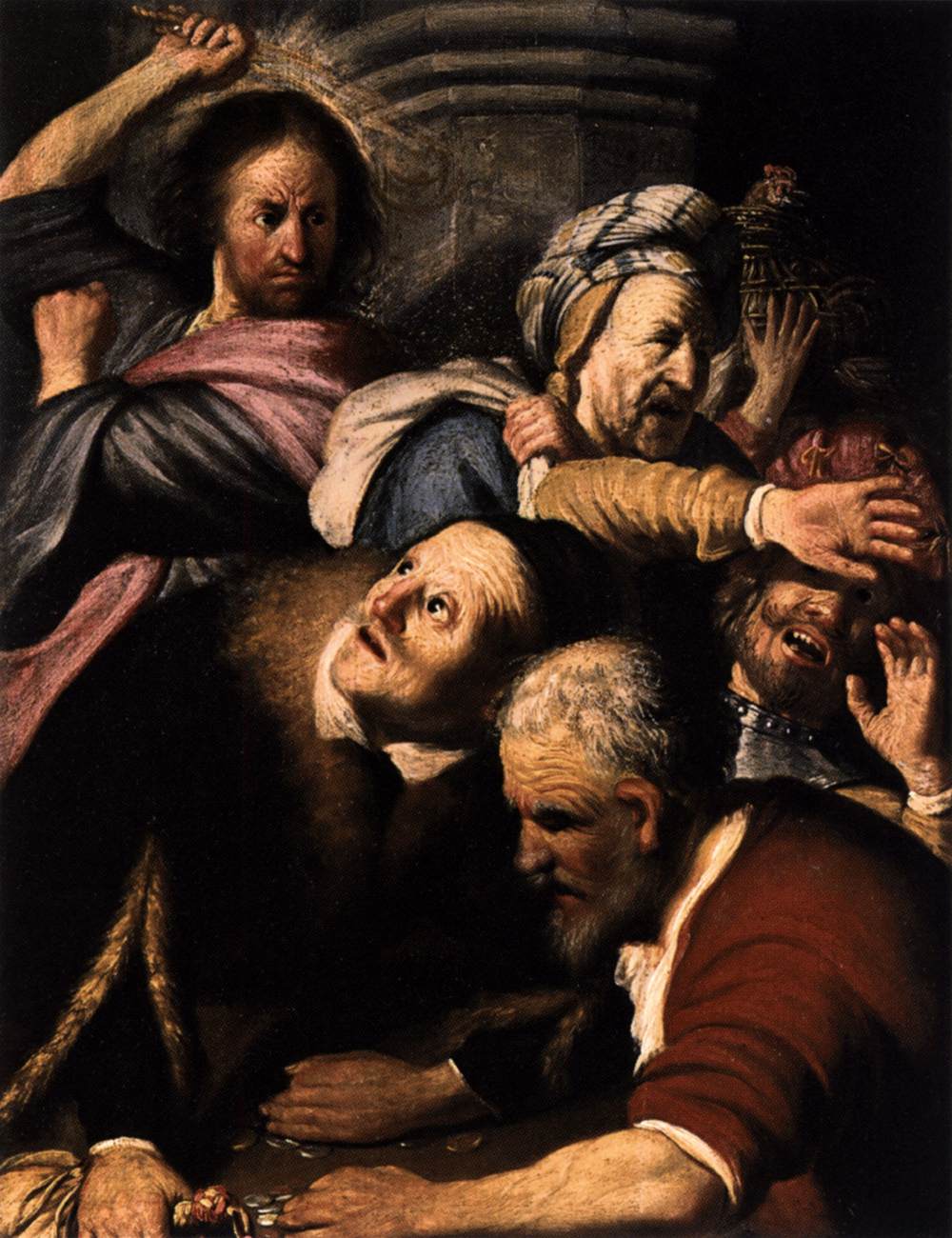
Christ driving the money-changers from the Temple 
Rembrandt [Web Gallery of Art]

And making a whip of cords, he drove them all out of the Temple, with the sheep and oxen (John 2:15; Gospel).

This Sunday we celebrate the dedication of the Cathedral of Rome. In a real sense it is the Mother Church for Catholics.

In a homily in Spain on 3 November 1982 Pope St John Paul II said: Any church is your house, and the house of God. Value it as the place where we encounter our common Father. For most of us  the church where first we were able to encounter our common Father was the church or chapel where our parents and godparents brought us to be baptised. The First Reading, from the Prophet Ezekiel, which speaks of the life-giving waters flowing out from the Temple, reminds us of the waters of baptism which cleanse away sin and give us the life of God himself. The response to the psalm reflects this: The waters of a river give joy to God’s city, the holy place, the abode of the Most High.

The First Reading and the Responsorial Psalm are connected with the fact that St John the Baptist is one of the patron saints of the Pope's Cathedral.

St Paul in the Second Reading tells us what baptism accomplishes in us: Do you not know that you are God’s temple and that God’s Spirit dwells in you? We become sons and daughters of God the Father, brothers and sisters of Jesus and brothers and sisters of one another. We are a living community, sharing in the mission of the Church to preach the Gospel to every creature. The Church becomes alive when we gather together in the church building, especially to celebrate the Holy Sacrifice of the Mass. 

Many years after my ordination I realised that I learned what family is from being together each day for our evening meal and for our special Sunday lunch. In the same way I learned what the Church is from my parents taking me to Sunday Mass when I was a young child until I was old enough to go on my own. We all went to Sunday Mass, though not together. The term 'Family Mass' wasn't used when I was growing up in Dublin.

The words of Jesus in today's Gospel, Take these things away; do not make my Father’s house a house of trade, always made sense to me since my experience of the church, the building, was that it was the place where we gathered for Mass, especially on Sunday, and where people went to pray during the week, old people like my paternal grandfather for long periods, workers and school children dropping in for a few minutes on their way home from work or school. In other words, the church building truly was my Father's house. And it usually was a house of beauty that invited one to pray. 

Something we can do today is to recall and thank God for the significant churches in our lives: the church where we were baptised, the church where we made our First Holy Communion, the church where we were confirmed, the church where we went to confession regularly, the church where we were married or ordained. For some, all of these important events happened in the same church, for others not so. But on all of these occasions we were able to encounter our common Father and in every church where the Blessed Sacrament is in the tabernacle we meet our Risen Saviour Jesus Christ our Brother.


The papal cathedra in St John Lateran 


Traditional Latin Mass

What earlier generations held as sacred, remains sacred and great for us too, and it cannot be all of a sudden entirely forbidden or even considered harmful (Benedict XVI). 

Dedication of the Archbasilica of our Saviour

The Complete Mass in Latin and English is here. (Adjust the date at the top of that page to 11-09-2025 if necessary).

Lesson: Revelations 21:2-5Gospel: Luke 19:1-10.

Zacchaeus
Willem Isaacsz van Swanenburg [Web Gallery of Art]

Jesus said to Zacchaeus, 'Today salvation has come to this house, since he also is a son of Abraham. For the Son of man came to seek and to save the lost' ((Luke 19:10; Gospel).

10 November 2016

'By your endurance you will gain your souls.' Sunday Reflections, 33rd Sunday in Ordinary Time, Year C

Nave of the Archbasilica of St John Lateran [Wikipedia]
The Cathedral of Rome, the 'Mother of all Churches'

Readings (New American Bible: Philippines, USA)

Readings (Jerusalem Bible: Australia, England & Wales, India [optional], Ireland, New Zealand, Pakistan, Scotland, South Africa)


When some were speaking about the temple, how it was adorned with beautiful stones and gifts dedicated to God, Jesus said,  ‘As for these things that you see, the days will come when not one stone will be left upon another; all will be thrown down.’
They asked him, ‘Teacher, when will this be, and what will be the sign that this is about to take place?’ And he said, ‘Beware that you are not led astray; for many will come in my name and say, “I am he!” and, “The time is near!” Do not go after them.
‘When you hear of wars and insurrections, do not be terrified; for these things must take place first, but the end will not follow immediately.’ Then he said to them, ‘Nation will rise against nation, and kingdom against kingdom; there will be great earthquakes, and in various places famines and plagues; and there will be dreadful portents and great signs from heaven.
‘But before all this occurs, they will arrest you and persecute you; they will hand you over to synagogues and prisons, and you will be brought before kings and governors because of my name. This will give you an opportunity to testify. So make up your minds not to prepare your defence in advance; for I will give you words and a wisdom that none of your opponents will be able to withstand or contradict. You will be betrayed even by parents and brothers, by relatives and friends; and they will put some of you to death. You will be hated by all because of my name. But not a hair of your head will perish. By your endurance you will gain your souls.


Earthquake destroys Basilica of St Benedict on 30 October 2016
Norcia (or Nursia) is the place where St Benedict was born c.480

This Sunday falls between two celebrations of church buildings in Rome, the Feast of the Dedication of the Lateran Basilica on 9 November and the Optional Memorial of the Dedication of the Basilicas of Saints Peter and Paul on 18 November. When the former falls on a Sunday its celebration takes precedence over the Sunday. The official name of the Lateran Basicilica is the Archbasilica of the Most Holy Saviour and of Saints John the Baptist and the Evangelist and is the Cathedral of the Diocese of Rome.

In the gospel Jesus speaks of the future destruction of the Temple where he had worshipped all his life, where he had been presented to the Father as an infant by Mary and Joseph, from which he threw the moneylenders because they were turning it into a market.

On 30 October the Basilica of St Benedict in his birthplace Norcia in Italy was destroyed in seconds by a powerful earthquake as if fulfilling the words of Jesus today, all will be thrown down.

Destroyed Basilica of St Benedict [Source:The Monks of Norcia]

In today's gospel Jesus warns us of wars and insurrections . . . great earthquakes . . . famine and plagues . . . You will be hated by all because of my name.

We are seeing all of these things in our time. They can lead us to lose hope - if we forget the closing words of Jesus in today's gospel: But not a hair of your head will perish. By your endurance you will gain your souls.

On 4 October this year Hurricane Matthew caused great destruction in southwestern Haiti, the poorest country in the Western Hemisphere. But the Sunday Examiner, the weekly newspaper of the Catholic Diocese of Hong Kong carried the following report in its issue for 30 October.

Port-au-Prince. Survivors of Hurricane Matthew put on their Sunday finest as they picked their way through rubble and downed power lines to gather in ruined churches on October 9, just three days after the devastating storm ravaged their homes. 

Photographs posted on news websites show pews in the open air, with the rubble from the hurricane piled to one side, as a neatly clad congregation in suits and ties, smart slacks and dresses made a colourful scene in what had once been churches with roofs.

Mass celebrated in Qaraqosh, Iraq, after its recent liberation

Archbishop Youhanna Boutros Moshe is the Syrian Catholic Archbishop of Mosul

In 2104 Christians were driven out of Mosul and nearby cities in Iraq by ISIS, also known as Daesh. For the first time in nearly 2,000 years Mass could not be celebrated in the area. But on Sunday 30 October Mass was celebrated again in the Church of the Immaculate Conception, Qaraqosh, near Mosul.

A church building is where Christians gather to celebrate the Eucharist, the Holy Mass, where they meet and receive the Risen Lord. Down the centuries Christian communities have built churches that are beautiful in order to draw people into the beauty and life of the Blessed Trinity. And even if the building is destroyed by an earthquake as in Norcia, by a hurricane as in southwestern Haiti, or by persecution  as in Qaraqosh, Iraq, the Lord is still present to and among the Christian community, especially when believers come together on Sunday, as Jesus Christ has asked us to do, to celebrate his life, death and Resurrection, and our hope in eternal life, in the Holy Sacrifice of the Mass.

By your endurance you will gain your souls.


Grave of Bishop Edward Galvin

St Columban's, Dalgan Park, Ireland

'But the spiritual edifice is, I think, intact.'

Since posting this week's Sunday Reflections I received the November 2016 issue of Far East, the magazine of the Columbans in Ireland and Britain, which has the following story that is connected so much with this Sunday's gospel.

After being expelled from China, September 1952

In the January/February 2006 issue of Far East, Fr Dan Fitzgerald recalled the following of Bishop Edward Galvin (Co-founder of the Columbans with Fr John Blowick):

Bishop Galvin was my bishop in China for six years. Three of us Columban priests arrived in Hanyang in central Chine in July 1946. We were the first Irish priests to arrive there after the war had ended in 1945.

The man we met on that July day looked older and more worn than his 64 years would suggest. He didn't look like a bishop either. He was in an old crumpled cotton Chinese shirt and pants, with perspiration running down his face and chest. Only for the plain episcopal ring he had on his finger, he might have been the gate-man. There was something about him that suggested one who had lived through a lot, had suffered and had survived.

His exile for Christ ended in September 1952. As he arrived in Hong Kong he said, They have taken our churches, schools, hospital and mission compounds, but the spiritual edifice is, I think, intact. I blessed the compound and the cathedral, the whole diocese, its Sisters, priests and people. I put then under the protection of Our Lord and His Blessed Mother, and of St Columban, the patron of the diocese and the cathedral. It was all I could do, but it was enough.

(1916 - 2016)


Antiphona ad Communionem   
Communion Antiphon  Mark 11:23-24

Amen dico vobis, quidquid orantes petitis, 
Amen, I say to you: whatever you ask in prayer,
credite quia accipientis, et fiet vobis, [dicit Dominus]. 
believe that you will receive, and it shall be given to you, [says the Lord]. 


08 November 2014

'Zeal for your house will consume me.' Sunday Reflections, Feast of the Dedication of the Lateran Basilica in Rome

Archbasilica of St John Lateran [Wikipedia]

The full name of the church is: Archbasilica of the Most Holy Saviour and Saints John the Baptist and the Evangelist at the Lateran. It is the Cathedral of the Diocese of Rome.

The Feast of the Dedication of the Lateran Basicila takes precedence over the 32nd Sunday in Ordinary Time.

Readings (New American Bible: Philippines, USA)

Readings (Jerusalem Bible: Australia, England & Wales, India [optional], Ireland, New Zealand, Pakistan, Scotland, South Africa) 


The Passover of the Jews was near, and Jesus went up to Jerusalem. In the temple he found people selling cattle, sheep, and doves, and the money changers seated at their tables. Making a whip of cords, he drove all of them out of the temple, both the sheep and the cattle. He also poured out the coins of the money changers and overturned their tables. He told those who were selling the doves, “Take these things out of here! Stop making my Father’s house a marketplace!”  His disciples remembered that it was written, “Zeal for your house will consume me.” The Jews then said to him, “What sign can you show us for doing this?” Jesus answered them, “Destroy this temple, and in three days I will raise it up.” The Jews then said, “This temple has been under construction for forty-six years, and will you raise it up in three days?” But he was speaking of the temple of his body. After he was raised from the dead, his disciples remembered that he had said this; and they believed the scripture and the word that Jesus had spoken.


Pushkin Museum, Moscow [Web Gallery of Art]


We are not isolated and we are not Christians on an individual basis, each one on his or her own, no, our Christian identity is to belong! We are Christians because we belong to the Church.

Pope Francis spoke these words at his General Audience on Wednesday 25 June this year. He went on to say:

The Christian belongs to a people called the Church and this Church is what makes him or her Christian, on the day of Baptism, and then in the course of catechesis, and so on. But no one, no one becomes Christian on his or her own. If we believe, if we know how to pray, if we acknowledge the Lord and can listen to his Word, if we feel him close to us and recognize him in our brothers and sisters, it is because others, before us, lived the faith and then transmitted it to us. We have received the faith from our fathers, from our ancestors, and they have instructed us in it . . . So, this is the Church: one great family, where we are welcomed and learn to live as believers and disciples of the Lord Jesus.


A few weeks earlier in his homily at Mass in St Martha's on 15 May the Bishop of Rome spoke in similar words:

But you cannot understand a Christian alone, just like you cannot understand Jesus Christ alone. Jesus Christ did not fall from the sky like a superhero who comes to save us. No. Jesus Christ has a history. And we can say, and it is true, that God has a history because He wanted to walk with us. And you cannot understand Jesus Christ without His history. So a Christian without history, without a Christian nation, a Christian without the Church is incomprehensible. It is a thing of the laboratory, an artificial thing, a thing that cannot give life.

This Sunday we celebrate the dedication of the Cathedral of Rome. In a real sense it is the Mother Church for Catholics.

In his homily in St Martha's Pope Francis said:

Looking back the Christian is a person who remembers: Let us seek the grace of memory, always. Looking forward, the Christian is a man, a woman of hope.

The feast of the dedication of any church is a feast of the Lord and takes precedence over a Sunday in Ordinary Time. And because St John the Baptist is one of the patrons of the Lateran Basilica the Mass has baptismal overtones, especially the First Reading.

I felt myself drawn by this feast to be a person who remembers, to accept the grace of memory from God and look back at some of the churches in my native Dublin in which I became a Christian and grew in the faith. Before the Holy Week liturgies were changed from the morning to the afternoon or evening by Pope Pius XII in 1955 my mother used to take my brother and me to visit seven churches on the afternoon of Holy Thursday to spend some time in adoration of the Blessed Sacrament in each. This practice seems to have died out in Dublin but it is very much alive here in the larger cities in the Philippines where it is known by the Spanish term visita iglesia. And I have just discovered that this practice originated in Rome, with the Archbasilica of St John Lateran top of the list.

Here I 'visit' a number of churches in Dublin that played a significant part in my becoming a member of the Church and in my growth in the faith. I invite each reader to make a similar pilgrimage of thanksgiving to God for the gift of our faith, for the gift of our Church and for those who have passed on the faith to us and nurtured us in it. The Church is a community of persons, God the Father's sons and daughters by virtue of our baptism, just as a family is a community of persons. And just as a family normally lives in a home - we describe persons living in extreme poverty as 'homeless' - so does the Christian family normally gather in its parish church.

Pope Francis describes the parish in Evangelii Gaudium No 28, in these words: The parish is the presence of the Church in a given territory, an environment for hearing God’s word, for growth in the Christian life, for dialogue, proclamation, charitable outreach, worship and celebration. 


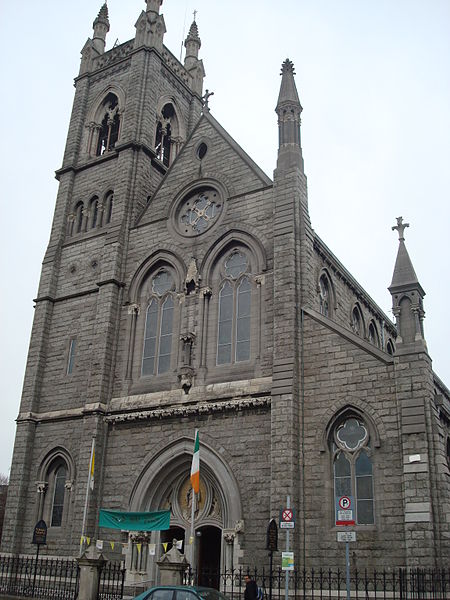
St Joseph's Church, Berkeley Road, Dublin [Wikipedia]

I was born in  small nursing home nearly opposite the church above on 20 April 193, Tuesday of Holy Week, the last time that Easter fell on the latest date possible, 25 April. A few days later, probably on Holy Saturday, I was baptised in that church, which wasn't our parish church as we lived on the other side of the city.

About five years ago I celebrated Mass for the first time in St Joseph's. The parish is now run by the Discalced Carmelites. The congregation on the Sunday I celebrated Mass was very different from what it would have been at the time of my birth. There were many Filipinos in the congregation, most of them nurses in the nearby Mater Hospital. And the servers were two girls aged about 12. One was white, from one of the oldest parts of the city, and the other was black, of Nigerian parentage. I was amused by the fact that the white girl would not acknowledge that she was from the inner city of Dublin while her companion was very proud to be a Dubliner! I met their mothers after Mass and they laughed when I told them this.

When I entered the Columban seminary in 1961 I could not have imagined such a congregation in any parish in Dublin, much less an altar-server whose parents were immigrants from Nigeria.

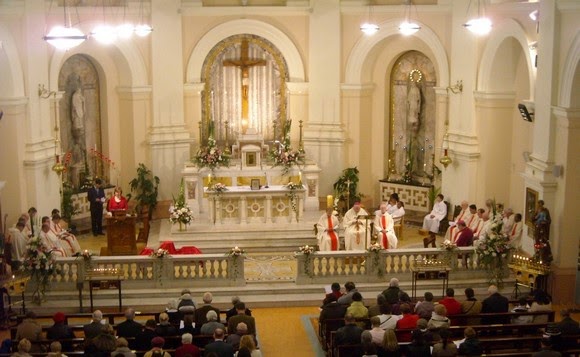
Our Lady Help of Christians Church, Drimnagh, Dublin

On a Christmas weekday a few months before I turned three I was thrown out of the church above, along with my pregnant mother, for shouting 'Ba' at the Infant in the crib.It was a traumatic experience for my mother. But whenever she would recall the event she would always add that the priest who ordered us out could not have done more for her sister, my Auntie Madge, who died four years later, in another parish.

In 1991, while at home in Dublin, I was asked by the Columbans to preach at all the Masses in that church on a Sunday in Lent when students from their final year in secondary school were observing a 24-hour fast to raise funds for Trócaire, the development agency of the Catholic Church in Ireland. I've never had a more attention-grabbing opening to a homily than I did that day: I was thrown out of this church. But by the time I had preached for the fourth time I felt a vicarious healing on behalf of my mother, who died in 1970. That was a real grace.


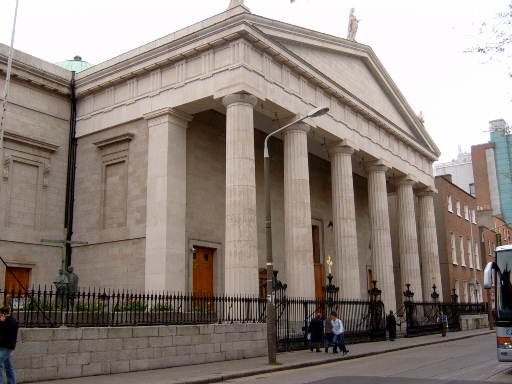
St Saviour's Church, Dominic St, Dublin [Wikipedia]

In the old days churches belonging to religious orders in Dublin usually had High Mass on such days as Easter Monday and Whit (Pentecost) Monday and my father would bring me to one or other of them on those occasions. I distinctly recall that when I was maybe seven or eight being particularly attracted by the habit of the Dominican friars. I didn't recognise then the beginnings of being called by God to be a priest but I see it now as such, even though I subsequently never considered becoming a Dominican.

St Dominic at Prayer, El Greco, 1600-02
Private Collection [Web Gallery of Art]

I must confess that I wasn't an entirely enthusiastic pilgrim when my father took me to High Mass or when my mother brought my brother and me to seven churches on Holy Thursday. I can see a reflection of my father in these words of Pope Francis in Evangelii Gaudium, No 167: Proclaiming Christ means showing that to believe in and to follow him is not only something right and true, but also something beautiful, capable of filling life with new splendour and profound joy, even in the midst of difficulties.Every expression of true beauty can thus be acknowledged as a path leading to an encounter with the Lord Jesus. My father seldom spoke about his faith but I could see even then, and more clearly later, how his faith permeated his whole life and how he felt uplifted by the beauty of the High Mass.

St Agatha's Church, North William St, Dublin [parish website]

It was in St Agatha's Church that I was confirmed by Archbishop John Charles McQuaid of Dublin in March 1954, along with my classmates from O'Connell Schools, which was located in the parish. St Agatha's didn't play any other part in my young life but its most illustrious parishioner, the Venerable Matt Talbot, has always been part of my life. Sometimes when walking 'into town' with my mother - her way of describing going into the city centre - we would go through Granby Lane, behind the Dominican church, where Matt died suddenly on his way to Mass there on Trinity Sunday 1925, and say a prayer at the simple shrine that marked the spot. Matt, a simple working man, overcame, with God's grace, his addiction to alcohol and lived a life of extraordinary asceticism that was known during his lifetime only to his spiritual director. Without being aware of it, my mother was strengthening my faith.


Holy Family Church, Aughrim St, Dublin [Facebook]


It was above all in Aughrim Street Church - Dubliners rarely refer to a church by its patronal name but by the street its on - that my faith grew. That faith was strengthened by the 'communal cough' after the second elevation, that of the chalice with the Precious Blood, that to me was a far deeper expression of faith than the perfunctory 'Christ has died . . .' introduced in 1969. It was the release of the sense of awe that people had, knowing that the bread and wine had become the Body and Blood of Christ. The church thronged with people young and old, most getting ready to go to work or to school, at the early morning Mass on the weekdays of Lent was also part of my growth in our faith.


I never became and altar-boy in our parish church, though I had enlisted as a trainee shortly after my First Holy Communion in 1950 at St Mary of the Angels, Church Street, the church of the Capuchin Friars (in video above), where my father used to take me some times for High Mass and where my mother took me the Sunday when St Maria Goretti was canonised in 1950. Alessandro Serenelli, who murdered the saint, spent the latter years of his life after being released from prison in a Capuchin friary in Italy, hence the connection with the Capuchin church in Dublin. What I remember is how long it took to say the fifteen decades of the Rosary that day in the church when I was a very unwilling participant!  

It was in Aughrim Street church that I celebrated my First Mass on 21 December 1967, the old feast of St Thomas the Apostle, the day after my ordination in St Mary's Pro-Cathedral, Dublin.

St Mary's Pro-cathedral, Dublin [Wikipedia]


Our class was to have been ordained in the seminary chapel in St Columban's College, Dalgan Park, Navan, about 35 kms north-west of Dublin, but had to be transferred at the last minute - we were informed about three days before 20 December - due to an outbreak of foot-and-mouth disease in Britain. Four opted to be ordained in Derry Cathedral, one in his native Glasgow on the 21st, with the remaining 14 to be ordained in the Pro-Cathedral in Dublin.

During our ordination ceremony

With Bishop Patrick Cleary who ordained us.

Bishop Cleary was one of the first Columbans and the first - and only, I think - Bishop of Nancheng, China, from which he was expelled in 1962.

When I was around 8 and 9 I was a member of the Palestrina Choir in the Pro-Cathedral and occasionally dropped in to pray there on my way home from school. But I have celebrated Mass there only twice - at my ordination and in November 2011 when I concelebrated in the annual Mass on the occasion of the death anniversary of Frank Duff, founder of the Legion of Mary, who died on 7 November 1980.

I realise that in these Sunday Reflections I have 'visited' seven churches in my native city and diocese. There are more, all of them places of God's very special presence, above all in the celebration of Mass and in the Blessed Sacrament, the latter inviting us into a deep intimacy with Jesus our Risen Lord.

Today's feast calls us to have a profound sense of thanksgiving to God for the gift of faith,  for his abiding presence among us, in our daily lives and in the special buildings in which we gather each Sunday and often on other days to celebrate the Holy Sacrifice of the Mass. And as we celebrate the Dedication of the Cathedral of Rome It is truly right and just that we pray for Pope Francis, who emphasises that he is Bishop of Rome, and for the People of God in that diocese

The papal cathedra in St John Lateran [Wikipedia]

The Latin word cathedra means a chair with armrests, used as a throne. As the throne of the bishop, form which he teaches, it is the root of the word 'cathedral'.

Art historian Elizabeth Lev speaks about the Cathedral of Rome