Showing posts with label New Zealand. Gallipoli. Show all posts

25 April 2014

ANZAC Day greetings to readers from Australia and New Zealand


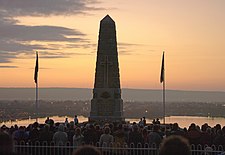
Anzac Day Dawn Service, King's Park, Western Australia, 25 April 2009

I posted this three years ago

The Columbans arrived in Australia in 1919 and in New Zealand two years later. Our arrival in those two countries was only a few years after the event in the Great War, World War I, that had a huge impact on their people of European origin, mainly British and Irish at the time, the landing in Gallipoli, Turkey, on 25 April 1915. Many of my confreres are from these two countries and because of that, their history is part of mine.

I paid my first visit to Australia just after Easter 1990. I was there for the 75th anniversary of the landing of the first members of the Australia and New Zealand Army Corps, the 'Anzacs', in Gallipoli. That particular anniversary generated new interest in this event. The Australian government flew a group of Gallipoli veterans, some of them aged more than 100, to Gallipoli to mark the event. Since then many young Australians have been going there for the anniversary ceremonies.

The landing at Anzac Cove, painting by George Lambert

On one TV discussion while I was there a participant pointed out that the iconic symbol of the Great War and Gallipoli for Australians wasn't one of soldiers killing or being killed, but of one saving lives: Private John Simpson, a stretcher-bearer, born in England, who was with the first group that landed, and his donkey, which he 'recruited' in Gallipoli and which acquired the name 'Duffy'. He had worked with donkeys as a youth during summers in England.

Private Simpson, centre, with his donkey and a wounded soldier (a Turk?)

John Simpson died on 15 May from machine gun fire, less than a month after he had arrived. He was 22. He quickly became a legend In Australia and his exploits were somewhat exaggerated, rather like some of the legends about the Church's martyrs. But there's no doubt about his bravery and that he saved many men.

Australian director Peter Weir's 1981 Gallipoli is one of the most memorable and moving films I have ever seen. It is built around the friendship of two young runners, Archy Hamilton, played by Mark Lee, and Frank Dunne, played by Mel Gibson. They meet as rivals in a 100-yard sprint but quickly become close friends or 'mates' and acquire more mates when they enlist in the army. Part of the movie's power is the detail paid to characters with small parts, every one a real human being, some attractive, some not.

Another is the wonderful use of music, especially of the Adagio in G minor by Venetian composer Tomaso Giovanni Albinoni (1671-1751). It is used with poignant effect at the end of the movie, with Frank  running back from the general to tell the major in charge of the group to which he and Archy belong that he was 're-considering the whole situation', ie, that he didn't want to have the soldiers go 'over the top' just yet. However, before he can reach the major a colonel has ordered that the soldiers go into attack immediately. The ending is unbearably sad,  the realisation of Frank that he is too late and his friend Archy going to his death.

The scenes in the trench before the soldiers go 'over the top' show their fear and their bravery. It shows them writing final letters, sharing a last cigarette and one praying the rosary. Archy recalls the words of his coach, his uncle. Here is that final scene.


Here is a beautiful video of Albinoni's Adagio played by the Franz Lizst Chamber Orchestra and recorded in Pannonhalma Archabbey, Hungary:


Eric Bogle, a Scottish singer-songwriter, wrote And the Band Played Waltzing Matilda in 1971, two years after he emigrated to Australia. The interpretation of Irish singer Liam Clancy is the best I have heard. War is not glorious for those who are maimed for life.


This year ANZAC Day falls on Easter Friday, but this song is more of a Good Friday one, recalling the words of Isaiah read on that day: He was despised and rejected by men; a man of sorrows, and acquainted with grief;  and as one from whom men hide their faces he was despised, and we esteemed him not.

25 April 2011

ANZAC Day

Anzac Day Dawn Service, King's Park, Western Australia, 25 April 2009

The Columbans arrived in Australia in 1919 and in New Zealand two years later. Our arrival in those two countries was only a few years after the event in the Great War, World War I, that had a huge impact on their people of European origin, mainly British and Irish at the time, the landing in Gallipoli, Turkey, on 25 April 1915. Many of my confreres are from these two countries and because of that, their history is part of mine.

I paid my first visit to Australia just after Easter 1990. I was there for the 75th anniversary of the landing of the first members of the Australia and New Zealand Army Corps, the 'Anzacs', in Gallipoli. That particular anniversary generated new interest in this event. The Australian government flew a group of Gallipoli veterans, some of them aged more than 100, to Gallipoli to mark the event. Since then many young Australians have been going there for the anniversary ceremonies.

The landing at Anzac Cove, painting by George Lambert

On one TV discussion while I was there a participant pointed out that the iconic symbol of the Great War and Gallipoli for Australians wasn't one of soldiers killing or being killed, but of one saving lives: Private John Simpson, a stretcher-bearer, born in England, who was with the first group that landed, and his donkey, which he 'recruited' in Gallipoli and which acquired the name 'Duffy'. He had worked with donkeys as a youth during summers in England.

Private Simpson, centre, with his donkey and a wounded soldier (a Turk?)

John Simpson died on 15 May from machine gun fire, less than a month after he had arrived. He was 22. He quickly became a legend In Australia and his exploits were somewhat exaggerated, rather like some of the legends about the Church's martyrs. But there's no doubt about his bravery and that he saved many men.

Australian director Peter Weir's 1981 Gallipoli is one of the most memorable and moving films I have ever seen. It is built around the friendship of two young runners, Archy Hamilton, played by Mark Lee, and Frank Dunne, played by Mel Gibson. They meet as rivals in a 100-yard sprint but quickly become close friends or 'mates' and acquire more mates when they enlist in the army. Part of the movie's power is the detail paid to characters with small parts, every one a real human being, some attractive, some not.

Another is the wonderful use of music, especially of the Adagio in G minor by Venetian composer Tomaso Giovanni Albinoni (1671-1751). It is used with poignant effect at the end of the movie, with Frank  running back from the general to tell the major in charge of the group to which he and Archy belong that he was 're-considering the whole situation', ie, that he didn't want to have the soldiers go 'over the top' just yet. However, before he can reach the major a colonel has ordered that the soldiers go into attack immediately. The ending is unbearably sad,  the realisation of Frank that he is too late and his friend Archy going to his death.

The scenes in the trench before the soldiers go 'over the top' show their fear and their bravery. It shows them writing final letters, sharing a last cigarette and one praying the rosary. Archy recalls the words of his coach, his uncle. Here is that final scene.


Here is a beautiful video of Albinoni's Adagio played by the Franz Lizst Chamber Orchestra and recorded in Pannonhalma Archabbey, Hungary:


Eric Bogle, a Scottish singer-songwriter, wrote And the Band Played Waltzing Matilda in 1971, two years after he emigrated to Australia. The interpretation of Irish singer Liam Clancy is the best I have heard. War is not glorious for those who are maimed for life.


This year ANZAC Day falls on Easter Monday, but this song is more of a Good Friday one, recalling the words of Isaiah read on that day: He was despised and rejected by men; a man of sorrows, and acquainted with grief;  and as one from whom men hide their faces he was despised, and we esteemed him not.

26 April 2009

ANZAC Day

Anzac, the Landing 1915, by George Lambert

Yesterday was ANZAC Day, a holiday in Australia and New Zealand that commemorates the members of the Australia and New Zealand Army Corp (ANZAC) who fought in the Great War (World War I). The landed at Gallipoli, Turkey, at dawn on 25 April 1915 and many were slaughtered. The ANZAC soldiers came to be known as ‘Anzacs’.

I happened to be in Australia for the 75th anniversary of that landing, 1990, and, as I recall, it was a moment when ANZAC Day received a new momentum, the young generation in particular, taking a fresh look at what had happened. The Australian government arranged for all veterans of Gallipoli who were well enough to travel to go to Gallipoli again. As far as I know, many Australians now visit Gallipoli on 25 April each year.

I don’t know what influence Peter Weir’s movie of 1981, Gallipoli, has had on Australians. It stars Mel Gibson. I first saw it in Toronto, where I was doing a year’s study, and it is one of the greatest movies I have ever seen, ever single scene a gem, with a magnificent and moving sound-track and the minor characters remaining in my memory.

ABC TV of Australia produced a documentary that I watched yesterday and today, Lost in Flanders, that shows how the remains of three Australian soldiers found in recent years in Belgium were identified through DNA tests. The programme reminds us that it wasn’t only in Gallipoli that Australian soldiers died in that awful war but also on the Western Front. One of the Belgians who discovered the remains was moved to tears when he saw that one of the soldiers had clearly been buried with special reverence, his arms crossed on his breast and his eyes, as it were, looking at you. It turned out that he had been buried by his older brother who survived the war.

I’m familiar with the area in Flanders featured in this documentary and located the grave of my great-uncle Corporal Larry Dowd who was killed near Ieper on the feast of the Transfiguration, 6 August, 1917, not long before the deaths of the five Australians featured in this programme.

Scottish songwriter Eric Bogle wrote The Band Played Waltzing Matilda in 1971. It evokes the terrible scars of war on some of those who survive. It's sung here by Irish singer Liam Clancy.

Anzac Cove, Gallipoli, Turkey