Showing posts with label Switzerland. Show all posts

22 November 2012

St Cecilia, Johann Sebastian Bach, and the Swiss connection

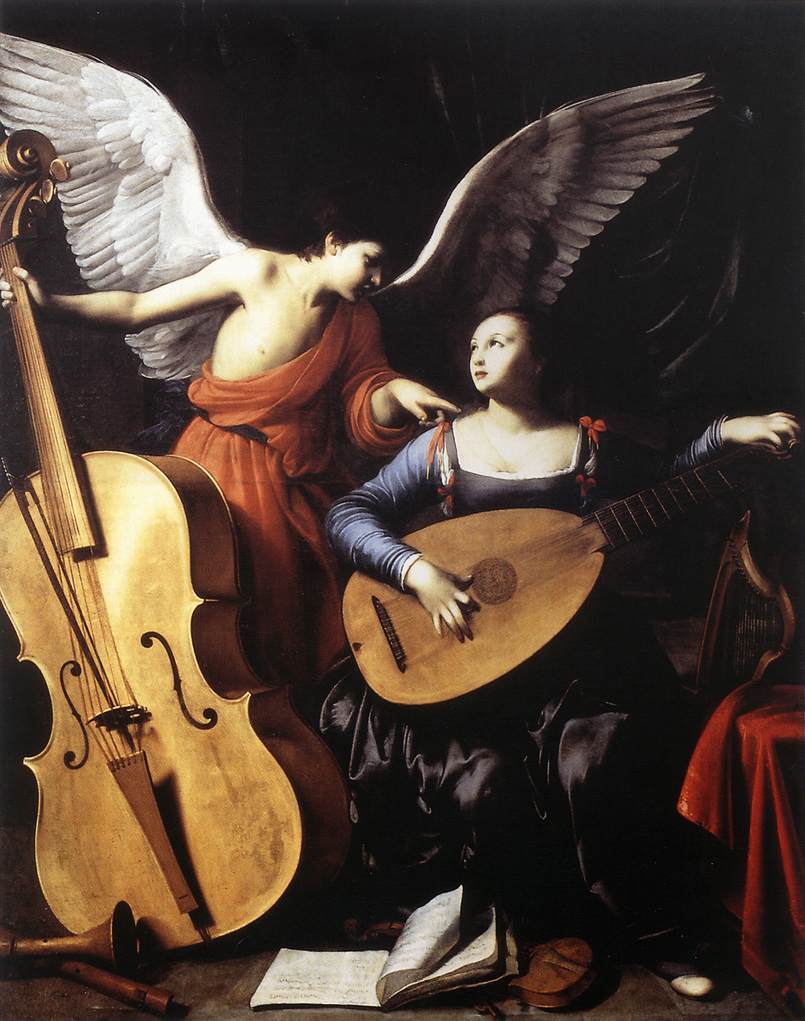
St Cecilia and the Angel, Carlo Saraceni, c.1610 (Web Gallery of Art)

St Cecilia, whose feast day it is today,22 November, is the patron saint of musicians. She was martyred probably in Sicily between 176 and 180 and is included in the second list of martyrs in the Roman Canon (Eucharistic Prayer I).

Whether the angels play only Bach praising God, I am not quite sure. I am sure, however, that en famille they play Mozart. So said Swiss Reformed theologian Karl Barth (1886 - 1968). 

A younger Swiss contemporary of Barth, Catholic theologian Fr Hans Urs von Balthasar (1905 - 1988) who died two days before Blessed Pope John Paul II was to have made him a cardinal, wrote: Before the beautiful—no, not really before but within the beautiful—the whole person quivers. He not only 'finds' the beautiful moving; rather, he experiences himself as being moved and possessed by it.

Very recently I came across a Swiss cellist with a very 'un-Swiss' name, Wen-Sinn Yang, whose parents came from Taiwan. He is a cellist and his instrument is a cousin of that which the angel in Saraceni's painting is holding. That seems to be a six-stringed double bass. Modern instruments in the violin family have only four.

Johann Sebastian Bach (1685 -1750) wrote an enormous amount of music, much of it for Sunday worship in the Lutheran churches in Leipzig. Among his works are six cello suites, which didn't really become known until the last century. Here Wen-Sinn Yang plays Bach's Cello suite No 1 in G major.


During the month of November we pray for the dead in a special way. I often think that we forget to pray for public and historical figures. We should pray for the soul of Johann Sebastian Bach and live in the hope that we will join him in praising God for all eternity. Praising God through music was at the very centre of his life on earth and his music continues to give us some experience of the beauty of God.


The grave of Johann Sebastian Bach in St Thomas' Church, Leipzig, Germany

A Happy Thanksgiving Day to American Readers!

16 October 2012

Feast of St Gall, companion of St Columban


Today is the feast of St Gall, one of St Columban's twelve companions when they set out around 585 from the monastery  in Bangor, in what is now Northern Ireland, on their Peregrinatio pro Christo, Pilgrimage for Christ. Their journey was to have an enormous impact on the history, culture and Catholic faith of Western Europe.

St Gall (c.550 - c.646)

Columban Fr Cyril Lovett, editor of Far East, the Columban magazine in Ireland and Britain, has an article in the current issue, 1400 Years of San Gallen, which gives some details of the story of St Gall, his relationship with St Columban and the Swiss town named after him. Here is the first part of the article:

San Gallen is a picturesque city, with 75,000 inhabitants, close to Lake Constance and represents the centre of eastern Switzerland. It takes its name from St Gall, a disciple of Columban and, according to Irish tradition, one of the original twelve who left Bangor with him around 585. San Gallen has been the site of a great monastery since the 8th century. Today it features the splendid baroque Cathedral of St Gallus and Otmar. The Abbey Library, a World Heritage Site, is Switzerland’s oldest, and holds a magnificent collection of early manuscripts and books, some dating back as far as 400 A.D. How did Gall come to settle in this beautiful place?
Fourteen hundred years ago, in 612, St Columban and his little band of monks had been expelled from Eastern France and from the great monasteries at Annegray, Fontaine and Luxeuil in the Vosges Region. He was preparing to leave the area of the Franks and his most recent foundation at Bregenz. Walafrid Strabo (808-849), whose manuscript of the Life of Gall can be seen in the Abbey Library, tells the story as it had come down in the monastery of San Gallen, “When the time of their departure was at hand, Gall suddenly fell ill of a fever. He threw himself at the abbot’s feet and said he was suffering from a severe illness and unable for the journey. Columban said to him, ‘Brother I know that now it seems a heavy burden to you to suffer further fatigue for my sake. Nevertheless, this I enjoin on you before I go, that so long as I live in the body, you do not dare to celebrate Mass’.” 

The decision seems very hard to us today. Even Walafrid Strabo felt that some excuse had to be made for it, as he added that Columban thought Gall was held back by love of the place where he had worked, and by fear of the fatigue of a long journey. Yet Columban was usually full of tenderness to his monks when they were ill. Not knowing the full circumstances of the incident we cannot presume to judge between saints. But it is another example of the fact that faced with a hard decision which he believed to be his duty, Columban would let no personal ties stand in his way
.


Collect for Feast Day of St Gall
Lord, our God, 
who drew Saint Gall to seek you in solitude,
and in the lofty splendour of the mountain 
revealed yourself to him; 
grant us by is intercession 
to follow the pattern 
of his meekness and unyielding faith 
and so enter with him into the joy of Christ our Lord 
Who lives and reigns with you in the unity of the Holy Spirit, 
one God, for ever and ever.
Agnus Dei by the choir and orchestra of the Cathedral at the Abbey of St Gallen