Showing posts with label faith. Show all posts

19 August 2019

'In giving us faith, the Lord has given us what is most precious in life.' Sunday Reflections, 21st Sunday in Ordinary Time, Year C

Syro-Malabar Catholic Wedding [Wikipedia]


Readings (New American Bible: Philippines, USA)

Readings (Jerusalem Bible: Australia, England & Wales, India [optional], Ireland, New Zealand, Pakistan, Scotland, South Africa)

Gospel Luke 13:22-30 (New Revised Standard Version, Anglicised Catholic Edition, Canada)  

Jesus[ went through one town and village after another, teaching as he made his way to Jerusalem. Someone asked him, ‘Lord, will only a few be saved?’ He said to them, ‘Strive to enter through the narrow door; for many, I tell you, will try to enter and will not be able. When once the owner of the house has got up and shut the door, and you begin to stand outside and to knock at the door, saying, “Lord, open to us”, then in reply he will say to you, “I do not know where you come from.”  Then you will begin to say, “We ate and drank with you, and you taught in our streets.”  But he will say, “I do not know where you come from; go away from me, all you evildoers!” There will be weeping and gnashing of teeth when you see Abraham and Isaac and Jacob and all the prophets in the kingdom of God, and you yourselves thrown out. Then people will come from east and west, from north and south, and will eat in the kingdom of God. Indeed, some are last who will be first, and some are first who will be last.’

Luke 13:22-30 in Filipino Sign Language


Six years ago when I was at home in Dublin from the Philippines a friend who had been a parishioner of mine in Mindanao when she was a child and now works near Dublin, invited me for a meal in a hotel. When the waitress came along I asked her if she was from Poland or Lithuania or 'one of those countries. 'One of those countries', she replied with a smile, 'Latvia.' She took our orders but the food was brought by an Indian waiter. Later on an Irish waiter looked after us.

St Andrew's Church, Westland Row, Dublin [Wikipedia]


A week later I found myself in St Andrew's Church, Westland Row, beside one of Dublin's main railway stations. While I was praying there a grandfather and his grandson aged about three came in. The grandfather was wearing bright summer clothes - unlike grandparents when I was young who seemed to be always dressed in dark clothes - and genuflected before kneeling in the pew. After a while the little boy asked him some questions. His grandfather pointed at the altar and also at some of the Stations of the Cross as he explained things to the youngster. They then left.

St Brigid's Church, Blanchardstown, Archdiocese of Dublin

On one Sunday a month in St Brigid's Church, Blanchardstown, in the Archdiocese of Dublin and the parish that became my home parish after my late father and my brother and his family moved there in the late 1970s has Mass for the Syro-Malabar Catholic community in Dublin once a month. Many of these are nurses from Kerala, India, working in Irish hospitals. St Brigid's Parish also has a Filipino choir that sings at one of the Masses on the last Sunday of the month, except during the summer.

Then people will come from east and west, from north and south, and will eat in the kingdom of God, Jesus tells us in the Gospel this Sunday. Forty years ago churches in Ireland were still full at Sunday Masses, with young and old, and almost everyone Irish. Today there are fewer priests,  fewer Sunday Masses and fewer people attending them, most of them old. A large proportion of Sunday congregations are from places such as India, Nigeria, Poland, the Philippines. Mass servers - and there aren't too many of these anymore - are likely to be either immigrants or the Irish-born children of immigrants.

The above are snapshots of contemporary Ireland, as different from the Ireland of my childhood as are the mobile phones that everyone has from the box cameras that a few had and the telephones  that even fewer had in my time. 


But we had something precious that has been largely lost - our Catholic faith. There are various reasons for the rejection of the Church by many and the outright rejection of the Christian faith by some. But this can remind us that our faith is pure gift from God, a gift that can be shared and that was generously shared, even to the point of giving up life itself, by the countless missionaries who went overseas, or it can be lost, not only by individuals bu by whole communities.


The gift of faith can be lost by taking it for granted, by apathy, by not taking it seriously, by not passing it on. Jesus in the Gospel is telling his fellow Jews - and we must never forget that he is and will be for all eternity a Jew, just like Mary - that many of them are in danger of losing the precious gift of the faith, the faith they inherited from Abraham, our father in faith (Eucharistic Prayer I - Roman Canon) Isaac and Jacob, and that others will accept that same gift with gratitude.

Luis Antonio Cardinal Tagle
Archbishop of Manila [Wikipedia]


In 2003, at a gathering of priests in Antipolo City, near Manila, sponsored by Worldwide Marriage Encounter, then Bishop Luis Antonio G. Tagle, now Cardinal-Archbishop of Manila, spoke about a then recent survey on the values of young Filipinos. What he projected could happen within twenty years in terms of the loss of the Catholic faith in the Philippines was what had been happening in Ireland over the previous twenty years.

I was heartened by the sight of the grandfather passing on our Catholic Christian faith to his young grandson by his example and by his readiness to answer the boy's questions. I am heartened by the living faith of so many immigrants to Ireland.

My hope is that the Catholic faith will continues to be passed on in Ireland and elsewhere by grandfathers - and grandmothers and parents - like the one I saw in St Andrew's Church. My hope is that the Catholic faith will be renewed in Ireland and elsewhere by the example and fervour of immigrants from Asia, Africa and Eastern Europe, by people from east and west, from north and south and that together we will all will eat in the kingdom of God, not only in heaven but here and now as brothers and sisters working together to build a world where the values  of the Gospel prevail, a world where everyone will have heard the Gospel of Jesus proclaimed to them, especially by the lives we lead. 

Blanchardstown Parish has a Nigerian priest as an assistant, Fr Aloysius Zuribo, who came to Ireland as an immigrant and later was ordained for the Archdiocese of Dublin.

My hope is that the nurses from Kerala, who trace their Catholic faith back to St Thomas the Apostle, the waiters, drivers, caregivers and nurses from the Philippines, whose faith embodies a tender love of Mary the Mother of God as our Mother, will help the Irish to re-discover the greatness of the gift that their ancestors received more than 1,500 years ago from a great missionary who first arrived in Ireland at the age of 16 as a kidnapped slave, St Patrick.

My fear is that there will not be enough grandfathers - and grandmothers and parents - who will know and value the gift of faith enough to pass it on and that the youngsters, children of immigrants to Ireland and elsewhere in the Western world, will succumb to the values of their contemporaries and reject the most precious gift that God has given us - our Catholic Christian faith, an invitation to share in the love of God for all eternity.


Though the video was made for the Feast of the Baptism of the Lord it invites us to reflect on our faith, received through baptism, as pure gift from God, something we should do constantly. 

Dear friends, in giving us faith, the Lord has given us what is most precious in life, that is, the truest and most beautiful reason for living: it is through grace that we have believed in God, that we have known his love with which he wants to save us and to deliver us from evil. Faith is the great gift with which he also gives us eternal life, true life. Now, dear parents and godparents, you are asking the Church to receive these children within her, to give them Baptism; and you are making this request by virtue of the gift of faith that you yourselves, in turn, have received (Pope Benedict XVI).

Baptising a young girl in the Philippines

04 July 2018

Keiko Uemura, a spring flower in the desert. Sunday Reflections, 14th Sunday in Ordinary Time, Year B

Keiko Uemura on her First Communion Day, December 1971
Keiko died 27 April 1972, aged 14

Readings(New American Bible: Philippines, USA)

Readings (Jerusalem Bible: Australia, England & Wales, India [optional], Ireland, New Zealand, Pakistan, Scotland, South Africa)

Gospel Mark 6:1-6 (New Revised Standard Version, Anglicised Catholic Edition)

Jesus left that place and came to his home town, and his disciples followed him. On the sabbath he began to teach in the synagogue, and many who heard him were astounded. They said, ‘Where did this man get all this? What is this wisdom that has been given to him? What deeds of power are being done by his hands! Is not this the carpenter, the son of Mary and brother of James and Joses and Judas and Simon, and are not his sisters here with us?’ And they took offence at him. Then Jesus said to them, ‘Prophets are not without honour, except in their home town, and among their own kin, and in their own house.’ And he could do no deed of power there, except that he laid his hands on a few sick people and cured them. And he was amazed at their unbelief.
Cherry Blossoms in Fukushima [Wikipedia]
Both the New American Bible and the Jerusalem Bible lectionaries read, He was amazed at their lack of faith. Jesus was among his own people, in the town where his brothers and sisters, ie, his cousins, lived. Perhaps his amazement was a form of frustration. Missionaries are men and women who are often 'amazed' at what seems to be their lack of 'success' in changing the situation, whether it is leading people to faith in Jesus Christ or working among baptised people for the justice that the Gospel demands but evidently isn't there.

Yet Jesus laid his hands on a few sick people and cured them. In other words, he found some who responded in faith.

One Columban priest who found faith in Keiko, a very sick 14-year-old girl in Japan, was Fr James Norris, a New Zealander who died on 6 October 2007. Japan is still a country where fewer than one in two hundred are Catholics. He wrote about his experience in Far East, the magazine of the Columbans in Ireland and Britain, in 1973. Father Jim's article made a profound impact on me and I reprinted it in Misyon in March-April 2008. our last printed edition. It is a story that moves me each time I think about it. Maybe the few who believed and were healed consoled Jesus in his humanity. Maybe he felt something of what Father Norris describes in the closing paragraph of his article.

The story of Keiko and her parents shows us that our Catholic Christian faith is a gift from God, a gift for which we should thank him every day.

A Spring Flower
by Fr James Norris 

Cherry Blossoms at the Tokyo Imperial Palace [Wikipedia]

There is a high school in our parish for nearly 2,000 girls conducted by the Sisters of the Infant of Jesus. Very few of these girls are baptized Christians. As a means of contact, I teach English to the junior high school pupils three times a week. My classes are very informal and I am afraid the young ladies don’t take me very seriously, possibly because I give them no homework or exams. My specialty is supposed to be pronunciation and intonation.

One day, early in November 1971, I received a summons from one of my little pupils, Keiko Uemura, aged 14. She was very sick in the hospital and wished to be baptized. I hadn’t noticed her absence at school. The nuns were full of apologies for not letting me know, but they hadn’t thought her illness was serious; moreover, she had never shown any real interest in religion but on the contrary, during religious classes seemed to take a delight in trying to tie the Sister up in knots with embarrassing questions.

When I visited her she seemed in good spirits. After ascertaining that she really did believe and had sufficient knowledge to realize what she was doing, I baptized her. A few days later I returned to the hospital with several books that explained the faith simply and would help her to pray. She began to prepare for her first Holy Communion. I discovered that despite her seemingly frivolous behavior during religion classes, she had retained quite a lot and what was more, in her present crisis could believe, simply and totally, with no reservations. 

In December she was moved to the University hospital, the largest in town and the best equipped. Keiko herself was not aware of it, but she was suffering from a rare type of bone cancer that sometimes afflicted children. The doctor gave her three months to live. Her parents were wonderful. One of them was always near her, day and night. In her case this devoted warm parental love was an actual grace that served to open out and expand her soul to receive the grace of God’s love. As Keiko responded to God’s love, the change in her thinking and outlook, her values, could not fail to impress her parents who in turn were drawn along by the girl towards God.

About Christmas time she made her first Holy Communion. She was radiantly happy that day, as is evident from the photo. Present for the occasion were her parents and some of the Sisters from the school. I made a tape recording for future use. Each week I took her Holy Communion. Her mother prepared the altar and with Keiko read the book on doctrine explaining the faith.

Home for the New Year
The girl was permitted to return home for three days over the New Year. As a result of an operation she had recovered so well that she could walk about slowly with the aid of crutches. She believed she was on the way to complete recovery; she was full of roseate plans for her future, a trip to Lourdes followed by a life of service as a nurse to crippled children. Her father hoped against hope for a miracle, but on the quiet he assured me that it was only a question of time.

Spiritual progress
During the next three months she made tremendous spiritual progress. Her mother told me that she herself was sometimes concerned by the flood of visitors, who often outstayed their welcome, even when Keiko was in pain. But the girl never showed it; she always put on a cheerful front and showed her gratitude to all-comers. Later when her mother grumbled about the inconsiderateness of some people, the girl stopped her with: ‘Mother, it may be alright for you to complain because you are not a Christian, but I am one now and must love everybody. Besides, the visitors come because they are interested in me and I am grateful for this.’ Apart from the occasional sigh or moan that escaped her lips, she never complained of the pain.

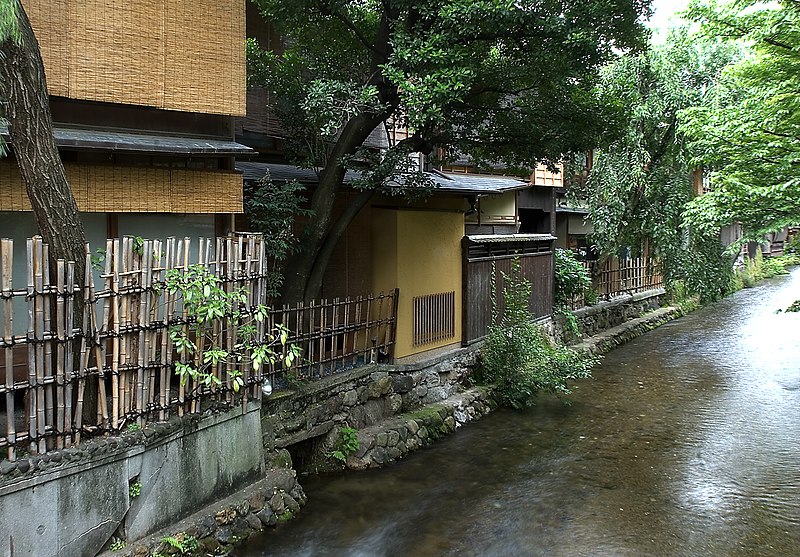
Shirakawa River [Wikipedia]


As the long winter faded, the cherry blossom trees along the Shirakawa River responded to the warm April sun and flooded the banks with a soft pink mist. I could see the blossoms from the window of her room, but the girl was too young to appreciate the pathos of their beauty – those petals whose destiny was to diffuse their delicate beauty for a brief span, only to be caught by the slightest breeze and flutter to the earth from which they sprang. Keiko never saw her own life and destiny in those blossoms.

About the middle of April she began to weaken. Within a week, she had lost consciousness and was given oxygen. She died peacefully on 27 April. The church was filled at her funeral. Her classmates were heartbroken and inconsolable, far more emotionally upset than her family. Indeed, I was surprised at how calmly her parents bore their great loss. I discovered it was because they had received the grace of the faith through the girl’s influence, even before they had begun any formal instructions. They were convinced that she still lived on in God and that they would meet her again.

Whole family converted
A week after the funeral her parents and her brother began their study of the doctrine. They were model catechumens. Every night before the family altar, united to Keiko in spirit, they said the rosary and read a chapter from the Scriptures. I baptized them on 6 November, the anniversary of Keiko’s baptism. There were tears of joy in their eyes that day as they realized they were united to their daughter by grace within the bosom of God the Father.

One of Keiko’s closest friends who was shattered by her death but very impressed by the spiritual change in the girl before her death, has resolved to follow in her footsteps and pursue the ideal of service Keiko set for herself had she lived. She is now under instructions and intends to become a nurse.

Fr James Norris after officiating at the joint wedding ceremony of three brothers in Japan

Testimony of her faith
There was nothing sensational about this girl’s short life. She did nothing that would merit notice in the mass media; her life created no more of a stir in society than a petal falling to the ground. But I am convinced her story is real news and a genuine success story. In these days of superficial sensationalism, even we Christians tend to forget that the real battles of life are won or lost within the depths of the heart where a man meets his God and says yes or no.

Moreover, in a country like Japan, a missioner seldom sees the grace of God’s action working so powerfully and swiftly in a soul. Such tangible evidence of God’s presence is almost a physical sign of His love which bolsters one’s hope no end, enabling the missioner to keep going. This slip of a girl was a candle in the darkness, a spring flower in the desert.

Mater Dei, Mother of God, Japan
Unknown artist, c.1900-05, painting on silk

Ave Maria in Japanese
Composer: Saburo Takada; singer: Atsuko Azuma


26 January 2016

Porferio D. Matulac RIP, the father of a Columban priest


Porferio D. Matulac was the father of Fr Cireneo 'Dodong' Matulac, a Columban priest ordained a few days after Christmas 2002. Father Dodong started off under my care as a 16-year-old first-year college seminarian in Cebu City, studying at the University of San Carlos. Later in his formation Dodong spent two years on mission in Chile as a seminarian on what we call 'First Mission Assignment'. After his ordination he spent some years in China and is now involved in the formation of Columban seminarians in Quezon City but is currently doing a year's study in Chicago.

I remember being very touched when he told me how his family welcomed each New Year. Shortly after his ordination I asked him to write an article about that for MISYON, now MISYONonline.com, the Columban magazine I edit here in the Philippines. It was published in the January-February 2004 issue. The Matulac Family live in a remote part of southwestern Mindanao, in a small village that is part of the municipality of Payao, Zamboanga Sibugay. Father Dodong was able to spend nearly a month with his family over Christmas and the New Year before returning to Chicago.

The funeral of Porferio takes place in Payao on 30 January at 10am.

How My Family Welcomes The New Year

by Fr Cireneo Matulac

Father Dodong with his parents 'Poping' and 'Vering' on his ordination day

There’s growing excitement in our family as we prepare for the New Year’s celebration. My brother has just left for the población to buy ice cream, the only time we have it, a real New Year’s treat. I feel that this New Year’s celebration will be different. My mother has insisted on baking rice cakes which she hadn’t done for years. My two sisters are preparing their favorite dish and my other brother is preparing his usual pork and chicken barbecue. My family has certainly become a lot bigger. I now have seventeen nephews and nieces, the oldest in his early twenties, and all of them are extremely excited. I’ve heard the younger ones say, ‘Uncle will celebrate Mass for the New Year in Lola’s house.’ ['Lola' is 'Grandma'].
Our time of the year
Celebrating the New Year has always been a happy occasion for my family. We welcome it in a festive manner even in dire times. My father makes sure that everyone is present and leads us in our family para-liturgical celebration, like a family Gagmayng Simbahanong Katilingban, (GSK), or basic ecclesial community. We start at 11pm and finish a few minutes before midnight when we wish each other ‘Happy New Year.’
My father selects a gospel reading and then expounds on it with the passionate homily he has prepared weeks before. His sermon usually revolves around how our family has gone through hardships and difficulties but has always been able to move forward. He attributes this not to any of his strengths and gifts but to prayer that God always answers. He reminds us that every evening my mother leads us in the rosary. I remember that as a child I always fell asleep before we finished. My father speaks of the generosity of God who continues to bless us all the days of our lives. When he comes to this point, my mother seconds him with her sobs and tears. She isn’t particularly sad. Her tears express a joy for which there are no words.
Father Dodong on a recent 'field-trip' in the USA

What binds my family
After our liturgy, we have the family dinner. This is the time when we make wishes for the coming year. When I was a young boy I asked God to make me a little taller. God answered my other prayers but not this one. This New Year, however, I can’t wish for anything more except for our family to be always together.
I know that this New Year will be different. I am the youngest child and I was ordained to the priesthood only a a few days ago. My mother told her grandchildren that this time we would have Mass instead of my father leading the family liturgy. Secretly, to his great delight, I asked my father to prepare the homily. Deep in my heart I know that this is a tradition that sustains us as a Christian family and that my vocation sprang mainly from my parents’ faith articulated by my father in his New Year’s sermon and made a lot more profound by my mother’s sobs and tears. I’m sure that it is going to be a different celebration this year, as my mother has told her grandchildren. But then it’s always different because each time we welcome the New Year we’re growing deeper in our faith in God. This yearly ritual has always been a wellspring of my family’s faith and my vocation to the priesthood.
Every New Year is indeed different and yet a continuation of what we’ve always been doing.


01 July 2015

'A spring flower in the desert.' Sunday Reflections, 14th Sunday in Ordinary Time, Year B

Keiko Shemura on her First Communion Day, December 1971
Keiko died 27 April 1972, aged 14

Readings (New American Bible: Philippines, USA)

Readings (Jerusalem Bible: Australia, England & Wales, India [optional], Ireland, New Zealand, Pakistan, Scotland, South Africa)


Jesus left that place and came to his hometown, and his disciples followed him. On the sabbath he began to teach in the synagogue, and many who heard him were astounded. They said, “Where did this man get all this? What is this wisdom that has been given to him? What deeds of power are being done by his hands! Is not this the carpenter, the son of Mary and brother of James and Joses and Judas and Simon, and are not his sisters here with us?” And they took offense at him. Then Jesus said to them, “Prophets are not without honor, except in their hometown, and among their own kin, and in their own house.” And he could do no deed of power there, except that he laid his hands on a few sick people and cured them. And he was amazed at their unbelief.
Cherry blossoms in Fukushima [Wikipedia]
Both the New American Bible and the Jerusalem Bible lectionaries read, He was amazed at their lack of faith. Jesus was among his own people, in the town where his brothers and sisters, ie, his cousins, lived. Perhaps his amazement was a form of frustration. Missionaries are men and women who are often 'amazed' at what seems to be their lack of 'success' in changing the situation, whether it is leading people to faith in Jesus Christ or working among baptised people for the justice that the Gospel demands but evidently isn't there.

Yet Jesus laid his hands on a few sick people and cured them. In other words, he found some who responded in faith.

One Columban priest who found faith in Keiko, a very sick 14-year-old girl in Japan, was Fr James Norris, a New Zealander who died on 6 October 2007. Japan is still a country where fewer than one in two hundred are Catholics. He wrote about his experience in Far East, the magazine of the Columbans in Ireland and Britain, in 1973. Father Jim's article made a profound impact on me and I reprinted it in Misyon in March-April 2008. our last printed edition. It is a story that moves me each time I think about it. Maybe the few who believed and were healed consoled Jesus in his humanity. Maybe he felt something of what Father Norris describes in the closing paragraph of his article.

The story of Keiko and her parents shows us that our Catholic Christian faith is a gift from God, a gift for which we should thank him every day.

A Spring Flower
by Fr James Norris 

Cherry blossoms at the Tokyo Imperial Palace [Wikipedia]

There is a high school in our parish for nearly 2,000 girls conducted by the Sisters of the Infant of Jesus. Very few of these girls are baptized Christians. As a means of contact, I teach English to the junior high school pupils three times a week. My classes are very informal and I am afraid the young ladies don’t take me very seriously, possibly because I give them no homework or exams. My specialty is supposed to be pronunciation and intonation.

One day, early in November 1971, I received a summons from one of my little pupils, Keiko Uemura, aged 14. She was very sick in the hospital and wished to be baptized. I hadn’t noticed her absence at school. The nuns were full of apologies for not letting me know, but they hadn’t thought her illness was serious; moreover, she had never shown any real interest in religion but on the contrary, during religious classes seemed to take a delight in trying to tie the Sister up in knots with embarrassing questions.

When I visited her she seemed in good spirits. After ascertaining that she really did believe and had sufficient knowledge to realize what she was doing, I baptized her. A few days later I returned to the hospital with several books that explained the faith simply and would help her to pray. She began to prepare for her first Holy Communion. I discovered that despite her seemingly frivolous behavior during religion classes, she had retained quite a lot and what was more, in her present crisis could believe, simply and totally, with no reservations. 

In December she was moved to the University hospital, the largest in town and the best equipped. Keiko herself was not aware of it, but she was suffering from a rare type of bone cancer that sometimes afflicted children. The doctor gave her three months to live. Her parents were wonderful. One of them was always near her, day and night. In her case this devoted warm parental love was an actual grace that served to open out and expand her soul to receive the grace of God’s love. As Keiko responded to God’s love, the change in her thinking and outlook, her values, could not fail to impress her parents who in turn were drawn along by the girl towards God.

About Christmas time she made her first Holy Communion. She was radiantly happy that day, as is evident from the photo. Present for the occasion were her parents and some of the Sisters from the school. I made a tape recording for future use. Each week I took her Holy Communion. Her mother prepared the altar and with Keiko read the book on doctrine explaining the faith.

Home for the New Year
The girl was permitted to return home for three days over the New Year. As a result of an operation she had recovered so well that she could walk about slowly with the aid of crutches. She believed she was on the way to complete recovery; she was full of roseate plans for her future, a trip to Lourdes followed by a life of service as a nurse to crippled children. Her father hoped against hope for a miracle, but on the quiet he assured me that it was only a question of time.

Spiritual progress
During the next three months she made tremendous spiritual progress. Her mother told me that she herself was sometimes concerned by the flood of visitors, who often outstayed their welcome, even when Keiko was in pain. But the girl never showed it; she always put on a cheerful front and showed her gratitude to all-comers. Later when her mother grumbled about the inconsiderateness of some people, the girl stopped her with: ‘Mother, it may be alright for you to complain because you are not a Christian, but I am one now and must love everybody. Besides, the visitors come because they are interested in me and I am grateful for this.’ Apart from the occasional sigh or moan that escaped her lips, she never complained of the pain.

Shirakawa River [Wikipedia]

As the long winter faded, the cherry blossom trees along the Shirakawa River responded to the warm April sun and flooded the banks with a soft pink mist. I could see the blossoms from the window of her room, but the girl was too young to appreciate the pathos of their beauty – those petals whose destiny was to diffuse their delicate beauty for a brief span, only to be caught by the slightest breeze and flutter to the earth from which they sprang. Keiko never saw her own life and destiny in those blossoms.

About the middle of April she began to weaken. Within a week, she had lost consciousness and was given oxygen. She died peacefully on 27 April. The church was filled at her funeral. Her classmates were heartbroken and inconsolable, far more emotionally upset than her family. Indeed, I was surprised at how calmly her parents bore their great loss. I discovered it was because they had received the grace of the faith through the girl’s influence, even before they had begun any formal instructions. They were convinced that she still lived on in God and that they would meet her again.

Whole family converted
A week after the funeral her parents and her brother began their study of the doctrine. They were model catechumens. Every night before the family altar, united to Keiko in spirit, they said the rosary and read a chapter from the Scriptures. I baptized them on 6 November, the anniversary of Keiko’s baptism. There were tears of joy in their eyes that day as they realized they were united to their daughter by grace within the bosom of God the Father.

One of Keiko’s closest friends who was shattered by her death but very impressed by the spiritual change in the girl before her death, has resolved to follow in her footsteps and pursue the ideal of service Keiko set for herself had she lived. She is now under instructions and intends to become a nurse.

Fr James Norris after officiating at the joint wedding ceremony of three brothers in Japan

Testimony of her faith
There was nothing sensational about this girl’s short life. She did nothing that would merit notice in the mass media; her life created no more of a stir in society than a petal falling to the ground. But I am convinced her story is real news and a genuine success story. In these days of superficial sensationalism, even we Christians tend to forget that the real battles of life are won or lost within the depths of the heart where a man meets his God and says yes or no.

Moreover, in a country like Japan, a missioner seldom sees the grace of God’s action working so powerfully and swiftly in a soul. Such tangible evidence of God’s presence is almost a physical sign of His love which bolsters one’s hope no end, enabling the missioner to keep going. This slip of a girl was a candle in the darkness, a spring flower in the desert.

 Mater Dei, Mother of God, Japan
Unknown artist, c.1900-05, painting on silk

Ave Maria in Japanese
Composer: Saburo Takada; singer: Atsuko Azuma