29 September 2011

Lala and Queen Elizabeth II


This column, updated 29 September 2011, appeared in the short-lived Negros Times 13-14 October 2008. The above was the picture that appeared with my weekly column. Last Tuesday, 28 September, the feast of St Vincent de Paul, was Lala's 'Official Birthday'. I only remembered that yesterday and thought of posting my three-year-old article here.

Both Lala and Queen Elizabeth II have have two birthdays, the real one and the official one. Lala’s official birthday is 27 September and she turned 32 two days ago. Queen Elizabeth’s official birthday is celebrated in 53 Commonwealth countries, but not on the same date. Only the Falkland Island observes her official birthday on her real one, 21 April. In the United Kingdom the Queen’s official birthday can be on the first, second or third Saturday in June. She turned 85 on her last birthday.

While there’s no confusion about the date of birth of Queen Elizabeth, there is about that of Lala. The young Princess Elizabeth was born in a palace in London. Lala was found shortly after birth in a trashcan in Cebu city in the central Philippines. Those who found her took her to the Asilo De La Milagrosa, the orphanage of the Daughters of Charity there. The Sisters noticed that the little girl had Trisomy 21 (Down Syndrome) and took her in and raised her. Since they didn’t know who her parents were they had to choose a name for her.

The Sisters chose 'Vicente' as her family name, in honor of St Vincent de Paul, and 'Louilla' as her Christian name, in honor of St Louise de Marillac. The two saints founded the Daughters of Charity in France in 1633. Lala, as all her friends know her, probably has something else in common with St Louise. She was almost certainly born out of wedlock, as the saint was, and, like St Louise, never knew her mother. I suspect that Lala’s mother, probably very young and unmarried, panicked – this possibly added to when she saw that her daughter wasn’t 'normal' - and left her baby where someone could find her and take care of her.

I first met Lala in Cebu in 1992 at a Faith and Light celebration. We had just begun a community there, after a retreat given by the co-founder of the movement, Jean Vanier, a Canadian layman, in Holy Family Retreat House, Cebu City, in October 1991. During the retreat he gave a public talk in the auditorium of St Theresa’s College, as I recall, and a group of interested people got together after that. The gathering at which Lala was present included members of Faith and Light from Manila who had come to tell us more about the movement.

I could see immediately that Lala had a special gift – she’s a natural 'ice-breaker'. Though she seldom says anything, she lights up any group into which she comes, unless she’s in a bad mood, which happens from time to time.

Lala became a member of our Faith and Light community in Cebu but I lost contact with her when I went to Lianga, Surigao del Sur, in 1993 as parish priest and to Manila the following year to become vocation director of the Columbans. But one day when I visited the L’Arche community in Cainta, Rizal, known as 'Ang Arko', I was surprised to see Lala there. L’Arche, the French for 'The Ark' as in Noah’s Ark, was founded by Jean Vanier, in 1964 when he invited two men with learning disabilities, Raphael Simi and Philippe Seux, who had been living in an institution, to join him in a small cottage he had bought and was renovating in the town of Trosly-Breuil, France. Jean had no intention of founding anything, but he realized very quickly that he had made a commitment to these two men. One of them, I forget which, chose to live independently some years later, something he could never have done had he stayed not met Jean. Out of these small beginnings has grown an international movement of about 130 residential communities where those with learning disabilities are enabled to live in a family-type situation and to develop their abilities to the greatest extent possible.

Jordan and Raymon, now young men, were welcomed by Ang Arko when they were very young. Both have physical as well as learning disabilities. The original house was in Manila but the community moved later to Cainta.

In Holy Week 2001 I attended the international pilgrimage of Faith and Light to Lourdes as chaplain to the group from the Philippines. Lala was one of the twelve or so Filipinos.

The Easter Vigil was celebrated in the underground basilica. Some of the Old Testament Vigil readings were dramatized. During the account of creation when the words 'God created man in his image; in the divine image he created him' were read, a spotlight shone on a young man in a wheelchair. But what moved me most was when 'Lala' was part of a group dramatizing the reading of the Exodus.

I simply marveled at the fact that a young woman who should never have been born, according to the 'wisdom' of so many, left after birth among garbage, was on the other side of the world helping to proclaim the Word of God to thousands of people, many like herself, and doing so with the joy that permeates her soul.

Queen Elizabeth has been blessed by God with a long and healthy life, in which she continues to serve her people with dignity. Though Queen Elizabeth is among the richest people in the world, Lala, also with her two birthdays, enjoys even greater riches, because the words of Mary’s prayer, the Magnificat, have been revealed in her life: 'God has lifted up the lowly'.

Rafael Simi (left) and Jean Vanier (right).

You can listen to an interview with Jean here. He turned 83 on 10 September.

This comment was posted when I first posted this three years ago:

Wow..I can't believe Im actually sitting here reading this post about Lala..This is wonderfull..Well, I actually grew up with Lala in the orphanage at Asilo dela Milagrosa..we are the same age..I was there from 1986-1994 until I was sent here in America to be adopted..The first time we were introduce to Lala we were a little nervous, we were very young and we never met someone like her, then she started to sing 'Tomorrow' and for some reason we were all drawn to her..As I remember, I was a little jealous because she was always happy, didnt care what everyone thought of her, she welcomed every visitor we had with a smile, she's very friendly..After I finished high school, I started working as a volunteer camp councelor but I was assigned in the office and there was this girl and she is also my age and I was ask to be her counselor for a couple of months and I was so excited, nobody knew why I was glad to do so and it all because I remembered Lala, it was 8 yrs. ago that i work at the camp, and here I am writing and remembering Lala..

I would like to thank you Fr. Sean for writing this post..

28 September 2011

Ever wonder what you hear through a stethoscope?


Did you ever wonder what you hear through a stethoscope? H/T to Father Z.

26 September 2011

'Engineer brothers down tools for life in the priesthood'

Fr James Doyle, Fr Brian Doyle OP, Bro Rory Doyle OFMConv

The photo above, courtesy of the Irish Dominicans, was taken on Saturday 3 September in Murrintown, County Wexford, in the south-west of Ireland, when Father Brian was ordained priest by Bishop Denis Brennan of Ferns. His brother Father James (Jim) is a priest in the Diocese of Ferns, which includes most of County Wexford, and his twin Brother Rory is also preparing for the priesthood as a Conventual Franciscan.

The three brothers are featured in today's Irish Independent: Engineer brothers down tools for life in the priesthood. The twins have doctorates in engineering. Father Jim worked with the Irish agency Concern in Cambodia and Burundi and found his vocation there.

Father Brian with his parents Joan and Brian senior (Irish Dominican Vocations)

Ten years ago I did mission appeals on behalf of the Columbans in the Diocese of Lancaster in the north-west of England. I met two of the three Burns brothers who, like the Doyle brothers, gave up very successful careers to become priests. I met two of the three Foulkes brothers who were also priests of the diocese. The third had already died.

We Columbans have been blessed with sets of three brothers, from Australia, Ireland and the USA. But in today's Ireland, where so many have left the Church, where so many are disheartened by scandals involving priests, it is very heartening to read about the Doyle brothers who  have one sister, Judith, who married last year. It is particularly heartening to read about it in the most widely read daily newspaper in Ireland.

The photos below are all taken from the Irish Dominican Vocations Blog of Fr Gerard Dunne OP.

Brother Brian during the Litany of the Saints

 Father Jim lays hands on his brother's head

 Bishop Brennan giving the sign of peace to Father Brian

It was seeing Dominican friars in their white habits in St Saviour's Church, Dublin, where my father used to take me occasionally for High Mass, that first stirred an interest in the priesthood in my heart. I was around seven at the time. Though I never seriously considered being a Dominican I am grateful to God for that early 'signpost', which has also been a signpost to many young men in Ireland in recent years, including two Irish diocesan priests who have joined the Order of Preachers. Here is a video from the Irish Dominican Vocations Blog that features that 'signpost'.


23 September 2011

'Which of the two did the father's will?' Sunday Reflections, 26th Sunday Year A

 
 Readings (New American Bible: Philippines, USA)

Gospel, Matthew 21:28-32 (Jerusalem Bible: Australia, England & Wales, India [optional], Ireland, New Zealand, Pakistan, Scotland, South Africa.)

Jesus said to the chief priests and the elders of the people: 'What is your opinion? A man had two sons. He went and said to the first, "My boy, you go and work in the vineyard today". He answered, "I will not go", but afterwards thought better of it and went. The man then went and said the same thing to the second who answered, "Certainly, sir", but did not go. Which of the two did the father's will?' 'The first' they said. Jesus said to them, 'I tell you solemnly, tax collectors and prostitutes are making their way into the kingdom of God before you. For John came to you, a pattern of true righteousness, but you did not believe him, and yet the tax collectors and prostitutes did. Even after seeing that, you refused to think better of it and believe in him.

Soiscéal, Matha 21:28-32 (Gaeilge, Irish)

San am sin dúirt Íosa le huachtaráin ne sagart agus le seanóir an phobail: “bhur mbarúil air seo: Bhí beirt mhac ag duine. D’agaill sé duine acu ar dtús: ‘A mhic,’ ar seisean, ‘téighse inniu ag obair san fhíonghort.’ D’fhreagair sé é: ‘Tá go maith, a dhuine uasail,’ ar seisean; ach ní dheachaigh. D’agaill sé an dara duine ar an gcuma chéanna, agus b’é a fhreagra seo: ‘Ní dhéanfaidh mé,’ ar seisean; ach ina dhiaidh sin tháinig aiféala air agus chuaigh. Cé acu den bheirt a rinne toil a athar?” “An dara duine,” ar siad. Dúirt Íosa leo: “Deirim libh go fírinneach, tá tosach ag na poibleacánaigh agus ag na striapacha oraibhse isteach i ríocht Dé. Óir tháinig Eoin chugaibh ar shlí na fíréantachta agus níor chreid sibh ann; na poibleacánaigh, áfach, agus na striapacha, chreid siad ann; agus cé go bhfaca sibhse é sin, níor bhuail an t aiféala mall féin sibh chun go gcreidfeadh sibh ann.”


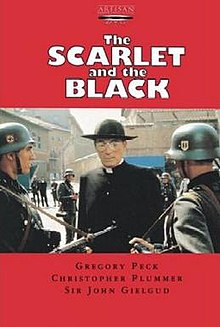
The scene in the video is just before the end of The Scarlet and the Black, a 1983 made-for-TV movie based on the true story of Irish priest Monsignor Hugh O'Flaherty, based in the Vatican during World War II, and his nemesis, Col Herbert Kappler, the SS chief in Rome during the latter part of the war. Monsignor O'Flaherty saved the lives of thousands of Jews and Allied soldiers. Kappler, who knows that the Allies are approaching Rome, is worried about the safety of his own family and sends some soldiers to Fr O'Flaherty to meet him at the Coliseum at night, guaranteeing his safety.

Just after the scene above Kappler asks the priest if he could help get his wife and children to safety. The Irishman gets very angry and walks away in disgust. Kappler shouts, 'You're just like the rest of them'.

The next scene, which I couldn't locate on YouTube, shows Kappler under arrest and, while being interrogated, learning that his family have arrived safely in Switzerland. When asked how, he replies that he doesn't know. But he realises that Monsignor O'Flaherty was responsible.

As the credits are rolling we read that Fr O'Flaherty visited Kappler regularly in jail and the German eventually asked to be baptised by the priest.

The closing scenes of The Scarlet and the Black are, for me, among the most memorable in any film I've seen and came to mind as I was praying with today's gospel. O'Flaherty's immediate and clear answer to Kappler's request echoes that of the first son in the parable: 'I will not go'.

But he did go, doing his father's will, as the Irish priest did the Father's will, winning back to God a man who had devoted his life to evil. Early in 1944 Kappler had supervised the summary execution of more than 300 randomly chosen Italians in the Ardeatine Caves in retaliation for the deaths of 33 SS men. Hugh O'Flaherty, at the moment of his death in 1963 surely heard Jesus speak to him his words from Matthew 25:36, 'I was . . . in prison and you came to see me'.

I find this gospel consoling because so often my immediate reaction to a request is to say 'No'. But God gives me the grace to say 'Yes'. The priest's immediate anger and disgust at Kappler's request were perfectly understandable and normal. In Worldwide Marriage Encounter we say that feelings are neither right nor wrong. It's what comes next that is either right or wrong. We also emphasise that Love is a Decision.

Father O'Flaherty's decision to love his enemy was one with eternal consequences as had his many decisions to save the lives of others despite the danger to his own life.

The real Herbert Kappler (1907 - 1978)

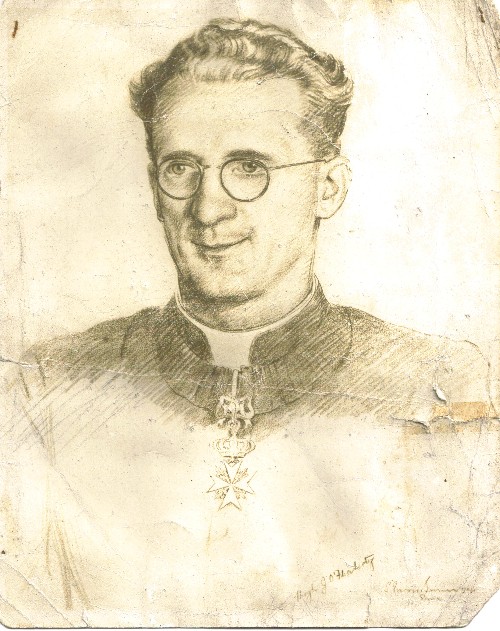
The real Monsignor Hugh O'Flaherty (1898 - 1863), from the website of the Hugh O'Flaherty Memorial Society.


22 September 2011

'The Return to the Dark Ages'


For many years my Columban colleague Fr Shay Cullen has been fighting agains the exploitation of women and children in the Philippines and has won a number of awards for this. He has spoken to legislators in a number of Western countries, some of which have brought in laws enabling them to charge their own citizens for crimes against children in other countries. Father Shay writes a weekly 'Reflections' column that is published in a number of countries. Reflections No 553, his latest, is below.

The news-clip above was made a few years when Rodrigo Duterte was Mayor of Davao City. Father Cullen mentions him, though not by name, in his column. As he was ineligible to run again last year for Mayor he had his daughter run instead while he ran for Vice Mayor. Both were elected. That is how power is passed on in most parts of the Philippines.


Fr Shay Cullen's columns are published in The Manila Times,
in publications in Ireland, the UK, Hong Kong, and online.

It’s back to the dark ages for the hysterical tabloid press in Metro Manila where the bellowing newscasters and commentators are condemning street children and children in conflict with the law as criminals. The most strident commentators call for the children to be charged and jailed and to reduce the age of criminal liability to 12 or younger. They demand that the Juvenile Justice Welfare Act be changed.

This act, Republic Act 9344, is a landmark piece of legislation of compassion that seeks to restore the deprived life of children in conflict with the law. It says that children younger than 15 have an alternative to harsh, cruel prison life where enough of them have been raped, abused, beaten and starved in sub-human conditions. They can be helped, given a chance of an education and rehabilitation through meeting their basic human rights, nutritional needs and education. However, up to a million children and minors from the teeming slums frequent the streets and join gangs to survive. Many hundreds of youth are still jailed in conditions not even fit for animals.

Those who advocate the repeal of the law don't know the reality. They are branding the street children as the tools of the criminal syndicates which the police are either too scared to oppose or are in cahoots with. Instead of exposing the criminal syndicates and their wealthy masterminds, the irresponsible commentators are setting up the street kids as targets for death squads.

Not only that, a few commentators, after giving tirades condemning the street kids over the radio or TV and arousing fear and hatred against them, launch their own text-in surveys, then use this survey result to justify their continued condemnation of the children. The one straightforward solution is to feed and educate the young and give jobs with a living wage to the older teenage youth.

The death squads too are busy killing hundreds of street youth in recent years and doing their bloody butchering work with a nods and winks from their political backers and incompetent police. The latest, most gruesome, has been the killing of three youths, 13 and 14, tied, gagged, tortured and stabbed a hundred times and thrown as garbage in a ditch in Zamboanga City, to the eternal shame of the politicians, police and citizens. Their muffled screams still cry out for justice and mercy. But there is none.

Cebu and Davao cities are the most notorious for the extermination of street youth. Ten years ago, I called on the then Mayor of Davao City to defend human rights and stop the killings of street youth. Instead, he charged me with libel and had me hailed to court.

It was a proud moment indeed to be able to take a stand for the kids in court but what¹s even more amazing was the crowd of street children that came to Davao City airport to surround me with their malnourished bodies to protect me from the assassins’ guns and escort me to a van away from danger. In the end, the Mayor was persuaded to drop the baseless charge. The death squads rule by fear but the politicians call it democracy. If the majority of the people approve by their silence, then I suppose it is. It is the democracy of death and the death of democracy.

There will be no end to the thousands homeless urchins that challenge our conscience and religious beliefs until the root cause is dealt with. That is the corrupt system of government and the insurmountable inequality of society. There is the unbridgeable gap between the tiny group of luxuriously living rich and the masses of struggling poor. It’s a society where two percent of the population own about 70 percent of the natural wealth and the millions of hungry slum dwelling people are barely surviving from day to day.

Poverty, mass unemployment and hunger drive the children from these slums on to the streets to a miserable life of hunger and hopelessness. They go begging, and cannot resist stealing when they are hungry and smell the aroma of the delicious foods that wafts out from the fast food restaurants. The hungry children are driven crazy with the desire for a decent meal. Most of the time they live on left-overs from garbage cans. The government has no homes to care for them and deliver their basic human rights. They are the abandoned and forgotten until they are forced to steal in order to eat. Then they are condemned to prison.

This is the fundamental failure of the Church, politicians, society and humanity - to remain indifferent to the hungry needy children and allow them to be condemned as criminals. We have to come to their defense and give them a life of dignity and decency. END

21 September 2011

The Calling of St Matthew


Fr Finbarr Maxwell, a Columban from Dublin who worked before in Pakistan and is studying in the USA at present, drew this painting to my attention when he gave a group of us here in the Philippines a retreat three or four years ago. The gospel of today's Mass for the Feast of St Matthew has a starkness and urgency about it. It's not how most of us hear our vocation or call, whatever it may be, from Jesus.

Fr Mike McGovern in the video points out that while Jesus and St Peter are dressed as men of their time and place, Matthew and his companions are dressed as contemporaries of Caravaggio. In other words, Jesus calls us where we are and in our times.

Matthew 9:9-13 (RSV Catholic Edition)

As Jesus passed on from there, he saw a man called Matthew sitting at the tax office; and he said to him, "Follow me." And he rose and followed him. And as he sat at table in the house, behold, many tax collectors and sinners came and sat down with Jesus and his disciples. And when the Pharisees saw this, they said to his disciples, "Why does your teacher eat with tax collectors and sinners?" But when he heard it, he said, "Those who are well have no need of a physician, but those who are sick. Go and learn what this means, 'I desire mercy, and not sacrifice.' For I came not to call the righteous, but sinners."

The Calling of St Matthew, Caravaggio, painted 1599-1600

20 September 2011

Feast of the Korean Martyrs. Pregnant Mother Spared by Persecutors.

St Andrew Kim Taegon, (1821-1846), Myeongdong Cathedral, Seoul

St Andrew Kim Taegon's last words: This is my last hour of life, listen to me attentively : if I have held communication with foreigners, it has been for my religion and for my God. It is for Him that I die. My immortal life is on the point of beginning. Become Christians if you wish to be happy after death, because God has eternal chastisements in store for those who have refused to know Him.

Today the Church honours the 103 Korean martyrs canonized on 6 May 1984 by Blessed Pope John Paul II in Seoul. However, around 8,000 Korean Catholics were martyred during periodic persecutions between 1839 and 1868. Among the 8,000 was the grandfather of the first Korean cardinal.


In an article published in July-August 2009 in Misyon, which I edit for the Columbans in the Philippines, after the death of Cardinal Kim Columban Fr Donal O'Keeffe told this extraordinary story: Kim Sou-Hwan (Stephen) was born in May 1922 in Taegu in the province of Kyongsangdo to a fervent Catholic family. His grandfather Kim Bo-hyun (John) was arrested and martyred in Seoul in 1868 during the last persecution of Christians in Korea. His grandmother was also to be executed with him but was released because she was pregnant. The child born was Kim Young-sok (Joseph) who was to become the father of Kim Sou-hwan.

Today many say it is a woman's 'right' to have her unborn baby killed. Yet those who put Cardinal Kim's grandfather and many others to death respected the life of the unborn child his grandmother was carrying.

Stephen Cardinal Kim Sou-whan (1922-2009)


A poem of remembrance
by Fr Kevin O'Rourke

Fr Kevin O’Rourke, a Columban from Ireland ordained in 1963, is professor of English at Kyunghee University in Seoul, Korea, and is the author of three books of Korean poetry in translation and is planning to produce an anthology from AD 668 to the present day.

Dust of snow,
a wind that chills to the bone,
pinched mourning faces,
collars raised, hats pulled low,
the shiver of death everywhere.
Cardinal Kim Suhwan
is lowered to his final resting place.

He brought forth simplicity,
a water simplicity that quickened
every root it touched.
He brought forth patience,
a medicament patience that salved
the wounds of the poor.
He brought forth compassion,
a loving compassion that embraced the world.
Simplicity, patience, compassion,
these three:
timber for a master carpenter,
clay for a master potter,
the hub of a master priest’s wheel.
'If you bring forth what is inside,
what you bring forth will save'.