Since we are travellers and pilgrims in the world, let us ever ponder on the end of the road, that is of our life, for the end of our roadway is our home (St Columban, 8th sermon).
Showing posts with label Claudio Monteverdi. Show all posts
Showing posts with label Claudio Monteverdi. Show all posts
Gospel Matthew 5:17-37 (English Standard Version Anglicised: India)
Jesus said to his
disciples:
“Do not think that I have come to abolish the Law or the
Prophets; I have not come to abolish them but to fulfil them.For
truly, I say to you, until heaven and earth pass away, not an iota, not a
dot, will pass from the Law until all is accomplished.Therefore whoever relaxes one of the
least of these commandments and teaches others to do the same will be called
least in the kingdom of heaven, but whoever does them and teaches them
will be called great in the kingdom of heaven.For I tell you, unless your righteousness
exceeds that of the scribes and Pharisees, you will never enter the
kingdom of heaven.
“You have heard that it was said to those
of old, ‘You shall not murder; and whoever murders will be liable to
judgement.’But I say to you that everyone who is
angry with his brother will be liable to judgement; whoever insults his
brother will be liable to the council; and whoever says, ‘You fool!’ will be
liable to the hell of fire.So if you are offering your gift at the altar and there
remember that your brother has something against you,leave your gift there before the altar and
go. First be reconciled to your brother, and then come and offer your gift.Come to terms quickly with your accuser while
you are going with him to court, lest your accuser hand you over to the judge,
and the judge to the guard, and you be put in prison.Truly, I say to you, you will never get
out until you have paid the last penny.
“You have heard that it was
said, ‘You shall not commit adultery.’But I say
to you that everyone who looks at a woman with lustful intent has already
committed adultery with her in his heart.If your right eye causes you to sin, tear it out and
throw it away. For it is better that you lose one of your members than that
your whole body be thrown into hell.And if your right hand causes you to sin, cut it off and
throw it away. For it is better that you lose one of your members than that
your whole body go into hell.
“It was also said, ‘Whoever divorces his wife, let him give
her a certificate of divorce.’But I say to you
that everyone who divorces his wife, except on the ground of sexual immorality,
makes her commit adultery, and whoever marries a divorced woman commits
adultery.
“Again you have heard that it was said
to those of old, ‘You shall not swear falsely, but shall perform to
the Lord what you have sworn.’But I say to you, Do
not take an oath at all, either by heaven, for it is the throne of God,or by the
earth, for it is his footstool, or by Jerusalem, for it is the city of the
great King.And do
not take an oath by your head, for you cannot make one hair white or black.Let what you say be simply ‘Yes’ or
‘No’; anything more than this comes from evil.”
Shorter form
of the Gospel
GospelMatthew 5:20-22a, 27-28, 33-34a, 37 (English Standard Version Anglicised: India)
Jesus said to his disciples:
“For I tell you, unless your
righteousness exceeds that of the scribes and Pharisees, you will never enter the kingdom of heaven.
“You have heard that it was said to
those of old, ‘You shall not murder; and whoever murders will be
liable to judgement.’But I say to you that everyone who is angry with
his brother will be liable to judgement; whoever insults his
brother will be liable to the council; and whoever says, ‘You fool!’ will be
liable to the hell of fire.
“You have heard that it was
said, ‘You shall not commit adultery.’But I say to you that everyone who looks at a woman
with lustful intent has already committed adultery with her in his heart.
“Again you have heard that it was
said to those of old, ‘You shall not swear falsely, but shall perform
to the Lord what you have sworn.’But I say to you, Do not take an oath at all,
either by heaven, for it is the throne of God,
“Let what you say be simply ‘Yes’ or
‘No’; anything more than this comes from evil.”
Responsorial Psalm (NAB Lectionary, Philippines, USA)
More than forty years ago I spent part of a summer working in a parish near New York City. One day when I was on duty I answered the phone. The man calling gave me his name, which I wrote down. He told me he was living in an irregular situation, having been divorced from his wife. He was asking what the Church could do for him in that situation. I tried to tell him about programmes that the Church had in the diocese for Catholics who were divorced and re-married civilly or living with someone else. The latter situation wasn't nearly as common then as it is now.
But he was getting more and more angry, though I remained calm. He eventually hung up.
I was able to find his mailing address easily on the parish register and wrote him a letter letting him know that I had understood his situation and the reason for his anger and frustration. Again, I informed him of the ways the Church was trying to be with those who found themselves in situations such as his.
The following day I had another phone call from the man. He thanked me profusely for my letter, for having listened to him and for having heard what he was trying to say. He also acknowledged that he was in a situation that he himself had created.
Today's Gospel shows us a Jesus who is somewhat different from the 'domesticated' meek and mild Jesus that we often imagine or create. He speaks of hard things: the consequences of breaking God's law, the necessity of forgiving and accepting forgiveness, the fruits of anger - not the feeling, which is something spontaneous, but the decision to remain angry/to hate - and the effects of adultery. Some of the most difficult parts of today's gospel may be omitted and probably will be by many priests, for various reasons.
The media at the moment are giving lots of coverage to how the Church approaches those who are living with someone not their spouse. One might be led to think that the Church is being harsh for the sake of being harsh, imposing impossible difficulties on some of its members and failing to be 'merciful' and 'pastoral'.
In 2014 Fr Edward McNamara LC in zenit.org, a Catholic news agency, replied to a question about this very matter. He quotes from The Catechism of the Catholic Church, Nos 1650 and 1651. The latter says, Toward Christians who live in this situation, and who often keep the faith and desire to bring up their children in a Christian manner, priests and the whole community must manifest an attentive solicitude, so that they do not consider themselves separated from the Church, in whose life they can and must participate as baptized persons: 'They should be encouraged to listen to the Word of God, to attend the Sacrifice of the Mass, to persevere in prayer, to contribute to works of charity and to community efforts for justice, to bring up their children in the Christian faith, to cultivate the spirit and practice of penance and thus implore, day by day, God's grace.
I have close friends in such situations and in visiting parishes in Britain to do mission appeals for the Columbans I met couples in irregular situations who were very much involved in their parishes, but who accepted the teaching of Jesus, expressed through his Church, and live with that painful reality which they know they have created for themselves, for whatever reasons.
In the story of the woman caught in adultery (John 8:1-11) we find this exchange at the end:
Jesus was left alone with the woman standing before him. Jesus straightened up and said to her, 'Woman, where are they? Has no one condemned you?' She said, 'No one, sir.'And Jesus said, 'Neither do I condemn you. Go your way, and from now on do not sin again.'
Jesus shows the woman the greatest respect. Part of that respect is not denying that she had sinned. She knew that she had. God alone knew what had been going on in her heart. Jesus restored her dignity to her, gave her hope: Neither do I condemn you. Go your way, and from now on do not sin again.
Jesus has taught us very clearly what marriage is: Some Pharisees came to him, and to test him they asked, 'Is it lawful for a man to divorce his wife for any cause?' He answered, 'Have you not read that the one who made them at the beginning "made them male and female,"and said, "For this reason a man shall leave his father and mother and be joined to his wife, and the two shall become one flesh"? So they are no longer two, but one flesh. Therefore what God has joined together, let no one separate' (Matthew 19:3-6).
This is a hard saying. Many utterly reject it, even the part about male and female. Others wrestle with the consequences of not accepting the teaching of Jesus when they find themselves in difficult situations.
Some think, wrongly, that the Church does not anyone who is divorced to receive Holy Communion. That is not quite accurate. Some are. An ongoing seriously sinful situation is created when two persons, at least one of whom is married in the eyes of the Church, choose to live together whether after a civil wedding or otherwise. The same, of course, applies to any two persons not married to each other who live together in a sexually intimate relationship. That is a choice people make. But if a divorced person lives a chaste life he or she isn't living in a sinful situation. The First Reading (Ecclesiasticus 15:15-20) makes it very clear that God gives us the freedom to choose - and that there are consequences to the choices we make:
If you choose, you can keep the commandments,
and to act faithfully is a matter of your own choice.
He has placed before you fire and water;
stretch out your hand for whichever you choose.
Before each person are life and death,
and whichever one chooses will be given.
For great is the wisdom of the Lord;
he is mighty in power and sees everything;
his eyes are on those who fear him,
and he knows every human action.
He has not commanded anyone to be wicked,
he has not given anyone permission to sin.
The response in the responsorial psalm, which is an echo of the first reading, is Blessed are they who follow the law of the Lord! (NAB). This is taken from Psalm 119 [118], as are the verses used in the responsorial psalm. this is the longest psalm, 176 verses in groups of eight in praise of God's law as something that makes us free.
In the Sermon on the Mount Jesus challenges us in every aspect of our lives. He challenges us to think with a new mindset. St Paul expresses it well: Let the same mind be in you that was in Christ Jesus (Philippians 2:5). That means taking to heart the words that Jesus repeated a number of times in the Sermon on the Mount: You have heard that it was said . . . But I say to you . . .
Adoramus te, Christe
Setting by Claudio Monteverdi, sung by Voces8
Adoramus te, Christe, et benedicimus tibi
Quia per sanguinem tuum pretiosum
redemisti mundum, miserere nobis.
We adore you, O Christ, and we bless you,
because with your precious blood
you have redeemed the world. Have mercy on us
Traditional Latin Mass
Sexagesima Sunday
The Complete Mass in Latin and English is here. (Adjust the date at the top of that page to 02-12-2023 if necessary).
Epistle: 2 Corinthians 11:19-33; 12:1-9. : Gospel: Luke 8:4-15.
The Sower
Vincent van Gogh [Web Gallery of Art]
A sower went out to sow his field (Luke 8:5; Gospel).
Readings(Jerusalem Bible: Australia,
England & Wales, India [optional], Ireland, New Zealand, Pakistan,
Scotland, South Africa)
Gospel Matthew 5:17-37 (New Revised
Standard Version, Anglicised Catholic Edition, Canada)
Jesus said to his
disciples:
‘Do not
think that I have come to abolish the law or the prophets; I have come not to
abolish but to fulfil. For truly I tell you, until heaven and earth pass
away, not one letter, not one stroke of a letter, will pass from the law
until all is accomplished. Therefore, whoever breaks one
of the least of these commandments, and teaches others to do the same, will be
called least in the kingdom of heaven; but whoever does them and teaches them
will be called great in the kingdom of heaven. For I tell you, unless your
righteousness exceeds that of the scribes and Pharisees, you will never enter
the kingdom of heaven.
‘You have
heard that it was said to those of ancient times, “You shall not murder”; and
“whoever murders shall be liable to judgement.” But I say to you that if
you are angry with a brother or sister,you will be liable to
judgement; and if you insult a brother or sister, you will be liable
to the council; and if you say, “You fool”, you will be liable to the
hell of fire. So when you are offering your gift at the altar, if you
remember that your brother or sister has something against you, leave
your gift there before the altar and go; first be reconciled to your brother or
sister, and then come and offer your gift. Come to terms quickly with
your accuser while you are on the way to court with
him, or your accuser may hand you over to the judge, and the judge to the
guard, and you will be thrown into prison. Truly I tell you, you will
never get out until you have paid the last penny.
‘You have
heard that it was said, “You shall not commit adultery.” But I say to you
that everyone who looks at a woman with lust has already committed adultery
with her in his heart. If your right eye causes you to sin, tear it out
and throw it away; it is better for you to lose one of your members than for
your whole body to be thrown into hell.And
if your right hand causes you to sin, cut it off and throw it away; it is
better for you to lose one of your members than for your whole body to go into
hell.
‘It was also
said, “Whoever divorces his wife, let him give her a certificate of
divorce.” But I say to you that anyone who divorces his wife, except on
the ground of unchastity, causes her to commit adultery; and whoever marries a
divorced woman commits adultery.
‘Again, you
have heard that it was said to those of ancient times, “You shall not swear
falsely, but carry out the vows you have made to the Lord.” But I say to
you, Do not swear at all, either by heaven, for it is the throne of
God, or by the earth, for it is his footstool, or by Jerusalem, for it is
the city of the great King. And do not swear by your head, for you cannot
make one hair white or black. Let your word be “Yes, Yes” or “No, No”;
anything more than this comes from the evil one.
Shorter form
of the Gospel
GospelMatthew 5:20-22a, 27-28, 33-34a, 37 (New
Revised Standard Version, Anglicised Catholic Edition, Canada)
Jesus said to his
disciples:
‘I tell you, unless your righteousness exceeds that of
the scribes and Pharisees, you will never enter the kingdom of heaven.
‘You have heard that it was said to those of
ancient times, “You shall not murder”; and “whoever murders shall be liable to
judgement.” But I say to you that if you are angry with a brother or sister, you will
be liable to judgement.
‘You have heard that it was said, “You shall not
commit adultery.” But I say
to you that everyone who looks at a woman with lust has already committed
adultery with her in his heart.
‘Again, you have heard that it was said to those
of ancient times, “You shall not swear falsely, but carry out the vows you have
made to the Lord.” But I say
to you, Do not swear at all.Let your word be “Yes, Yes” or
“No, No”; anything more than this comes from the evil one.’
Responsorial Psalm (NAB Lectionary, Philippines, USA)
Nearly forty years ago I spent part of a summer
working in a parish near New York City. One day when I was on duty I answered
the phone. The man calling gave me his name, which I wrote down. He told me he
was living in an irregular situation, having been divorced from his wife. He
was asking what the Church could do for him in that situation. I tried to tell
him about programmes that the Church had in the diocese for Catholics who were
divorced and re-married civilly or living with someone else. The latter
situation wasn't nearly as common then as it is now.
But he was getting more and more angry, though I
remained calm. He eventually hung up.
I was able to find his mailing address easily on the parish register and
wrote him a letter letting him know that I had understood his situation and the
reason for his anger and frustration. Again, I informed him of the ways the
Church was trying to be with those who found themselves in situations such as
his.
The following day I had another phone call from the
man. He thanked me profusely for my letter, for having listened to him and for
having heard what he was trying to say. He also acknowledged that he was in a
situation that he himself had created.
Today's Gospel shows us a Jesus who is somewhat
different from the 'domesticated' meek and mild Jesus that we often imagine or
create. He speaks of hard things: the consequences of breaking God's law, the
necessity of forgiving and accepting forgiveness, the fruits of anger - not the
feeling, which is something spontaneous, but the decision to
remain angry/to hate - and the effects of adultery. Some of the most difficult
parts of the gospel may be omitted and probably will be by many priests, for
various reasons.
The media at the moment are giving lots of coverage
to how the Church approaches those who are living with someone not their
spouse. One might be led to think that the Church is being harsh for the sake
of being harsh, imposing impossible difficulties on some of its members and
failing to be 'merciful' and 'pastoral'.
In 2014 Fr Edward McNamara LC replied in zenit.org, a Catholic news agency, replied to a question about this very matter. He quotes
from The Catechism of the Catholic Church, Nos 1650 and 1651.
The latter says, Toward Christians who live in this situation, and who
often keep the faith and desire to bring up their children in a Christian
manner, priests and the whole community must manifest an attentive solicitude,
so that they do not consider themselves separated from the Church, in whose
life they can and must participate as baptized persons: 'They should be
encouraged to listen to the Word of God, to attend the Sacrifice of the Mass,
to persevere in prayer, to contribute to works of charity and to community
efforts for justice, to bring up their children in the Christian faith, to
cultivate the spirit and practice of penance and thus implore, day by day,
God's grace.
I have close friends in such situations and in
visiting parishes in Britain to do mission appeals for the Columbans I met
couples in irregular situations who were very much involved in their parishes,
but who accept the teaching of Jesus, expressed through his Church, and live
with that painful reality which they know they have created for themselves, for
whatever reasons.
In the story of the woman caught in adultery (John 8:1-11) we find this exchange at the end:
Jesus was left alone with the woman standing before
him. Jesus straightened up and said to her, 'Woman, where are they? Has no
one condemned you?' She said, 'No one, sir.'And Jesus said, 'Neither do I condemn you. Go your way, and from now on do not sin again.'
Jesus shows the woman the greatest respect. Part of
that respect is not denying that she had sinned. She knew that she had. God
alone knew what had been going on in her heart. Jesus restored her dignity to
her, gave her hope: Neither do I condemn you. Go your way, and from now
on do not sin again.
Jesus has taught us very clearly what marriage is: Some
Pharisees came to him, and to test him they asked, 'Is it lawful for a man to
divorce his wife for any cause?' He answered, 'Have you not read that the
one who made them at the beginning "made them male and female,"and said, "For this reason a man shall leave his father and mother and be joined to his
wife, and the two shall become one flesh"? So they are no longer two, but
one flesh. Therefore what God has joined together, let no one separate' (Matthew 19:3-6).
This is a hard saying. Many utterly reject it, even
the part about male and female. Others wrestle with the consequences of not
accepting the teaching of Jesus when they find themselves in difficult
situations.
Some think,
wrongly, that the Church does not anyone who is divorced to receive
Holy Communion. That is not quite accurate. Some are. An ongoing seriously sinful situation is
created when two persons, at least one of whom is married in the eyes of the
Church, choose to live together whether after a civil wedding or otherwise. The
same, of course, applies to any two persons not married to each other who live
together in a sexually intimate relationship. That is a choice people make. But
if a divorced person lives a chaste life he or she isn't living in a sinful
situation.
The First Reading (Ecclesiasticus 15:15-20) makes it very clear that God gives us the freedom to choose -
and that there are consequences to the choices we make:
If you choose, you can keep
the commandments,
and to act
faithfully is a matter of your own choice.
He has placed before you fire
and water;
stretch out
your hand for whichever you choose.
Before each person are
life and death,
and
whichever one chooses will be given.
For great is the wisdom of the
Lord;
he is
mighty in power and sees everything;
his eyes are on those who fear
him,
and he
knows every human action.
He has not commanded
anyone to be wicked,
he has not given
anyone permission to sin.
The response in the responsorial psalm, which is an echo of the first reading,
is Blessed are they who follow the law of the Lord! (NAB). This is
taken from Psalm 119 [118], as are the verses used in the responsorial psalm.
this is the longest psalm, 176 verses in groups of eight in praise of God's law
as something that makes us free.
In the Sermon on the Mount Jesus challenges us in
every aspect of our lives. He challenges us to think with a new mindset. St
Paul expresses it well: Let the same mind be in you that was in Christ
Jesus (Philippians 2:5). That means taking to heart the words that Jesus
repeated a number of times in the Sermon on the Mount: You have heard that it was said . . . But I say to you . . .
Readings(Jerusalem Bible: Australia,
England & Wales, India [optional], Ireland, New Zealand, Pakistan,
Scotland, South Africa)
Gospel Matthew 3:1-12 (New Revised
Standard Version, Anglicised Catholic Edition, Canada)
In
those days John the Baptist appeared in the wilderness of Judea,
proclaiming, ‘Repent, for the kingdom of heaven has come near.’This is the one of whom the prophet Isaiah spoke when he said,
‘The
voice of one crying out in the wilderness: “Prepare the way of the Lord, make his paths straight.”’
Now
John wore clothing of camel’s hair with a leather belt around his waist, and
his food was locusts and wild honey. Then the people of Jerusalem and all
Judea were going out to him, and all the region along the Jordan, and they
were baptized by him in the river Jordan, confessing their sins.
But when he
saw many Pharisees and Sadducees coming for baptism, he said to them, ‘You
brood of vipers! Who warned you to flee from the wrath to come? Bear fruit
worthy of repentance. Do not presume to say to yourselves, “We have
Abraham as our ancestor”; for I tell you, God is able from these stones to
raise up children to Abraham. Even now the axe is lying at the root of the
trees; every tree therefore that does not bear good fruit is cut down and
thrown into the fire.
‘I baptize
you with water for repentance, but one who is more powerful than I is
coming after me; I am not worthy to carry his sandals. He will baptize you
with the Holy Spirit and fire. His winnowing-fork is in his is in his hand, and he will clear his threshing-floor and
will gather his wheat into the granary; but the chaff he will burn with
unquenchable fire.’
Repent, for the kingdom of heaven has come near is the stark message of St John the Baptist.
He says of his ministry, I baptize you withwater for
repentance. The response to the Responsorial Psalm is Justice shall
flourish in his time, and fullness of peace for ever.
Repentance, justice and peace go together - with
God's mercy. Pope Francis has spoken many times about that. In that context he
has also reminded us, especially priests, of the importance of the sacrament of confession/penance/reconciliation.
Jesus speaks to us through his Church this Sunday
reminding us of the importance of repenting in order to welcome him into our
lives. In Advent we prepare to celebrate his birth and also for his Second
coming, whenever that will be. And we also prepare for his daily coming into
our lives.
We frequently fail Jesus by our sins. But he
doesn't leave us in despair. He doesn't turn his back on us.
In his Wednesday General Audience on 20 November
2013 Pope Francis spoke about the remission of sins. As he often does, he used
three points. The first was that the principal agent in the forgiveness
of sins is the Holy Spirit. I'll print the rest of his talk and highlight parts
of it. I'll also add some (comments).
And we come to the second element:
Jesus gave the Apostles the power to forgive sins. It is a little difficult to
understand how a man can forgive sins, but Jesus gives this power. The
Church is the depository of the power of the keys, of opening or closing to
forgiveness. God forgives every man in his sovereign mercy, but he
himself willed that those who belong to Christ and to the Church receive
forgiveness by means of the ministers of the community.(This means that the sacrament of
confession is an explicit expression of God's will and that God forgives us
through the ministry of the priest.) Through the apostolic ministry the mercy of God
reaches me, my faults are forgiven and joy is bestowed on me.(God's mercy and the joy that comes from this, two realities that Pope
Francis has spoken about again and again.) In this way Jesus calls us to live
out reconciliation in the ecclesial, the community, dimension as well. And this
is very beautiful.
The Church, which is holy and at the same time in need of penitence, accompanies
us on the journey of conversion throughout our life. The Church is not
mistress of the power of the keys, but a servant of the ministry of mercy and
rejoices every time she can offer this divine gift.
Perhaps many do not understand the ecclesial
dimension of forgiveness, because individualism, subjectivism, always
dominates, and even we Christians are affected by this. Certainly, God
forgives every penitent sinner, personally, but the Christian is tied to
Christ, and Christ is united to the Church. For us Christians there is a
further gift, there is also a further duty: to pass humbly through the ecclesial community.(Through
baptism we are related to Jesus Christ and to one another through the Church.
It can never be a matter simply of 'Jesus and I', though he calls each of us
into an intimate relationship with him, but never apart from his and our
relationship with others.) We
have to appreciate it; it is a gift, a cure, a protection as well as the
assurance that God has forgiven me. I go to my brother priest and I say:
'Father, I did this...'. And he responds: 'But I forgive you; God forgives
you'. At that moment, I am sure that God has forgiven me!
And this is beautiful, this is having the surety
that God forgives us always, he never tires of forgiving us. And we must never tire of going to ask
for forgiveness. You may feel ashamed to tell your sins, but as our mothers
and our grandmothers used to say, it is better to be red once than yellow a
thousand times. We blush once but then our sins are forgiven and we go
forward.
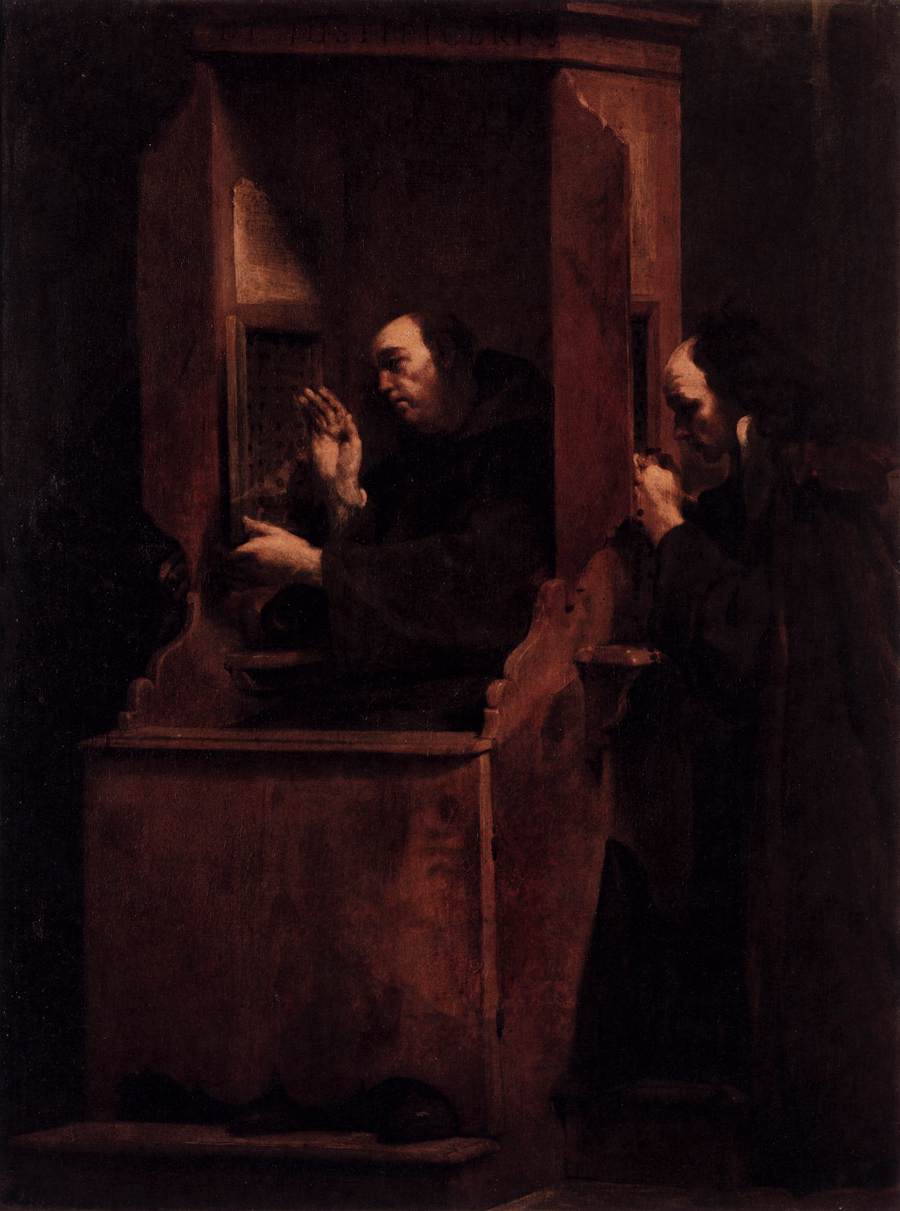
Pope Francis goes to confession
The service that the priest
assumes a ministry, on behalf of God, to forgive sins is very delicate and
requires that his heart be at peace, that the priest have peace in his heart;
that he not mistreat the faithful, but that he be gentle, benevolent and
merciful; that he know how to plant hope in hearts and, above all, that he be
aware that the brother or sister who approaches the Sacrament of Reconciliation
seeking forgiveness does so just as many people approached Jesus to be healed. The priest who is not of this disposition of mind had better
not administer this sacrament until he has addressed it. The penitent faithful
have the right, all faithful have the right, to find in priests servants of the
forgiveness of God.(While Pope Francis doesn't
call priests a 'brood of vipers', as St John the Baptist calls some of the
Sadducees and Pharisees in today's gospel, he implies that those who are not
'gentle, benevolent and merciful' in the confessional are such.)
Dear brothers, as members of the Church are we conscious of the beauty of this
gift that God himself offers us? Do we feel the joy of this cure, of this
motherly attention that the Church has for us? Do we know how to appreciate it
with simplicity and diligence? Let us not forget that God never tires
of forgiving us; through the ministry of priests he holds us close in a new
embrace and regenerates us and allows us to rise again and resume the journey.
For this is our life: to rise again continuously and to resume our journey.
+++
[This isthe form of absolutiongiven by the priest. The highlighted words
are essential for the validity of the sacrament.
God, the Father of mercies,
through the death and the resurrection of his Son
has reconciled the world to himself
and sent the Holy Spirit among us
for the forgiveness of sins;
through the ministry of the Church
may God give you pardon and peace,
and I absolve you from your sins in the name of the Father, and of
the Son and of the Holy Spirit.]