Showing posts with label St Maximilian Kolbe. Show all posts

19 April 2024

'I know my own and my own know me.' Sunday Reflections, 4th Sunday of Easter, Year B


The Good Shepherd
Early Italian Christian Painter [Web Gallery of Art]

Readings (Jerusalem Bible: Australia, England & Wales, Ireland, New Zealand, Pakistan, Scotland)

Readings (New American Bible: Philippines, USA)

Gospel  John 10:11-18  (English Standard Version, Anglicised)

Jesus said:

“I am the good shepherd. The good shepherd lays down his life for the sheep. He who is a hired hand and not a shepherd, who does not own the sheep, sees the wolf coming and leaves the sheep and flees, and the wolf snatches them and scatters them. He flees because he is a hired hand and cares nothing for the sheep. I am the good shepherd. I know my own and my own know me, just as the Father knows me and I know the Father; and I lay down my life for the sheep. And I have other sheep that are not of this fold. I must bring them also, and they will listen to my voice. So there will be one flock, one shepherd. For this reason the Father loves me, because I lay down my life that I may take it up again. No one takes it from me, but I lay it down of my own accord. I have authority to lay it down, and I have authority to take it up again. This charge I have received from my Father.”


Léachtaí i nGaeilge


Janusz Korczak
(22 July 1878 or 1879 – 7 August 1942) 

Pope St John Paul II said of this man, a Polish Jew, a paediatrician, writer and teacher who went to his death with a group of orphans in his charge although he had been offered the chance to be spared, for the world of today, Janusz Korczak is a symbol of true religion and true morality.

There were similarities between the sacrifice of of St Maximilian Kolbe OFMConv, canonised on 10 October 1982, and Dr Korczak, both Polish. Fr Kolbe offered his life in exchange for that of Franciszek Gajowniczek,  a young Polish soldier interned in Auschwitz who was to be executed with nine others chosen at random because three of their companions had escaped. The Franciscan friar heard the young soldier cry 'My wife and my children'. His offer was accepted and he and the other nine were put in a cell and left without food or water. After two weeks the Franciscan priest was the only one still alive and was given a lethal injection on 14 August 1941.

Almost a year later Janusz Korczak was to die in Treblinka extermination camp along with nearly 200 Jewish orphans who had been living in the orphanage that he had set up in Warsaw in 1911-12. However, when the Nazis took over Warsaw they forced the orphanage to move to the Ghetto that they created in a district of the Polish capital in late 1940.

German soldiers came on 5 or 6 August 1942 to collect the orphans and about 12 staff members to take them to Treblinka. Dr Korczak had already turned down offers of sanctuary for himself before this and turned down an offer at this point.


A witness described the sceneJanusz Korczak was marching, his head bent forward, holding the hand of a child, without a hat, a leather belt around his waist, and wearing high boots. A few nurses were followed by two hundred children, dressed in clean and meticulously cared for clothes, as they were being carried to the altar.


At the point of departure for Treblinka an SS officer recognised Dr Korczak as the author of a book that was a favourite of his children and offered him a means of escape. Once again this remarkable man turned down this offer and went with the children to the camp where their lives were soon to end in the gas chambers.


Janusz Korczak could not save the lives of the children under his care but he made sure that they left the orphanage with dignity, wearing their best clothes and each bringing an item that was special to him or her. He chose not to leave them but to die with them.


St Maximilan Kolbe chose to give his life for someone he did not know because that man had a family and he hadn't.

Greater love has no one than this, that someone lay down his life for his friends (John 15:13).


Cell where St Maximilian Kolbe died, 14 August 1941

[The hired hand] flees because he is a hired hand and cares nothing for the sheep. I am the good shepherd. I know my own and my own know me, just as the Father knows me and I know the Father; and I lay down my life for the sheep (John 10:13-15; today's Gospel).

St Maximilian Kolbe and Janusz Korczak, both sons of Abraham, our father in faith, could say as Jesus did, I know my own and my own know me . . . and I lay down my life for the sheep.


Monument to Janusz Korczak, Warsaw

More than 80 years after the deaths of St Maximilian Kolbe and Janusz Korczak children in their millions are being legally killed in their mothers' wombs. The nearly 200 Jewish orphans, their nurses and Janusz Korczak were also 'legally' killed as were St Maximilain Kolbe and his nine companions.

Ego sum pastor bonus (I am the good shepherd)
Music by Mariano Garau, a contemporary Italian composer
Sung by St Lawrence Catholic Chapel Choir, University of Kansas

The refrain is based on today's Gospel while the verses are from Psalm 22[23]:1-3. The texts are in Latin.

Death of a good shepherd


May I ask your prayers for the repose of the soul of a good friend of many years, Fr Gerry Truno of the Diocese of Dumaguete, Philippines. I knew him through our involvement in Worldwide Marriage Encounter, Philippines, and also in the Jesus Caritas Fraternity of Priests. Though he was much younger than me he inspired me by his simplicity, humility and prayerfulness, qualities that many saw in him. He truly was a good shepherd, especially to the seminarians he served for so many years.  His funeral will take place on Tuesday 23 April. Solas na bhFlaitheas air - The Light of Heaven upon him. 

Traditional Latin Mass

Third Sunday after Easter

The Complete Mass in Latin and English is here. (Adjust the date at the top of that page to 04-21-2024 if necessary).

Epistle: 1 Peter 2:11-19.  Gospel: John 16:16-22.

Passover begins 22 April

Never Again: A Song to Remember The Holocaust
Words and music by Stephen Melzack

The words ‘B’YomHaShoah yikatevun’ in the song mean ‘On Holocaust Day it is Written’

In memory of Dr Janusz Korczak, the twelve nurses from his orphanage and the nearly 200 orphans murdered in Treblinka for the sole reason that, like Jesus, Mary and Joseph, they were Jewish.


12 August 2022

'We will be true to thee till death.' Sunday Reflections, 20th Sunday in Ordinary Time, Year C

Blessed Margaret Ball and Blessed Francis Taylor
St Mary's Pro-Cathedral, Dublin [Wikipedia; photo]

Readings (Jerusalem Bible: Australia, England & Wales, India [optional], Ireland, New Zealand, Pakistan, Scotland, South Africa)

Readings (New American Bible: Philippines, USA)

Gospel Luke 12:49-53 (English Standard Version Anglicised: India).

Jesus said to his disciples:

“I came to cast fire on the earth, and would that it were already kindled! I have a baptism to be baptized with, and how great is my distress until it is accomplished! Do you think that I have come to give peace on earth? No, I tell you, but rather division. For from now on in one house there will be five divided, three against two and two against three. They will be divided, father against son and son against father, mother against daughter and daughter against mother, mother-in-law against her daughter-in-law and daughter-in-law against mother-in-law.”


Léachtaí i nGaeilge 


Jeremiah Lamenting the Destruction of Jerusalem
Rembrandt [Web Gallery of Art]

Then the officials said to the king, ‘This man should be put to death’ . . . Then the king commanded Ebed-Melek the Cushite, ‘Take thirty men from here with you and lift Jeremiah the prophet out of the cistern before he dies’ (Jeremiah 38: 4, 10; First Reading).

Margaret Bermingham (1515-1584) was born near where I live in County Meath, Ireland, into a prosperous Catholic family. In her mid-teens she married Bartholomew Ball, Becoming part of another prosperous Catholic family. Some sources say that the couple had twenty children, others ten. But only five survived into adulthood. Bartholomew served as Lord Mayor of Dublin for a while. Two of his sons were to find themselves in the same position, as did Francis Taylor, who married Gennet Shelton, a granddaughter of Margaret. Both Margaret and her grandson-in-law were to meet a similar fate and are numbered among the 17 Irish Martyrs beatified by St John Paul II on 22 September 1992.

It was a time when Queen Elizabeth I carried out a persecution of Catholics in England and Ireland who would not submit to her as head of the Church of England and the Church of Ireland, the members of which were called Protestants. Walter Ball, the eldest son of Margaret and Bartholomew, became a zealous Protestant and in 1577 was appointed Commissioner for Ecclesiastical Causes, a position, as far as I can make out, the main responsibility of which was to persecute Catholics.

Margaret's home in Dublin was a safe house for bishops and priests where they could celebrate Mass, something they could not do publicly. When Walter became Lord Mayor in 1580, while still retaining his previous position, a higher one, he had  his mother, who suffered greatly from arthritis, arrested and dragged through the streets of Dublin tied to a wooden pallet and taken to the prison in Dublin Castle, the seat of English rule in Ireland. This was the method often used to bring prisoners to the gallows. Walter said that his mother deserved to be executed for her Catholic faith but that he had spared her.

Two years later Walter's younger brother Nicholas became Lord Mayor. He had remained faithful to the Catholic faith but was powerless to release his mother as Walter outranked him by his royal appointment as Commissioner for Ecclesiastical Causes. However, he visited his mother regularly, bringing her food, clothing and some furniture. But the appalling conditions gradually wore Margaret down and she died in 1584.

She had consistently prayed for her son Walter and did not disinherit him.

Eleven years later Francis Taylor, who had married Margaret's granddaughter Gennet Shelton, both of them faithful Catholics, became Lord Mayor of Dublin in 1595 but was imprisoned for his faith in Dublin Castle, like his grandmother-in-law, and died seven years later in 1613 from the harsh conditions that had gradually worn him down.

Both Margaret and Francis were beatified with 15 other Irish Martyrs on 27 September 1992 by St John Paul II. In his homily the Pope saidAll sectors of God’s people are represented among these seventeen Servants of God: Bishops, priests both secular and religious, a religious brother and six lay people, including Margaret Bermingham Ball, a woman of extraordinary integrity who, together with the physical trials she had to endure, underwent the agony of being betrayed through the complicity of her own son.

Further on St John Paul said: The Martyrs’ significance for today lies in the fact that their testimony shatters the vain claim to live one’s life or to build a model of society without an integral vision of our human destiny, without reference to our eternal calling, without transcendence. The Martyrs exhort succeeding generations of Irish men and women: 'Fight the good fight of the faith; take hold of the eternal life to which you were called . . . keep the commandment unstained and free from reproach until the appearing of our Lord Jesus Christ'.

It is unbelievable how cruelly Walter Ball treated his mother and his family. We can hope that his mother's prayers obtained for him the grace of repentance before he died.

For from now on in one house there will be five divided, three against two and two against three.


St Maximilian Kolbe OFM Conv
8 January 1894 - 14 August 1941

When St John Paul II canonised his fellow-Pole on 10 October 1982 he described him as a Martyr for Charity. He was a prisoner in Auschwitz concentration camp. On an occasion when a prisoner escaped ten others were ordered to be executed by being deprived of food and water in a bunker. One of them, Franciszek Gajowniczek, a Polish soldier cried out, My wife! My children! The priest offered to take his place, an offer that was accepted. By the time the Nazis needed the bunker again all but the Franciscan had died of starvation and thirst. He was killed by lethal injection on 14 August 1941.This year his memorial is not observed by the Church as it falls on a Sunday. The guards had heard him while the others were still alive leading them in prayer and hymns.

Franciszek Gajowniczek
15 November 1901 – 13 March 1995

Walter Ball had deliberately caused the death of his mother because she would not deny her faith. Fr Kolbe offered his life to keep intact the family of someone he hardly knew. Franciszek was reunited with his wife Helena at the end of the War but, sadly, their two sons had died in January 1945 under a Soviet bombardment. However, he was the guest of St Paul VI at the beatification on 17 October 1971 of the man who had saved him and a guest of St John Paul II at the canonisation of St Maximilian on 10 October 1982.

Persecution and martyrdom have been part of the Church's history from the beginning. On 22 June this year, Pentecost Sunday, at least 40 people were massacred while attending Mass in Owo in southwestern Nigeria.

For from now on in one house there will be five divided, three against two and two against three.

Faith of our Fathers

Words by Fr Frederick William Faber 

Sung by Frank Patterson

With the Irish Philharmonic Orchestra and Chorus


Fr Faber wrote the words of this hymn to honour the Catholic martyrs of England and Ireland who died during the Reformation. The word 'Fathers' is used in an inclusive sense, meaning 'ancestors'. The version above uses the traditional tune Sawston, the one most common in Britain and Ireland. The tune normally used in the USA is called St Catherine and was written by Henri Hemy.

Up to the 1960s this hymn used to be sung before the national anthem at Gaelic Football and Hurling finals in Ireland.

The final stanza of the hymn expresses for me the faith of Blessed Margaret Ball and her love for her son Walter, despite wht he had done to her.

Faith of our Fathers! we will love
Both friend and foe in all our strife:
And preach thee too, as love knows how
By kindly words and virtuous life
.

Faith of our fathers' holy faith!

We will be true to thee till death!


Traditional Latin Mass

Tenth Sunday after Pentecost

The Complete Mass in Latin and English is here. (Adjust the date at the top of that page to 8-14-2022 if necessary).

Epistle: 1 Corinthians 12:2-11Gospel: Luke 18:9-14

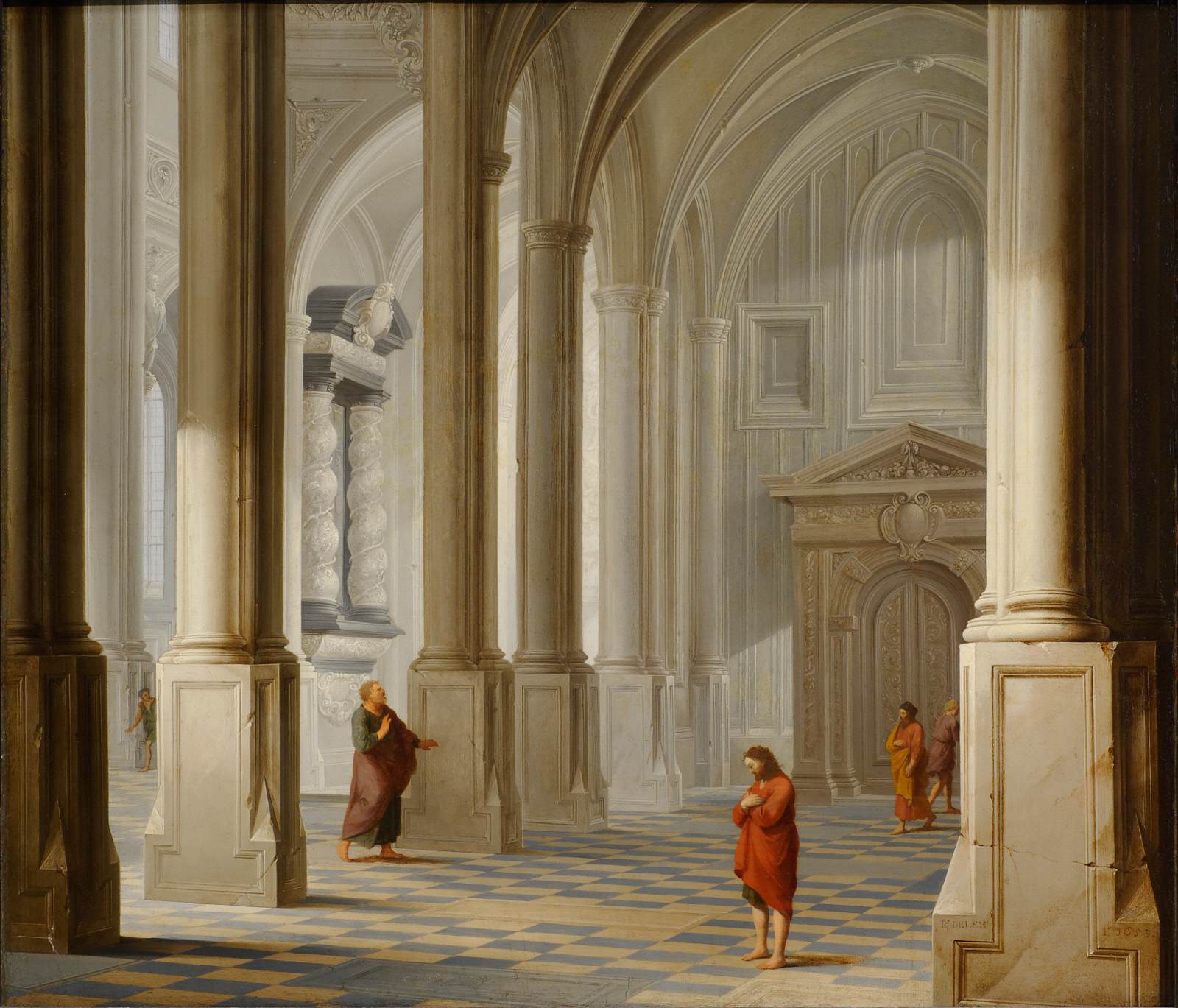
Church Interior with the Parable of the Pharisee and the Publican

Dirck van Delen [Web Gallery of Art]


22 April 2021

'You do not leave a child at a time like this' (Janusz Korczak). Sunday Reflections, 4th Sunday of Easter, Year B


The Good Shepherd
Early Italian Christian Painter [Web Gallery of Art]

Readings (Jerusalem Bible: Australia, England & Wales, Ireland, New Zealand, Pakistan, Scotland)

Readings (New American Bible: Philippines, USA)

Gospel  John 19:11-18  (English Standard Version, Anglicised)

Jesus said:

“I am the good shepherd. The good shepherd lays down his life for the sheep. He who is a hired hand and not a shepherd, who does not own the sheep, sees the wolf coming and leaves the sheep and flees, and the wolf snatches them and scatters them. He flees because he is a hired hand and cares nothing for the sheep. I am the good shepherd. I know my own and my own know me, just as the Father knows me and I know the Father; and I lay down my life for the sheep. And I have other sheep that are not of this fold. I must bring them also, and they will listen to my voice. So there will be one flock, one shepherd. For this reason the Father loves me, because I lay down my life that I may take it up again. No one takes it from me, but I lay it down of my own accord. I have authority to lay it down, and I have authority to take it up again. This charge I have received from my Father.”


Léachtaí i nGaeilge


Janusz Korczak
(22 July 1878 or 1879 – 7 August 1942)


When St John Paul II canonised St Maximilian Kolbe OFMConv on 10 October 1982 he cited Janusz Korczak, a Jewish writer and teacher, who went to his death with a group of orphans in his charge although he had been offered the chance to be spared. He was also a paediatrician.

There were similarities between the sacrifice of of Fr Kolbe and Dr Korczak, both Polish. Fr Kolbe offered his life in exchange for that of Franciszek Gajowniczek,  a young Polish soldier interned in Auschwitz who was to be executed with nine others chosen at random because three of their companions had escaped. The Franciscan friar heard the young soldier cry 'My wife and my children'. His offer was accepted and he and the other nine were put in a cell and left without food or water. After two weeks the Franciscan priest was the only one still alive and was given a lethal injection on 14 August 1941.

Almost a year later Janusz Korczak was to die in Treblinka extermination camp along with nearly 200 Jewish orphans who had been living in the orphanage that he had set up in Warsaw in 1911-12. However, when the Nazis took over Warsaw they forced the orphanage to move to the Ghetto that they created in a district of the Polish capital in late 1940.

German soldiers came on 5 or 6 August 1942 to collect the orphans and about 12 staff members to take them to Treblinka. Dr Korczak had already turned down offers of sanctuary for himself before this and turned down an offer at this point.


A witness described the sceneJanusz Korczak was marching, his head bent forward, holding the hand of a child, without a hat, a leather belt around his waist, and wearing high boots. A few nurses were followed by two hundred children, dressed in clean and meticulously cared for clothes, as they were being carried to the altar.


At the point of departure for Treblinka an SS officer recognised Dr Korczak as the author of a book that was a favourite of his children and offered him a means of escape. Once again this remarkable man turned down this offer and went with the children to the camp where their lives were soon to end in the gas chambers.


Janusz Korczak could not save the lives of the children under his care but he made sure that they left the orphanage with dignity, wearing their best clothes and each bringing an item that was special to him or her. He chose not to leave them but to die with them.


St Maximilan Kolbe chose to give his life for someone he did not know because that man had a family and he hadn't.

Greater love has no one than this, that someone lay down his life for his friends (John 15:13).


Cell where St Maximilian Kolbe died, 14 August 1941
[Wikipedia, source of photo]

[The hired hand] flees because he is a hired hand and cares nothing for the sheep. I am the good shepherd. I know my own and my own know me, just as the Father knows me and I know the Father; and I lay down my life for the sheep (John 10:13-15).

Monument to Janusz Korczak, Warsaw
[Wikipedia, source of photo]

Three years ago on this Sunday I told the story of Janusz Korczak in my homily at a Mass in a parish in Dublin. It was a few weeks before a referendum in the Republic of Ireland to change an article in the Constitution so that abortion on demand could be legalised. I hoped that the congregation would make the connection between the sacrifice of Janusz Korczak and what we would be voting on. Some certainly did, because they told me so after Mass. Rightly or wrongly, I had decided to speak on the matter of the right to life of the unborn child in the form of a 'parable', even though this story really happened. But I sometimes ask myself if during those days - I addressed the matter similarly in other Sunday homilies at that time - I was somewhat cowardly.

Sadly, two-thirds of those who voted wanted change. The legislation that followed, allowing for abortion on demand up to 12 weeks, but with restrictions thereafter, came into effect on the Solemnity of Mary, Mother of God, 1 January 2019. That year 6,666 human beings were legally aborted in the Republic of Ireland. There are no figures yet for 2020. 

The nearly 200 Jewish orphans, their nurses and Janusz Korczak were also 'legally' killed as were St Maximilain Kolbe and his nine companions.

Surrexit Pastor Bonus

Setting by Orlando di Lasso

Sung by Vox AngelorumChoir, MBK, Jakarta

At St Paul’s Within theWalls, Rome


Antiphona ad communionem

Communion Antiphon


Surrexit Pastor Bonus, 

The Good Shepherd has risen,

qui animam suam posuit pro ovibus suis,

who laid down his life for his sheep

et pro grege suo mori dignatus est, alleluia.


Extraordinary Form of the Mass

Traditional Latin Mass (TLM) 

Third Sunday after Easter 

The Complete Mass in Latin and English is here. (Adjust the date at the top of that page to 4-25-2021 if necessary).

Epistle: 1 Peter 2:11-19.  GospelJohn 16:16-22.


Authentic Beauty

Authentic beauty, however, unlocks the yearning of the human heart, the profound desire to know, to love, to go towards the Other, to reach for the Beyond.

Pope Benedict XVI meeting with artists in the Sistine Chapel, 21 November 2009.

Never Again: A Song to Remember The Holocaust
Words and music by Stephen Melzack

The words ‘B’YomHaShoah yikatevun’ in the song mean ‘On Holocaust Day it is Written’

In memory of Dr Janusz Korczak, the twelve nurses from his orphanage and the nearly 200 orphans murdered in Treblinka for the sole reason that, like Jesus, Mary and Joseph, they were Jewish.


18 April 2018

'I lay down my life for the sheep.' Sunday Reflections, Fourth Sunday of Easter, Year B


Christ the Good Shepherd, Murillo [WikiArt]


Readings (New American Bible: Philippines, USA)

Readings (Jerusalem Bible: Australia, England & Wales, India [optional], Ireland, New Zealand, Pakistan, Scotland, South Africa)

Gospel John 10:11-18 (New Revised Standard Version, Anglicised Catholic Edition)

Jesus said:

‘I am the good shepherd. The good shepherd lays down his life for the sheep. The hired hand, who is not the shepherd and does not own the sheep, sees the wolf coming and leaves the sheep and runs away—and the wolf snatches them and scatters them. The hired hand runs away because a hired hand does not care for the sheep. I am the good shepherd. I know my own and my own know me, just as the Father knows me and I know the Father. And I lay down my life for the sheep. I have other sheep that do not belong to this fold. I must bring them also, and they will listen to my voice. So there will be one flock, one shepherd. For this reason the Father loves me, because I lay down my life in order to take it up again. No one takes it from me, but I lay it down of my own accord. I have power to lay it down, and I have power to take it up again. I have received this command from my Father.’

Janusz Korczak
(22 July 1878 or 1879 – 7 August 1942)

When St John Paul II canonised St Maximilian Kolbe OFMConv on 10 October 1982 he cited Janusz Korczak, a Jewish writer and teacher, who went to his death with a group of orphans in his charge although he had been offered the chance to be spared. He was also a pediatrician.

There were similarities between the sacrifice of of Fr Kolbe and Dr Korczak, both Polish. Fr Kolbe offered his life in exchange for that of Franciszek Gajowniczek,  a young Polish soldier interned in Auschwitz who was to be executed with nine others chosen at random because three of their companions had escaped. The Franciscan friar heard the young soldier cry 'My wife and my children'. His offer was accepted and he and the other nine were put in a cell and left without food or water. After two weeks the Franciscan priest was the only one still alive and was given a lethal injection on 14 August 1941.

Almost a year later Janusz Korczak was to die in Treblinka extermination camp along with nearly 200 Jewish orphans who had been living in the orphanage that he had set up in Warsaw in 1911-12. However, when the Nazis took over Warsaw they forced the orphanage to move to the Ghetto that they created in a district of the Polish capital in late 1940.

German soldiers came on 5 or 6 August 1942 to collect the orphans and about 12 staff members to take them to Treblinka. Dr Korczak had already turned down offers of sanctuary for himself before this and turned down an offer at this point.

A witness described the scene: Janusz Korczak was marching, his head bent forward, holding the hand of a child, without a hat, a leather belt around his waist, and wearing high boots. A few nurses were followed by two hundred children, dressed in clean and meticulously cared for clothes, as they were being carried to the altar.

At the point of departure for Treblinka an SS officer recognised Dr Korczak as the author of a book that was a favourite of his children and offered him a means of escape. Once again this remarkable man turned down this offer and went with the children to the camp where their lives were soon to end in the gas chambers.

Janusz Korczak could not save the lives of the children under his care but he made sure that they left the orphanage with dignity, wearing their best clothes and each bringing an item that was special to him or her. He chose not to leave them but to die with them.

St Maximilan Kolbe chose to give his life for someone he did not know because that man had a family and he hadn't.

Cell where St Maximilan Kolbe died [Wikipedia]

The hired hand runs away because a hired hand does not care for the sheep. I am the good shepherd. I know my own and my own know me, just as the Father knows me and I know the Father. And I lay down my life for the sheep (John 10:13-15).

Monument to Janusz Korczak, Warsaw [Wikipedia]


Antiphona ad communionem
Communion Antiphon

Surrexit Pastor Bonus,
The Good Shepherd has risen,
qui animam suam posuit pro ovibus suis,
who laid down his life for his sheep
et pro grege suo mori dignatus est, alleluia.
And willingly died for his flock, alleluia.