Showing posts with label missionaries. Show all posts

03 December 2013

St Francis Xavier: 'Many, many people hereabouts are not becoming Christians for one reason only: there is nobody to make them Christians.'


Today, 3 December, is the feast of St Francis Xavier, the great Jesuit missionary priest who, with St Thérèse of Lisieux is the patron saint of missionaries. Here is an extract from a letter of the saint to St Ignatius of Loyola, the founder of the Society of Jesus, the Jesuits. This is the Second Reading in the Office of Readings in the Breviary for the saint's feast day. I copied this version from DivineOffice.org, a website that has the full Prayer of the Church for each day. I have highlighted parts of the letter of St Francis Xavier.

From the letters to Saint Ignatius by Saint Francis Xavier, priest
Woe to me if I do not preach the Gospel

We have visited the villages of the new converts who accepted the Christian religion a few years ago. No Portuguese live here—the country is so utterly barren and poor. The native Christians have no priests. They know only that they are Christians. There is nobody to say Mass for them; nobody to teach them the Creed, the Our Father, the Hail Mary and the Commandments of God’s Law.

I have not stopped since the day I arrived. I conscientiously made the rounds of the villages. I bathed in the sacred waters all the children who had not yet been baptized. This means that I have purified a very large number of children so young that, as the saying goes, they could not tell their right hand from their left. The older children would not let me say my Office or eat or sleep until I taught them one prayer or another. Then I began to understand: “The kingdom of heaven belongs to such as these.”

I could not refuse so devout a request without failing in devotion myself. I taught them, first the confession of faith in the Father, the Son and the Holy Spirit, then the Apostles’ Creed, the Our Father and Hail Mary. I noticed among them persons of great intelligence. If only someone could educate them in the Christian way of life, I have no doubt that they would make excellent Christians.

Many, many people hereabouts are not becoming Christians for one reason only: there is nobody to make them Christians. Again and again I have thought of going round the universities of Europe, especially Paris, and everywhere crying out like a madman, riveting the attention of those with more learning than charity: “What a tragedy: how many souls are being shut out of heaven and falling into hell, thanks to you!

I wish they would work as hard at this as they do at their books, and so settle their account with God for their learning and the talents entrusted to them.

This thought would certainly stir most of them to meditate on spiritual realities, to listen actively to what God is saying to them. They would forget their own desires, their human affairs, and give themselves over entirely to God’s will and his choice. They would cry out with all their heart: Lord, I am here! What do you want me to do? Send me anywhere you like—even to India.


Evangelii Gaudium, the new Apostolic Exhortation of Pope Francis, a Jesuit like the saint we celebrate today, begins with these words:

The joy of the gospel fills the hearts and lives of all who encounter Jesus. Those who accept his offer of salvation are set free from sin, sorrow, inner emptiness and loneliness. With Christ joy is constantly born anew. In this Exhortation I wish to encourage the Christian faithful to embark upon a new chapter of evangelization marked by this joy, while pointing out new paths for the Church's journey in years to come.

I'm sure that St Francis Xavier, whose whole being burned with the desire to bring the Gospel of Jesus Christ to the whole world, would agree.

14 August 2012

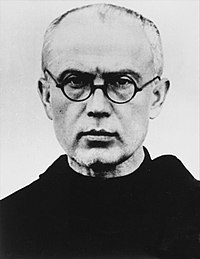
Media man, missionary, Franciscan, priest, martyr: St Maximilian Kolbe


Had he been living today there is no doubt that St Maximilian Kolbe would have been using the internet to share the gospel with 'this digital continent', the expression Pope Benedict used in his message for the 43rd World Communications Day in 2009. He directly challenged young people:

It falls, in particular, to young people, who have an almost spontaneous affinity for the new means of communication, to take on the responsibility for the evangelization of this 'digital continent'. Be sure to announce the Gospel to your contemporaries with enthusiasm. You know their fears and their hopes, their aspirations and their disappointments: the greatest gift you can give to them is to share with them the 'Good News' of a God who became man, who suffered, died and rose again to save all people. Human hearts are yearning for a world where love endures, where gifts are shared, where unity is built, where freedom finds meaning in truth, and where identity is found in respectful communion. Our faith can respond to these expectations: may you become its heralds! The Pope accompanies you with his prayers and his blessing.

In his message for the following year Pope Benedict directly challenged priests:

Priests are thus challenged to proclaim the Gospel by employing the latest generation of audiovisual resources (images, videos, animated features, blogs, websites) which, alongside traditional means, can open up broad new vistas for dialogue, evangelization and catechesis.

St Maximilian Kolbe OFMConv (8 January 1894 - 14 August 1941)

Fr Maximilian Kolbe OFMConv would have entirely approved, since newspapers, magazines and the radio were central to his apostolate in pre-War Poland. He also used the media when he spent some years in Japan.

He would have approved even more these words of Pope Benedict in the same message:

Yet priests present in the world of digital communications should be less notable for their media savvy than for their priestly heart, their closeness to Christ. This will not only enliven their pastoral outreach, but also will give a 'soul' to the fabric of communications that makes up the 'Web'.

St Maximilian's pioneering use of the mass media is largely overlooked because of his extraordinary martyrdom in Auschwitz when he offered to die in place of a married Polish soldier whom he didn't even know, one of ten chosen to be executed by starvation in retaliation for the escape of three prisoners. His offer was accepted. It is known that he led the others in prayer, constantly giving them hope, and that after two weeks (different sources give different lengths of time) he was the only one still alive. At that stage he was executed by lethal injection, on the eve of the Assumption. It was fitting that he die on that day as he had an extraordinary devotion to our Blessed Mother under the title 'Mary Immaculate'.

Stained glass, Conventual Franciscan Church, Szombathely, Hungary

Collect

O God, who filled the Priest and Martyr Saint Maximilian Kolbe
with a burning love for the Immaculate Virgin Mary
and with zeal for souls and love of neighbour,
graciously grant, through his intercession,
that, striving for your glory by eagerly serving others,
we may be conformed, even until death, to your Son.
Who lives and reigns with you in the unity of the Holy spirit,
one God, for ever and ever.

22 July 2012

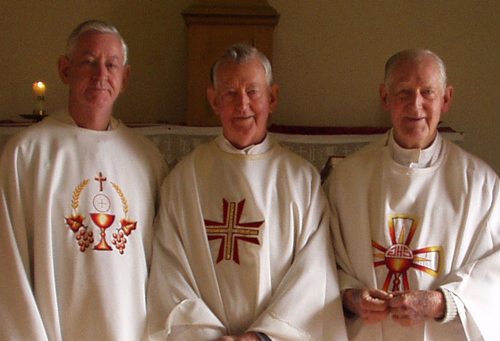
176 years of service as Columban priests by the Baker Brothers of Australia

The Baker Brothers: Fr Pat (ordained 1962), Fr Leo (1948) and Fr Chris (1950)

Yesterday, 21 July, was the Golden Jubilee of the ordination of Fr Patrick (Pat) John Baker, the youngest of a family of five boys and three girls, from Camperdown, Victoria, Australia. Father Pat worked in Australia in the early years of his priesthood and came to the Philippines on 21 September 1972, the day Martial Law was officially declared, though it wasn't announced till two days later. He has been here most of the time since and now lives at the headquarters of the Columbans in the Philippines where he is working on the archives. He worked in a number of parishes in Mindanao and also spent some eyars in Cebu City on the college formation program of the Columbans. That was phased ut some years ago.
The photo above was taken in 2008 on the occasion of the Diamond Jubilee of the ordination of Father Leo and is taken from the website of the Columbans in Australia and New Zealand, as is the photo below. You can read Bakers delight on that website.
Father Leo, a gifted photographer, wrote quite a few articles for the various Columban magazines during his many years in Japan and since then. He is now retired and lives at St Columban's, Essednone, near Melbourne, where he takes delight in working in the garden there. Father Chris, a Scripture scholar, is in Peru.
The three Columban Bakers have between them served 176 years in the priesthood, an extraordinary blessing for their family, for the Columbans and for the Church. We Columbans have been blessed with a number of sets of three brothers. The Bakers are the only such from Australia and one of only two sets where all three are still living. The others are the Smyths from Straide, County Mayo, Ireland, Fr Patrick (ordained in 1969 and now in Ireland, Fr John (1962), now working with Koreans in Chicago and Fr Malachy (1966) in Ireland. All three spent many years in Korea.
I wish Father Pat and his brothers Ad multos annos! 'To many years!'

Frs Pat, Leo and Chris Baker in 1962


19 July 2012

Columban Fr Michael Sinnott, kidnapped in the Philippines in 2009, retiring to Ireland


Fr Michael Sinnott arriving in Dublin in December 2009 after his release

The website of the Catholic Bishops's Conference of the Philippines (CBCP) carried this story yesterday
MANILA, July 18, 2012— An Irish missionary kidnapped and freed by gunmen in 2009 in Mindanao is leaving the Philippines for good.
Father Michael Sinnott of the Society of St. Columban is leaving for Ireland Friday and will retire there after many years of serving the Catholic Church and various communities in Mindanao.
In a send-off party held at the Malate Church on Tuesday night, Sinnott admitted how difficult it was for him to decide whether to retire in the Philippines or in his native land.
Greeted by President Gloria M. Arroyo the day of his release, 12 November 2009
“It really was a very difficult decision to make. I realized that I’m going home and not going back but I still think I made the right decision that there is really nothing more I can do here in Manila that there’s more I can do at home,” Sinnott said.
“I will live a big part of my heart here in the Philippines and I will always remember the people that I met and helped me,” he said.
At a press conference after being released.
His 58 years as a missionary has given Sinnott a unique window into the heart of a people that have lived through poverty, armed conflicts, and the daily struggles of too little food and too little hope for the future.
When he arrived in Mindanao in the 1950s, he was a young priest only few years out of the seminary.
“After ordination two of us were sent to Rome and we know that time that one of us would be going to Japan and one to the Philippines but we don’t know who…,” he said.
“I was delighted when I got my appointment to the Philippines and I’ve never been sorry ever since,” said Sinnott.
Working in one of the country’s poorest regions was hard, he said but it was all worth it.

In Manila a few days after his release
On October 11, 2009, heavily armed men abducted Sinnott from his house in Pagadian City and was forced to walk into the mountains despite having a serious heart condition.
Al-Qaida-linked Abu Sayyaf militants and insurgents from the larger Moro Islamic Liberation Front have a presence in the vast Zamboanga peninsula.
He was released in a coastal village in Zamboanga City after a month in captivity and without carrying his medication.
Since then, Sinnott was brought to the Columban’s regional house in Manila and was never assigned again in Mindanao.
“For the long time that I’ve been here… it’s been a privileged for me to serve the people of the Philippines and I learned a lot more from them more than I gave, especially from the ordinary people for their goodness and their faith,” he said.
“I also would like to thank the Columbans for their support. We sometimes have an arguments but I have to say that everytime I was in trouble they were always there to help me,” said Sinnott. [RL/CBCPNews]
Misyononline has a dossier on Father Sinnott's kidnapping and release here.

03 April 2012

Columban priest given Pakistan's highest civilian award for foreign nationals

Fr Robert McCulloch with his Sitara-e-Quaid-e-Azam award

Pakistan's highest civilian award for foreign nationals, the Sitara-e-Quaid-Azam was presented to Fr Robert McCulloch by the Governor of Sindh, Dr Ishrat ul Ebad Khan, on 23 March, Pakistan Day, at Government House in Karachi.

Governor Ishrat ul Ebal Khan of Sindh conferring the award on Fr McCulloch

The award was given by President Asif Ali Zardari of Pakistan to Fr McCulloch in recognition of his 34 years of service and contribution to Pakistan in education, health, and inter-faith relations. An Australia, the awardee worked in Mindanao, Philippines, from 1971 until 1978 when he was part of the pioneering group of Columbans to go to Pakistan. He recently moved to Rome as Procurator General of the Columbans.

Fr McCulloch, left, with Bishop Max Rodrigues of Hyderabad and James Francis, Administrator of St Elizabeth Hospital


A reception was held on 26 March at St Elizabeth Hospital where Fr McCulloch is Chairman of the Administrative Council. Among those present was MNA (Member of the National Assembly) Tayyab Hussain who praised the work of St Elizabeth Hospital under the leadership of Fr McCulloch. He said that the hospital was an outstanding beacon of compassion in Hyderabad especially through its medical outreach programmes, palliative care for the terminally ill, and flood relief activities. He held up St Elizabeth Hospital as an example to other institutions in Hyderabad and Pakistan of how people of different faiths, cultures and languages can work together for the betterment and progress of Pakistan and its people. 
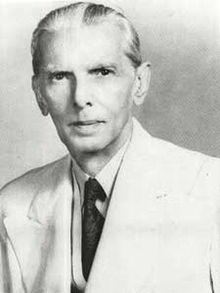
Muhammad Ali Jinnah, 'Quaid-e-Azam' (1876-1948)
 
Fr McCulloch said that he was personally honoured in being awarded the Sitara-e-Quaid-Azam by the President and receiving it from the Governor of Sindh, Dr Ishrat ul Ibad. He said that the award also showed that the government of Pakistan recognized the presence and work of the Catholic Church throughout Pakistan and in interior Sindh. Fr McCulloch said he was proud to receive an award which carried the name of the Quaid-e-Azam who founded Pakistan to be a nation based upon principles of unity, equality, and religious harmony. (Sitara-e-Quaid-e-Azam means 'Star of the Great Leader'. This is in honour of Muhammad Ali Jinnah, the founder of Pakistan).


At Governor's House Karachi after investitute: Syed Tayyab Hussain [MNA for Hyderabad], Fr Tomás  King [Columban Coordinator in Pakistan], Fr Robert McCulloch, Deacon Gulshan Barkat, James Francis [administrator St Elizabeth Hospital], Dr Tariq Arshad [Deputy Medical Superintendent SEH]


Floods have played a major part in the history of the Columbans, those in China in the 1930s that affected millions, those in Mindanao last December and, currently, in Fiji. Last October St Elizabeth Hospital was flooded.

20 January 2012

'At once they left their nets and followed him', Sunday Reflections, 3rd Sunday in Ordinary Time Year B

Calling of Peter and Andrew, Duccio di Buoninsegna, painted 1308-11
Readings (New American Bible: Philippines, USA)
Gospel Mark 1:14-20 (Jerusalem Bible: Australia, England & Wales, India [optional], Ireland, New Zealand, Pakistan, Scotland, South Africa)


After John had been arrested, Jesus went into Galilee. There he proclaimed the Good News from God. ‘The time has come’ he said ‘and the kingdom of God is close at hand. Repent, and believe the Good News.’
As he was walking along by the Sea of Galilee he saw Simon and his brother Andrew casting a net in the lake – for they were fishermen. And Jesus said to them, ‘Follow me and I will make you into fishers of men.’ And at once they left their nets and followed him.


Going on a little further, he saw James son of Zebedee and his brother John; they too were in their boat, mending their nets. He called them at once and, leaving their father Zebedee in the boat with the men he employed, they went after him.


An Soiscéal Marcas 1:14-20 (Gaeilge, Irish)


Tar éis Eoin a bheith tugtha ar láimh, tháinig Íosa go dtí an Ghailíl ag fógairt soiscéal Dé agus ag rá: “Tá an tréimhse caite agus tá ríocht Dé in achmaireacht. Déanaigí aithrí agus creidigí sa soiscéal.”


Bhí sé ag imeacht leis cois farraige na Gailíle nuair a chonaic sé Síomón agus Aindrias deartháir Shíomóin agus iad ag caitheamh eangaí san fharraige, mar iascairí a bhí iontu. Dúirt Íosa leo: “Tagaigí i mo dhiaidh, agus déanfaidh mé díbh iascairí ar dhaoine.” D’fhág aid na líonta láithreach agus lean aid é. Bhuail sé ar aghaidh beagán eile agus chonaic sé Séamas mac Zeibidé agus Eoin a dheartháir, iad ina mbád féin ag ceartú na líonta, agus ghlaoigh sé iad láithreach. D’fhág aid a n-athair Zeibidé sa bhád, é féin agus an lucht pá, agus ghabh aid leis.


The young Fr Edward Galvin in China

One hundred years ago a 29-year-old Irishman who had been working in Brooklyn, New York City, wrote a letter to his mother in his native County Cork. Nothing unusual in that. There were countless young Irishmen and women in the USA who had gone there because there was no work for them at home. That was the case with this young man. He had been ordained in 1909 for his own Diocese of Cork but his bishop had so many priests that he loaned the young man, Fr Edward Galvin, to the Diocese of Brooklyn.

While there he felt a desire to be a missionary. This led him to head off to China in February 1912 from Toronto, Canada, with a Canadian priest, Fr John Fraser, instead of going home to Ireland.

Here is his letter, written in Toronto:

Photocopy of letter (Thanks, Father Rex)
Dear Mother,

I am sorry, dear Mother, to have to write this letter, but God’s will be done. Everything is in His hands. Mother, don’t grieve, don’t cry. It is God’s will. God has called and I had to obey.

I am not going back to Ireland. I am going as a missionary to China. May God’s will be done. God knows my heart is broken, not for myself but for you whom I love above all the world.

Mother, you know how this has always been on my mind. But I thought it was a foolish thought – a boyish thought; that it would pass away as I grew older. But it never passed, never, never, never.

Why should God ask me to do this thing that is breaking my heart to do? I don’t know. God knows best. May His will be done. “If any man will come after me let him take up his cross and follow me.” Oh yes, but oh my God I never thought that it was so hard to follow. I have tried to follow when you called. I ask you in return to console my poor mother, to comfort her, to help her to make the Sacrifice I am making and spare her until we meet again.’
 

Frs Edward Galvin, John Blowick (seated) and Owen McPolin shortly after the arrival of the first group of Columbans in China. They left Ireland in 1920. Fr Blowick, the first Superior General, returned to Ireland to direct the Society and to teach in the Columban seminary.

Fr Fraser was to found the Scarboro Foreign Mission Society, with its headquarters in Scarborough, Ontario, now part of Metro Toronto, and the young Fr Galvin was to co-found with Fr John Blowick, another Irish diocesan priest and more than five years younger, what was first known as the Maynooth Mission to China in 1916 and formally became the Society of St Columban in 1918. Both societies had China as their original mission and both are societies of secular priests, not religious.

Father Galvin thought his idea of becoming a missionary was ‘a foolish thought – a boyish thought’. The actual moment when God called him as starkly as Jesus called Peter and Andrew, James and John, in today’s gospel happened on his weekly day off when he had planned to go to the office of the Propagation of the Faith in New York City to explore the idea of becoming a missionary. Two unexpected sick calls came that morning, which he responded to, leaving it too late for him to do what he had planned. Then Fr John Fraser arrived unannounced at the rectory and it was this meeting the led Edward Galvin to China shortly afterwards.

The cover of The Far East, the Columban magazine in Ireland, was the same for many years and the Chinese junk symbolised the Columbans for the Irish people and touched the imagination of many a future Columban missionary, including my own while I was still in kindergarten.

I don’t know what went on in the hearts of Peter and Andrew when, as St Mark tells us, ‘at once they left their nets and followed’ Jesus, or in the hearts of James and John who 'leaving their father Zebedee . . . went after him’. That decision was to lead ultimately to the martyrdom of three of them and to John standing at the Cross of Jesus and taking on the care of Mary, the Mother of Jesus.

Father Galvin recalled years later what it had cost him to set off for China, starting from New York City: I still remember the pain of parting on that grey, dreary morning. When the train got underway for Toronto, I crumpled up in the coach and cried as if my heart would break.’

He was to become Bishop of Hanyang in China where he was to experience natural calamiteis such as great floods, the Sino-Japanese War, World War II and the Communist takeover, leading his expulsion in 1952. Born on the feast of St Columban, 23 November 1882, he died on 23 February 1956, the feast of the great martyr-bishop St Polycarp of Smyrna who knew St John the Evangelist who, with his brother James, had left his father to follow Jesus.

The cover on The Far East after the death of Bishop Galvin.

You can read more in an article by English Columban Fr Pat Sayles, Edward J. Galvin: a Trailblazer for God. 

14 October 2011

'You shall love your neighbor.. .' Sunday Reflections, 30th Sunday in Ordinary Time Year A

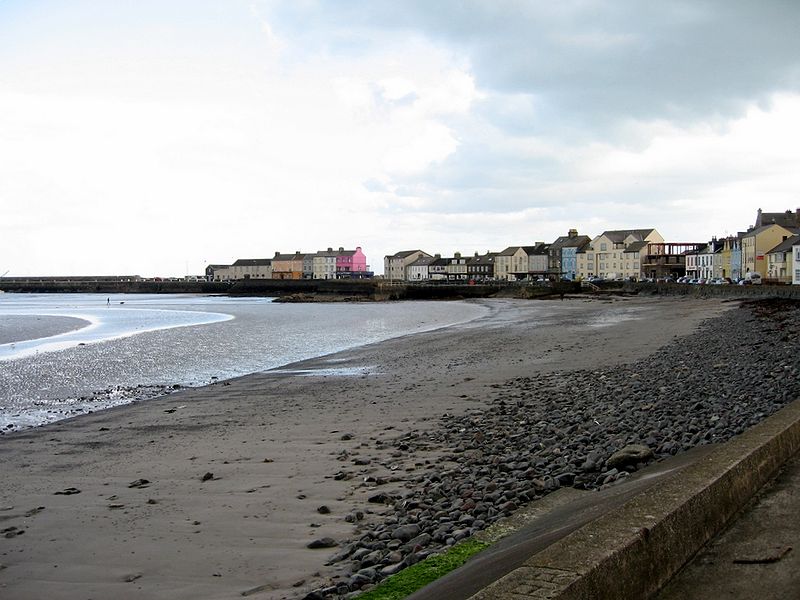
Donaghadee, County Down, Northern Ireland

Readings (New American Bible: Philippines, USA)

Gospel Matthew 22:34-40 (NAB)

When the Pharisees heard that Jesus had silenced the Sadducees,

they gathered together, and one of them,
a scholar of the law tested him by asking,
"Teacher, which commandment in the law is the greatest?"
He said to him,
"You shall love the Lord, your God,
with all your heart,
with all your soul,
and with all your mind.
This is the greatest and the first commandment.
The second is like it:
You shall love your neighbor as yourself.
The whole law and the prophets depend on these two commandments."

+++

Sister Perpetua was Mercy Sister from County Down, Northern Ireland, who died earlier this years. A nurse by profession, she spent some years in Iceland, working in a Catholic hospital there. She had a great love for those who were sick and especially for those who were bereaved.

A few years ago when I visited her in her convent in Downpatrick, where St Patrick is buried, she took me to St Comgall's Church in Donaghadee, probably the most Protestant town in the whole of Ireland. St Comgall's Catholic Church is on a side-sreet. It is part of the parish of Bangor, about the kilometres further north, also on the coast. The parish church there is also St Comgall's.

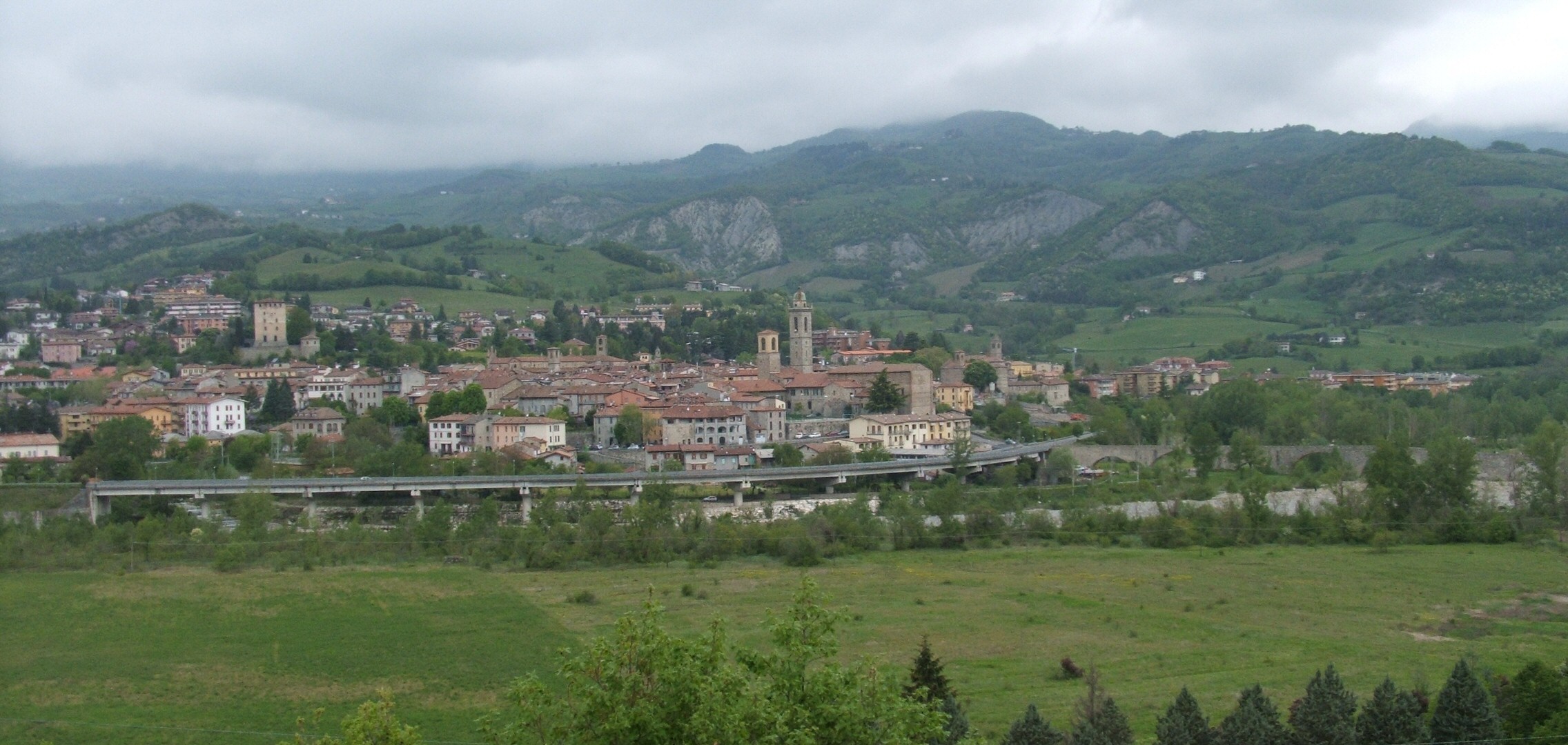
This saint founded the famous monastery in Bangor in 555. Some years later, during the lifetime of St Comgall, St Columbanus (Columban) entered there. Later he and twelve companions left for Continental Europe as Peregrini pro Christo, 'Pilgrims for Christ'.St Columban, the patron of the Missionary Society of St Columban to which I belong, founded a number of monasterieson the European mainland,preaching the gospel wherever they went. The saint's last monastery was in Bobbio, in northern Italy, where he died in 615.

St Columban set out from Bangor as a missionary. More than thirteen centuries later an Italian ice-cream seller, whose name I do not know but will call 'Luigi, found his way to the area from which St Columban had set out on his long journey. This Italian, to earn a living, opened an ice-cream parlour in Donaghadee, where he spent the rest of his life.

On another occasion when I went to visit Sister Perpetua she had just come back from the funeral of Luigi. She told me she had been afraid that very few would attend. But the church was packed and Sister Perpetua found herself sitting beside a Protestant man who had probably never entered a Catholic church before in his life. He told Sister why he was there.

He was one of a large family that never had money to spare. Occasionally during the summer his father would bring the children to Luigi's for ice-cream, even though he never had enough to buy for them all. 'Luigi never let us go', he told Sister,'without making sure that each of us had ice-cream, no matter how little money my father had. That is why I am here'.

St Columban left Ireland to be a missionary and died in Italy. Luigi left Italy to make a living in the area from which St Columban had set out and died in Ireland. He probably never thought of himself as a missionary but he crossed the religious barrier in Ireland by his simple love for poor children.

'You shall love your neighbour . . .'


I am posting this early because I probably won't have access to the internet for the next eight days as I give a retreat to some Missionaries of Charity in Tagaytay City, an elevated and pleasantly cooler area south of Manila. Please keep the Sisters and me in your prayers. Perhaps you can invoke St Columban and Blessed Mother Teresa.

05 May 2011

'Were not our hearts burning within us . . .' Third Sunday of Easter


Readings (New American Bible, used in the Philippines and USA)

Gospel Luke 24: 13-35 (NAB)

That very day, the first day of the week, two of Jesus’ disciples were going to a village seven miles from Jerusalem called Emmaus, and they were conversing about all the things that had occurred. And it happened that while they were conversing and debating, Jesus himself drew near and walked with them, but their eyes were prevented from recognizing him.

He asked them, “What are you discussing as you walk along?” They stopped, looking downcast.

One of them, named Cleopas, said to him in reply, “Are you the only visitor to Jerusalem who does not know of the things that have taken place there in these days?” And he replied to them, “What sort of things?” They said to him, “The things that happened to Jesus the Nazarene, who was a prophet mighty in deed and word before God and all the people, how our chief priests and rulers both handed him over to a sentence of death and crucified him. But we were hoping that he would be the one to redeem Israel; and besides all this, it is now the third day since this took place. Some women from our group, however, have astounded us: they were at the tomb early in the morning and did not find his body; they came back and reported that they had indeed seen a vision of angels who announced that he was alive. Then some of those with us went to the tomb and found things just as the women had described, but him they did not see.”

And he said to them, “Oh, how foolish you are! How slow of heart to believe all that the prophets spoke! Was it not necessary that the Christ should suffer these things and enter into his glory?” Then beginning with Moses and all the prophets, he interpreted to them what referred to him in all the Scriptures.

As they approached the village to which they were going, he gave the impression that he was going on farther. But they urged him, “Stay with us, for it is nearly evening and the day is almost over.” So he went in to stay with them. And it happened that, while he was with them at table, he took bread, said the blessing, broke it, and gave it to them.

With that their eyes were opened and they recognized him, but he vanished from their sight. Then they said to each other, “Were not our hearts burning within us while he spoke to us on the way and opened the Scriptures to us?” So they set out at once and returned to Jerusalem where they found gathered together the eleven and those with them who were saying, “The Lord has truly been raised and has appeared to Simon!” Then the two recounted what had taken place on the way and how he was made known to them in the breaking of bread.

Supper at Emmaus, Hendrick Terbrugghen, c.1621


In Terbrugghen’s painting the disciple on the right grips his chair as he rises, recognizing Jesus. His companion is looking across at him as if asking ‘Is it really the Lord?’ Jesus is looking beyond the two, perhaps looking out at all whom he died for and to whom he wants the Good News of his Resurrection preached. Is he asking each of us as he looks straight at us, ‘Do you too recognize me? Will you “go to Jerusalem” and further afield to share this recognition with others?’ His face too carries the wrinkles that come with age and suffering, though they’re not the wrinkles of old age. A friend commented on last Sunday’s Reflections, ‘Let wrinkles be written on your face but not in your heart’.

When Jesus disappeared from their sight the two disciples didn’t feel the slightest distress. Rather, they recognized what had been happening as they walked along with Jesus earlier: ‘Were not our hearts burning within us . . .’ They immediately set out for Jerusalem, even though it was night, because they could not contain their excitement and joy.


These two were among the very first missionaries. When I entered the Columbans in 1961 our Constitutions were in Latin. I remember one phrase vividly, ‘sine more proficiscar’, to ‘set out without delay’ to whatever mission you were given. This is exactly what the two did.


There is no sense of missing Jesus, of nostalgia, rather a conviction of his living presence even though he had disappeared from their sight. It is this same conviction that drives our Christina lives, that enables us when we come through a painful experience to see its life-giving meaning.


The experience of the two disciples reminds me to some extent of how I discovered God was calling me to be a Columban priest. It wasn’t a sudden event, such as what happened at the supper in Emmaus. But it was a conviction that one day I recognized and realized had been growing quietly for some time. ‘Were not our hearts . . .’ And while at one level what happened at the supper was sudden, it was a moment of revelation showing the meaning of all that had gone before, not only on the road from Jerusalem to Emmaus but everything since Creation itself.


The two disciples invited Jesus to join them on the road and prevailed on him to stay with them in the inn. When Jesus was about to be born there was no room for him in the inn. This time there was, because these two honest men welcomed him and in doing so made it possible for Jesus to reveal himself to them.


+++


The Entrance Antiphon or Introit for this Sunday is from Ps 65:1-2 (Ps 66 in most versions of the Bible). The Latin text is: Jubilate Deo, omnis terra, alleluia: psalmum dicite nomini eius, alleluia: date gloriam laudi eius, alleluia, alleluia, alleluia - Let all the earth cry out to God with joy; praise the glory of his name; proclaim his glorious praise, allelulia. Here is a setting in Gregorian chant sung by the Schola Gregoriana Mediolanensis, Milan. It uses ‘universa terra’ instead of ‘omnis terra’.


Here is a Taizé chant using the words Jubilate Deo, omnis terra, servite Domino in laetitia. Alleluia, Let all the earth cry out to God with joy; serve him with delight.


03 February 2011

A Tale of Two Missionaries, 801-865 and 1927-2003

Yesterday I posted about Fr Bob Burke, a Columban who died on 24 January. A Columban priest in the USA emailed the letter below to me today, the feast of St Ansgar. It was written by another great American Columban missionary, Fr Jim McCaslin (photo below), who died just over six months after he wrote it, on 16 September 2003. He had been a priest for nearly 49 years. I've highlighted parts of the letter and added some [comments].


February 4, 2003


DEAR FRIENDS,

I began this on February 3, the Feast of Saint Ansgar. Who? Saint Ansgar, a bishop born in France at the beginning of the ninth century. In 1826 he began his missionary efforts in Denmark later going to Sweden, and it seems those peoples were not very receptive to his efforts. It is said that "he endured many difficulties in his work of evangelization but his spirit never failed". He died in 865.

Statue of St Ansgar (801-865) in Hamburg, where he was archbishop

You never heard of him? Well, I wouldn't have either except that he has appeared in my prayer book (the Divine Office or the Breviary) every February for many years. His feast may be celebrated in Denmark, Sweden and possibly in Hamburg, Germany, where he at some stage became bishop — I don't know. [St Ansgar is patron of Scandinavia where Catholics are a very small minority and many of them immigrants, including quite a nubmer of Filipinos.] However, his feast in the universal church is not very important and is called `optional'.

So why am I writing about him?


He was a missionary, that's why, and so am I. This year I opted to read the lesson given for his feast and found it was from The Decree of the Second Vatican Council on the Missionary Activity of the Church (nos 23‑24). I was struck in a special way by what was said about missionaries, some of which I want to share with you:

"Every disciple of Christ has the obligation to do his part in spreading the faith. Yet Christ the Lord always calls whomever he chooses from the number of his disciples 'to be with him and to be sent by him' to preach to the nations.”

"Therefore ... Christ inspires the missionary vocation in the hearts of individuals. At the same time he raises up in the church certain groups which take as their special task that duty of preaching the gospel which weighs upon the whole church.

"For there are certain priests, religious and lay people who are prepared to undertake mission work in their own countries or abroad and who are endowed with appropriate natural dispositions, character and talents. ['Grace builds on nature', as the theologians say.] These souls are marked with a special vocation. Sent by legitimate authority, they go faithfully and obediently to those who are far from Christ. [The 'legitimate authority' is very important, since no missionary goes simply of his own accord but as one assigned by the Church.] They are set apart for the work to which they have been called as ministers of the gospel so that 'the offering of the gentiles may become acceptable, being sanctified by the Holy Spirit' (Rom 15:16).

"Yet a man must so respond to God's call so that, without consulting flesh and blood, he can devote himself totally to the work of the gospel. This response, however, can be made only when the Holy Spirit gives him inspiration and strength. For he who is sent enters upon the life of Him who 'emptied himself taking the nature of a slave' (Phil 2:7). Therefore, he must stand by his vocation for a lifetime, and renounce himself and all those whom he consider as his own instead becoming 'all things to all men.” (I Cor 9:22). [God doesn't play with our lives but remains utterly faithful to us when he calls us to any vocation.]

Forty‑eight years ago in 1955 I was sent by the Church through the Columban Fathers as a missionary to the people of the Philippines. [Note how Father Jim sees himself as having been sent by the Church.] Although the vast majority of Filipinos (about 80%) were baptized Catholics, only a small percentage were evangelized in any real sense. I don't know precisely how I was chosen by the Church to be a missionary and as such sent to evangelize Filipinos, but I have always had the firmest conviction that I was, and doing so has been the warp and woof of my life both as a priest and as a man. [Being a missionary priest is not a 'job'.]

Seven years ago I came down with colon cancer in Hong Kong where I had in the previous year gone to continue to help in the evangelization of Filipinos forced by economic necessity to go abroad in search of a livelihood. Cancer is scary enough that I wondered if my life as missionary among them had been aborted, but after an operation and chemotherapy in Omaha [Father Jim's native city and the locaiton of the HQ of the Columbans in the USA] was happy to learn that there was no sign of cancer, and I was free to return to my work of both evangelizing and being evangelized by Filipinos. For that indeed had been happening for a long, long time. [We missionaries are blessed by God through the people to whom we are sent.]

Within a year, however, new cancer appeared in the lungs and I began five years of chemotherapy in Hong‑Kong, during which time I was able to stay on as a very happy and productive missionary. That was true until July 2002 when I was vacationing in the USA and my lung cancer suddenly began to grow while new cells at the bones at the base of my spine. In that condition I could not return to Hong Kong but had to return to Omaha for radiation and a new chemotherapy.

Meanwhile, I reached my 75th birthday while the chemo sapped my strength and Filipinos wondered by phone and letters when I was `coming home'. My body and my doctor told me that at the very least it would not be very soon, yet I remained optimistic that I would indeed return. After all, I was a missionary who had to stand by my vocation for a lifetime. As a priest and as a man I knew no other life, nor did I want any other.

Then about two months ago (in January) my latest chemo was shown to be no longer effective and the cancer was growing again. Since then I have been treated orally with a new one which the literature suggests is resorted to when `everything else fails'! I am not particularly frightened by that news but it does sadden me. Am I still a missionary when I can no longer be with those with whom my whole life has been spent? Can I be a missionary when I am scarcely able to leave my brother's house, where I have been recuperating and awaiting a return of health that would permit me to be back among them?


I can now put more time into prayer and reflection on God's word, but I don't know that I pray any better than before, I have more time to remember with great joy the many hundreds who have called me Father, whose love has sustained me for such a long time. I have always believed that a priest must be a man of prayer if he is to be worth anything at all, a missionary perhaps more than others. The time I had expected to put in face to face I can no longer give. Yet, as their father whose heart they know they own, I must continue give that time even during the long lonely hours of each day, and not forgetting the many others, non‑Filipinos, who have also been so much a part of my life, who have loved me more than I deserve and who also call me Father. As poor as my prayer may be, 'I have come to realize that for now it's the only way I have of being missionary. And I promise to follow that way as long as I still have breath within me. Perhaps I can apply to myself what I have preached to elderly others, that this time may be the most productive of any other time in a long missionary career. [Father Jim was a dedicated missionary till the moment of his death.] May it be so. Pray for me. Thank you, Saint Ansgar.

Yesterday the doctor told me I should have another C-scan to see whether the present chemo is producing the desired effect, to bring the cancer under control. My blood tests have been good but I am losing weight, and I am also frequently sick to my stomach with lots of vomiting. Not so promising, but God continues to look after me.

I am sending this especially to the many who have written me but have heard nothing from me for a long 'time. Forgive me. I really have been unable to do what I am doing now because physically it has been too painful. You are worth it but I can't promise to be able to do it again. Depend on my prayers — and my love.

Jim McCaslin

(Latest cat scan shows spread in lungs and liver and pancreas. My future seems to be in the past.) 


02 February 2011

Columban Father Robert W. Burke RIP

Please pray for the soul of Fr Robert W. Burke who died on 24 January in Chicago. Father Bob was ordained in 1949 as a priest of the Archdiocese of Chicago but later became a Columban. He worked for many years in Negros Occidental in the area given to the Columbans in 1950 that became the Diocese of Kabankalan in 1987.

Father Bob around the time of his ordination in 1949

Below is an obituary sent by the Director of the Columbans in the USA, Fr Arturo Aguilar.

Rev. Robert W. Burke, SSC
Darien, Illinois

Born: October 15, 1923 (born in Visitation Parish, Chicago, IL)

Died: January 24, 2011 (at Emeritus Assisted Living Facility in Burr Ridge, IL)

Fr. Robert W. Burke, SSC was born in Chicago in 1923. He died January 24, 2011, at age 87, after nearly 62 years serving as a Catholic priest.

Born and raised in Chicago, Fr. Burke spent his summers on the family dairy farm in Casco, Wisconsin. The hard work and love of the outdoors helped prepare him later for his missionary work in the Philippines. Fr. Burke often joked that this experience contributed to a “healthy constitution.”

A more recent photo

Fr. Burke was raised with the family rosary and as a child always had a May altar in his room. His sister, Mary Rita remembers how at an early age, Fr. Bob wanted to be a priest. “As early as four- and five-years-old, we played communion. We would put a chair down sideways in a doorway to create the altar railing, where Bob would give me Necco candy wafers for communion.”

A true Cubs fan, he worked as an Andy Frain during the 1945 Cubs World Series. While attending his earlier years in seminary at Quigley High School, Fr. Burke delivered 50 lb. blocks of ice in the early morning to the three- and four-flats before attending daily classes at Quigley.

Following graduation from St. Mary of the Lake Major Seminary in 1949, he was ordained for the Archdiocese of Chicago and said his first Mass at St. Sabina Parish in Chicago. He was assigned to St. Catherine of Siena Parish in Oak Park, IL (now known as St. Catherine of Siena Parish/St. Lucy). In 1954, Fr. Burke requested permission to join the Missionary Society of St. Columban which was granted.

In 1955, as a Columban Father, he was appointed to Negros Occidental, Republic of the Philippines, where he arrived by freighter and spent 38 years in various assignments including the communities of Isabela, Kabankalan, the barrio of Bacuyangan in Hinoba-an and Bacolod.


'Look up at the Lord with gladness and smile; your face will never be ashamed (Ps 33:6)'.
Communion Antiphon, Third Sunday in Ordinary Time, the day before Father Bob died peacefully.

The Columban Fathers mission is to serve others, especially the poor. With a strong Chicago backing through the then newly formed St. Catherine of Siena Mission Club, Fr. Burke’s causes were supported throughout his many years in the Philippines, building schools and churches in the various Filipino communities. He found the people of the Philippines to be a generous and welcoming community. Fr. Burke most enjoyed the Filipino gatherings involving song and dance. His favorite sharing song was Yellow Bird, which will forever be linked to him.


In the early 1980’s Negros received international attention for its non-violent protests in support of a better life for the poor. Attention stemmed from harsh actions by the Marcos regime taken against local clergy and, in particular, the Columban Fathers. In 1993 he returned to the Chicago area and served the Filipino community and assisted at Our Lady of Peace Catholic Church in Darien, IL, until health issues limited his active ministry.

Fr. Burke lived his final days at Emeritus assisted living facility in Burr Ridge, where he felt his final calling. It was his hope to continue his mission in his new capacity, sharing his final days with those dealing with daily struggles, where he previously assisted as chaplain. His care-takers felt a warmth from his smile and just as he did throughout his life, he made a difference to the lives of those surrounding him.

Fr. Burke was the son of the late William D. Burke and Mary Clare Butler Burke. He is survived his sister Mary Rita (Robert) Braasch of Darien, IL and brothers Dr. Donald (Lori) Burke of Racine, WI, Fr. Alfred Burke, OSA a pastor in Yokohama, Japan. Was the uncle to Robert (Susan) Braasch Jr, William (Vera) Braasch, Thomas Braasch, Kathleen (Paul) Dobill, Marita (Scott) Blanken, James Braasch, Daniel Braasch, Gerald (Teresa) Braasch, Michael Burke, Timothy (Lucy) Burke, Susan (John) Verhaeghe, Donald (Jean) Burke, Mark (Laurie) Burke, Maureen (Levent) Bayraktar, and many great-nephews and -nieces.

+++


You can read an article by Father Burke about a march from Kabankalan to Bacolod City in 1984 in support of the Negros Nine in which he and other Columbans took part on the website of the Negros Nine Human Development Foundation, Inc: An Eyewitness Account of Exodus 84.


01 February 2011

'My Mother's Insight'. A young Korean Columban writes about his mother's visit to China

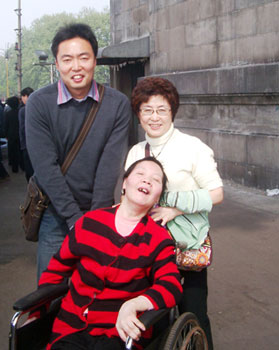
Tae-moon Kwon, Johan, then a seminarian with his mother and Yang-Ai in Wuchang, China, April 2008.

Fr Tae-moon Kwon, whose baptismal name is Johan, was ordained to the priesthood in Korea in January last year. He reflects on his mother's visit to China while he was there on his first mission assignment (FMA) as a seminarian with Fr Andrei Paz, a Filipino Columban, who was ordained as a priest on 7 December 2009. Both took up their first missionary assignment as priests in Taiwan in September.

Father Tae-moon's article has appeared in a number of Columban publications. It isn't often that a missionary's mother can visit him. The insight of  Mrs Kwon was into how her prayer had changed without her being aware of it and embracing asher own family the people her son was serving as a seminarian.

I have highlighted some parts of the article and added some [comments].

Rev Tae-moon Kwan, Johan, left, and Rev Andrei Paz, right, with Auxiliary Bishop Thomas J. Paprocki of Chicago at the Mass at which they were ordained as deacons, 7 June 2009

On 3 April 2008 my mother came from Korea to China to see me. My plan wasn't to go sightseeing but to let her see how we Columbans work in China. [I'm not a great one myself for sightseeing with visitors. I find that they are touched when I bring them to visit people I work with.] As a result, we met many of the people whom I was encountering in my ministry.

With my mother I went to Jingzhou to meet Korean Sisters and others who work with lepers; also to Xiantao to see the Chinese priests and Sisters there. My mother was impressed with their simple lifestyle, especially that of the late Bishop Peter Zhang.

One day my mother, a Chinese seminarian and myself went to the first Yangtze Bridge with Yang-Ai. Paralysed at the age of 18, Yang-Ai was now 48. When I escorted her to the church in Wuchang last year, using a wheelchair, she said she wanted to see the First Bridge. She remembered being brought there when she was eight. With our help, her wish of 40 years was finally fulfilled. It was a great moment for me, the Chinese seminarian and my mother. [Very often what a person who is not fully independent asks for is something very simple, such as the request of Yang-Ai.]

My mother also met many parishioners in Wuchang church. We had dinner together, took pictures, chatted and listened to the history of the Church in China. She was delighted with the experience.

The last day before she left, my mother said, 'Tae-moon, do you know how happy I am? Now I have the answer to my prayer when I asked what does it all mean. Before you left Korea for your First Mission Assignment, my prayers were entirely for you, but somehow they have changed.

'Now my prayer is not only for you but for all the people you encounter. I did not understand why the object of my prayer had changed in this way because it was not my intention to change it. But now that I have met the people whom you know in China, I understand why I pray like this. Even though I did not know them before, even though I cannot speak Chinese, I feel strongly that they are my family, my children, my sisters, my brothers, my parents and my grandparents.' [What a beautiful discovery. The visit brought to Mrs Kwon's attention something that the Holy Spirit had already done in her. This reminds me too of a lovely line in the reading from the Life of St Anthony the Abbot by St Athanasius in the Office of Readings for the feast of St Anthony, 17 January: 'Some loved him as a son, and others as though her were a brother'. It is some loving him 'as a son' that really hits me, since it is so unusual. I presume that people didn't see him that way when he reached 100! he ided aged 105 or 106.]

When I heard her say this, I was so proud of my mother and the Chinese people I had come to know. I could feel how close she had come to them and how close they were to her as one family in God.

When she went back to Korea I found myself reflecting on her time here. Before I came to China for my First Mission Assignment, I often wondered about the work I could do because of my limitations in the Chinese situation. Here I have met people with mental and physical disabilities, lepers, elderly people, children of poor migrant parents, seminarians, priests, Sisters and the humble and faithful parishioners in Wuchang Church.

These people are exactly the same people whom Jesus helped, loved, often met and ate with, during his time on earth. They treated me and my mother with great love, kindness and hospitality. They eagerly shared their lives with us. Could it be any better? I gain confidence from those people who give me the energy for mission and help me to improve. Even if my pastoral work is restricted by the Chinese Government, God has given me a great sense of love and relationship through his people in this country. [Jesus took on our limitations too and worked within those parameters, affecting us all.]

I am grateful for the opportunity to experience God's love, to feel his presence and to realise the extent of his compassion.

Rev Tae-moon Kwan, Johan, Auxiliary Bishop Thomas J. Paprocki of Chicago and Rev Andrei Paz, after the Mass at which the two Columbans were ordained as deacons, 7 June 2009