16 January 2014

Sunday Reflections, Feast of the Sto Niño Year A (Philippines), 19 January 2014

Holy Child of Cebu
Balaang Bata sa Sugbo
Santo Niño de Cebú

The Feast of the Santo Niño is proper to the Philippines and is celebrated on the Second Sunday in Ordinary Times. The prayers and readings of the Mass are proper to the feast. Here are the readings, taken from the New American Bible, the English translation used in the Lectionary in the country.

First Reading Isaiah 9:1-6    

The people who walked in darkness
have seen a great light;
upon those who dwelt in the land of gloom
a light has shone.
You have brought them abundant joy
and great rejoicing,
as they rejoice before you as at the harvest,
as people make merry when dividing spoils.
For the yoke that burdened them,
the pole on their shoulder,
and the rod of their taskmaster
you have smashed, as on the day of Midian.
For every boot that tramped in battle,
every cloak rolled in blood,
will be burned as fuel for flames.
For a child is born to us, a son is given us;
upon his shoulder dominion rests.
They name him Wonder-Counselor, God-Hero,
Father-Forever, Prince of Peace.
His dominion is vast
and forever peaceful,
from David’s throne, and over his kingdom,
which he confirms and sustains
by judgment and justice,
both now and forever.
The zeal of the LORD of hosts will do this!

Responsorial Psalm   Ps 96[97]: 1-2, 2-3, 11-12, 13

R. Today is born our Savior, Christ the Lord.
Sing to the LORD a new song;
   sing to the LORD, all you lands.
Sing to the LORD; bless his name.
R. Today is born our Savior, Christ the Lord.
Announce his salvation, day after day.
Tell his glory among the nations;
among all peoples, his wondrous deeds.
R. Today is born our Savior, Christ the Lord.
Let the heavens be glad and the earth rejoice;
   let the sea and what fills it resound;
   let the plains be joyful and all that is in them!
Then shall all the trees of the forest exult.
R. Today is born our Savior, Christ the Lord.
They shall exult before the LORD, for he comes;
   for he comes to rule the earth.
He shall rule the world with justice
   and the peoples with his constancy.
R. Today is born our Savior, Christ the Lord.

Second Reading Ephesian 1:3-6, 15-18 

Blessed be the God and Father of our Lord Jesus Christ, who has blessed us in Christ with every spiritual blessing in the heavens, as he chose us in him, before the foundation of the world, to be holy and without blemish before him. In love he destined us for adoption to himself through Jesus Christ, in accord with the favor of his will, for the praise of the glory of his grace that he granted us in the beloved.

Therefore, I, too, hearing of your faith in the Lord Jesus and of your love for all the holy ones, do not cease giving thanks for you, remembering you in my prayers, that the God of our Lord Jesus Christ, the Father of glory, may give you a spirit of wisdom and revelation resulting in knowledge of him.

May the eyes of (your) hearts be enlightened, that you may know what is the hope that belongs to his call, what are the riches of glory in his inheritance among the holy ones.

Gospel, Matthew 18:1-5, 10

At that time the disciples approached Jesus and said, "Who is the greatest in the kingdom of heaven?"

He called a child over, placed it in their midst, and said, "Amen, I say to you, unless you turn and become like children, you will not enter the kingdom of heaven.

Whoever humbles himself like this child is the greatest in the kingdom of heaven. And whoever receives one child such as this in my name receives me.

"Whoever causes one of these little ones who believe in me to sin, it would be better for him to have a great millstone hung around his neck and to be drowned in the depths of the sea.

"See that you do not despise one of these little ones, for I say to you that their angels in heaven always look upon the face of my heavenly Father.

The Novena Song for the Feast of the Sto Niño


The Feast of the Santo Niño is hugely important in the Philippines. It is also an extension, in a real sense, of Christmas, even though the liturgical season of Christmas ended last Sunday with the Feast of the Baptism of the Lord. The first Reading is that used in the Christmas Mass During the Night ('Midnight Mass').

It is also a celebration of the fact that Jesus came among us as a child. After posting this I read Our Stories on Misyon, the Columban online magazine I edit here in the Philippines, a reflection by our editorial assistant Richelle Verdeprado on the continuity between childhood dreams and the opportunities given us each day of our adult lives to create stories that glorify God’s presence in our lives.

Here are some quotations from Pope Francis, chosen in the context of this Sunday's celebration.

Apostolic Exhortation of Pope Francis

No 21. The Gospel joy which enlivens the community of disciples is a missionary joy.

No.23. The joy of the Gospel is for all people: no one can be excluded.

No 24. An evangelizing community knows that the Lord has taken the initiative, he has loved us first (cf. 1 Jn 4:19), and therefore we can move forward, boldly take the initiative, go out to others, seek those who have fallen away, stand at the crossroads and welcome the outcast. Such a community has an endless desire to show mercy, the fruit of its own experience of the power of the Father’s infinite mercy. 

Finally an evangelizing community is filled with joy; it knows how to rejoice always. It celebrates every small victory, every step forward in the work of evangelization. Evangelization with joy becomes beauty in the liturgy, as part of our daily concern to spread goodness. The Church evangelizes and is herself evangelized through the beauty of the liturgy, which is both a celebration of the task of evangelization and the source of her renewed self-giving.

No 30. Each particular Church, as a portion of the Catholic Church under the leadership of its bishop, is likewise called to missionary conversion . . . It is the Church incarnate in a certain place, equipped with all the means of salvation bestowed by Christ, but with local features. Its joy in communicating Jesus Christ is expressed both by a concern to preach him to areas in greater need and in constantly going forth to the outskirts of its own territory or towards new sociocultural settings.

During the Novena in preparation for the feast.

No. 49.  I prefer a Church which is bruised, hurting and dirty because it has been out on the streets, rather than a Church which is unhealthy from being confined and from clinging to its own security.

No. 68. The immense importance of a culture marked by faith cannot be overlooked; before the onslaught of contemporary secularism an evangelized culture, for all its limits, has many more resources than the mere sum total of believers. An evangelized popular culture contains values of faith and solidarity capable of encouraging the development of a more just and believing society, and possesses a particular wisdom which ought to be gratefully acknowledged.

No.69. It is imperative to evangelize cultures in order to inculturate the Gospel. In countries of Catholic tradition, this means encouraging, fostering and reinforcing a richness which already exists.

No. 71. The new Jerusalem, the holy city (cf. Rev 21:2-4), is the goal towards which all of humanity is moving. It is curious that God’s revelation tells us that the fullness of humanity and of history is realized in a city. We need to look at our cities with a contemplative gaze, a gaze of faith which sees God dwelling in their homes, in their streets and squares. God’s presence accompanies the sincere efforts of individuals and groups to find encouragement and meaning in their lives. He dwells among them, fostering solidarity, fraternity, and the desire for goodness, truth and justice.

Sto Niño, Gugma Ko, 'Holy Child, My Love', 

I don't know who the singer and musicians are in the video above but here is the song sung by its composer, Manny Lapingcao.


The website of the Basilica Minore de Santo Niño de Cebu, Cebu City, is here.


10 January 2014

'This is my beloved Son . . .' Sunday Reflections, The Baptism of the Lord, Year A


The Baptism of Christ, El Greco, painted 1608-28 [Web Gallery of Art]

Readings (New American Bible: Philippines, USA)                                  

Readings (Jerusalem Bible: Australia, England & Wales, India [optional], Ireland, New Zealand, Pakistan, Scotland, South Africa)

Gospel Matthew 3:13-17 (New RevisedStandard Version, Catholic Edition, Canada) 

Then Jesus came from Galilee to the Jordan to John, to be baptized by him. John would have prevented him, saying, “I need to be baptized by you, and do you come to me?” But Jesus answered him, “Let it be so now; for thus it is fitting for us to fulfil all righteousness.” Then he consented.  And when Jesus was baptized, he went up immediately from the water, and behold, the heavens were opened and he saw the Spirit of God descending like a dove, and alighting on him; and lo, a voice from heaven, saying, “This is my beloved Son, with whom I am well pleased.”


Today's Feast of the Baptism of the Lord brings the liturgical season of Christmas to an end. My edition of The Divine Office suggests the hymn above, Of the Father's Love Begotten (Divinum Mysterium),  as one that may be sung today.


'I baptise you in the name of the Father . . .' 28 December 2011


A Columban confrere, Fr Peter Steen, who died in Ireland in May 2009 at the age of 84 just a couple of weeks after leaving the Philippines, spoke to me a number of times, as I recall, about paintings of the baptism of Jesus. Many of them show only Jesus and his cousin, St John the Baptist. He thought that these were very inaccurate. Jesus lined up with others. St Luke's account specifically says When all the people were baptized, and when Jesus also had been baptized and was praying (3:21).

Anyone present that day, if they had noticed Jesus at all, would have seen him as another sinner. This is an extraordinary expression of God's love for us, that God who became Man would let himself be seen as one of us sinners. In Evangelii Gaudium, The Joy of the Gospel, Pope Francis writes about evangelization: The heart of its message will always be the same: the God who revealed his immense love in the crucified and risen Christ (No 11).

Today ends the Church's liturgical season of Christmas in which we have focused to a large degree on the fact that some, at least, especially the shepherds and the Magi, recognised in Jesus a child from God. But today the Church moves thirty years forward, to the beginning of the public life of Jesus, when he identifies himself with us sinners. This is how he began to reveal his immense love that would culminate in his crucifixion and resurrection.

Pope Francis reminds us in the same document, God never tires of forgiving us; we are the ones who tire of seeking his mercy (No 3). Jesus lining up with sinners to be baptised is a powerful reminder that God never tires of forgiving us.

14 young women and girls lining up for baptism and confirmation, 28 December 2011

At his weekly general audience last Wednesday Pope Francis began a series of teachings on baptism. Here is a summary in English of what Pope Francis said in Italian. I have emphasised some parts of the text.


Dear Brothers and Sisters: Today we begin a series of catecheses on the sacraments, starting with baptism. The Second Vatican Council tells us that the Church herself is a 'sacrament', a grace-filled sign which makes Christ’s saving work present in history, through the power of the Holy Spirit. The first of the Church’s seven sacraments, baptism gives us new birth in Christ, makes us sharers in the mystery of his death and resurrection, grants the forgiveness of sin and brings us new freedom as God’s children and members of his Church. Let us not forget the great gift we have received. Our baptism has changed us, given us a new and glorious hope, and empowered us to bring God’s redeeming love to all, particularly the poor, in whom we see the face of Christ. Our baptism has also given us a share in the Church’s mission of evangelization; as disciples, we are also missionaries. As we celebrate the feast of the Baptism of the Lord this Sunday, let us ask him to renew in us the grace of our baptism and to make us, with all our brothers and sisters, true children of God and living members of his body, the Church.


Before the audience members of a circus entertained Pope Francis and the people at the audience. Speaking directly to the circus performers the Pope said, When you travel from city to city I ask you to become messengers of joy, messengers of brotherhood in a world that greatly needs it.

Pope Francis makes the same point in a colourful way in Evangelii Gaudium No 10: An evangelizer must never look likes someone who has just come back from a funeral!

In reality, funerals can be powerful moments of evangelization. Fr Michael Scully, a Columban priest who worked in Japan for many years, told of how a funeral homily given by Fr Willie Spicer, another Columban at whose funeral he was preaching, led to the conversion of a Japanese artist. 


At the moment of our baptism God the Father quietly said the words he spoke at the baptism of Jesus: This is my beloved son/daughter, with whom I am well pleased.

The Baptism of Jesus took place at the beginning of his public ministry. Our baptism initiates us into our participation in and responsibility for continuing that ministry, which Jesus handed over to the Church. Pope Francis speaks about the urgency of that in Evangelii Gaudium No 14: Lastly, we cannot forget that evangelization is first and foremost about preaching the Gospel to those who do not know Jesus Christ or who have always rejected him. Many of them are quietly seeking God, led by a yearning to see his face, even in countries of ancient Christian tradition. All of them have a right to receive the Gospel. Christians have the duty to proclaim the Gospel without excluding anyone. Instead of seeming to impose new obligations, they should appear as people who wish to share their joy, who point to a horizon of beauty and who invite others to a delicious banquet. It is not by proselytizing that the Church grows, but 'by attraction'.


Blessed Miguel Pro SJ (1891 - 1927)
‘¡Viva Cristo Rey!’ 'Long live Christ the King!' 23 November 1927

Pope Francis reminds us that the Church grows by attraction. Two priest-martyrs exemplify that for me very powerfully and humanly. One is Blessed Miguel Pro SJ whose last words at his execution were ¡Viva Cristo Rey. He once promised to joke in heavenIf I meet any long-faced saints there I will cheer them up with the Mexican Hat Dance! 

Fr Ragheed Ganni (1972 - 2007)

Father Ragheed, an engineer by profession, lived in the Irish College in Rome while styudying there. Someone who knew him said this of him after he was murdered in Iraq in 2007: 
He was a raconteur par excellence and a font of knowledge - we discussed everything and anything from the metaphysical to the trivial. A young and gauche student at the time, I learnt about Iraq and about theology; about the workings of the college in the summer and the best places to eat pizza. I was amazed at his command of English and Italian and his perennial good spirits and big smile - he was and will always be an inspiration.

An Irish priest who lived in the next room to Father Ragheed in Rome, Fr Murchadh Ó Madagáin, wrote on his blog about the Iraqi priest: And the thing that will stick with me the most is probably this: he said that without the Eucharist, the people have nothingThat is why he was prepared to stay, because he believed that the Eucharist was everything, and the people needed this hope and so he was prepared to stay there and risk death.  [Emphasis added in both quotations above.] 

Can there be more attractive examples of the living out of our baptismal mission, messengers of joy, messengers of brotherhood in a world that greatly needs it, than these two young priests who chose to live in great danger in their homelands, one prepared to do the Mexican Hat Dance in heaven, the other who knew where to find the best pizza in Rome, dying for their faith?

07 January 2014

'Let birds fly above the earth across the firmament of the heavens' (Genesis 1:20).


Yesterday I posted videos of jazz violinist Stephane Grappelli and classical violinist Yehudi Menuhin in very different interpretations of Bach's Concerto for Two Violins. In the 1970s these two made some recordings of standards together, one of them Hoagy Carmichael's Skylark. Here is their beautiful rendition of a beautiful melody.


Stephane Grappelli and Yehudi Menuhin, 1976, photo by Allan Warren [Wikipedia]

Johnny Mercer wrote the lyrics. The song is interpreted here by English singer Dame Cleo Laine and flautist Sir James Galway from Northern Ireland.


06 January 2014

Bach to Bach - and Bach again!


Yesterday I came across the video above of Stephane Grappelli, Django Reinhardt and Eddie South improvising on the First Movement of Bach's Double Violin Concerto in D minor. I think it was in the autumn of 1981 when I was doing a sabbatical year in Toronto that I attended a concert by Stephane Grappelli. There was a full house, the audience ranging in age From one to ninety-two, to quote The Christmas Song. It was an occasion on which I felt I was in the presence of someone doing exactly what God had made him to do. that's the only way I can describe Grappelli.

There is a comment under this video that reads,  This is beautiful. I'm sure the old man himself would appreciate. Here is the same music played as 'The Old Man' wrote it by two of the great classical violinists of our time, Yehudi Menuhin and David Oistrakh. Menuhin and Grappelli teamed up many years later to make some memorable recordings, blending their two very different styles.


I'm sure 'The Old Man' would also approve of this vocal arrangement of the same music by The Swingle Singers, from the 1960s.


03 January 2014

'They saw the child with Mary his mother; and they knelt down and paid him homage.' Sunday Reflections, Epiphany


THE EPIPHANY OF THE LORD

In countries where this is a holyday of obligation, eg, Ireland, the solemnity is celebrated on the traditional date, 6 January. Where it is not a holyday of obligation, eg, the Philippines, it is observed on this Sunday.

The Epiphany has two different Mass formularies, At the Vigil Mass, celebrated on Saturday evening, and At the Mass during the Day. While the prayers and chants are different, the same readings are used at both Masses.

Readings (New American Bible: Philippines, USA)                                  

Readings (Jerusalem Bible: Australia, England & Wales, India [optional], Ireland, New Zealand, Pakistan, Scotland, South Africa)

SECOND SUNDAY AFTER THE NATIVITY (Years A, B, C)

Readings (Jerusalem Bible) 

THE EPIPHANY OF THE LORD

Gospel Matthew 2:1-12 (New RevisedStandard Version, Catholic Edition, Canada) 

In the time of King Herod, after Jesus was born in Bethlehem of Judea, wise men from the East came to Jerusalem, asking, “Where is the child who has been born king of the Jews? For we observed his star at its rising, and have come to pay him homage.” When King Herod heard this, he was frightened, and all Jerusalem with him; and calling together all the chief priests and scribes of the people, he inquired of them where the Messiah was to be born.  They told him, “In Bethlehem of Judea; for so it has been written by the prophet:

 ‘And you, Bethlehem, in the land of Judah,
    are by no means least among the rulers of Judah;
for from you shall come a ruler
    who is to shepherd my people Israel.’”

Then Herod secretly called for the wise men and learned from them the exact time when the star had appeared. Then he sent them to Bethlehem, saying, “Go and search diligently for the child; and when you have found him, bring me word so that I may also go and pay him homage.” When they had heard the king, they set out; and there, ahead of them, went the star that they had seen at its rising, until it stopped over the place where the child was. When they saw that the star had stopped, they were overwhelmed with joy. On entering the house, they saw the child with Mary his mother; and they knelt down and paid him homage. Then, opening their treasure chests, they offered him gifts of gold, frankincense, and myrrh. And having been warned in a dream not to return to Herod, they left for their own country by another road.


The Adoration of the MagiVelásquez, 1619

When I entered St Columban's seminary in Ireland in 1961 the vast majority of Catholic missionaries were Westerners. We Columbans were predominantly Irish, with a good number of Americans, Australians, New Zealanders and a few from England and Scotland. There were many seminaries in Ireland preparing men to be priests overseas. And the vast majority of missionaries were priests and religious. That was before Vatican II.

The Council, the first to have a significant number of bishops from outside the Western world, called on the Church in each country to be a sending and receiving Church. 

When I came to the Philippines in 1971 most of the bishops and priests in Mindanao were foreign missionaries. Now the Philippine hierarchy is totally Filipino and a number of the bishops have themselves worked overseas as missionaries. The first bishop in the history of Mongolia is a Filipino, Bishop Wenceslao Padilla CICM. Most of the missionaries there are Asians and Africans and have included lay missionaries from Japan, a country where fewer than one in 200 is a Catholic.

This new reality in the Church was unimaginable to me when I joined the Columbans. I could not foresee that in less than 50 years there would be priests from countries such as India and Nigeria working in my native Dublin, including a Nigerian ordained for the Archdiocese.

The Solemnity of the Epiphany celebrates the fact that Jesus came into the world for everyone. I'm not sure how the convention developed, but many of the great artists, such as Murillo and Velásquez (above) have depicted one of the Wise Men / Kings as a black African, representing the peoples outside of Europe.

Three or four years ago when I was celebrating Sunday Mass in St Brigid's, Blanchardstown, a village outside of Dublin when I was a child but now a built-up area with many immigrants and the place I go home to in Ireland, I saw a young family arrive late. I smiled inwardly when I saw that they were Filipinos. But I felt a great sense of joy when I saw them come right up to the front pew, the father carrying his infant. I felt a surge of hope that immigrant Catholics from the Philippines, India, Nigeria, Poland and other countries would bring a renewal of Christian faith to an Ireland that has to a great extent lost that faith after 1,500 years.


One element of the Christian faith that has remained very strong in Ireland is generosity, especially to people in countries devastated by wars and natural calamities such as Supertyphoon Haiyan/Yolanda in the Philippines in November, as the video above shows. The Filipinos who have migrated to Ireland in the last 14 years or so have been a tremendous gift from God to the Irish people. Nurses and caregivers from the Philippines and Kerala, India, in particular, have been the 'Wise Men and Women from the East' whose 'gold, frankincense and myrrh' is their strong Catholic faith and their professional competence with genuine care for those they are looking after. Filipino nurses held a birthday party for a friend of mine who was in a coma in hospital in Dublin just a few months before she died, something that was of enormous help to her husband and adult sons. A Filipino nurse who works in a large government hospital in Dublin used to visit a gravely ill Columban priest there  when she was off-duty - he wasn't one of her patients - because he had spent most of his life in the Philippines and was a friend of mine. She texted me when he died.

The Magi, when they saw the child with Mary his mother, they knelt down and paid him homage. Today's feast invites us to see Mary and her Child present among immigrants to our native countries and invites us to pay homage to that Child in our celebrations of the Holy Mass, in our daily prayer and through the joyful way we try to live our Christian faith, with a profound sense of gratitude for the priceless gift that it is.


Antiphona at introitum

Ecce advenit
Dominator Dominus:
et regnum in manu ejus, 
et potestas, et imperium.

Psalm 71 [72]:1) Deus, judicium tuum regi da:
et justitiam tuam Filio regis.
Gloria Patri . . .

Entrance Antiphon

Behold, the Lord,
the Mighty One, has come,
And kingship is in his grasp,
And power and dominion.

Psalm 71 [72]:1) Give the king your justice, O God,
    and your righteousness to a king’s son.
Glory . . .

The words in italics are sung when the longer form of the Entrance Antiphon is used, as it is in the Extraordinary Form of the Mass.

The Vatican Council's Sacrosantum Concilium tells us in No 36.1 that the use of the Latin language is to be preserved in the Latin rites. The same document says in No 116, The Church acknowledges Gregorian chant as specially suited to the Roman liturgy: therefore, other things being equal, it should be given pride of place in liturgical services.

Sacrosanctum Concilium also brought in a much wider use of the mother tongue in the liturgy. Here is a setting of the Kyrie (the only part of the Latin Mass in Greek), Gloria  and Sanctus-Benedictus in Japanese by Saburo Takada (1913-2000).


01 January 2014

'Mary treasured all these words and pondered them in her heart.' Happy New Year!


Solemnity of Mary,
the Holy Mother of God

So the shepherds went with haste and found Mary and Joseph, and the child lying in the manger. When they saw this, they made known what had been told them about this child; and all who heard it were amazed at what the shepherds told them. But Mary treasured all these words and pondered them in her heart. The shepherds returned, glorifying and praising God for all they had heard and seen, as it had been told them.

After eight days had passed, it was time to circumcise the child; and he was called Jesus, the name given by the angel before he was conceived in the womb. (Luke 2:16-21, NRSV CE)


May God, the source and origin of all blessing, 
grant you grace,
 pour out his blessing of abundance, 
and keep you safe from harm throughout the year.

(Roman Missal, Solemn Blessings, The Beginning of the Year)

28 December 2013

'An angel of the Lord appeared to Joseph in a dream . . .' Sunday Reflections. The Holy Family of Jesus, Mary and Joseph


Readings (New American Bible: Philippines, USA)                                  

Readings (Jerusalem Bible: Australia, England & Wales, India [optional], Ireland, New Zealand, Pakistan, Scotland, South Africa)

Gospel Matthew 2:13-15, 19-23 (New Revised Standard Version, Catholic Edition, Canada)

Now after the wise men had left, an angel of the Lord appeared to Joseph in a dream and said, “Get up, take the child and his mother, and flee to Egypt, and remain there until I tell you; for Herod is about to search for the child, to destroy him.” Then Joseph got up, took the child and his mother by night, and went to Egypt, and remained there until the death of Herod. This was to fulfill what had been spoken by the Lord through the prophet, “Out of Egypt I have called my son.”

When Herod died, an angel of the Lord suddenly appeared in a dream to Joseph in Egypt and said, “Get up, take the child and his mother, and go to the land of Israel, for those who were seeking the child’s life are dead.” Then Joseph got up, took the child and his mother, and went to the land of Israel. But when he heard that Archelaus was ruling over Judea in place of his father Herod, he was afraid to go there. And after being warned in a dream, he went away to the district of Galilee. There he made his home in a town called Nazareth, so that what had been spoken through the prophets might be fulfilled, “He will be called a Nazorean.”


My child, help your father in his old age,
    and do not grieve him as long as he lives;
13 even if his mind fails, be patient with him;
    because you have all your faculties do not despise him.
14 For kindness to a father will not be forgotten,
    and will be credited to you against your sins;
15 in the day of your distress it will be remembered in your favor. (From today's First Reading, NRSVCE).

It is significant that the First Reading in today's Mass on the Feast of the Holy Family reminds us of the old and how we should love them, especially our fathers. The most powerful image during the Christmas Season is that of the Infant Jesus and his helplessness, something that today's gospel emphasises. Without the protection of St Joseph, the Husband of his Mother, Jesus would have been killed.

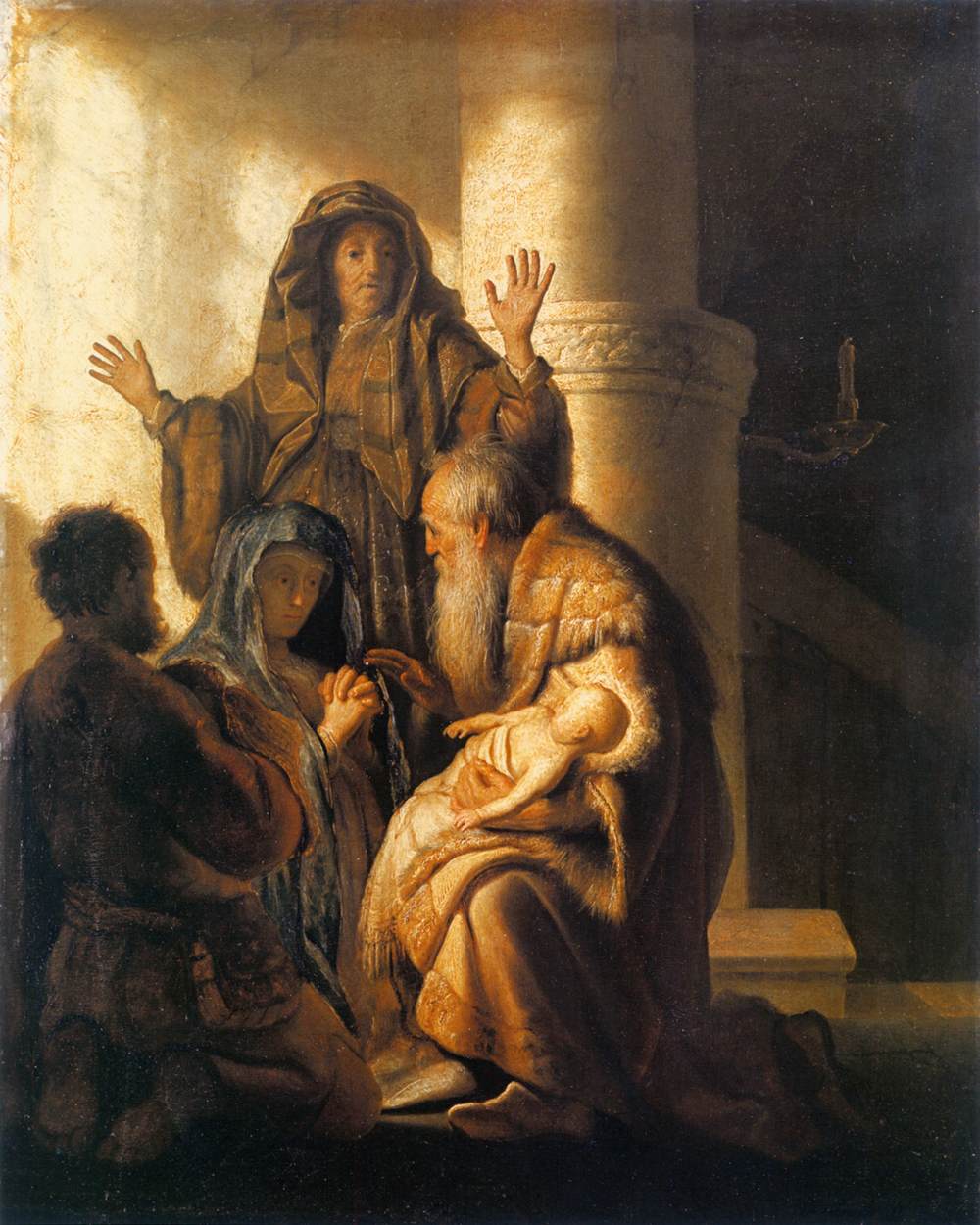
But the First Reading reminds us of the helplessness of many old people, especially those with various forms of dementia. St Luke in his  description of the presentation of Jesus in the Temple shows us an old man, Simeon, recognising and taking the Child Jesus in his arms and praising God, and Anna, a widow aged 84, also praising God and speaking about him. The lives of the very young and the old are intertwined, as this scene shows. But there is a special link when the old become, like the very young, dependent on others and sometimes need the kind of personal care they needed in their first year of life. 

A friend of mine in England, Mrs Frances Molloy, founded the Pastoral Care Project, located in the Archdiocese of Birmingham, the purpose of which is stated below.

Frances sent me this:  


‘Like a weaned child on its mother’s breast.’ Ps 130. 

In the course of my work with the Pastoral Care Project I have been privileged to meet many frail elderly people, many of whom are bearing the illness of dementia. Being with them deepens my awareness of how God reveals his love through them. When these experiences are reflected upon they become a moment of truth and a source of inspiration. I wish to share one such experience with you. 

On one occasion, when I was preparing to lead a time of Adoration before the Blessed Sacrament in a Care Home, I noticed a resident as she was being accompanied to her seat by a member of staff, the lady seemed slightly agitated, and I noticed she was holding a bundle of clothes under her arm. It is not unusual in itself to see someone with dementia carrying personal items with them. 

However, she seemed less agitated when my co-leader began playing the guitar and singing the first hymn. As I stood to read, I noticed the lady’s eyes were fixed on me. I had chosen a verse from the gospel of the day John 15:9. As I read, ‘As the Father has loved me so I have loved you,’ the lady repeated those words - her eyes still fixed on me; still holding the bundle of clothes under her arm. Sometimes a person with dementia will repeat what the person before them is saying. 

The musician followed with the next hymn, the Hail Mary. During the hymn I looked around at the people present as they joined in the singing, but my eyes were drawn back to the lady with the bundle of clothes as  she began to unfold them in harmony with the music. She was no longer agitated, she was careful in the way she was handling the clothes; reshaping them and then she then held them close to her, and began rocking as if comforting a child. The shape she had made out of the clothes actually looked like an infant wrapped in a blanket. What was once a bundle of clothes under her arm now resembled an infant being cradled. She sat contented and when the service was over she rose and walked away with confidence saying ‘thank you’ to me, with a wonderful smile – a stark contrast to when she first sat down.

The lady was clearly touched by the whole prayer experience. the co-leader and myself were quite overwhelmed at the time and reflected on it afterwards and in the days which followed. It is a reminder that affording people the time and space to engage with all the senses will help them to remember and participate in their faith. This is very important, even more so for anyone who is living with dementia and unable to ask to join in the community worship. For me this experience is something I cherish and each time I think about it I am still deeply touched, which is why I wish to share it with you. For me I often wonder about what was happening deep within her, was she holding her child, a grandchild or was it totally spiritual; did she feel she was being held by the loving, living God?

I would like to invite you to read and ponder the reflection; the Scripture, sing or pray the Hail Mary, and imagine the lady with dementia holding her bundle of clothes.

There are moments when people with dementia are transformed especially when they are singing or receiving Holy Communion. I hope by sharing this story it will be a source of encouragement for families and those who are apprehensive about pastoral visiting or taking Holy Communion to the sick

Please do write or email me if you have a story or reflection you would like to share. Sharing enables a better understanding of the person with dementia so that we may see God’s beauty in them.

Best wishes 
 
Frances Molloy 

Project Manager Pastoral Care Project, St Gerard’s, Coventry Road, Coleshill, B46 3ED, England, UK 
 Registered Charity 1094766 

Sometimes adult children, and religious superiors, have to make very difficult decisions in order to take care of aged parents or members, decisions that aren't always accepted by the older person. But as the angel prompted St Joseph through a dream as to what he should do in order to take care of Mary and Jesus so will God prompt us when we are faced with the difficulties of caring for fragile older persons, some with dementia. The Holy Spirit prompts us in today's First Reading: 
For kindness to a father (or to any old person in need) will not be forgotten,
    and will be credited to you against your sins;
15 
in the day of your distress it will be remembered in your favor. 

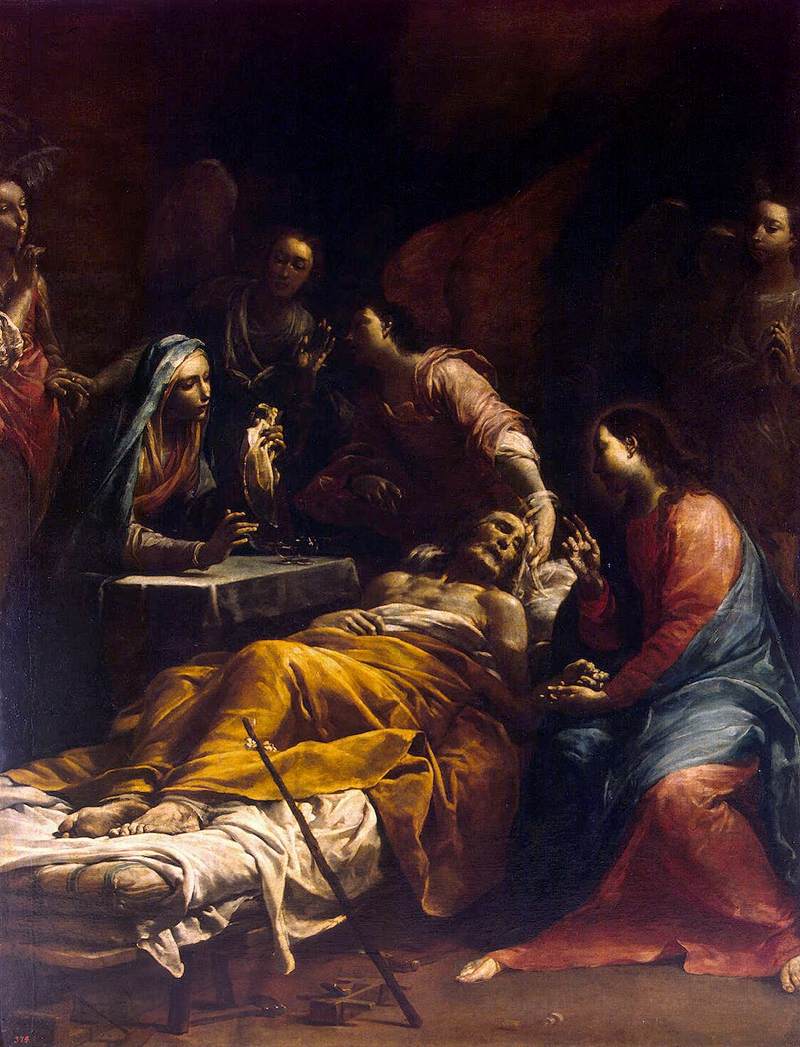
We may hope that in our final moments we will have the same companions as St Joseph had.

Death of St Joseph, Giuseppe Maria Crespi, c.1712 [Web Gallery of Art]


Céad Míle Fáilte romhat, a Íosa, a Íosa  
A Hundred Thousand Welcomes, Jesus

This Irish hymn is sung both as a Christmas carol and as a Communion hymn. The English translation below is not meant to be sung to the melody.

SA GHAEILGE / IN IRISH

Céad míle fáilte romhat, a Íosa, a Íosa,
Céad míle fáilte romhat, a Íosa,
Céad míle fáilte romhat, a Shlánaitheoir
Céad míle míle fáilte romhat, a Íosa, a Íosa.

Glóir agus moladh duit, a Íosa, a Íosa,
Glóir agus moladh duit, a Íosa,
Glóir agus moladh duit, a Shlánaitheoir,
Glóir, moladh agus buíochas duit, a Íosa, a Íosa.

Céad míle fáilte romhat, a Shlánaitheoir,
Céad míle míle fáilte romhat, a Íosa, a Íosa.


IN ENGLISH / SA BHÉARLA

A hundred thousand welcomes to you, o Jesus, o Jesus,
A hundred thousand welcomes to you, o Jesus,
A hundred thousand welcomes to you, o Saviour,
A hundred thousand welcomes to you, o Jesus, o Jesus.

Glory and praise to you, o Jesus, o Jesus,
Glory and praise to you, o Jesus,
Glory and praise to you, o Saviour,
Glory, praise and thanks to you, o Jesus, o Jesus.

A hundred thousand welcomes to you, o Saviour,
A hundred thousand welcomes to you, o Jesus, o Jesus.

The Holy Family, Francisco de Zurbarán, 1659 [Web Gallery of Art]