Since we are travellers and pilgrims in the world, let us ever ponder on the end of the road, that is of our life, for the end of our roadway is our home (St Columban, 8th sermon).
I came across this video yesterday, Tuesday 1 December, and posted it on Facebook. When I opened Facebook this morning I found a message from Loren herself, whom I have never met, and one from a mutual friend in the Philippines, Gwen Llano, who has been involved in Faith and Light for many years. Gwen gave a seminar in Lebanon in 2020 and met Loren there.
The website of the Catholic Bishops' Conference of the Philippines (CBCP) has a report on Loren's talk here. The report by Roy Lagarde says: Pope Leo XIV on Monday said migrants’ experiences must push Christians to oppose war and build communities where no one seeking safety feels unwelcome, after hearing a Filipino woman’s testimony.
Loren Capobres, a former Filipino domestic worker in Lebanon who now works with Jesuit Refugee Service, shared stories that illustrate both the human cost of conflict and the Church’s moral responsibility.
Capobres described her work with migrants through Couples for Christ Lebanon, the Arrupe Migrant Center, and St. Joseph’s Tabaris Parish, which she calls her second home.
She said the parish, supported by Jesuit Refugee Service, became a shelter for migrants who lost homes, work, and security during fighting.
Lebanon is a country that knows suffering. The Lebanese Civil War (1975-1990) led to 150,000 deaths and a million people leaving the country. The population in 1970 was 2,386,114.The country has also given refuge to people fleeing from other wars in the Middle East.
Catholic immigrants such as Loren Capobres bring a deep and generous faith and enrich the countries wherever they go. Here in Ireland I'm often struck by the Catholic faith of Filipinos, Indians from Kerala, who trace their faith back to St Thomas the Apostle, and Nigerians in particular. They come from countries that are very different culturally in many ways from Ireland, but share with us here the deepest identity of all: our Catholic faith received at baptism that when lived leads persons to serve others generously.
May God continue to bless Loren Capobres and so many others like her, wherever they may be.
The video above, with yours truly speaking, was posted last week on the website of the Missionary Society of St Columban in Ireland under the title Elderly Columban Missionaries Say 'Thanks'!
Most of us Columban priests living here in St Columban's, Dalgan Park, Navan, are officially retired, though some of us are still active in various kinds of pastoral work. There are more than sixty of us here, most of us in our 70s, 80s and 90s. When I entered what was then our seminary here in 1961 there were more than 190 studying for the priesthood, spread over seven years.
St Columban's is northwest of Dublin city. We have a very good bus service, with four buses per hour most of the time going to and coming from the city centre, a journey of about 50 minutes. There is also a bus to and from Dublin Airport every hour, 24 hours.
We are very conscious of the support of the people of Ireland, Great Britain, Australia, New Zealand and the USA from our beginnings more than 100 years ago. In more recent years we have been receiving support from the Catholics of Chile, Fiji, Korea, Peru and the Philippines. That support is both financial and spiritual. Indeed those who pray for us are spread far and wide.
St Paul in his letters uses words of gratitude extensively. Romans 1:8 is an example: First, I thank my God through Jesus Christ for all of you, because your faith is proclaimed in all the world.
Those of us who spent many years in the Philippines, in particular, see the truth of this because many of our former parishioners are now living and working in Ireland. Irish people now associate Filipinos with hospitals because so many of our nurses in Ireland are from 'The Pearl of the Orient'. None of us when we went to the Philippines could have imagined that. And many of the Filipinos here proclaim their faith often without being aware of it, through their care for the sick, through their participation at Sunday Mass, which most Irish Catholics don't do any more. Some parishes have Filipino choirs, the initiative coming from the Filipinos themselves.
And we have a growing number of Filipino-Irish people. Some are immigrants who have become Irish citizens and a growing number are the children of Filipinos born here in Ireland.
The same can be said about Catholics with origins in other place, notably Poland, Nigeria, Kerala in India, but also from many other place.
We retired Columban missionaries are often bridges between immigrants from the countries we worked in and the people of Ireland who welcome them. We know what it is like to be an immigrant. We know what it is like to learn a new language and to adjust to what we initially experience as 'strange' ways of doing things. But we also identify with immigrants from places where we have worked. They are not strangers to us. Their identity is part of ours.
Above all, we know that our deepest identity comes from our baptism as children of the Father, brothers and sisters of Jesus the Risen Lord and therefore of one another. And we hope and pray that those not yet baptised may one day discover the deepest identity and the eternal life to which they are called.
Stephane
Grappelli and Frankie Gavin
The
opening music to the Columban video is Oh the Days of the Kerry Dances (or The Kerry Dance), words and music by James Lynam Molloy. One of the recurring lines in the song is Oh for one of those hours of gladness, Gone, alas, like our youth too soon. John McCormack's recording, with which all of us here have been familiar from our childhood, is here. The lyrics resonate with me from time to time.
However, in the joyful version of the tune above - the one used in the Columban video - we have an elderly jazz musician from France, Stephane Grappelli now no longer with us, and a young Irish traditional musician, Frankie Gavin, playing together and blending their different traditions. There is clear respect between the two and their supporting musicians, each taking delight in the playing of the other. Both come from musical traditions where the older pass on their skills to the younger, where the older encourage the younger and take joy in their talent and progress, where the older and the younger listen to and appreciate the other.
This video is a kind of metaphor for me as an older missionary priest and resonates with my experience down the years. The young and the old have a great deal to share together and are a source of inspiration and life to one another. I remember a few years ago one quiet afternoon in St Andrew's Church, Westland Row, Dublin, seeing a grandfather teaching his toddler grandson how to genuflect before the Blessed Sacrament and pointing out different things in the church to the youngster. The old man was passing on the Faith while the child was a source of life and encouragement to his grandfather.
As I say in the video, Being old is good! And thank God for that.
St
Columban’s Cemetery, Dalgan Park, Navan, Ireland
More than 400 Columban missionaries are buried here.
We humbly beseech your mercy, O
Lord, for your servants that, having worked tirelessly for the spread
of the Gospel, they may merit to enter the rewards of the Kingdom.
Through our Lord Jesus Christ,
your Son, who lives and reigns with you in the unity of the Holy Spirit, God,
for ever and ever.
Readings(Jerusalem Bible: Australia, England & Wales, India [optional],
Ireland, New Zealand, Pakistan, Scotland, South Africa)
The readings above are used both at the Vigil Mass
and at the Mass during the Day. Each Mass has its own set of prayers and
antiphons.
In countries where the Epiphany is observed as a
Holyday of Obligation on 6 January, eg, Ireland, the Mass of the Second Sunday after the Nativity is
celebrated. The same readings are used in Years A, B, C:
The same text (cf. Matthew 2:2), without 'Alleluia, alleluia,' is used as the Communion Antiphon at the Mass during the Day.
GospelMatthew 2:1-12 (New
Revised Standard Version, Catholic Edition, Canada)
In the time
of King Herod, after Jesus was born in Bethlehem of Judea, wise menfrom the East came to Jerusalem,asking, “Where is the child who has been born king of the Jews?
For we observed his star at its rising,and have come to pay him homage.”When King Herod heard this, he was frightened, and all Jerusalem
with him;and calling together all the chief priests and
scribes of the people, he inquired of them where the Messiahwas to be born.They told
him, “In Bethlehem of Judea; for so it has been written by the prophet:
‘And you,
Bethlehem, in the land of Judah, are by no means least among the
rulers of Judah; for
from you shall come a ruler who is to shepherdmy people Israel.’”
Then Herod secretly called for the wise menand learned from them the exact time
when the star had appeared.Then he sent
them to Bethlehem, saying, “Go and search diligently for the child; and when
you have found him, bring me word so that I may also go and pay him homage.”When they
had heard the king, they set out; and there, ahead of them, went the star that
they had seen at its rising,until it stopped over the place where the child was.When they
saw that the star had stopped,they were overwhelmed with joy.On entering
the house, they saw the child with Mary his mother; and they knelt down and
paid him homage. Then, opening their treasure chests, they offered him gifts of
gold, frankincense, and myrrh.And having been warned in a dream not to return
to Herod, they left for their own country by another road.
While based in Britain from 2000 till 2002 I was able to spend Christmas with my
brother and his family in Dublin, a short flight from England, in 2000 and
2001. During the holiday in 2001 I saw a documentary on RTÉ, Ireland's national
broadcasting service, about Filipino nurses in Ireland. These began to arrive
in 2000, initially at the invitation of the Irish government to work in
government hospitals. Very quickly there was an 'invasion' of Filipino nurses
and carers, now to be found in hospitals and nursing homes in every part of the
country.
One
of the nurses interviewed told how many Filipinos, knowing that the Irish
celebrate Christmas on the 25th, unlike the Philippines where the culmination
of the feast is on the night of the 24th, offered to work on Christmas Day so
that their Irish companions could be with their families. This also helped to dull the pain of being away from their own families.
I
was moved to tears at the testimony of one nurse, from Mindanao as I recall,
speaking about her job and her first Christmas in Ireland in 2000. She spoke
very highly of her employers, of her working conditions and of her
accommodation, which she compared with that of the Holy Family on the first
Christmas night. She spoke of Jesus, Mary and Joseph in this situation as if
they were members of her own family, as in a very deep sense they are, or we of
their family.
Here
was a young woman from the East powerfully proclaiming, without being aware of
it, that the Word became flesh and lived among us. The fact that she wasn't aware of it, that she was speaking about her 'next door neighbours', made her proclamation of faith all the more powerful. She would have known many in her own place, and very likely knew from her own experience, something of what Joseph and Mary went through in Bethlehem. Her faith in the Word who became flesh and lived among us wasn't something in her head but part of her very being.
For much of the last century thousands of Catholic priests, religious Sisters and Brothers left Europe and North America to preach and live the Gospel in the nations of Africa, Asia and South America. Some of the countries and regions from which they left, eg, Belgium, the Netherlands, Ireland, Quebec, have to a great extent lost or even rejected the Catholic Christian faith. The Jewish people had, in faith, awaited the coming of the Messiah for many centuries. But when He came it was uneducated shepherds who first recognised him and later Simeon and Anna, two devout and elderly Jews who spent lengthy periods in prayer in the Temple. Today's feast highlights wise men from the east, not 'believers' in the Jewish sense, led by God's special grace to Bethlehem to bring gifts in response to that grace, explaining, We . . . have come to pay him homage.They reveal to us that God calls people from every part of the world to do the same and to bring others with them. Will nurses from the Philippines and from Kerala in India, migrants from Korea and Vietnam, from the east, bring the gift of faith in Jesus Christ once again to the many people in Western Europe and North America who no longer know him in any real sense? Will they by the lives they lead as working immigrants gently invite those in the West who have lost the precious gift of our Catholic Christian faith to once again come to pay him homage?
Gospel John 1:35-42 (Jerusalem Bible: Australia, England & Wales, India [optional], Ireland, New Zealand, Pakistan, Scotland, South Africa)
As John stood with two of his disciples, Jesus passed, and John stared hard at him and said, ‘Look, there is the lamb of God.’ Hearing this, the two disciples followed Jesus. Jesus turned round, saw them following and said, ‘What do you want?’ They answered, ‘Rabbi,’ – which means Teacher – ‘where do you live?’ ‘Come and see’ he replied; so they went and saw where he lived, and stayed with him the rest of that day. It was about the tenth hour.
One of these two who became followers of Jesus after hearing what John had said was Andrew, the brother of Simon Peter. Early next morning, Andrew met his brother and said to him, ‘We have found the Messiah’ – which means the Christ – and he took Simon to Jesus. Jesus looked hard at him and said, ‘You are Simon son of John; you are to be called Cephas’ – meaning Rock.
An Soiscéal Eoin 1;35-42 (Gaeilge, Irish)
San am sin bhí Eoin ina sheasamh ansiúd agus beirt dá dheisceabail. Agus ag stánadh dó ar Íosa ag gabháil thart dúirt sé: “Seo é Uan Dé.” Chuala an bheirt deisceabal é ag rá na cainte agus lean rin Íosa. D’iompaigh Íosa, chonaic iad á leanúint agus dúirt sé leo: “Cad tá uaibh?” D’fhreagair rin é: “A raibí” – is é sin le rá “a mháistir” – “Cá bhfuil cónaí ort?” “Tagaigí agus feicigí,” ar sé leo. Tháinig rin dá bhrí sin agus chonaic rin cá raibh cónaí air, agus d’fhan rin fairis an lá sin. Bhí sé timpeall an deichiú huair.
Duine den bheirt a chuala Eoin agus a lean Íosa a ba ea Aindrias, deartháir Shíomóin Peadar. Fuair seisean ar dtús a dheartháir féin Síomón agus dúirt sé leis: “Fuaireamar an Meisias” – is é sín le rá an tUngthach. Thug sé leis é chun Íosa. D’fhéach Íosa go rin air agus dúirt: “Is tú Síomón mac Eoin. Tabharfar ort Céafas” – focal a chiallaíonn Carraig.
+++
God’s call can come in the most unexpected ways. One of my Irish Columban confreres, Fr Bobby Gilmore, has written about discovering his call to be a missionary priest by the visit of a famous Welsh rugby player, Cliff Morgan, to his boarding school in the 1950s, St Joseph’s, Garbally Park, Ballinasloe, County Galway, owned by the Diocese of Clonfert. Rugby was the main sport in Garbally Park and the young Bobby’s passion. The school invited Cliff Morgan to speak to the students. Afterwards there was a question and answer session. Someone asked the guest what his priorities in life were. To the utter astonishment of Bobby, rugby was only the third or fourth priority of the great player. This led him to question his own priorities and led to his becoming a Columban priest.
Late in 2000 I did a mission appeal for the Columbans in the place where Cliff Morgan was born and where he is still a legend. Unfortunately, I didn’t know Father Bobby’s vocation story at the time. He spent many eyars in Mindanao and Camiguin in the Philippines before going to Jamaica. He later worked with Irish immigrants in England. He is now based in Ireland and is President and one of the founders of Migrants Rights Centre Ireland. MRCI was st up in 2000.
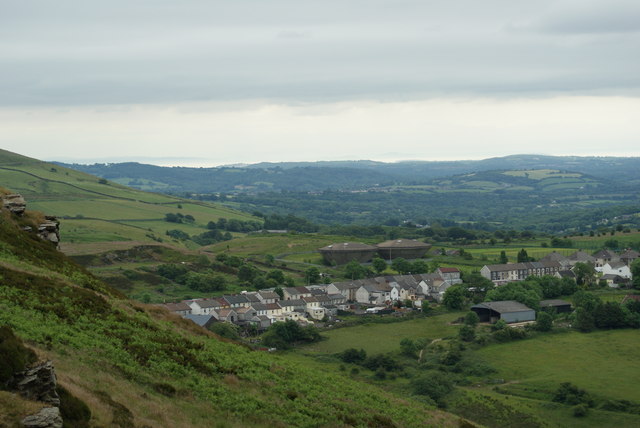
Trebanog, south Wales, where Cliff Morgan was born in 1930. I celebrated Sunday Mass in a school there late in 2000 while doing a mission appeal for the Columbans. The parish church is in a larger town.
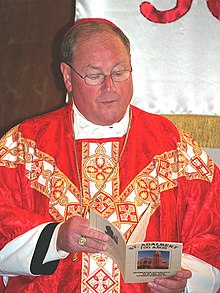
In a talk he gave in August 2009 in Arizona to a convention of the Knights of Columbus Cardinal-designate Archbishop Timothy M. Dolan of New York (above) spoke of four practical challenges the Church currently faces in preaching the Gospel to all people, the first being the instability of marriage and family.
‘That’s where we have the real vocation crisis,’ he remarked, noting that ‘only 50% of our Catholic young people are getting married. We have a vocation crisis to life-long, life-giving, loving, faithful marriage. If we take care of that one, we’ll have all the priests and nuns we need for the church,’ he said.
Last year the Central Statistics Office in the Republic of Ireland reported that nearly half of first tie births take place outside of marriage, 28 per cent of births of a second child and 22 per cent of births of a third child.
God may indeed call a child from that background to the priesthood, to religious life, to the sacrament of marriage but the chances of that child discovering his or her call from God is surely greatly reduced, since that child most likely has little or no faith context.
When the late Richard Cardinal Cushing of Boston was ordained bishop he proudly showed his episcopal ring to his widowed Irish mother, She pointed at her wedding ring and said to him, ‘If it wasn’t for this, you wouldn’t be wearing that’.
This video of a march in Dublin on 17 December is from the website of MRCI. These are working people who want to play a full part in Irish society. The Irish government is trying to get the government of the USA to regularise Irish people there who are in a similar position. Eleven days before the march Dublin City Council unanimously passed this resolution:
This Council supports the undocumented Irish campaign in the US to introduce an earned regularisation scheme. This Council also notes with concern the high numbers of undocumented families and children living in Ireland without rights and under tremendous stress and fear. This Council supports the introduction of an earned regularisation scheme in Ireland, based on criteria set down by the Department of Justice, so that undocumented migrants living in Ireland can participate fully in the social, political and economic affairs of the country. This Council asks that the Minister for Justice be written to upon the passing of this motion to inform him of Dublin City Council's support for an earned regularisation scheme.
If the rugby-mad Bobby Gilmore had not been so astonished by the priorities in life of a young Welsh rugby player 55 or so years ago perhaps he would never have worked as a priest in the Philippines, Jamaica and England and would not now be involved in enabling immigrants to his native Ireland to be truly at home there.
God's call can indeed come in unexpected ways. Had St Andrew not listened to the words of St John the Baptist, accepted the invitation of Jesus to 'come and see', he probably would have spent the rest of his life catching fish instead of 'catching men' with the Gospel in a country not his own and dying on a cross as Jesus did.