31 March 2010

Coming to the defence of Pope Benedict - and of the truth


New York Times published an article on 25 March under the headline Vatican Refused to Unfrock U.S. Priest Who Abused Boys. The story has been reported in the media around the world. The article suggests that Cardinal Ratzinger, as he then was, was negligent in dealing with such cases, particularly with that of Fr Lawrence Murphy in the NYT article.


There have been a number of vigorous responses to the NYT article.

One is the message of Archbishop Jerome Listecki, the new archbishop of Milwaukee, to which the late Father Murphy belonged, at the end of the Chrism Mass. Archbishop Listecki noted the following (editor's emphasis here and in the following item):

This past week our Holy Father, Pope Benedict XVI has come under criticism for the way he has handled past cases of clergy sexual abuse of minors, including a case here involving Lawrence Murphy. The allegations against him, as well as the facts supporting him, are widely available.


The Holy Father does not need me to defend him or his decisions. I believe, and history will confirm that his actions in responding to this crisis, swiftly and decisively and his compassionate response to victims/surviovrs, speak for themselves. The Holy Father has been firm in his commitment to combat clergy sexual abuse; root it out of the Church; reach out to those who have been harmed; and hold perpetrators accountable. He has been a leader, meeting with victims/survivors and chastising bishops for their lack of judgment and leadership.

Mistakes were made in the Lawrence Murphy case. The mistakes were not made in Rome in the 1996, 1997 and 1998. The mistakes were made here, in the Archdiocese of Milwaukee, in the 1970s, the 1980s and the 1990s, by the Church, by civil authorities, by Church officials, and by bishops. And for that, I beg your forgiveness in the name of the Church and in the name of this Archdiocese of Milwaukee.


Fr Thomas Brundage JCL, (in photo) who was the presiding judge for the Archdiocese of Milwaukee for the canonical trial of Fr Murphy writes in the Catholic Anchor, under the headline Setting the record straight in the case of abusive Milwaukee priest Father Lawrence Murphy:

As I have found that the reporting on this issue has been inaccurate and poor in terms of the facts, I am also writing from a sense of duty to the truth.

Thefact that I presided over this trial and have never once been contacted by any news organization for comment speaks for itself.


My intent in writing this column is to accomplish the following:


To tell the back-story of what actually happened in the Father Murphy case on the local level;


To outline the sloppy and inaccurate reporting on the Father Murphy case by the New York Times and other media outlets;

To assert that Pope Benedict XVI has done more than any other pope or bishop in history to rid the Catholic Church of the scourge of child sexual abuse and provide for those who have been injured;


To set the record straight with regards to the efforts made by the church to heal the wounds caused by clergy sexual misconduct. The Catholic Church is probably the safest place for children at this point in history.


Before proceeding, it is important to point out the scourge that child sexual abuse has been — not only for the church but for society as well. Few actions can distort a child’s life more than sexual abuse. It is a form of emotional and spiritual homicide and it starts a trajectory toward a skewed sense of sexuality. When committed by a person in authority, it creates a distrust of almost anyone, anywhere.


As a volunteer prison chaplain in Alaska, I have found a corollary between those who have been incarcerated for child sexual abuse and the priests who have committed such grievous actions. They tend to be very smart and manipulative. They tend to be well liked and charming. They tend to have one aim in life — to satisfy their hunger. Most are highly narcissistic and do not see the harm that they have caused. They view the children they have abused not as people but as objects. They rarely show remorse and moreover, sometimes portray themselves as the victims. They are, in short, dangerous people and should never be trusted again. Most will recommit their crimes if given a chance.


As for the numerous reports about the case of Father Murphy, the back-story has not been reported as of yet.

You can read the full article here.

Other relevant articles are those by John Allen in the National Catholic Reporter, Keeping the Record Straight on Benedict and the Crisis, and one by Canadian priest and columnist, Fr Raymond de Souza, A Response to the New York Times.

Please pray for all who have been absued as children by priests; pray for the repentance of those who have abused; pray for Pope Benedict that he may have strength to always do what is right and that he may not be maligned for the neglicence and sins of others.

30 March 2010

Child protection: the current reality in the Catholic Church in Ireland


The Irish Times today carries the letter below, written by Ian Elliott, which shows clearly what the authorities in the Catholic Church in Ireland are actually doing to prevent any possibility of children being abused by persons working for the Church. Mr Elliott himself is not a Catholic but a Presbyterian. I have highlighted that part of the letter that informs us that any allegations are first referred to the civil authorities.

There is much valid criticism of the failure of Church authorities before to observe either civil law or canon law. No such criticism can be made about what Church authorities are doing now.

Madam, – I refer to the letter . . . (March 22nd), about systems put in place in Nova Scotia, Canada. I note [the writer's] demand for similar practices here, and would like to draw your readers’ attention to the measures that have been put in place and are expected of all parts of the Catholic Church in Ireland to safeguard children in our care.

Safeguarding Children – Standards and Guidance document for the Catholic Church in Ireland, January, 2009, sets out the expected standards of policy, practice and practice necessary to ensure that we create safe environments for children (www.safeguarding.ie).

All parts of the church have agreed to put in place the following: 1. A written child protection policy statement. 2. Procedures for responding to allegations of abuse. Note that it is church policy that all allegations are referred to the statutory authorities for their investigation before any church inquiry takes place. 3. Procedures for preventing harm to children, including proper recruitment, selection, vetting and supervision of staff and volunteers; codes of behaviour; parental consent and health and safety. 4. Training on safeguarding children. 5. Information for children, parents and adults on safeguarding children, and the church’s procedures. 6. Support for victims of abuse; advice and support for those who hold key roles in safeguarding children; and support and management of those who present a risk to children. 7. An annual audit of policy and practice. To ensure compliance with these standards the national office will also conduct audits starting with each diocese during 2010.

I believe Safeguarding Children has become a priority for the Catholic Church in Ireland; and I hope than in implementing these standards, children’s safety and well-being will become the paramount consideration of all those who hold positions of authority. – Yours, etc,

IAN ELLIOTT,

Chief Executive,
National Board for Safeguarding of Children in the Catholic Church,
St Patrick’s College,
Maynooth, Co Kildare.

26 March 2010

Holy See responds to New York Times on the 'Murphy Case' in Milwaukee


On 24 March, the New York Times published a story under the heading Vatican Declined to Defrock U.S. Priest Who Abused Boys. The report included a link to a statement bythe Holy See Press Office in respons to documents shown by the NYT to them. I have highlighted parts of the statement and added some (comments).
The following is the full text of the statement given to the New York Times on March 24, 2010:

The tragic case of Father Lawrence Murphy, a priest of the Archdiocese of Milwaukee, involved particularly vulnerable victims who suffered terribly from what he did. By sexually abusing children who were hearing-impaired, Father Murphy violated the law and, more importantly, the sacred trust that his victims had placed in him. (A clear acknowledgment that the priest broke the law. I work with Deaf people and I see a particularly reprehensible aspect to the abuse that added to the trauma of young people who have a difficulty in communicating with the wider community).

During the mid-1970s, some of Father Murphy’s victims reported his abuse to civil authorities, who investigated him at that time; however, according to news reports, that investigation was dropped. The Congregation for the Doctrine of the Faith was not informed of the matter until some twenty years later. (The civil authorities did not pursue the case.)

It has been suggested that a relationship exists between the application of Crimen sollicitationis and the non-reporting of child abuse to civil authorities in this case. In fact, there is no such relationship. Indeed, contrary to some statements that have circulated in the press, neither Crimen nor the Code of Canon Law ever prohibited the reporting of child abuse to law enforcement authorities. (There is no conflict between civil law and canon law. The Dublin Report, done by the Irish State, was highly critical of three archbishops of Dublin for NOT following canon law, which requires a canonical trial for a priest accused of abusing children. If these trials had taken place so much harm would have been prevented. And a canonical trial would not in any way prevent the civil authorities of pursuing the matter in the civil courts.)

In the late 1990s, after over two decades had passed since the abuse had been reported to diocesan officials and the police, the Congregation for the Doctrine of the Faith was presented for the first time with the question of how to treat the Murphy case canonically. The Congregation was informed of the matter because it involved solicitation in the confessional, which is a violation of the Sacrament of Penance. It is important to note that the canonical question presented to the Congregation was unrelated to any potential civil or criminal proceedings against Father Murphy. (Solicitation in the confessional means a priest asking a penitent to engage in sexual activity.)
In such cases, the Code of Canon Law does not envision automatic penalties, but recommends that a judgment be made not excluding even the greatest ecclesiastical penalty of dismissal from the clerical state (cf. Canon 1395, no. 2). (Some civil legal systems, eg, those of Ireland and of England, also allow judges great leeway in applying sentences). In light of the facts that Father Murphy was elderly and in very poor health, and that he was living in seclusion and no allegations of abuse had been reported in over 20 years, the Congregation for the Doctrine of the Faith suggested that the Archbishop of Milwaukee give consideration to addressing the situation by, for example, restricting Father Murphy’s public ministry and requiring that Father Murphy accept full responsibility for the gravity of his acts. Father Murphy died approximately four months later, without further incident. (The man was near death and clearly was no danger to anyone at that stage, no allegations having been made for over 20 years. It can indeed be argued that dismissal from the priesthood would have been a clear sign to the victims that they had been listened to. But the decision not to do that did not put any yong person in danger.)

[00405-02.01] [Original text: English]

[B0167-XX.01]

25 March 2010

'Be it done to me according to thy word'


And Mary said: Behold the handmaid of the Lord; be it done to me according to thy word (Lk 1:38, Douay-Rheims).

Concerning the Divine Word

With the divinest Word, the Virgin
Made pregnant, down the road
Comes walking, if you'll grant her
A room in your abode.

( St John of the Cross; translated by Roy Campbell)

20 March 2010

Pope Benedict's Pastoral Letter to Irish Catholics


This is taken from the Vatican Information Service. The text of the full letter is here. I've highlighted parts of the summary and made some [comments]. I have read the full letter.

VATICAN CITY, 20 MAR 2010 (VIS) - Given below is the English-language summary of the Pope's Pastoral Letter to the Catholics of Ireland, which was made public this morning:


The Pope has written a Pastoral Letter to all the Catholics of Ireland, expressing his dismay at the sexual abuse of young people by Church representatives and the way this was addressed by local bishops and religious superiors. He asks that the Letter be read with attention and in its entirety. The Holy Father speaks of his closeness in prayer to the whole Irish Catholic community at this painful time and he proposes a path of healing, renewal and reparation.


He calls on them to remember the rock from which they were hewn, particularly the fine contribution made by Irish missionaries to European civilisation, and to the spread of Christianity in every continent. Recent years have seen many challenges to the faith in Ireland, in the wake of fast-paced social change and a decline in adherence to traditional devotional and sacramental practices. This is the context in which the Church's handling of the problem of child sexual abuse has to be understood. [Sexual abuse by priests was there before the great social changes in the last three or four decades in Ireland but Pope Benedict is right, I believe, in putting the issue in the context of what I see to be a loss of faith in Ireland. I wonder if some of the priests who abused, especially some ordained in the 1990s and mentioned in the Murphy Report on abuse in the Archdiocese of Dublin, had any faith at all. At least two were engaged in the sexual abuse of children they met while doing pastoral work as seminarians. I find this horrific. The Pope goes on to write about problems in the formation of seminarians and novices. But persons of no religious faith who live by a moral code recognise clearly that the abuse of children is morally wrong.]


Many factors have given rise to the problem: insufficient moral and spiritual formation in seminaries and novitiates, a tendency in society to favour the clergy and other authority figures, and a misplaced concern for the reputation of the Church and the avoidance of scandal, resulting in failure to apply existing canonical penalties when needed. [It is ironic that the 'misplaced concern for the reputation of the Church' has dragged the whole Church into the mud and driven many out of the Church. While some have dismissed canon law as having no relevance the Murphy Report was severely critical of three archbishops of Dublin who failed to apply it and thereby aggravated the situation. There is no conflict between canon law and civil law. The State cannot dismiss a priest from the priesthood but it can put him in jail. The church can dismiss him from the priesthood and has the obligation of informing the civil authorities. I have a fear for the Church in the Philippines where the priest is given the kind of deference the Pope refers to.] Only by careful examination of the many elements that gave rise to the crisis can its causes be properly diagnosed and effective remedies be found.


During their "ad limina" visit to Rome in 2006, the Pope urged the Irish bishops to "establish the truth of what happened in the past, to take whatever steps are necessary to prevent it from occurring again, to ensure that the principles of justice are fully respected, and above all, to bring healing to the victims and to all those affected by these egregious crimes." [Pope Benedict, in the full text of his letter, recognises very clearly how so many young people have been betrayed. Others are suffering too in a different way. I felt a great heaviness after the Murphy Report came out. Priests living their lives conscientiously in Ireland have, I should think, a difficult time right now. Many people, not only family members of those who have been abused, but thos who have been faithful and upright Cathoics all their lives, have had their faith shaken.] Since that time he himself has met victims on more than one occasion, listening to their stories, praying with them and for them, and he is ready to do so again in the future. [I am disappointed and even dismayed that the Pope wasn't more explicit on this. I think it would have helped enormously had he said that he was going to Ireland with the sole purpose of meeting victims. But he does leave the door open and it is very clear from the full letter that he is not in any way dismissing the pain of those who have been abused. But I do't thin the letter goes far enough on this.] In February 2010 he called the Irish bishops to Rome to discuss with them the steps they are taking to remedy the problem, with particular reference to the procedures and protocols now in place to ensure the safety of children in church environments and to respond swiftly and justly to allegations of abuse. In this Pastoral Letter, he speaks directly to a series of different groups within the Irish Catholic community, in the light of the situation that has arisen.


Addressing the victims of abuse first of all, he acknowledges the grievous betrayal they have suffered and he tells them how sorry he is over what they have endured. He recognises that, in many cases, no one would listen when they found the courage to speak of what happened. He understands how those in residential institutions must have felt, with no way of escape from their sufferings. While recognising how hard it must be for many of them to forgive or be reconciled with the Church, he urges them not to lose hope. Jesus Christ, Himself a victim of unjust sufferings, understands the depths of their pain and its enduring effect upon their lives and relationships. Yet His wounds, transformed by His redemptive sufferings, are the very means by which the power of evil is broken and we are reborn to life and hope. [St Thomas the Apostle found his great faith in the wounds that the Risen Lord carried - and will for all eternity.] The Pope urges victims to seek in the Church the opportunity to encounter Jesus Christ and to find healing and reconciliation by rediscovering the infinite love that Christ has for each one of them. [Pope Benedict in everything he says and writes focuses on the Lord Jesus.]

In his words to priests and religious who have abused young people, the Pope calls upon them to answer before God and before properly constituted tribunals for the sinful and criminal actions they have committed. They have betrayed a sacred trust and brought shame and dishonour upon their confreres. Great harm has been done, not only to the victims, but also to the public perception of the priesthood and religious life in Ireland. While summoning them to submit to the demands of justice, he reminds them that they should not despair of God's mercy, which is freely offered to even the greatest of sinners, if they repent of their actions, do penance, and humbly pray for forgiveness.


The Pope encourages parents to persevere in the demanding task of bringing up children to know that they are loved and cherished, and to develop a healthy self-esteem. Parents have the primary responsibility for educating new generations in the moral principles that are essential for a civilised society. The Pope invites children and young people to find in the Church an opportunity for a life-giving encounter with Christ, and not to be deterred by the failings of some priests and religious. He looks to the younger generation to contribute to the renewal of the Church. He also urges priests and religious not to be discouraged, but rather to dedicate themselves anew to their respective apostolates, working in harmony with their superiors so as to offer new life and vitality to the Church in Ireland through their living witness to the Lord's redeeming work.


Addressing himself to the Irish bishops, the Pope notes the grave errors of judgement and failure of leadership on the part of many, because they did not correctly apply canonical procedures when responding to allegations of abuse. [He echoes the criticism the Murphy Report made about this.] While it was often hard to know how to address complex situations, the fact remains that serious mistakes were made, and they have lost credibility as a result. He urges them to make determined efforts to remedy past mistakes and to prevent any recurrence by fully implementing canon law and co-operating with the civil authorities in their areas of competence. [I had been noted by some commentators that the Vatican hadn't explicitly endorsed the new regulations the Church has worked out with the civil authorities in the Irish Republic and in Northern Ireland but this seems to do just that,] He calls upon the bishops, moreover, to rededicate themselves to the pursuit of holiness, setting an example themselves, and encouraging the priests and the lay faithful to play their part in the life and mission of the Church. .


Finally, the Pope proposes some specific steps to foster the renewal of the Church in Ireland. He asks all to offer up their Friday penances, for a period of one year, in reparation for the sins of abuse that have occurred. He recommends frequent recourse to the Sacrament of Reconciliation and the practice of Eucharistic adoration. [Get back to basics! He is calling every Catholic in Ireland to renewal, to a year-long 'Lent' if you like.] He announces his intention to hold an Apostolic Visitation of certain dioceses, religious congregations and seminaries, with the involvement of the Roman Curia, [Here is a chance for the Vatican to work side-by-side with the Irish civil authorities, something it has failed to do till now, as the Murphy Report shows, ignoring letters form the Murph Commission on flimsy grounds of protocol. The Vatican could replace the current Papal Nuncio who clearly doesn't see the problem. Unfortunately, there are no 'seminaries' to be visited, only St Patrick's National Seminary in Maynooth. All the others have closed.] and he proposes a nationwide Mission for bishops, priests and religious in Ireland [I hope that the Catholics of Ireland will bakcd this up by their prayer and by healthy friendships with priests and religious. When I was young priests and religious were kept at a distance by many, a misplaced awe, to some degree. Maybe that's one of the reasons why we've had so many priests trying to 'prove' that they were like everyone else.] This being the international Year for Priests, he holds up the figure of St. John Vianney as a model and intercessor for a revitalised priestly ministry in Ireland. After thanking all who have worked so hard to deal decisively with the problem, he concludes by proposing a Prayer for the Church in Ireland, to be used by all the faithful to invoke the grace of healing and renewal at this difficult time.


Pope Benedict added this to his pastoral letter:


Prayer for the Church in Ireland


God of our fathers, renew us in the faith which is our life and salvation, the hope which promises forgiveness and interior renewal, the charity which purifies and opens our hearts to love you, and in you, each of our brothers and sisters.


Lord Jesus Christ, may the Church in Ireland renew her age-old commitment to the education of our young people in the way of truth and goodness, holiness and generous service to society.


Holy Spirit, comforter, advocate and guide, inspire a new springtime of holiness and apostolic zeal for the Church in Ireland.


May our sorrow and our tears, our sincere effort to redress past wrongs, and our firm purpose of amendment bear an abundant harvest of grace for the deepening of the faith in our families, parishes, schools and communities, for the spiritual progress of Irish society, and the growth of charity, justice, joy and peace within the whole human family.


To you, Triune God, confident in the loving protection of Mary, Queen of Ireland, our Mother, and of St Patrick, St Brigid and all the saints, do we entrust ourselves, our children, and the needs of the Church in Ireland.


19 March 2010

A fellow-missionary's homily on St Patrick's Day


My fellow-Columban Fr Cyril Lovett, who edits the Far East, the magazine of the Columbans in Ireland and Britain, gave this homily at Mass in St Columban's, Dalgan Park, Navan, County Meath, Ireland, on St Patrick's Day. I've highlighted some parts and added a [comment] or two.

FROM ONE MISSIONARY TO ANOTHER


A reading of St Patrick’s Confession from the viewpoint of a fellow-missionary.

I have always had great affection and admiration for Patrick, and in my years on mission in the Philippines and Brazil I always read his Confession with sympathy and empathy around this time every year.

There are three particular aspects of Patrick that I want to look at:

• Patrick’s attitude towards the Irish.

• The fact that he always remained a foreigner.

• The crushing blow of having his life’s work denigrated by those who should have supported him.

Patrick’s initial contact with the Irish was enough to make him anti-Irish for ever. His father was a Roman citizen, living in the south of Britain, probably working as a civil servant in what would be known today as Boulogne-sur-mer, on the coast of northern France. As Patrick grew up in this isolated outpost, the Roman Empire was beginning to crumble. By 410 Alaric and his Goths had swept into Rome and sacked the city for three days.

At the age of 16 disaster struck nearer to home. His father’s house was raided by Irish pirates and Patrick along with many other youngsters was carried off to Ireland. There he was sold as a slave and spent the next six years herding sheep in all weathers on the slopes of Slemish in the north-east.

So, his first experience of the Irish was anything but a favourable one: the son of an upper class Roman citizen was poorly fed and housed; had to get used to manual labour; and had very little experience of any kindness from his captors. His writings are notable for acknowledging kindness from any source, but of these early years he had no kindness to report. [Fr Michael Sinnott, the 79-year-old Columban kidnapped last October  and held for 32 days in the southern Philippines, speaks of the kindness of his captors every time he is interviewed about his ordeal].

His normal schooling was also interrupted. He tried to make up for it later but he had to cope for the rest of his life with being a lonely man, with a permanent feeling of being isolated and unwanted. In our first ventures into another culture, we generally go full of hope and as we learn to cope with a strange new world we are enriched by the good things in it, and we learn to live with the down-side. [Father Sinnott has spoken of never understanding all the nuances of the culture in which he lives.]

When we return after holidays, it is the richness of the good things in the people and the culture that sustain us. For that reason I find it hard to imagine the heroism of Patrick who would later chose to go again to a people who had only given him unhappy memories and minister among them for more than thirty years.

Patrick remained a foreigner in Ireland for the rest of his life; this had to be so.

He writes “This is where I am now in all my insignificance among strangers”. This is a state that all of us missionaries can identify with. For all of us, working in one or more different cultures has been an enormous enrichment. The downside is that we can never fully belong: as soon as we open out mouths we are recognised as foreigners, even if our appearance has not proclaimed that loudly beforehand. And then having adapted as best we can to the new culture, we often find that we can no longer be fully at home in our own culture. There is then an aspect of being a nomad in living out our missionary vocation. [This aspect of missionary life is being written about more lately. The situation of the missionary is not quite the same as that of a migrant, whoe life may well be more lonely. But it is a phenomenon of migration that people from the same area in the home country often migrate to the same country and even the same area, eg, there are many Australians whose ancestors came from County Clare in Ireland. But people from neighboruing County Galway tended to migrate to the USA. Daly City in California is full of Filipinos. Most of the Filipinos in Hawaii, or people there of Philippine origin, trace their roots to the Ilocos region of northern Luzon. So migrants often find a large community of their own, unlike missionaries.] Patrick’s initial six years in Ireland meant that he acquired a good grasp of the language, but he would write later of his critics, “I was afraid of drawing general gossip on myself because I had not studied like the other who got a thorough grounding in law and theology. They never had to change their medium of speech since childhood…while I had to express myself in a foreign language.” [I once met a Filipino businesswoman at a gathering of Irish people in Cebu, Philippines, one St Patrick's Day. She travelled extensively and spoke English fluently. But she told me how trying it was at times when she had nobody to speak to in her own language, Cebuano visayan.]

He never went home to Britain and he felt that deeply. [Until less than a hundred years ago many missionaries never expected to go home again. Manyh of them didn't because they died very young.] He wrote, “It is not practical for me to consider leaving them and going to Britain. How dearly would I love to go, like a man going to his homeland and relatives, and not only there but also to Gaul in order to visit the brothers and to meet the members of the Christian community. God knows how I yearned for it but I am tied by the Spirit”.

And then there was that awful experience that happened to him late in life. When he had decided to respond to the Spirit calling him to evangelise the Irish, it seems he went for his early formation to Germanus of Auxerre. Germanus took him under his wing, understood his difficulties as a late vocation, but recognised his sanctity and his missionary potential, and had him ordained a deacon and later a bishop. When Germanus went to visit Britain, Patrick went along with him to try and get the financial backing of the British bishops for his mission to Ireland. But, Ireland was considered unimportant and savage; after all Patrick’s predecessor Palladius had disappeared there without a trace, and Patrick did not have great credentials. He may have wasted up to eight to ten years before he finally got the backing he sought.

Then, years later, as Patrick was trying to face the various challenges of his mission in Ireland, there was a disaster.

Here is how he describes it...

"I was put to the test by some of my senior fellow-bishops (in England) who came to cast up my sins at me in order to discredit my hard work as a bishop of this mission… After thirty years they discovered against me a confession which I had made before I became a deacon. In the anxiety of my troubled mind I confided to my dearest friend what I had done in my boyhood in one day… because I had not yet overcome my sinful ways…

My only sorrow that we should have deserved to hear such a report is for my dearest friend. To him I had confided my very soul… Now I was not in Britain at the debate… how could he have let me down publicly before all, good and bad, in a matter in which he had previously favoured me?” [It is not an enemy who taunts me-- then I could bear it; it is not an adversary who deals insolently with me-- then I could hide from him. But it is you, my equal, my companion, my familiar friend. We used to hold sweet converse together; within God's house we walked in fellowship Ps 55 (54) 12-14].

And he goes on to say, “On that day indeed the impulse was overpowering to fall away not only here and now but forever. But the Lord graciously spared his exile and wanderer and helped me greatly when I was walked on in this way. The disgrace and blame I felt, however, were considerable.”

So, this is the Patrick that I can relate to: a man heroic in his human qualities; a man who faced the kind of difficulties that missionaries of every age continue to face; a man of deep faith; a man who was inclined to postpone some hard decisions; a man who carried scars from the past, who was very conscious of his own shortcomings; and a man who suffered greatly at the hands of the very ones who should have supported him.

We ask his intercession for our country as it passes through the present crisis.

Homily at Mass in Dalgan Park by Fr Cyril Lovett SSC - 17 March 2010

17 March 2010

A St Patrick's Day greeting from the Philippines


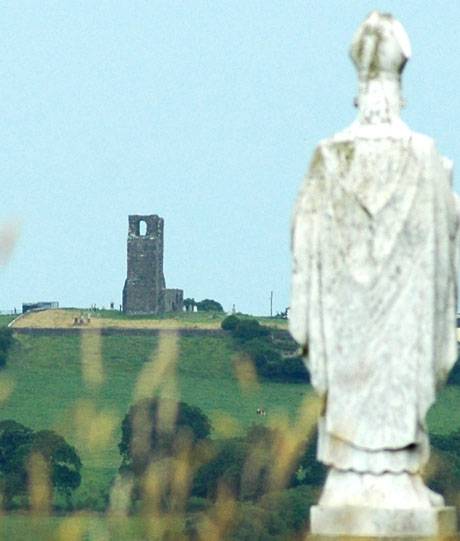
The Hill of Tara is where the High Kings of Ireland lived. You can see it directly from the front door of St Columban's, Dalgan Park, Navan, where Irish Columban priests were formed from 1941 onwards. My maternal grandmother grew up in this area.

St Patrick, whose place of birth we do not know, wasn't Irish but probably grew up in Wales. He was kidnapped at the age of 16 and taken to Ireland to take care of animals. He escaped six years later and returned as a missionary bishop. He died in Ireland in 461. He is patron saint of Ireland and of Nigeria.


The UST Singers, from the University of Sto Tomas, Manila, sing an Old Irish Blessing. The university is the oldest existing in Asia.


Dóchas Linn Naomh Pádraig (a traditional hymn in honour of St Patrick, with my English translation).


Dóchas linn Naomh Pádraig, Aspal mór na hÉireann,

Bring hope to us, St Patrick, great Apostle of Ireland,

Ainm oirearc gléigeal, solas mór an tsaoil é.

Illustrious, glorious name, he is the great light of the world.

D'fhill le soiscéal grá dúinn d'ainneoin blianta i ngéibheann.

He came back to us with the gospel of love, despite years of captivity.

Grá mór Mhac na páirte, d'fhuascail cách ón daorbhruid.

Great love of the Son, freed all from oppression.


'Sé a chloigh na draoithe,

He who defeated the druids

Croíthe dúra gan aon mhaith.

Hard of heart and no good.

D'ísligh dream an díomais

Brought down the arrogant

Trí neart Dé ár dtréan-fhlaith.

Through the strength of God our powerful lord


Sléibhte, gleannta, máighe,'s bailte mór’ na hÉireann:

Hill, valleys, plains, large towns of Ireland

Ghlan sé iad go deo dúinn, míle glóir dár naomh dhil.

He cleaned them for ever, a thousand praises to our dear saint

Iarr’maid ort, a Phádraig, guí orainn na Gaela,

We ask you, Patrick, pray for us Irish,

Dia linn lá 'gus oíche 's Pádraig Aspal Éireann.

God and St Patrick Apostle of Ireland be with us day and night.