Showing posts with label Nigeria. Show all posts

23 February 2024

'I just want a place at the feet of Jesus.' Sunday Reflections, 2nd Sunday of Lent, Year B


The Transfiguration
Blessed Fra Angelico [Web Gallery of Art]

Fra Angelico (c.1395 - 18 February 1455) was an Italian Dominican friar. He was beatified by Pope St John Paul 11 on 3 October 1992 and his feast day is observed on 18 February.

Readings (Jerusalem Bible: Australia, England & Wales, Ireland, New Zealand, Pakistan, Scotland)

Readings (New American Bible: Philippines, USA)

Gospel Mark 9:2-10 (English Standard Version Anglicised, India)

After six days Jesus took with him Peter and James and John, and led them up a high mountain by themselves. And he was transfigured before them, and his clothes became radiant, intensely white, as no one on earth could bleach them. And there appeared to them Elijah with Moses, and they were talking with Jesus. And Peter said to Jesus, “Rabbi, it is good that we are here. Let us make three tents, one for you and one for Moses and one for Elijah.” For he did not know what to say, for they were terrified. And a cloud overshadowed them, and a voice came out of the cloud, “This is my beloved Son;[c] listen to him. And suddenly, looking around, they no longer saw anyone with them but Jesus only.

And as they were coming down the mountain, he charged them to tell no one what they had seen, until the Son of Man had risen from the dead. So they kept the matter to themselves, questioning what this rising from the dead might mean.


Léachtaí i nGaeilge


Assumpsit Iesus Petrum
Sebastián de Vivanco (Ávila, 1551 - Salamanca, 1622)
Música Reservata de Barcelona directed by Bruno Turner


Assumpsit Iesus Petrum, et Iacobum et Ioannem fratrem eius, et duxit eos in montem excelsum seorsum, et transfiguratus est ante eos.

Jesus took with him Peter and James and John, and led them up a high mountain by themselves.

Et ecce vox de nube dicens: His est Filius meus dilectus, in quo mihi bene complauci, ipsum audite.

And a voice came out of the cloud, "This is my beloved Son; listen to him" (Mark 10: 2,7).

Servant of God Clement Shahbaz Bhatti [Wikipedia]
(9 September 1968 - 2 March 2011) 

In today's first reading God asks Abraham to sacrifice his only son 'on a height that I will point out to you'. We can only imagine the heartbreak of Abraham being asked by God to give offer his only son by Sarah his wife, born when both of them were very old. But God wasn't looking for the life of Isaac but for Abraham to submit himself to God's will, no matter the consequences. Abraham's sacrifice of his own will made him our Father in faith, as the Roman Canon says, the Father of countless Jews and Christians. Muslims also venerate him.

From the time of St Stephen, the first Christian martyr, down to our own day, God has been calling certain individuals to give up everything that is precious to them, including life itself, for the sake of others.

The struggle of Abraham is a sign of the struggle that Jesus would have to go through. Last Sunday we got a glimpse of his struggle in the desert where he was tempted by Satan, basically to abandon the mission the Father had given him. During Holy Week we will see his awful struggle in the Garden of Gethsemane and his cry from the Cross, My God, my God, why have you forsaken me?

Each of us in some way has to share in that struggle, to let go of our own will in something big or small for the sake of others and to do what God want us to do.

Shahbaz Bhatti was living in a situation where he knew that God might ask him to give up his own life. Less than two months before his death Governor Salmaan Taseer of Punjab, a Muslim, was murdered by one of his own security guards because of his opposition to Pakistan's Blasphemy Law.

Mr Bhatti was deeply committed to working for groups discriminated against, including the Christian minority in Pakistan. He gave as the reason for his commitment, I only want a place at the feet of Jesus. I want my life, my character, my actions to speak for me and say that I am following Jesus Christ. (These words were quoted in the reflection on the Second Station of the Cross in the Colosseum in Rome led by Pope Francis on Good Friday 2015.) He was gunned down on 2 March 2011 in  Islamabad, just after leaving his mother's home.

In the video below Shahbaz Bhatti speaks about the possibility of his death. A note with the video says :Bhatti's close colleague shared the video with Al Jazeera saying that Bhatti had requested him to do so in the eventuality of his assassination because 'it is with the Muslim world I want to share the message of love. That is the only message that can bring the Muslim world out of the circle of hate and killings'.

Al Jazeera is not responsible for the content of this video.


[Update: Benedict Rogers, a close friend of Shahbaz Bhatti, in an article published on 2 March 2021 writes about this interview: Four months before his murder, he recorded an interview with the BBC for broadcast in the event of his death.]

Below the video is a transcript of what Mr Bhatti said.


Minister Bhatti, you forgot one question in the interview. Your life is threatened by whom and what sort of threats are you receiving?

The forces of violence, militant banned organizations, the Taliban, and Al Qaeda, they want to impose their radical philosophy on Pakistan. And whoever stands against their radical philosophy that threatens them, when I’m leading this campaign against the Sharia Law, for the abolishment [abolition] of [the] Blasphemy Law, and speaking for the oppressed and marginalized, persecuted Christian and other minorities, these Taliban threaten me.

But I want to share that I believe in Jesus Christ who has given his own life for us. I know what is the meaning of [the] Cross and I am following of the Cross and I am ready to die for a cause. I’m living for my community and suffering people and I will die to defend their rights. So these threats and these warnings cannot change my opinion and principles. I will prefer to die for my principle and for the justice of my community rather [than] to compromise on these threats.

Sts Peter, James and John, as they came down the mountain after having seen the Transfigured Jesus, wondered what 'risen from the dead' meant. A few weeks after the assassination of Clement Shahbaz Bhatti the bishops of Pakistan petitioned the Holy See to declare him a martyr. Bishop Andrew Francis of Multan, who drafted the petition, said, We Christians in Pakistan want to transform the death of Shahbaz Bhatti into a prophecy of the Resurrection. It was only after the Crucifixion that the Resurrection could occur and it was only after Easter Sunday that the Apostles found the answer to their question. On 2 March 2016, the fifth anniversary of his death, the Diocese of Islamabad-Rawalpindi began collecting testimonies about Shahbaz Bhatti to inquire into his martyrdom and sanctity.

May each of us pray for the grace to make these words of Shahbaz Bhatti our own: I just want a place at the feet of Jesus. I want my life, my character, my actions to speak for me and say that I am following Jesus Christ.
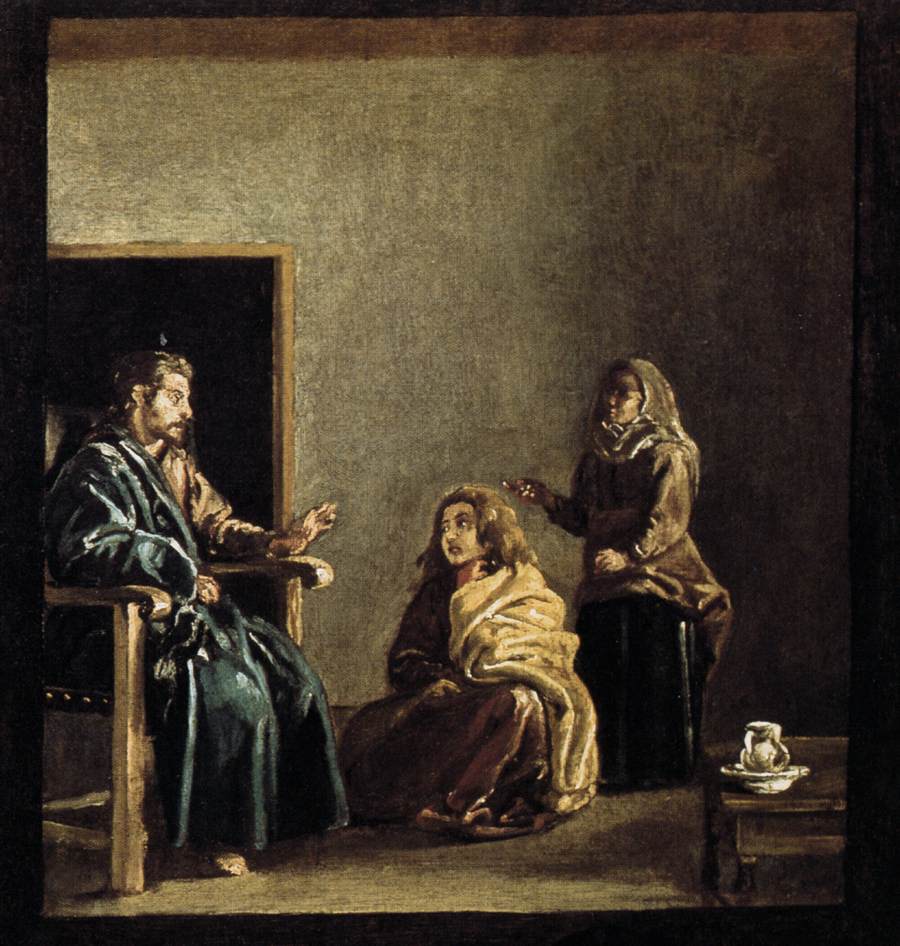

Christ in the House of Mary and Martha (detail)
Velázquez  [Web Gallery of Art]

Martha had a sister called Mary, who sat at the Lord’s feet and listened to his teaching (Luke 10:39).

I just want a place at the feet of Jesus (Shahbaz Bhatti).

+++

On 18 February The Catholic Herald (England) posted this story on their website: Report: 8,000 Christians murdered in worst year for Islamist attacks.


Traditional Latin Mass

Second Sunday in Lent

The complete Mass in Latin and English is here. (Adjust the date at the top of that page to 2-25-2024 if necessary).

Epistle: 1 Thessalonians 4:1-7. Gospel: Matthew 17:1-9. 

Transfiguration
Marco Benefial [Web Gallery of Art]

After six days Jesus took with him Peter and James and John his brother, and led them up a high mountain apart (Matthew 17:1; Gospel).


13 January 2015

Freedom of speech in Paris? In Europe?


Some people are calling for the resignation of BBC reporter Tim Willcox because of a comment he made to a Jewish woman whom he was interviewing on air during the rally for freedom of speech and national unity in Paris on Sunday.

His did indeed cut across the woman when she was answering a question he had put to her and made a comment that was somewhat irrelevant. In that comment he referred first to 'Israel's policy' and then equated Israel with 'Jewish hands'.

The kosher grocery store in Paris clearly was a specific target just as the office of Charlie Hebdo was. Those murdered in the grocery store were killed simply because they were perceived to be Jewish while those murdered in the Charlie Hebdo offices were killed because of the perception that they had mocked Islam, as indeed some of them had, just as they had mocked Judaism and Christianity. The Jewish customers were murdered simply for being what they were, while the cartoonists and journalists were killed because of the perception of what they were doing.

None of these murders can be justified in any way. They were utterly evil acts.

Charlie Hebdo regularly mocked Judaism and Christianity, to the extent of being vilely blasphemous, as you can see on the blog of Fr Ray Blake, a priest of the Diocese of Arundel and Brighton in the south of England, though in doing so it wasn't breaking French law.

But there is a certain irony in the fact that some want a journalist to be fired because he was exercising his right to freedom of speech during a march in support of freedom of speech.

Mr Willcox wasn't engaged in a studio interview but reporting 'live', when it is so easy to make an awkwardly expressed comment or question. But every issue and every item in Charlie Hebdo is planned and premeditated. 

I wonder how many who have been saying Je suis Charlie are aware that they are supporting blasphemy.

Yes! Freedom of Speech during a march in support of Freedom of Speech!

Meanwhile, last May, BBC Radio Devon sacked veteran DJ David Lowe because of a 'racist' word on a recording made in 1932 that he broadcast in his weekly 'golden oldies' programme. The station would not allow him to make an on-air apology for what was a genuine mistake. At the time the recording was made the word in question was not perceived to be racist, though it is now.

I don't think that there are any plans yet in the UK to destroy all copies of Shakespeare's Merchant of Venice or of Dickens's Oliver Twist, or to forbid stage or TV productions of the former or of the musical version of the latter, Oliver!, despite the unattractive Jewish character central to each work.


Rocco Buttiglione [Wikipedia]

Rocco Buttiglione, an Italian politician, was rejected in 2004 as a commissioner of the European Union because of his views on homosexuality. 'I may think that homosexuality is a sin, and this has no effect on politics, unless I say that homosexuality is a crime,' said the Italian as he pledged to nonetheless defend the rights of gays.

Yes, indeed, 'Freedom of Speech'!

23 August 2013

'Men will come from east and west . . .' Sunday Reflections, 21st Sunday in Ordinary Time Year C

Open Air Rock Cross also called Nasrani Sthambams in front of the 2nd Century built Marth Mariam Catholic Church at Kuravilangadu, Kerala, India. This church belongs to the Syro-Malabar Catholic Church, in full communion with Rome.

Readings (New American Bible: Philippines, USA)                                  

Readings (Jerusalem Bible: Australia, England & Wales, India [optional], Ireland, New Zealand, Pakistan, Scotland, South Africa)

Gospel Luke 13:22-30 (Revised Standard Version – Catholic Edition)

Jesus went on his way through towns and villages, teaching, and journeying toward Jerusalem. And some one said to him, "Lord, will those who are saved be few?" And he said to them, "Strive to enter by the narrow door; for many, I tell you, will seek to enter and will not be able. When once the householder has risen up and shut the door, you will begin to stand outside and to knock at the door, saying, 'Lord, open to us.' He will answer you, 'I do not know where you come from.' Then you will begin to say, 'We ate and drank in your presence, and you taught in our streets.' But he will say, 'I tell you, I do not know where you come from; depart from me, all you workers of iniquity!' There you will weep and gnash your teeth, when you see Abraham and Isaac and Jacob and all the prophets in the kingdom of God and you yourselves thrust out. And men will come from east and west, and from north and south, and sit at table in the kingdom of God. And behold, some are last who will be first, and some are first who will be last."


(Our Lady of Naval de Manila)

Earlier this month a friend of mine from the Philippines, Marifel, who was a parishioner of mine in Tangub City, Mindanao, when she was a child and now works as a receptionist for a community of Dominican Sisters near Dublin, invited me for a meal in a hotel. When the waitress came along I asked her if she was from Poland or Lithuania or 'one of those countries. 'One of those countries', she replied with a smile, 'Latvia.' She took our orders but the food was brought by an Indian waiter. Later on an Irish waiter looked after us.


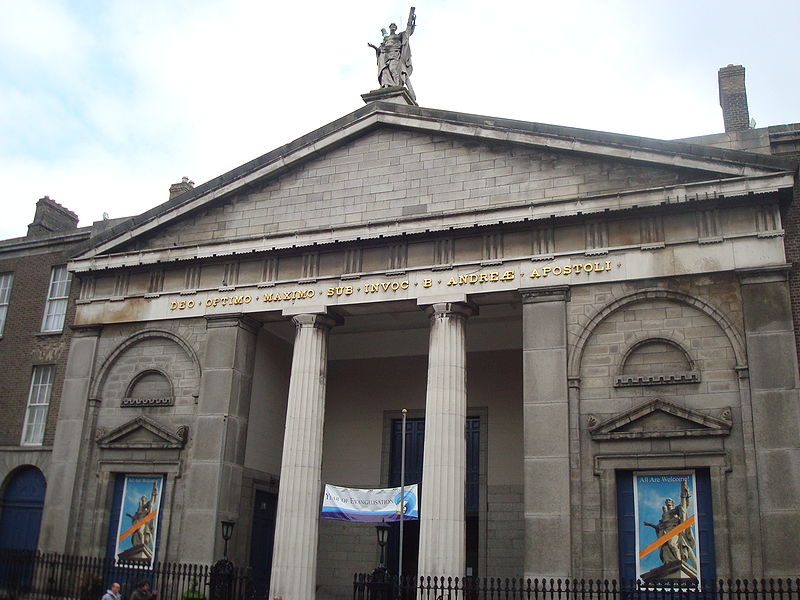
A week later I found myself in St Andrew's Church, Westland Row (above), beside one of Dublin's main railway stations. While I was praying there a grandfather and his grandson aged about three came in. The grandfather was wearing bright summer clothes - unlike grandparents when I was young who seemed to be always dressed in dark clothes - and genuflected before kneeling in the pew. After a while the little boy asked him some questions. His grandfather pointed at the altar and also at some of the Stations of the Cross as he explained things to the youngster. They then left.

On one Sunday a month in St Brigid's Church, Blanchardstown, in the Archdiocese of Dublin and the parish I come home to when I visit Ireland, has Mass for the Syro-Malabar Catholic community in Dublin. Many of these are nurses from Kerala, India, working in Irish hospitals. St Brigid's Parish also has a Filipino choir that sings at one of the Masses on the last Sunday of the month, except during the summer.

And men will come from east and west, and from north and south, and sit at table in the kingdom of God, Jesus tells us in the Gospel this Sunday. Thirty years ago churches in Ireland were still full at Sunday Masses, with young and old, and almost everyone Irish. Today there are fewer priests,  fewer Sunday Masses and fewer people attending them, most of them old. A large proportion of Sunday congregations are from places such as India, Nigeria, Poland, the Philippines. Mass servers - and there aren't too many of these anymore - are likely to be either immigrants or the Irish-born children of immigrants.

The above are snapshots of contemporary Ireland, as different from the Ireland of my childhood as are the mobile phones that everyone has from the box cameras that a few had and the telephones  that even fewer had in my time. 

But we had something precious that has been largely lost - our Catholic faith. There are various reasons for the rejection of the Church by many and the outright rejection of the Christian faith by some. But this can remind us that our faith is pure gift from God, a gift that can be shared and that was generously shared, even to the point of giving up life itself, by the countless missionaries who went overseas, or it can be lost, not only by individuals bu by whole communities.

The gift of faith can be lost by taking it for granted, by apathy, by not taking it seriously, by not passing it on. Jesus in the Gospel is telling his fellow Jews - and we must never forget that he is and will be for all eternity a Jew, just like Mary - that many of them are in danger of losing the precious gift of the faith, the faith they inherited from Abraham, our father in faith (Eucharistic Prayer I - Roman Canon) Isaac and Jacob, and that others will accept that same gift with gratitude.

Luis Antonio Cardinal Tagle, Archbishop of Manila [Wikipedia]

In 2003, at a gathering of priests in Antipolo City, near Manila, sponsored by Worldwide Marriage Encounter, then Bishop Luis Antonio G. Tagle, now Cardinal-Archbishop of Manila, spoke about a then recent survey on the values of young Filipinos. What he projected could happen within twenty years in terms of the loss of the Catholic faith in the Philippines was what had been happening in Ireland over the previous twenty years.

I was heartened by the sight of the grandfather passing on our Catholic Christian faith to his young grandson by his example and his readiness to answer the boy's questions. I am heartened by the living faith of so many immigrants to Ireland.

My hope is that the Catholic faith will continues to be passed on in Ireland and elsewhere by grandfathers - and grandmothers and parents - like the one I saw in St Andrew's Church. My hope is that the Catholic faith will be renewed in Ireland and elsewhere by the example and fervour of immigrants from Asia, Africa and Eastern Europe, by men from east and west, and from north and south and that together we will all sit at table in the kingdom of God, not only in heaven but here and now as brothers and sisters working together to build a world where the values  of the Gospel prevail, a world where everyone will have heard the Gospel of Jesus proclaimed to them, especially by the lives we lead. 

My hope is that the nurses from Kerala, who trace their Catholic faith back to St Thomas the Apostle, the waiters, caregivers and nurses from the Philippines, whose faith embodies a tender love of Mary the Mother of God as our Mother, will help the Irish to re-discover the greatness of the gift that their ancestors received more than 1,500 years ago from a great missionary who first arrived in Ireland at the age of 16 as a kidnapped slave, St Patrick.

My fear is that there will not be enough grandfathers - and grandmothers and parents - who will know and value the gift of faith enough to pass it on and that the youngsters, children of immigrants to Ireland and elsewhere in the Western world, will succumb to the values of their contemporaries and reject the most precious gift that God has given us - our Catholic Christian faith, an invitation to share in the love of God for all eternity.


Though the video was made for the Feast of the Baptism of the Lord it invites us to reflect on our faith, received through baptism, as pure gift from God, something we should do constantly.

Collect

O God, who cause the minds of the faithful 
to unite in a single purpose, 
grant your people to love what you command 
and to desire what you promise, 
that, amid the uncertainties of this world, 
our hearts may be fixed on that place where true gladness is found.
Through our Lord Jesus Christ, your Son, 
who lives and reigns with you 
in the unity of the Holy Spirit, 
one God, for ever and ever.

Photos from Wikipedia.

17 March 2010

A St Patrick's Day greeting from the Philippines


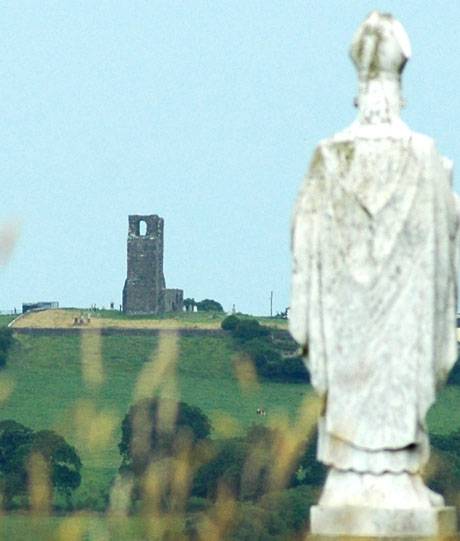
The Hill of Tara is where the High Kings of Ireland lived. You can see it directly from the front door of St Columban's, Dalgan Park, Navan, where Irish Columban priests were formed from 1941 onwards. My maternal grandmother grew up in this area.

St Patrick, whose place of birth we do not know, wasn't Irish but probably grew up in Wales. He was kidnapped at the age of 16 and taken to Ireland to take care of animals. He escaped six years later and returned as a missionary bishop. He died in Ireland in 461. He is patron saint of Ireland and of Nigeria.


The UST Singers, from the University of Sto Tomas, Manila, sing an Old Irish Blessing. The university is the oldest existing in Asia.


Dóchas Linn Naomh Pádraig (a traditional hymn in honour of St Patrick, with my English translation).


Dóchas linn Naomh Pádraig, Aspal mór na hÉireann,

Bring hope to us, St Patrick, great Apostle of Ireland,

Ainm oirearc gléigeal, solas mór an tsaoil é.

Illustrious, glorious name, he is the great light of the world.

D'fhill le soiscéal grá dúinn d'ainneoin blianta i ngéibheann.

He came back to us with the gospel of love, despite years of captivity.

Grá mór Mhac na páirte, d'fhuascail cách ón daorbhruid.

Great love of the Son, freed all from oppression.


'Sé a chloigh na draoithe,

He who defeated the druids

Croíthe dúra gan aon mhaith.

Hard of heart and no good.

D'ísligh dream an díomais

Brought down the arrogant

Trí neart Dé ár dtréan-fhlaith.

Through the strength of God our powerful lord


Sléibhte, gleannta, máighe,'s bailte mór’ na hÉireann:

Hill, valleys, plains, large towns of Ireland

Ghlan sé iad go deo dúinn, míle glóir dár naomh dhil.

He cleaned them for ever, a thousand praises to our dear saint

Iarr’maid ort, a Phádraig, guí orainn na Gaela,

We ask you, Patrick, pray for us Irish,

Dia linn lá 'gus oíche 's Pádraig Aspal Éireann.

God and St Patrick Apostle of Ireland be with us day and night.

13 March 2010

'On God's Mission': Irish TV series on Catholic missionaries

Thanks to Shane blogger of St Adamnan's Diary, who commented on my previous post, for alerting me to RTÉ's two-part TV series, 'On Mission'. RTÉ is Ireland's national radio and TV service. The first programme, 50 minutes long, was broadcast on 2 March and is available online till 23 March here, while the second, shown a week later, is online until 30 March here. Shane gave a link to the blog of Fr Ray Blake of St Mary Magdalen Parish, Brighton, England.

The first programme of 'On Mission' covers the growth of the missionary movement of the Irish Catholic Church from the early part of the last century until the 1960s while the second part shows how it has declined and changed, being replaced to a large degree by the growth of NGOs which send many young Irish people overseas.

Fr (later Bishop) Edward Galvin in China

The Missionary Society of St Columban, of which I am a member, featured in both parts. 90-year-old Father Michael Healy ordained in 1943 eight months after I was born was interviewed. During the War years, when missionaries were unable to travel to Columban missions, he worked in Britain. Then he was sent to China and after being expelled from there with other missionaries he was assigned to Burma. When I was sent to Britain in 2000 where I spent two years visiting parishes on behalf of the Columbans he was still doing mission appeals, a joyful, happy priest with a huge network of friends.

I was very interested to see footage of Bishop Edward Galvin, co-founder, with Fr John Blowick, of the Columbans. When the Irish bishops gave their consent to the Maynooth Mission to China on 10 October 1916 Father Galvin was only 33 and Father Blowick 29. The Maynooth Mission formally became the Society of St Columban on 29 June 1918, the feast of St Peter and St Paul.

The narrator, Barry McGovern, who has a wonderful speaking voice, said that trouble seemed to follow the Columbans everywhere. That is true. We were caught in a China that was caught up in turmoil from bandits, then the Sino-Japanese War followed by World War II and the Communist takeover in 1949. Our missionaries in the Philippines, Burma and Korea were also directly affected by World War II and a number of our priests died in the Korea War that followed a few years later.

Bishop Joseph Shanahan CSSp of Southern Nigeria

This first programme showed the idealism and foresight of such great missionaries as Bishop Edward Glavin, Bishop Joseph Shanahan CSSp of Southern Nigeria, and Mother Mary Martin, who founded the Medical Missionaries of Mary and had to fight her way through opposition in the Vatican that finally recognised the need for religious Sisters who were qualified in the medical professions.

One of those who commented during the first programme was Festus Ikeotuonye, a Nigerian sociologist who has lived in Dublin for ten years. He seemed to say that the Irish and other missionaries had been colonizers and implied, as I understood, that they had probably done more harm than good. Yet the programme showed that Irish missionaries, coming from a background of being colonised themselves, understood the people of Africa, in particular, in a way that missionaries from colonising powers such as Belgium and France didn't. I wonder if he would have been working as a sociologist in Dublin if people with the vision of Bishop Shanahan had not started an educational system that was taken up in many African countries. The programme stated that Bishop Shanahan had been deeply influenced by his father's passionate belief that education was the key to freedom.


Mother Mary Martin MMM

The missionaries in the first half of the last century were driven by a passion to bring the Gospel of Jesus Christ to persons who didn't know him. They saw 'success', if that word may be used, as the number of those who were baptised. yet Bishop Galvin once said 'We are not here to convert China but to do God's will'. He had no interest whatever in the trappings of being a bishop but was very particular about his episcopal motto, Fiat voluntas tua, 'Thy will be done', as William Barrett points out in his biography of this great bishop, The Red-Lacquered Gate.

The second programme quoted my Columban colleague, Fr Shay Cullen, saying Saving souls doesn't come into the equation, doesn't come into our thinking - we've gone beyond all that. That's a very old theology, that's quite irrelevant nowadays. We're about transforming society and trying to create some kingdom of justice and peace here on this earth. Father Shay was one year behind me in the seminary. He has dedicated his life to saving children and women caught in sex slavery and has helped to bring about a change in the laws of a number of countries, including the Philippines, where he is located. I have no doubt that what he is doing is a proclamation of the Gospel.
Fr Shay Cullen

However, I think that one of the roots of injustice is that so many baptised persons, especially persons with power, are 'practical atheists', as distinct from persons who don't believe in God but who live by a moral code. I don't think that these 'practical atheists' really believe that they have to answer to God for the injustices they bring about, for the human degradation that they cause. I think that the Church has to speak to people about our eternal destiny. Father Shay refers to the Sermon on the Mount. Jesus makes quite a few references to Hell, especially in the parable of the last judgement, Mt 25:31-46, which shows a direct link between what we do here and now and what will happen to us after death. I think we need to look again at 'saving souls'.

Fr Shay Cullent with children

When I was in the seminary in the 1960s there was a common saying, 'You can't preach the gospel to an empty stomach'. (I don't remember any of our teachers saying this). On the face of it this seems to be true. But it's not. Jesus fed the hungry, cured the sick, forgave sinners. All of this was a proclamation of the Gospel. Irish missionaries have been doing all of those things, often in desperate situations, staying with the people, as the missionaried did with the Ibos of Biafra, Nigeria. They weren't supporting a political point of view but simply staying with the people in their plight. The result was that they were expelled when the Biafran War ended.
Sr Cyril Mooney IBVM, Kolkata, India

Loreto Sister Cyril Mooney IBVM in Kolkata came across as a loving grandmother, driven by her Christian faith, enabling children living on the streets to get an education and to have a future. She recognises the goodness of people of other faiths and that virtue is not confined to Catholics or Christians. She also faces the reality that the vast majority of Indians are not Christians and doesn't believe that they thereby go to Hell. Sister Cyril came to an awareness of her vocation to be a missionary Sister at the age of 13 at a specific moment and in a specific place. She can recall the words of a visiting missionary Sister that touched her heart. My own awareness of being called to be a missionary priest began at around the same age, as you can see in my previous post, though not at a precise moment. She is still living her vocation joyfully 63 years later, as the programme clearly showed. Her love for the children she serves was palpable. I was delighted also to see her stroking her cat!

Students at Loreto Sealdah, Kolkata, established by Sr Cyril Mooney IBVM

John O'Shea of GOAL recognised the heroism of the Irish missionaries of the last century in that they gave their whole lives whereas young Irish people today will give a year or two of their lives but rarely their whole lives in service overseas. It was faith that drove the missionaries but it is not always faith that motivates those who go on overseas service now, though it may be a factor. Generosity too is clearly there.

Every morning, on arrival at school, Sr. Cyril is greeted by her 'rainbows'.
Sister Cyril greeting students in the morning

As I write this I recall that a few months ago two Irish people were kidnapped, one in Sudan, one here in the Philippines. Sharon Commins of Dublin and Hilda Kawuki of Uganda, both GOAL volunteers, were kidnapped in Darfur, on 3 July and released on 18 October, a week after Fr Michael Sinnott, a 79-year-old Columban priest, was abducted in the southern Philippines. He was released 32 days later. Father Sinnott was a Catholic missionary in the old sense, Sharon and Hilda aid workers in a desperate situation. Yet their Catholic faith sustained them during their ordeal and was quite probably part of their motivation in going to Sudan in the first place. Though neither Fr Michael Sinnott nor Sharon Commins were mentioned in the series, they represent, I think, the best of the old and the best of the new.

Tom McGurk wrote about 'On God's Mission' in the 7 March edition of Sunday Business Post, an Irish newspaper, The forgotten Irishmen and women with a mission.

It was the Catholic faith that men and women from every part of Ireland to give their lives in the service of others in countries so different from their own. I don't think they were 'colonisers' but persons who wanted others to know Jesus Christ. They used every means possible to do this, setting up schools where people had no opportunity of formal education before, opening clinics and hospitals where no formal medical care had been available, feeding the hungry in the midst of war and famine, all in the name of Jesus Christ.

Just as I was starting to write this a technician from Philippine Long Distance Telephone Company (PLDT) came to check our broadband service which, at times, is 'iffy'. We had a good chat. He came here 26 years ago from Leyte, another island, on a brief visit to do a job. A German Benedictine Sister asked him if he wanted to continue his education. The result was that he stayed here, met his wife, is actively involved in his parish and one of his two children is graduating this month as salutatorian (the student with the second highest grades) from a school run by the same Benedictine Sisters, now nearly all Filipinos. There are many others like him who are grateful to God for the opportunities dedicated missionaries created for them and for enabling so many to come to know Jesus Christ.

You can read an article on the life of Bishop Edward Galvin in the current issue of Misyon, which I edit for the Columbans in the Philippines, Edward J. Galvin: Trailblazer for God.

There's information on Loreto Sealdah, Kolkata, here.